The State of Direct Response Copywriting in 2025 (And How to CRUSH It)
Lecture-style module introducing RNBC 2 and the current state of direct response copywriting in 2025. Covers a working definition of copywriting and direct response, the two core customer journeys (prospect→purchaser and purchaser→repeat buyer), platform- and context-specific ad strategies (YouTube, native, meta, TikTok, etc.), landing experience congruence (VSLs, advertorials, product pages, checkout), and how AI accelerates copy production and testing. Emphasizes holistic thinking, product–market awareness, testing, and the shift toward strategist 'copy thinker' skills.
Chapters
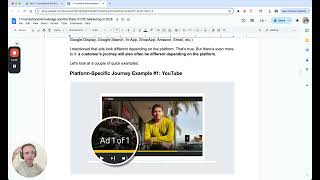
All right, welcome again to RNBC 2 in this first module, before we dive into the reimagined RNBC method and all the other amazing stuff that you saw in the intro, we're going to just talk about copywriting and the state of direct response in 2025. And I'm trying to do this video in this section so that it's both beginner friendly for people who really don't know anything and people who are more seasoned vets and who may know parts of this, but also can benefit from a reminder. And we'll probably, you know, hopefully see some unique insights as well. Okay, so what are we going to be covering? What are we going to be covering? Sometimes I combine my words and talk fast. We'll talk about, you know, what is copywriting? The two crucial customer journeys. You need to understand what sales funnels look like in 2025, the true purpose of direct response marketing. Context is king. Or I can even say why context is king. So why? All advertising starts with product market awareness and platform specific strategies. And then a little bit about the RNBC 2 approach and how it simplifies complexity and leverages AI. Now, frankly, you already saw a lot about this in the intro module. Originally, I didn't know that I was gonna do that intro module and realized I needed to. And so we'll talk about this a little bit, but let's just kind of get started, right? What is copyrighting? Okay. And I know there's a lot of stuff on here and you might be reading ahead. I get it. Try to stick with me. I didn't want to make this into a PowerPoint. There's just no point. Okay. What is copywriting? It's like the art and science of writing advertisements. Okay. And so simple from that context. Like there's no magic thing for copywriting. It's just like it's writing ads. And of course that's a huge part of what RBC2 is about. But if we think about it, the really important thing about RNBC 2, and I think this would be different from RNBC 1, is copyright doesn't exist in a vacuum. I think in RNBC 1, the original RNBC, like I talked about all these different elements, right, In a sales letter, an ad, whatever it was, but I don't think it was holistic enough. And you know, the change, even since 2020, even though I'd scaled things and had all this success and you know, at the time CNBC1 is, since then I've just scaled more businesses, really been in the trenches on so much stuff and, and worked with, you know, thousands of copywriters and hundreds of business owners and all that stuff. And, and it's like copywriting is cool, but it doesn't exist in a, in a vacuum. And so many, especially for you freelance copywriters who are watching RNBC 2 and maybe you're earlier on, you sort of think like, okay, I write emails for the company and you know, they make money, I make money. I write video sales letter, I write sales pages, I write advertorials, whatever it is. And even for in house copywriters, right? Like businesses hire copywriters and say, write us emails, write this. But it's like that doesn't work. You really need to understand the holistic view and the holistic picture which comes back to product market awareness and platform specific strategies. And also what is the journey, right? What is the journey that somebody is on? And the first journey and the one we'll focus on mostly in this video is a journey from prospect to purchaser, right? So that's where they start. At point A, they're not a customer. And then through your efforts, which include copywriting, right, they arrive at point B, which is becoming a paying customer. And this really, if we're staying simple so far, you know, you're writing ads that help somebody go from point A, not a customer, to point B, they become a customer. And then there's a second journey where they become a go from a customer to a repeat champion or just another repeat customer, right? They already bought once, now they buy again and again and again. And that can happen in an upsell. So right after they buy, they're given an upsell. Hey, buy more stuff, right? It can happen with email marketing over the course of weeks, months or years. Can happen through sms, call set, all kinds of other things we can do, right? Content. So we're gonna mostly focus on that first journey. In this intro, we're guiding someone from point A, not a customer, to point B, a customer. And that first journey is often visualized as a sales funnel. Okay, so this is just one way of looking at a sales funnel. You know, you've got your advertisement, maybe there's some organic discovery or recommendation from a friend. Whatever it is, somebody becomes aware of your brand or product or service that you're writing for, right? So a simple way of looking at it. When they see an ad for your product now, they're aware of it. If the product generates their interest through curiosity and emotional connection, speaking to their pain point, whatever other thing it is, they click the Ad, right? They get to your website, they're sold even more, their desire increases, right? And it's not just a desire for the product, it's a desire to solve their pain point. We'll go through all this in depth in rnbc, don't worry. Right? But their desire to solve their pain point increases and hopefully they take action, right? So this is a classic ADA framework, right? But awareness, interest, desire, action. They take action, they buy. Okay, so like, that's sort of like the psychological journey. And as I put here, how does it begin? Well, it could be an advertisement. That's mostly what we'll focus on, rnbc. Two, it could be organic discovery. They browse on Amazon, they Google something and see an organic SEO result. A friend recommends it, whatever it is. But we'll focus on advertisements. And there's a lot of ways that a customer sees an ad, right? And the digital landscape is vast. So they can see ads on Facebook and Instagram, native ads, TikTok, YouTube, Google display, in app stuff on Shopify, Amazon, email marketing, and of course, even radio and tv. Now am I going fast on this? And you're like, well, I don't know a lot about TikTok ads. That's okay. Guess what? We're going to have it covered in RNBC too, right? But those are all platforms where a prospective customer might encounter your ad. And what's really important to understand is that ads will typically look, feel and be written differently depending on the platform. And we'll explore that in depth below in this, well, kind of in depth in this video and then hugely in depth throughout RNBC too. But for now, let's just say, okay, they see an ad, and if it's a good ad, it compels that person to take action. So the ad elicits a direct response. And that in essence is direct response copywriting. It's writing ads and other marketing materials designed to get a prospective customer to take an immediate measurable action, which could include calling a number, clicking a link, buying a product, sharing a post, sign up for a newsletter, and so on. So the point is that they're taking an action. And the sole criterion by which we really judge an ad's effectiveness, whether it's good or not, is this ability to get the right kind of people to consistently take the desired action when they see it. Okay, so what's. Process that for a moment together. Copywriting is like the art and science of writing ads, right? And really direct response copywriting is you're creating an ad that gets somebody and not Just somebody but the right person to take the action we want them to take. Which in other words means we get them to directly respond to our app, directly respond to our copyright. That's direct response copyrighting. And we say the right person. That comes back down to this idea of product market awareness, which we'll go into very in depth in the next module as we begin research on a broad level. What we mean is if I have an ad for a coffee brand, right? Let's say I have a coffee that also gives you energy without the caffeine crash. Okay, do I want 8 year olds clicking on the app? No. Do I want people who don't drink coffee clicking on the ad? Not really. Some of you might think, well, yeah, because what if they decide to drink coffee? It's like, okay, sure, that's hard. I want someone who's like a coffee drinker who loves coffee but feels like they drink too much of it and is kind of thinking they should quit or cut back, but they don't want to. And they, but they, they just really love coffee. That's why I want to click on my ad. Okay, that's cool. I want them to directly respond to my ad. Do I want somebody who's actively looking for coffee without the crash products to click on my ad? Yeah, them too. But that's where we understand product market awareness because it's like, well, where are most people going to be? We'll talk about this more. I don't want to ruin the next module. Right, but that's like the right person. Not the 8 year old who doesn't drink coffee. Not the non coffee drinker, the coffee drinker who loves coffee but is kind of doesn't like the negative effects of it. That's the right person. I want them to directly respond to my copyrighting into my app. Okay, so let's assume we have a good app. A prospect sees it and they respond by clicking, well, what happens next? You know, in an ultra simplified version, go to a website, they add a product to their cart and they check out buy, right? Oh my God, easy peasy. We did it, we're done. And as they're still like, there's always a celebration thing, it's just a hold of a second. Yeah, we did it. Okay, easy peasy. And it can be that simple actually. But realistically, it really is the truth about direct response copywriting and direct response marketing in general is that context is important. And this is really not just. I mean, when I say direct response, I'm not talking about the old school, like super aggressive, hour long video sales list. I'm just saying anything where you're getting somebody to respond directly. So this could be extremely branded, super clean E comm. It could be some crazy aggressive shit like where if somebody's using a deep fake of George Clooney, doesn't matter. I'm not advocating for doing deep fakes. I'm just saying like it could be any, anything, any type of marketing that elicits a direct response is. Is that's what we're talking about, right? Context is important. So to understand why if we go back to these different ad platforms, like what you'll notice is the ads will look different depending on the platform. And it's not just that the ad will look different, it's that the customer journey will be different too. So we can look at some quick examples here. We'll look at YouTube. Okay? You're on YouTube, you're watching a video, an ad pops up. Well, it's important to think about this. Why is the person on YouTube? Why do you go to YouTube, one of the biggest search engines in the world? Search engine, Interesting. You're usually going on YouTube. I may have it down below, but it's either for education or entertainment. Okay, so what does that mean for a YouTube ad? Usually you'll find that YouTube ads our video museum. Which makes sense because if somebody goes to YouTube to watch videos, it makes sense that your ad would be a video. Right? That's congruent. We'll talk about congruency more in a moment. I went here to watch videos. This is a video. But I didn't just go here to watch any video. I came here to watch entertaining videos or educational videos to learn. So guess what? Video ads that are more educational or entertaining or both will tend to outperform those that are just aggressively hard sell somebody. And where do they go after they click on a YouTube ad? Well, a lot of times they'll go. Not always, but a lot of times they'll go to a page on your website that features another video. Why? Because they're already in video watching mode. And so especially if you have a short video ad and it goes to a landing page, it's a very obvious advertisement, the spell is broken. But if they go to a page that has like a video, then also add some copy, but the video is prominently featured and they can watch it and they right then more likely to buy. So that could be a video sales letter in the classic sense, but could also be like an ecomm landing page. But let's look at another example. Let's look at native advertising. Okay, So I have a whole module, a couple things. A lot of things on native advertising. Native advertising, though, is like, you're on wherever you're on, like, weather.com and you see like from around the web and they kind of look like they're going to be other news articles. So when I say news articles, that's important because who normally sees a native app? Usually they're reading articles online. So it's like news or celebrity gossip, how to guide sports updates, content related to one of their interests. So if I'm doing that like I always do. Topeka, Kansas news. Okay, I'll make this fast. All right. Kansas Supreme Court makes license plate visibility ruling. Oh, my gosh. Top big news in Kansas right now. Okay. I think this will have it. So I'm reading the news. I'm like a local person. I'm living in Kansas. Cool. Sponsored content. Costco shoppers say this wrinkle cream is actually worth it. This skinny drink is going viral. Mouth wrinkles are no match for this little known drugstore wrinkle cream. Here's a, you know, drain edema. Smart way to eliminate fleas. So the point is, even though you can be like, they kind of look ridiculous, turns out they work. But if I click on this, if I'm on native and I'm reading an article and then I click on, let's click on bug md. Even though this is sort of like a. It does show the product right away, the format of it, of this sales page is kind of like an article, right? It's lots of reading. But I was just on a website reading lots of stuff, and then I get to a product page. Okay, what if I click on this edema one reveal the shocking kitchen item causing your edema. Hint, it's not salt. Okay. Even though it's not super, like long, it feels like an article. I was just reading articles. That makes sense, right? Because the native ad kind of looks like is designed to look and read like a link to an interesting news story. Okay. Overall, it's supposed to blend in with the surrounding content. Some places do a better job than others. You'll see that later in RBC too. Some websites. And so where do they go after they click a native ad? Almost always to an advertorial, which is like an advertisement that's crafted to look and feel like an editorial piece or a news story because it maintains congruence. So congruence is maintaining a consistent feeling. Consistent feeling experience for A prospect throughout their journey from point A to point B. So again, if I'm reading about the Kansas Supreme Court's license plate visibility, rolling, then I click this ad and the ad takes me right to here. I'm like, what the fuck? Why am I reading this ad? Part of my language. But I'm gonna cuss in RNBC too, you know, I'm like, I don't know what's going on if I come here. And again, I don't actually love this format, but at least here it's like, let's look at mobile because people probably on mobile, bored. Yes, it shows this, but it sort of looks like something I would read as well. Okay. And then I'm like, okay, I'm reading. It's not the worst. I click on that edema thing. This can go to a video sales letter, I imagine, right? Okay. So if I'm here, I click on this edema things. I've got edema. It goes right to this big thing. Click a video, I'm like, what the heck? I'm not going to watch a video. Goes here. Kind of feels like a little another article about the shocking kitchen item causing your edema. Oh, there's a video about it. Okay. Like not perfect, but it works. And it's still more congruent. Right. So the other context element, those platform specific. Right. So YouTube is different than native, is different than meta, is different than whatever else TikTok. But there's also the product market awareness element. So I talked about that a bit before. I'm not going to go into too much more because the next module and research is all about. Let's go back to our overarching customer journey. So remember, we're trying to get our prospect from point A, seeing an ad to point B, buying your product or service. So far they've seen the ad, they've clicked the ad, they've landed on a context specific page on your website. So it could be a page of a video after a YouTube ad or an advertorial after a native ad. And what happens next? Well, it still actually kind of depends. Right. So let's stay on our native ad example to illustrate where do they go from advertorial and the paths can diverge. Now I have this right now, but you sort of just saw it in real life. Okay, so if the advertisement was really long and the product's not super expensive, they might go to a product page. Right. I just clicked on these. I didn't have this planned. So you had the bug MD advertorial It's quite long and it goes to a product page. And what's the pricing switch to? One time purchase. Look at that, 24 each. You can get a single one for $34. Okay, that makes sense. I just, all the selling just happens here, right? I'm super sold. I'm ready to buy. I don't need a lot of information much FAQs in case I miss something. Don't need a time information. Right, but. And I kind of talk about why here. But it's what I just said. Say it's really short. Okay, this is really short. Less than like 200 words. So where might it go here? Might go to VSL Video Sales. Just like an online infomercial. Right. We'll obviously talk a lot about VSLs. Why that? Well, because here we just want to get them curious. There's this, you know, secret thing for edema, but we're gonna do a really long video sales letter selling them on it. Let me answer one question. You might be thinking, well, how do I know? Why should I do a VSL or should I do a long advertorial to a product page? And the answer is, and this will continue to be the answer we'll talk about throughout RNBC 2, is that both probably work. To be honest with you, Fewer and fewer people do long form video sales letters on landing pages. They still work though. And some people are, you know, that's what I've grown up on. That's how I was raised. That's what works. So, you know, that's cool. The thing is, and I think I talk about this later. I know, I know I talk about it later. In RBC2 there is no like single right way to sell. Like there's some hypothetical imaginable imagine. You can imagine this hypothetical optimal funnel. That's the perfect funnel. Perfect information. But you will never have perfect information or complete information. And so all you're doing is like hypothesizing, guessing and testing things. So for brands when you're like, do I need a vsl? Maybe. But maybe not. Maybe long advertorial to a nice product page does enough for you. Okay, maybe then you test the VSL Short advertorial to a video sales letter. There's no magic answer. Again, I do give you a training that kind of tells you what the helps you select have an ideal optimal funnel strategy. It's in part got I guess 12 or 13 or something. So. But that's like a, you know, a baseline. But really you have to experiment Find out what works best. Right? Just one of the reasons marketing is hard. It was always hard. But going back to the state of marketing in 2025, it's especially hard because there's so much stuff is context specific on platforms, product market awareness and all that. It used to be back in the day, basically any ad goes to a video sales letter, goes to checkout and print. But that's like not what you see anymore. A lot of people who are struggling, who used to do really well and who struggle now for like business owners, brands, stuff like that, it's because they're still trying to make that model work and they're not mentally adjusting to the fact that that's not reality anymore. Reality now is that there's a lot of different things that work and often the video sales that are on landing page isn't one of them. Again, can work often not the move. Right. And so marketing changes, technology changes, platform change, consumer habits change, psychology changes, all these things change. You have to change too. So we'll spend a lot of time talking about video sales letters in this course. Of course, of course, of course, of course. But you know, what is it doing like on a page, like a landing page, like this one, it's going to hook a prospect in the first five seconds. Create curiosity, build rapport, establish credibility, often have a hero's journey story. What does that mean? Like, it means that I started off here, I'm a reluctant hero. I was here, life was fine, but something pulled me into action. I was suffering, somebody I knew was suffering. I noticed that things weren't right. And so I got called to action to where I had to go, solve, figure out a real solution to this suffering. Right. And in order to do that, I had to find out the real reason why people suffer. And I found the real solution. And that's what the unique mechanism is. And like everything I'm talking about, we'll have more detail on that. You know, ultimately I discovered, created partnered with somebody to have this product that was the best manifestation of that solution. The easiest, most convenient, most price effective. Right? All that. It's got lots of high perceived value. It should cost a lot more than it does, but it's going to be a great deal for you. Buy the product. Okay. That's like on a really broad level what a VSL does, especially an on page VSL sort of similar for in feed VSLs, VSLs that run as an ad on Facebook or Instagram, but sometimes it's not. And we'll get into the differences for RNBC too. But let's take a brief pause here. Okay. We've, we've started from understanding what copywriting is and what direct response copywriting is. We've, we're looking at the initial customer journey, the role of ads, platform context, how different types of ads lead to different initial landing, sorry, landing page experiences like Advertiser VSLs. And so you're kind of getting a glimpse into the strategic thinking that's involved here. Let's continue our journey. So once they've gotten to an advertorial or a video sales letter or product page, we still need them to take another action which is adding a product to their cart and then checking out and the checkout. There's still work to be done because we gotta get them to do kind of the craziest stuff on the checkout page. They gotta enter their personal information, enter their credit card details. They've got mentally prepared to power their money, make the final commitment by clicking place order. And so even the copy and the style of the checkout page can vary dramatically, which will Explore more in RBC2 and I mentioned it in the first sort of overview video too. But once they do that, the good news is we've conceptually completed the first customer journey, gain them from point A, not a paying customer, to point B. And it's exciting, but you might be sitting here thinking, damn, marketing can be hard. And you know what? It can be, especially in 2025, we consider all the individual components and how they can be combined in different ways. Right? There's different ad types that go different pre sale pages, but maybe they don't. Maybe they just go right to a sales page, AKA pdp. I put product pages different than the sales page. We'll get into that later. Checkout flows. There's like a lot of stuff, so it feels like a lot. But it doesn't really have to be so overwhelming because when we zoom out, all we're really doing. I mean I honestly could just put like. Yes, like a vsl lander I would say and there's a pdp like, But whatever. Okay. All really is like add VSL checkout. That's sort of like the classic model still can work. Add advertorial VSL checkout. Add advertorial VSL product page checkout. Add product page checkout Ad advertorial product page checkout. And actually this is probably the most common one used by most people I know doing eight figures in decom. But the ad might be a video sales that are ad might Be sales. Okay. But the point is it should be is less overwhelming. So the type of ad, all these things could vary, but we're gonna cover all of that systematically throughout RBC2. And I have this info graphic that I created. I mentioned briefly in the overview of sort of. You may have started this video here, I just took you through the battles of marketing hell, but you will make it to the other side. Okay? And while you're doing this journey, you're going to have a huge advantage, which is that you're going to see transparency into what already works. And what I mean by that is the simplest way to write effective copy for any product or service is to just model what other successful brands selling similar products or services are already doing. You don't need to reinvent the wheel and you shouldn't. You just need to model off of what's working. And so I talk about swiping a lot in RBC2 and it's also really the foundation of all of the copy generation stuff that we do. So we'll dissect tons of effective copy across every stage of a sales funnel. We'll look at real examples, we'll see what's working, and we'll give you the knowledge so you can create similar assets very quickly. And like I just alluded to, it gets even better because thanks to the rise of large language models and LLMs and the specific processes you will learn inside RNBC 2, it's now easier than ever to write great copy for all these funnel assets in anywhere from five minutes to maybe a few hours at most. And yeah, this is a radical shift from when I did the original rnbc back in 2020 because that was a good game changer. Cause I show people how to write a great sales letter in like a week instead of eight weeks. It's crazy. This is five years. So five years ago, the idea of writing a great sales letter, like a long form video sales letter in a week was like mind blowing right now. And for me it was like 12 to 16 hours. Like oh my God, that's dinosaur time, right? You should be a great vsl and like a couple of hours now, you know, I mean like I put here, I could write two to four high quality VSLs in a single day. You're starting out, might take you longer but like definitely no more than five days. And even though the idea of writing it in a week when I did RBC 1 and 5 days is kind of a week now, but the amount of time you spend will be just spend way Less hours doing it. Because it's really more about thinking than it is with writing the whole copy. Thinker versus copywriter. Right. And that's just VSLs. But the same prospect or process, the same, I guess, acceleration. Sorry, I can't talk. Apparently applies to every other aspect. Copyright 2. This is a huge part of RNBC 2. Like, it's really not RNBC 1. People were like, oh, it's really about VSLs. RNBC 2 is not really about VSLs. It's about, there's a lot of video stuff, video ads, short ads, meta, all that. But it's really about the whole holistic marketing journey for direct to consumer utilizing direct response copyrighted elements and other direct response marketing elements. And so you can see how to use these different, you know, tools to just. I mean, I put 5 to 10 advertorials. You could do like 100 AVs in a day. Honestly, 20, 40 good ads in a single day. Hundreds of promising angles and hooks. A complete upsell in about an hour. I mean more like 15 minutes once you have the process. Five minutes. You'll see. Because I wrote this before I even created rbc. I made my processes even better while doing RBC too. You know, email sequences in an hour, same thing. I mean, honestly, like, it's like, it's really like, like 10 minutes. I, I promise you, I guess if you include like editing, changing stuff, like whatever, okay, maybe it's an hour, but you'll get great. Really. Basically better than what 99% of people are going to write in like 10 minutes. Five minutes. Once you use these cloud projects and you've done the legwork, initial time, all this deep research, especially on. On, on. Yeah, just like actual, the research part, like the, that I talked about, part one, product market awareness, comparative research, psychographics and yeah, PDPs as well. Okay. And this is all proven. You put, put my money, I'll put my money where my mouth is. I mean like, I don't know, like put me to the test. What I'm trying to say, you'll go through RBC2, you tell me when you're done through going through this. If it's not the craziest thing you've ever seen, it doesn't completely shift the way you view everything with copyright marketing. Okay. And I put here that, yeah, we're living in this golden age where AI handles much of the heavy lifting. And really it's about your knowledge, strategic thinking and confidence as a copyright expert that is a critical differentiating factor. Okay. And so for rbc, Two, that's what we're going to do. We're going to deconstruct every type of copy you're likely to encounter, no matter, you know what your role is. If you're a freelance copywriter, an in house marketer, an executive, a business owner, you're going to understand the theory, the structure, structure, structure, all the essential elements, the ability to discern what makes, you know, good copy versus good, mediocre or bad. And again, plenty of examples. Then we'll accelerate with AI. You know, you'll be given these specific processes for just generating endless AI. That's AI, like endless copywriting. Outputs that are extremely good. You know, often times there basically are a final draft and it'll be shown how to think and edit, like a top tier copyright. But what's cool is, you'll see is almost all that editing is the way we're doing RBC too. And you can do it manually as well. Okay. But like usually it's telling quad or whatever LM it is. Hey, this is, it's really, it's ideas. Hey, this doesn't make sense. You know, we're missing a big idea here. Let's come up with some big ideas, some hooks. Okay, that's good. Hey, you know, we said this. I think it'd be better if we did this. Okay. And so that's like I said, I keep saying it, copy thinker, not a copywriter. And I know it sounds kind of cheesy, but it really is actually. I'm so glad I thought of it while doing these videos this morning because that really is like the crucial difference is it frees you to think. And so thinking is important. I can't stress that enough. Right. Like hopefully RBC2 helps you think differently and helps you think like a marketer, like a strategist, like a copy thinker. Okay. If it doesn't, that's kind of problematic. It should, but like that's something you can be doing regardless of this course is like focusing on how to think. And there's good books on it. I could maybe I'll do a, a bonus module or something about some books that, that, that talks to you about thinking, but you're really a thinker. Right. And so then we get into the outline, which I went through in part, you know, the first intro opening of RBC2, so I'll stop there. Okay. And as I mentioned, we talked about A to B, but then we also have from B to C and D and E and F. Right. For upsells, email marketing. How do you get them to buy more? I mean, abandoned cards technically are like, they didn't buy the first time, but we get them to buy. But this stuff's getting them to buy more. All that. Right. And some different bonuses. And like I said, I'll include more bonuses. And you know, as we're going. So that's it right now. You just went through this part. Part one, foundations. Now we're going to get into deep research and then mechanisms and everything else I talked about in the previous video. So dive in, get started. I'm here to support. Excited to support. And lfg, as the kids would say. All right. Thank you.
More from Stefan











Why Understanding Product-Market Awareness Is More Important Than Ever in 2025