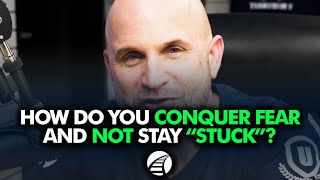
This Life Mastery Q&A (Stephen Scoggins) answers viewer questions on four practical self-improvement areas: (1) financial habits—focus on needs, spend less than you earn, use saving ratios and delayed gratification; (2) developing real-time self-awareness—'G' (Gain perspective) from the GROW process and using the Peak Performance Assessment to identify strengths, struggles and blind spots; (3) conquering fear—use faith or a persistent vision, keep the 'why' in front of you, and take consistent action; (4) finishing what you start—use a prioritized to-do list and small-step rewards (checking boxes) to sustain progress. The tone is coaching-oriented, action-focused, and faith-friendly.
Chapters
Hey guys. Welcome back to Journey Principles with Life Mastery. Q and A. Your questions are actually getting quite good. I'm actually really enjoying them so much so I'm actually having to take the time to jot down notes before I actually take the time to answer the question. Why? Because I want to make sure I give you good information and not waste your time. As you can imagine.
Today's question is what are the best financial habits to become more financially secure? I think the greatest thing that you need to focus on is make sure you're focusing on your needs and not your wants. One of the biggest mistakes that I made was I was constantly spending my money without taking care of my actual needs. Now, your needs can be a variety of specific things, but they typically come out of four areas. Your physiological needs, meaning there are things that you need to eat, drink, that kind of thing. Your shelter, your utilities, and your transportation. Each of those four areas is incredibly important to getting you to and from places to actually make more income and that, that kind of setup. Alright, number two, make sure you're going to spend less than you make. Now, I realize that if you're not making a whole lot right now, that's going to be incredibly difficult, or at least on the surface it's going to feel that way. And what I mean by that is you have to have a ratio that you kind of come into play with. So for example, in this season of my life, I'm hoping to become more what's known as a reverse tither, which means I'm going to end up giving away or investing 90% of my income and then living on the 10%. Now, I didn't get here overnight. So what I suggest you do is maybe you start with 20% of your income, take 20% of your income and actually put that away in a savings account. I prefer money market because you get a little bit interest, it takes a lot longer to build up and it's also not as easy to access in case of an emergency. Now, that being said, emergency fund, Dave Ramsey. That's where the savings thing comes into play. So make sure you're actually taking the time to use your ratios to actually build up some savings because you want to go 20%, then 50% and then hopefully 75 and then hopefully 90. Kind of where I'm heading. All right, number three, the final thing, okay. Take the time to use delayed gratification. If you're young like Connor is from our team, one of the things he could most likely be doing right now is using his free Time rather than going out with friends and things of that nature, at least right now, and actually going ahead and getting a part time job and then banking that money, you know, putting that money away. Putting that money away, Putting that money away. What happens is if you use delayed gratification long enough, then when about 24 to 36 months of just intentional sacrifice. Historically, what I've seen is all of a sudden good things happen and you're able to actually go ahead and get off the delayed gratification thing because you'll have a whole bunch of money saved up, you'll have a whole lot more opportunity and you can actually get to spending. So I hope that gives you a little taste of the three things that I would do to go ahead and get started in becoming more financially stable. And we'll check you on the next question.
All right, next question. How do I actually develop real time self awareness? Well, that's not quite a loaded question. It's actually an easier one to answer than you might think. Realize one of the things that you need to do is you need to focus on the G of our grow process now. Now, if you haven't seen the grow process, go ahead and check out one of the other channels, check out the face to face or our whiteboard lessons and you'll cover the grow process in detail. But we're going to focus on the G, which is gain perspective. When I'm talking gaining perspective, you're trying to look at your life and yourself from as many angles as possible. You might be looking at it from your friend's angle, from your family's angle, from your inside angle, but ultimately you're trying to get really to the answer of three specific questions. Question one, how did I get here? In other words, how did you get to this point in your life? What are all the influences? What are all the types of things that you witnessed, the environment you grew up in, and things of that nature that brought you to today? All right, step two in the step two, or question two in this case would actually be where do I want to go? Right. That is a very important question. Because if you have no idea where you want to go, how will you ever actually expect to get there? Okay. All right, question number three. All right. When we're talking about gaining perspective, Right. Question number three is what drives, motivates and fires me up? I find that most people never answer that one specific question because they don't know how. Right. Well, the best way to do that is to actually take advantage of our free resource called The Peak Performance Assessment. We'll make sure that we actually put that link in the description below. But in the meantime, what it will show you is your strengths, your, your struggles, your blind spots. It'll help you understand why you make certain decisions and take certain actions along with what's the best way to communicate with you? What's the best way to make sure you're learning? What's the best way to understand if you're making progress or you're not making Progress? It's an 80 page report on you. And when you're. Once you're clear on you, you can also clear on your future. So that's how I answer how to make sure that you can actually become more self aware. So now it's up to you. Pick Peak Performance Assessment. Go learn about yourself. Alright, here's our next question. How do I conquer fear and not get stuck because of it? As you can imagine, fear keeps a lot of people bound. Okay, so from a faith perspective, I would say you need to lean into faith because by definition the absence of fear is faith and the absence of faith is fear. So now from a secular mindset or someone who maybe doesn't have the same faith decision making that I use, I would also say that you probably need to keep a vision of where you want to go directly and tied in front of you on a regular basis. And the reason being is because your why to move forward has to be stronger than your ability to stay stuck. Okay? Once you get really clear and you can keep your vision in front of you on a regular basis, it's going to make it much, much easier to keep working your plan and to keep taking the next step. Even when things are uncomfortable, even when, even when things don't feel great, even when your friends and family don't think you can do it, know that we do believe you can do it. And here's how you do it. Okay? Vision. Jot down your vision. Keep it in front of you. Step two, if it gets tough, feel free to reach out to us and we'll be happy to kind of keep you motivated. All right? Step three of that process is you gotta keep taking action, right? Don't let fear immobilize you. I promise you that if you keep taking the steps we're giving you, you will make repeated process. And while it may seem incremental at best, and as you're getting going on your journey, I promise you a year from now you have taken 10001500 steps and you'll be a lot further along. All Right. Keep. Keep Connor in mind from our show. Right. Connor's a young man who got started on his journey about two years ago, and now he's making more money than he's ever made before. He's. He's changing more lives than he's ever changed before. And all because he decided to focus on changing his own life and his own identity and self. So use those same principles. Don't let. Don't let. Don't focus on fear, focus on faith. Focus on where you want to go, and then take the steps to get there and you can eliminate fear in your own life.
Next question. Are you ready? How do I learn to think to complete things? I start. All right, here it is. Here's a simple secret. Create a to do list. I know that sounds stupid. I know it sounds trivial, but you can see I'm using my own cheat sheet to make sure that I give you the most value I possibly can. And I draw little boxes with little check marks. That little act helps me understand that as I'm moving forward, I get a little dopamine hit and a little dopamine reward hit, if you will, or a little serotonin bump just because I completed the task before it. Far too often I see people not getting stuff done because they're focused on the end rather than the step that's in front of them. So a to do list makes you focus on the step in front of you while allowing you the ability to prioritize what actions you need to take. If you're constantly trying to get to the end without actually doing the steps in the middle, you're never going to get to the end, which means you're always going to want to procrastinate, which means you're never really going to feel like you're fully invested, which means you're always going to be stuck. Okay, so make sure you use a simple priority process called a to do list. Write down the things that are most important, that need to happen in order of importance of how you're actually going to make that happen. And then simply do that one action. Reward yourself with a dopamine, hit with a little checkbox, and then do the next one. And that's how you actually keep yourself moving and remain from getting stuck.
I'll see you in the next video. And please, if you enjoyed the Life Mastery content, do me a favor. Consider hitting the subscribe button and clicking the bell so you'll be notified anytime we release a new video, which will be a lot.