THE REAL ESTATE ROLLER COASTER
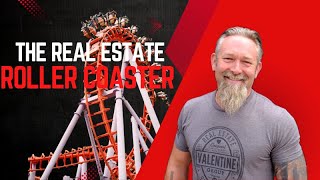
A conversational YouTube interview with Steve D Valentine explaining the “real estate roller coaster” — the feast-or-famine, deal-to-deal volatility agents experience. Steve uses childhood and early-career anecdotes (including a strong Christmas year around 1999 before his 2000 marriage) to show how sudden large commissions can mask unstable cash flow. He recommends concrete measures to escape the cycle: tax-aware business structuring (moving from 1099 to a business/W2+K1 setup), building reserves (a 10% rule and a separate vault account at MidFirst Bank that grew to $27,000), and diversifying income beyond commissions (investing, rentals, referrals, off-market opportunities). He also emphasizes hiring experienced agents who own homes and have deep contract/inspection experience.
Questions this video answers
2000
1999
10%
$27,000
MidFirst Bank
Chapters
Steve, I hear the phrase real estate roller coaster all the time, but really unpack it for me. What does the real estate roller coaster mean?
The real estate roller coaster is something I've lived and experienced my whole life. My parents were real estate agents. So the real estate roller coaster is you do the work and you think about the ride, right? The excitement, thinking about getting to the top and then the fall and the going in and out of the loops. Well, it's the same thing in real estate is it's a constant roller coaster ride. You get on, you're excited, everybody gets their license, they're excited. I'm going to go show houses, I want to make six figures. And they click up, they're excited, right? And they get some deals under their belt and they're under contract and they get to the top. They've made all the money, but they forgot to do all the things that got them to the top. Right. So then the drop comes. What happens to the drop? You, the pit of your stomach is, I don't have any money, I don't have any deals and I have to get back on this damn ride again and go through the same pain. Yeah. Right.
So the real estate roller coaster is the real estate version of living check to check.
Correct.
But it's really living deal to deal.
It's deal to deal. And the difference in real estate is not living paycheck to paycheck. You might live 90 days to 90 days and like you get that one big check, you sell your first million dollar house and you get a $30,000 commission check. You're like, I'm going on vacation for 90 days. You're a baller, right? You're a 30k millionaire all of a sudden. And then you realize, oh, it took me six months to get to that 30k. So that 30k is really six months of work that's now being paid to do, not six months of freedom.
Yeah. So you had mentioned that you've experienced this even growing up. Like, tell me a story. Like, what do you mean? Like what? How did it impact you even just as a kid?
Well, as a kid, you never knew. Well, I'll give you the greatest example. At Christmas, here's the story, right? At Christmas time, you always knew how we were doing, right? And that was the one month you really knew because you could see it.
Sure.
Right. You could see it in the presents. You could see it was being spent on decorations. You could be at what spent on parties. And so I remember the year before Wendy and I got married, it was a really good year. So it was 1999 and we got married in 2000. So in 99 that Christmas, dude, the biggest tree I'd ever seen, the most presents I had ever seen under the tree. My mom just went apeshit, right? And you realize like, oh, we must had a really good month. And I think that time as I was just getting into real estate, I think that was like the first month they'd had like, I don't know, 100 or $200,000 of income that came in that month. And so when that happens, it's like, look at all the freedom we have. And then you go back to a month later or you know, next month we're broke. Rather than, okay, we've survived on 10 grand a month for six months. We have $190,000 in excess. How do we budget so that we never have to experience this roller coaster again? And this is where real estate agents, it's feast or fam. And they spend everything because they're making up for lost time, but they're not preparing for future either.
Alright, so then let's talk about what are some of you the. Well, let's just start with that. What are some core lessons that you have learned that help you get off of the roller coaster ride and more onto kind of a trajectory you want to be on?
The first lesson is understanding, which I didn't know until later on. Actually, the first year was okay, I made $100,000, but nobody told me to save for taxes. Oh, okay. And you're a 1099 and all of a sudden you have $30,000 in taxes and you're like, oh shit. Right? You also don't realize the impact that has on your purchase power as a human being. You don't have W2 income. You have 1099 income, which you have to have two years of self employed. And what do most real estate agents do? They write everything off. So you don't have to pay any taxes. They're not bankable, they're broken all the time.
Right.
And it's always this, I don't want to pay taxes. Well, getting off the roller coaster also requires financial wisdom from people around you. Well, the way I was taught to do it was the wrong way to do it. My dad paid hundreds of thousands of dollars in taxes that he never should have had to if he had sought the financial wisdom of, hey, once you get to making a certain amount of money, you want to change your tax structure from independent contractor to a PLLC in real estate where Your license is attached to a business account and now your commissions can be paid to the business rather than you individually. Then your business pays you a paycheck. Now you're a W2 employee plus K1 income. And what happens there is the K1 income from your business. It doesn't have self employment and all the Medicare, all the other ancillary things that come with it, you're actually paying it by paying yourself a salary which offsets some of your taxable liability.
Yeah.
So that's one of the big places like to get off. And then what I also realized to get off of that roller coaster when I left my parents partnership was I also need to have some reserves. Right. So what I did was I just went in very small and I took 10% every foreclosure check that we got. So we were selling foreclosures at the time. It was a volume play. Right. So there were some months we closed 100 transactions, but it was probably like $750 on average of the commission.
Well, hey, some would say a dripping faucet fills a bucket, right?
Exactly. That's true. Right.
Steve tells me that all the time.
So it was a volume play and it was a lot of money and it was a lot of work. But I realized like I never want to go back to where I was. So I need to have a safety net. So we started to understand what reserves were, which you go to the Dave Ramsey, right. It's the emergency fund. Well, when you live in a commission based business, you have to have more of emergency fund. So we just simply took. I remember it so like yesterday when we did it is I opened up a checking account at MidFirst Bank. I didn't get the online access and I didn't get a debit card intentionally. Yeah, I wanted it to be a vault. And they were a holes too. Like if you want to pull 10 grand out, you had to have three signatures in the bank manager to get your cash out, which was good, but still annoying. So we took our direct deposit from realty executives and I instantly set up and I didn't even tell my wife. 90% we have to live on, 10% has to go into reserves. And I never looked at it again until a year later when I realized the dripping faucet filled the bucket and all of a sudden I had $27,000 in reserves.
Yeah.
Now it's like, okay, I'm good. How do we keep that going? And even today there's still a percentage that's put away or we have Reserves in different buckets. Now, it's different because they're not necessarily in savings. It's not liquid. We have it in different places. And insurance policies in stock in houses. So there's different reserve buckets we have.
Yeah. Nice. All right, well then what would you say to maybe someone who's either been in the industry for a while, but they are still on that ride, or maybe someone who's younger in the. In the industry and they're just strapping up and they're like, this comes down like here I just pull this bar down. Right. Because they're getting ready to get on the ride. So how would you encourage them to put that in place in the real estate business now, even though they might not have any deals in the pipeline and they might also be doing real estate part time to try to get started and convert over full time.
There's actually a more important lesson in this, is that if you're really just going to be the traditional real estate agent and you're never going to look at all the other opportunities and ways you can create income, you're always going to be on that roller coaster, Right. Unless you do some of the small things that we talked about. And then you're really, you're really just a W2 employee that gets paid as a 1099 because you're still up and down, up and down. And there's kind of a lid on your income if you're not going to venture out into the bigger things. And what I mean by that is you can be a solo agent, do really, really well, and you can be a solo agent who also looks at all the other opportunities and ways to create income inside this business. Right? And so when you start to create other. Here's the side note and the squirrel. Everybody wants to talk about creating multiple streams of income, and they get sidetracked on the multiple streams of income. The question is, where are the multiple streams of income with what you do. Yeah, Right. So understanding that is when you understand there's multiple ways to create income. And not everything is tied to a commission check. You then will get off the roller coaster and go, screw this ride. Right? I don't want to throw up anymore. I don't want to live like this anymore. I want to see all the ways that I can create income so that I can build a train track to the destination of freedom, which is also called retirement. Right. And freedom becomes a place where you get to choose who you work with, when you work with them, and how you work with them. And if you want to do it at all. So building that track is understanding that every time you, you start by learning the traditional side of buying and selling and learning it, and then you start to see where the opportunities lie. Where can I invest in real estate? So the first place would be where do you buy a home that you're going to live in and convert into a rental property? And then where does the off market fit into this business? Where do I refer more people or people refer me to drive more income? So now as you're laying those types of tracks, you see all the different pieces of income where it doesn't rely on selling yourself again.
Yes. Okay, so. Well, I'll ask you this question then. I have a statement. Out of, let's say 60,000 active real estate agents in Arizona.
Okay.
What would be your guesstimate of how many of those agents are on the roller coaster?
59,920 of them. Alright.
The reason I wanted to ask that is because this video we're actually also sending out to consumers. And so I, I'm not an agent, I'm just a real estate consumer myself. I just live in a house. Right. But it's that thought process of, in the mindset of working with a real estate agent or the next time I go to hire a real estate agent. And I know you're big on interviewing an agent. Right. And knowing what's best for, for the client. Do you ask enough questions about finding the right real estate agent? It's a really interesting concept to me to consider hiring somebody for the largest transaction of my life that's broke. That, that is broke. And that doesn't have their, their real estate future in line. That doesn't have like bro, I forget like the, it happens every day.
The guy that sells you the Lamborghini doesn't own a freaking Lamborghini. Yeah, right. The guy that's selling you coaching on the other end has been through it, but he's never had any success at it or else he wouldn't be selling you the coaching.
I guess though it's. You take Lambo drivers. It would be different if there was a place that I could go to with, with real estate agents I can find the right person. With a Lambo dealer, I just have to go talk to a car salesman.
Sure.
And you know, it has been properly trained.
There's, here's the difference and this is what I've learned in this capacity of the difference between somebody that gets into real estate is sales and somebody that's operating a business. And Providing consulting, guidance and wisdom.
Okay.
I can't sell anybody a house. I can talk somebody into doing something they shouldn't because I know. Yeah, right. That's really, like, when I think about salespeople, you know, everybody's like, real estate agents are either one step below or one step above cars, used car sales.
That's the slimy fear, right. That a consumer has is. Yeah, the snake oil thing.
So the questions from the consumer is really, you know, work. Where it comes down is like. And you'll know the difference based on the conversation you have. You see, what I tell people is that they're not paying me a commission. They're agreeing to invest a portion of their equity or their earned income for the guidance and wisdom that I provide through the experiences I've had.
Which is important because you had them. But I think as a consumer, I never would have realized, like, oh, I should be looking for someone who's had the experiences I'm looking to guide me through.
Here's one question nobody asks their real estate agent. Do you own a home? Do you know me? Real estate agents will sell you a home, but they don't own a home. Which means they've never emotionally been through the process of buying a home. And the scarier parts of it. Right now, my experience is we've owned thousands of homes. We fixed hundreds of sewer lines. We've experienced hundreds of losses. All the pieces that lead back to all my life experiences will equate to getting you where you want to go. If you don't want to fight me on it. But if you think you know better than I do, we're not a good fit.
Yeah.
But if you can trust that my experiences. And by the way, here is the. The real estate roller coaster piece is that if you can trust my experiences over the person that does really pretty pictures and marketing and understanding that the portion of marketing the Property is about 5% of it. The 95% comes when a contract comes. Because everything that makes a difference happens from a contract to closing, not from marketing to a contract. Yeah, monkey effing a football can do that part. And by the way, everything has to do with price based on condition in the current market that we're in educationally in that aspect, everything else comes into. And I'll share a story with you. Right. I had a client where, again, experience where I paid myself. Right. We had their house on the market. Second home market was getting close to the end of the summer. We got the house under contract. Okay. At the same time, it's under contract. I get a call from another agent who I know very well, says, hey, is there any chance this thing is going to fall apart because my client sold their home and they really want this house. And I said, hey, it's currently an inspection period, but we just got the inspection request for the repairs. Let me talk with my client real quick. So I called my client and I said, hey, here's where we're at. We sold the house at 805. We have this list of unreasonable repairs because the agent the buyer hired wasn't familiar with the second home market. So the repairs they were requesting were not legitimate. So again, the person they hired screwed this up for him. So I called the client, said, hey, I've got a gamble. Do you want to take it? And he's like, tell me what it is. I said, I need to psychologically play both sides of the fence. We could end up with nothing. We could end up with an extra 20 grand in the sales price. He's like, I trust you. I trust your experience. However you want to play it, I understand we could end up with nothing, but we could end up with this. Go ahead. So I went back to the agent and I gave him all the inspections and the repair request, and I said, hey, you guys offered 825. If you can do the 825 and you can accept it as is with these things, we're good. I don't want to cancel this one and give you the opportunity if you guys are going to come back on the inspection. So we cleared everything up front. I still had time to respond to this, and so they agreed to everything. They wrote a backup offer. It was signed, sealed, delivered before I responded to this. So we were 100% agreed to in five days. During the inspection period, I went back to this buyer and told them, we're not doing any repairs. You guys should go find another house. Your choice. Now, the thing was is they could have accepted that with the repairs that weren't that big of a deal, they were probably five grand worth of repairs. Got a good deal on the house, closed on it.
Yeah.
They said no. The reason being their agent wasn't competent enough to walk them through the pieces. So they lost that house over $5,000 worth of repairs. And they had the better deal. This client. I ended up getting $20,000 more for my client. No repairs, and it was cash. And it closed before this one would have. That was where I earned my money. How do you sell that to somebody? I can tell you the stories all Day long.
Yeah.
But until you get into it, you don't know what problems are going to arise because there's too many variables. And I'll be hell, I'd be damned if I want somebody that's got 90 hours worth of real estate school that has to fight through as an attorney when it comes down to these things. And when you know the contract as well as I do, by the way, we've executed, I mean, 10,000 contracts in my career. There's a lot of loopholes. You know how to work around and you know how to navigate the conversation with the agent, with the seller, with the buyer to get everybody where you want them. Yeah. And that comes with experience. It doesn't come with sales training. It doesn't. It comes through obstacles. Right. It's like, oh, crap. Right. I've learned so much more for their things failing than I have from them succeeding. Yeah.
Well, it's awesome because I know, I know. We actually are sending this video out also to just like your database of people that have done business with you and alongside you. And I think it's a great reminder because I don't know any other agents that have so many that were clients that become investors into you. And I think that's because people discover the competency that you have in this industry that going, oh, man. Yeah, you helped me get a house, but I hadn't thought about what I was doing. Money, you can take that too, right? Oh, you acquired more.
Oh, like it's, it's.
They get to journey with you and you guide them through this whole journey versus a transactional house deal and you just move on to the next house deal.
You couldn't have transitioned that, you know, roller coaster to train any better. And it depends on what you want your career to look like. And the difference between sales, you know, or the roller coaster and the train is that I don't get up every morning and have to resell myself to somebody. I don't have to make a hundred calls to new people that don't know me to try to convince them to do something with me. Right. I don't have to do that. Yeah. The average person has to get up and look for the next thing. What we've created is an ecosystem. Right. And the ecosystem is, hey, if it's your first time purchase, you're an investor and I'm going to show you what comes with this and where we go and how to solve it, maybe creatively get around it, whatever. I mean, it's great. When somebody comes in, they're qualified, they know what house they want to buy and we can just get through it. It's easy, right? No big deal. The other ones that are complicated are a lot of fun showing people how to do it. And this is how we've transitioned from roller coaster to here is we understand all the opportunities. When I sit with a client, I can give them five to seven options as to what to do with their house, depending on where they want to go. This person only has one path.
That doesn't seem to be a path that's like I have met already in the last couple years, too many real estate agents that have been in the business as long as you, some of them even longer than you, but they live in the loop still. Because the roller coaster is a loop. It goes round and round and round. Where I'm trying to go in my life is not a loop.
Right.
I'm not trying to stay here and I'm not trying to end up here. And so that to me is like where the disconnect is for a lot of agents that are on the ride because people don't want to get on the ride with you. We're trying to get to our own retirement destination. And so it's. Yeah, helping someone that really understands how they've done that for themselves, I think is a big picture.
It's becoming. And it's the same reason that we're doing this video series is that I've realized in life is that have so many experiences in life and in business that I need to share more with you guys so that you understand what's actually possible and what we actually do in the business. And you know, some of you fall on social, some of you don't. So it was really important to just kind of put this out in the piece of here. All the ways and how we get off of this and over here and applies whether your real estate age or not, we all want to build financial train tracks. And I can help in any one of those ways, either through what I do in real estate and what I do with investors, or connecting you with the people that I've invested with or the things that I've invested with or the ideas that I have to help you navigate those items, just like I've had to navigate.
Yeah, well, awesome. Well remind people where they can find you on all platforms.
And Instagram is steved Valentine's TikTok is the same. And if that still exists when this video comes out. And then YouTube, this is more of a new thing where I really would ask that you subscribe, watch these videos, save them, share them. It's really about adding value to your life and where we can connect and how we can do business. I don't want to sell myself to you. I want to attract myself or attract you into our ecosystem so that you know what you're getting. And the fact is, it's a lifetime of wisdom and knowledge. And sometimes you get to learn from my failures. And I lost the money, and I'm going to keep you from doing it based on my experiences. I'm the risk taker. You're not. My goal is to help you navigate those risks and do better with your financial freedom. Awesome.
More from Steve

It’s Not What Your House Is Worth; It’s What It Can Do for You (Pause, Identify, Respond)









