Why 80% of sales reps struggled in Q2 and 5 things you can do about it
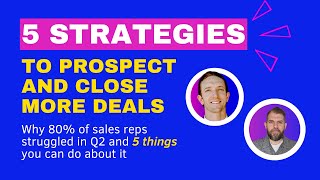
This is a YouTube Sales DNA podcast episode (hosts Nick Clare and Harrison Uccession) discussing why many sales reps underperformed in Q2 and practical steps to fix it. They cite LinkedIn poll results showing 80% of reps struggled in Q2, with prospecting (49%) and deals going dark (39%) as top issues. The episode gives two main sets of advice: (1) prospecting — deliverability fixes and a 12-rule checklist (focus on problem vs product, one problem per email, mobile-optimized <125 words, no links/images in first email, short subject lines that look internal, create curiosity but don’t satisfy it, personalize/relevance, outcomes vs features, highlight differentiators, match message to responsibility); and (2) closing / preventing deals from going dark — deepen discovery to align to high-priority initiatives, identify how prospects are measured, multi-thread accounts (avoid single-threaded opportunities), find and arm internal champions with a business case and short video, and ask for calendared next-steps. The hosts recommend leaders train reps on sales skills (not only product knowledge) and run focused outreach practices to fill the pipeline.
Questions this video answers
80%
49%
39%
78%
Around seven people
Chapters
Hey, everybody. Welcome to another episode of the Sales DNA podcast. This one is just going to be Nick and I, and we're going to be talking about. There's something that's really important that we're seeing happening right now in. In the. The industry and in the field, especially for. For sales reps. So we had a poll on LinkedIn the other day and found that 80% of reps struggled in Q2. Right. So, meaning that, you know, they. They did not. You meet expectations, they didn't hit quota. You know, they felt that it's really challenging out there right now and that their performance wasn't great. That's 80%. That is a substantial amount of people. Right. That means only 20% of people are actually doing well at the moment. And so we wanted to try and dig a little bit deeper to find out what those challenges were. So we followed it up with another poll. And what we found is that 49% of reps are struggling with prospecting, so struggling to get that first meeting on the book and actually create new opportunities. And then secondarily to that, 39% of reps are struggling with deals going dark. So they're doing all right getting that first meeting. So they have the first meeting, you know, they feel like things go well and then all of a sudden, poof, right. They disappear. You get ghosted, and, you know, your prospect is gone. And so what we really wanted to focus on in this episode is to talk about these challenges and give you some tips, tricks, strategies that you can deploy right now to help you out here in Q3 overcoming these challenges. Yeah. So, Nick, I know you're still leading the team over there at Dfinij, and I'm curious, what did you kind of see as well, to kind of double down on the, you know, the results that we got from the poll?
Yeah, I think it's tough out there. Like everyone's saying, I have a small team that's building and ramping, so my story is going to be unique in that aspect. But the main rep this ramped actually hit 150 to plan this quarter in Q2, so that's a bit of an outlier. And I think I can pinpoint, kind of wise doing it other than being a great rep, lots of experience, lots of connections, the obvious things you want from that. But even those people are not being successful at the moment if they're not doing certain things. And I think normally focus on what's the rep doing to be successful. And we need to take a step back and say, as A sales leader as a company, how are we setting them up for success? So one thing we had in place, and this is not a problem, but it kind of going to sound like that one thing we had embraced is we had an agency going outbound for us as well to expand our reach. So that was succession on this, on our behalf this time, but could be anybody, right? So you choose. We had marketing running different things. We were at as many events as we could be. We were running trade trade shows. We were putting people up to go out for dinner in places. We were putting the investment in finding those leads through multiple spaces. The bit the reps doing is important. Reaching out to current contacts, finding new contacts, LinkedIn, their own email outreach. Like they have to be the master of their own destiny. But if the company isn't fully behind them doing all of those other things, I think it's really hard for anybody to hit target. So I would say that's one of the things. And then the rep, it was just an endless, like I think about and that he bought him another 25 of his target on the last out at quarter through a couple of deals, just continually plugging away. It.
Yeah, no, that, that makes a lot of sense. Yeah. It's really about how do you support the reps. And in this case too, you've got an experienced rep who probably has a lot of the skills necessary to be successful. But there's also a lot of reps out there who I think maybe even if they got into sales within the last couple of years, they're more familiar with how do you sell when money is flowing and companies have a lot of budget. And so one of the things I wanted to. A couple of things that we wanted to talk about here were around prospecting. So give you some tips there and then also some skills and tips that you can use to help drive these deals to close. So I think starting from a prospecting perspective, one of the biggest changes that's probably happened in the last few years is how easy it has become to send emails at scale. So because there are all of these tools like Apollo Outreach, Salesloft, etc. These tools that exist at a allow you to essentially load up your spam cannon and blast out emails to people. It's become so easy to do that that so many companies or so many prospects are inundated with messaging on a regular basis. So they get so many emails. You go to anybody's inbox and you'll see thousands of emails in there and a lot of them are crap. And so you have to do something to stand out. But something that's happened from an email service provider standpoint is they have started crack down on cold email, meaning like prospecting, spam filters, the promotions tab that you see, right. They're trying to make it make the inbox as streamlined as possible for all of their users. Right. So Google and Outlook are the main people doing this. And what this has led to is a lot of deliverability challenges. And so sometimes if you're sending out a bunch of emails or you're sending out cold emails and you're not getting replies, it's not always because your messaging isn't good. It's also because you potentially are just not getting your email delivered effectively. And so I wanted to give you a couple tips just around that from a deliverability perspective. You know, one is don't include links in your first email, don't include images in your first email. These are the types of things that are going to get your message, you know, blocked, especially if it's the first email you're sending to that individual or to that domain. So avoid the links. And this also includes your signature. So if you're signature has links and images in it, make sure that you're removing those and you're sending plain text images or plain text messages as your first email.
One of the things that people forget that is a link as well technically does the same effect with link is when you put read receipts and over receipts to turn those off.
That was going to be my next point, which is, which is when you are tracking email opens. So if you're using a tool like Apollo Outreach, Salesloft, et cetera, any, any tools that tracks email opens, or even HubSpot for that matter, right? Tracks email opens. What happens is a little one by one pixel gets embedded into that email. And so when the email is received by the recipient, that pixel gets tried to be loaded. It's tried to load, the email server tries to load the pixel. There we go, that's what I'm going for. And upon loading that pixel, it sends a trigger back to your sending provider that says this pixel was loaded. So this is going to be logged as an opened email. Now a couple downsides there are that nowadays all these email servers, or a lot of email servers are just opening up every email that comes through. So anybody with an iPhone as an example, that you send an email to, that goes through, so they use the, you know, the mail app on their phone, all of those emails are automatically opened by Apple and their servers so you're getting all of these bots that are going to automatically open your email and so those are going to trigger this pixel unknowingly or like a false negative and then you have the. Or false positive I should say. But then you have. On the flip side, there are a lot of servers out there that actually will never open emails. So especially if you're sending to like large pharma or companies that are really hypersensitive around the security of their email, they will not allow them to download or open images. And so because of that, the trigger for the pixel never gets loaded. And so you actually end up with false negatives. So people will actually open your email but you don't know about it. And so the whole point I'm trying to get to here is that you don't get accurate metrics from your open rates when tracking them. And so because of that and the fact that is going to increase your chance of ending up in the spam folder or the promotions tab is usually just not tracked your email opens. We talk a lot about this in a newsletter that we put out recently. So if you want to, you know, you know, go find that. It's just blog succession bio and you can read more about it there. But when it comes to deliverability, those are just a couple quick tips that are going to help you actually get your message delivered more. Right? No links, no images, anywhere in your first message to somebody and then stop tracking open rates. Yeah. And this isn't going to guarantee delivery, but it's at least going to help once you're delivered.
You don't got to be interesting, right? This is. We always talk about being specific, finding a connection. And I had an example literally two days ago of how I thought I had a connection with someone. I thought I was being specific and they didn't answer. Then I sent a sort of like Joji line that would stand out. Just one line and they responded. And I'll give the story because it tickled me and made me chuckle. Anyways, but I used to work with somebody when I was Ashley Danica and for working for Divinogen, I wanted to get a connection with this person. They work at Live Pharma and not the right person, but I want their help to get to the right person. So I just sent a message. This guy used to have an allotment for any Americans. That's a vegetable patch, right? And so you lie. So we used to share tips about growing vegetables like all 20 year olds do. Right. And so I sent him A message. Hey, how's it going? Still got the allotment. This is what I'm doing. Really interested to get in touch. Can you help me out while I grab a coffee? Saw he read it because it was on LinkedIn. No response. And I just sent back one line of I will smash up your lettuces. That's all I said, guy in a jokey message. I know this person well enough that I could do this. Right. And he replied with, well, that got my attention. Cool speak. Let's grab a coffee. But you would think the first one with somebody you know you've worked with would be enough. But it just shows you everyone's so busy that even that it's like, I'll get to that later. I don't believe he was completely just isn't it, I'll get to that later. So I had to stand out even more.
Yeah. I mean this is what we talk about. I mean this is even with some of, you know, right. This is where we came up with the, the four Rs of prospecting. Right. You got to send the right message to the right person at the right time through the right channel. Yeah. And in this particular case may not have been the right time. Right. Or it was the wrong channel or whatever it is.
Right.
So it's like you have to, you know, you have something, you have to be consistent. And you know, that's part of the, the challenge with, with prospecting is you can't just have a one and done message that you send out and you hope that somebody's going to respond.
I tell that story because it's a little bit silly. But the point is it's somebody I knew with a message, I knew about him and still I got no response. So it tells you that 4R framework is important and it tells you how much consistency and follow up is important.
Yeah. And so the next kind of thing we wanted to help you with was a couple of tips like this, specifically around prospecting. So we call these 12 rules for prospecting, which are you need to focus more on the problem than your product. So what is the problem that you help this person solve? Talk about that over the product or service that you are selling. Right. Nobody cares about what it is that you do. They want to help try and solve their particular problems. Next is you want to focus on one problem per email. Another challenge we see with a lot of prospecting emails is they're so long, meaning they try and solve every single problem that they could cover in one email. And nobody has Time to read all of that. So you want to keep it specific, keep it concise, and you want to focus on one problem per email. If you solve many different problems, that's great. That's why you want to put them into a sequence over a period of time. You want to make sure that you're talking about them more than you. Right? So if your message reads like I, I, I or oui, oui, oui, if you're French, that might work. You want to remove a lot of that I and we phrasing and flip it to show how you are going to help them or what they are going to get from working with your product. And the next thing that you want to focus on is number four is you want to match your message to their responsibilities. If you're emailing somebody that is a director at large pharma, the things that they care about are substantially different than the person at the bench doing work. Same thing goes for small startup. Person at the bench is doing a lot of things that are going to be different than somebody, maybe a cso, whatever it is. And so you have to match your message to the level of responsibility. And so if you're sending a message about solving a really technical challenge at the bench to a vp, this is not something they're going to be really interested in. And so you have to match that level. You want to talk about how you're going to help progress their programs faster by solving certain challenges that may be technical challenges at the bench, but you have to elevate that conversation to what matters to that individual. And the same thing goes if you mess with somebody at the bench, talking about accelerating their research or progressing expressing their programs faster, like they're probably more worried about solving a reproducibility issue or how they can generate different data, how they can optimize a particular assay, they're not as worried about those bigger problems for that one.
I always give the example back in the day when I was working in the lab for stem cells, growing IPSC cells that you have to passage like every day. You can move a couple of days, but you need to feed them all the time. If somebody has sent me, hey, here's some new media, it's going to make your cells healthier or something maybe I listen to. But when this new media come out that allowed you to get your weekends back because you could leave the sales for two days, that message everyone wanted to hear about, because suddenly we can have our weekend VP is not going to care as much about the weekend Right. But the guy in the lab really does well.
He may care more about the retention. Right. It's like, hey, you might be able to keep your employees around longer if you're able to provide them this so they can get their weekends back. Right. So you know those types of things. It's a different way to flip that message. Exactly. The next thing that you're going to want to do is you're going to want to. And this is probably one of the most important elements of these. Your top 12 tips is to make it mobile optimized. So you want your message to be optimized for a mobile device. Most emails are opened and read on your phone. And so you want to keep it to under 125 words, ideally under 100. And so if you want to test this, send yourself an email and see what it looks like. And the rule, I like to say is if you have to scroll, your message is too long. You want it to fit on one screen. Hopefully not all of your customers are using old Nokia flip phones or something like that where they had a really tiny screen. Most people got an iPhone or an Android at this point, and they've got big screens. And so just take a look at it. What does it look like? See if it all fits on one screen. And that's what you want to shoot for. Because when somebody opens a message, one of the first questions they're going to ask themselves is, how long is this going to take me to read? And if you're looking at an essay and they can immediately tell us, probably a sales email, they're going to just delete it. They're not going to take the time to read it. Another important concept, so this is number six on the list, is you need to create curiosity, but never satisfy it. So what does that mean? If you tell that person everything that you do as a company, or you are essentially trying to like, quote, unquote, sell your product or service over email, which is not a great channel. We'll talk about that one in a sec. Um, you're giving them all the information that they could possibly need, and so there's no reason for them to reply back to you. So what you want to do with prospecting is you want to create curiosity. You want to get them interested in learning how you can help them solve a problem without specifically telling them every detail about how you can do that for them, because that's going to get them to be curious about learning more to where they will then respond. And you can take the conversation forward at that point, right? So create curiosity, never satisfy it. And then that leads into the next point, which is number seven, which is don't sell your product or service over email. Email is not a channel to sell, right? Email is a channel to create that curiosity, get them to respond, to generate a meeting. And that meeting is your opportunity to sell. So don't give them all the information about what you do in that particular email. This next one is number eight, which is making sure that you highlight your differentiators. Most people talk about all of the standard capabilities that everybody can do, right? You talk about your ISO certified lab, you're talking about how you've got experts on staff who can help answer all your technical questions, your product is high quality, blah, blah, blah, all the same stuff that every other company can talk about. If you truly believe that that is a differentiat for you, I would highly recommend you go to every other competitor's website. You'll probably see that they say the same things. And so what you want to do is do a quick messaging test which says, I'm sending this message to somebody and ask yourself if any other company could replace my name or my company's name in this email. Like, could I still send this? Right. Could any company basically come in and send the exact same email? And if the answer is yes, then your message is too vague and you need to focus more on your differentiated capabilities, the things that you can uniquely provide to the customer. All right, the next one is you need to focus on outcomes versus features, right? So this is number nine, outcomes versus features. What are the things that you are going to help your customer actually be able to achieve and what are they going to be able to do using your product or service? Not talking about the feature. So the example I give, when we were at Citigo, we was a CRISPR gene editing company and we had this feature which was a 200 point transaction optimization. So what this was was we would run 200 different transfection conditions for every cell line that we would edit. And so the benefit that you would get from that is that you would get high editing efficiency across many different cell types. But again, neither of these things are relevant to a customer. A customer doesn't care that you run 200 point transfection optimization. They don't care that you can get high editing efficiency across multiple cell types. The outcome though, that they're able to achieve is that they can work in biologically relevant cell types that they may not have. And so that is an outcome driven message that you're enabling them to be able to do, whereas historically they couldn't. And so you're transitioning and taking your features and you're turning those into outcomes. All right, we already talked about deliverability. So number 10 on this list is no links or images in email. Number one, just remember that. Don't do that. Keep them out. Make sure the message is delivered. Number 11 on this list is short subject lines, less than 5 words and make them look like an internal email. I have seen a lot of subject lines and the first thing and the subject line is improve, reduce, enhance. Right? These are words that scream marketing. Nobody ever sends an email to a colleague that says, hey, want to enhance your cell culture capabilities? Nobody ever says that. Like, nobody's going to send that to their colleague. And so when you're sending emails, you want it to look like it's coming from somebody internally to them. You want it to be short.
Sweet.
To the point.
I've just hacked the system. I'm sick of internal replies because my email inbox is getting full. I'm writing all my internal emails as improving hearts and no one's going to open them.
Nobody will open them. Yeah, well, I mean, so if you think about what it takes for somebody to open an email, the three main things they're going to ask themselves are who's sending it to me? Right. If they recognize the sender, they're probably going to open it. If you see as a subject line is the next part. If the subject line looks like something that you would be interested in or it's relevant to you, you're going to open it. And then the third one is the preview text window. So that's going to be that first line that shows up in your email is going to be a part of the preview text right next to the subject line. So if you go into your email, whether Gmail, Outlook, whatever it is, you'll see subject line. Immediately next to it is the preview text window. So the reason we recommend Short subject lines 1 is like they look more like internal emails, right? So you want it to be bo look like an internal, you know, lowercase letters if possible. But then if it's short, you'll see more of the preview text window. And so if you're personalizing your message and the first line is relevant and personalized to that individual, they're going to see that and so be more likely to actually open that email. And so that's why we recommend short subject lines that are boring, look like internal emails and remove all of the Crappy buzzwords. And then lastly, your message needs to be personalized and relevant to them. And so I talk about the spam cannon, which is what most people use, which is they take a template, they load it up and they hit send all. And so that's what most reps are doing. That is why everybody's inbox is inundated with crap. And so what you need to do in order to stand out is you need to make your message both personalized and relevant. It doesn't mean personalize it. You know, hey, I saw you went to, you know, Johns Hopkins University, blah blah, blah. Right? Unless you have a direct connection to Johns Hopkins Atkins, maybe that works. But you need it to be relevant. You need to talk about why you're reaching out about something. So it might be, hey, I saw you guys are hiring for a scientist and it looks like one of the experiences they need is crispr experience. Hey, by the way, we can help with this. Blah, blah, blah, right? You can kind of jump into your message from there, but you want it to be personalized and relevant for why you are specifically reaching out to them right now. So that's what you want to do.
Spam can is not good. If I say that I'm going to smash up your letters to a thousand people, it just becomes threatening. Right? It's not specific, it's not relevant to them.
Right, Exactly. So yes, put down the span cannon and spend a couple minutes to actually stand out in your prospecting efforts. So Those are the 12 things. Quickly go through them. You focus on a problem versus the product. One problem per email, them versus you. Messaging. Match to their responsibility. Mobile optimized. So ideally under 100 words. Create curiosity and never satisfy it. Don't try and sell your product or service. Highlight your differentiators. Focus on outcomes versus features. No links or images in email. One short subject lines. And then make sure it's personalized and relevant. Right? So if you follow those things, you're going to massively increase your response rates to your prospecting efforts.
So two things. The first thing is there's a decent list there of lots of content if you wasn't writing it all down. Harrison posted this on his LinkedIn on 17 July 2023, depending on when you're listening to this. And I've just posted it on Biotech Sales Guy, which is an Instagram sort of a bit more of a jokey feed that we have that I do. So look on any of those and you'll have that list to go back to. Second thing is this comes back to filling your pipe, right? So all of that sounds like we've gone through a list of why are we doing it. We spoke about what's this podcast about helping people achieve target. Because Q2 is tough. Start doing this now, I guarantee you a close more deal with this quarter.
Depending on your sales cycle, you'll at least start finding more opportunities to fill the pipeline. Right? Which is, which is, you know, 49 of reps are struggling with prospecting right now. And so, you know, 49 of you just got, you know, a lot of tips and tricks that you can use immediately to improve your prospecting effort.
And what I'll say is, is that when you do this well and it's specific and relevant, people that enter your pipeline for as a prospect are more likely to close and close quicker because you've hit them on a pain point. You've hit them with something relevant, you've already primed them to be interested. You're not like you're not duping someone into having a call with you and then trying to convince them they've come fairly convinced. So. And if you're a sales leader listening to this, all I can say is share this with your team and then what I recommend is that you put an action in place. So what I did with teams in the past was I demanded everybody did frenzy outreaches a day by LinkedIn or email. Because you think of that, you've got a team of five people, 20 a day, you know, about 100 actual outreaches a day. Just by asking everyone to do this, it feels achievable. They're going to follow this system and you're going to fill your funnel.
But the other piece is making sure that you're, you know, monitoring that they are implementing these things. Right. It's like you have to take a look at your own personal go take a look at the messages that you're representing out. See, is it matching this criteria or do these look like, you know, might as well be a one pager for marketing that are put in email form and you know, loading up the spam cannon and sending it out.
I think I've been doing this and I think most of the issue is with sales leaders reps, a lot of the time is you do this because you know you have to and not necessarily because one, I really believe it'll work or that you're good at it, right. And if you're doing it because you have to, you're just getting it done. It's a task to get off my list so I can get to the other thing. But you just need to trust this process. Take a break from that thought and just invest in it. And if in a month's time you'll see a month time, you're seeing no results from this, you can go back to your previous thought that this was a waste of time. But imagine what that month was worth if it turns out to be as good as we're saying.
All right, so that is going to help you cover the prospecting side of things. Now we want to talk about the other 39% of you that are struggling with deals going dark. So the typical situation that we see a lot, that we hear a lot from other reps is that have a great first call, things are looking good, the person is interested, they want to learn more. Like send me as much information as you can. They're so excited. Would love to learn all about your technology, whatever it is, right? Things are going well, right? You get. Yeah, exactly, happy ears. But then what ends up happening is it goes and it progresses nowhere. The deal does not continue. And so what we're going to talk about here are a couple strategies that you can deploy, use in your initial conversation to better align your solution to high priority initiatives. And then we're going to give you a couple tips as well to help drive these deals to close. And actually what we call is build decision consensus amongst the buying committee. So maybe hitting on that first topic. So in, in your discovery conversation, the things that you have to do that are most important to align to the customer's priorities is you have to align your solution to their company labs, et cetera, highest priority initiatives. So how do you do that? Right, so when you think about how budget is allocated within a company, allocated from the top down. So at some point in time, the executive team had a strategic meeting or mat talking about strategy and they decided, okay, these are our top five priorities for the next six months, whatever it is. And they then allocate a set amount of budget towards each initiative, towards each program, each project, whatever it is. And then that starts to funnel down throughout the work. So different departments get different levels of funding for different types of projects and then that follows down into the scientists and then the actual work that they prioritize. And so, but what you have to do from a sales perspective is you have to identify what some of those higher level priorities are. If you're talking to a bench scientist, they have very specific technical things that they're trying to solve. Unfortunately, most of those aren't aligned to high, you know, priority problems that you require where the budget is already allocated to. And so you need to ask certain questions like how are you being measured right now? How's your team being measured? We had a conversation with somebody the other day who mentioned that the company had shifted the way that they were being measured from the number of new programs started to the number of INDs that they submitted. And so that alone is talking about a whole new set of initiatives that they're probably focused around, which is like the speed at which they can push to ind. Right. Those are different objectives than if you're talking about smarting new programs. So if you understand how a customer or a prospect is being measured, you're going to get a much better understanding of how to align your solution to solve that bigger challenge that they care about, that the boss cares about, that the boss's boss cares about. And that's what you have to align your solution to solve, not the bench level project. What do you think about that?
Yeah, I think we've all said it and it's obvious and it's getting those, all of the buy in from those various stakeholders and making sure, you know, they are. I think that's the challenging thing and people just don't want to ask the question who else is involved. I think that's the biggest thing my reps is when you're going through this and you're getting to that point, you've got interest from somebody else, you feel like you've got the understanding of what they need, you've got their pain points. You need to know who else is involved so that you get buying from everyone and that you can drive this forward. That I think helps me because if one person goes dark, you'll soon know someone else.
Well, I mean, yeah. So this goes back to some of the data where there's around at least seven people in the Apple is buying process nowadays. And you may think, hey, my reagent has, you know, only one person is purchasing it. And I highly doubt that because there's always people that are involved that are leveraging the data downstream of what that person is working on or that were involved in, you know, setting the objectives upstream for them as well. And so you have to basically, you have to basically understand who all is involved. Right. There's seven different people that are going to be involved in each of these different decisions. And so the other thing we found was that 78% of opportunities that sales reps are working are single threaded, meaning they're only Working with one individual. So if you go through your pipeline right now and you go through every single opportunity, ask yourself, how many of these opportunities do I have? One point of contact, two points of contact, three, four, five, whatever it is, if you have less than seven points of contact, you're probably not talking to every single person that's involved in that decision making process, whether it's people influencing it or people that are actually making the decision. And so to your point, Nick, you have to understand who all is impacted by the decision. Who's all is going to be impacted by the use of the product or service. If you're selling an instrument to a core lab for the other labs around them that are also going to be leveraging this instrument, if you're selling reagents, who are the people downstream of you that are going to have to be validating the assays or the data that you're generating? So there's a lot of other people involved in the decisions that you may not actually be aware of.
If you're saying this to yourself or a rep is saying it to you as a leader and the phrase is I'm talking to the main guy, I've got the guy we need, or something along those lines, which I've heard a lot of times from reps, it's okay, I've got the main person, that's fine. You don't know the account well enough. Unless that's a one person company. That is not true.
Right.
Because even in a two person company they're going to confer about this because they're spending money.
Even if you're talking to the CEO of the company who could make this, who's going to be making the ultimate decision, no CEO is going to make it unilateral decision without involving their team. And same thing goes if you're talking to the director of the program that could make the decision, they are going to talk to different members of their team to get their opinion, to get their input on this decision. And so you have to get buy in from all of those stakeholders as.
Well, depending on the issues, or maybe you're going down the rabbit hole, but also depends on the culture. So if you're in Europe and you're thinking about different countries, or even you're thinking about Japan, maybe these countries, some of these different countries have more of a collaborative nature in the way they make decisions. So it could be even more people.
Right? Yeah, it's a great point. So short version is you want a quick, quick win for yourself, is go through all of your deals that you have right now, ask yourself, how many people and points of contact do I have associated with this opportunity? If it's less than 5, reach out to other people within that organization. Go and try and meet with them, find them, find all who is influenced and have a conversation with them about your product, your whatever it is. Do discovery, go deep with them, find out how they're being measured. You'll find out what matters most to them. If you know that that company or that team is now being measured on the number of INDs that they deliver, well, great. Now you can use that in your conversation with these other people to say, hey, how do you think that this product or service could help you hit that objective of those ind? And what you're doing here is you're building a groundswell of people that are going to support you. Because. Because no sales decision or no buying decision is made with the salesperson on the call, right? That's very rarely ever actually going to be the case. Most decisions are going to be made behind closed doors in a room where your champion or your customer is having some sort of discussion should we buy this product, why or whatnot, how does it compare to this other one? And there's some sort of discussion happening in that room that you're not in. And so if you don't have support from multiple different stakeholders and you don't have a champion who's driving this deal forward internally at that company, really wants your solution to be implemented and they have the power and influence to get it done, your deal is most likely going to get stuck, right? So you need to multi thread and you need to find these champions. We talked about this actually yesterday in one of our skill up sessions in succession, which was the first person you talk to isn't always your champion. Because if you think about a person who, let's say somebody comes inbound to you and they're like, hey, I want to learn more about your products or service. My guess is they're also going to other companies as well. So they may or may not be your champion. They may actually be a champion of another company, of a competitor. So you might be talking to the person, but they are also talking to the other companies or the other sales reps that are out there. So when you're multi threading, you also are giving yourself a better chance to find other champions, other people that have influence and sway in that purchasing decision to get their buy in to then persuade the person that you're, you know, as, as your point of contact that you've got. And so it's important to remember that your first point of contact, your first interaction with somebody, isn't always going to be your champion. They're not always going to be the one that wants to drive and put your solution in place. Cool. So now that we are multi threaded, we're talking to a bunch of different people, we're identifying our champions. What do we have to do now? Well, now you have to actually arm them to sell on your behalf. So one of the biggest challenges is that customers don't buy your product or service all the time. And most of them are scientists. They don't know how to sell internally. They don't know how to sell the benefits or the outcomes that you can help generate. What a lot of times they'll do is they'll go and just pull up the slides of the data that you showed them. They'll talk about your features and functions. But like the purchases, the person making the decision doesn't care about those things, but they care about hitting their nine inds that they have to get to this year. They care about that IND number. They don't really care about all of the little bells and whistles that your product or service has, which is how most scientists are actually trying to sell this thing internally. So what you need to do is you need to arm them with a business case or some sort of value story that tells the story for them, and you're basically simply train them how to sell this internally. And you can do this simply by saying, hey, I know you want to get this in place, right? You've told me that you want our product or service in place for your company. Do you mind if I give you a couple of tips so that you can best sell this idea to xyz, to your boss, whoever it is who's making that decision. Most people will be like, yeah, that's great. Okay, great. Now you can actually write out that narrative for them. You could talk them through the different talking points, train them up on the objections that they might face, show how they can highlight how one particular feature or benefit will drive a specific outcome that they need. And you train them on how to do this so they can have this conversation internally.
Something I like to do in these scenarios as well, because not everyone's the most charismatic presenter or good at getting information across. So you can arm them, but then they've also got to be able to present that in a way that you would be happy with. So you do exactly what Harrison said, but Alongside that deck and that narrative and that information you share, share a video of you telling that story in about three minutes, right? And say hey, if you, if you need, if you want to share this with everyone, send it in advance of your meeting. They will know it's just me telling the them what I told you. Feel free to share that across. And then that way you need to manage your facial voice and your, your narrative out there before the meeting. And they won't always do it, but if they haven't got it, they part it.
Well, yeah, that's a great point. I mean you should just do it anyways, like hey, I'll, I'll just make this three minute video for you too. It just give me a good refresher for you either going to the meeting or if you want to use it and send it around. And if you're not, how to record this video. You know there's a tool called Loom, there's Vidyard, right? These are free tools that you can use to create short videos. You can even just pull up your zoom and record yourself talking on your zoom or your teams, whatever it is, just record a quick video and then send that to them and arm them with this information so that way they can, they can use it and share it around internally. That's a great call out. Cool. So now we've talked a lot about how you can better find new opportunities, right? Some prospecting skills, how you can multi thread align the high priority initiatives, build that sort of business case or that value story and arm your champion with it. Just doing these things alone is really going to help you not only one find new opportunities, but also help drive these opportunities to close. And I think specifically around when you think about why deals go dark, it typically ties back to your discovery conversation. A lot of people think it has to do with follow up. It really comes back to the discovery conversation, how deep you're going in discovery to align to those high priority initiatives. So if there's something that you can really focus on, it's that component, right? It's how do you understand what's going on in their business today? What are the problems that they're facing? How are they measured? Why are those problems surfacing up? Are the root cause? What is the business impact of not solving them? And then what do potential solutions look like? Those are the types of things that you have to uncover in your discovery conversation in order to basically get this person bought into the idea that you can have an impact on their business, business and their job. And so focus discovery as. As well.
Yeah. Because the challenge here is when you send that email to get them to talk to you again and they've gone dark, what's happened is it's no longer interesting because it wasn't important enough.
And you need to remind us, and.
You need to remind them in that email why it was important in the first place. If you didn't do enough discovery, you do not know. So if you're going, hey, are you still interested in our piece of equipment? It's still got that blue shiny light, right? It gives a crap. Right. But if you say, is it still a challenge for you to get your assay completed in five days and this is causing you issues and the alcohol equipment could do that for you, is that still important? That's a different message. Like, obviously said that very generically. That's a very different message and you've aligned to what their challenge was.
Yeah, yeah. Again, though, even in that message, though, you're still talking about, like a really technical challenge. If you can roll that up to say, you know, how it's impacting the, you know, the metric that matters most for they're measured, how their team is measured, how their department is measured, that's where it's really going to shine through. And a great question that you can use in this is like, hey, where does this sit on your priority list? And then they'll tell you, and then you say, hey, where does it sit on your boss's priority list on solving this thing? And so they'll tell you that too. And if they don't know, it's a great opportunity to involve other people. Right? So it's like, hey, if this isn't going to be a priority for them, my guess is it's going to be really hard to get approval for budget for this thing. So is it worth involving them in the conversation to see if this is, you know, something that's a high priority? Those are the types of things that you need to be doing in the discovery conversations. Because in discovery, that's when people are going to be most open to give you this information. If at the end of that call, they're like, hey, I send us some more information. And you just go and send them some more information. Like, that deal's probably dead. You can even at the end of that call try and be upfront with them. Is like, hey, to be honest, when people ask me to just send them more information, it's typically one of, like, two things. One is they're actually not that Interested, they don't think it's a big priority. And so if you just let me know now, that's great, I'll still send you the information so you have it. But at least we know that this isn't going to be the biggest priority for you. And maybe we revisit this in a couple of months or they really want this information so they can go and try and sell it internally and set up another meeting, whatever it is. Right. And then that person is going to tell you where they fit because you've given them the okay to say that it's not actually a priority. People are obviously oftentimes scared to tell you no or that they're not interested. And so if you give them the ability to do that at the end of your call, call when you sense that there is maybe something that's not that important to them, give them that ability and they're going to be more likely to be honest with you. So you can kind of disqualify that deal as early as possible.
The thing people are most scared about giving away for free is their time. So if they're not willing to set up a follow up meeting with you at the end of the first call you've made, that's a huge red flag. If you say, hey, great, this seems important, let's put the next one on the calendar for you. We can move it if necessary, but let's get on the calendar now so we know when we're meeting next. When works for you to have that internal conversation and come back to me if they go, oh, I'm busy, I'll get back. Red flag.
Right, right. Go find somebody else in that organization to talk to. And I think that's the other piece that maybe reps are doing as well is if that were to come up, go find another person in that same team. If this person is having some sort of challenge they're trying to solve, go find another person. Like use it as like an inbound trigger to say this account has this sort of challenge that they're facing. Let me go find another person in their lab, on their team, et cetera, that you may also be able to help drive this forward. And so I think we've talked about a lot of different things here from like prospecting into closing and how to drive these deals through to make sure that they don't ghost you. So I recommend coming back, replaying this thing if you want, focusing on the different areas that are most important to you. So if you're struggling to get initial conversations with people. Focus on the prospecting stuff. Pick out a couple of things to work on first. Don't try and do everything all at once. Same thing goes if you're struggling and getting ghosted, I would say recommend step one is making sure that you're doing all of the right things in your discovery call and that you're really honing in on aligning to high priority initiatives. And then focus on are you multithreading? Do you have a real champion? And are you arming them to sell on your behalf? Cool. Any. Any last words of wisdom, Nick?
No, I think we've given a lot there. We should do a follow up on this and if anyone has any questions on it specifically, send them in and we'll answer them on a different episode.
Yeah, absolutely. There'll be a link below the podcast here, so ask us anything, click that link, fill out the quick form and then we'll answer those questions. You can also reach out to us. Send me an email harrisonuccession Bio or if you want to, you know, kind of ramp up your training and skills on any of these topics, you can come and join Succession so Succession Bio Bio Join. It's our community skill development platform where we've got training courses, content, resources, live events, workshops, all sorts of great stuff to help up level your sales skills. And I'd say one last word of wisdom for all of the sales leaders out there. If your teams are struggling with these particular elements, either prospecting or, you know, just driving deals to close, these are the types of sales skills that you should be teaching them. Teach them the sales skills necessary to execute and complete these, you know, these deals because that is oftentimes the biggest gap. I see a lot of sales leaders focusing on the technical product knowledge of their tool and they call that training. But that doesn't arm you with the actual sales skills that you need to drive deals to close. Right. Data doesn't sell itself, the product doesn't sell itself just because you have that knowledge. Like you're not going to, you know, it's not going to be the things that are going to drive deals to close, especially when budgets are so restrictive at the moment. And so you've got to make sure that you are arming your team with skills necessary to align to high priority initiatives and to build decision consensus within that buying committee. Cool. Awesome. Well, thanks everybody. This has been a fun episode to record. We got really tactical, a lot of big stuff in here, so if you enjoyed it, let us know. Message us on LinkedIn. Say you love this episode. This will be on YouTube as well. So go on YouTube and like it. Subscribe and add some comments. Really appreciate it.
Thanks Doug.
Thanks all. See you on the next one.
More from Nick



[Leadership] Creating a culture of coaching and skill improvement with Sai Guduguntla
[Leadership] Founder selling and how AI will change how team's work with Angie Schwab