Finding Work That Leaves You Fulfilled w/ Dr. Tessa West | The Psychology Podcast
Dr. Tessa West identifies five toxic coworker types and five sources of career frustration, from identity crises to feeling underappreciated. She offers practical fixes like job-crafting and targeted networking, and explains when to push through a bad role versus when to leave.
Chapters
You know, the first step before you leave anyone or before you make any big moves is to dive into the psychological underpinnings of your unhappiness. So stop making lists about sort of, do I want to work from home? What city do I want to be in? What kind of money do I want to make? And really try to understand the psychological underpinnings of why you're miserable here.
Today we have the NYU professor Tessa West on the show. Dr. West studies the nature and dynamics of social perception. She's the author of the book Jerks at Work and more recently Job Therapy: Finding Work That Works for You. In this wide-ranging discussion, we discuss how to deal with jerks in the workplace, the different types of jerks, and 5 common sources of career frustration. We also discuss some great lessons she has learned from collecting data from people who hire, promote, and fire people, such as how to make a resume more appealing, It was so great to finally have Dr. West on the show, and there's such a wealth of information in this episode that you won't want to miss. So without further ado, I bring you Dr. Tessa West. Welcome, Tessa West, to The Psychology Podcast.
Thank you for having me.
Some ground rules. If you ever feel anxious or need any mindfulness or grounding during the show, you can borrow my chill pill.
Amazing.
It's 250 milligrams. So, so glad to have you here. Congratulations on your new book, Job Therapy: Finding the Work That Works for You. Is it okay before we get into the nitty-gritty of your new book, can we talk about some of your older work since this is your first time ever on the Psychology Podcast? I never had a chance to nerd out with you about jerks at work, for instance.
Absolutely.
Yeah, I love that research. So you wrote an early book called Jerks at Work: Toxic Coworkers and What to Do About Them. First of all, do you think nowadays it's kind of calling everyone toxic is maybe starting to get overused a little bit? Because now I'm noticing a trend on TikTok where Every, you know, 13-year-old is— they're like, everyone around me is toxic.
Absolutely. Even when I wrote this book, I sort of hated the subtitle.
That's funny.
You know, it's really easy to call someone toxic if they do something that you don't like or they give you negative feedback. I think toxic is overplayed, and it's also just a word we use anytime we feel uncomfortable in a social interaction. We immediately label the person toxic, and it's really hard to actually Have a counter to that. If someone calls you toxic and you say, well, I was just trying to give you honest feedback, that makes you look even more toxic, right? And so yes, I do think it's problematic, and I will be the first person to throw that part of my book title under the bus.
OK, so with that said, there are legitimately toxic, legit toxic people at work. What are some of the main characteristics? Because I know you wrote a cool article saying there are different types of toxic people. I think you outlined 5 or so.
Yep.
Could you maybe go through some of that?
Yeah, I think most of the most dangerous toxic coworkers have some pretty enviable skill sets. And so one of my favorites is the kiss-up kick-downer. So this is that person who is just really good at making the boss happy. They tend to be pretty talented at work, and they tend to have a skill of reading the room well, so they know who in power they need to impress, but at the same time, They're pretty mean to the people who work for them or the people who work at the same level as them. So their skill set is really knowing who to impress and who to kind of throw under the bus to help get ahead at work.
So they're starfuckers.
Absolute starfuckers. We all know those people. We know these people.
Come on, let's be honest.
And the stars they are fucking have no idea. They fall victim to flattery very easily, and I think for good reason, because these people tend to be actually pretty good at their jobs.
For sure. Okay, so then what's another type? What's your favorite type, which you like to avoid?
I think the gaslighter is the most dangerous one.
Oh, they're the worst. Oh my gosh.
They are on kind of a different level. I like to say that jerks at work are kind of made. They're not born. We grow them out of certain kind of systems in the workplace, but gaslighters, they're their own category, and I think they have some true kind of personality issues. They're also really motivated to destroy you, whereas I think most jerks are actually not. The work jerkery is kind of a consequence of their actions, but it's not the The real goal. Gaslighters, they lie with the intent of deceiving on a grand scale, and they tend to be very careful and get away with it because they can pull you into all kinds of unethical behavior that you don't actually see coming.
That's true. I wrote an article for Psychology Today where I outlined the asshole circumplex, where I looked— I showed the agency versus communion, and then on every single one of the 8, I listed what type of asshole it was.
Love it.
Yeah, cool. It's really nerdy, and I knew you would appreciate it. because of that. So I'll send you that article. I mean, it's scientifically validated and everything.
It's amazing, yeah.
So I think maybe you could slot some of your toxic people into— Into your asshole quadrants. Yeah, the quadrants. That's exactly right. I have the quiet asshole. Then I have the arrogant asshole. Then I have the manipulative asshole, and all sorts of things.
All the nice shades of asshole are in there.
Exactly. That's exactly right. I see a new book title coming, a new fiction book title. Okay, so what can you do at work if you really— like, can you avoid them? Like, there's a power dynamic there, and that puts you in a really tough situation. It's like, what do you do if you feel like you can't, like, say no to requests that are unethical?
Yeah, I think, you know, most people who are victims of gaslighters, their instinct is to be really inward and try to fight the battle alone. And that's part of what got them there, right? So gaslighters tend to cut you off socially. In fact, that's the biggest red flag that you're being targeted by one of these high status people is they're taking you out of important meetings, they're telling you no one respects you or likes you, or the kind of more interesting and dangerous one is the one who makes you feel special. You're part of this special new thing, and we can't tell anyone about it yet, so keep it secret. So that's the real battle that they're fighting. I think for them, they need to start networking with people who are at their level, and not to throw their gaslighter under the bus or to gossip about them, but to get a sense of how they're actually perceived by others at work, to get some reputational information about what other people actually think. actually think of them. So most of these people have no idea. They're living under some illusion that they're either— people are afraid of them or people think they're incompetent, and they need to do some reality checking before they can do anything about the actual gaslighter asshole boss that they're dealing with.
What category would you put Michael Scott in?
Oh gosh. He's interesting because he has flavors of all of the different types, including my favorite kind of new research topic, which is just awkwardness in inappropriate Awkwardness in the workplace. But yeah, he definitely kind of does all these little things— micromanagement, misperceiving status cues, all the things.
Hold on, is awkwardness always the same thing as inappropriate? Like, I feel like there are a lot of people on the neurodivergent spectrum, myself included, who, um, you know, maybe sometimes awkward, but does that always mean it's inappropriate? Like, just because someone else is uncomfortable with your, with your different social style, does that necessarily make it inappropriate in the workplace?
I love that question. I actually think we're starting to think about awkwardness more as something that people do with another person. Less about kind of being a personality trait, like you are an awkward person, I'm an awkward person, but more awkwardness is a dance that we do together.
I like that.
And a lot of that comes out of uncertainty around how to handle certain social situations. So it takes two to be awkward, and it takes two to actually resolve that awkwardness in the moment. And often, you know, the reason why it doesn't get resolved is because neither party know exactly what to do. Should I make a joke? Should I apologize? And so it's really kind of an interpersonal dynamic more than it is a trait That someone has.
I love that. I mean, like, there's nothing better than when I'm around a fellow awkward person because then we can have fun. Like, people who aren't awkward are boring, you know? And so—
They're super boring. And I think awkwardness isn't something that is objective anyway. It's something that is subjectively perceived.
Yeah, I love that. I just kind of talked over you, so now I'm self-conscious that I'm toxic because I just talked over you.
Talking over each other is actually a sign that conversation's going well.
Oh, good. So it doesn't always— it's not always an indicator that the person's toxic. Okay, good. Whew. I'm just thinking very self-consciously now, looking at your 5 list. The micromanager. The problem with— OK, this is a cool topic. I really like being too nice at work, because I created this scale, pathological altruism scale, that I call it— now I call it intrusive helping is the phrase I use in my new book. So do you think— does that link to some of that work that you've written about, like intrusive helping or excessive helping?
Excessive helping is kind of a form of micromanagement, I think. I think when I think about people who are too nice, I tend to think of, and I'd be curious what you think about this, feedback that is generic but nice. So the less specific it is, the less useful it is. Nice specific feedback is fine, but what we tend to do at work when we feel uncomfortable is we smile through our gritted teeth and we say, you're doing so great here, in an effort to kind of avoid being called toxic.
Mm-hmm.
And I think some of that kind of toxic altruism comes from this, workplace culture of everybody is really nice here, we shouldn't insult people, instead of teaching people how to give useful critical feedback in a way that doesn't feel harmful. We're just layering on the niceties after niceties, and they're not actually improving or getting any better.
Do nice guys really finish last?
Not in my age group, Scott. When women are in their 40s, we are happy with the nice guys. But in, in your 20s, I think maybe— I think, yeah, nice guys finish first as you get older.
Yeah, yeah. Let's talk about your new book. Okay, let's talk about your new book. Um, it— wow, it's really good. First of all, I feel like it should be on every organizational psychologist's bookshelf, psychologist's bookshelf, as well as obviously people in general public as well. Um, you talk about 5 common sources of career frustration in this book. Um, I found each one really interesting, so if we could double-click on each one, I think that would selfishly be really interesting to me.
Okay, sounds good.
So identity crisis. Is this something that is age-dependent, or is there no expiration date to when you can have an identity crisis?
I don't think there's an expiration date for an identity crisis or any of these crises. I think, you know, I frame this chapter around people who have spent some time becoming good at something, enough time where they have sunk their identity into that career, into that part of their job, and questioning it is existential. It's uncomfortable, and, you know, there is a bit of a sunk cost that goes along with people who've been working in one profession for a long time, but you could also have just spent some time training in that profession, getting a degree, and then realizing it's not really for you, you know, or just spent a lot of kind of psychological investment in that, or even investing by moving or breaking up with someone or, you know, taking a pay cut. There's a lot of ways we can psychologically invest identity-wise into a career that it then becomes costly, and I think years spent on the job isn't necessarily the only way that we can do that. There's lots of other ways.
Wow. Um, well, what— first of all, don't panic, right? If it's happening to you, like, what's some advice? Like, let's say someone's listening to this episode right now and they really are having this identity crisis, um, and they feel like they shouldn't. Maybe they're feeling even shame. I feel like all your 5, there's— I could see a case where you have a metacognition where you have shame over having the thing.
Yep.
You know, I was thinking about that.
Yeah. Yeah, I think, you know, the first step for identity crisis, and really for all of them, but really for this one, is to first just do a little bit of a self-assessment. Like, how bad is it really? And on what component are you really suffering from that identity loss? Are you, you know, de-identified entirely with this thing? Are you just not satisfied with this particular workplace that you're having? And then I think you wanna ask yourself a couple questions of, how upset would I be if I could never do this thing again?
Yeah.
If I had to let this goal go? You know, I've done— I surveyed a lot of people for this book, and, you know, what I found is a lot of people are still highly identified with careers that don't make them happy. We see this in healthcare a lot where there's a lot of burnout, and that's just a really rough psychological place to be in. It's very depressing to feel highly committed to something that makes you miserable, but I think anyone who's ever been in a relationship or a crappy marriage knows what it's like to commit to something that you hate, that makes you unhappy, and so think about this through the lens of—
Not you.
Yeah, well, I'm on my second marriage, so I definitely went through that first stage. You know, I, I think that—
I say that because the husband's right there.
The husband is in the room and he's giving me, he's giving me major side-eye right now. He's also quoted in the Identity Crisis, um, you know, I interviewed Dave Van Babel for that. He's the identity expert. But, you know, we talk a lot about hating something that you— that is still a part of you. And I think a lot of people can identify with that rough psychological experience.
Well, usually if I hate something about myself, I don't identify with it. You know what I'm saying? You know what I'm saying? Oh, but if it's keeping you a lot of money, right?
It's paying you a lot of money, or you spent 15 years in med school to learn how to remove this one thing out of the gallbladder, and that's all you're good at, but you no longer want to operate on the gallbladder, then that's, that's going to lead to some kind of identity crisis, right? Especially if you're really good at it and other people are relying on you to be that expert. You know, you're the only brain surgeon in town. You're the only dentist who can really Do a good root canal. Leaving, you're going to let a lot of people down. And I think that's something that a lot of people suffer with.
I'm just thinking about all my life choices right now.
Don't get too existential on me.
Let's move to the next one. So drifted apart. I mean, look, I see a correlation between some of these. It's not like they're completely orthogonal dimensions in a factor analysis.
You know what I'm saying?
You know what I'm saying? A little factor analysis humor. I was gonna make a Varimax rotation joke, but I think that would be lost on this feed. I was gonna say these all gotta be team players on the principal component analysis. Let's be honest. Let's be honest. Okay, our audience is lost here.
Eigenvalues over 1, okay, we're done.
Our audience is completely lost. No eigenvalue jokes? Okay. So drifting apart, do you recognize this as part of yourself anymore? And obviously that's related to the identity crisis one, but it does partially separate. Like, what is that? What does that feel like, first of all?
It feels like I used to love this thing in front of me, and I don't really recognize it anymore. And it's not that I don't want this career, you know, and I will— I'll have to tell you— slip into relationship language a lot when I talk about stuff. So you look at the person sitting next to you in bed, and who are you? You know, you used to be this fun, engaging, interesting person, and I don't Are you referring to yourself? Yeah, or yourself, or the person you're looking at, or, you know, I'm looking at him.
Who are you?
Who is this man who is tweeting all the time? I don't recognize— no, he was always that person. You know, and it's not that you want a new career. You want the old thing back. And I think the problem is knowing whether that old thing exists in another place and whether the changes you've experienced are due to kind of structural, top-down, hard-to-see, hard-to-control things about the organization or the field or the economy or whatever, or something kind of more local about your team. or your boss. So knowing the level of change is important for these folks.
Yeah, I mean, that drifting apart is— that can be so tough. You're like drifting apart from yourself. We just don't talk about that enough. I mean, I do because I love Carl Rogers, and I love the idea of self-connection and the idea of existential loneliness that they were— the humanistic psychologist wrote about. Yeah, but I'm not everyone, you know. Most, you know, I think that this idea needs to be talked about more, especially in the workplace, you know, and people shouldn't be ashamed for, you know, there are people who'd go 40 years, right? And it's like, I almost— you'd almost expect after 40 years you'd get like bored with some aspect of, you know, something.
Yeah, all of a sudden you wake up and it doesn't do it for you anymore, and you look in the mirror and you're like, who am I? Who is this job? Which one has changed? Is it me or is it the career? And so a lot of their soul-searching is figuring out how much of it is them, you know, and that's a tough conversation to have with yourself.
How much work have you done in the field of job crafting? Because they often say in the organizational psychology literature that if that happens, then you should job craft yourself out of it.
What do you mean by job craft? I love jargon and I love making people explain jargon.
Well, changing the role in a way that matches who the new you, you know, like if you're a teacher, let's say you're a teacher, but you're really feeling like you want to be an actor. You know, you reframe your job as like, I'm not a teacher anymore. I'm like, I'm going to be like, you know, performing for my students.
I'm a performer of knowledge.
Yeah, yeah, exactly.
I mean, there's some kind of mental gymnastics you can do, but I think you want to be honest with yourself about whether you've now fallen into what I call passion roles, which are just things you love to do, but no one's going to give you a raise for that. You know, you can become the teacher who also runs the drama club, but that's probably just some extra side gig that you're not getting paid for. So be careful of that kind of slippery state of job crafting yourself into Roles that people don't respect as much as you think they ought to. I tend to be very cynical about all these kinds of things. If people will still pay you the same, great.
Okay, good. Yeah, because I was gonna say, like, you shouldn't always care what other people think, right? And sometimes it takes some big risks, you know, to completely change professions.
Yeah.
Um, Ro, torn between places. Are you taking on too many roles at work, switching tasks, or stuck between What does it mean to be stuck between 2 paths at work?
Yeah, so I think when I think of someone who's torn between places, there's like 2 things. There's, I'm taking on way too many roles, like official job titles, and my research has shown that the average person has like 10, and a lot of these they're doing for visibility purposes because they think they'll get a raise and they don't actually get a raise for it, but then there's this daily low-level task-switching problem that we all suffer from where we don't know how to organize our work into the right kind of spheres or we're being phone calls or text messages from the boss pulling us away from our work, which is different than the kind of structural role-based problem. And I think people probably suffer a little bit from both, but they're very different kinds of problems with different solutions attached to them.
Can you elaborate? What are the different solutions attached to them?
Sure. I think for the first one, taking on these roles, there's often this mismatch between what people in power who give you raises and promotions think you ought to be doing and the roles that you take on because a colleague or a collaborator tells you they're a good idea. And I think you really want to kind of square that circle, close that communication gap when you're hired, when you're actually interviewing, and talk about those different roles. There's a lot of slippage going on at work and a lot of increase and—
Doesn't sound good.
Yeah, it sounds really gross when I say it that way.
Yeah, it didn't sound good.
Slippage. There's a lot of roles with fancy titles.
Yeah.
You know, Chief Happiness Officer and things like that. That's so true. A lot of C-suite titles, lots of kind of—
Chief Diversity Officer. Do we know about that?
That is a dying role. Yeah, that's me. Sorry, CDOs, you know, that are in the moment that people are taking on that don't maybe have the prestige or the career growth that they think that they should have. And they're lured into taking these things. So they need to have real conversations like, is that actually— are those roles worth it? Also, stop the volunteer work, folks. My research shows that people spend about 12 hours a week doing volunteer work that they are not getting paid to do at work. And this isn't like fun volunteering on the side. These are roles that someone else is probably getting paid to do that you're now volunteering and stepping in. And I think that is a little bit of a disease we all have in the workplace right now. This business of volunteering for other people's jobs in an effort to get visibility for it.
Is that maybe like, is that related to being too nice?
It is. Everything's related, Scott, to being too nice. If we were all just bigger assholes, no.
Wait, but there's truth to that. In my opening New Year, New You episode, remember, Michael? I said my New Year's resolution this year is to lower my agreeableness levels 30%.
You do.
And I think I'm doing a pretty good job this year so far.
When you're too agreeable, you overpromise all kinds of things.
Totally.
It actually ends up biting you in the ass more than you realize.
I was too high. Something had to change. So how about the under— oh no, let's go to runner-up. Runner-up. Do you always feel like you keep coming in second? Wow, that one hit.
Yeah, no one in here has ever been the runner-up, right?
Holy shit, that one hit. That one hit. That's a thing the kids say these days. That hits.
Yeah, I got a chills. Emotional things hit. Yeah. Wow.
Personally resonant. Okay. So what do you do if you feel that way at work? What can you do? I mean, you can't like force your way to number one.
You can't, but you probably—
Make peace with it?
You know, so I surveyed hires and promoters and then also runner-ups for that chapter. And there are these huge kind of gaps between them. And one of the big reasons why people fall into the runner-up category is because they missed a role, like 2 roles ago.
Okay.
That they ought to have taken. And a lot of them are what are— they get what's called a battlefield promotion. In the moment when there's a crisis at work, they are promoted to a position that they probably weren't quite ready for. And it was super flattering and they took it. And then they can't climb up from that role, in part because they haven't filled in the sort of back roles that they needed to even get to that spot. And so they think, because I have the role now, I need to get promoted to the next role. They're qualified, but everyone looking at their resume is going, there's a bunch of gaps. There's a bunch of things they needed to do about 4 steps ago that no one told them was necessary because they wanted them for this battlefield promotion. That's kind of a terrifying thought because now, should I go back in time and fill in those roles, or what exactly should I do to kind of fix that? That's the tough conversation.
Definitely. Well, this seems very related to the next one, the underappreciated star. I mean, sometimes you keep coming in second, but you know that you're the best, right? You know, and like, what do you do if you're like— what do you do if you are crushing it and no one's noticing?
Yeah, I know. You know, this is— diagnosing yourself as an underappreciated star is really tough, and I have a pretty high bar of like, are you actually a star? No, really. No, really. You know, these folks tend to know that they're stars and they're underappreciated, and they're not just runner-ups. because there's a lot of carrot dangling. There's a lot of—
A lot of what?
People are dangling a carrot in front of them going, you know what?
Carrot dipping?
Carrot dangling.
Oh, dangling. Carrot dangling.
Dangling.
Oh, wow.
I'm a Californian. I have a weird non-regional dialect accent.
I got it.
Yeah, so they often work for companies that say, once we get the next amount of investment, we'll be able to promote you, or we'll be able to give you that share of whatever, or we'll be able to hire the staff that you need. So a lot of these folks are actually working for startup companies. They want to do something new and exciting, and then they're kind of handed 500 different things, and it never actually comes to fruition. And so they sort of realize, I'm a star here, but I'm underappreciated in the sense that they can never compensate me exactly for what I want. Or they work in an industry where there's just so few resources at the top that there's a whole bunch of underappreciated stars kind of at the middle level. And only 1 or 2 can ever actually climb up.
Oh boy, that hit.
Yeah, I mean, I think we all know what it feels like to see a colleague get raised, get a raise or promotion because they got an offer elsewhere.
But what if they get a raise or promotion because they steal all your work?
Then they need to go back to my first book and read the chapter on the credit stealer.
Good, good.
You know, I wrote these books so they could talk to each other.
They really are in tandem. They are, they are. Yeah, yeah, yeah, that's true. 'Cause you raised a point, like, you're wary of people self-diagnosing as the underappreciated star, because that isn't a type of toxic person who constantly feels underappreciated. That's vulnerable narcissism, you know? So how do you know if you're a vulnerable narcissist or you actually are being underappreciated?
Yeah, I really think the only way to do that is to actually put yourself out there and find out who the relevant social comparison other is. We often pick the wrong people. We pick the person who's in the office next to us who seems to, get more than we do, but we don't actually know who's in the real pool of talent we're being compared to. So you want, you know, a lesson in humility and a reality check about your starhood. Put yourself out there, network with people who hire in your field, show them your resume, and find out who those others actually are that you're being compared to. And most of us are pretty off base. I mean, I know my grad students compare themselves to others in our program, not to the 30 other people who are going to be applying for jobs at the same time as them because they don't even know those folks exist. Layer onto that the complexity that there is no static pool in the job market. It's iterative. It's constantly changing, and even hirers don't know who's in it all the time. It's like, you know, a slime mold that goes in weird directions. So it is very difficult to know whether you're a star relative to the right people, but that should be a question you should be asking yourself.
That's a little self-reflection. Doesn't hurt.
It's hard though. People don't like Okay, am I really a star? Let me compare myself to people who hold my roles at the top organizations. What do they look like on paper? Am I really as good as those people?
That's a really good point. It's a really good point. Yeah. Okay, well, you talk about a lot of situations where people really want to change their jobs. They want to get out of there, but they want to find something that's more in line with their values. I actually see your research as fitting within a larger umbrella of of research called meaningful work, which is really hot right now, as you know, obviously. But I consider, as I was reading your book, I was like, this fits in nicely with that. Jane Dutton's work and all that. So what's your own spin on this? How people really can find things that are more in line with their values? And how do you know when it's time to quit and time to grit? When do you grit and when do you quit?
Yeah, the question, right? I think you have to stop thinking about your job as something that happens to you and stop using this passive language when you talk about the workplace.
That's clever.
Like, my boss did this to me, or this happened to me, and think about it like you would any other relationship. And, you know, the first step before you leave anyone or before you make any big moves is to dive into the psychological underpinnings of your unhappiness. So stop making lists about sort of, do I want to work from home? What city do I want to be in? What kind of money do I want to make? and really try to understand the psychological underpinnings of why you're miserable here. I also think you need to dive into what makes you stressed out at work, and in this book, I have this daily stress test where I have people think about what are they anticipating stressing them out, and then at the end of the day, write down what actually stresses them out.
Ooh.
Most of the time, what we anticipate is not the thing that stressed us out at the end of the day, 'cause we're good at planning for those things. It's the unanticipated stressors that actually eat away at our psychological well-being and our physical health, So if you collect a little bit of data on yourself, you're going to know what's actually triggering your stress responses and harming your sleep and making you, you know, yell at people at home. You know, you need to collect that data to understand why and then think about your career as you would any other type of relationship where you have to ask these tough questions. I think in terms of when is it okay to stay, when is it okay to go, Yeah. you need to collect some data on your ups and downs before you make that decision. And most of us, our memories are pretty bad when it comes to what makes us happy at work and for how How long are we happy? We need to collect that data daily as if we were in any other kind of relationship. Intermittent reinforcement, that can really keep you kind of anchored to something. Being embedded in the workplace, having an easy commute, friends at work, those things keep you embedded. So you've got to pull apart all of those things before you make the decision and don't just make it about listing what you want and what you don't have and get over the grass is greener thing. Grass is never greener. Grass is usually grass. Um, you know, it's the dimensions on which you need to learn to— that you want to satisfy on, that a lot of people don't do the soul searching on.
On Instagram, I keep seeing the same thing over and over again, which is supposed to make people feel better, but it actually does make me feel better. It says, um, a lot of people want what other people have, but they're not willing to do what it takes to be that person, or they wouldn't even like it the rest of the person's life if they had it, something like that, and I think there's a really large grain of truth to that.
Yeah, I mean, I looked at people who are promoted and people who just narrowly missed a promotion, and I asked that second group, what does this other group have that you want? And I asked the same of that group, and they always think their lives are much better than they actually are after promotion. They even think they're getting more work-life balance and more free time after a promotion. Which is crazy to me, but I think people think they're just gonna get more of all the good things after they get the new job, after they get the promotion, and they're not actually asking themselves, what am I willing to give up should I take on this role? And what are the ways in which I would fail at this new role? And do I have what it takes to make sure that doesn't happen? Those are questions you should be asking in the interview stage as well, but this loss frame is really important. What are you willing to give up if you change careers or if you were to go for this new company?
Yeah.
If you want me to take on this new role, that means saying no to my coworkers. How am I going to protect myself from the social repercussions of that, the status loss of that? Would I now have to say no to people who are used to hearing yes from me? Walk through those kind of loss frame questions before you think that it's just going to be much better to have that higher status role or that new job in that new organization.
It feels like no matter what your fantasy or dream is, if you get it in reality, You're— it's never quite like you imagined it, you know? Like, I, I keep thinking of like all these famous people, like, who, who they just like— I'm trying to think of some examples. Uh, what's the guy from, uh, Well, Alrighty Then? What's his name?
Oh God, yeah.
Jim Carrey.
Jim Carrey. Jim Carrey.
Um, you know, I saw an interview with him. He was like, wow, fame is totally not— it is not it. Yeah, yeah, it's not where it's at. Now he's trying so hard to deprogram and to just be and exist.
He became an artist, right?
I don't— well, he's, he's, he's no self now, apparently.
Oh, interesting.
He's like— I saw an interview, he's like, I am nothing now. I am nothing. I am not Jim Carrey. I do not identify with Jim Carrey.
That's very existential.
That's what he says.
Yes.
So anyway, I think there's a deep truth there. It just doesn't— it's, it's never quite what it seems. And then, and then like the day after you get it, like, it doesn't— it's like, okay, now what? You know, it's like you're still living, you're still moving on.
You still have to eat lunch and get coffee. We also think we're all gonna get better over time, and we pretty much just stay the same. We just get different, you know? We don't become more moral or more interesting or hotter.
Really?
No, because you wake up, we don't get hotter unless we try.
I get hotter every day.
I also, but I think it's just my makeup game is improving. It's like you wake up, you have coffee.
My makeup game is not improving.
Your hair is good though, whatever you're doing.
Thank you. I got a haircut today, folks. Just today.
Solid, solid.
Thank you.
Some of us, like you, do get hotter over time, but most of us stay the same or get worse.
I feel you, you know. Well, but okay, not just, not just that domain of life, but just like, it just feels like, um, I mean, don't people grow, uh, more? Like you said morally, for instance, and that just shocked me that you like, you had a very cynical view of that. You're like, you're like, yeah, most people don't grow more, they stay the same. Wait, is that true? Like, I, I mean, I think of my own self, I think like I cringe when I think of some of the things, the way I treat, the things I've said when I was 19 years old. I hope I—
Because the downward social past self-comparisons are salient, right? It's easy for us to think of all the ways in which we've gotten better. It's hard for us to think of all the ways in which we've gotten worse. And I actually think when it comes to job change, think about parallel changes you work at. I used to have X and now I want Y, or I used to be X and now I want to be Y. People will just be super aspirational in ways that are actually pretty tough to live up to those standards.
Oh, that's interesting.
You know, I think our day-to-day lives pretty much stay the same. You get up, you have coffee, you write your tweet, you go to work. No, at no point in there are you thinking to yourself, I'm just gonna completely change all my moral foundations. You know, we're not that deep at the end of the day. And I think we just go about our lives and we're pretty consistent. We're much more consistent over time than I think we think we are in terms of what irritates us, what makes us happy, what tastes good, what tastes bad, how motivated we are to exercise. It takes a lot to really disrupt that flow and to make us completely different people.
Is that why we really gravitate towards these aberrant people that they get so famous?
Yeah, for their taking ice baths, or in Silicon Valley, we used to call them weekend warriors. They would go all in on these things, these crazy things. I think they're fascinating to watch because most of us could never actually do that, or we try it for 5 minutes and say, there's a reason why I don't have an ice tub in my backyard. It's actually quite uncomfortable and painful. So change is hard.
But there is an idea that those people are better humans.
They're not better humans.
I don't think they are, but there is this— that's how we treat them on Instagram, right? We treat these examples of people who extremely focus on changing their bodies as the paragon. I would almost go so far to, dare I use the phrase bro culture?
Yeah.
I feel like there is a culture on Instagram of treating that, and that's not moral development.
No.
That's you wake up at 5:00 AM. That's body consciousness. Yeah, and you think you're better than everyone else because you woke up at 5:00 and all the suckers are still sleeping.
It's the new status dimension, actually. So I study Sartorial cues of status. So the clothes we wear.
Oh, whoa.
It's kind of fascinating. So the new version of showing off that you're wealthy is having a 6-pack. It's not having a Louis Vuitton bag because, you know, can like anybody can buy that with a credit card. So the minute it becomes mainstream, it's no longer a dimension of status. You know, certain brands of clothing that have no labels on them are recognized by 1% of the population as being high status. So that's a whole thing. But now having incredible fitness, especially into your 50s, is a status symbol because that's very difficult to achieve if you don't have money. We are misaligned on what actually matters, but we pay attention a lot to these kind of visible cues of status that aren't legitimate cues of status, but it's rare and it's associated with having wealth.
Well, you kind of nailed it by just even saying the word status. I mean, we don't even need to be focused so much on— where's the rule saying that that is what we have to be obsessed with? But that is what humans are obsessed with. Are you familiar with Geoffrey Miller's work on virtue signaling products?
Oh, yes.
He wrote a whole book called Spent.
I know.
I really liked the book Spent, and not many people I don't know have read it. I don't know if it was a New York Times bestseller or anything, but I remember reading it when it came out, and it really tickled my nerdy side, you know? And it explained a lot, you know, like college degrees.
Yep.
We want to do things that are hard to fake, you know, for mating. Signals or whatever. We're obviously talking about more than just mating signals right now. But, but yeah. And then Gad Saad, I think he used to write about that. Do you— did you ever— Homo— was it Homo something?
Yeah, no, I'm like drawing a blank. I have a paper where I've cited like all this money. Do you know that book? It's about status. I mean, yeah, it's fascinating how we cycle through different status cues over the history of humanity. So it used to be skinny, and then it was fat, and then it was skinny, and then it was fat again.
When was it fat? You mean during maybe the Renaissance era?
It was, but it's still fat in some cultures where there's very little food. So it's very much culturally determined by what is rare, what is hard to actually achieve.
Well, people in America are horrible about that. Just watching celebrities who've lost a lot of weight and even the hate they get for selling out their fat audience. It's like, how dare you? I saw this, I was recently just reading this article about this famous celebrity who did that. She lost like 30 pounds and she showed her new body. She got hate for that. You get hate for everything. But then of course you get hate for being fat too, right? So it's like you can't, if you're in the public eye, you almost can't win, right?
You can't win. And so Ozempic was a status thing because it's very expensive to get Ozempic unless you actually have diabetes. But now, and so a lot of celebrities are taking Ozempic or something like it to lose a lot of weight, and that was high status. Now 1 in 8 Americans are on something like Ozempic.
Really?
So now it's actually being knocked down as like a low status thing to do to lose weight. So with just in the past 12 months, we've seen weight loss drugs. I don't know if you remember this during COVID if you were able to have a COVID test early on in the pandemic before they were common and you showed the results of your COVID test, I mean, Heidi Klum got completely destroyed on Instagram. I believe it was her because she showed she had taken a COVID test and people were like, those aren't widely available. Stop flexing with your legitimate COVID test. So if it's rare, it counts as status. That's the only dimension that determines it.
Humans.
Humans.
You conducted a massive study. I mean, we're talking like, what, 40,000 or something? Well, how many people did you—
For job therapy?
Yeah, for job therapy.
Thousands and thousands of people. I lost track of how many. I don't think it was 40, but each chapter had, you know, thousands at least.
Yeah, no, I know. I'm like, holy crap. That's like— just so our listeners know, that's a lot for scientific studies. My— yeah, just PhD dissertation.
Just for this book too. I haven't even published those findings elsewhere yet.
It almost doesn't matter anymore.
Yeah, yeah, that's true.
The book is, you know, that's what matters. Um, I mean, obviously a tenure committee I would disagree with that, but luckily I'm past that. But luckily you can do whatever you want.
That's right.
You could pull out a joint right now on the Psychology Podcast like they do on Rogan and you wouldn't get fired.
It would be fine.
Yeah. Yeah. Um, so, uh, because you, you studied data from people who hire, promote, and fire people, so a wide range of things. So let's hear some secrets that you found. One, how can you make a resume more appealing?
Yeah, I think I think this, this one's pretty easy. First off, if you have a bunch of overlapping dates on your resume, which people have, they're doing gigage, you have to let those different roles talk to each other. You need to explain how this role at this job is related to this role at this other job, and people think that more is more when it comes to these things. Just say how leading this team was related to this other role.
Okay.
I think, you know, showing role overlap and just just using that language is really important.
Cool.
You know, I think people debate over whether or not you want to use a photograph or not. Most people say no. You know, have those dates on your resume. Show the languages that you speak. People are not doing this. Really weirdly, they're not actually showcasing, you know, all the languages that they have spoken over various parts of their lives. There's like been a lot of whitewashing of resumes, and I think that might be why that's happening.
How's that a politically correct term, whitewashing?
I think it is now these days. I think that's one that was banned from— Was it? Am I going to get canceled for saying it?
I think so.
Okay. Luckily, it was in a published paper, so I will say that. You know, just kind of showcasing all those things. I think, you know, there's certain things you don't want to keep on your resume, all of those gigages that aren't related to your actual job. Hires are very cynical about side hustles. And so if you have a side hustle that overlaps with your main employment, you better explain that hustle and how it's actually related.
Especially if it's OnlyFans.
Yep, especially. Or depending on your industry, that might be the thing that gets you the job.
Oh, I see. Well, yeah, I'm thinking academia.
I share a name with a dead porn star, so I have to—
Wait, say that again?
Yes, Tessa West was a porn star.
But not you.
Not me, just another Tessa West.
I almost got off my chair. I thought you were saying you in your prior life. I've been introduced to some actresses.
She used to be a porn star. porn star, and it was a joke that fell very flat. And then people came up to me at a conference once and said, I'm so proud of you for owning your truth. And I'm like, that was just a different Tessa West who was born days apart from me. She died of a heroin overdose, but there was some overlap there.
But I will say that when I Google Tessa West, you are the first thing that comes up.
Yeah, that's because we did a lot of work to get together.
You've done some work.
Her death date used to be on Google with my photo.
Oh my gosh.
So yes, we took some of that off.
Wow. Okay, I'm glad I made my joke because I found out a lot more about you. So networking, whom to network? Okay, so can you have good social sense about that? Like, isn't it bad to network with like dark triad people, for instance, even if they're gonna help you?
Oh, that's a good question. Yeah, I think you might not know they're a dark triad when you first start out networking, but I would actually say there's no one way to network. You know, every chapter is about a different type of goal, and so should you network within your industry or whatever? But I think I would say that if you have systematic questions for those dark triad people, for which they will give you useful answers, then why discount them entirely?
Right.
They can share parts of the hidden curriculum with you. If they can tell you what nobody told them would happen at work, you can learn. Dark triad people exist at work, and so if they have a certain kind of experience that's interesting, or people have worked with them, I say don't discount the evil people from your networking, because evil people are at work, so why not learn from them in some capacity? You're not gonna be able to avoid them once you take the job, so why avoid them in the networking phase?
Okay, let's show dark triad people some more love is what you're saying. They kind of, they're underappreciated.
Or allow them to have utility for us. Yeah, it sounds like you're saying they're underappreciated.
Well, that's funny, yeah, because they're very utilitarian.
They're your kiss-up, kick-downers at work, so you might encounter them.
So, but like, dark triad people, they tend to love networking. They do love networking. They just love it. It's like breakfast for them. Coffee and then networking and alliances. They think very strategically. It doesn't come as naturally to me to kind of, I don't think like, oh, if I— but I know people who are like, oh, if I— they view everything as a pawn, everyone as a pawn in their chess game. If I'm friends with this person, then that'll unlock this person after 2 more, this celebrity.
Yeah, they're the ones that give networking a bad reputation and make us feel dirty and cringey by doing it. Because they're doing it for that purpose, not to actually learn real things about a potential job.
But we can gain from that, from being friends with them. What about white triad people? I don't know if you're familiar with my construct.
Tell us all about white triad, and I will tell you—
White triad, whoa.
Wait, did you say white triad or light triad?
Light, light, light. I'm saying light, light, light. You know what's interesting though? Some people actually say it's racist to do the light versus dark, and I'm like, how is that racist?
No, that's just light.
How is light, how is the contrast of light versus dark, like at all—
The colors, the presence of light or the absence of light.
I was on Twitter, people were like, that's racist, you should rename your construct, it shouldn't be the light triad, it's like—
Tell a physicist to rename that.
Right, well yeah, yeah.
People who study the cosmos.
Thanks for letting me get that out of my system. But anyway, we called it the light triad, and to contrast it with the dark triad, It includes the 3 components, the 3 members of the Light Triad are Kantianism, which is treating people as an end in themselves, not as a means to an end. It's a nerdy sort of counterpart to Machiavellianism on the Dark Triad. And then we have faith in humanity, really believing in the fundamental goodness of humans. And then we have humanism, treating every individual with dignity and respect. And it has been catching some traction in terms of research. A lot of research studies have extended our work and replicated it, I will say.
Yeah, most important thing.
No, it's pretty exciting actually. getting all over the place.
That's amazing.
And secondly, a lot of people are taking our work and applying it in the organizations to say, how can we have more light triad leaders? Because there really is a gender difference. In our research, we found striking, striking gender differences in the light versus dark triad. Whereas like we're talking— and when I say striking, I mean like striking. Like you can't— like 90% dark triad are men. 90% of high— we're talking about the high White triad group are women.
Yep.
What is going on?
Yeah, I mean, do you think there's a selection that if you're dark triad and you're a man, it's just much easier to get ahead? Oh, interesting point. It's very tough if you're a dark triad woman to climb to the top and become a CEO, to be—
Really?
You know, I think you're gonna get punched down so many times. It's not impossible, but by the time you get— I think that we select out for people who are counter-stereotypical, especially There's a lot of research on this in gender. You're going to face a lot of backlash if you're a woman doing those things in ways that men do not face that same backlash. So I think there might be a bit of a selection bias, just who's able to climb up to the top with those traits, and you might find equal in high school kids or something like that, like before people become careerists. I'd be curious to see if those gender differences exist in the youth, or is it just once you're within an organization and you look to see What people are selecting on. It's interesting to think about. I just did a podcast on personality hires, and if you would say that light triad people are more likely to be personality hires because they're the glue that can bring teams together.
We need more light triad leaders.
They get people engaged. We need more people like this around. But they also obviously have to have those hard skills or they're going to go through that kind of imposter syndrome and kind feel low status at work. But yeah, I think that we underemphasize the importance of having those traits. And to see that people are realizing that it's important for leaders to have them and to not be snakes in suits is great to see.
That was a good book. Yeah, and you've brought up imposter syndrome. And it's interesting, there's 2 types of people who report having imposter syndrome. There are actually dark triad imposter syndrome reporters who they only use it as a strategic presentation strategy to regulate your view of them so that they can get away with more crap because you have empathy for them. Oh, you have imposter syndrome. It's okay that you didn't do anything at work today.
Yeah, self-deprecation can be used in very interesting and strategic ways.
It's a self-presentation strategy. But then there are the types who are more genuine, low self-esteem, you know. But anyway, we identified in research These 2 different types. So I just wanted to bring up that little nuance.
Interesting.
A little nuance.
We should collect some data. I've really tried with my stuff and see where people are kind of falling in these kind of career trajectories.
Honestly, I'd love that. It's just a 12-item scale that we can all do.
Yeah, give it to me. I'll put it on my website. I'll add it right now to my Qualtrics as I'm live collecting data on the types.
We get more data. We get more data.
I'll have my lab manager do the modification for the IRB right after this.
Are you serious?
Yeah, I'm serious.
You're not gonna get my boobs up here, right?
No, no, send it to me.
'Cause that's really exciting.
Yeah.
Cool. We would love to collaborate with you. Yeah, that's amazing. Any sort of— as we end the interview today, any sort of last secret advice you can give people trying to have a competitive advantage at work or find more meaning at work?
Find more meaning. Take it slow. More is not more. If you're applying for 50 jobs a week, you're doing it wrong. Everything needs to be careful and strategic. And send in those tailored resumes and cover letters. I think the number one mistake people make is they hit the easy apply button online. No one's reading those applications, by the way. Like, that is just a thing that— one thing I learned from hiring managers and also just professional recruiters is they often have a quota of how many people they need to apply for a job for them to get paid, and that quota is pretty arbitrary. So if you see something that seems very easy to apply for, it's— you're probably not going to get interviewed. You need to take the kind of longer, windier road of networking, tailoring, Taking your time, and you should be applying for like you know two to five jobs a week. That's the right way to do it, and it should feel much more bespoke when you're doing it. So you know slower is better. Take your time, and if you're having an existential crisis, you're in good company. It's okay. Doesn't mean the world will end. Do a little soul searching. I got lots of quizzes at the front end of all of these chapters to see if it helps you kind of figure out if this is me. A little bit of self labeling, I think, also. That helps too. But don't feel bad about it. We all go through this. I mean, I've had like 50 career crises, so it's okay.
Last question, which is everyone wants to know, how do you still look like you're 25 years old?
I think this is all these lights.
Okay, okay. Is it the baby face? What is it? Like, how do you still—
I'm a 42-year-old woman.
I know, but I'm saying how—
I feel 105 on the inside.
I know, I get that. I get that. I resonate with that. No, we— I'm so appreciative that you came on the Psychology Podcast today.
Thank you so much for having me. Now I feel like I need to hug your chill pill at the end.
Yeah.
I feel it's like a rite of passage for—
It is. It is.
Being on this. I need to get one of these for my office too, for when everyone comes and cries.
Yes.
And I can just tell them to take a chill pill.
Yes, for your students.
Yes.
Yeah, yes, 100%. Well, thank you so much. Thank you.
More from Tessa


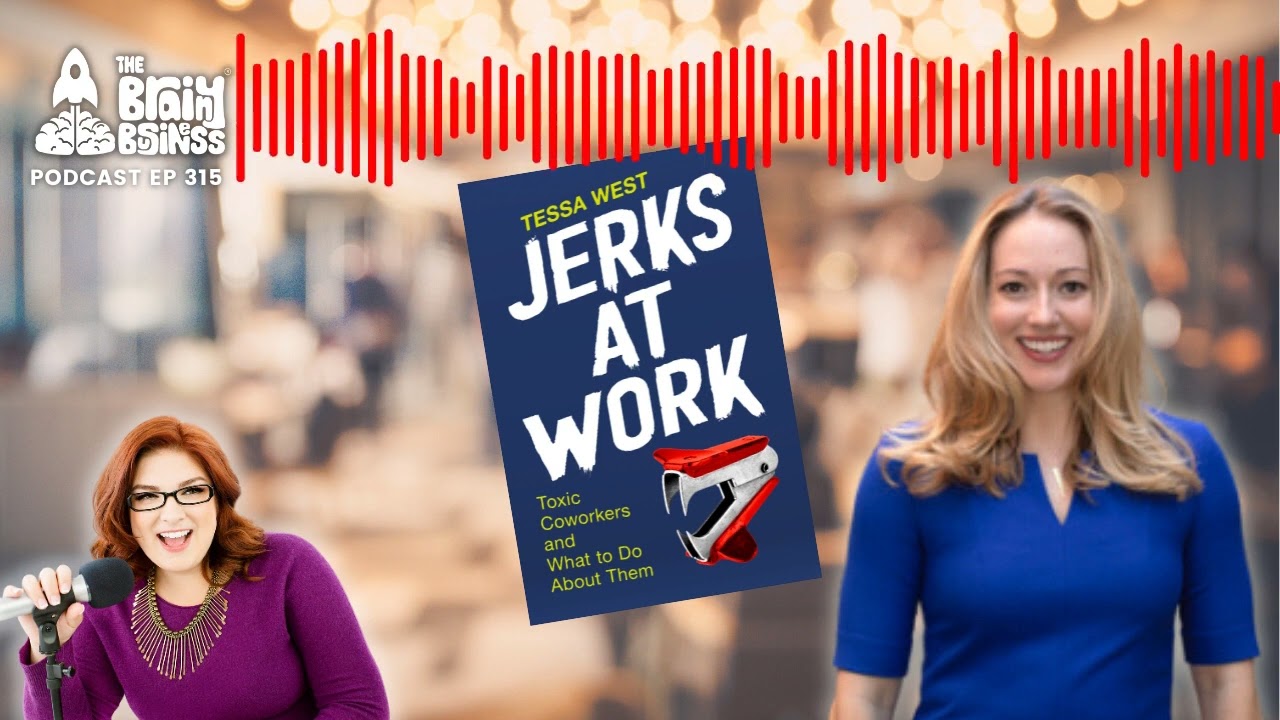
Jerks At Work: How To Deal With Difficult Colleagues, w/ Tessa West | Brainy Business podcast ep 315