Jerks At Work: How To Deal With Difficult Colleagues, w/ Tessa West | Brainy Business podcast ep 315
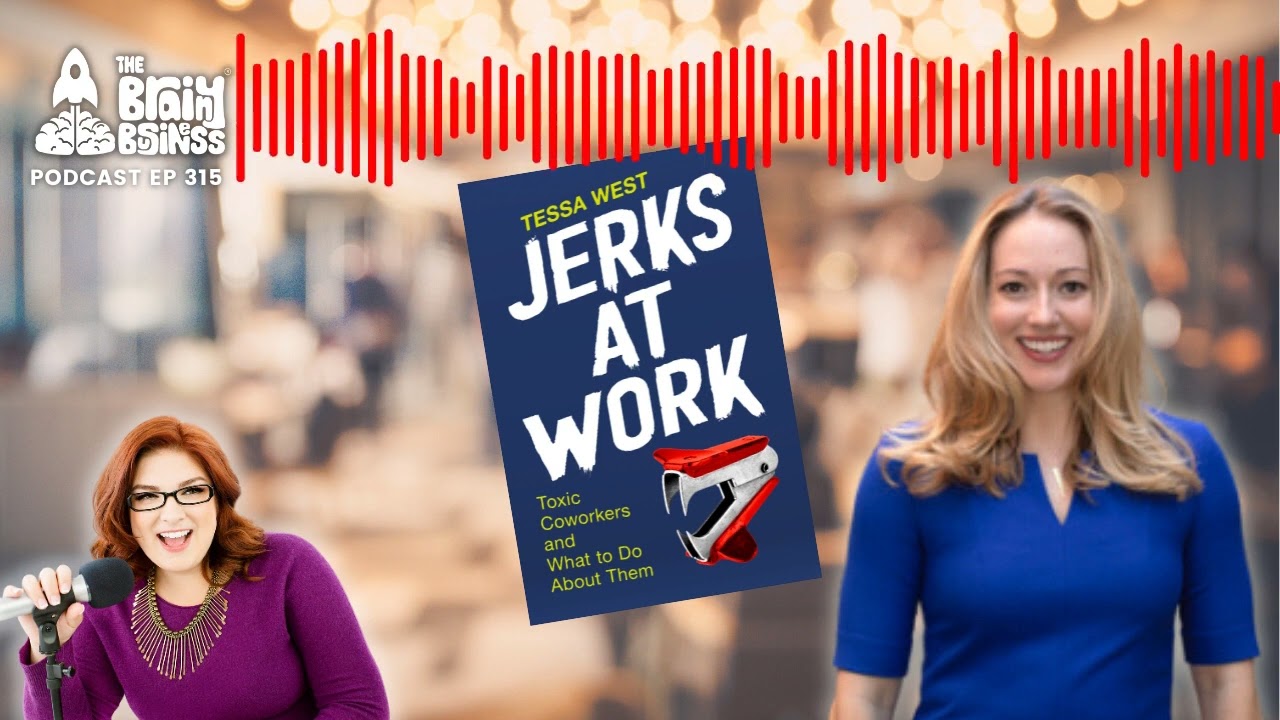
In episode 315 of The Brainy Business, host Melina Palmer interviews Dr. Tessa West, a NYU social‑psychology professor and author of Jerks at Work. West explains her 15‑year research program on uncomfortable social interactions, emphasizing how physiological signals (heart rate, blood pressure) reveal hidden stress that people often mask with smiles. She describes how everyday micro‑stressors at work accumulate, affecting health (e.g., cortisol‑driven weight gain). The conversation then moves to the core of her book: a taxonomy of seven workplace “jerks” – the kiss‑up/kick‑downer, credit stealer, bulldozer, free rider, micromanager, neglectful boss, and gaslighter – each illustrated with vivid examples. West offers practical, often non‑confrontational tactics for handling small discomforts before they snowball, and stresses that the real problem lies in organizational structures and incentive systems that enable such behavior. She advises job seekers to spot red‑flag structures during interviews and recommends that small‑business owners design roles that match employees’ psychological needs (e.g., tolerance for uncertainty) to prevent work‑jerkery. The interview closes with tips for individuals to assess whether they are acting like a jerk, advocating behavior‑specific feedback questions and avoiding the word “jerk.” Throughout, West references her book, online quizzes, her research lab, and a recent Wall Street Journal article co‑authored with Daniel Yudkin.
Chapters
Welcome to episode 315 of The Brainy Business, Understanding the Psychology of Why People Buy. In today's episode, I'm excited to introduce you to Dr. Tessa West, author of Jerks at Work. Ready? Let's get started.
You are listening to The Brainy Business Podcast, where we dig into the psychology of why people buy and help you incorporate behavioral economics into your business, making it more brain-friendly. Now here's your host, Melina Palmer.
Hello. Hello, everyone. My name is Melina Palmer, and I want to welcome you to the Brainy Business Podcast. In today's conversation, I'm joined by Dr. Tessa West. Tessa is a professor of psychology at New York University and a leading expert in the science of interpersonal communication. Her research focuses on questions like, how can we improve communication across cultural and national divides? And what hurdles do we need to overcome to make hybrid communication work? Tessa got her PhD from the University of Connecticut and has published over 70 academic articles in psychology's most prestigious journals, including Proceedings of the National Academy of Sciences of the United States of America, Psychological Science, Journal of Experimental Social Psychology, and Journal of Personality and Social Psychology. She has received multiple grants and several career awards, including the Early Career Award from the Foundation for Personality Personality and Social Psychology, and the Theoretical Innovation Prize from the Foundation for Personality and Social Psychology. Tessa is a regular contributor to the Wall Street Journal, whose work has been covered by Scientific American, the New York Times, ABC World News, Time, the Huffington Post, the Guardian, the Globe and Mail, Bloomberg Strategy and Business, and the U.S. Supreme Court. She has appeared on The Nightly Show with Larry Wilmore, as well as on David McRaney's live You Are Not So Smart podcast. A special thank. Thank you to David for suggesting I feature Tessa on the show. Thanks, David. Appreciate you. Tessa has worked with and delivered keynotes for Capital Group, Splunk, Make-A-Wish Foundation, Bristol-Myers Squibb, CoreLogic, Capital One, KPMG, Premise Health, HPE, Gilead, Pfizer, Relativity Survey, Monkey, and more on topics related to improving diversity inclusion practices, fostering better leadership, and just generally improving communication. She is the author of the book Jerks at Work: Which is the feature of our conversation today. Really quickly, before we get into that conversation, I wanna be sure you know there are links in the show notes for everything, including related past episodes, links to articles and books like Jerks at Work, and so much more. It's all within the app you're listening to and at thebrainybusiness.com/315. Now let's jump right in. Dr. Tessa West, welcome to the Brainy Business Podcast. Thank you.
Thanks so much for having me on.
Absolutely. I'm so excited to be chatting with you today. And for everyone who's not yet familiar with you and your work, can you share a little bit about your background?
Sure. So I'm a social psychology professor at New York University, and I study uncomfortable social interactions. So everything from how we ask for feedback from a boss to how we negotiate with someone who comes from a different country, you know, everything from the context of cross-national interactions to even doctor-patient interactions. So I'm really the business of getting deep into why people feel uncomfortable and how we can help them kind of get over the hump of their discomfort to improve communication.
Hmm. In the discomfort space, I guess, how do you determine what is uncomfortable enough to be worth researching?
That is a great question. Everyone has a different tolerance for discomfort. One thing that we actually do is measure people's physiology. So people will often not tell you that they're uncomfortable. And in fact, the more uncomfortable they are, the happier they appear, the more they smile and nod. It's an effect that we sometimes call the brittle smiles effect. And we can really actually gauge that discomfort by looking at their cardiovascular responses. Is their heart rate through the roof? Is their blood pressure going crazy? That's really the indicator of discomfort in social science because quite frankly, people just won't tell you that they're uncomfortable. And in fact, they say the opposite. This is great. I love this interaction. It's so fun. You look at their body and you're like, that's absolutely not the case.
So what's the— I guess, and it's not like the reasoning behind that, right? Because, you know, get why we don't want to stick out from the herd or feel uncomfortable and, you know, that, that way. So you feel like you have to go along groupthink or whatever it is. Clearly, this happens though at work. All the time. And is that the right path to get into, like, how you started looking at jerks at work as far as it's like what makes people feel uncomfortable? Do you want to tell a little bit about that?
Yeah, sure. So, you know, I've been studying discomfort for 15 years or so, um, in different kinds of contexts where people are working together. And what I found is that even when it's really obvious to give people feedback, um, things that they could do to improve or things that would make the interaction go more smoothly, they simply don't do it. So, the workplace is kind of this perfect breeding ground for the type of discomfort that people don't feel like they have the skill sets to actually work around or improve. And what we do at work often is either freeze, so we do nothing at all, we just kind of like stand there and grin and bear it, like when your boss is giving you that feedback and you're just hoping you can make it to the bar after work so you can actually process it. You know, and I think these kinds of interactions are really common, so I really landed on this this, you know, communication in the workspace topic because we feel uncomfortable like 15 times a day at work. And most of us don't know what to do about that. And that's the case whether we're interacting with a colleague or a coworker or someone who holds power over us or someone we hold power over. So you see it kind of in every different direction, in every social context. And there doesn't seem to be just a, a good playbook out there on, on, on how to actually handle that, how to kind of regulate that discomfort in a way that's actually healthy and effective.
Hmm. I'm reminded too, when Dolly Chugh was on the show talking about a more just future, uh, we were talking about how the past feels further away than the future feels, right? So if in the moment the thing happens at work and your feathers are ruffled or your reaction's to freeze, right? So if you're a freezer, which many of us are, and then you rethink it all after the fact and go, oh man, next time I'm going to, or, oh, why didn't I say this? We totally overanalyze the thing. But we think we'll do something next time and then forget about the one that just happened, just keeps on kind of going. And then we freeze again and again and again.
Yeah, hindsight is 20/20. I think most of us are really good at saying, why didn't I just say that thing in the moment? Well, the reason you didn't say that is because there's no social script to say it, or you're worried about how it's going to be received, or no one before you has actually talked that way. So, there's just a ton of uncertainty out there. So, it's easy for us to tell ourselves, yeah, I should have resolved that conflict this way. But in the moment, we feel incredibly uncertain that that would've been effective at all. And often, it's just not worth the risk. We would rather just not put our neck out there or not violate some implicit norm of niceness in the workplace or a norm around giving critical feedback, or, you know, fear that our boss is gonna engage in reverse blame if we give them critical feedback, all these kinds of things. are scary and very real. And I think we sometimes discount those things when we're talking to our friends at the end of the day thinking, why didn't I just say that thing? Well, those are the reasons why you didn't say it, and they're good reasons.
Right, right. So are there some tips as far as helping to uncover which discomfort is worth pushing through and when it is the right choice to not say anything or to live in it?
Yeah, to just like marinate in your discomfort forever. No, I think so. I love this question because the reality is at work, most of the discomforts we face are small. They're bite-sized, but they're cumulative, right? We don't get screamed at very often. I mean, that can happen, but usually HR gets involved or there's some kind of recourse for when that happens. Most of these discomforts, you could discount away any one of them. You could say, well, it wasn't that big a deal, or I'll just avoid this person, or I'll find a new bathroom or a new coffee shop, or turn my lights off when they're walking down the hall. You know, most. Discomforts are small. And so I think it behooves us to always have a plan of how we're gonna handle all of them. But I think the good news is you actually don't really need to be confrontational. There's a lot of ways of handling small discomforts, small potential conflicts in the workplace that actually don't involve confrontation at all. Or they, they involve it, but not in the way that we're used to thinking about it. They don't involve criticisms per se. So I think What I would say is no discomfort is too small to address. You should learn strategies that work on those little things because before you know it, they're going to add up. And we know from stress in the body, we know from health psychology, the most stress that actually affects our health leads to obesity and cardiovascular issues is cumulative. It's not those big bursts of stress. It's the little things that add up over time. So, from that perspective, I say, try to learn the strategy so that you aren't kind of rationalizing why you didn't do the thing this one time because it just felt too small.
Right. Yeah. I know I mentioned this to you in our pre-chat, but I'm definitely going to be linking to my interview with Rob Cross about the microstress effect. Going to show definitely how, like you said, these things add up and how those microstressors live under the radar that they're causing problems, but nothing feels like it's Enough to do something about, but they add up in a way that really makes a big difference. And the thing that sticks with me on that, I remember from our conversation where he was talking about research showing that, you know, you metabolize food differently even if you're feeling stress. And was saying, I believe it was that you would metabolize in a different way to where you potentially have gained 11 pounds or like have 11 pounds more than people that aren't under the same stress, which is awful. And yeah,
it is awful. And you can blame all your cortisol bursts on that, right?
But I had proposed the reframe of like, the value of being able to like, I could lose 11 pounds just by reducing some of this stress. I can eat the cake and also lose some weight, right? Like, win.
That's right. Like, just need to be in a more positive mindset when we eat the cake,
right? Really love it and not live in the stress. That's the— that's the new life goal.
I love that. Yeah, it's a great diet book topic, actually,
right? Yeah, I think we'll, we'll write it. We'll write that book. That's coming next. So I also— I feel like it'll be a fun, potentially thing that we edit out, you never know. But diversion, I mentioned to you that I often will ask people about their dissertations. And now I feel like because I put it out there and you said I could ask, I'm curious, what did you study for your dissertation?
I had a very messed up dissertation. I, I, so I studied, so my dissertation's on interpersonal accuracy, why, what it takes to read someone well and why we're often wrong when we read other people. And one of the things I theorized about in my dissertation, which was 100 years ago, Is that when we're threatened, you know, when accuracy is scary, when really knowing what someone's thinking or feeling is threatened to the relationship, you're going to be motivated to be inaccurate. And so I did this study, which never got published for good reasons, but we brought couples into the lab. And then I had the couples have these kind of pseudo dates with hot single people, where they would watch their partner go into this tiny little room that I found. And they thought they were asking each other getting acquainted conversations, but they were really telling each other jokes. And so you'd be sitting in this room and you would hear your partner, haha, you're so funny. You know, and everybody was hot. I intentionally recruited all these hot single people. And then I asked people how attracted their partner was to each of those individuals under kind of different types of threat. And not surprisingly, if you really threaten someone, you underestimate how attracted your partner was to that person. But you can kind of reverse it if you give people enough money. So, So I pitted a couple of these accuracy incentives against each other to just really kind of screw with people in a way that, now that I think back on it, was probably not cool. But it was a really fun way to study the effects of threat on accuracy and really getting to the bottom of why we have a hard time actually knowing what other people are thinking and feeling when those thoughts or feelings can really damage the relationship.
Hmm. Interesting. Right. You see your significant other laughing at the other person's jokes, and I'm sure it's like,
oh,
on edge for sure.
I don't even know how I came up with that paradigm. I thought it was the best idea ever.
I love it. It— I was just reminded of an episode of Friends, right, going like, talk about the Wayback Machine, right, as we go into these, but where Monica tells Chandler that the person that new person at work is the funniest guy she's ever met, like the funniest person she's ever met. And I think— I don't remember if it's Joey or Chandler, right? But then— or Joey or Ross— that then says like, you told him that this person's the funniest person you ever met? Like, have you met Chandler? Like, you know, yeah, it's not gonna go over well.
Humor is a magical threat card. If you want to threaten your relationship, pull the humor card. Tell, tell your partner you met the funniest person you've ever met. I didn't even need to do my dissertation. I could have just cited Right, right.
We know that that's how that all works for sure. It would have saved some time maybe, but we wouldn't have had the fun of— I'm sure those were fun studies to watch.
Yes, they were.
Awesome. Well, thanks for taking that little sidestep with me. I always think it's interesting to find out what someone— because doing a dissertation is not just like, well, random, right? There's a lot of time invested in that, and hopefully it's something you were really interested in. I'd like to see how that You know, forms the type of work that you continue to do.
Yeah, for sure.
Yeah. And so let's talk a little bit about jerks at work. There are a few, uh, categories of them that you have broken down here. And I see, you know, in looking at some of the quizzes at the end, which I really love, and how we break into— there's coworkers and then there's bosses. Sometimes they cross over and whatnot, but you Obviously, you know, know much more on this than me. So, can you talk a little bit about the jerks at work?
Sure. So, the first jerk I talk about is the kiss-up kick-downer. This is my favorite jerk. It's the kind of more Machiavellian type that is quite good at impressing the boss, usually has a lot of skills. But when the boss isn't around or paying attention, this person tends to kind of, you know, just really wreak havoc on colleagues or people who work underneath them. They're insulting, they take power away from them, they're very systematic about how they talk about these individuals to the boss. And so, if this is your first foray into work jerkery, you're going to be feeling really stressed. How do I handle this person who is two-faced, acts very differently, but at the same time is extremely talented? They have skills, they know how to read the room, all of these kinds of things. And so, I like that kind of jerk because they're complex, and that makes them interesting. But they, but they can be very difficult to deal with, I think.
Most important new term, if you're new into the foray of work jerkery, is perhaps my favorite, definitely favorite statement of the month. We'll see how long it goes.
We're trying to make work jerkery happen.
Work jerkery. Yeah, we're gonna make that happen too. All right. But yeah, so we have our kiss-up kick-downer. To kick things off.
To kick things off. And then we, we, we go into the credit stealer. So we all know who this person is. We've all experienced this feeling of having credit stolen in front of us. Credit stealers, the good ones, are pretty clever about actually giving credit publicly to the people that they then victimize later. So they're not just kind of unilaterally stealing credit. They're also handing it out, sometimes even a little bit inappropriately, just to make themselves look like team players. They're tough to pin down because I think most of us feel like we should get more credit than we're getting. It's kind of a human universal to think that we've contributed more to team projects and so forth than other people think we've done. And so there's this balance of how much is the credit being stolen versus you sort of overclaiming it. And I try to kind of get into that complexity a little bit in that chapter. And then we have the bulldozer, who we have all experienced during COVID during Zoom calls, that person who's screen takes up the whole thing. If you have your Zoom set that way, where the speaker is the screen, these people tend to kind of verbally dominate, but they also go behind the scenes to pull levers of power in ways that get them the things that they want. So they'll overthrow group decisions. In academia, this often means going to the deans or the chair to overthrow a hire. They have a lot of power. They've been around forever. So the bulldozers that talk a lot and are low status, everybody ignores. But the ones that have been around for a while, they know when to keep their mouth closed and when to kind of go behind the scenes to do their dirty work. As you can tell, I like the people who are clever and know how to kind of climb up the ladder when they're doing these things. And then we have the free rider who's kind of the opposite of this. This person tends to be very charismatic, well-liked. You keep them on the team because they have good gossip and they can get you dinner reservations and they're fun, but they're really good at kind of allocating their work evenly across team members, often to kind of the most junior people so that no one person feels the pain. And they talk a lot about work, but they don't do a lot of work. And it takes a while, often, especially if you're in a disorganized team, to kind of figure out this is happening. But I think free riding is also something that during the pandemic we felt pretty pervasively in most work places. Then from there, I go into the managers. So I have the micromanager, who tends to have some control issues. Often those are coming from the top. They tend to be put in positions of power because they were good at your job. And, you know, unfortunately, when they are put into management roles, they don't know what they're doing. And so they tend to oversee their old job, which is now yours. And that can be tough to deal with. But I like the micromanager because their heart is often in the right But it's just, we gotta work on the balance a little and work on the power coming from above that's actually often leading to that micromanagement. And then we have the opposite side, who's the neglectful boss. Now, these people ironically also tend to be micromanagers. They micromanage, they disappear, they neglect, they come back, they do it again. I think most neglectful bosses actually kind of oscillate between micromanagement and neglect. They don't tend to just do one or they wouldn't have lasted very long. And they have a very bad habit of showing up at the 11th hour and kind of exerting lots of top-down control over you and then disappearing again. So you have that kind of that micro-stressy feeling for 2 weeks out of the quarter or the year or whatever. And then, then they're off, you know, they're off doing whatever. And then they come back and do it again. And then I end with kind of the more unique one, which is the gaslighter. So this person is probably the most strategic of the jerks I talk about. They lie, but with the intent of kind of creating a false reality. They tend to also have power and status. And so they're going to build a case for themselves in a way that will make it very tough for you to kind of fight them on your own. And kind of one of the unfortunate truths of the gaslighter is they often get you to do things that are potentially a little bit unethical, such that you can't just kind of tell on them or complain about them because you have gotten your hands dirty along the way. And I think that that can be a tough pill for a lot of people to swallow once they realize that this is going on. But they're definitely kind of the more clinical of all the people I talk about in the book. Everyone else is within the realm of normal behavior, extreme versions. Gaslighting, I think, is in a category of its own. Yeah. So those are the 7 types.
It was interesting, and I'm sure everyone has this experience in reading the book and very similar I know I mentioned Amy Gallo was on the show recently talking about getting along, and where you can see the, the types. And there are the moments where you think about, do I do that? And we also have moments of remembering maybe work stories or circumstances of things that happen and go, oh my gosh, that was this, right? And you can see it. You do a really great job of having stories that pull us in that we can relate to. And even if I personally haven't had that exact boss interaction or whatever it is, I know people that have dealt with that or, you know, seen it somewhere in these different kind of areas and whatnot. So I have a story that kept coming up for me where— and so do you have people that just tell you their work stories all the time? Is this like your whole life of people telling
you? I love work stories. Not really. People sort of will say, I did this thing, am I a jerk? And then they're waiting for me to say no, and then I never do. So that's kind of the more common experience, but I'd love to hear your story.
So I was 16 and in my first, like, real sort of job. And actually, I think I went through some process of being able to start working at 15 and a half where, like, it was a special thing. But so first job at a clothing store, I worked at Oshkosh B'Gosh, which is always fun to say, and, uh, not fun to answer the phone and say that over and over again. But I'm like learning, you know, workplace dynamics and all the things. I'm very much the lowest person in this scenario, and it's all about, of course, selling and cross-selling different stuff. And so I was helping this family and it was getting all their, like, everyone back to school clothes. I'd been working with this family for hours and had like 3 kids trying on all the things and doing the like socks and grabbing stuff or whatever. And so then the assistant manager comes over and asked them at some point if they would like her to go grab something or go get something for it, like a pair of socks. To match, and they had said explicitly like, "Well, like it's okay, but she's been helping us for a really long time. I want to make sure she gets the commission and like credit for the sale. Like I like if you go, do you have to split something? We don't want this, right?" They they actually said it to her without me doing or saying anything, and it came up like two or three times, and she said, "Oh no no no big deal." Blah blah blah. And so then when it went to ring it up, and then said that. Like, make sure that I was going to get— that she was going to get half of the sale for the pair of socks that she grabbed to add to this. Like, seriously, it was like a $700 sale and she grabbed a pair of socks and they were like very adamant. And they said like, we'll leave, we'll come back. Like, you shouldn't give it. And she's like, oh no, this is how it works, blah, blah, blah. And like rung it up and took half the sale on this. Yeah. And she was the assistant manager. So then I, being the naive person I am, ended up having a conversation with the manager who was almost never there and never talked to anybody. And the assistant manager really ran everything. And he was very exhausted all the time and whatever. But I said— And he didn't like confrontation. Learn, right? But I explained what happened and I wanted to make sure it didn't reflect in my numbers with this. And so then he decides to have a— he has me in the back room, me sitting in the back corner, brings in this, the assistant manager and says, name. I'll say Susie. That's the name I always give people. Susie, Melina says you've been stealing sales. Discuss, discuss. And he left, and she's at the door, and I'm just sitting there in the corner.
Oh wow.
And he went away, left me there in this room as a, you know, 16-year-old in my first job with the assistant manager. So—
I had that manager too. I think we had the same manager.
Right. And so I think she definitely did the kiss-up kick-down for sure. She was a super credit stealer. And then I see the neglectful boss in the other guy as well.
Yeah, there's a lot of colors to this story. I
think it was traumatizing.
Yeah, I worked in Nordstrom's and I sold shoes and it was very similar. We call them shoe sharks, but stealing sales is just super common. The manager So, so the first part of your story about the assistant manager typing in her number for half the sale, that doesn't surprise me at all. That would have happened all the time on the floor at Nordstrom's if our manager had allowed it. And clearly, this is why this person was able to do this, right? You know, I've heard similar stories of bosses just inviting people to lunch to resolve conflict, throwing down their credit card and then leaving and saying, okay, I'll come back in an hour and collect my credit card. And I think The managers there, insofar as they outsource conflict management to the people in the conflict, especially young people, it's just a huge flag that says, you can do this here. You can get away with it. There's absolutely no repercussions for it. There's no even real conversation around it. But what your manager did is the dominant response. Most managers don't just want to avoid conflict themselves. They want to avoid conflict among their team members, and they think people should just hash it out, figure it out. In fact, in my quiz, the most common type of jerk is actually kind of the person who wants nothing to do with the problem, but nothing to do with the solution either. They're super hands-off about everything. So, insofar as you have that management strategy, people are just gonna like— it's gonna be total anarchy out there. Yeah. And, you know, they're gonna steal sales from the 16-year-old. That's just what they're gonna do because it's human nature and this zero-sum game called You know, commission. So that part doesn't surprise me at all.
I know. And I still see these little like baby socks as I— but I do think, you know, there's the other side of learning of like, I will not be a manager like that later. I won't do that someday when I have the opportunity. But it's, uh, yeah. So for everyone that has These sorts of like layered, like you say, you see there's like layered problems, right? And it's not just that the, you know, your micromanager might also be a credit stealer and the, you know, kiss up, kick down, maybe whatever, right? You get some of these things layering in. So, as someone is looking to kind of tease out the root of their problem and figure out what actions to take and And whatnot, what sort of advice do you give for people there?
Yeah, I think kind of like the single best piece of advice is to not think about these problems as like bad apples, to think of the structural issues at that particular workplace that are breeding them. Because you're right, I think these things tend to be interwoven. A kiss-up kick-downer in their infancy will eventually become a gaslighter once they're a leader. And when you're walking into a new workplace, looking at the structures and systems that allow these things to breathe, to grow, is probably the single best thing you can do. Just because you don't have a kiss-up kickdowner now doesn't mean that you won't have one in 6 months if you work in a place that only, say, gives you a raise based on your commission for selling all the baby socks, but it doesn't actually give you promotion based on your ability to train up new employees or other kinds of behaviors that we care about at work. So I, I tend to think about, look for those red flags during the interview process or early on when you get a job for all the structures and systems that allow these things to happen. And there's a couple hallmarks for each of these types, but the key is to just think about them really broadly because I think most of the behaviors I talk about, anyone will do them if they can get away with it. Like I said, with your socks story, of course this person stole your sales. It was perfect breeding ground for that kind of behavior. They knew what the manager was gonna do. And if you were to interview your manager and say, why did you allow that to happen? They'd say, why wouldn't I? Why would I try to resolve that? I don't get paid for that. I get paid the same no matter what happens here. Doesn't matter. I just have to hit a certain number. I don't care who actually sells it. I'm not looking for growth in sales for employees. I don't care about the revolving door of talent. Like, look at what's incentivizing your boss. Those are the red flags. Of course, people are gonna do that because your boss is incentivized to do certain things. So, I mean, that's kind of a convoluted answer. It's easy to sort of pick people off and say, I don't wanna work in a place with a person who does X, Y, and Z. Instead, think, I don't wanna work in a place that allows the following kinds of behaviors to happen, either because they're ignored or because they're incentivized. And then you can actually kind of do your homework a little bit to figure out what those workplaces look like, mostly just for the longevity of your job as well. You might get lucky and everyone's great when you start, but just a couple bad hires in a workplace that just is a fertile breeding ground for this stuff, and in a few months, you're going to be dealing with this stuff.
Oh, yeah. I'm definitely going to be linking to the episode on incentives, where we talked about nudges, and when Uyi Nnezi was on the show talking about mixed signals, like all the things, probably I'll link to the Cobra Effect too, because that's fun, just as things can go wrong, and just how quickly one Mismatched incentive in the— with the right, you know, like you said, very fertile breeding ground for things to go awry. And that leads me to what I think is probably the last full question we'll have time for with you today is looking at the small business owners, small to mid-sized business owners that are listening. And so, it's not like the hiring in, but it's for them as they— whether they have a team or they're thinking about having a team later. You know, definitely feeling overworked and stressed and so many things, probably prone to micromanage and become very neglectful, like in these things that happen. Uh, what sort of advice do you have for them to not go down the path of work jerkery? Making it happen?
Yeah, I, that's a really good question. I think, um, one main thing that turns on work jerkery for most of us is uncertainty. Um, uncertainty is the death of us at work. It increases our stress. It does all kinds of bad things. And uncertainty can come from a lot of places. It can come from, you don't know how safe it is for you to make a mistake here. Are you going to get fired? To, you don't know whether you should micromanage in a certain situation or not. It's this feeling that if you do X, you don't know what Y is going to be. You don't know how you're going to be treated by upper-level management or what the recourse is going to be. And for some of us, that uncertainty leads us to micromanage in an effort to gain control over something we don't have control over. But for others of us, it's an overwhelming experience that leads us to neglect. We're so uncertain about so many things, we sort of freeze and just go watch Netflix all day or something like that. So I say for people in that position, don't think about specific behaviors yet. Think about the kind of like psychological states that turn these behaviors on. Everybody has an Achilles heel. Everyone has a worst version of themselves at work. Know what that is and know what your psychological trigger is, whether that's uncertainty reduction or psychological safety, which is in the same kind of space as that, but kind of knowing what is— what will trigger people to feel the most anxious and uncomfortable at work, and then in turn act the worst versions of themselves. Don't hire people just based on their behaviors, because all of us can behave in, you know, lots of different ways depending on the context. Hire them based on their match between what the workplace has to offer. This is just a really uncertain place. There's a, where there's a lot of moving parts. If you're high on need for closure, you're not gonna be a good fit for that job, you know, because you're gonna be in the worst psychological version of yourself at work, and that's gonna turn on your bad behaviors, which we all have. So, I say kind of like, use that as a segue, learning about the kind of the, the, the good and the bad, the kind of peaks and valleys of the job psychologically. And then try to find people who kind of fit those things so that you're getting the best versions of them depending upon what the strengths and the weaknesses of the job is. And all jobs have, you know, strengths and they have a peak version of the job. They have a valley version of the job. But I think you gotta be honest about in your company, what is that peak version and what's that valley version? And then be honest with people when you're interviewing. Say, don't pretend, you know, on first dates with romantic partners or on interviews, we act like this is the best place ever. I hate that approach. I'm for the full honesty approach. Here's what's good about this job. Here is what will stress you out. How do you feel about that? How— what are your coping mechanisms for those things that will stress you out? Because we're looking for people who are able to kind of manage those things. So, the kind of psychological entry point, I think, is better than don't micromanage or don't neglect. Those are behaviors, but we can all do those things under the right circumstances.
Yeah. My husband and I, early in our, our dating, we played a game that we called The Worst Thing About Me. And yeah, and so that— I love that. And we also, in super nerdery, like had a Zoom meeting. We had been friends before this and then like had a Zoom meeting each, you know, talking through all the things that could potentially derail, like finances, relationships, politics, Like, all the stuff before we went on a real first date, because we're ridiculous like that. But by sharing those things that are what you think are the worst thing about you, vulnerability loop goodness and whatnot, and just being honest, you know, so you can say, oh, actually, that's a deal breaker. And it should be that way, I think, with companies too. We shouldn't be so, like, desperate for the job, but it feels that way, right? When you go in and you're interviewing, like, you have to get it and get that sense of validation or whatever. But if they can be honest and you can be honest, people can find the right fit because not every position is a perfect fit for every single person. So, I really love that. Wonderful. Well, as we go to close out, I think we have one more moment of— you said you just had an article in the Wall Street Journal that was talking about helping people to find out if they're the jerk. Do you want to share a little bit about that?
Sure. Yeah. So I think, you know, I firmly believe that we can all be the jerk. Um, but it can be very tough to find out if it's you. And I think simply asking people, have I been a jerk at work, isn't gonna get you very far. So in the article that I wrote with, uh, Daniel Yudkin, um, who's at Wharton, we talk about kind of ways of sidestepping into that conversation. So everything from, you know, if you hold power over the person, instead of saying, am I a jerk? Or did you like my behavior? Ask them what the ideal version of a behavior looks Like, you know, what's the ideal amount of turnaround time for me to get to your document? What, what does that look like? You know, and asking for feedback in very kind of small bite-sized chunks that are behavior-based. So instead of saying, you know, do you feel like I trust you? You would ask about a behavior related to that that's much smaller. Were you okay with the kind of edits I made to your document? The more, the more specific, the more behavioral, the less about kind of an impression, the better. I think our temptation is to just use the impressions we have and ask about traits. Am I trustworthy? Am I reliable? Those things are too big and scary. People aren't honest about those things. So stick it— stick small. Ask about ideal behaviors. And one fascinating finding we had in looking through some Reddit data was that the things that actually get people labeled a jerk aren't what you think. They tend to be just really Critical behaviors where you're making fun of people for missteps. So making a misstep is actually okay. Telling a joke that didn't land, I mean, not an offensive joke, but an off-color joke that didn't land, that's okay. Making fun of someone for doing that is not okay. So I think, you know, being overly punitive, overly judgmental is actually kind of the number one category we found that got people labeled work jerks. So if you're worried about it, you're probably not actually a jerk. You're worried, you know, Don't be too judgy. Don't be too harsh on people. Give people some leniency and ask for feedback in these kinds of sidesteppy ways that makes it much less scary for them. You have to perspective take about how intimidating it is to give this kind of feedback. So, you want to make it easy for them. And I think in the article, we kind of walk through a few ways you can actually do that. And those are a few of them.
Oh, awesome. Yeah. The way you ask the question is very tough, like, you know, going, well, I'm not a jerk, right?
No, don't use the word jerk at all. Kill the word jerk from, from your vocabulary.
Uh, the, the path to work jerkery is to not talk about being a jerk.
Work jerkery.
Yeah, or to avoiding work jerkery. I don't know, we'll make it happen. It'll be a thing. So thanks so much for the conversation. For everyone who I know is now super excited go get their copy of Jerks at Work and to learn more about you and connect, what's their best path to doing that?
You can go to tessawestauthor.com if you want to, um, read all these articles or there's links to the book. My quizzes are on there. You can get instant feedback about where you fall. Um, if you're interested in my research, you can go to tessawestlab.com and that's kind of my other identity. You can check out what my lab's up to, all of our uncomfortable interaction studies and download our papers and so forth.
Oh, fun. I look forward to reading about all the discomfort as we move forward. So thanks again, Tessa. It's been a lot of fun chatting with you.
Thank you.
Thank you again to Dr. Tessa West for joining me on the show today. What got your brain buzzing in today's conversation? For me, I really loved chatting with Tessa today and learning more about her journey to work jerkery. I swear we're gonna make it catch on. It's fascinating to me that it started with an interest in discomfort and why people feel uncomfortable, and then looking for the people and places that can lead to discomfort, and all of that turning into an area of expertise she likely never even dreamed about way back when she was doing her dissertation research with couples and a hot single making them laugh. It's really fascinating to see how journeys evolve when you let interesting questions lead the way. And it's making me reflect on my own path and how I got to where I am now. I definitely didn't expect this life or expertise when I went to school, not even when I started my master's in focusing on behavioral economics. Curiosity and openness to opportunity has led me here, and I can't wait to see what's next. What about you? How has your journey evolved over time? Did you think your expertise would be what it is today? What about the things you're passionate about in your business? Were they things that had you excited 2 or 5 or 10 years ago or more? What turning points got you to where you are today? It's kind of funny to think about it, but I wonder how many of the entrepreneurs and small business owners listening got their businesses started and were fueled by a jerk at work. That person that made you say, enough, no more. That motivated you to take the plunge into the scary unknown of starting a business. Perhaps now is a good time to thank those jerks for the gift that they gave you to be who and where you are today. And no matter what, I highly recommend checking out Tessa's wonderful book, Jerks at Work, for insights into working better with anyone and how to create a working environment where people can thrive without the work jerkery. Thanks again to David McRaney for the suggestion of reaching out to Tessa. Great recommendation, of course. And while we didn't talk about it on the show, Tessa is actually married to Jay Van Bavel, one of the co-authors of the awesome book The Power of Us, which I've talked about on the show many times. Jay's co-author Dominic Packer was the one I interviewed here on The Brainy Business, but I also love to see Jay's content on LinkedIn and we connect there often. So thanks to all those awesome people for helping me get connected to Tessa. I hope you enjoyed the conversation as much as I did. As we close out the show, don't forget about those show notes, which include links to all the related past episodes and books, including of course Jerks at Work, The Power of Us, How Minds Change, Getting Along, and The Microstress Effect, as well as ways to connect with Tessa and more. It's all waiting for you in the app you're listening to and at thebrainybusiness.com/315. And thank you again to Dr. Tessa West for joining me on the show today. It was a delight to chat with and learn from you. Join me Tuesday for another brainy episode of the Brainy Business Podcast. It's going to be a lot of fun. You won't want to miss it. Until then, thanks again for listening and learning with me. Thank you. me, and remember to be thoughtful.
Thank you for listening to the Brainy Business Podcast. Melina offers virtual strategy sessions, workshops, and other services to help businesses be more brain-friendly. For more free resources, visit thebrainybusiness.com.
More from Tessa
Finding Work That Leaves You Fulfilled w/ Dr. Tessa West | The Psychology Podcast