Unmasking Jerks at Work: A Conversation with Tessa West
Social psychologist Tessa West identifies seven types of workplace jerks: kiss-up/kick-downers, credit stealers, bulldozers, free riders, micromanagers, and gaslighters. She traces these behaviors to organizational structures that reward individual performance, and warns that remote work and AI can mask toxic patterns while making them harder to detect.
Chapters
Welcome to the Australian Institute of Insider Threat, and thank you for joining me for this special interview. Today, I'm joined by Tessa West, Professor of Psychology at New York University and author of bestselling book Jerks at Work. In this conversation, we'll explore some of the key themes from her book, including some of the seven distinct types of toxic behavior she identifies like kiss up. And kickdown, and micromanager, and many more. If you've ever struggled with difficult colleagues, questioned why toxic behavior goes unchecked, or wondered how workplace culture can truly change, this interview is for you. Whether you're, um, a team leader or simply curious about what really drives dysfunctional work, this conversation offers sharp insights and practical takeaways you won't So to kick things off, Tessa, welcome again.
And thank you so much for having me. I'm excited.
Yes. And could you start by telling us a little bit about who you are? That would be great.
Sure. Yeah. So I'm a social psychology professor at New York University. And before I got into studying the workplace, I spent 20 years studying difficult conversations and all the ways in which we are indirect in our communications, Especially in situations where we really should actually be opening up, telling people what we really feel, asking people what they're thinking and feeling when we have no idea, and we really just kind of beat around the bush and have very circumscribed kind of ways of communicating. So I spent 20 years doing that in the lab, also going out into the field, studying negotiations in the real world before I then transferred that knowledge over to understanding the workplace. and understanding how relationships at work can often go wrong for lots of complicated reasons. And that's why I wrote Jerks at Work.
Oh, okay. So that was the premise of the start of the first question. Jerks at Work, it's quite bold and unfiltered. I mean, is that an American thing or, you know, let me ask the question is why? Why, why was this title? I mean, you mentioned just briefly, but I just wanted to go into a bit more details.
Yeah, I did not sugarcoat this one at all. My communication style is very direct. I use humor to talk about difficult things, and I think everybody knows what a jerk at work is. We all can recognize that. I think it's something that you see it and you know it, and I didn't wanna euphemize it and say things like difficult relationships at work or how to get around hardships, jerks at work. We all know what that is. You know, there were lots of titles that were floated around that were softer, nicer. And I'm like, no, I don't want that. I want the real version that people really feel, but sometimes feel like they can't actually say out loud. That's the one I want. That's the version of this book I want.
Yeah, look, I think the sort of conversation that you see a lot is toxic behavior or disengaged employees or something like that. I think the title of this book just gets to the heart of the matter. Let me ask you this question. What made you think, okay, I've got to write a book? Did you see something missing in the market to say, okay, there's nothing that talks about these sort of jerks at work and so forth? So I'm curious.
Yeah. I didn't think about the market at all. Honestly, I had never actually thought about writing a trade book. So as a professor, I had spent most of my career just trying to solve, you know, basically jerk at work issues, but within a lab setting. And then I took on, after I got tenure, my first real leadership role, and I realized that I was super ill-equipped. No one had trained me for this. I was making mistakes. People were mad at me. People cried because I made decisions they hated.
Okay.
Yeah, I mean, and, you know, we were going through an office move. So if anyone's ever gone through an office move in academia, you stay in one place for 30 years. And if someone moves your office, that's enough to get you to retire. And so people feel very emotional about their space, and we are doing a physical move, and I kind of mishandled some of those emotions. And honestly, the impetus for this was sitting on a subway in New York City thinking, I'm gonna write a book about this, all the types of people that I have been, that I have encountered. through my career in academia, but also I worked in sales. I sold men's shoes for a long time. I've seen lots of versions of this in my life. I have worn many hats, and I thought it would be fun to do, especially after you, you get tenure, you can do more fun things. And I didn't know the market at all, and I actually talked to an agent, and I'm kind of glad I didn't because going in a little bit fresher and without that knowledge, I think, actually kind of helped me come up with the premise for this book.
Right. Fantastic. So what led you to specifically identify these 7 toxic workplace behaviors? And let's mention them. You've got kiss-up, kick-down, the credit stealer, the bulldozer, the free rider, the micromanager, and the gaslighter as the most, let's say, critical to address in this book rather than maybe the broader issues like bullying and harassment that you see quite a bit.
Yeah. Yeah, I think that's a really good question. I think, why write this as a typology of types of people instead of issues that people encounter? By trade, I'm a relationships researcher. And so when I think about difficulties people face, I tend to think about them almost instantly in terms of a relationship they're having with someone. So if you tell me that you're being harassed or bullied, I'll say, tell me about the person that's doing that.
Yeah.
have they done that to other people? And so I kind of instantly go from the one-on-one relationship to thinking about how that is operating in networks, to thinking about how things like power and status are influencing it. And I think what this book does is it talks about types of people, but it talks about them in a very relational way, um, where you're thinking about your relationship with them, but also their relationship with other people. And that's how we operate at work. We don't op— we don't go to work and think about bullying as a construct.
Correct.
I feel bullied by people, like, you know, is a fuzzy thing. We think about John down the hall, he's gonna do that thing again, and then Tom's gonna defend him, and then she's gonna pretend like she didn't hear it. You know, those are relational issues. That's how those things actually work. And so that's how we need to actually address them, I think, um, when we're talking about them.
So, so, so that takes me to the question, were there other sort of toxic behaviors that you were considering adding to the book, but you sort of left them? Because the question is, why just 7? I mean, when you look at human behavior, it's so dynamic, so So large. Why just 7 toxic behaviors?
Yeah. How do you get to this kind of parsimonious version? I think what I did, I had to kind of come up with archetypes that didn't have some overlap, but not too much in terms of kind of the underlying causes and what the structures of the organizations look like that create those things. At the time I wrote this, there was a lot of talk around microaggressions, Why not write about that? That to me is a subjective behavior, not so much a category of, you know, relational things that organizations can do. And not everybody even agrees on what a microaggression is. I also steered clear of every ism. There's no sexism. There's no racism. The isms are not in this book. And I think that's because you might be experiencing one of those and they get manifested as these types that I talk about.
Right.
It's not as if racism and sexism doesn't exist. But it often kind of shows up in the form of these types of things. And but yes, I think I tried to stick with things that are really common no matter what industry you're in, what level of your career you feel, and that didn't have too much overlap in terms of the structural dynamics that produce them, that they're a little bit unique in that way.
Interesting. Are toxic workplace behaviors like those outlined in your book a sort of a symptom or sort of a byproduct of, let's say, poor leadership in organization culture?
Yeah, I think it's just a cycle of doom with both. I think you can, you can enter this any direction you want, right? So you can think about where does it start at the interview stage, right? You can ask interview questions to detect these things. You can, you can go through sourcing of candidates who are kiss-up kick-downers, and you can kind of see that on their their resume. And so there's selection bias at that stage. There's selection bias at the promotion stage. So there's, there's that kind of element of when you build an organization, who are you selecting to put in positions? And then there's a, there's a kind of higher-level structure of an organization. What does it take to get to the top? And is it a zero-sum game to get to the top? And if it's zero-sum, and a lot of organizations are like that, every law firm is like that, not everyone's gonna make partner. you will have this competitive behavior. It's built into the DNA of the organization. Very much so. You know, and I think kind of one thing that's really important is we all talk about like teamwork and collaboration, but at the end of the day, your resume has your individual contributions, your return on investment, and it's hard to get around that. And so I think they are the cause, they are the symptom. And I think we have to be really honest with ourselves if we're in an organization that is like that, but we pretend we're not. We were like, we value all of this, you know, lovely getting together. staff, but really only one of you is gonna make it to the top.
Yeah.
And a lot of organizations do that.
Yeah. So I wanna dive into 2 specific, uh, jerks at work. Um, the first one is kiss up, kick down. I specifically chose that because I see that quite a lot in many organizations. Tessa, I'll get you to briefly outline what it is and then I'll ask you a question about that.
Yes. So the kiss-up, kick-down is my favorite jerk at work. I think they're the most interesting. These people really can read a room, and so they can tell who they need to kiss up to, who they need to be nice to, and who they can kind of get away with being a little bit dismissive to, even take advantage of in the organization. And that's really based on people's power and status.
Yeah.
Often what these individuals will do is perform quite well And the boss tends to like them. And so if you're on the receiving end of this behavior, they're very clever about how they do it. They don't do it in front of certain people. When they talk about you behind your back, they do it in a way that looks mature. You know, they don't trash talk you in a way that makes them look like they're just competitive without kind of cause. And so when you, when you deal with these people, you're not just dealing with someone who's rude and mean. You're dealing with someone who's a good performer and who tends to be well-liked. by the people in power. And it makes them very good at climbing up and, you know, gaining status, but also knowing who among the people who have status, what their relationships are with each other, which bosses like each other, which bosses hate each other. They know all those kind of sticky dynamics within, you know, that hierarchy at work, within that social network at work.
Yeah, they, they do. What's interesting, I think you mentioned in the book, is they also understand who they can kiss up and who they can kick down. So not just in terms of management, but it could be a competitor. So they've got to also be very careful of knowing what relationship this person has with their manager. My question is, can it often be construed as a performance? Or so the kiss up and kick down can be construed as high performance rather than a sort of a typical jerk or a toxic behavior?
I mean, I would say that often is high performance. I would say that in a lot of organizations, this is what it takes to become a high performer. And, you know, it's a necessary condition and they select on it and they don't call it this. But, you know, it's a Machiavellian way of thinking. And I think there's a lot of organizations, there's a lot of industries that say, look, you got to figure out, you know, who you can step on to get ahead here. That's just the way it is. And you get— you can— that's how you climb up. I think it's, it's, it is a way to perform well. And I think that is a question everyone needs to ask themselves when they enter into a new industry. Is this what it takes to get ahead?
Yeah, interesting because in the book you also mentioned that such a well-known term, the winner takes all in some ways and the proportion of what may be the CEO wage remuneration compared to someone who's just starting is quite a big difference. It's exponentially. It's not a relatively— the question is, is it our organization rewarding such behavior without really understanding of what's going on?
Yeah, I mean, I think, you know, a lot of our compensation structures are really top-heavy. At least in the US, this is a real problem. And I think when you have people at the top who are making 600% more than the next level down, that behavior in the middle is gonna get ultra, ultra competitive, right? Like, as that percentage difference becomes more exacerbated, what it takes to get up, it's just like watching one of those, you know, reality competition shows where when there's 5 people left and there's only one, that's when things get real nasty. I mean, those shows show you exactly what happens in organizations. So I don't even know if they're inadvertently doing it. I almost think in those places, they know exactly what they're doing. They don't have a problem with that. I think that, you know, the kicking down only backfires when the wrong people get kicked down and it becomes expensive to replace the revolving door of talent, or they're accidentally kicking down the wrong types of people. And we're kind of accidentally getting rid of top talent who also has traits like being quiet, being an individual contributor, being victims of these types of individuals. And those are the wrong victims to kick down, and organizations lose money because those are the victims. So that's when they tend to actually pay attention, like, oh man, this bully is kicking down all these people who are really easy to take advantage of. Those are our best engineers. You know, they're quiet and then they're easy to bully and they don't stand up for themselves, but they're also our best engineers. That's when they tend to freak out. Yeah.
Yeah. Yeah. So, so it's interesting you say that. So who suffers the most here? Is it their colleagues that they actually undermine, or the leaders who are deceived by the charm, or the organization as a whole?
I think it depends on what outcome you're talking about. So the organization as a whole, if you wanna ask me, you know, how much, what, what their stock is worth at the end of the year, you know, that's kind of the level at which this would show up. A manager, if you want to look at whether they got promoted. So if their team sucks because this is going on, they're not gonna get promoted. And then the kicked, the person being kicked down because they're just hopping from job to job. They can't stick in a job. They, they can't build their career out. So everyone loses, but on a different dimension.
Correct. A slight change of question. So in the US, and I know this has been talked, um, in somewhat length in Australia about merit-based, uh, recruitment. So what's happening in the US, how is that changing the kiss-up kick-down scenario by and large?
So are you defining merit-based in terms of like hard outcomes that they've contributed to the company? Or are you talking about this in terms of like Education, like boxes that they've checked off?
Look at that. That's a good conversation. Well, I think from my perspective, it would be someone that has been promoted based on their— well, could it be both? Could it be based on their education and output?
Yeah. So maybe they got selected because of their education, and then their output may or may not actually reflect their individual contributions or not. I think I would say smart organizations are treating those things as good indicators, but not sufficient indicators of what someone is like at work. I think we can't completely get rid of merit. You need to have certain skills.
No.
You need to be able to contribute in a certain way.
Correct.
I'm not a big fan of this idea of like getting rid of all those things that actually, you know, are important for the financial bottom line. Once among those people, that's when you need to start doing some digging to figure out what they're like to work with, what kind of collaborators they are, you know, do they have a revolving door of talent? It's a necessary but not sufficient condition. I think that's how we should probably start thinking about those and not just say they checked off all the boxes. Great. Move them on to onboarding. Do some digging first, HR. Look, look into those things a little bit more.
Yeah, no, no, it's just, it's just been so much on the news. Um, in, uh, maybe, maybe we, we're getting news in Australia which is slightly skewed or, um, it's coming from the US and then, and a lot of it has been over the last 4 years very much skewed towards being more gender or, um, Based or, you know, anyway, I didn't want to go into any politics at all, but it looks like that is changing quite a bit. I want to dive into micromanage because you deem it as another jerk at work, but it has dual relationship. It's got the good and the bad. So I want you to give us a sort of your Your view, obviously, from your book. I'd love to understand, and the viewers would love to understand, what do you mean by micromanagers?
Yeah, I like to think about this one from the perspective of the micromanager and the victim. I think it's kind of an interesting juxtaposition. So the victim feels like no matter how hard they work, they're never gonna get anything done and there are no boundaries. I think we all kind of know what a micromanaging boss feels like. We rush to the finish line, and then they move that finish line. Um, that kind of, that feeling that, um, there's moving goalposts all the time.
Yep.
I think that's probably the best psychological way of experiencing it, that we, there's a lot of uncertainty because those goalposts are moving. Um, from the perspective of the micromanager, they're often very anxious and uncertain, and that's coming down from the top. Um, a lot of them were put into these positions of management because they were good at the job you now hold. And so that, that's why they're micromanaging it. not because they have any leadership experience, and they don't actually know how to hire and oversee a team. What they know how to do is the thing that you're now doing, and they're anxious about it. And the way that they're mitigating their anxiety is by telling you how to do it better, not learning new skills and learning how to kind of scale a team and so forth. And so I kind of feel bad for these people because a lot of them are just panicking and they want their boss to be happy and they don't know how to get there. But the people on the receiving end are just also being tortured by all of this over and over and over again. Um, and so, you know, you feel bad for both, but often for kind of different reasons.
Yeah. So you mentioned in the book that this type of jerk behavior, toxic behavior, is most prevalent in— from the 7 jerks. Or if, uh, why is that? I mean, I mean, you, you, you did step into it Is it because the manager is afraid about the results or output? What's causing them to say, okay, I'm gonna just, you know, send you 10 emails in the next hour and I'm just gonna buzz around you like a bee and really be annoying and never get you and never allow you to finish your work? What's the driving behavior behind that? Micromanager?
That's a good question. I think, you know, there's that insecurity, but there's also a lot of norms in the workplace that feed that. And so if you walk into a management position and everybody else at your level is also doing that stuff, they're emailing people 10 times a day, they're working on the weekend, they're buzzing, they're like, you know, in that Google Doc hovering all the time, then you should do that too. And I think that's a huge piece of this. Some of, some of these behaviors are actually not coming from people wanting to do this. They're coming from norms in the organization and like what what everyone around you is doing. People hear, oh, you know, that manager across the hall, he bugs his team on the weekends. Oh man, I don't bug my team on the weekends. Is that that bad? Do I look lazy if I don't?
Yeah, yeah.
You know, all that stuff starts to come up. And so the micromanagement comes more from wanting to act a certain way and then create a certain impression than actual desire. Um, so I, I think that, that, that is one piece of it. And I also think that Managers often don't know what will happen to them if their team screws up. They are never told by their manager, if your team makes a mistake, this is what will happen to you. It's not gonna be the end of the world, or it will be the end of the world. It's just like a big uncertainty bubble. And so they're so afraid. Yeah. Yeah. My team makes a big mistake, I'm gonna be on the chopping block, or maybe nobody will notice. They have no idea because that conversation rarely comes up when you're promoted. You're promoted and your boss doesn't go, okay, if your team totally messes this up and it's like a disaster, here's what's gonna happen. What if it's this kind of disaster or that kind of disaster or a minor disaster? You know, we don't really usually talk that way. We talk in terms of team success. We know the big things that can be bad, but the little things, the gray area things, we don't usually talk about those things.
Yeah, actually, you raise a very important point. And so let me ask you this question. Most people are promoted because of maybe the good job they have done, but they may be very specific to their type of skill. They don't have skill in terms of management. So what's your view when people get promoted based on their, let's say, how good they are, but not based on the skills of how good they will, you know, manage people?
Yeah, I think it's a disaster. I mean, I've had a lot of managers, bosses, It's a disaster if those skills don't overlap or if you've never sampled those skills. And I'll get concrete. So in academia, if you're a really good researcher, so you're creative, you're good at statistics, and you can run studies and write grants, you do really well. If you're really conscientious, you often get promoted to run a department because of those things. The most important thing about running a department is being able to say no to people and being a direct communicator and being okay with people not liking you and pissing people off. That's almost the opposite skill of the first thing.
I know.
And so what you get are people into those managerial positions, and they're used to being people pleasers, and they're used to being respected and liked. And now all of a sudden they have to say no to a big powerful person or directly communicate to someone who's, you know, a little bit intimidating. And those skills have never been sampled for that person before. And, you know, they, they freak out about it. And so I think you have to sample those things. You need to know explicitly what those skills are and why they're different from the others. And warn people, this might not feel good, and this is what it's gonna look like, and I'm not gonna pretend you're gonna love it. People hate this for these reasons, and they love it for these reasons. And I think just being explicitly honest and kind of listing those out and having those conversations, and then saying, what do we need to do to prepare you for this? Are you prepared? We need to have those conversations more.
Yeah, I know it's very true. You know, part of my interest with, with this book is also very much based on understanding human behavior and what things could go wrong. What we haven't talked a little bit about is the amount of stress or maybe, you know, reducing morale within the organization or with— well, what I like what you said is the 10 feet surrounding that person. I found it very interesting, very quaint that sentence that, you know, people tend to care about what's happening 10 feet, but not above or below. So when you have micromanagement that's taking place, it also festers a sort of a stressful environment. What we haven't talked about is the, if you want to call it, the deficit that we then see, not just in terms of maybe loss of productivity, which is the typical measurement of employee engagement, but also the lack of trust or the that the trust that now becomes disengaged and becomes toxic. And so I just want a side word from you having spent looking at organizational cultures. What happens when you have micromanagers and so forth and it sort of festers beyond just that one person?
Yeah, I think, or just, you know, lore of what it's like to work with that person. I think, you know, in psychology, we talk a lot about learned helplessness, this idea that no matter what you do, you're going to get punished for it, or maybe not. I really think that it's akin to a learned helplessness experience, you know? And when you feel learned helplessness, you give up in a lot of different ways. And I think that kind of experience is contagious, and it leads to, you know, at least a lack of effort, but it also just kind of leads to like an ennui at work. It leads to this like, eh. You know, who cares if we land this or that client? And doesn't really matter. I think it just, it, it spreads a cynicism within the workplace because you're exhausted. Um, you tend to not get rewarded for all these stupid little things that your boss is constantly asking you to do. And then the people around you see you're doing that and see you're not getting rewarded. And they also can kind of experience that stuff by proxy. And so I, everyone starts to feel learned helplessness, and that's a really bad place to be in. And these, I study all kinds of forms of contagion, emotion contagion, stress contagion. Everything is contagious, like all forms of emotion and behavior and stuff like that can spread. And this is just another one of them. Even if you're not being micromanaged, if you see your friend being micromanaged, you're also, it also can affect your emotional state, your stress levels and things like that.
You mentioned that managers often think that one of the key reasons that people leave is because they didn't get maybe the right wage they were hoping. But a lot of people leave because they're not happy internally, not because of remuneration, but because the way they're being treated, supported and so forth. I just wanted to get your sort of comment on that.
Yeah, I think we lie when we leave. Those HR exit interviews often ask you about things that you just don't— I mean, I wrote an op-ed on this, like, we're dishonest all the time. And for some, sometimes it's just uncomfortable to say what you thought about your boss. Sometimes there's big social costs. You have to go on the market. You don't want to get a reputation for trash-talking this person. And we— it's like breaking up with, you know, your romantic partner and saying, it's not me, it's not you, it's me. We do that at work all the time. It's more comfortable to say, I just want a better comp package than—
Yeah.
Yeah, you'll be crazy with your 1,000 emails. And so perpetuates a problem for the next person, you know, and over and over again.
I was gonna ask you, you mentioned in the book that, you know, micromanagers tend to, maybe it's maybe not the right word, they tend to revolve. They can't, you know, if they spend considerable time trying to micromanage That person, then they also become somewhat negligent during the rest of activities. I want you to sort of explore a little bit more about it because the negligent is one of the other joke you mentioned in it. But you very much the the negligent boss. So I'd love to hear your perspective because most most people probably don't see that. They probably expect that. Their boss will probably micromanage everyone, but that's probably unrealistic.
Yeah, I think the first time I sort of realized this, that my micromanager actually did not have things together as much as I thought he did, and he was actually quite neglectful. I had this aha moment that, of course, he doesn't have time to micromanage everybody. He must be dropping the balls elsewhere. And I think when you're a neglectful boss, It's usually because they're 2 sides of the same coin. And I think when we're in a bad relationship with our boss, we see how they're treating us and we don't see so much how they're treating other people, or we assume that if— that other people are getting the same negative treatment. We rarely assume they're getting the opposite type of negative treatment.
Correct.
I'm being micromanaged, you're being neglected. That seems weird.
Correct.
But that's how that kind of works because they simply can't do that. In fact, Most micromanagers are kind of messes in other places. Um, they've completely neglected other parts at work or their home life. And, you know, often the way that they deal with the anxiety of that neglect is to further micromanage. And so it— that balance just kind of continues. And I think that's something that people find very surprising, um, partly because they're so focused on the, the relationship they have with their micromanager.
Yeah. Um, also, I think I find it interesting. I just want to go a little bit into, in terms of there's a positive and a negative. I mean, we tend to focus very much because of the book title, Jerks at Work. There's a positive element of being a micromanager. Can you sort of elaborate on that?
I mean, I'll start off by saying that I think almost everybody says they have a micromanager because everyone thinks their boss pays too much attention to their stuff. And I'm a little cynical about that. I don't I think we actually all have micromanagers. And I do have a part in this book where I'm like, do you actually need to be micromanaged because you've kind of messed up? I think that there are times and there's kinds of work where, you know, really specific attention to detail is absolutely needed, you know, in certain types of careers and also people who need to be overseen in a very careful way. And I think most of us don't like to admit that we need to be micromanaged. You know, lots of folks I've interviewed will tell me they're being micromanaged, and then I'll say, okay, let's talk about your work history. Well, I got fired because I screwed this up, and then I got fired because I screwed that up. Sounds like it's not a micromanagement problem. It's, you know, it's an oversight issue. It looks like they're—
Yeah.
So I think you have to be honest with yourself of like, is this micromanagement, or is this the right level of management given my past performance history, or given my skill set? And I think for a lot of people, it's a pride issue. They don't, they think it's mean or rude that their boss is overseeing them at that level. And they're too proud to admit that they maybe need that kind of oversight.
Yeah. Is there a specific industry or maybe it's more than one industry where micromanagers tend to thrive and maybe it's a good thing?
I think, you know, I've done a lot of work in the, in the medical world, in emergency departments in particular. So anytime there's heightened stress, there is really small mistakes can lead to catastrophic outcomes and you're under time pressure. I would say those are kind of the magical ingredients. So surgeons in an operating room, I have a study looking at kidney transplant doctors. I also have a friend who worked for the Jet Propulsion Laboratory and put the Mars rover on Yeah, yeah, yeah, yep, yep. Screwing little things up means that rover's gonna collapse. And so, and it's also in a tight timeframe getting that thing on there. The team has to be super tight in communication. And so, you know, those high-stress encounters that require an enormous amount of precision, you can't whine about being micromanaged in those situations. I think they also tend to be incredibly hierarchical situations in order for them to operate. And so when you're complaining about being micromanaged, it's usually because a very high-status, powerful person is doing it because they absolutely have to in order for this operation to work.
Okay, cool. From the 7 toxic workplace behaviors that you have identified, um, and I'll just go through them again, the kiss-up, kick-down, the credit stealer, the bulldozer, the free rider, the micromanager, and the gaslighter. Did you find that certain types are more tolerated or even normalized in specific industries or corporate cultures?
Oh, that's a good question. I think that piss-up kick-down is very common in law and finance, those kinds of industries that are go— what I would call go-getter industries.
Yeah.
I think that credit stealing is more common in kind of creative industries or industries that being, you know, being called geniuses is important. So kind of being labeled as someone who came up with the idea that maybe the group is getting benefited from. I actually saw this a lot in architecture. So in architecture firms, the person who kind of came up with the coolest idea usually is a group.
Yeah.
That there's some credit stealing that kind of goes on in there. The gaslighting is just such a tough one because it's such a strange type of person. I think that that one kind of is a standalone. zone. But I think that anything in organizations where, you know, the bulldozer is kind of a type of person who can kind of talk over everyone, but they can also go behind the scenes and, and do things like cut off searches and stuff like that. So siloed-off organizations. So this isn't an industry, but global organizations where the global offices don't talk to each other, or where there's silos that don't talk to each other. You see that a lot because there's not a crosstalk stopping it. Um, you know, and I think, you know, there's all these new industries now happening with, with the birth of AI kind of, you know, infiltrating jobs and stuff like that. But yeah, I think those are kind of like the main ones that actually have kind of traction to these types.
Yeah. And which of these 7 ones do you believe, um, could cause, I suppose, the, the biggest or the more from the long-term damage and harm to organizations and teams? From which of the 7?
Yeah, I think, I mean, should they just kind of go unnoticed, untreated? I honestly think it's free riding because it's common. It doesn't feel that bad. And it's not usually labeled as a toxic behavior. It's kind of normalized. And so free riding happens when you have someone on a team who's not pulling their weight, but they usually get away with it because people like them. They're socially skilled. And they're good at spreading the work out over others. And I think that is a real dangerous thing because companies don't detect it. And, you know, when the behavior is not seen as toxic, when you don't feel it, it's like a frog in boiling water a little bit.
Ah, yes.
That's the most dangerous type because you don't see it and get rid of it. You know, kiss up, kick down. Once everyone agrees on it, you pluck it out and it's like a weed. But, but this one is harder to see. It's easy to explain away in any given one situation. And the person tends to be nice and likable among the team members. And, and that erodes productivity. It erodes trust. It erodes all kinds of things in ways we often don't acknowledge or see. So for that reason, I picked that one as the most dangerous.
Okay. How do you see it? How do you see these 7 toxic behaviors evolve given that AI is becoming more predominant in our business way of life? And also the fact that, for example, you and me, we are remote. Well, I'm actually in the office, but you happen to be from home. How does that change the, the Those, those toxic behaviors?
That's an interesting question. I think with AI, we can kind of— I'm doing some work with this now. We can think of it as, are you offloading your work to AI? Are you using chatbot to do your work, or is AI stealing your job? You know, those are kind of the different things that can happen.
Correct.
Correct. AI stealing your job, I think that breeds a lot of kiss-up competitive behavior. We're seeing that at, you know, rank-and-file jobs, Yes. Back office jobs. That's where that's happening. And so people are having to kind of learn all new skills going back to work. I think these types of jerks don't touch that so much because it's not interpersonal issues that are stealing your job. It's, it's your skill set and or lack that AI now has your skills. Where I find it fascinating is when people start using chatbot to do their job. And I'm gonna answer a question you didn't ask. A huge thing people are now doing is using chatbot to handle their conflicts. They then ask it.
Oh, that's, that's interesting.
My coworker did this. What do I do?
Yes.
Huge thing going on right now. And I think that is really interesting because, you know, you can get all kinds of answers out of these large language models and it, it sometimes is completely off. And if you don't want to develop those interpersonal skills yourself, Then you're relying on this as a tool. And I actually, I have a real problem with people kind of outsourcing difficulties to chatbots, to AI to manage these things. It's actually much more common to when people are working remotely. So, you know, you, you tell me I don't get the promotion or we're having a conflict. I never have to see you, but I need to write you an email and it's uncomfortable and I don't know what to say and it's gonna take me forever. Chatbot, what do I say? And then it tells me what to do and I don't have to think about it. I'm not gonna see you anyway. So there's no follow-up. Done. That's the danger.
So given, given that is taking place, how are these 7 behaviors changing as a result? Are they becoming some, some of them becoming more prevalent? Are they becoming harder to Detect?
Oh, that's such a good question. I am— I think they're gonna become harder to detect because a lot— it's— this is gonna add a lot of noise into the system. Right? And so you can think about the things that people used to do, and now they're offloading that work to AI.
Yeah.
They're not free riding off their colleagues anymore. They're just asking AI to do it.
Correct.
And so maybe that's getting rid of some of that free riding, but it's leading to weird work or, you know, chatbot work. And so that introduces a different problem, but it gets rid of that interpersonal conflict. You know, I think those are the kind of sticky things that are gonna start to happen. That is gonna be super interesting. And now that you said that, I'm like, someone could write a whole book of like what happens to difficult interpersonal relationships at work when AI is now thrown into the mix.
You know, how is that kind of leading to these evolutions?
And I think it really depends on how you're using it and what you're using it for. And I think everyone is playing around with it right now. Most people are like not actually willing to admit how much they rely on it, how much of a crutch they're, they're using it, especially for those kind of interpersonal difficulty issues.
Yeah, yeah, yeah.
They're using it on the dating websites too to like write their profiles and their communications, all that kind of stuff.
Yeah. And I'm guessing that also I mean, you mentioned the book that was it 2/3 of people, or maybe I read it somewhere else, 2/3 of people, you know, fake their resume. So that makes it very interesting once they get employed and that becomes quite difficult for organizations to verify whether they have these skills or not. I wanted to touch on a topic around employee engagement. On a regular basis, the Gallup State of Global Workplace comes out with a report. And they've, I think just recently, they said 62% of employees are merely showing up and 15% are actively disengaged. So the question is, to what extent do toxic workplace behaviors like those you've outlined in your book, fuel disengagement, or is it the other way around? So, for example, is disengagement generally fueling the type of behavior that you see in the book?
I mean, I think it can go both ways. I definitely think if you have this toxicity over time, people are going to say, you know, why try here? There's no point, depending on the sort of like version of jerk that you get. I mean, some really wear you down more than others. And I think that over time, with all that learned helplessness, what you're going to see is kind of, you know, what we see in the health literature, what we call a blunted stress response. You start— stop reacting at all. You actually just do nothing.
Right.
You don't freak out. You don't get excited. You show a flat kind of affective response. So I think that that can be the consequence. But then what ends up happening is you have a culture of sort of like a whole bunch of people who are super blah. And don't really come in. And I've talked to people who've said, I interviewed for a job and looked amazing on paper, and the recruiter loved it, seemed awesome. And then I went there and everyone just seemed like a weird zombie walking around. And there was like 10% of the workforce that actually shows up. And it's not like they seem miserable. They just seemed like zombies, like they were a little out of it. What's going on? It didn't seem like people were mean. And I'm like, okay, they're on like level 3, like stage 3 of dealing with jerks, probably. And these are the people who are left over, who are willing to kind of not leave or couldn't leave. And so I think that's kind of what you end up over time in these cultures are the people who had no alternative or who just personally could, could handle it or didn't care. And that's kind of not the workforce you wanna have.
Yeah. So, so my side question, 'cause I, I don't really know how much is thought about, how much does leadership bear in terms of what happens From a behavior, general behavior within the organization. We understand from a culture perspective. I know from an insider threat, when I talk to people, usually employees always look up to executives and they say, well, if there's a policy that stipulates that thou shalt do something and the executive doesn't do it, then why should I do it? And that basically starts to breed a behavior that a lot of things can actually happen. Well, and I just wonder whether leadership is to blame for part of the behavior that is taking place, like what you mentioned about kiss up and kick down and so forth, you know, credit stealing and so forth.
Yeah, I mean, leadership plays a huge role in this, but I think in a kind of much more complicated role than like blame the leaders for everyone kind of being mean to each other at work. I think, you know, leaders are often kind of pulled in from the outside, um, and they're put in these situations, and they often have kind of weird types of power. So newcomers, for instance, have less soft power than, than you think they would if they're coming from the outside.
Correct.
So blaming that leader when they're like, look, I might make a lot of money and I have a C-suite title, but No one really listens to me behind the scenes, you know. So I think there's a lot of complexities there. I think pointing fingers at just the leaders isn't an effective way. We all want to do that. But I think that leaders often are also often the victims of these things in a lot of ways because they're coming in multiple directions. And so I think focusing on difficult behaviors at work by role-based assignment tends to not be the most efficient thing to do because it's complicated. But leaders, of course, have accountability. What you're talking about is we have a policy and our leaders aren't doing it. They're not demonstrating it. That's— you're not going to get a normative behavior. We know this from like 1950s psychology. You want a norm?
Yeah.
The people who are the most, you know, important within that society need to do it or no one's going to do it. That's just like basics. But aside from that, after that, it gets real messy because leaders don't always have as much power as you think they do. I mean, one kind of fascinating thing I learned About, um, from my second book is that one of the main reasons why people can't get promoted is because their leader does not have as much power as you think they do and their manager doesn't. They show up in the room, they advocate for them and nobody listens to them. And so that kind of thing can also happen.
Okay. So let me, let me finish this interview with this question. Um, so we, we're seeing a, a, a significant decline in trust, uh, Not just within countries, but also within organizations. Is the future of employee engagement a race against burnout and disengagement, or can organizations genuinely turn the tide?
Yeah, it's such an interesting question because we've been talking about burnout since COVID And I think that we all wanted— that was like our favorite boogeyman for a while. You know, let's blame it all on burnout. And then there was the wellbeing boom to fix us all. And then we had, you know, quiet quitting and all that. I think that we can always turn the tide around, but I think that burnout is, is a much more complex kind of experience of actually not having a handle on what stresses you out at a low-level kind of daily experience.
Correct.
And that can happen when you don't understand how the way you treat employees is stressing them out at a low daily level, not yelling at them, But asking them for something last minute, putting a meeting on their calendar or their diary last minute, those small behaviors that you're doing at work that you don't talk about, that's actually what burnout really is. It's, it's death by a thousand paper cuts. Um, and over time, they're burning out and they don't realize it because they're not actually thinking of those little things as stressors. They only think of the big things as stressors.
Yeah.
And so, what I'd say is trust is a, is a big complex concept. It's not that people don't trust their bosses and then they burn out. is that they have, like, bad relationships where they can't say, please don't email me last minute and put this on my calendar. And they do that 100 times a day. And over time, they become burned out. And so it's like not being able to talk to your boss about something small 100 times a day. That's burnout.
Correct. Correct. So where, where's the best place for people to get ahold of your book?
So you can go to tessawestauthor.com, and there's something you can click on that will go to whatever location you're in, depending on what country you're in, to different bookstores, local bookstores, as well as Amazon always has it. So those are the places.
Yeah, because I know that we've listed your book on the Insider's Threat website, the Australian Institute of Insider Threat website. I better check the link. Number one, are you coming out with a sequel to this book?
I don't know if, if people have ideas, I'd love to hear them. Oh, what is Jerks at Work 2 going to be about? What should I talk about in that second one? Send me ideas. I love, like, I, I love the kind of hearing from the crowd perspective.
Okay, okay. Well, let's hope we get some feedback. Um, yeah, last, uh, but not least, uh, what's— if people do want to reach out to you, Tessa, what's, what's the best way for them to do so?
So you can find me on LinkedIn and Instagram and all those places. Don't go to X. I never check it. You can email me, tessa.west@nyu.edu, or you can go to my website. There's also a button you can click. I tend to be pretty responsive. So lots of ways you can find me. Good.
Fantastic. Look, last comment for me. I really enjoyed reading this book. Obviously, you know, I enjoy understanding about human behavior. I enjoy about understanding why people do what they do. And oh yeah, what a question. What, what's the idea of this? Well, it's not really a stapler, but, um, why, why put it there? Is it just to, as a nitty-picky, or is it, is it a sign of frustration, or?
Yeah, I think we all know what it feels like to be bitten like that, right?
Yes.
The original picture actually was a tack, but it looked too sharp.
Oh, okay.
That felt like too much abuse.
Like, yes, you're stabbed.
So just like a little bit of a nip is kind of more what we're going for with the, with the, the teethy staple remover. But then the young kids are like, what is that?
Yeah, yeah, yeah, yeah.
What a staple remover was.
Yes. Yeah, exactly. Well, Tessa, thank you so much. Uh, I very much enjoyed the conversation. Uh, and again, I very much enjoyed the book. And for those of you, please go and get your copy of the book and and give her some feedback for the next book because I'm sure she'd love that. Tessa, thanks again. And I'll chat with you next time.
Thank you.
Thanks.
More from Tessa
Finding Work That Leaves You Fulfilled w/ Dr. Tessa West | The Psychology Podcast


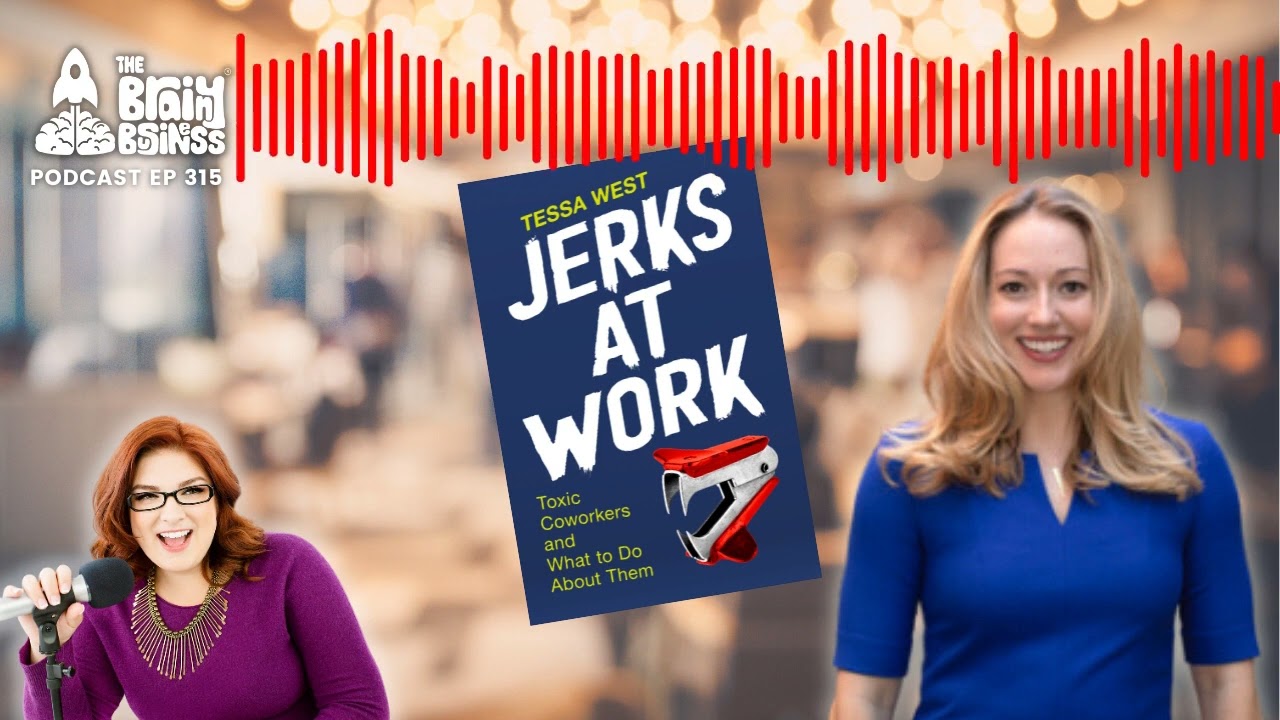
Jerks At Work: How To Deal With Difficult Colleagues, w/ Tessa West | Brainy Business podcast ep 315