Beyond Borders: From Argentina to Poland to Texas—Oscar Macchioni reflects on a life in music

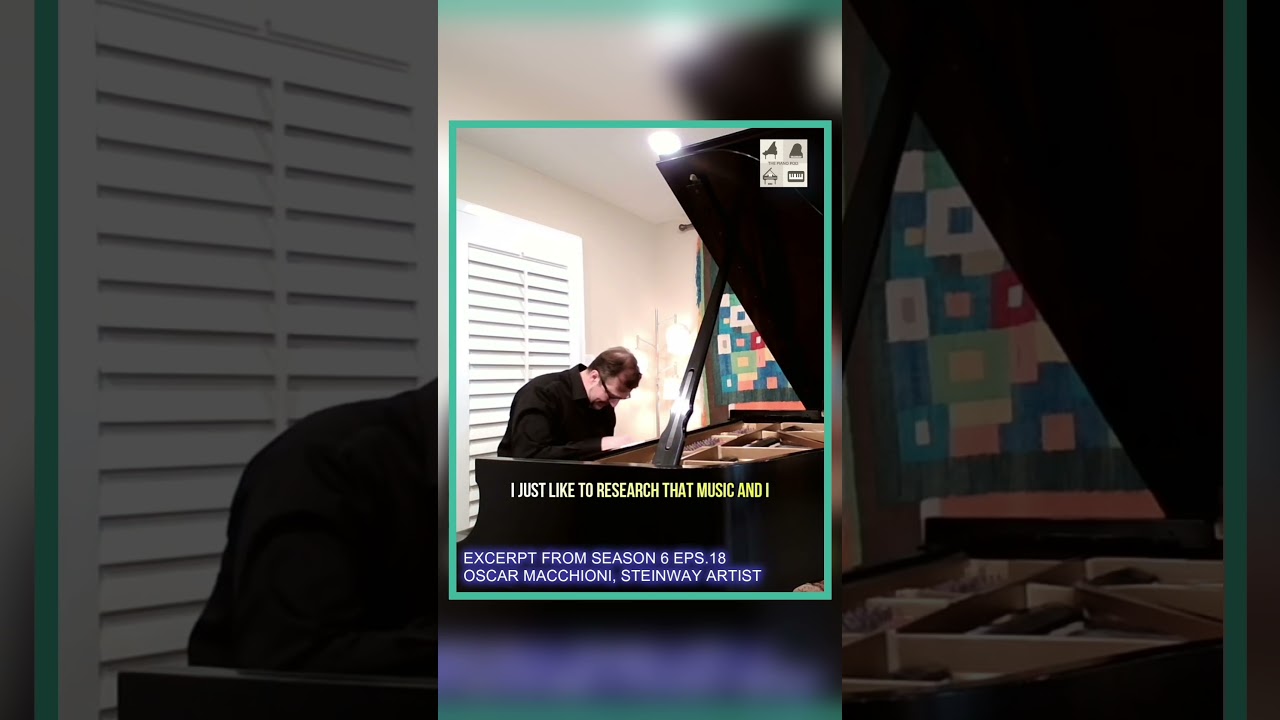
This content was created by The Piano Pod with Yukimi Song. This content was uploaded by The Piano Pod with Yukimi Song. This is a YouTube podcast episode (The Piano Pod with Yukimi Song — Season 6, Episode 18) published June 11, 2026 featuring an interview-style conversation. Host Yukimi Song interviews Dr. Oscar Macchioni about his transnational musical career (Argentina → Poland → Texas), his research and recording project Mostly Tangos: Piano Music from the Americas, his book/dissertation on the tango in North American piano music, repertoire and programming choices, teaching and pedagogy (including William Bolcom/Balkan’s pedagogical "Monster Pieces"), and his engagement with composers such as Szymanowski and Piazzolla. The excerpt includes host commentary, an introduction/outro, and an extended interview with Dr. Macchioni; metadata indicates the content is a YouTube video titled "Beyond Borders: From Argentina to Poland to Texas—Oscar Macchioni reflects on a life in music."
Chapters
Welcome back to The Piano Pod with Yukimi Song with Yukimi Song with Yukimi Song.
This season we have been exploring creativity and connection. Conversations with artists who are not only performing at the highest level, but also rethinking how music lives within communities, cultures, and contemporary life. Our guest today, Dr. Oscar Macchioni, is one of those artists. Born in Argentina, shaped by years of study in Poland, and now serving as Associate Professor of Piano Pedagogy at University of North Texas, Dr. Macchioni has built a career that moves fluently across borders, musically, intellectually, and culturally. A central part of today's conversation is his album Mostly Tangos: Piano Music from the Americas, but this is not simply a conversation about tango. It becomes a larger discussion about identity, artistic labels, repertoire, concert life, pedagogy, and how music travels across generations and cultures. We also talk about composers such as Karol Szymanowski and William Balkum, community engagement in places people may not immediately associate with classical music, and the role artists and institutions can play in creating meaningful human connection. This is Season 6, Episode 18 of The Piano Pod with Dr. Oscar Macchione. And before we begin, I just want to thank all of you for being part of this season. We are now entering the final 3 episodes of Season 6, which means we are also beginning to look ahead toward Season 7 this September, Culture and Courage. If you know fellow artists, educators, composers, or cultural thinkers you would love to hear featured in Season 7, feel free to nominate guests through our website or social media pages. Some of our most meaningful conversations have come directly from listener recommendations. Oh, and before we go, don't forget to subscribe to our YouTube channel, follow The Piano Pod with Yukimi Song on your favorite podcast platform, and leave a like, comment, or review. Every single follow, share, and subscription genuinely helps independent production like this continue to grow. Thank you again for listening, for sharing, and for helping build this community together. And now, my conversation with Dr. Oscar Macchione. Please enjoy the show.
You are listening to The Piano Pod, where we talk to the brightest minds in the industry about how they are bringing the piano into the future and thriving in a complex, ever-evolving world. Oscar, welcome to The Piano Pod. It's really a pleasure to have you here. Where are you joining us from today?
I am in Denton, Texas. That's outside Dallas, and this is where I live.
Oh, great and wonderful. Texas has been such a central part of your life and work, and then I'm really looking forward to exploring that part of your life journey with you today. And so your former student Aaron Williams, who is a long-term friend of mine and, uh, he is also a very big supporter of what I do at The Piano Pod with Yukimi Song, recommended that I should reach out to you, and I'm so glad I did. And when he spoke about your work, what stood out to me was not only your work as a pianist and, you know, as a concert pianist and recording artist, but also the way you built a life that integrates performance and teaching and community altogether. And that's a strong sense of intention in how you do and what you do, you know, how you approach both music and education and shaping not only individual students, but also the environments. And communities around you. So I'd love to start with this question: with all you do—performance, pedagogy, and community—at the center of all this, what continues to drive your work today, meaning mission and passion?
You know, through my life and through my career, the passion never changed. It's always, of course, the music, right? And but maybe the mission keeps changing a little bit through the decades of my career. And I would say when I was younger, I was more focused in performing and performing pieces that, you know, they were not common pieces to perform. You know, now everybody is performing, you know, unrepresented composers and so on. But I was doing this 30 years ago. I was performing full programs of Latin Latin American composers. Uh, other people of course were doing that, but it wasn't as the fad of being doing those things at that time. And now, uh, probably for the last 10 years of my last decade, it's mostly focused in teaching, in passing all everything I know to the students. And I'm really in a privileged position right now at the University of North Texas, such a great university with great faculty and great students. You know, it's the biggest public university in the United States. We have about 1,600 majors in music only. No way. Really? Yes. So there are bigger universities, but they are, they are private universities. This is a public university. And, you know, it's world recognized, the level of the faculty and the level of the students. Students. So, um, I came here 2 and a half years ago just to teach piano pedagogy and how to teach those, uh, very high-level performers that we have doing doctoral degrees, um, how to teach. Because it's not the same performing than teaching, you know. There are two different worlds, and sometimes they do not complement each other. Um, so anyway, in this past decade or so, my focus is mostly in teaching. I do still perform and record, but not as— that's not the main focus right now as it was, you know, 20, 30 years ago.
Okay, well, thank you. I would love to talk more about your approach to teaching, and that's a very— as you said, now your focus. And also Aaron specifically told me to ask you those questions. So, but Before, before that, I want to get into this. Now, we, uh, we briefly spoke on the phone a couple weeks ago, and one thing that stood out to me in that brief conversation was your perspective on not wanting to be categorized or labeled within one single genre. And as I mentioned to you on the phone, I also try to avoid labeling artists based on genre background, origin, and prefer to approach each conversation without preconceived ideas of the individual that I'm speaking with. So with that in mind, you are from Argentina and have published a tango in America, in American piano music, correct? Yes. And yet you don't present yourself as a tango pianist. And in fact, you refused that. So you resisted being labeled as such. So given your broad repertoire, first of all, what is this Tango in American Music about? Let's start with that. And it's a book, right? Obviously engages with the tango. Right.
So this is the result of my doctoral dissertation at the University of Arizona. Of course, I play Beethoven, Chopin, Soler, Scarlatti, you know, the traditional repertoire, but then you need to narrow down to a specific topic that is unique, that has not been explored before or been explored very little. So you can contribute to that particular topic. So I was already in the United States and I decided to focus on American composers who composed tangos for piano. Um, again, me being from Argentina, uh, I will say I was not fond of tango music when I was young. No, my parents were, because they were, they, they, you know, they, they were from the '50s, '60s. So the tango in Argentina at that time, kind of the, the interest went down a little bit. And now, of course, in the '80s, '90s, and right now, is very popular for young people even to dance tango. That was not the case. That was not the period where I, you know, where I grow up in Argentina, you know, the '70s, the '80s. It was not popular in young people to listen or to dance or to perform that music. We were more concerned with national rock, what we call at that time. Okay, so I grew up with that type of music, rock music and popular music, not tango music itself. But I thought that would be a great opportunity to explore that topic, not only because I was interested now that I was a little bit older in connecting the tango and how the tango influenced composers around the world. But because at that time also I got a fellowship with the Smithsonian Institution in Washington, D.C., it was a summer graduate fellowship that I could research and I could do whatever I wanted related to Latin American culture. Okay, so, um, although I was based at the Smithsonian Institution in one of those buildings, I was just down the road from the Library of Congress. So most of my time, instead of spending in the buildings where I was assigned an office, I would just go to the Library of Congress and start researching, you know, composers, American composers who composed tangos for piano. And that is the result really of my doctoral dissertation that then College Music Society, which is one of the biggest societies for professional musicians, The Piano Pod in the world, of course, is in the United States. They started with a new series that they would— they were trying to blend that traditional music with more social issues, and it's called Cultural Expression in Music. So my book, which was my dissertation basically, is the first book they ever published. And it's called The Tango in American Piano Music. And what I did is I selected— because of course I could not talk about the hundreds and hundreds of American composers who composed tangos, I have to select. So I focus from the early 20th century to the last part of the 20th century. So I started with Virgil Thomson and Aaron Copland,. And then I finish with William Balkan, which the tango is from the 1980s. And I cover, uh, different genres with tango itself, um, but, but the book starts with really, uh, um, an overview of the, uh, Argentine tango, or the tango that, you know, was really, uh, popular in Argentina and in the world in the 1920s. By the way, the tango is not really Argentine, it's, it came from Europe, from Spain. But what we talked to today, when people refer about tango today, they usually refer to the tango that developed in the La Plata River, which is Uruguay and Argentina. You know, it developed between these two countries. So, um, so I decided to focus on what characteristics of tango these American composers choose to emphasize in their compositions and if they really related or not to the, to the Argentine tango. So that was the, the topic of— that's the topic of that book.
So you're talking about America as in North America?
Just for North America, correct. And you— U.S. composers. Wow. USA composers only.
Yeah. Yeah. And how many U.S. composers you found that are really influenced by Argentine tango?
Well, the interesting thing with the Argentine tango is that it was such a big hit in the early part of the 1900s. So the 1910s, 1920s, it was when that genre went outside Argentina and really exploded. Everybody was composing tango. And then through the 20th century and even today, what we call classical or art music composers still compose tango. So tango was one of those very influential dances that developed around the world and composers, you know, took note of that. It was very, very popular. Musicals incorporated tangos. Even the Vatican had to create a decree forbidding Catholics from dancing the tango because it was such a, you know, not to them a decent dance. Because it's the approximation, you know, it's one of the only dances that the bodies touch, really. You know, you embrace your couple very close. You know, the waltz, you embrace the couple, but there is always a distance between the bodies. You know, there is always a few inches between the bodies. But the tango is the one that you actually have to connect your chest to chest. So that created, of course, a huge revolt in some, you know, like the Catholic Church. So it was so influential that even religion got involved and politics got involved, uh, you know, within tango at that particular period, you know, very early 20th century. Wow, that's interesting.
But, you know, I didn't think of tango in that sense. Like, um, you know, we talk about waltz, we talk about polonaise, we talk about mazurkas, and they are from, let's say, Poland originally. And then we don't think those as a Polish music, more like a genre now. Does that make sense? And a lot of composers all over the world, they compose those music à la mazurka, à la waltz, and then name it as such. But we consider them as genres. But when it comes to tango, I'm almost thinking, well, it is a genre, but I never thought of that way. The composers beyond Argentina would compose as one of the genres, dance genres. Does that make sense? Yeah. Yes.
And in particular, when we are talking about, you know, classical music or academic music, I don't think these composers meant that music to be dance because within the tango genre, you have tangos that are danceable, that you can dance, and tangos that are really, you know, the lyrics are— although you can dance every tango, really, but there are others that are more melodic. And then, uh, and so when these composers thought about the, the how to incorporate certain characteristics of the Argentine tango, I don't think they had in mind for the music to be dance. I think they had in mind for the music to reflect what they thought or what they perceived that were tango characteristics. And so the public will be able to kind of, you know, cross-reference, says, oh yes, this sounds as a tango, this doesn't sound as a tango, and has to do with the rhythms and has to do with other, of course, musical characteristics. Right, right, right.
I mean, for example, like Bach, you know, composed a lot of dance suites, but they're not really meant to dance with, right? Right. So something like that. Am I right? Something like that.
And of course, you know, because the tango is an urban genre, it's popular, you know, it belongs to the, to the, uh, really to the, the area of Buenos Aires and, uh, Montevideo, Uruguay, on that, you know, area of Buenos Aires, Argentina, and Uruguay. Um, that's where the tango developed, really. And Argentina is a large country, so we have areas of Argentina where the tango is not, um, I won't say popular, but it's not what represents those regions of Argentina. Including myself, I'm from northern Argentina, so the tango does not represent me. I don't feel like the tango is, is the, the musical genre that represents my region and my area. It's very focalized. And it's only, you could say, Buenos Aires and Montevideo, Uruguay, which is across the La Plata River. That's what the tango represents, the people specifically from those areas. So that's what I call this an urban general. She represents an urban area and not necessarily the whole country.
Hmm. Did you turn this into an album? I know there's like a Mostly Tangos piano music from the Americas. That was the album from 2009. Is it part of the project from this? Came out of this?
Well, within my dissertation, I recorded all the pieces. So I talk about, like I said, there is an introduction in my book about what is tango, where the tango came from, when the tango started developing in Argentina, which is what— or in Montevideo, in that area, what is what recognized today as tango. And then I go into the selection of American composers who composed tangos, and that's Virgil Thomson, Aaron Copland, Chester Biscardi, Samuel Barber, and William Balkan. So I recorded all these pieces for my dissertation. It's a CD that goes with my dissertation. But after a few years after that, when I decided to record my first album, I incorporated some of this music. For instance, in the, in the the recording that you just mentioned, Mostly Tangos, again, the title is Mostly Tangos: Piano Music from the Americas. So I, uh, play many other composers and many other genres, genres that are not tango in that CD. But I do play in that CD the William Balkan tango. I played Samuel Barber tango, and then I play, uh, Astor Piazzolla which, you know, was the modern— the father of the modern tango per se. And then I play pieces by Villa-Lobos, which is not a tango. I play pieces by Manuel Ponce, which are not tangos.
Really, I was enjoying listening to this album for the last couple days. So, and then they— this album is available on Apple Music.
Yeah, it is, it's on, on, on Amazon, you can, you can find it.
Spotify, you know, it's everywhere. Okay, I will make sure to link that in the show notes. So what do you think that these people misunderstand about this distinction, you know, or label you? Oh, Argentine tango. Oh, I should go to Dr. Oscar Marchioni.
I don't believe in labels. I actually, and that was when, like you mentioned, when we talk on the phone, I said, please do not refer to me as the tango guy. Because yes, I did a lot of research. Yes, I have a book. Yeah, yes, I have a lot of CD, not only that solo CD, but also I have a whole CD of, of Astor Piazzolla play in, in duos and trios, so piano, violin, and cello. And I played that music for a long time and for many decades, but I don't want to be labeled as the tango guy. I don't want to be labeled as the Piazzolla person. I think those labels are very dangerous. And they are very narrow-minded. And, um, um, I, I don't, uh, pretend to be an expert on all this. I'm just like to research that music, and I like to play that music among other things that I like to play of traditional music too. So I don't want to be labeled as the such-and-such person. I don't believe that. And I don't also— I don't believe that because you are from Poland, you are better playing Chopin anybody else, or that because you are from Russia you are the best Rachmaninoff performer, because that's not true. That's, that's a very false statement. Just look at the winners of the Chopin Competition in Warsaw and you will see what I'm talking about.
Yeah, absolutely. Well, thank you. Yeah, but it's easier, especially for tango music like that, to label you as such, right?
Right. And because also, you know, because like I said, I performed that for a long time and I keep performing, but I don't want be labeled as an expert because I'm not an expert. I don't believe in experts in one thing. It's just what we do at that particular time. And yes, I may know a little bit more than my neighbor because I play maybe more music, but that doesn't make me an expert per se.
Right. Now, some of the tangos you performed, like especially Piazzolla's and such. You arranged your—
I, I did one, one, a couple of them, but, but one, um, that I put on YouTube, uh, that was during, I think during the pandemic also, that I, I, I decided to arrange La Muerte del Ángel because I played that as a trio. And, um, as it happened with most of Piazzolla music, he did compose at the piano, but he was not a pianist. So sometimes the music that when you get the music, the score, the sheet music is very bare. There is not much there. There are many, I would say, even technically uncomfortable, not difficult, but very uncomfortable or unusual ways of writing because again, he was not a pianist. He just wrote the music in a, you know, in a piano format. So I decided to make an arrangement of that, really combining the solo piano version that again is very simple in the score when you buy it, and the trio version that was arranged by somebody else and has a different, you know, section that is not in the solo piano version. And the trio version really is based on Piazzolla performances, when they perform this music, they rearrange the music many times, so it's never exactly the same. So there are sections on that arrangement that I did that really I took the ideas from the trio version of this particular piece, which is "La Muerte del Ángel." Now you also mentioned this composer, William Balkom, and I have never heard of him until I learned him through this, this episode.
So tell us more about him. He is an American composer from last century, or— well, he's an American composer.
He was born in 1938. He's still alive. Oh, he's still alive. I talked to him last year because I also wrote an article about one of his pedagogical pieces that maybe we can talk later on, the Monster pieces for piano. Um, so, um, so I encountered him, uh, you know, he was one of the— my composers from my dissertation. But, um, I heard his music before because I have some classmates playing some of his rags. I mean, he's very famous for his piano rags. So, and they're wonderful pieces. So I know that, and I knew that by listening to some of my classmates performing his music. But then when I start researching about American composers who composed tangos, his name came immediately because he composed what is the title is The Dead Moth tango. When I interviewed him, this was like 25, 30 years ago, um, he said that, you know, the title is because he was writing a tango, he knew he wanted to write a tango, and it happened that a moth was on the score and he just smashed that moth, and there the title, The Dead Moth Tango.
And, uh, that's also in the album, right? That's, that's in the album, right?
That's, that's one of in the, um, uh, mostly tango piano music from the Americas, actually. Yeah, yeah, it's in the album.
Great. So, and, uh, besides Besides this tango music, what else should we look for in his compositions? Is he known for piano works, or does he compose—
Well, he composed, you know, symphonies, operas, quartets, piano music, chamber music, song cycles, because his wife is Joan Morris, who is a soprano, which is a singer, and they play together for a long time. So there's a a lot of song cycles that he wrote. I would say that for listeners who are not familiar with Volkmann, to listen to The Piano Rags and to listen to The Cabaret Songs, which is, is an incredible set. And again, that's— The Cabaret Song is one of the songs I heard my colleagues when I was doing my doctoral degree performing. And that's how I became more interested in Volcom. But his style is all over the— he doesn't have one specific style. Some of the music is very even avant-garde. So I probably, I wouldn't recommend to start listening that music, but start with the music that is more tonal and is more close to some genres that people may know, like, you know, Scott Joplin. The Piano Rags, um, because the, the Piano Rags that Balkan composed are really incredible. Perhaps the most famous one is The Graceful Ghost. Uh, I'm sure that people will recognize that piece if they start listening to that, and that will be probably the entry point, I would say, for, uh, his music. And then they can explore, of course, more advanced music and, uh, you know, techniques that he used. But, uh, The Graceful Ghost will be probably the— I would say that I would recommend that as the entrance point to listen to Balkan's, uh, musical language.
Okay, well, thank you for, for your recommendation. And also, you recently wrote about Monster Pieces. Yes, it's a set of piano works by Balkan as By Balkan.
And, you know, like, I'm always interested in letting people know about unusual repertoire, repertoire that is not well known or performed a lot. So I was writing an article for the American Music Teachers Magazine, which is basically, you know, a piano teachers magazine in the United States. And I I remember that I had this core, which is incredible, and I have it here because it's with William Volcom's own drawings. So I remember I bought this core on a used book, on a used book store in Tucson, Arizona, when I was, you know, when I was doing my doctoral degree. And I just I thought it was cute, and I put it on my, you know, among my scores and never saw it again. Until 2 years ago, I started writing this article, and I said, oh, I have that score. So these are 10 pieces. It's called Monster Pieces, all one word, for older children for piano. And really, the description is an adventure in contemporary piano music, an adventure in contemporary music for the piano students. And they are very small, very simple pieces. You know, most of them are 16 to 20 measures long, except for the last one. And they incorporate contemporary piano techniques. Okay, they incorporate clusters, that is when you play many notes at the same time, either with your palm or with your arm and forearm. Uh, of course, language, uh, that is not tonal completely. Um, and, and it's, it's very cute because he, uh, he illustrate every one of them. Oh my goodness, it's an illustration by William Balkoff. No way! Drawing are his drawings. Are you serious? Yes. The titles are like The Mad Monster, The Sad Monster, uh, The Bad Mister, The Glad Minister, The Plaid Miss. And The Plaid Miss, of course, has a plaid, um, dress.
Oh, how cute! Oh my goodness.
Um, and, and so on. So, um I think it's a wonderful set of pieces, very short. Again, some of them last maybe a minute when you perform, but it's a good introduction to contemporary piano music. Again, this was written in the '80s, so it's not contemporary anymore, but that's what we call at that time contemporary music.
But still, it's, it's, uh, I think music education even nowadays is it's just a traditional way of playing the piano, teaching piano. So I think there's a big market for that. And honestly, if I were, you know, there's a time machine and being able to go back when I was a child, I wish I had a book like that to learn. Yeah.
And there are many composers, of course, there are many composers that compose in a more tonal or traditional way for students, many pedagogical composers. You know, that they're still composing that many composers that are no longer with us that composed specifically for kids, because this music is to be performed by kids. You know, it's not like Schumann's "Kinderszenen," which is not to be played by kids, it's to be played by grown-up pianists, really, but about kids' scenes. These are for kids to play. So this is a great introduction. Sometimes teachers don't know how to introduce students to more contemporary music, to different languages. Sometimes the music that we have by other composers are long pieces and very complicated pieces. This is specifically composed for kids. And like I said, some of them are only 10, 16 measures long, and each one tackles a different, you know, rhythms or aleatoria playing. There is no bar lines, there is no timing, there is nothing. You just play The notes as you wish.
I'd like to talk about your concert career, and you've performed widely throughout your career. And how do you think about shaping a program for a given season? Do you build around themes or composers or something else, or are you trying to incorporate many different time periods?
You know, I think of a program, of a concert program, as very like an 8-course meal. I think that when you perform and when we perform, the majority of the public attending our performer performances are not going to be musicians, are going to be music lovers, are going to be people who love to go to a live concert, and they are going to be doctors, engineers, teachers, workers from, you know, all sorts of trades. But so we need to be very careful when we program music because of course I love certain, maybe I love certain type of music, but if I only play that music in that program, it may not be successful for the listeners. So I, when I play programs, you know, I try to be careful, even if it's within Latin American music, which I play many programs that they were only Latin American music, I always trying to include music that is going to be a little bit more accessible and easy to listen and introduce some music that is a little bit more out there with the language is more strange for the public, but I will never never program a whole program, a whole concert with music that is going to be strange to everybody. I think that those are very unsuccessful programs. Uh, I saw people leaving within 10, 15, 20 minutes because they cannot stand that, and we need to be sensible to that. And like I said, um, I love chocolate, but I cannot live only with chocolate. You're right. You know, I mean, I love pasta too. So why I will eat for a whole year only chocolate and deprive myself of all the other tastes that are so wonderful in other type of music? So when we do, and when performers do this very narrow, uh, programs, what are they trying to prove? Are they trying to prove that they can play only that music, or they can stand up only to play the 32 2 Beethoven sonatas in 2, 3 nights. I mean, and what that's— are they thinking about the public? That they are— because I'm a pianist and I love Beethoven, I don't think I can go 3 days in a row to listen to Beethoven sonatas. It's like you are eating the same food over and over and over and over and over again for 3, 4 days. So when, when, when that's— it's an amazing accomplishment. Uh, are we accomplished anything for the public who are there? And the majority are not going be pianists, they are not going to be musicians. So again, I think in a different way, I like to program the variety within my programs when I program a concert or recital, because I think of that way of being able to give to the public different tastes Like when you have a very nice, you know, elaborate meal, you have different things, not just one thing. You know, I don't think anybody would want to go and eat pasta, 8 different pastas in one night.
Yeah, it's just too much. That's true. Although I love pasta, but that's—
Oh, me too. Don't get me wrong. And I can eat the same food for days. I don't have any problem. Eating leftovers after leftover. But, but I don't have to force that in somebody else. That's, that's what I feel. I cannot force that taste in somebody else.
Now, before we get into your origin story, I'd love to touch on something that, you know, connects to your time in Poland. So you spent a significant period there as a student, and that's when you discovered the 20th century Polish composer Szymanowski and developed a deep connection to his music. And today his work, you know, has increasingly become part of the broader repertoire, which is great, with pieces like his mazurkas and preludes and so on. And usually, you know, especially mazurkas, they are often sort of side by side compared or discussed with Chopin's mazurkas, right? So what specific characteristic or piece by Szymanowski drew you into your repertoire in the first place?
Okay, so when I went to Poland, I didn't know of Szymanowski. Maybe I heard his name as a student at the university in Argentina, but I never heard his music and I never played his music. I didn't have access to the scores, so it was just a name. So during my first piano lesson in Kraków, my teacher says, well, do you know Szymanowski? And I say no. She said, well, you need to bring, you know, Etude Op. 4 No. 3 for me, which is the famous B-flat minor etude. You needed to bring for me for next class, for your next lesson. So I went, I made a copy of the score and I start practicing for my next lesson and I fell in love. Of course, this is a very famous piece, it's very romantic and very powerful, very dramatic. And so I brought that piece to my next lesson, among other things. And she said, you know, you are good for this. You really understood his language and his intention. You know, with one week of work, when I was practicing Mozart and Bach and Chopin for years. And probably for her, I wasn't good enough. But for— with Shimanovsky, she said, you really understand his language. So that's how I started. And she started assigning me more pieces and more pieces. And that's how I really fell in love with his music. Żymanowski has different periods, you know, he's very transitional from late 1800s to the beginning of the 20th century. So the music, and I love all his music, don't get me wrong, and, but the music I really identifies with me is the early period, which is the more romantic period, almost a mix of Scriabin and Rachmaninoff and Chopin. Although I think that Żymanowski was very sophisticated, in his writing. Um, so that's the music that I identify with, although I love the media— middle period, which is more impressionistic, and he's exploring with different harmonies and other, other things, or the folk period, which is the mazurkas, and, and it's just a very advanced type of, of musical language. Um, I still like the early period, which is the more romantic period, so it's all the preludes, his Etudes Opus 4 variations, And after that, he started, you know, exploring a little bit more and opening his compositional techniques and his taste for harmonies and layers of sounds and, you know, to a different level with a different optic than the romantic that he has in the earliest work.
So, like, I've known his reputation as like a dense harmonic language, and so pedaling can be challenging and so on. But is that— does that apply to his early works, or you think—
Yes, still apply to his— still apply to his early work, right from the very beginning, which is the, the preludes. He composed those, and those are gems. I mean, they are just incredible, uh, pieces, Nine Preludes, Opus 1, he composed those when he was still a teenager. And the depth, the— I don't know how to say, but the melancholy of those preludes is what draws my attention. And that's what I love so much. You know, along also with the, with the Etudes, Opus 4, and the Variations, Opus 3. It's a very melancholic type of writing, and, um, I don't know, I think I like melancholic music. And, and what you mentioned about the textures and the pedaling and all that is true. I mean, it is in the, in the applies to the very early, uh, the compositions too. And, um, it's very hard to read. Sometimes pianists don't want to play Shimanovsky because there is so many accidentals and so many difficult keys to read and so many double sharps and double flats and modulations that surprise us, not only hearing, then also physically, how to, you know, how to get from here to there. Sometimes it's not uncomfortable, the writing, although he was a pianist, but the writing is not 100% comfortable for the pianist. Liszt is very difficult, but it's absolutely comfortable. I mean, I think that every pianist will feel feel that the music fits their hands and, and what their hands can do physically to play those things, um, regardless of the difficulty, regardless of the speed that you have to play some of these pieces. I'm talking about how the, the music fits the pianist's hands. And with Liszt, it's just he knew exactly what he was doing. Same thing with Chopin. It may be very difficult to play, but the music fits the hands. The anatomy of the hands. With Shimanovsky, it's a little bit different. Not everything fits in your hands, so you need to find ways of making it happen because he was more concerned just with the— I think with the results of the music than with how the hands can or cannot perform certain things. So there are very awkward passages, very awkward moments. Right in the preludes, all the arpeggios in the left hand goes from up, down. When in traditional music, in romantic music, all the arpeggios start in the lower note and go up. That creates a problem with the pedaling because you end up with the fundamental notes of the arpeggio at the very end of the arpeggio, and, uh, it creates all sorts of problems with the pedaling, uh, that of course they are absolutely doable once you understand what is going on with the music and do not try to apply traditional pedaling or romantic pedaling for that music that sounds very romantic, but it's written in a very different way than the traditional romantic music. Wow.
So you seem to know a lot about Szymanowski. So probably that comes from your years in Poland, correct?
Yes, yes. And I study a lot of the music especially not everything, but some of the Nine Preludes and a couple of the Etudes when I was for 2 years in Poland. So I was able to work with my professor, which was Eva Bukojemska, and she is— she's still alive, and she's the editor of the Szymanowski piano music, especially the early part. That's the part that she liked, and that's the part that she introduced to me also. That's what I think. I, I love it. But, um, so during the, you know, of course I, I, I learned about his music there. I learned it in Poland with a Polish teacher who actually edited his music. And, and then of course I came to the United States. I have to learn all sorts of music. I play Beethoven, Bach, Chopin, you know, Balkan, piazzola, everything else. But always I would come back every so often and play the old pieces, the old Shimanovsky pieces that I knew. Till about 3 years ago, I have a faculty development leave at the University of Texas at El Paso. I taught there for 20 years before I came to UNT 3 years ago. So that was my first sabbatical after 20 years or 15 years working there. My project, and people were surprised, my friends and my colleagues were surprised that I didn't do anything with Latin American music when everybody now is doing, you know, Latin American music and a bunch of things. I said, no, this project is going to be Szymanowski, it's going to be Karol Szymanowski. I have 6 months, um, I'm going to back to Poland after almost 30 years that I haven't been there. I will go back to Poland, I will research the libraries, and I will try to, you know, try to absorb again the atmosphere, the culture, the Polish culture, go and visit again his villa in Zakopane, which is a small town in the mountains. He had a villa there, and all, you know, there is so much, uh, artifacts that belongs to him, like clothing and scores and, um, furniture and everything else. And I will, I will start, you know, doing a research and trying to put together a Shimanovsky CD, which I finished this past summer. So at that moment, uh, 3 years, 4 years ago, what I did is I recorded in video at home all the preludes, you know, all the 9 preludes, Opus 1. And I also recorded the Etudes, Opus 4, but I wasn't quite happy, so they are are not publicly available. Okay. I mean, they are good, but, but, you know, so, so then I decided I would do an audio recording, you know, a very good quality audio recording. And that's what I did last summer. I recorded in audio all the Preludes, all the Etudes Opus 4. I have to learn new pieces, so I learned the Variations Opus 3, which I always liked that since I ever— since I first heard those pieces in Poland played by a classmate. I love it. So finally, after 30 years, I, you know, I learned the piece and then two mazurkas. I needed to complete the album with, you know, some short pieces. And so I learned a couple of mazurkas.
Amazing. And is that— album coming out soon, or is it available? That album is already—
I mean, it's, it's finished. It's, it's, uh, it's going to come out now in the summer, probably in the summer.
Saluté. Yeah, so I want to talk about your origin story now. So you're starting your life from Argentina, and somehow you went to Poland and studied for 2 years, which is great, and now you're in Texas. Wow, you are all over. The Map. So tell us, how was music first introduced to you, and did you grow up in a maybe musical family? No, no, no musical family.
No piano, no musical instruments except for a radio and a TV. Really? So, um, so this is what also I want to, um, emphasize, that by the purist thought that you need to to be good and to be successful at something, you, especially in music and art, you need to grow up in a musical family, you need to grow up with good teachers in a good environment, is false. It's a very false statement. Because if, if we go by that, I shouldn't be here talking to you. I should be an engineer, I should be a doctor, I should be something else than a pianist or a musician. I don't consider myself a pianist. I consider myself a musician first, then a teacher, then maybe a pianist. So, so, so by the traditional thought of, oh, you need to, you need to grow up in that environment, I wouldn't be here. I wouldn't be here. I grew up in a very small town in northern Argentina, Tafí Viejo, in a small province in Tucumán is the province. Although my mother took piano lessons when she was young, but she never, you know, went ahead because they didn't have money to buy a piano. My parents didn't have money, although they knew I loved piano and I asked them to take piano lessons. I started taking piano lessons when I was 8, but I didn't have a piano at home. So they would pay extra every week for me to go and practice in my teacher's piano. So I didn't have a piano 24/7. Wow. I have a piano only 2 hours per week to practice. Okay, it's later on when they were able, and it's not because they didn't want, piano in Argentina still too expensive. And so it's not, sometimes people in the United States, Americans don't understand how expensive is for a family in another country to have a car or to buy a piano when the, the focus of that, those families, is to have a good home, to have a steady home, and to have a good education for the, for, for the children, and not necessarily about what you have as material things. So that's how I started piano. I asked them that I want opportunity to play piano because I always felt attracted to the piano. When I would see a piano on TV or in school, you know, when we were singing in kindergarten, I always felt that attraction to the instrument that I wouldn't feel with any other thing that surrounded me at that time. It was the piano. So kind of I was obsessed with the piano, but I didn't have the opportunity to have a piano. And my parents never forced us to do anything, so they waited for me to ask for piano lessons. So I think I was 7 or 8 when I said, you know, Mom, I want to take piano lessons. But we don't have a piano. How you are going to practice? I said, I want to take piano lessons. And that's how I started, you know. And when I say a small town, well, there wasn't, and I don't think there is any grand piano in that little town right now.
Then, so, Argentina, you went to college there? As a music major. So, are you in here? No, no, no, no, no, Argentina. Argentina. Yes, yes.
And actually, my university has the same letters, UNT, that the actual university. No way! It's Universidad Nacional de Tucumán. So it's, it's the same letters, UNT. It's very funny. Yeah. Um, so I, again, I, I took piano lessons till I was about, you know, I think I finished high school. And then it was time to decide what career I want to, you know, pursue in college. And I always liked design, so I thought I would like to become an architect. And of course, I enrolled at the University in the career in music. And I lasted— because I enrolled in both. I enrolled in engineering and I enrolled in music at the same time. I see. And I lasted less than 2 months in the engineering university and I quit because I love so much what I was seeing in the, in the School of Music at the university. That I just thought I cannot spend one more second doing, you know, math and drawings and things like that. I have to really dedicate myself to music.
So, wow. Then that led you to somehow Poland for graduate school, right?
So before I finished, at that time, the university in Argentina was 6 years, 7 years for a music program. Time, um, not 4 like, you know, in the United States, or right now is 5, but at that time was a little bit longer. Um, and, um, so before I finished, I knew I wanted to leave Argentina. I knew I wanted to study somewhere else. So at that time, there were, um, uh, and of course we didn't have any money, so I, I will have to go to a place that they help me financially, that they will give me, you know, they will pay for this, for, for the tuition and, and room and board and all that. So there were two, um, advertisings from the Czech Republic and from the Polish, uh, government, uh, for studying music and any other, you know, engineering, architecture, whatever you wanted in those countries. They will pay pay for that. They will pay for— the only thing I needed to pay was my ticket getting there. Once I got there, I would be paid an stipend every month and I will have room in a dorm and I will have one meal per day paid by the government. So I decided to go to Poland. Poland. I don't know why, but I decided to go to Poland. So I sent my cassette tape audition to my teacher, and she accepted me. And, and, uh, there I was, the first time leaving my little town in northern Argentina, going to Poland. I did not speak the language. I still can't speak the language, it's too difficult. But, um, I was— I did— I studied there what you would call today almost like an artist diploma.. So you only take piano lessons once per week with your teacher and that's it. That's the only thing you do. Wow. So that's what I did in Kraków. That's what I did in Poland for 2 years. And my teacher, she's Polish, but she spoke Spanish. So she said, let's do this. If you allow me to teach you in Spanish so I can keep practicing my Spanish, I will teach you piano.
I said, fine. Wow. And for 2 years you spent your time there.
And she would introduce Polish as, you know, as we were doing the lessons and so on. But mostly they were in Spanish because she wanted to, you know, practice her Spanish with me.
Right. And then, so did the experience change you in what way, you know, artistically? What do you think? In Poland?
Oh, um, well, when, when, when I went to Poland and I heard, you know, my classmates, people playing, I was in shock because I don't think I was at that level. Um, although, you know, my teacher accepted me, so I probably— I was not that bad. But, but I was in shock because I never heard people playing live like that. I always heard recordings and videos but I didn't grow in an environment that have that high level of playing. Not everybody, I have to say, not everybody, but the ones who play well, they were playing at a level I never encountered when I was, you know, a young student in Argentina. So I was shocked. So it made me work harder. It made me appreciate that opportunity that I have to develop my playing, my technique, my musicality, my knowledge of the world, because I went to Krakow, which is a fantastic city. It's a beautiful, beautiful city. So I felt very lucky and I took, I really took advantage of the opportunity. And I think that that really One of the things that I remember from the time in Poland was developing my artistry, talking about the music in a different level that I hadn't experienced before. Okay, really, instead of looking at the sometimes at the very little minutiae of the music, talking about what this is going to sound like What do you want this to sound like? And that was working with, you know, with my professor, you know, all these ideas opening my mind about musical ideas, about voicing in the piano, fingering, you know, that was new, you know, kind of new to me to have a teacher talking at that level of artistry with me as a student.
Wow. And then after Poland, it led you to the United States immediately?
Right, because I knew I wanted to continue my education. And, uh, you know, I already finished the university, which was just an undergrad degree. That's as far as at that time you could go with your, with your, uh, music, music education. And so I knew I wanted to do something different. I knew there were other Opportunities, there were other degrees like master's degree and doctoral degrees, but you needed to leave the country. You could, you know, you couldn't study that in Argentina, not even in Europe 30 years ago. That was really the United States. So I have an uncle in New York and he said, yep, before you go back to Argentina, come and visit me. And so I came for the first time to the United States for 3 weeks. Over the summer to visit him. And at that time, he already had arranged for me to practice at Steinway Hall in New York City. He had arranged some interviews with piano teachers in New York. Wow. So I thought I was going to New York to be a tourist. Little I knew I was practicing the piano. Having lessons with different teachers. And then one of the teachers said, you, you have to come back here. You have to keep, you know, studying your, your master's degree, your doctoral degree. And that's how I, you know, I end up just staying in the United States and going to different schools to complete, you know, not complete, but continue my education.
Yeah. So your studies continued in New York or elsewhere? Where?
I study New York, uh, privately, um, and then I got a scholarship from the Organization of American States that pay everything to go to study at LSU, Louisiana State University. So I did my master's there, and then, um, because I wanted to do a little bit more with Latin American music at that time, I start searching for performers of Latin American music who taught at different institutions. And I came across the name of Noéma Fernández, who is an American-Cuban pianist who taught at the University of Arizona. So I submitted a tape and I got accepted with a scholarship, with an assistantship. And that's how I ended up in Arizona and completing my doctoral degree at the University of Arizona. I see.
Yeah, you mentioned LSU. I have some friends who went to LSU for piano. It's a really good school there. Yeah, yeah, yeah.
Very good school. Yes.
Wonderful. Wow. So then now you are in El Paso. Not only you're performing, but I think being an educator is a huge part of who you are. So is it okay if we start talking about your teaching styles and so on?
Yes, yes. So, so just to clarify, um, after— right before I graduated from the University of Arizona, I— before I even completed my course load as a doctoral student, I was already applying for jobs because I wanted to know what will be to apply for jobs, where the jobs were asking at that particular time from the candidates, what I will have to do during my job application, during my interview, and what I will have to teach. So kind of I start doing that entrepreneurship very early and applying for jobs. And I apply, I got interviewed by many, and I got an offer from the University of Texas at El Paso, which is just 4 hours from Tucson. Where I was. And that's how I started at the University of Texas El Paso 23 years ago. And I was there for 20 years. I mean, I went from a visiting professor to a full tenure-track professor. And then 3 years ago, this opportunity here at the University of North Texas opened. I did not think I would leave El Paso because I was there already for 20 years. I thought I would probably retire in El Paso, but this was an excellent opportunity for specifically piano pedagogy, which is, well, like we talk at the very beginning, which is what my interest right now is. And I applied for the position and I got the position. So I've been here for 2.5 years.
And this University of North Texas, it's, you said it's one of the biggest. Yes. Music, music and higher education. It's a college of music.
It's a college of music. And we have, I think, 15, almost close to 1,600 students in music only.
Oh my God.
Yeah. It's a huge place. We have world-class faculty and students, Grammy Awards from the institution. So it's an exciting environment because of the level of the students that we accept to come here and also, of course, the level of the faculty. And, you know, although we are in Denton, it's only 40 minutes from Dallas and 40 minutes from Fort Worth, which this met— metroplex area full of museums, orchestras, you know, Van Cliburn is just down the road. And so, so it's, it's, it's, um, it's very exciting, especially for pianists, because Texas is a big piano state. Very big piano— no, not big in the sense of, um, geography, which is big, right? It's very big. But also in, in, in terms of quality, um, and, and, uh, educate— piano education is, is, is Fantastic. Yeah, music education.
I hear you. I used to live in Florida, Tallahassee, and I met a lot of people from Texas too. And it's a culturally, it's huge. People don't think, people don't associate Texas that way, you know, but it is. Yes. Yeah.
Again, those preconceived ideas that are harming sometimes the opinions and how we perceive things.
Yes, yes, yes, yes. So then Aaron Williams, so who were your former students, mentioned specifically about, uh, your approach to education. Now, uh, he specifically told me about the fundamentals like structure, form, solfège— yes, solfège— and deep score study while remaining open to contemporary repertoire and new ways of engaging audience So what are the most common problems you see in students today? You know, people, kids have memory issues, anxiety. Oh, huge. This is not just, I'm not just talking about this common performance anxiety, but the core of the performance anxiety issue is a big debate, I think. And then superficial interpretation and so on. So what are your thoughts on those?
I grew up in a very structured, you know, European conservatory education where you needed to fit that particular mold. They didn't— that type of structure, which is important and is necessary. Bad, we need to be flexible. Um, so I grew up with that. I grew up with a lot of structure in, in my, in my education, good or bad. But I have a lot of structures. I, you know, I have to do specific things. I have to do etudes. I have to do technique. I have to do repertoire. I was taught how to practice. I was taught how to memorize, which I was lucky enough— and all this happened when I went to the university, you know, when finally I graduated from high school and I went to the university. I got this teacher, Lucia Herrera, which was incredible. She taught me how to practice. She taught me what I would do first, second, third, and what would be the progressions, how I will do. You practice this first, you do it 10 times, you do it 3 times, you do it 1 time, and then you move on, and then you put these 2 together. And so she taught me all that. She taught me how to memorize. Piece, sometimes without playing them at the piano, but memorize with the score, which is the most important thing. And I don't think— when I talk to my students today about this, they look at me like I'm speaking a language that they don't understand, because there is so much emphasis, and always been, but I think today, that how many hours they practice, and I say how many hours they waste, because they waste. They do not really practice, they make noise. Um, one of the first things I say, who plays the piano? The fingers? No, the fingers don't play the piano, the brain plays the piano. You know, I was in a class yesterday and I said, who, what part of the body plays the pedal? The foot? No, the ear plays the pedal. The ear and the brain use the foot to go down and up and down, but it's not the foot, it's the ear. It's not even, you know, it's just the ear. So those misconceptions that comes from sometimes students who may have great piano teachers, but those piano teachers don't see this areas. And so what I want to say is I grew up with a very structured, um, instruction, so I believe in that. But at the same time, I think that that conservatory type of training where if you don't fit to that particular mold, you are out, you cannot become a musician, is ill, is really ill also, because Now we know a lot of things through neuroscience and through psychology that they are— we are not all the same, but we all should have the same options and we should all have the same possibilities given to us to develop talent, to develop education, to develop many things. So I believe in the structure of a conservatory system, but I, but I think we need to be flexible because we may have students who have some learning disabilities who can be fantastic musicians. And if we don't know how to teach them and we said, oh no, you are not good enough, just go and do something else, you are really denying somebody something beautiful, which is becoming a performer. Or becoming a musician. Right.
Those trainings are there for us to use rather than try for us to fit into the mold, right? Exactly.
So what I believe in that, I also believe that we can bend those and we should be flexible because we all learn very different. We all have mental issues. We all have at different levels. We are not perfect. We should not be perfect. So, so we need to contemplate those things when we have students, when we teach students. If the student is not getting something, it's the teacher's job to find a way to explain to that student 100 different ways till the student get it. Of course, there is a limit. There may be some really learning, very, very learning disabilities, you know, very high learning disabilities, and sometimes we cannot really reach that students. But let's talk about more normal things. Is the job of a teacher to teach the student how to practice, how to memorize? It's not the job of a teacher to sit and listen to the student and say, oh, that's wrong. Come back, listen, you know, practice more and come back next week. We all saw those type of teaching and they still around, those type of teachers. Uh, but that's not good teaching. A good, a good teacher should spend time trying to find out how I help these students, how I will help this particular student, which I may have to give a completely opposite direction and opposite indication to what I gave my previous students an hour ago.
Yeah, well, even in this, with the same student, you may contradict sometimes, like from lesson 1 to lesson 2. You know, it's like you said one thing and the next day, next lesson, it's like completely the opposite.
Because, because we all process things differently. We all understand things sometimes in a different way. And again, I keep saying this is the job of the teacher to make that student progress. Any progress. I don't care if it's here or it's up there. That will be according to the student also, you know, to the ability of the student.. But any type of progress is the job of the teacher. That's what they are getting paid for, privately or through an institution. We get paid to teach, right?
Yeah, yes, absolutely. And I've been doing that for decades as well. And so, and also, you know, these days it's surprising to me, like, I live in Brooklyn and then I have young— there are young Gen Z young professionals live around me, so they would sign up piano lessons with me. They would come and then they would watch YouTube clips, and then actually they can quite play by mimicking. But I'm— so in a way, the role of piano teachers had changed because they can really literally learn something on video. But obviously that's not learning, that's not education. So that's where we come in. So we have to really change our mindset about teaching. Otherwise, you know, they can just copy whatever they want on YouTube and then, you know, here I am, I can play somewhat Chopin sound like.
Right, right. So coming back to the beginning of this question that you mentioned about, you know, anxiety and memorization and lack of interpretation, What I see today is that almost every pianist sounds exactly the same like the next pianist. What I'm missing, and this is not because I'm getting old, but I'm missing when you could hear a recording and say, oh, that's Gilles, oh, that's Horowitz, oh, that's Hoffman. Oh, you know, that's, that's horror. I mean, Cortot, you could hear each one has a very, very distinctive sound. Each one has a very distinctive phrasing and a very distinctive approach to the music they were playing. And what I see today is almost like factory training. They, they all, of course, the level of the technical ability of these people today is incredible. I keep saying, Cortot will audition today to a music school and he wouldn't be accepted if he was in the bad days when he played a lot of wrong notes. But he didn't care about that. These people didn't care about that. Horowitz didn't care about playing the wrong notes. And there is so much emphasis in perfection And that vertical plane, which I call the typewriting, is that they are typewriting on, you know, on a keyboard, that they miss the horizontal, they miss the different layers. And I'm not talking about everybody, of course, but I see a tendency of everybody playing the same way, everybody phrasing Chopin the same way. And the Chopin Ballade on measure, they all do do exactly the same thing. So there is no personality in their playing. And I would rather listen somebody have a memory slip and playing bad notes than playing so perfect but so boring and so— and not unmusical but an artistic way of playing. The level, the development of the technique today is just It's amazing. These students can play things at a speed that nobody would dare to play that speed 50 years ago. But they are missing the most important part, which is the poetry of the music, which is the poetry of the phrasing, which is the layers of sound. Because you can play fast doesn't mean that you have to play fast. Because you can play loud doesn't mean that you have to play loud, because you may, you know, impress your neighbors, but you are not going to impress a musician with that type of playing. And you mentioned something also about performance anxiety. Of course, today we are allowed to talk about those things. People in the past, teachers in the past, wouldn't talk about that. But also, I think it's because many Many teachers perhaps did— they did not experience that. So although I think that everybody experienced that, but they didn't want to talk about that, or it wasn't strong enough to really derail their performances. But we have students that they deal with that and they are very good students and excellent musicians. So as teachers, we should read about that. There is so many techniques, there is so many things that we, we could be, even if we don't apply those, we could be referring our students to read, to seek help by somebody who can deal or know how to deal with those type of things instead of ignoring them. Right. Oh, well, you need to practice more, you know. Right, right. Yeah, that's practicing more doesn't make any sense when the problem is It's not hours of practices, it's how you practice.
That's right. And also it's all about context too. How they think of music, how they think about music performance. Yes. If it's a constant pressure, like, oh, I have to play in the competition, that sort of mindset actually will kill the, I think, the talent and ability You know, if the music making is more to do with, you know, in the community, for example, or, you know, making music for something else, something good cause, then totally it changes, right? Yeah. It changes, completely changes. Yes. Yes. Now, so speaking of community, I know you built a wonderful community back in El Paso and where you engaged with community and also University of Texas at El Paso for 20 years, and that's where my friend Aaron met you, right? And El Paso is a very unique, you know, borderland place where West Texas, southern New Mexico, and Mexico— literally Mexico— meet Mexico. Yes. And then that's where you started this Borderland Chopin Festival. That's amazing. To, of course, to promote The Legacy and Music of Chopin. Yeah. Yes. So can you tell us, and is it still on, going on, right?
Oh, yes, still on, still on. So before I left UTEP, I have the opportunity to talk to a donor, and I presented this project that we used to have in El Paso. A Chopin Festival was organized by a local pianist. And this person died and then nothing happened for 2 or 3 years. So I said, well, we need to recover that because those concerts were very popular, were sold out, free to the public, but they were standing up, standing only, standing room only. So they were very popular and they were all based on Chopin music. So of course, the pianist could play other pieces, but the majority of the program they played was Chopin because it was called the Chopin Festival. So I decided to somehow continue, but in a different way. So I created this Borderlands Chopin Festival that started really with a local festival for the students from Las Cruces, El Paso, and Ciudad Juárez, which is New Mexico, Texas, and Mexico. So there are all these three cities that are very close. Together. And so for the students only from the area. So the idea is we will bring artists and performers from other places and they will work with the students and we will have a little competition. And that's happened every 2 years. So that's still going on. I just finished the third one this past March. And we are able to give, of course, prices to the students. But I think more important, because I love the area of El Paso, but it's very isolated. People need to understand that to drive from El Paso to Dallas takes 10 hours. Wow. And you are not even on the other side of the state. State. You are not by the Louisiana border yet, and it takes 10 hours. So a flight from El Paso to Dallas is an hour and 20, an hour and 40 minutes. The closest bigger cities that El Paso have will be Phoenix, about 7 hours, Tucson, uh, but they are not that much bigger. They are bigger, but they are not that much bigger. It's not a metropolitan area like Dallas or New York or LA. You know, which I'm— when I talk about big, big, big, big cities. So, um, it's a very— it's beautiful area, but it's very isolated, geographically isolated. So the idea of this festival is to bring people, um, artists to the area, perform, give master classes to the student, have a competition where they have to play at least one Chopin piece. But then the first prize of each category is is, uh, all paid summer camp somewhere else, including the college level, that is a summer festival in Europe. So if they get accepted to a summer festival in Europe, we pay for all that. They get paid for the ticket, the tuition, and everything. But every 3 years we have an international competition, and this is the big one. Of course, the local students don't compete on that one. This is really an international level competition that we are having the second one in 2027. And the prizes are like first prize is $20,000, $15,000, $10,000 performance with El Paso Symphony Orchestra, solo recitals back in El Paso. We cover all their expenses, no airfare, but we cover the hotel, the meals, everything during the 4, 5, 6 days that they are going to be present in El Paso during the competition. Really?
And then what are the demographics like, age groups and—
For the, for the local competition, we have by school age. So we have elementary school, we have middle school, high school, and college level. For the international one is 18 to 35 years. Warsaw.
I see. And the international one takes place every 3 years?
Every 3 years. So the first, the first one was 2024 and was very successful. And again, we bring a very, you know, if you look at the, at the, at the jury, you know, Antonio Pompa Valdi, Kenny, Kevin Kenner, you know, people who even won the Chopin Competition in Warsaw, like Kevin Kenner. We had as a guest artist that we have a recital opening night before the competition was Lata Chochieva. She's a Pletnev student, or, you know, so, you know, it's a very high level. We have fantastic players coming from all over the world to compete for that. And that was the first one we ever did international. So now the second one, we are already preparing for that. The Piano Pod is going to take place in May 2027.
And then, so it's coming up next year. So when should pianists register? When do you start accepting the first—
We are going to start pretty soon. So we already have the webpage. Everything is ready to go. We didn't announce yet. Okay. It's coming in the next couple of weeks. So pianists could already start signing up or, you know, of looking at the repertoire. The webpage is working and all the rules, regulation, repertoire is there. Okay. Uh, is the, the application is not open yet, right?
And then what's, uh, what's the web address? Do you know?
The web address is borderlinechopincompetition.com. Borderlinechopincompetition.com. I will send you a link.
Yes, and I will list that in the show notes as Well, great. I know we're talking, uh, you know, for a long time, and we're coming toward the end of our conversation. How are we doing?
Are you okay? Oh, I'm fine. I love this. Thank you so much.
Oh, thank you. So how do you think classical music can remain relevant and continue to influence people in a positive way and evolve in this very busy, crazy world?
You know, I'm, I'm not afraid Some people said that classical music is going to die and all that. And yes, it's going to die if we don't reach the people we need to reach. When I perform, I'm not performing for my colleagues. I'm not performing for the people who play what I play and who can criticize me. I'm performing for the people who don't know about music. I'm performing for the people who enjoy listening music. So if, if we change a little bit the optics of why we do what we do, I think that music, classical music, will always be relevant. One of the things I did for a long time in El Paso, and I'm going to start doing here in Denton, I play a lot of community concerts. You know, I got a grant from the city of El Paso and from the Texas Council on the Arts to perform concerts in public libraries, retirement homes, schools, places where people don't have access specifically to classical music. You know, there are so many communities and that, that they don't have music going into the communities that they will have to go to a concert hall. They will have to go to the symphony hall. Well, they don't have transportation. They don't have money to pay $45, $75, $200 for a ticket. They don't, but they still love music and they still enjoy music. So we need to go to those places. We need to get down from our ivory towers, get down and play for them in their environments. I play in pianos that keys were not working, pianos that they were out of tune. I brought electronic keyboards, full-size electronic keyboards to some of these places. This is not about you. This is not about Chopin. This is not about Beethoven. This is not about Bach. This is about them. That's the whole purpose, is about them. So it doesn't matter in what piano you play. Of course, It bothers us as pianists. The piano is out of tune. This key doesn't work. But guess what? You need to learn how to survive that. You need to learn how to do it because the people listening, they may not know that the piano is out of tune. They may not know that that key didn't sound and you are skipping that key every time you have to play it because it's not going down or it's not coming up, whatever is the problem with the piano. They don't know that you are there for a different purpose. You are not there to play faithful Bach, Chopin. You are there to play music for them. So that's a different perspective. We need to change. We need to go to the communities. I mean, you know, people and they've been doing this for decades. And, you know, this is not a new concept, by the way. This is a concept that many artists, many orchestras are doing. I think we just need to do it more. But also we need to program accordingly to them. You know, you cannot take the orchestra to a community center and play only the music that you think they should be listening to because it's the music you are programming next week in the big concert hall. So when I go and I play for them, what I play—Furelis, everybody loves Furelis. Bach Prelude in C, everybody loves the Bach Prelude in C. You know, a Chopin nocturne, the E-flat, I mean, everybody heard that even on TV, in advertising, in commercials. They have a reference, they know that. In between those things, I may add something new to them. I may add a tango, I may add, you know, a Gershwin, I may add Balkan, but it's just, just something different. The bulk of the program is things that will make them feel good, and I always introduce the piece. One of the other things I think that is the worst thing about classical music today is that rigid, rigid, rigid. You cannot applaud between movements. If you are in a concert hall and you applaud between two movements, people look at you and penalize you. Like some of the conductors did, and using really foul language back into the people who applaud in a wrong place. A wrong place? Who said that is the wrong place? Right. Who says that is the wrong place? So instead of punishing those people, we need to educate those people. And we cannot get mad because they interrupt your, your concentration going from the first movement to the second movement. Who cares about that? If you're a professional, you should be able to keep your concentration regardless of the applause, regardless if there's a bomb outside, you know, noises. If you are truly, if you are truly a musician, you should be able to keep going and should not affect the way you perform that next movement. Shouldn't, because you are a professional. So should not affect. So I think that's one of the problems that I see. People being penalized because they upload in the wrong place, because they cough. Of course, the cell phones is always a problem. But you need to— we need to educate those people and not by punishing them, not by, you know, you know, yeah, we can't do that. Um, otherwise we are seen as this elitist music. And, you know, and, and who said that you cannot applaud between movements? Where is that on the score? You know, in Mozart's time, people were drinking and eating. And, and so when came that rigid view of classical music that you need to sit for 2 hours quiet without making any noise, barely breathing because you may distract the performer. You know, sorry, I get very, very agitated because it bothers— yes, it bothers me if it happened to me, but I should be able to keep going and do not punish those people like they do. Yeah, yeah, absolutely. So one of the things also is talking about the music. Why performers just bow, play, bow, and leave? What about saying something about the music you are going to perform? I perform sometimes the most— there is one of the tangos that I play that is called Elastic Tango, and you know, each beat keeps getting longer and longer like elasticity, and it gets clusters and random improvisations going up and down the keyboard. And when I explain to the people that this is a funny thing, it's a comic thing, when I explain the stretching of the beat, they love the music. But if you listen without the context, without explaining, they will hate the music because they wouldn't, they wouldn't be able to understand. Right, what you are, what you are playing. So especially if you are going to introduce music that does not use a tonal language, I think you need to explain. But even if you use music, if you play music that use a tonal language, I still think that the people want to hear your opinion, not just your interpretation, but your opinion, just a context, just few words about the piece you are going to play. And I think we are missing a lot of that in classical concerts. Just go to a rock concert and they talk all the time. They just don't just play music, they talk, they talk to the public. And so that—
They do the crowd work. Yes. Right.
So that rigid concept of— I don't think is the right approach to classical music.
Yeah. Well, thank you. It's been a really enjoyable conversation. So Before we go, are there any— so you mentioned the album is coming up this summer. So this episode will be released in May. So about a month or 2 months. We look forward to the album, right? Do you know the title yet?
Not yet. Not yet. Okay. But it's all, it's all Szymanowski. It's all Szymanowski. It's just kind of denying what we talked for, for almost 2 hours. That I like to put different things, but this is probably the only project that I will do that is just one composer.
Yeah, that sounds great. And is there anything else that we should know, that any project or initiatives coming up for you?
That's the most, you know, I would say the most significant one because I spend a lot of time and effort, and I think it's going to be I mean, I'm very happy. I'm never happy with the performances, with the recordings, of course. I listen very critical to myself, but I think that this is good. I'm very happy with the product right now. So again, that's the most immediate one.
So for our listeners, especially pianists and piano enthusiasts, I encourage you to visit oscar machiani.net to explore more of Dr. Marchioni's work, including his recordings and writings and recent projects, and then just to be able to stay in touch with him. Well, Oscar, thank you so much for being here today. Now, but before I let you go, we have one more thing to do. It's called rapid-fire questions, and I ask silly questions, but I want you to take them seriously because those questions may reveal who you are. So So please answer each question with the shortest response possible. No explanation is necessary. Okay, question number 1: What is your comfort food? Every. Okay, how do you like your coffee in the morning?
Uh, with milk and 2 Splenda.
Great. Cats or dogs? Dogs. Sunrise or sunset? Sunrise. I'm a morning person. OK. Summer or winter?
Winter. I just love to be home cuddling and cozy. Yeah. Great.
Now, Level 2. What skill have you always wanted to learn but haven't had a chance to? Painting. Good one. What is your word or words to live by? Be curious. Ah, good one. Favorite venue you have ever performed in?
I would say, because how I felt when I performed and I thought it was a good performance, uh, St. James's Piccadilly in London.
What is the most important quality you look for in other people? Sincerity. And name a composer you wish more people knew about? Karol Szymanowski. Of course. Last 2 questions. Name one piece in your current playlist. Doesn't have to be classical music.
What I listened recently is a piece called Gracias a la Vida, Thank You to Life, by Mercedes Sosa, which is a popular singer. She's no longer with but she's from Tucumán, from the same city, and it is being used in one of the films, the recent films, you know, international films. They use it as background music, but it's just giving thank you to life, basically.
Last question, fill in the blank: Music is blank.
Music is everything to me.
Wonderful. Oscar, thank you so much for joining us today, for sharing your artistry, your deep thoughts and journey. And to our listeners, thank you for spending this time with us. I hope this conversation stays with you. Please check out Dr. Macchione's website at oscar-macchione.net. Be sure to like this video and subscribe. Feel free to leave a comment and/or share your thoughts in the comments or on social media and tag us @ThePianoPod with Yukimi Song. We'll see you next time on The The Piano Pod with Yukimi Song. Thank you so much, Oscar.
Thank you, was a pleasure.
Thank you, thank you.
More from The


Spirit, Body, and Soul: Pianist & Composer David Berry on Virtuosity, Creativity, and...



Season 6 Episode 20 | "Spirit, Body, and Soul" feat. David Berry, Concert Pianist & Composer


Sound Liberation: Joe Williams on Black Artistry, Legacy & Belonging in Concert Music