Architectural Sketching : The Power Plant in Spokane, Washington
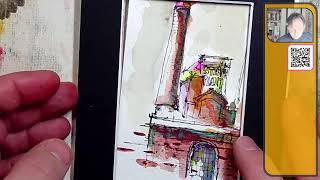
Architect Jason Nicholas sketches the Spokane steam plant live, layering purple pens, watercolor markers, and ArtGraph chalk to build brick texture and depth. He works wet-on-wet, pulls from music and industrial architecture, and takes viewer questions about his improvisational process.
Chapters
Hey, happy, um, Friday. Hope you're doing well. It's 10:43 PM on the East Coast. I'm, uh, working on a sketch here, inkspired by the steam plant building in Spokane, Washington. This is one of the facades. You can see the smokestacks, the chimney stacks coming up here. I'm kind of embellishing it with my own colors like I usually do, but it's a most— it's a brick Pretty much a brick building. There you go, throw down some colors. I see Karen's in the house. Karen, great to see you. Hope all's well. It's always great to see you tuning in. I appreciate it. Let's see, I'll zoom in so you guys can see how some of this is drying. There you go. Good stuff. It's all good.
All right, cool.
Yeah, I like the way this is drying. A little closer. I just love the way these colors blending there. There, some hard edges happening. Get some light on it so you can see it pretty good. This is really fun, what's happening in here also.
Turquoise.
Pretty cool little sketch. Let's see, I think I'm going to make some, um, I think I'm going to mix like a purple purply color. Actually, you know what we're going to use? I'm going to use, uh, I have my purple Varsity pen right here, so let's use the purple Varsity. And I'm thinking in this window area, we'll just throw some in there. Hope, hope, uh, you all had a good Friday. So just throwing down some purple. I'm gonna bleed it. Let's throw some water down on there. Ooh, runaway pen! Let's do this. I'm just dipping my brush in some water. There you go, you can see that nice purple kind of happening there. I like that. Just for the glass area, we'll just have some purple going on. I'm gonna throw some up here. It's maybe where this, um, perspective kind of goes back a little bit. There's some purple on there. One of the cool things I like about the Varsity pens is I can just tap them on the wet areas. I'll zoom in so you can see it closer. So I'm just gonna tap it here on the wet area where I have that window going. The ink just really comes out of these Varsity pens super duper nice. Super duper. Should we rhyme? Should we rhyme the entire show? Let's make a go of— let's make a go and rhyme the entire show until I hear you say no. Should I go slow and stop the show? I don't know. There we go. All right, so we got some purple going on. Cool. I'm loving these colors. I want to leave some white on there. I'll zoom out a little bit, see what it's looking like overall. Ta-da! Hey, Karen says, has some time off of work, so I've been working on my bird paintings. Karen, OMG, your bird paintings are awesome. Awesome, awesome. I— yeah, they're incredible. I am envious. I wish I could do animals. Um, I know you've been practicing and practicing, and it shows. So keep up the work and keep posting those bird paintings. I love seeing them. Very, very cool. You may have done one, and I'm not sure, but have you painted any cardinals yet? I'm just curious. Uh, Chip just arrived. What sketches is— hey Chip, good to see you. Hope all is well. Chip, this is a sketch that's inspired by the, the Steam Plant building in Spokane, Washington. Um, it's an old electric steam plant that's now being converted into restaurant space. It has office spaces in it. It's an incredible, incredible building. Um, one day I'm gonna just do a whole kind of show— we'll talk about the building. I just— I'm mesmerized by it. Um, it's incredible. I have a lot of pictures and love to walk you guys through it a little bit. And I'm going to be doing a lot of sketches of it, so you'll see more of it for sure. Um, I just dipped into some blue and throw some on my brush, and I'm doing blue— I just want to darken some of this, mix it with the purple. Almost get a kind of gray, maybe a grayish thing happening in there. Maybe not. We're gonna let the paint do what it wants to. And I do want to intensify this. This is mostly a brick building. Um, you guys know I like to throw my own colors on. I do want to intensify some of that, and I do have this Art Graph right here, and this is really cool to make some brick. What I could do is dip— I'm just dipping the edge right here into a little bit of water. You can see it's wet. I don't know, maybe you can see it's wet. And to create brick, I could just do this. Let's zoom in. This is a 4x8 sheet of cold press paper. I love the proportions. If I just kind of— maybe too wet, but let's see. I should actually— I should have dipped the small— smaller side in. Oh, now I'm wearing this all over. Um, you can kind of see if I just tap this down, you can get kind of brick looking stuff. Again, I'm just doing this for fun. This could be messy too, but You can kind of see over here it's working on this edge a little bit. Now I got it all over my finger. No, no, um, it's all good. It works really well when I have more paper, bigger surface area to do the ch-ch-chew the brick thing I'm trying to do. I think you can see the idea of what I was— what I'm thinking. Just tapping it down, get some kind of brick effects happening on the building. So it's a really cool way to add some texture. Ta-da! But it's all good. Yeah, they got a lot up there. You can wet it, I could paint it, move it around if I want. I'm gonna let it dry like this. I know I got some off the edge here, but that's fine. Quick, loose, wonky. Um, let's throw some yellow. I need some brightness on here, so I'm gonna break into some yellow. Let me move this ArtGraph thing because I've already— why are you wearing it? It's not art unless— what, guys? It's not art unless you wear it. Ta-da! I'm wearing it on my fingers. I got it all over the place. Um, let's just throw down some more yellow. This will be a fun one to come back and add some ink, some details on with the Sharpie or my Pilot Precise Pen. After it dries. No, just California birds, Karen says. Okay, that's cool. I love that. Chip says love the darker colors. Yeah, I have to add a little bit of depth. It's a watercolor brick. Oh, the ArtGraph. Here, I'll show you. I have the wrapper here. That's what it is. It's not watercolor, it's more of a chalk. It's more of a, like, a chalky material. Um, it's water, it dissolves in water, comes— you get all the different colors. I absolutely love this stuff. I only started using Yep, maybe, maybe 2 years ago. It's really, really cool stuff. Just want to pop some yellow, just add a little bit of brightness on, on this. I feel like I'm trying to be a little too careful with this instead of just letting it go like I usually do. I'm thinking a little too much about it, which, um, I don't really want to think too much about it. I just want to kind of paint, so I've changed my mind gear, my mind gear. My mindset a little bit. Just go for it. So I'm going to make some blue, brown, to make some gray up.
There we go.
A little bit more blue, I think. Yeah, just want a grayish kind of color. Cover some of that window area. We could do some of this gray also, maybe. I don't know, let's do some over here. Cool, there we go. I think I'm liking it. Um, let it dry a little bit. Looks good. Hey, thank you, I appreciate that, Karen. Also, thank you always for, um, sending me the stars on Facebook. I really do appreciate it, it's so fun. And believe it or not, with your stars, you know, I'm able to buy a pen or some paper. And yeah, they do add up. So I appreciate anybody, any of you guys that send stars on Facebook. Thank you. If you don't, I still appreciate you. It's all good. I just love you being here and commenting and chatting, asking questions. All right, what should I do? I want to do some cray cray on this little sketch thingy. I don't know, I'm thinking too much. I'm gonna grab and go, grab and go. What do I want to throw on there? You know what I haven't used in a while? Um, sepia. I'm gonna grab a seat— my seat— a watercolor marker. Find it. I got my watercolor markers in here, so I'm gonna grab sepia. I'm gonna throw some background on this and a little atmosphere to it. So we're gonna take— this is a Winsor Newton This is sepia. It's a watercolor marker with a bunch of different kinds of colors in here. Yeah, let's throw in some sepia in the background and just darken it up, make it a little gray. Maybe that'd be fun. So here's the sepia marker. Instead of me using the marker right on the paper, I could do that. But I like— I have better control if I throw the— see, if I throw the sepia right down on my board, and I'm gonna use my brush and water on it, and I'm just gonna lift some of that up, and we're just gonna kind of Just throw some of that sepia right on the paper, create a little bit of atmosphere, a little bit of mood. Normally I like to work at an angle, like, or tilt the paper up at an angle so things bleed down. I didn't put anything underneath this. Could I use—
I will just throw this on there.
There you go. I just want it down at an angle so the water kind of runs down the page a little bit. You can see how that sepia is— has a kind of a cool atmospheric grungy kind of vibe to it, which I like. Now if I take the marker and put it right in the wet area, you can see it coming out a little bit. I like that look. Uh, if I threw the marker right down on paper, the dry paper, it— for me, it kind of stains where I throw it down, and I can't move it really loosely with water. That's why I like to kind of either start on the palette, lift it, and on, but then just dip it down on wet areas. I guess I could also just add water on the paper first and then put the marker on it. A lot of different ways to do things with your, uh, your tools. So don't be afraid to experiment and try. I like the mushroom effect that's happening here. Pretty cool, right? I just think it's helping just to create a little bit more of a setting of where this building is. Sometimes I'll leave the backgrounds white and on these kinds of sketches, and sometimes I'll add a sky or something in the back. See, maybe I'll just put the brush— I mean, the marker down here, kind of see what happens.
Cool.
I'm liking it. Let me know if you have any questions or comments out there in Instaland or Facebookland or YouTube land. You can probably hear in my voice, I'm pretty tired, but I wanted to do some sketching. So, appreciate the tiredness. I mean, I'm sorry about tiredness. Uh-oh, Karen says, "Watch out for the face." Oh my gosh, yeah, where's that sketch from yesterday? Where'd I put it? I think it's here. Oh, I think it's right here. By the way, I love this. This is a really fun little— it's a black and white Maine-inspired sketch. These might be my favorite kinds of sketches, to be honest with you. I just— I love black and white.
Really cool.
But anyway, yeah, here's the one from last night where we— where you guys discovered a face in the sky that I eventually kind of took out. That was so funny. I love when you guys see things in paintings and sketches. So fun. Chip has a question. He says, "What might be 3 things that determine your direction in what you paint? Location, mood, etc." I'm gonna let this dry. I'm gonna have a sip of water. It's an awesome question. What might be 3 things that determine your direction in which you paint? So Chip, I don't know if you mean like subjects I'm gonna paint or the mood or style. If it's a style thing, um, 3 things that come to mind. One thing is music. Music I'm listening to at the current time can definitely impact where I'm headed with a sketch. Materials or tools I have nearby, that kind of impacts also. I like to grab and go. I don't like to sit, stop, and search for a pen or a color or a paint or a brush. I like to I like to create in kind of fast— at a fast pace, so I need to grab and go. So that kind of influences the style or how things will look as well. Um, what else? Music, what's near me, um, and I have to say, in the back of my mind when I'm doing architecture, I love industrial architecture. Vibe of industrial architecture, old rusty buildings. Um, I love metal, the color of copper as it weathers. Um, I always have that kind of in the back of my brain, and I like to bring that aesthetic to what I'm doing. You know, even new buildings, if I sketch them, it'll end up having some kind of industrial vibe. So I don't know if that kind of makes sense. I'm just Talking off the fly— off the fly? On the fly? If I was a fly on the wall, whatever the expression is. Well, I hope that answered your question. Let me know. I'm not sure if you meant that or something else. I think— I love the question, so thank you. What I love about questions is it makes me think about my process because I don't stop enough to think about what I'm doing. I just do it. But I need to know what I'm doing and why I'm doing it, because when I teach it, talk about it, it'll make it easier for me to under— to get my point across of what I'm doing. And what I'm doing isn't the right way, it's just my way. Some of you guys like what I do, which is awesome. Um, there you go. So I wanted to throw down some of this preppy yellow color. So music. So for example, right now, um, this music is awesome. I love it. It's a great playlist, but I have to be honest with you, I'm not actually hearing this music in this— in my brain right now. So, uh, I'm actually hearing a little bit of, um, the Cranberries in my head because I've been listening to them a lot. So the song Zombie is in my head as I'm sketching tonight. I can't play that because I'll get copyrighted.
All right, let's do it.
Let's just splatter some guys, you know, like, like the splatter. Uh, Chip says, I think you just answered it. Hey Chip, thank you so much Chip, thank you for making me think and you guys out there and asking questions, it really— I do love it, I love reflecting on what I'm doing, it's so helpful. On many levels. Mickey, hey Mickey, great to see you. Mickey says copper is your favorite, also tin barn roofs. Yeah, oh my gosh, I love old weathered tin barn roofs. Beautiful. You know what, that might have to be— I'm gonna write that down. That may have to be an upcoming— let me know, would you guys want to see like a barn sketch, like an old barn? Sketchbook. Here's the funny thing, I'm looking for something to write, to use to write a note with. If I zoom out, look at my desk here. I don't know if you guys can see it all. Um, here, I'll move this over. There's only half of it. So I'm trying to find something to write stuff down with, and I have all this right here. I'm so silly. Um, now I'm looking for scrap paper. I have— I do have scrap paper here. This is scrap paper. Let this dry for a sec. So yeah, maybe we'll do like, um, an old weathered barn next time. Maybe tomorrow, uh, tomorrow night, probably not. Maybe tomorrow afternoon, or maybe Sunday or something. So old weather barn. Also in the chat, let me know what other types of buildings and architecture would you like to see me sketch. I'm open for suggestions. You know, I do— I love New York City. I do a lot of NYC stuff. This building is in Spokane, one we're doing tonight. But in the chat, just put down maybe some buildings or cities or states or towns. I don't care, it doesn't have to be a city vibe. I can do— I can sketch any kind of building. Um, so I'd love to know what you guys want to see. Let's move this back into view. Chip says, 'Need stickies on the wall.' I know, right? I'm a sticky note guy. I have piles of sticky notes behind me. Love that, Chip. Chip said, 'Music is a great answer. That's pure mood.' Yeah, I can't I've tried sketching and painting in silence. I can't do it. I do love quiet. There's a time for quiet. Um, but this stuff, I need to hear music. I'll listen to anything from classical to ABBA to Neil Diamond to Metallica. I mean, I'm all over the place with music. I don't do country music though. I never really got into it. Um, yes, I'll buy an Old Barn sketch. I collect them. Hey Mickey, that is so cool! I'll do an Old Barn sketch, and if you like it, I would love to sell it to you. That's so awesome. Sorry guys, I'm really thirsty. Yeah, I'll do that. I have a cool book if you guys want to see. I haven't done show and tell Show and tell? Show and tell in a while. Let me show you a really cool barn book. Just dab this a little bit, then I'll get the book. I've showed it before, it's really awesome. Mickey, you might dig it. This looks like a hidden Mickey up here. You got a hidden Mickey in the sky. All my Disney fans. I'm also going to be sketching a lot of Disney stuff, inspired stuff. Buildings, theme park rides and stuff. Um, that's kind of a summer goal of mine this year. Not that I'll be at Disney, maybe, but I want to sketch Disney. Get that book. Ah, it's right here. Love this book. Let me move this out of the way. Zoom out. This is a really cool book, Old House and Barn Plans by Richard Rawson. I've had this book for many, many years. It came out in originally 1950, but this edition is from 1990, so I've had this since 1990. And here's what I love. So, um, I'm an art— as most of you guys know, if you don't know, I'm an architect by trade. Um, so it has some really cool technical types of drawings in here, right? It's a very technical architectural type of plans. Love them. Love architectural drawing. That's going to be something fun to start doing live as well, maybe doing some art technical drawings. I've been talking about it for a while. But it also has— let me just check out these drawings as well. Pretty awesome, right? And there's some loose sketchy things. This isn't so loose, but it's a beautiful sketch. See what else we have in here. I love, I love round barns. Check out that floor plan. These structures are just so incredible. I love cross-sections. This is a cross-section sketch. If any of my students are watching, hey, hey out there, um, this is a cross-section. So we're cutting through the barn, we can see the structure Imagine a cross-section, like a— like you're cutting through a cake. Split the cake and you can see inside and see all the layers. So that's like this— a section drawing is cutting through a building, seeing the layers inside. What else? I could show you this book for hours. I love— I really love this actually. This is cool. Look at the hatching on this, just the pen work. These may have been old plates. I'm not sure if these are ink sketches or these were drawn like on plates. I'd have to find out, like engravings. I love the— look at the depth and interest you can create with just lines that crisscrossing each other. Look at that roof, it has that nice weathered look to it. Hope you guys are digging this book. I love when they just reverse things in black and white, so powerful. I did that in high school, in college, and a lot of projects, these types of drawings, black background with white walls. You know, even look at this, it's just so cool. Even just look at the trees and landscaping, it's really simple. Give it— it gives it an atmosphere, a setting, just by throwing some landscaping on there.
There's anything else?
It's just a cool aerial perspective. So yeah, so this is called again Old House Book of Barn Plans, Richard Rawson. Highly recommend it if you like barns. All right, let's put this back. There's another barn book on my shelf. See the camera following me in here. I'm looking on my shelf here.
Holy moly, I'm not seeing it.
Yeah, it makes me a little bit confused. It should be in here. Well, here, I'm going to show you this book. Oh, I have another book by this— I can't find it now, but, um, I have another book by Eric Sloan. I have one that's just about Barnes. I don't— it should be in here. I don't see it, but Eric Sloan, if you don't— if you've never seen one of his books, yeah, let me just show you inside. Hope you guys are liking this, um. You can just move them around and not erase. Yeah, too cool. Does different styles of music affect the way you paint? Yes, Chip, it does. Here, I'll show this here and look at the book in a sec. Oh, absolutely. Yeah, if I'm listening to Metallica or AC/DC or hard rock, oh yeah, my hand will it'll be much faster. You'll see me grooving. Lines will be much looser. Then if I slow it down, I'm listening to Sweet Caroline. I'm a huge Neil Diamond fan. I'll listen to Neil Diamond. It's totally different, very slower pace. Drawings usually end up being cleaner and the color is calmer. So music totally can affect my styles. Oklahoma's full of great old barns, really, even round ones. Oh, Nikki, that is awesome. Like, you like to do pen and ink? I love that. Karen says yes, did a lot of pen and ink in college. I love that. All right, let me show you this book and then, uh, we'll wrap up the factory— the steam plant building, I mean. I'm gonna zoom in so you can see some of the stuff. This was actually an old book they were throwing away, getting rid of, and I was able to get it. Um, so Eric Sloan is great, great. He tells a lot of history. I mean, there's some— learn about fences, but I just love, um, the sketches and drawings that go along with the content of his books. I check this stuff out. Like, here's a windmill. How cool is this? And then if you have— I love this page. This has like— it almost reminds me of like a Leonardo da Vinci type of sketch. It's just breaking down different components of the windmill. This is interesting. Do they really have dogs used to— and on treadmills too?
That's kind of—
well, I guess they did. That's a whole different conversation.
Huh, I didn't know that.
Horse treadmill. So I guess, I guess at one point in history animals were used, um, in mills. We're gonna— we'll save that topic for, uh, that is not for this show. I don't know how I feel about that, but you know, different times. Um, this is a cool perspective. Look at this, these trees. Very scribbly. This is really— I'm gonna need one of those Post-its now, Chip, so I can mark this page. I just love this sketch. It's having a lane, the width of a lane for— oh, a cemetery. There's actually some kind of cemetery there. It's about the lanes in the cemetery. So, it's a really, just really cool illustrator. Look here. Here's some really— covered bridges are awesome also. I'd love to sketch more covered bridges.
Cool, right?
So, here's— this is another book. Again, the author is Eric Sloan. He has a bunch of books out and I know there's one that's just barns. I have it here. It's called The Age of Barns. I may have brought it to school. It's possible. All right, let's wrap this one up. Let me know if you guys have any more questions as we're rolling along here. Appreciate you guys watching. Not seeing any YouTubers out there, if any. If you are out there on YouTube, feel free to say hello in the comments. Say hello back to you. And Instagrammers, if you're watching, say hello also in the comments. I can't see if you're watching on Insta unless you put a comment on. Where's my Instagram?
There we go.
All right, this is drying up, so I'm gonna just come back and throw some details. Let's use a Pilot Precise Pen. Actually, changed my mind. Let's use the Sharpie. I have a Sharpie roller pen here. I'm gonna change this playlist a little bit. I'm gonna click on where it says this one. You guys see this okay? Should I zoom in? I try to create the idea of make these look a little more curved, uh, and we'll throw down some lines on here. Make sure there's ink coming out of here. Here we go. I'm going to do just broken lines here just so it looks kind of curved. And I'm breaking the lines up just to indicate that there's maybe some brick on these stacks. All right, so you get the— you get the hint or suggestion of brick. If I do these all just straight lines, it would less look— less look— it would look less bricky. That is why I teach architecture and CAD, not language arts. I am not a master of the English language. I stutter, I stammer, I jibber, I jabber, and you know what? It's me. It's who I am, and I've learned to love it. Even if I'm presenting, I've presented in front of boards and building departments and things, and I am who I am. I'm quirky. So embrace your quirkiness. All right, cool. Yeah, I like the way it's looking. Just a little bit of texture, right? It's— this little texture is, I think, adding— it's just adding to, um, this little sketch another level. And just to help these look a little more round, I'm going to do— you've seen me do this trick a lot— let's put some vertical lines. But I'm going to do this. Pull them down just so it looks kind of curvish.
Curvish, right?
This for me is— I love, I love this. It's just coming together. I start throwing these lines on, they're scratchy, wonky. Oh, so fun. It's actually, uh, this actually says Steam Plant here.
Steam Plant.
Should I be brave and write it?
Let's do it.
It doesn't fit. It doesn't fit. Little building. Maybe some of the letters fell off. Oh no, no, he didn't do it! Steam pants. Oh boy, set myself up on this one. You can tell I'm having fun. I'm not, I'm not really caring if I can't fit the letters. It's a sketch, it's wonky. If I had a typo there— all right, so, Systemic Planet, it's acceptable. And I could actually cheat a little bit. I could pull this edge out, kind of bring this here, kind of pull down a corner here if I wanted. That looks like— let me see what that says. Ta-da! Let's do some, uh, there's a cornice piece here, so I'm going to kind of pop it out a little bit. Just give it extra line here, here as well, just to pull that shape out. You guys love how this dried. Look at these colors. Karen says good night. Hey, good night, Karen. Take care. Great to See you. Thank you for watching. And then in the window, we're going to show some of the window panes here. Helps create a little bit of scale for the building. Um, a little bit of an overhang cornice line here. Just pull it out.
What else? Kind of like—
I kind of like where it's headed.
Do have a kind of a trim piece here around the window. There's an interesting—
on the facade we have kind of these cornice pieces, kind of come down like this.
One here.
Then I will add a little— I'll add some lines here to help show some more brick, just to break the scale of this down a little bit. Normally I would do this with my Sharpie marker because it'll catch the skips of the texture on the paper, will make the marker skip a little bit. Seems to work better with the marker than a pen tip. Yeah, this, this marker would definitely work better.
That's okay.
All right, I'm liking it. It's kind of funky designs up in this part of the chimney. Can't really see. I am looking at a picture, but I can't really see it. It's so small, kind of like, uh, just like this, maybe something like that. Kind of an oval, and then we have half oval, half oval that overlaps it. Set area brick here. Cool. Ta-da! Liking it. I'm gonna come back and use our light aqua color pencil. I want to really pop out some aqua on here, and this is a great way to do it. Um, I do have my neon yellow here. All my favorite color pencil colors are right here next to me. Throw some of these on. Silos are really interesting sketch. Yeah, silos are very cool. Colors are really nice, rustic. Hey, thank you. Oh boy, I'm so thirsty. All right, let's see. Let's pop down some of this turquoise and we'll wrap up. You can just see how it's going to pop a little bit. I like to lay it over these rusty colors. I don't want to get too crazy. There you go. I think that's looking pretty cool. That might be enough turquoise.
I'll zoom out.
Yeah, I like it. Actually, I kind of like this. I like this big kind of patch of it there. And I love using neon pink, it just adds some whimsy to the sculpture, a little bit of fun.
Here we go.
I think it's enough pink on there, just a little bit. At least some neon yellow. I do want to brighten some of this up a little bit. You could also use a highlighter. Highlighters work well, um, although if you don't want ink to bleed The highlighter, make sure it's ink that won't bleed. Some pops of color, maybe we'll even throw a little bit down in some of these windows. I'm going to zoom in on the window. I like the way that— I like the colors here that happened. I like the colors happening there. This one might be done, guys. See, let's throw a frame around it. I wish the frame opening was a little bit taller, but this is okay. And it's a cool little picture. I could even— I can move it up. I don't have to have an entire So, smokestacks in there. I could—
I don't like that.
Let's slide it down. Maybe, maybe something like this in the frame. Go higher. Yeah, maybe something like this. I like to— I want to capture, I think, this color up there.
So there you go.
All righty, let me check the chat for any last questions or comments. We're going to wrap up. All right, I think we're all caught up with everything. Thank you guys so, so much. Hey Mickey, it was great seeing you on here. Thank you for your comments, I really appreciate that, and suggestion, um, to do a barn sketch. So I think I'll— I might hit that up next time. Uh, Karen, it was great seeing you. Thank you for tuning in. Chip was in the house. Chip, I appreciated you as well. And I think that's all that was watching live that commented, so thank you guys. If you're still watching or watching the replay, hello to you and thank you. I do appreciate you guys. Keep paying it forward with creativity, or I like to say, use your creativity for positivity. And enjoy the rest of your Friday evening. Have a awesome Saturday. I will be on sometime over the weekend, I'm not sure when. Thank you guys, take care, have a great, great day. Peace and live creatively.
See you soon.





