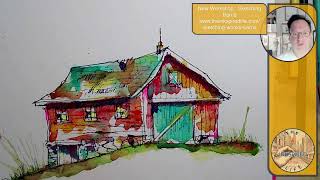
Artist Jason Nicholas finishes a barn sketch using Sharpie, watercolor, and colored pencil. He layers lemon yellow for freshness and purple for shadows, uses wood-grain hatching for texture, and keeps the composition wonky by preserving white space. He's hosting a virtual workshop on October 26 called How to Sketch Wonky Barns.
Chapters
Hello, it's, uh, 10:51 PM Saturday night. Hope you're doing well. I'm, uh, I'm on briefly. I just want to kind of wrap this one up. I started today this cool barn sketch. I really, I like the way it's dried. I'm going to zoom in and show you some of the colors. So this is Sharpie and watercolor that you're seeing here, and, uh, I'm— I always love watercolor because it's so fun to see how it dries. You know, I'm really digging some of these colors, like right in here. Pretty cool. And then I also love what's happening up in this section as well. So let me take you along on a maybe a 10-minute sketching session here. Yeah, we'll do about 10 minutes at the most, and we'll just add a little bit more to this and try to wrap it up. Hope you're having a great day today. I'm gonna dig into some watercolor and just add some more on here. Let's see, I'm going to grab some like a lemon yellow color. I want to put a little pop of freshness in here, a little bit of zest. Whenever I use lemon yellow, I think of cooking and how we add lemon and lemon zest into our cooking to kind of give it a kind of a freshness, a pop of zest. I feel like this, uh, sketch needs a little bit of that zest going on here. Let me zoom in. There we go. Just gonna throw down some red with a Pilot Precise pen. Move my colors, my palette. There, there we go. Cool. I like throwing this layer of red ink on top, just gives a little bit of texture, maybe an idea of some kind of wood grain happening here. And we'll carry that up here as well. There we go. And again, the same idea here except I'm doing it horizontally. Capture some, you know, maybe some wood graining type of effect. Cool. Let's see, I want to add— I did hatch some lines here for shadows, but let me throw down— let's see, I can mix up some maybe purple watercolor paint, but you know, I want to try it. I have some blue Sharpie highlighters— I'm not blue, purple. Let's, um, see if I can put some of this down here, see what it looks like. Oops, this one might be out of, out of juice. Let's see. Yeah, I'm going to grab another one. That one is no bueno. Got another one here. Let's try this one. What the heck? All right, so Not gonna use the purple Sharpie highlighters. That's fine. So we'll just mix up some purple paint here. I like using purple for shadows rather than just like a grayish or dark color. You can see I have some kind of in the palette here. So red, I'm gonna throw some blue in there as well. And we'll just make up our own color. I want to lean a little bit more towards the blue than the red. Let's see, that should be good. There we go. Yeah, I like that. So it'll dry a little bit lighter, but it'll just help to add some shadow, give some depth to like the overhang of the roof areas. What the heck, maybe we'll throw some, uh, throw some in here, maybe a little bit of shadow on this door. Maybe we'll do a little bit under this overhang where the barn door slides open. I'm just gonna hit some of these stones here as well. Cool. I like it. I think that's good with the watercolor. We have some red on there now. Uh, let's throw down some color pencil. Alright, cool. I think this one's done. So, um, cool little barn. We have a Sharpie on here. Watercolor and some colored pencil on this. I'll zoom in so you can see some of the details, how things are drying, how it's coming, how it all came together here. I really am liking the roof. I came back and added some lines on here just to pull out a little bit of texture on that roof. I thought it looks too— looked too flat. Or plain. And notice I didn't do this, these hatch lines everywhere, just in a few sections, just to keep it whimsical and wonky looking. If I did these kind of lines across the entire roof, I think it would lose character. It would have been too much. So one of the things that you want to be conscious of, or, or try not to do is put too much on, like too many lines, too many details, too much color. Notice there's a lot of white space in here as well. Um, it allows for some breathing room and some interpretation. Um, I'm liking it. And maybe I'll add something in the background. I probably will add— I'll probably add a color in the background for maybe a sky, but I'll think about that. I'm going to leave it at this for now. Um, yeah, if you enjoyed this quick barn sketch, this is part 2. I did the earlier one, um, this morning, so feel free to go back and look on my YouTube channel under the live videos. You can see the earlier 2 of these. The first one is just the outline and kind of Sharpie And then I threw some color on earlier today, and this is the final one here. All right, you guys are awesome. I have a workshop coming up on October 26th, How to Sketch Wonky Barns. It'll be virtual via Zoom, and we'll be sketching in, you know, things like this, barns like this. So, uh, the workshop allows you to get a little closer peek inside to my inside of my brain, creative thinking process. And we'll have other people on the Zoom as well to get feedback and share in a fun and collaborative environment. All right guys, thank you so much for watching. Enjoy the rest of your day. Remember, use your creativity to put some positivity out there in the world. All right, we'll see you real soon. Take care, peace, and live creatively.