INK-provising. Conquering Blank Paper Syndrome - Pro tips - v1.0
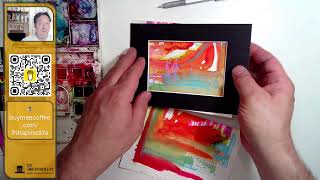
Artist Jason Nicholas improvises a mixed-media sketch on blank watercolor paper, using ink, watercolor, oil pastels, and markers while taking direction from chat viewers. He layers colors and lets inks bleed to discover shapes, eventually developing the abstract marks into a beach scene he titles "A Day at the Beach."
Chapters
Hello, happy Friday! Hope you're doing well. Hey, let's do that again. Hey there, happy Friday, hope you're doing well. It is 8:51 PM here in New Jersey. Yeah, what a long crazy week. Good stuff, but just long. Um, so I'm looking forward to doing some sketching. I need to— yeah, I just need to end the work, the work week. Um, with a bit of creative infusion. So let's do some sketching. I honestly can tell you I have no idea what I'm going to sketch. I haven't— don't have any photos up. I didn't even think of an idea before I hit the start button tonight. So we're just gonna, uh, we're gonna conquer blank paper syndrome. Yeah. So if you look at my desktop here, I have a blank sheet of watercolor paper. Nothing's on it. And sometimes that is a really— what's the word? I guess sometimes blank— I call it blank paper syndrome. It's a big fear of starting to sketch or paint, not knowing what to do. And I sometimes find myself staring at the sheet of paper and yeah, just kind of staring and staring at it. Um, but let's see if we can break that kind of blank paper syndrome and just do something. So for me, it all starts with right here, a creative mindset. I want to shift my brain from being afraid of this paper to looking at it as a think of it as a creative playground, right? This sheet of paper is, you know, think about when you were a kid going to the sandbox, playing with stuff, building castles. This, this is my sandbox right here. So I'm not going to let this blank sheet of paper kind of scare me. I'm not going to worry about making a mistake on it. It's only paper. Um, feel free to, to burn through it and just have fun. So tip number 1 for, for me to crush blank paper syndrome is shift your mindset to a playful one. So let's just spend some time. I have some watercolors here, I have some pens, markers, I have stuff in here. I don't even know what tools I'm going to use. I'm just going to kind of grab and go. And that's another fun way to break creative, uh, to break the blank paper syndrome. Just grab and go with whatever pens, pencils, paints, any supplies you have nearby. Um, sometimes if I sit there and I think too long about what I'm going to use to create a sketch, it kind of paralyzes me because I'm thinking too much about what I'm going to use. Um, so think of this as like an improv session. We'll just go for it and have fun. And it might not even look like a building, it might not look like anything, it It might just be colors or lines on a piece of paper, and that is cool with me. It's just the act of creating that fires me up. Hey, I see D-Ray is in the house. Great to see you. Chip is in the house. Great to see you, man. Yeah, this is my sandbox. So I think tonight we're gonna focus on crushing blank paper syndrome, and I'll just throw tips out that come to my brain. That might be a little repetitive, so bear with me. All right, blank piece of paper. Um, here's what I feel like doing. I feel like just throwing some color on here. Not even— I'm not even gonna start with a pen or a Sharpie. We're just going to throw color down and maybe come back in and we'll add lines on top of it. So I have a new ink color that's right here that we're going to use. It's called Clementine. Um, I'll have it there so you can see it. Maybe it'll focus. Focus, focus, focus. Maybe not. Um, it's Clementine by Birmingham Pen Company, so it's brand spanking new, never used it. Well, let's throw some down. I really love— I really love Birmingham Pen Company ink. I love their colors. I'm not— I'm— it's not the cheapest ink out there, but it's, um, I love the quality. It's pretty awesome. All right, I'm just dipping into my paintbrush. Well, not dipping into my paintbrush, dipping my paintbrush into water. I'm literally just going to dip in here. Feel free to ask questions, guys. This is a great night to throw questions in there, pick my creative brain, ask anything about sketching, drawing, painting. Especially architecture. And ask me about creative mindset as well. I'm up for it. All right, we got some of that Clementine down. Let's just throw it on here. I do want to just put this at a little angle, so let me prop this up here. I like to— I like to do ink and watercolor at an angle so things run down— everything runs down the page, which I like. All right, I'm actually going to change the tunes up. I want to put something a little peppy on. So another pro tip that helps me with crushing blank paper syndrome is music. Put it— I like putting the tunes on and just going with it. So we're going to change it up. I'm going to play a little bit, uh, a little more peppy, kind of fun, maybe more rock type of music. Yeah, let's do it. I wish I can't play any classic rock. I don't have— it's all copyrighted. So I'm using a sound service that I paid to use these tunes. So let's see what we got. All right, I'm talking a lot. Let's throw this stuff down. I'm not going to talk for a minute or two and just let the music Take me somewhere. So you can see I'm just, just throwing down some color, just listening to music. It's no longer a blank sheet of paper, right? It's got something on it, it's got some color, very abstract, and that's, that's cool. I'm just having an open mind and just kind of just throwing colors down. It's fun. I'm just— I'm kind of feeling the vibe. And look how that is some red. That is some serious red going on. Um, and the fun thing will, will be when this dries, we'll just sketch on top of it. Probably take the Sharpie out. Of course, my brain is always seeing, um I'm always seeing buildings. I'm already starting to see a skyline happening in here, so we'll see where we end up heading. What else do I want to grab and go with? Um, let's grab and go. I guess let's go and go in here for a sec. Um, I don't know, we got these oil pastels. Sure, why not throw down some of this oil pastel on this? This actually looks very cool. Let me zoom in. This is looking cool, this oil pastel on top of the, that orange ink, I guess, or was it called Clementine ink?
So we got a little bit of mixed media happening here, right?
This is very different than we usually see me doing. It's It's even looser than I usually start, right? I usually will start with my Sharpie, do some outlines for the building, but this— we're just throwing down color. How many times have I said that? Um, all right, maybe I'll let this dry, then we can throw down some ink on top of it. Uh, actually, no, I'm not done yet. I'm gonna grab— I have a pink preppy I'm sorry, Varsity Pen. So let's just throw on some pink, pink ink, and we will bleed it. Uh, let's see, I want to just tilt it up a little bit more. Let's just let it run down here this way. Let's throw on some pink. I'm, I'm curious. I want to see how this pink ink is going to look. Actually, it's I'm loving this color here. I'll zoom in in a second. I don't know, you might see me do this. My hand wants— my hand's actually telling me what to do. It wants to do a curve or something, so let's do it. Let me just see if it's going to draw it. There we go. My hand said let's curve this here, so we're curving it. Oh, am I running out of ink? Um, it's really cool. You can see how this is all starting to dry here. So being playful and not really having— so my only intention really tonight is to be playful. Sometimes I like to set creative intentions before I start sketching or painting. So the only intention I set here in my brain was to be playful. And by being playful and experimenting, one of the things I'm really— I'm discovering is the colors I used here really, really make for an awesome, like, fire. I mean, look at these colors. They're— they are fire, as the kids say. They're fire. Um, Really, really amazing. And honestly, I don't remember how it happened, so that's why it's good to have a recording. I can go back and watch what I threw down. I mean, I know you— some watercolor yellow and the orange. I don't even— I don't even know if I added red here. I can't remember. But anyway, so you never know what's going to happen when you're just kind of free-forming, playing around, even with textures. Like, I'm loving the texture of the oil pastel on top of the watercolor here. I actually really, really love it here on that orange background. So I'm playing, but I'm also learning. I'm learning things I like, techniques, things are happening. I'm learning things I don't really like. This is— I like what's happening down here though. I like the colors that are puddling at the bottom. I'm going to try to let this dry like this. So don't think every time you sit down to sketch something that it actually has to be something. It doesn't have to end up looking like something. It can just be. Just as the Beatles say, just let it be. And It's kind of— we're doing the same, we're just letting it be. Um, this is actually very cool here too. I love watching this stuff dry right here. I love what's happening in here, this hard edge. Just that shape is really cool. So you can look at colors, the way they mix. Don't mix. You'll get textures, hard edges like here. Um, shapes. Look at shapes. There's some cool white space here, some cool shapes there. There's, there's something this needs. I want to add some dark, like some dark blue. So I don't have any— what color left in here really, so I'm gonna just throw down some— I have a Varsity pen, I'm sorry, Preppy pen, so let's just throw down some Preppy. I really want— I'm curious to see what this orange looks like next to some blue. Let's bleed that. This is like techno It's like Transformer music or something. I like it. So right, even the tunes are different than I usually play, so I'm creating— it's helping me to create in a different style. The music— this isn't coming out. See, I like the Varsity pens because they'll— if I do this, the Varsity ink will bleed out nicely. Preppies don't really do that, so I kind of gotta— I kind of have to throw the ink down and then the water on top. Yeah, totally. I totally lost the blue. Here we go. I'm just throwing some water on top of that blue. I'm gonna— I really, I just want to see how it would bleed into the orange, how it would look. Ah, I feel like pulling out some highlighter. Let's put some yellow highlighter on this. Um, let's see, colored pencil. Let's throw on some colored pencil. I'm gonna take out, uh, light aqua, of course, neon pink, my favorite colors. Gotta grab, grab the chartreuse. Let's just grab these for now. All right, so I think I'm at a point after I throw down some colored pencil Actually, you know what, before I do the color pencil— nope, never mind. Now I'm starting to overthink it, and I don't want to do that. I just want to create a flow to keep going. So again, this is meant to be loose, fun, crazy, whimsical, playing with colors, playing with inks. I love the way this is drying. These colors here are so cool. Some of you guys may even start You might be looking at this and seeing faces or other shapes or things pop out. That's one of the— excuse me— that's one of the fun things to do when you're creating like very abstract things is you can, uh, sometimes you just see images or you see— lots of times people see faces in abstract pieces. Nothing's popping out to me yet and I haven't really been looking, although The only thing— something has popped out. This almost reminds me of the shape of— this could almost be like a violin or something, kind of the base. If we finished it out, we could turn this into either maybe a guitar here or some kind of violin. I love this color palette. The light aqua on top of this orange is looking sweet. If you guys— if you guys watched me when I first started going live, gosh, I don't know how long ago, but I would usually start off the live streams doing these abstract cityscape sketches. Um, which was a really fun way to conquer blank paper syndrome. I would basically just kind of free scribble, free form. I call them med ink-tations lots of times. Just close my eyes and I would just put the pen down, draw stuff, and then somehow turn that into a skyline. So that was a really cool way to start the sketch sessions and to get the creative flow going. And to not worry about looking at a blank sheet of paper. You know, sometimes you just have to get the momentum going, and it could be something as simple as just scribbling. Put some— put your favorite music on and just let your pen or pencil just kind of move. Med Ink Tations. Med Ink Tations. I think I have a video out there somewhere on my YouTube channel I put out about that a long time ago. Maybe I'm due to do an update. So I'm just loving this color, so I'm just— that's why I'm just going with it. If we have any Miami Dolphin fans, this kind of reminds me of the Dolphins colors. I used to be a huge— I used to be a huge football fan when I was, I don't know, probably in the '80s, '70s, '80s. I used to love the Dolphins when they had Dan Marino playing and Don Shula was the coach. Um, big Pittsburgh fan. How'd I get on the football? Big Pittsburgh fan when Terry Bradshaw was quarterback. I don't really follow, follow it anymore, but I guess these colors are reminding me of sports teams here. All right, you got to throw some pink on here. You know I'm gonna— you knew that was gonna happen. And I just put my hand in a puddle of wet ink. Another color combo I really love— it might be hard to see on camera— is neon pink on top of orange. It creates a really beautiful color, right? Might be hard to see, but right here, really awesome. Actually, what does the pink look like on top of the, um, red? Let's try that. Yeah, that's actually pretty cool too. Awesome. Alright. Maybe this, maybe this one's done. Playtime thing, just throwing down colors. Hey, who— I don't have any Seinfeld fans out there. Seinfeld. But Seinfeld was a show about nothing, right? This, this is a mixed media sketch about nothing. About nothing. Like, as far as content goes or subject matter goes, there's nothing. Special about that. But what is special is that this was just play, playtime, playtime in the sandbox. It's the creative sandbox, right? One of the things I like to do when I do like these quick fun, the colors down abstract things, is I'll— I like to look at the page and from different, um, orientations. All right, so when I turn it this way, I can totally see a landscape happening. We've got some land, some ground in the foreground. Maybe we have a sun— sunrise or sunset happening here. I can see these being turned into, uh, I could bring a pen and turn these into mountains somehow back here. So this, yeah, I could picture that being almost, uh, turned into some kind of landscape sketch in this position. Let's look at it this way. Oh, actually, yeah, here you can actually see guitar, violin, or some kind of instrument, right? When I turn it upside down, I see it a lot more. Let me get, uh, let me get my frame out. Which one? This one, maybe? Let's try this one. So if you look in this section here, right, do you guys see that with me? Can you almost see some kind of an instrument happening in here? Any of my musicians out there, you can let me know. Does it look more like a fiddle, violin? I'm seeing violin in my brain. Or fiddle and violin is the same. I think they are, right? Again, my musical Peeps out there can let me know. Um, but yeah, that's really cool. I'm seeing an instrument. So, you know, another cool thing with these abstract pieces is framing different parts. You see me do this all the time on sketches and paintings, just frame different areas. I mean, these could be cool abstract compositions. This looks almost like some kind of like white eyes. Oh, I almost see a skull. Do you guys see a skull here? This is fun. I'm seeing a skull kind of happening here with— these are like the eyes of the skull. Here's like the head kind of wraps down. This could be like the jawline in here. All right, this is so cool. So this is a really great exercise for, um, for developing your creativity. Creativity is a skill that can be developed. It's not something, um, when people say they're not creative, it's not true. We all can be creative. It's a skill that can be developed. Some obviously may have more special gifts than others, but we can all work on it, right? So this is a really good strategy for just kind of visualizing and using your brain to stimulate the creativity, to see different shapes, different objects in abstract things. It's kind of fun. So that was interesting. Yeah, so a skull, I see a violin. This I almost see I almost see a person. Let me frame this too. Sorry if I'm shaking this around a lot here. I'm almost just seeing, um, the dress. Maybe, maybe there's a woman here with this, like a dress flowing out. Maybe she's holding something in her hand, kind of comes up to a head. So maybe there's some kind of silhouette of a person happening there. And this was just all a result of flipping it over. We were looking at it this way when I was drawing and painting, but flipping it on its head, I'm seeing it totally different. Hey, Misty Cat— Misty Kate! I almost said Misty Cafe. I guess I could go for a cup of coffee. Misty Kate, great to see you. Okay, D-Ray sees the skull. Awesome. You guys see the violin? Yeah, yeah, right? So I'm not cray cray. So if you're just joining us, tonight is— I set an intention just to be playful, not trying to create anything at all, not a building. And I have to fight that. I really got to fight the urge to not create a building. Or some kind of architecture or some kind of a cityscape. Um, let me put some music back on. Let's put this on. So I— my, my brain is fighting to not do that, which is cool, but this is fun, right? Just throwing in colors and messing around and seeing what happens. All right, we— let's see, we didn't look at it this way. We looked at it this way. Yeah, because I said like a landscape here. Let's— we didn't look at it this way yet. So let's look at it this way. Let me get a drink of some lemonade. Lemonade. Limonada.
By the way, I'm using a—
Retro hasn't made an appearance. Do you guys remember Retro? Here's Retro. I have not sketched Retro the dog and the whistling cowboy in eons. I'll have to bring them back. But here's Retro, the Retro mug. I always wanted to do something more with Retro and the Whistling Cowboy and do some kind of story with those two characters. Oh, I love, I love lemonade. Mm-hmm. All right. Yeah, this is cool. So, uh, let's look at it this way. So again, I could also see another landscape foreground here. Sun, sunset, sunrise happening here. What else do I see in this? Anything? No, nothing else is jumping out at me right now. And then this is the way we sketch it. Um, I do love— I like— I love the way this is drying down here. To check this area out, it's pretty cool. Alright guys, let's see. So we've been talking about crushing blank paper syndrome. We talked about using music. We talked about, oh, creative mindset. Just think of this as playtime and experiment. You don't always need to have a specific subject in mind when you're starting. If you're— so, but if your goal is, say you were wanting to create— let's say I wanted to sketch the Empire State Building and I was stuck. I had a blank sheet of paper, I didn't know where to start. I know the building, but maybe I just didn't feel like I wasn't ready to sketch it, but I needed to sketch it. Just by doing something loose, quick colorful or non-colorful, just scribbles. Once you get that momentum going, then it's kind of easy to switch to the subject you wanted to sketch or paint. So sometimes getting started is just that creative, that motivation, that energy. Yeah, I'm just, I'm just, I'm just listening to music and doodling. This reminds me of— I used to do a lot of abstract acrylic paintings. Um, if you look on my YouTube and go way back, you'll see a bunch because I would livestream them. It was always fun. The comments I got were awesome too, because people would comment and say, um, yeah, I don't get it. And that's cool, because I didn't get it either. I was just doing it. Um, if we don't always have to get it, just do it. Make it. You know what, if you guys see me smiling, that's, that's my goal. I just want to smile. You know what I want to try? I want to throw down some marker on here. Um, I have markers here. This one's called Bright Orchid. Let's throw some marker on this paper. So this is watercolor paper. These guys, if you ever use these markers, make sure you use them in a well-ventilated area. They really are powerful. Can I bleed these? I don't think I can bleed them. No. Oh, you know what I want to use? I have some Posca paint pens. Let's throw some of them, uh, let's use some Posca paint pens. Um, the other blank crushing blank paper syndrome tip was grab and go. So grab and go with whatever sketching, painting tools, supplies you have around. That way you're not sitting here thinking about what to use, you're just using it. And again, that keeps that flow going. If I have to think too long about what I'm doing, uh, personally it shuts me down. My brain really wants to just keep moving, and it's okay, it's okay to be slow, but if I'm sitting here thinking about what to use and thinking about what to draw and thinking about how many lines I should throw down here, that for me slows my momentum down. Um, I haven't really used Posca paint pens too much, but I'm kind of liking I like how thick they are when you put them on top of the ink and the watercolor. Let me throw some down here.
Let's just—
you can see, let me know if you guys have used these paint pens. I like it. I think I have like 6 colors. Let's grab— I have— what is this, like a purple or something? I don't even know. This is, uh, where's the color? Lavender. Shake up some lavender.
Oh, you know what, let's sketch.
Let's get some lavender kind of people figures here. You know, some kind of lavender people hanging out. Maybe we have a small lavender child over here. Maybe this is a family at the beach. Maybe it's a beach scene, so we have a couple peeps there. Maybe a kid's down here doing beachy things. Got another one, maybe their friends or siblings, maybe they're twins. There you go, that's cool. We got some peeps on there. So guys, let me know if you have any questions or comments. I'm going to wrap up probably in a couple minutes. All right, so this, this in my brain has somehow now transformed into a day at the beach. So you never know what's gonna happen. Once I threw these people here, we call it a day at the beach, and I'm thinking it would be— we would frame it like this. Oops, I cut off the kids there. Cut their legs off. Um, that wasn't nice. There we go. Now we got them in the frame. Yeah, let's call this a day at the beach. Or do we do it this way? Let's look at this frame also. Maybe something like this. I kind of like it. You guys like this? Yeah, I'm actually digging it. That's funny, I'm asking you guys if you like it and I'm sitting here saying I like it. I, I want to throw some white on here. I do have a white paint pen. My mouth is really close to the microphone. If it just got really loud, that's why. I don't have a white— I do, I have a white paint pen. So why do I want white? Because I want to draw a seagull. Let's say we're going to frame it this way. Actually, I could use your, your input. Do you guys like it vertically like this, or do you like the frame horizontal like this? Let me know in the comments, vertical or horizontal, because I think I'm actually going to cut this one out and put it out there for bid or for sale, because this is actually a cool little custom piece. I like it a lot. That lemonade is so good. And also, depending on your answer, is where I will probably put a couple of seagulls. All right, so while we're waiting for responses, hope you could— hope you guys are out there. If you're out in chat land, let me know. You guys are quiet. I do see a bunch of people out there watching. I see their— well, I can see a number on my screen, but I still don't know who's watching. But, um, yeah, it's all good. I'm just going to put some of the stuff away. I like this music. Hey, we have Zikorex. Zikorex is out there in YouTube land. Zikorex says horizontal. Hey, thank you for commenting and over there on YouTube, I appreciate it. All right, we gotta— we got one horizontal, we got one vertical. I'll tell you what my thoughts are. Misty, thank you. Mr. Kate says, I like the vertical. Thanks for commenting, guys. Chip says, much energy expressed here with the colors. Hey, thank you, Chip, I appreciate that. Chip is awesome. Chip, I'm hoping I get to see you this summer. It would be so fun to get together and we will, we will chat, tour around, look at some stuff, and do some sketching. Horizontal looks like a day at the beach. We got two horizontals. All right, so my vote— I'm actually on Team Vertical. Let me zoom out a little bit. I'm on Team Vertical. Although, although this could actually be a very abstract sailboat in the background if we did it horizontal. That I'm not— I am now just seeing that, whereas this way I cut that out. Hm, I should leave it up to the buyer. Just offer two options. Horizontal. All right, horizontal is winning, guys. Yeah, I, you know, day at the beach, when you think of beaches, right? Beaches are definitely very very horizontal. You know, you look out at the water, the horizon, it's horizontal. So I could see why you guys would say that. Excuse me, why you guys would say that. All right, I think, I think I'm being converted to Team Horizontal, which is fine because I could do something else with others. Stuff. Maybe this could be some kind of abstract, um, something or else or other. Or do we just frame out the violin— the guitar— the violin? He's overthinking it. Vertical looks like buildings in the distance. Let's see what Chip says. Yeah, so Chip, I, I see what you're saying back here, right? I agree. Uh, Zikorex, horizontal, you can still draw seagulls. Yeah, so I could draw seagulls. I think I could put them in either way. I'm thinking up in here we'll do some seagulls. Well, either way they would still be on the drawing. Painting, sketch painting, whatever we want to call it. I'm not really too technical with my terms. I like to call these sketch paintings because it has a little bit of sketching, a little bit of painting. All right, let's do, uh, some white Posca pen. I have a white gel pen, but they don't work as well, so let's do this bad boy. Thank you guys for your input, I appreciate that. I love the feedback, I love the interaction. Um, it keeps me going for sure. All right, so let's do— we're gonna do really simple seagulls. We're just gonna— I like to maybe up in here, like the letter M. So we'll just call those seagulls. Really simple letter M's. Quick way to— that I just like to share a seagull. Yeah, this looks cool. This was just one— this was one of those fun pieces to see come together. You guys are awesome. Here's what it looks like vertical with the seagulls. Yes, Chip says horizontal speaks more about possibilities. I'm gonna— I'm going with— I, I'm gonna go with team horizontal. You guys are convincing me. Let me get a pencil. I just want to draw a line where I might cut the paper. Where's my, uh, got some pencils here. This is a really cool— I love this pencil, by the way. This is a cool mechanical pencil. I've had this a long, long, long time. This, this may be back from the college days. It's a Rotring aluminum. I love the weight on it. So let's just kind of frame this and we'll just put a sketch line. I do want to show a little bit. I kind of want it up in here. Let's see, I could do it that way with some white space on that side. We don't want to cut that off. No, I like it shifted more this way, the people more to the left. So I think I'd— I think I would do it right here. All right, so I'm just going to mark this. So I can cut it out. I'll cut it— actually, we'll cut it now. Well, this paper is going to rip there.
It doesn't matter. I nail it.
I'm just redoing it. I kind of like it here a little bit better. All right, now let's cut this out. Yes, sand at the bottom. Yeah, right, definitely. We're going to cut this. I'm going to have a really cool metal ruler here. Ta-da! Welcome to some behind the scenes. So we're going to cut that, and I have a couple of X-Acto knives around here. All right, let's cut this bad boy. We're gonna slice and dice right here. Um, I don't really want to cut the sheet of paper underneath, so I have, I have some scrap cardboard. I also have a cutting mat here. I'm being lazy because I don't want to take stuff off the cutting mat, but I'm going to do that. Just kind of move some stuff. All right, so I'm just going to stick a cutting mat underneath. There we go. I am hoping this summer to make some models. I, I miss making architectural models big time, so I, I think I'm going to try to make some models and even, uh, do some live streaming. I think it'd be really cool. All right, so we got that cut. This we can just tear off. If you want to just tear this off too. We'll see what we can do with this other sheet. And this we were going to cut here. Oh, I am, I am putting stuff on top of my keyboard. I just hit my Apple iTunes somehow. Oops, I don't know if you guys ever heard that, but my iTunes were playing. All right, let's cut this off here. We'll see what it looks like matted again. Um, this video is one to definitely go back, rewatch. We talked about crushing, Blake Paper Syndrome, being playful, grabbing and going, all kinds of good tips, and not really pre-planning, and we ended up with a cool little day at the beach abstract scene like this. I just want to put this here and I can cut the bottom. Yeah, that's cool. So I'm just gonna— I'm just gonna slice this. Um, I'll just mark with a pencil. I could cut it directly, but we'll just do that. Ta-da! And we'll cut it here. Hope you guys are enjoying this session of me cutting this paper. And I don't even know if the music's still playing because I put stuff on top of the keyboard and it went wonky. Everything went wonky. I don't even know if I'm still streaming. I may have turned it off. All right, cool. So we got this piece Let's just freehand that. That works awesome. So you guys can see it cut out. Here's the mat around it. So now we can kind of just see it on its own. And A Day at the Beach is here. Ta-da! Oops, ta-da! There you go, awesome. Hey, if you're on, uh, Instagram, I see some people on Instagram. Thank you for watching on Insta. I am not hearing— oh, I hear the music now. All right, Chip says, would love to hear your 3 thought processes when attacking abstract.
Oh.
Chip, that's a great question. Um, so I am not— what's the word— I am totally amateur artist. I have not trained in abstracts and art history or anything like that. Um, here's my take on what— on your question. For me, abstract means— here are 3 things it means to me. One, And it kind of relates to blank paper syndrome, crushing blank paper syndrome. One, it would be, um, for me, abstract is grab and go creating, creating on the fly using what's around— the tools, colors, equipment— grabbing, going, and just creating. I'm sure real abstract painters have total methodology that they follow. So abstract to me is just creating without wanting to create anything. Um, so grab and go would be one. Number two, um, for me, abstract has colors in it. So being playful and just throwing colors down, they could be whatever you want, you know, complementary, non-complementary. So grab and go, throwing color. And the third thing that comes to me with abstract is shapes. Shapes. Just looking for, not necessarily creating random shapes, but looking for random shapes in what you're creating. Does that make sense? So it's not about creating random shapes, it's about finding and discovering the randomness, or the— I'm sorry, discovering, finding the shapes after you've created, thrown down the color and the lines and all that. I hope that made sense because that was a pretty abstract answer. Get— see what I did there? Get it? Um, Chip says no plan. Yeah, for me, abstract is no plan. The only plan, or sometimes I called intention, the only intention I had was to be playful. So that was my plan, be playful and throw stuff down. Yeah, uh, or preconceived notion. Yeah, no, so for example, this is a This was not— I didn't know this was going to be called A Day at the Beach. I had no idea what it was going to end up being, if anything, but it ended up turning into something I saw, and you guys helped, definitely helped me along the journey. I just saw this kind of little beach scene. So yeah, no pre— no preconceived notions. We could take this sheet of paper, this other part of it, right? Again, I'm now— I'm seeing landscapes. So this, I'm seeing— I'm seeing another landscape. I'm almost seeing, um— oh, let's get the frame out. Framing this makes a huge difference, by the way. Let's just put this on here. So this could be like a day at the dunes. Like, this is kind of— this is kind of like a dune or something. Like, I'm really loving what I did— what I did— I shouldn't say what I did because it kind of just happened, so I can't really take full credit. Um, I'm more like the vehicle. Is that the word? I'm getting deep here. I'm more like the vehicle, or— yeah, Chip, Chip, I know you can go deep, man, so if you know what I'm trying to say, help me. Like, I didn't— I don't feel like I really created this this. It just kind of came through me. I know it's weird, but anyway, this one looks like kind of a beach here, a dune, maybe sunset in the background. We got a dune. The blue to me looks like, uh, some kind of reeds or grasses you might see growing at a dune. So if I was to add some more, maybe develop it a little further, we could call this A Day at the Dune. And we could pair it with a day at the beach, right? Can you see what I'm seeing here? Like this beautiful sun. Would this be a sunset or sunrise? And I might, I might throw in a little bit of— just to show some water in here, I might throw down some light aqua or something in here just to give it a little more of a setting. Vertical in the city. Oh, Chip. So Chip, I like what you're saying because what I said earlier was to look at your abstracts from different angles. So I did see a city this way a while ago, so you might be, you might be thinking this. Yeah, so I did, I just seen abstract cityscape here, um, a little bit ago. So that could definitely happen. I could, I could easily transform this into a cityscape, even if it's maybe the top of buildings. This could be almost the top of the Empire State Building with a spire here. I could flush out some details with ink or pencil, some windows. These could be buildings in the background. So yeah, I totally could see some skyscrapers there. One thing, if you just, if you didn't watch the beginning, one thing I was trying not to do— I didn't want to think about sketching a building. I was really trying hard to be abstract, and my brain was fighting me because I'm so used to doing buildings all the time. And that's where I had to go back and remind myself, just have fun, don't worry about what happens. So I'm just looking at it from this angle as well. And we could do it upside down here too. This is actually— this is actually a kind of a cool composition. I like the stripes. I'm really liking the— we get the pink stripes, we have the blue stripes. I'm not seeing anything in it, but I don't need to see anything in it. I'm just liking the patterns. So for me, I would go do this, or I— my brain's still seeing the kind of original Dune idea here. Hopefully that makes sense. But Pierre on the top— but Pierre on— Pierre on the top, your point in the horizontal mode. Pier on the top, horizontal mode. Hold on a sec, let's see. Um, this way, maybe you're talking about this way. These could definitely be piers. These could be piers for a pier, or here even, right? We can create a pier here. So if that's what you're seeing, I totally agree on that. No worries about the typos, I am the king of typos. Pure to the right, over, over in here maybe, right? So what is fun? Everybody's seeing something different, and that's what makes doing abstract stuff really fun. So cool. All right guys, I'm gonna wrap up. Let me know if you have any final questions. Um, my creative brain is on fire right now. I love the questions, I love the comments. I probably put a lot of people to sleep out there. I had people leaving. That's all good. I hope you guys were able to get something out of tonight. Um, even if it's just to hang out for a little bit, listen to me blither, blather, blubber, blunder, um, but just watch some creativity in action. This, this show is a lot about, um, just creativity kind of happening on the fly, and that's one of the reasons I don't like to really pre-plan these show or script it out. I want it to be kind of freeform. So thank you guys so, so much for joining me tonight. I really appreciate you. Tomorrow's Saturday. I may be going into New York City tomorrow if I get up early enough to go do some sketching, um, although I have a lot of work I got to get done, paperwork stuff. We'll see what the day brings. Um, you guys are amazing. D-Ray, thank you so much for being in the house tonight live. And Chip, um, thank you so much, Chip. I always love, love, love your questions. Thank you for putting them in here. Um, it makes me think where I need to go think, so thank you. Uh, we had Zikorex and Misty K over there on YouTube. If you guys are still there, thank you so much for watching. I appreciate it. If you are watching on YouTube, I would love for you to hit that like button If you haven't subscribed, please subscribe. I would love to get to 1,000 by the end of this month. I'm at 727, I think, maybe. If I can get to 1,000 for end of this month, that would be amazing. Um, I just want to put it out there so more people can see this and maybe gain from it. Um, Misty, thank you, thank you for watching. So you guys are awesome over there on YouTube. Facebook peeps, you guys are awesome. And I have some on Insta, the Instagram peeps, thank you so much for Insta-gramming. Take care, guys. Um, keep using your creativity for positivity. Let's pay it forward. Let's put positive vibes out there. We need them in this world. We definitely need it. Thank you, guys. Take care. Have a great, great rest of your night. Enjoy your Saturday if I don't see you tomorrow night. Peace and live creatively. See you guys real soon. Finish button, where is that finish button? 734. Hey, thank you. Wow, thank you, Misty Kate. I'm up to 734. Yes. You know, it's kind of weird, it's not really about the numbers, but it's about— I just want to serve I want to be a creative inspiration and just help people out there. So that's what it's really about. Take care, guys. Peace out. 1, 2— I was kind of waiting for a good song to end on, but we're gonna end here. Take care, guys.





