Inking Out Loud
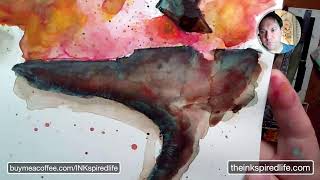
Artist Jason Nicholas paints a covered bridge in watercolor and works on a mixed-media anvil piece, talking through his choices with chat. He uses dirty water, blue-brown shadow mixes, and sepia ink, explaining how he embraces accidents and adjusts work based on feedback from viewers like Roo.
Chapters
Hey everybody, hope you're doing well on, uh, Saturday night, 7:52 PM. Hope you're doing awesome. I see Dorothy is in the house. And Chip. Hey, good to see you guys. Dorothy says, "I really like the covered bridge." Oh, awesome. I'm so glad you like it. Chip says, "Here, good to see you." Awesome, Chip. It's always, always great to see you too. So I wanted to add some color to this. It was originally just a black Sharpie sketch, and tonight I felt like just breaking out some some colors and throwing some wash on here, and I just want to play around, and I'm actually liking it. It's pretty cool. Um, so one of the things I'm doing is I'm mixing blue and brown to create kind of shadows in here. A little more blue than brown in the mix. But I like, I like shadows that aren't just black. The man says as he puts black— no, it's not black. It does look black, but it's not. It really has more blue in it. Spread a little too much on there. Got away from me a smidge, but just going to touch it down here. I'm just trying to make this overhang have some depth to it. So I'm throwing down that dark line there. I don't care if it's wonky, it's a wonky old bridge, right? It's, uh, it's definitely wonky. I'm looking at it on screen. And then let's see, we have some water down here, so I'm not sure what color I'll do that. Purple maybe. Anyway, I hope you guys are doing well on this Saturday night. Let me know what you've been up to. I want to dirty up this turquoise roof a little bit, so I'm going to throw— I'm just going to stick with watercolors. I'm going to throw some brown on here. You know, maybe it wasn't— maybe it's an old roof, old metal roof. It's kind of rusting a little bit. There we go, that's cool. So I'm really literally just throwing down some brown. I think you guys can see the paint palette. I don't know if you can, but, uh, you can see part of it. So I'm just dipping into the brown watercolor paint and just kind of throwing it on here. I don't mind if it's runny, it looks streaky. Actually, I'm gonna like the hard edge that happens here. So I just want to dirty it up a little bit. I think that looks pretty good. Should we do— what should we do with this water? Let's see. I don't want to make it straight up blue. I don't— definitely don't want to make it turquoise. Maybe we'll do like a dirty— it's my dirty blue water. Maybe we'll go back to our gray and brown, but we'll— I'm sorry, blue and brown. We'll use more blue in it, right? Because we have some water here kind of going underneath the bridge. Sorry, I think we covered up a little bit. There we go. So I'm liking this. It's not just blue, it's blue, a little bit of brown in it. I'm just tapping my brush here. I'm going to leave this white to separate the green and the blue a little bit. There we go. I think it's kind of cool. Uh, like this stone look at the front. Oh, that's cool. I'm glad you like the stone here. That's awesome. Um, Chip says a bridge you visited. No, Chip, I did not visit this bridge. This is, um, I looked at a bunch of reference photos, a lot of different covered bridges, and I kind of just sketched this one. So it's not, it's not a real bridge anywhere. It was inspired by several different bridges. So good question. I honestly don't think I've ever seen a real covered bridge. I mean, in person. I mean, I've seen pictures, but I don't think I've ever Maybe when I was really young. I don't know if I've ever been across a covered bridge. I think they're amazing and beautiful, you know, very functional structures, but they're beautiful, especially the old wonky ones. And my AirPods just got a paint job. Here's the bonus for logging in tonight. My AirPods now have some— this is actually turquoise guache. This isn't watercolor. This is gouache. I have— I had some in my drawer and I wanted to play with it. Um, gouaches can be very opaque, so I threw some down. I just wanted to test it, see how much it covers over the ink lines. So it's not art unless— what, guys? It's not art unless you wear it. I was going to try to spray it off, but I think I'll make a mess. So I'm definitely wearing my art tonight. Cool. I don't know, I kind of like— I kind of like this. I don't know if I would add anything else to it. Love the white spots. Do I need to do a background? And which side do I think I do want to put a background on here? Maybe we'll just do a real light I'm picturing almost like a fall kind of day, so maybe a gray kind of wash in the background. So let's do that. Let's put some gray back there. Hey, Karen's in the house! Karen, good to see you. Hope all's well. It's always great to see you in the house. You guys are awesome. Thank you for tuning in and watching. Let me know if you have any cues for me. This is gonna be a quick visit. We have a— we're gonna, we're gonna go watch a movie or something outside. Not outside, in the whole living room. I'm gonna make popcorn. Definitely not going outside. It's like, I think it's in the teens maybe. All right, so let's throw some kind of gray wash in the background and then I'll show you, um, what's underneath here. I have an anvil painting that I started this morning. I've been adding to it throughout the day, and I'll kind of show you guys where it's at right now. All right, let's do the gray first. I'm just going to throw down some water. So this is actually dirty water going down. I might not even have to do anything. Maybe I'll just leave it this use the dirty water. You guys know I like that trick, right? I always usually keep a thing of dirty water on hand, which I'm actually kind of liking it. I don't, I don't think I'm going to add any watercolor to that. I might just Dip into the dirty water and add some more of it. So here I'm literally just kind of dipping my brush, just tapping it down, not really even painting. I'll just darken some spots up. I think it creates a nice gray effect. I'm pict— like I said, I'm imagining a kind of an autumn day here. And that might be just, just enough. I don't want to overdo it. I think it's cool for the background. And I might just throw some of that same dirty water, just bring it down onto the stone wall. Definitely want to leave some white spots there. And we're going to bring some up, dirty water, and throw it down on top of the barn here. So we'll kind of age it a little bit more, I think, just in places. I'm not going to do the whole thing, just kind of randomly throwing it down. I like— I like the way it's looking here. Let's throw some on this facade here. Throw a little bit on the stones. And I don't care if some of that goes down in the water. I think it might just tie things together having it up here on the barn. And throw a little bit down here as well. Even if you can't see that much of it, it is there and it might just help tie these together a little bit. So my brain says, but my brain has been wrong. Throw some on the roof. Cool. I think this barn is done. We'll let it dry, leave it here for a minute. Um, Chip says, I think Amish country has several covered bridges. Yeah, definitely. I was in Amish country. Gosh, that's Hershey, PA. How many years ago? Just trying to think of old my son is. Yeah, I don't know, 8 years ago, 9. I remember going out to Amish country. So yeah, that's cool, Chip. I should definitely look into that. Would be awesome. Karen says wet and rainy day here in California. Oh, that's a good thing, right? Right, having the rain in California is a good thing. So let me know if that's a good thing. If it is, awesome. Cool, so I hope you guys like this barn. I'll post a picture, actually I'll find, I'll post a picture of it next to the black and white version and just get comments and feedback and see which one you guys like better. I know which one I'm liking better, but I won't say it until I get some feedback. I'm gonna move this carefully so it can dry, and then I'll take a quick look at the Anvil painting. Just relocating that so it dries. Boom. I'm gonna have to zoom out for this a little bit. So let me move this down. So here is— so here's the Anvil painting. I might be zoomed in too close. Let me zoom out a little bit. I think— there you go, you can see it all now. So I've been working on this on and off today. I was inspired this morning watching Roo when he asked for suggestions and I just randomly said, "A day in the life of an anvil," and I started doing this anvil painting. I think it's coming along pretty well. It's mostly watercolor. It does have some acrylic ink. And it actually has some turquoise colored pencil. I'll zoom in as well. So you can kind of see the turquoise. Actually, I'm sorry, it's not turquoise, it's light aqua. Light aqua. My favorite colored pencil color right here. So I threw some of that light aqua just to give some curves and definition to kind of give this a little bit of three-dimensionality. I was fortunate to have some feedback from Roo today about this, since he's a smithing expert, and he gave me some feedback and I tried to make some corrections. One correction he, or suggestion he had, was for the hammer. So I'm in the process of kind of, I added this point, I'm in the process of kind of darkening this area up I'll have to add another layer. And another thing I'm trying to go back and cover up is I had a stem. I had the handle coming through the top of the hammer. I'll zoom in. He's— and he gave me some good feedback and, you know, suggested I eliminate that stem. So I cut that stem off and I'm trying to cover it now with some different layers. So I'll have to come back, put maybe another layer or probably two layers on top. And I want to darken this area here. Like, actually, we'll do that while we're talking. I think it's dry now. Uh, Dor— Karen says yes. Oh, I'm so glad you're getting rain. Awesome. I know you guys, uh, it's been very, very dry out there in California, so I'm so glad to hear that. Love it. Dorothy says the red yellow makes me think It is really hot on fire. Ooh, I'm so glad you like that. Let me zoom out. You guys can see. So what's interesting is, um, this is hot press watercolor paper, 140-pound. I have— I rarely, rarely use it. I just grabbed it this morning. It was the closest thing I could get to, and I'm actually liking the way it's looking on the hot press paper. So it's really interesting. I'm also using the bottom of this paper as kind of a palette, a working palette. So you can see down here, I'll test out some colors and stuff. I'll even mix the paint right on the paper before I apply it to the actual painting. I do this a lot. I, you know, I have the mixing palettes in here, but I like to mix things on the paper because then I can see what it's going to look like on paper. So I'm just going to turn this around so you can see it closer. So here's what it looks like. Here's my mixing palette that I was using and working with. Here's some of that turquoise gouache I was talking about. I actually put a dab, a big dab on there, unfortunately. I hate wasting this paint. I— but I didn't use any of the gouache on here. This is a colored pencil. So I hope you guys are liking this one. I'm really, really enjoying this. This is a fun piece. I'm having fun with fire. I know that sounds weird, um, and I don't mean like in a bad way, but I just love the colors. I'm sure if I studied flames and how they really look, this is probably not accurate. I at all. You know, I know there's some blue flames, I know there's bright spots in certain areas. I didn't look at any reference images. I'm just kind of painting from my gut, from my heart, from what I'm feeling. And that's how I just added these colors on here. Um, some heavy metal music would have been awesome with this. So if I had some Metallica going while I was painting today, who knows where this, how this would have exploded into. Maybe we'll try that another time. Anyway, let's zoom in. I'm gonna— I want to darken this area a little bit and just blend it together because right now I think you can tell I added it. So what do I want to do? How do I want to add that? I have some sepia— I have some sepia acrylic ink here. I think I'm going to throw this down on here. Try to darken that up. So don't be afraid to make mistakes, guys. You could modify things, you can work with them. Sometimes they're happy accidents. Um, instead of restarting this, I thought I'd come back and just try to modify it and see what happens. I'm trying to figure out what the best view is. I think closer is a better view for you guys. There you go. I'm gonna grab a drink. Some water and we'll get cracking. All right, there we go. And paper towels are definitely my friends when I'm painting. Go through them like crazy. All right, so what I'm actually going to do is I'm going to take some of the sepia acrylic paint. I'm gonna put it on in this lid that I use. It has this cool dropper. I don't want to use too much. I'll put a couple drops in there. It's such a small area and this stuff can go a long way. So tightening this up— always tighten your caps up when you're done. I've knocked over my fair share. Just ask my floor if you saw my floor in here. Good thing it's a concrete floor, no carpeting, just bare concrete. It has a lot of, uh, stains on it from me spilling ink. I'm actually going to lift some of that back out just to kind of— I want to soften the edges a little bit there. Kind of make it look aged a little bit. I think it's out of focus. Is that out of focus? Um, it's in focus now. I'm sure I'm going to have to come back and do this a few times. There might be another way to do what I'm doing, but this is what I got going. I'm gonna throw a little bit of color in this flame area. It's where the handle poked through the top of the hammer. I'm trying to get rid of it. There we go. I think that's— I think that's being covered up pretty well. I'm going to leave it at that, the man says, as I bring down some of the yellow here. I think that'll be okay. And there you can kind of see what it's looking like. Hope you guys are enjoying this piece. Let me know if you have any Qs in my last couple minutes here. Um, I still didn't do my bridge sketch today. There's a chance I'll pop on on a couple of hours after I chill out, and I'm able to do my bridge online tonight. Let's see, I'm just on the internet for a second. I want to check something on Facebook. Let's see. I just want to— actually, I'm checking my livestream for a second. I want to— I've been having some comments that people can't see comments. So I want to see. Obviously you guys can see me on Facebook. I'm sorry, I'm playing with this now. There have been some updates. I want to make sure everything's going through okay. Oh well. Yeah, it looks okay. Everything looks okay on my end. Awesome. Alright, cool. So this I think is fine. I'm gonna let it dry. This paper is bent up, it's curling up. So I kind of want— I'm gonna tilt it so that area I just painted kind of— I want the paint to run down this way. So my board is at an angle and I can let the paint run down a little bit. And I'm just gonna put this water bottle here to keep it kind of anchored down. Hopefully it'll stay. Yeah, definitely, I'm going to come back and do something here. I might even end up just putting some straight on Um, here's what I'm going to do after it dries. I think this will be the— I have a— my Aqua— sorry, my watercolor marker, Sepia. I think after this dries, I'm just going to come back with this watercolor marker and draw right on the paper right in this area and just blend that together. So keep it out to remind me. Cool. And there you guys go. Here's a look at my messy desk. It's actually not too bad. I normally have all my pens and everything on the left side because I'm left-handed. It's easier for me to grab and go. But this is a fairly large sheet of paper and wasn't working. And actually, this is— everything's usually on the left, so which is— it's not. All right. Uh, like, you guys are like, why is he even telling us that? Because I can. It's called nervous chatter. Now I'm not nervous. You guys are awesome. Thank you for watching. I'll, I'll probably be back on in a couple hours, um, to do my bridge sketch. Can't promise though. Thank you guys so much. Take care. Let me know if any questions or comments, leave them in the chat. Thank you for liking this. Thank you for sharing it. And I always appreciate looking at all of your amazing artwork and creativity. I think we all fuel each other, inspire each other by sharing what we're doing. So keep sharing, guys. It helps my fire keep— helps keep my fire lit up. And hopefully what I'm doing lights your fire in a positive way, whether it's something creative or positive mindset motivational thing. I love it. That's what I'm here to do. And I'll take another look. I actually am really loving this, to be honest with you. Um, a lot of layers went down on this, a lot of different layers. But let me show you guys a close-up before I head out. Chip says good night. Dorothy says good night. Hey guys, good night Dorothy. Thank you for a lot watching live. And your positive comments. Chip, always great seeing you too. Thank you and have a great night. Well, uh, Chip, we'll catch up one of these days via phone in the next week or so. Maybe I'll give you a shout if that's cool. We'll check in. Thanks guys, take care, have a great, great night. See you soon. Peace and live creatively. By the way, I'm only charging half price because I think only half my face was on camera. Most of the night. So it's half price admission for tonight's live stream. I don't know, maybe my whole face was on there. Maybe we don't even need a face on there. Now I'm really thinking out loud. All right guys, take care. I'm gonna go make some popcorn and watch a movie. See you later.





