INking Out Loud
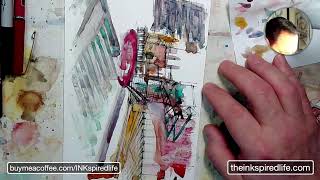
Artist Jason Nicholas sketches the Booth Theatre in watercolor and ink, explaining how he uses angled Sharpie strokes and dirty water washes to capture feeling over realism. He shares that his Chief Architect students are highly engaged, including one building a LEGO light-box inspired by his work.
Chapters
Hey Jennifer, good to see you. Hope all is well in Arizona. It's always great to see you pop on. I am on at a really strange time for me. I'm— I don't know if I've ever streamed this time, but, uh, instead of taking a nap, I wanted to do some sketching. So thank you for logging in and joining. I hope everything's well. So I'm just continuing to work on this sketch I've been working on for the past, uh, few days. And today I'm just adding some Sharpie lines on top of this watercolor and ink, just pulling out some details of this building, trying to keep it loose, which is giving a little more dimension to what I'm sketching here. So hopefully you guys can all see that okay. Awesome. Let's see, I gotta log into, uh, I have to log into Facebook for a second while I'm on here. So let's see, I'm gonna do this. I just want to check something on my Facebook stream. Um, let's see, let's do this. Very cool, I think I'm good to go. Awesome. Cool, so I've been working on this perspective sketch loosely based on a photograph I took in the city. Just took my watch off. I don't like sketching with a watch on. Anyway, this has been a fun one to work on with this different type of paper. I'm having fun just playing around. I just want to add some details and I think wrap this one up today. Let's see, what do I want to do? I want to sketch, um, just some horizontal lines across here. Actually, let's do it this way, just to indicate that there's some kind of, some kind of block work happening on this facade here. Again, I didn't count the blocks. I don't even know if this is on the building. I just, I stopped looking at the reference photo 2 days ago, so I'm kind of just doing my own thing. Riffing. And that's what I like doing. I just like to riff. If I use a photograph, I'll just kind of maybe start with it and lay out some basic ideas and shapes, then I'll just riff off of it. Keeps me much freer and looser. I'm not trying to recreate exactly what I was looking at. So I'm just adding some texture here with this block work. There's actually some brickwork back in here as well. Zoom in. So the reason I'm using a Sharpie is it won't bleed in case I want to add some more color on top of this. Just got to find the right angle to hold the Sharpie. So I'm sketching some kind of brickwork here, and I'm just angling the Sharpie because I want to keep these lines kind of fine, not too dark. I find that by tilting the Sharpie at different angles to the paper, I can get different effects with the lines. Different thicknesses, different weights, line weights. So let's just kind of show this as brickwork here. There we go. Cool. I'm adding these random vertical lines just to just again to indicate, indicate some kind of brick happening here. Very, very cool. I definitely do want to work on this marquee sign and pull this out a little bit more. This is the Booth Theatre. That actually is a sign that will, that says Booth. So I'll come back and that might be the last thing I work on. What else do I want to add on this? I don't know, I kind of like the white space here. I don't think I'm going to add anything. Maybe we'll just add a little more red to that brick area. Let me zoom in. Let's add some color there. So, let's see, I have a couple options. I could use some red watercolor. I'm actually thinking about bleeding some red. I haven't tried it yet. I love to bleed some red Pilot pen on my ink washes. So maybe I'm going to bleed some of this red. Let's see what that looks like on here. Let's take the watercolor. Yeah, let's put a couple spots down and we'll add some water and we'll see what happens. That's good for now. Let me get my brush. I'm just dipping this in— I have some of our dirty water. I still haven't cleaned this water out, but I like using dirty water a lot to keep kind of the industrial grunge vibe. So let's throw down some dirty water on top of that pen and we'll just let the pen bleed. It's looking— there we go, you can kind of see it bleeding there. It's looking a little, um, maybe a little more pink than I was thinking. Which might be okay. I'm just going to randomly put it in some places here. I don't want an even red. Maybe the pink against some of the lighter red will actually work well, keeping it uneven. So I'm just Just dabbing some water on this and letting it bleed. I think I'm actually kind of liking it. Sorry, I keep moving the paper around. It's a habit of mine when I'm sketching. If it's not in the sketchbook and I'm holding— not holding it, I tend to move the paper around when I'm working on it. And just for fun, let's grab some red watercolor as well and see what that looks like. Actually, that's kind of cool. I'm going to let that bleed. Let's bleed some of that red watercolor into that ink. I might even dab some of it out and pull it back a little bit. I'll let it sit there for a minute or two and I'll dab a paper towel. I'm going to lift some of that red off of there. I just want to kind of stain the paper. And let me lift off some of that. Cool. And now I'm just mixing some blue and brown. I want to— there might be a little bit of red in there just to create some little bit of shadows. I like to mix blue and brown, create some great shadow areas. Let me throw some maybe up in here a little bit. Gotta be careful. I don't want to put my palm right where I just added some red, and that would not be cool. So I just want to create a little bit of depth on the top here, so I'm going to throw down that gray kind of mixture. Here I'm actually touching in a little bit of turquoise with kind of this blue-brown-gray. There we go, that's cool. I like the way it's looking. And the idea of these lines is just to give a suggestion of some window, some rows of windows kind of in perspective view without actually drawing all the windows in. So the lines are a really cool way of just getting that idea across. Just another way to keep it kind of loose. I do want— I have some brackets here I kind of want to pop out. They're getting lost, some iron brackets. So I might use some turquoise to pop those out. Let's see how it looks. Hey Karen, good to see you. Hope all's well. What is new and exciting in the world of college stuff. Oh, I put that in the wrong spot. That's all right, just do that. That works. Let's see, we'll give it a try. See, so I put some turquoise on here. I want to pop these metal brackets out. Are they this color in reality? Absolutely not. But this is my reality of what I'm creating, so I don't— I'm not trying to represent what's really there. It's kind of how I feel. I kind of want this turquoise to pop out a little bit so you can see these angle brackets kind of happening here. I think I actually like it. So if I zoom out, let's check it out. Camera says busy as usual. I get it, I totally get it, man. Hang in there, I'm sure you're doing a great job and doing the best you can. I totally understand what it's like to, um, to be busy in school. Eh, cool. All right, there we go. Awesome. I think this one would be done for now. Cameron says, uh, how are your classes doing? Hey Cameron, my classes are going really, really well. Thank you for asking. We, um, 5 out of my 6 classes are actually doing Chief Architect right now, and I have to say, I'm getting really, really good reaction and feedback. We're not doing Chief Architect for too long. It might be 2, 3 weeks at the most, but kids are really loving it, getting really good reactions. They're picking it up quick. It's been actually really, really fun to watch. So yeah, thank you for asking. And also, just today, um, just today we are— we had an idea. I'm working with another student. He is actually going to make some prototype lightbox models inspired by you, but he's going to make them out of Lego and see how it goes. And he might be bringing that into a future class project. So right now he's just brainstorming some ideas and we'll see how it goes. So I'll keep you posted on that. I appreciate your questions as always. The disease, the Chief Architect disease. No, it's a blessing. It's awesome. If Susan has any questions, let me know. I am very interested in seeing what they're doing. Hey, thank you, Cameron. I definitely appreciate that so much. I'll definitely let you know if there's any questions about it. I really appreciate that. Cool. So guys, you can see I've been working on this. Hopefully, if you're just watching, thank you for watching. It's almost 5:30, kind of a weird time for me to be on sketching. It was either sketching or napping, and I picked sketching. I know, I'm kind of crazy. But, um, I was in the mood to work on this a little bit. And this one is pretty much done. The only last thing I kind of want to do is I do want to— this is the Booth Theatre, so B-O-O-T-H. I do want to kind of bring back— I lightly sketched in here the word Booth, but I want to make it more apparent. So I will not be doing that right now. I'll come back and do that at some point. And then I think after that, I'm going to be wrapped up with this one. Zoom out a little bit more, you can kind of see my work area here and what it looks like. So yeah, it's been a really cool project to work on. So that's it, guys. I'm gonna wrap up. Just wanted to pop on for a half hour and work on this. I hopefully will see you sometime again live during the week. Guys, enjoy the rest of your day. I do appreciate you watching and liking and sharing the videos. Um, and I'm only one follower away from 1,000, so I'm hoping sometime this week I can get one more person to start following my Inkspired Life Facebook page and we'll hit the 1,000 mark. So that would be so cool. Um, and thank you guys for helping spread the positive word. I really appreciate it. Have an awesome rest of your day, and I will see you soon. Take care.





