INKing Out Loud
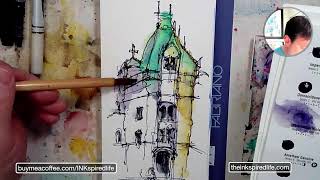
Artist Jason Nicholas sketches the Biltmore House in Asheville live, working loose with Sharpie, ink, and watercolor on a 4"x8" Fabriano page. He layers turquoise and violet washes, uses hatching to build shadow, and talks through why loose sketching beats precise technical drawing for exploring architecture.
Chapters
Hey there, everybody. Hope you're having an awesome Friday. I'm popping on for a few minutes during my lunch break here. Spring break has started, yes, which is awesome. So I wanted to pop on to do a quick sketch. So yeah, hopefully you're having a great, great day today and happy Good Friday. So just take a look at my desk here, you'll see I call this my creation station. I have a lot of stuff stuff out here. So I'm not sure which paper I'm going to use. I guess it'll depend on the building I'm going to sketch and the view of it. Um, so I already know the building I want to sketch and have a few photos pulled up that I have taken. So we'll take a look through those and I'll kind of just talk out loud about them and, um, we'll pick one to do a sketch from. So anyway, I hope you're all having a great, great day. So I'm going to bring up on screen, let's see, a few different images. Boom! So I don't know if anybody has been here. If you know the name of the building, let me know in the chat. Whether you're watching live or the replay, feel free to comment. So this is the Biltmore House, which is part of the Biltmore Estate. In Asheville, Carolina. I believe it was built in the 1890s, early 1890s. Um, it's a really, really, really cool structure. The grounds are amazing. Um, I'm still processing it all. I was there, I had the opportunity to spend a few hours walking around. I think I was there maybe 3, 3 and a half hours or so. Really, really captivating building and grounds, and there's a conservatory. I mean, it's incredible. So this is kind of the iconic view of the Biltmore House, French Renaissance château style architecture. And you know, when I'm looking, when I go to a site and I'm looking at the architecture, which my eye and brain kind of go to naturally. I look at the overall structure we're building first before I kind of start zooming in on details. So I would just love to go around and photograph, and if I have the time, or I'll make the time to at least do a few quick sketches while I'm there. So here's a great overview shot. I don't, I don't think I'm going to sketch this today. So let's go to— let me bring up another image. Let's see, let's turn this one on. So you can see I'm kind of getting a little bit closer on the building. This is the left wing of the building. Um, here my brain is really going towards kind of the top of that tower with the projecting window area. Really, really cool part of the facade. Let's see, let's bring up another one. This, I'm focusing on the stair tower part of the building. Really cool. I love the angles there of the windows. That could be a possibility for sketching today. I like taking kind of weird perspective views of buildings. So here I'm kind of down low looking up at the building. I love the way it kind of distorts. For me, when I take— when I'm looking around and I look from different viewpoints, Sometimes I'll get low on the ground. Sometimes I get really close to the facade. It just really presents the buildings in different ways. Sometimes they twist, perspectives are distorted. It's really, it's a cool way to explore architecture. And here we have another view with the stair tower and kind of the entry piece here. On the right-hand side. I kind of like this. I think I'm gonna sketch this really quickly and just outline it for now. So let's go with this one. I'm actually gonna take it off screen, turn it off. All right, let's do some quick sketching. So because of that picture, let me bring it back on. I have a few different size sketchbooks here. I'm gonna move this over. So I have this, uh, Fabriano. I love the format. This is 4 inches by 8 inches. Really, really cool landscape portrait, or you can do a portrait, I guess, but I like the proportions of it. So I'm— I could sketch this and maybe just focus on part of the— that image. I could also break out the Strathmore Visual Journal as well. This is 5.5 by 8 inches. I'm not feeling like I want to use this format, so I'm not going to put this one— I'm not going to use that one. And it just fell on the floor, almost in the trash. And here we have the Fabriano, 7 inches by 10 inches. Really great size, a lot of space on here. Here's something I was just messing around with last night, just playing around. Inspired by the— oh my gosh, I'm not gonna get the name right. It's on the Thames in London. I forget what it's called. I don't know if it's the barriers. Ah, it's— they're basically locks or gates that can control the flow of the Thames River. So that's what that is. So we have that as well, but I think I'm going to break out this the 4x8 format. And let's just play around with this. I'll zoom in, and this is gonna be really quick. I'm just gonna do some sketching. I am starting with a Sharpie, and the reason I'm starting with a Sharpie is because I know I eventually want to add a wash of color or ink on here, and the Sharpie will not bleed bleed with that wash. So that's why I'm going to start with a Sharpie. Um, if I want ink to bleed, I could always come back in with any of my bleeding ink pens. I have this, I have my Lamy over here, but I always— I typically will start with a Sharpie. That way when I wash and bleed ink on here, it won't get too mucky. So let's do this. Hey, I see Deborah's in the house! Deborah, great to see you. Hope all's well. Thanks for popping on. So I'm gonna work with this image you see on screen, but I'm not gonna sketch the whole thing. I'm gonna just pick a portion of it and sketch it. I'm actually going to take it off screen because here's the reason: I'm gonna use the photograph only for a quick loose outline. If I leave the photo up I feel like it's there and I'm going to want to draw details and create it accurately, and I don't want that. So I'm going to just draw a quick kind of outline and work from there. I want to keep it quick and loose and just fun. I'm not trying to recreate a photograph, and I feel like sometimes when I leave photos up and I'm sketching live, um, the viewers, you guys, are comparing what I'm sketching to the photograph, which is cool, but you're expecting my sketch to look like the photograph. That's not what I do. It's not my style at all. So it's kind of misleading to some people. I've had comments in the past where people would be like, "What are you— that doesn't look like the photo." And I'm like, "Yeah, I don't want it to look like the photo." That's why I took a photo. But that's just me. Some of you guys out there are amazing realists. You blow me away with your details, whether it's a building or a person or an animal. That's awesome. That is a skill that I have never practiced or developed, and honestly, I don't have the patience right now to do that. I like to be kind of quick, get things done. So that's where we're gonna— that's where we're gonna head. Alrighty, let's turn this off. Alright, I'm just gonna do a quick sketch here. Kind of making some room. I got a lot of stuff out here. I'm not gonna add any watercolor right now so I can move this out of my way. I'm gonna actually limit my time. It's 12:30. I am only gonna sketch for about 15 minutes. So 12:45 is my end goal. Cool. Alright, let's do this. I have— actually, let me back off a sec. I haven't really sketched this building other than— where is my journal? 2 or 3 really quick sketches I did. Here it is. I'll show you what I sketched on site. I didn't sit down and see and sketch a lot of things there. I just kind of on the move a lot. I wanted to explore the entire property as quickly as I could, so I didn't really sit down in one spot too often, too long. Let me see if I can find— oh, all right. So here, this was my really quick initial— I tried to do almost a continuous line type sketch when I first got there, just looking at the building. Zoom out a little bit. So I was just trying to get the feel of kind of the roof peaks and chimneys coming up here, another roof peak. So that was my quick, quick sketch. This one I sat down a little bit slower sketching speed. This was just this portion of the Conservatory greenhouse building. Really cool, like Mediterranean clay style roofs on this building. And then the last sketch I did there was kind of the backside of that same building, but I like the industrial look of these conservatories. I just catch that really— this was a pretty quick sketch on site. I love industrial architecture. And that's it. That's all I've sketched of this building. So I'm gonna do a lot of sketches of it, but let's just start today with this right here. So this show is called Inking Out Loud because I'm gonna kind of just talk what's going through my brain as I'm looking and sketching. I oftentimes will start with the roof of a building, especially unique roof like this, or the spires on St. Patrick's Cathedral, if you've seen me sketch that before. And I'm going to hold my Sharpie kind of loose because I want it to be sketchy looking. So here we go. This is the very top of the roof. So I am looking at the photo I showed you before, but only to get a quick outline here. And honestly, I'm looking more at the photo and less at my paper as I'm sketching. And see, make sure it's on screen, you can see that. So kind of have the roof going. I'm going to come down the side, I have a little piece sticking up here. So I'm going to do a gargoyle thingy on the side. Boom. Building's coming down like this. I'm not even going to finish it off at the bottom, I just want to kind of let it bleed a little bit there. Or not bleed, but kind of just end there. And then over here, I'm gonna start— now I have kind of an outline of that. I have some roof, I have like a cornice piece up here. I'm gonna sketch it, and it's at an angle. But before I do that, I have this piece that comes down here. I'm just kind of sketching what's popping out at my eye right now, and I have this kind of strong piece that does that. Then we have this that tapers at an angle. We have another piece here that goes off at a perspective angle. Got some kind of blocky thing here happening. Uh, this kind of continues down a little bit. I don't care if lines are overlapping. We have another piece detail that's projected line, line line course that comes like that. And then the main feature I'm seeing right now, I see an arch here, goes down kind of like this, and there are windows in here that are arched as well. And down here we have some rectangular windows. Notice my windows, I'm not sitting there drawing perfect rectangles. Just trying to capture the idea of some kind of window there. Here's the main archway that enters into this tower. Cool. And then we have this— we actually have building corner that comes down here. So once I have kind of the outline— hey, Linda's in the house! Good to see you, Linda. Hope all's well. Once I have kind of just a rough outline, now I'm looking more closer at some of the details. So up in here I have a couple of windows. Something in there. This cornice piece is very detailed, but I'm not, I'm not going to sketch all the details. I just want to get the idea of it. And I noticed there's some vertical pieces in here. I'm going to sketch that. And on the perspective, the side view here, I have the same kind of lines, vertical lines, but they get a little closer as it gets further from you. And also we have some smaller kind of windows happening here. And to get the idea of perspective, I'm sketching the windows, the tops and bottoms, at a slight, a slight angle. They're not straight across the page. And then down here we have another one. It's actually— it's kind of an arch on top of it. We have another kind of a belt course projected line that continues like this. And what else? We have some vertical pieces that continue down the facade here. Hey, Jennifer, cheers! Hope you're doing well. It's great to see you. So glad you guys are popping on. Let me know if you have any questions. So if you're just joining, I'm sketching a small section of the Biltmore Estate here, keeping it quick and loose and fun. My goal is I'm going to wrap up at 12:45 and we'll see where I'm at. I mean, if I really wanted to sketch this in detail, I could spend hours and hours on this one piece. There's so much happening. So here's a little secret. One of the reasons I love loose sketching, especially for architecture, is that I can go back. I noticed I was a little off here with something. I can go back and put lines on top. Because it's already looking wonky, there's room for freedom. If I was making a technical drawing, I wouldn't have that luxury because everything would have to be precise. So that's kind of one of the reasons I really do love, um, loose style sketching. Not only is it quick, but it's more freeing for me. So we have this building. I'm gonna actually draw a little bit on the sides here. Building does that. I'm gonna just let it bleed off the end. And then over here, there is a piece here. I just want to throw this here like that. Boom, done. Cool. Then we have some kind of stairs happening in here. And we have a lion statue, which I am not going to attempt to sketch the whole thing right now, but there is a statue here. So that's kind of my outline. So I think it'd be fun, I have some more time left, let me just throw down, um, let's throw down some wash on here. I'm just going to bleed some. Let's just bleed some ink. What do I want to bleed? I have my Lamy. This has Apple Snail colored ink, which I love. So I'm going to bleed some of this. Is this building's color? No. I'll pull up the photograph so you guys can see it again. You find the button. So I'm focusing on this kind of little piece here, the photograph, and you can see the building is not going to be the color I'm going to make it, and that's cool. All right, let's do it. Let's just bleed some ink and have some fun. And I'm just going to take out, um, bamboo brush here and throw this here. And I'm actually using dirty water in here, which you guys know about. I think you know if you've watched me before, I like to use dirty water a lot because I'm not like a purist. Um, with what I'm doing here at all. So I'm just going to dip into that water and let's just bleed some of this ink around a little bit. Let's see. I will also— I do want to kind of darken this a little bit. Just throw some hatching lines in here. All right, cool. I'll tend to not— I'll tend to kind of mix things up as I'm sketching. I won't like sketch everything with the ink that I want to do now. I'll kind of do a little bit of ink. I might come in with a Sharpie, outline some more things. If I was doing watercolor, you might see me adding some colors, going back and doing some sketching. So I really kind of work back and forth between different mediums. You know, sometimes it's a matter of waiting for things to dry, or it's just more of a matter of just kind of the mood I'm in or what I'm feeling. I like to kind of create on the fly. Whoa, not literally like on a fly, because that would— I would need a magnifying glass. I like to create on the fly, just grab and go a lot. So speaking of grabbing and going, I am gonna just I feel like just playing around some color, so I am just going to throw— I feel like throwing on some turquoise. So maybe we'll throw some turquoise on this roof area. Again, these colors are not here. There is a turquoise, actually there's a turquoise ish color at the very top of the building, up in this piece. Linda says, love, love the green. Oh, that's so cool. I'm glad that you love it. So this is, this is Apple Snail ink in the pen, which is this color. And then here's the turquoise. And when they mix together, you get a pretty cool, almost like patina copper kind of look happening. It's a lot of fun. I keep dropping things off the edge of my board. The great abyss over here. I'll zoom out. You can see where the— you guys want to see the great abyss? Here's the great abyss. Bum bum bum. Let's spin this. You can see I have this like ledge and I keep dropping things off. So this is like the great abyss over here. Where I keep my water. By the way, that was included with the price of admission. No extra charge for the view of the abyss. Don't ask me to spell abyss. Okay, zoom in. Boom. Sorry guys, I know I move things around a lot when I'm doing this. See? Something just fell off the— into the abyss. Oh, man. I think I'm done with the ink for now. With the watercolor dry, I want to come in before I wrap. It's 12:45. Let's move this out of the way as well. Safe from the abyss. And I'm just going to throw some ink on here with my Pilot pen. So why am I switching to the Pilot? Well, I wanted to do these window areas, and I'm gonna bleed it a little bit of it, and I like the way the Pilot will bleed. That kind of goes back to what I was saying before, why I like to start with a Sharpie is because you just saw I was kind of adding the ink and the watercolor. If I had done the original sketch with, say, my Pilot pen or even a Lamy pen with non-waterproof ink. No, if it was non-waterproof, it all would have bled when I added that water and I would have made a mess. So that's why I like to start with this bad boy, Sharpie. But now I'm going to zoom in. You guys can see what I'm doing in the windows here. I'm not coloring them all black. Solid. I just want to create the idea that we have some openings going on in this facade. Go down in here and let's just hatch this in because this is kind of a recessed opening into the building. Just want to give that idea. Over here we do have some windows. Boom. And I'm going to just bleed a little bit of that. I got to move this here. Just dip it into that dirty water and, uh, let's see, get a paper towel here. So this is just— this is not going to bleed incredibly a lot, but you can see kind of getting some soft gray tones. If I did it up here, you could see it better. I also have the, uh, the Pentel EnerGel needle tip pen. Thanks to Roo for that one, which really works nicely on the wet water. So this will be fun to bleed in here as well. You see it just kind of bleeding here. And this is the stuff I live for, guys. I just love just the little details. Just this little bleeding spot here really excites me. I love this spot right here as well. Kind of a hard edge from that, um, the ink. This is drying— I don't know if you could see it that well— this is drying a really cool kind of yellowish color, and I didn't use any yellow. I love the way that's drying as well. So that would be— that's this area right here. And let's just bleed some of this here, and then we're going to wrap. So this is just kind of step 1 or phase 1 for this sketch. I'll probably end up spending another 30 minutes maybe on it. And just adding some more details after it dries. But that just gives you a good sense of how I like to start these sketches. I kind of love the fact there's a lot of white here, so you're not going to see a lot more color added to the sketch. Deborah says, looks great. Hey, thank you, Deborah, I appreciate that so much. Glad you like it. There you go. I like, I like all the white. I feel like there is a color I want to add, and I feel— I think that color would be a purple. I feel like I want to use like a deep purple that just helped create some shadows on here, and I can mix up a purple watercolor. I could pull out one of these, um, sheets I have from these Daniel Smith trial sheets I have. I'm sure there's a purple on here I could use if I wanted. There's like a— I kind of like this Cobalt Violet Deep, so actually I might end up playing with that on this painting. Um, or Ultramarine Violet I like as well. I don't know if you can see that. Here's the Cobalt and the Ultramarine Violet. Actually, I think I like— I don't know, I'm not sure which one I like better. I kind of liking the reddish, the more red in the Cobalt Violet Deep. So one of those two, or maybe both. I'll play around with them, throw on here. I can go on for like 2 more minutes and I gotta wrap. Actually got a webinar thing I need to watch at 1. Anyway, it's great being here during spring break, guys. I'm planning on popping up a lot during spring break with some sketching stuff, especially if I make a road trip one day next week. I'd love to stream from there for a few minutes, so that would be fun. So hopefully if you guys around, I'd love for you to pop on. I'm not gonna— it's not gonna be scheduled, so I don't have a time I could put out there. It'll just kind of happen when it happens. All right, let's throw on some of this Ultramarine Violet. Again, this is our Daniel Smith kind of like sample sheets. I— they weren't free. I've got them on Amazon. I don't remember how much it cost, but it's just a fun way to try different colors out. So let's— I want to throw in some maybe here. I'll just throw some of that I feel like we just need this. This is a cool way just to add me some shadow and a little bit more color, but I'm not going to go nuts with it. I just want to throw some on top of this here. I've only used Daniel Smith watercolor paints a couple of times, but I have to say, they're— they seem— they're top-notch. Really, really amazing paints. Fortunately, I think they're a little too expensive for me right now. You could just see how adding that purple is a cool way to create the idea of maybe some shadows. This is kind of recessed in here a little bit. I'm not getting the concentrated look I want here. I'm just doing a light touch over the paper because I want some of the texture to show through, kind of flicking, flicking my brush down a little bit. All right, cool. Alright, well there you go guys. That's my quick lunchtime sketching session for today. I didn't have a sandwich with me, otherwise I would have had a sandwich while I was sketching. But that's okay. You guys are awesome. I always appreciate watching and commenting and sharing. It's so fun for me to do this. Linda loves the granulation. Just a 5 mil to your watercolor collection every now and then. Yeah, so just add a little bit, right? The granulation of Daniel Smith is incredible. Um, it's starting to dry. I don't know if you can kind of see it happening up in here as it's drying. The granulation— look at the, like, the pockets of color. That's the granulation, those little splotches or pockets of color happening. Guys, isn't this a cool— look at this area. Isn't that pretty cool? We have the, the, uh, Apple Snail ink mixing a little bit with the turquoise and then the ultramarine violet. Awesome. Thank you guys for watching. I appreciate you all. I, I— there's a good chance I'll be on tonight sketching. Hopefully if I'm on, see, I'll see you guys later. And I had one more thing I wanted to wrap up with. I can't remember. Dang. That's right. Linda, thank you. Shout out to you. I appreciate you so much. I appreciate everybody in here. Linda, just wanted to make a note that I'm going to be mailing that other bridge sketch out to you tomorrow. So thank you again. Take care, guys. Have a great rest of your day. Peace, and live creatively. I will see you soon. I moved the— I moved this thing on my screen, so I have to— the finish button's all the way to the right. Right, got it. See you guys. Take care.





