Inking Out Loud - Loose Style Architectural Sketching
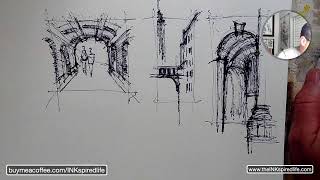
Architect Jason Nicholas sketches the New York Public Library with a Sharpie, narrating how music drives his hand and explaining loose line work, hatching, and perspective. He contrasts expressive sketching with precise drafting and shares memories of drawing on-site at the library, a bridge, and the Statue of Liberty.
Chapters
Hey Mickey, good to see you. Hope you're having a great, great night. Hey everybody, happy, um, Thursday. Hope you're all doing well. Tonight I am sketching, um, the New York Public Library, or part of the library. Really very, very cool building, classical in style. But I want to keep this really fast and loose. Hey Jody, good to see you. D-Ray, good to see you. Hope you guys are all doing well. Yeah, so, um, like I said, this is a sketch just inspired by the New York Public Library. I was— happened to walk past it a few weeks ago, or a couple weeks ago, and it's a real, real cool building. Classical, has all these great kind of columns happening on it. Um, just huge in scale. And this is just a little section of the building. It continues on to the left-hand side. It just keeps going and going. Hope you can hear me okay. I don't have the music on. It was actually pretty loud last night. I listened to the replay as well. It was still kind of loud. And I don't know why. So I'm not streaming tonight with music. I am actually listening to music, but I'm not streaming it. And I have Vivaldi's Storm on. Apparently it's on repeat because this is the third time I've heard it. Uh, it's probably my favorite piece of— I guess it's classical music. I love Vivaldi's Storm. It's just The energy in that music is awesome to sketch to. So if you see me kind of bopping my head around and moving my hand furiously, it's— that's the music. The music's just energizing me. I'd play it for you guys, but I'd be copyrighted and silenced by YouTube and Facebook. But hopefully you guys can tell. You might not be able to tell what building it is, but you can see that it is kind of a classical style, and you're getting the sense of some columns happening in here. And I'm just using my Sharpie to throw down these lines right now. And I think I'm just going to stick with my Sharpie. I want to pull these columns out, so I'm just going to go back over the outline here and it'll— you can start to see them reading more as columns. I hope you can. That's my goal. This is a— some kind of an urn thing happening here, big sculpture kind of in— that's not really sculpture, it's an urn in the foreground here. Just throw some contour lines here just like so it looks like it's curving a little bit. Just kind of curves around the bottom. Boom. We have the building in the background rising up. We have a big cool pediment up here at the top. Let's see if it's going to play again. I guess it's on repeat, so I guess it'll keep playing. Oh no, this popped on. George— Ray Charles, Georgia on My Mind is now playing. How cool, from Vivaldi to Ray Charles. Dang. Um, you guys are great. Let me look in the chat to see if any questions or comments. Hello from Tennessee! Jody is in Tennessee. Awesome. I don't think I've ever been to Tennessee. I'm actually headed to Idaho next week. For an academy. It's called Chief Architect Academy. It's a software program that I use. I also teach in school. I'm going to use it as a professional. It's architectural software for designing buildings. It's going to be cool. So I'm going to this academy that I actually was really lucky and won a scholarship to, um, to attend. So that's gonna be a really cool way to wrap up my summer before I head back to school. So this is kind of a recessed area. We have some shadows happening, so I'm just going to hatch these in here. Really, I'm just kind of— it's almost like scribbling these hatch lines in like that, just to create a sense of depth happening here. Also with this arch way. We'll do the same thing. There's a cool pediment here, triangular piece over the door. I think there's glass back in here as well. There's a cool chandelier thingy hanging here. So it's kind of hanging down here. Cool. Hey, Arseth's in house! Good to see you. Hope we're all doing great. Love the depth of today's sketch. Oh, thank you. We're used to seeing your head pop around. Thanks, D-Ray. Yeah, it just made it look a little weird without actually music playing. So, uh, little Ray Charles is going right now. I love this song, it's beautiful, but I need some energy, so I'm actually going back and putting on Vivaldi's Storm again. There we go. You'll, you'll probably notice my hand and I sketch— I'm going to be sketching differently because of the music. It really influences what I'm doing with my, my hand. There's a cool banner or something hanging on here. I'll show you guys the photograph I'm kind of look— I'm looking at in a minute or so. Got some steps happening, so I'm going to do some vertical lines just to indicate the height. There's some height to these steps here, and a lot of artistic license happening here. So I'm really pushing the Sharpie down hard on to this watercolor paper because I want to grind this in. I want this really nice and dark so you can see these recesses kind of happening in here. Probably even hear it as I'm scribbling. Let's do the same thing here. Really cool door here. So I've been inside the New York Public Library. I was in there once, um, a few years ago during the holidays. Really incredible building inside. I have to get back in there. All right, let me show you guys the picture I'm looking at just so you can see what I'm being inspired by tonight. Boom. So this is the actual photograph that I took, and, um, yeah, you can see it's just like I— like you guys know, I use my photos just for inspiration. I'm definitely not trying to replicate, um, replicate the photograph. I'm just being inspired by it with my lines here. Very, very cool building. Hey, Tatsy's in the house! Good to see you, hope you're doing well. I used, I used DataCAD years ago. Oh, when you did drafting? That's so cool. Um, DataCAD, I had a friend who worked at a firm, they used it, they had to use DataCAD. That's really awesome. What kind of drafting did you do? Was it architectural? I'd love to know. Yeah, the software I use is Chief Architect. I've been using it for, oh, I don't know, 8 years, 10 years. I really love the software. You can design in 2D and 3D at the same time. And if you guys are ever interested, let me know. Well, um, we'll do a demonstration. Maybe we'll design something on live online here. I'll use the software and take you kind of behind the scenes of how it works. I was thinking about doing some live streams using Chief Architect. And we got an overhang here, so I'm just gonna do some hatching. I mean, if you guys like this sketch, I'm gonna think I'm gonna leave this one black and white again, just like I did last night. If you guys were watching, some of you were out there, which is cool. If you weren't, um, no worries. Here's what the focus was last night, a bridge in Central Park. And then, um, here's the NYPL. I kind of like this. I think I might leave it where it is. I don't know if I want to add too much more to it. Let's flip back to the bridge for a sec. No, not a lot of lines on here, not a lot of detail. But you can totally see what it is. You can tell what it is. This has a little more energy to it, but I'm kind of digging it. Uh, music and creating for me are so integral. Yeah, absolutely. Music has such an impact on what I'm creating and how Absolutely. I, yeah, I think I've probably mentioned it all the time. I, I can't, I can't not work. Wait, how do I say that? I cannot work without music. I need music on no matter what I'm doing. It's, it's, it, it also drives me as well, so I get it. Just, I just want to do, throw some shadows kind of on this side here a little bit. Maybe I'm going to zoom in so you can see some of this line work closer. Uh, yeah, it just zoomed in, right? Cool. I'm just gonna go to my playlist. We're gonna, um, we're gonna go— we're gonna put some REM on. I like REM, some old school. There we go. So if you look at the lines on here, really, some of them are very, very scribbly, and I love that scribbly look. For me, scribbles have energy and a feeling to them, whereas architecture blueprint drawings are very technical, precise. These are scribbly, loose, wonky lines. That kind of express an energy or how I feel when I'm in the city looking at this building. And I'm surrounded by the vibrancy, the energy, the chaos of the city, and looking at a beautiful classical symmetrical building. So the really opposite things are happening, right? Symmetry, classical, and the chaos of the city kind of collide. And by these quick loose sketches, this is just kind of my feeling. I, I just can remember being sitting out there. I actually did do a sketch there. Let me see if I could find it. Uh, I don't know if it's— I don't remember. Let me see if it's in my journal here. I'll show you the actual sketch I did on location. It's somewhere in one of my books. It might— oh, it might be in this one here. Let's see. Nope. Heck, it might be in one of these. I'll find it, I swear. I need to go through and label all my sketchbooks, put years and stuff on them. Uh, it might be this one. Here's actually, here's the bridge I showed you earlier. Let's take a look. This is the one I sketched there on location. And then here's the sketch I did last night. So you can just kind of compare them to each other. Let's flip this over. Just give me a sec. Holy moly, here we are. So you can see the two different sketches here. You know, it's, it's the same view. Let me see if I can zoom in. It's the same view. Um, this was done very quickly sitting on a bench. I was waiting to go on a tour of Central Park, so I did whip this out really quick. This I took a little more time last night. We talked about this kind of flowing line here that really added kind of, kind of a graceful energy to that sketch. I don't know if I have the NYPL in this book. I should. Well, here's the— here's an opposite— here's— this is the NYPL, New York Public Library, but the opposite side of the building from the sketch I did tonight. This is actually a sketch sitting in Bryant Park looking towards the library, and why PL, New York Public Library, is right here. The park, we have some trees, and then in the background we have, um, this is actually the Radiator Building here. There's a water tower. Just a quick little park sketch. I did this sitting in the park. And why I love sketching on location, one of the reasons As I can close my eyes right now and I can remember that day sitting there and sketching this. It was early in the morning, not a lot of people around, so it was kind of actually a peaceful morning. Um, a little coffee cart off behind me. I can remember smelling the coffee while I was sitting here and sketching it. I actually was eating a black and white cookie that I got from Zaros at the bus station, so I had my little black and white cookie I was eating, sketching, um, I could actually hear birds in the morning, so I heard birds chirping. Um, it's a beautiful just morning in the park, so it all comes back to me. So that's cool. I have other sketches of the library but not in this book. Cool, let's see. Hey, Becky! Becky's in the house. Good to see you, Becky. How are you? We appreciate your inspiration, Jason Nicholas Nicholas. Thank you, D-Ray. You're awesome. Let's go back. So let's go back to the live NYPL sketch we just did. Um, you can't work in silence. Same. Yeah, I, I can't work in silence. I've tried. I can sleep. I can't even really sleep in silence. I used to listen to stuff when I go to sleep. Yeah, I'm just switching gears here, um, changing some tunes up. All right, uh, that'd be interesting to have the machine. Love what you did last night, but dig the energy. Hey, thank you, appreciate that. The Door got an amazing six-pack. Yes, it does. Dóra has me in a six-pack. I love that. Right here, boom. Another reason I love sketching is because, you know, I can sketch things that I personally don't have. And I don't have an incredible, amazing building like the New York Public Library. I definitely don't have a six-pack. So, uh, sketching allows for that to happen. That's awesome. I love that comment. Scribble lines show off the feel of energy. I think so as well. Awesome, thank you. Becky says, good evening, Jason. Good evening, Becky. Um, Inklings. Yeah, we got a bunch of Inklings in here. This is so fun. The smaller sketch of the bridge catches my attention. Oh, let's go back. Yeah, I'm curious to know what you guys like better if you had to pick one. Let's do a vote. Where the heck is that sketch? All right, if you had to pick that bridge, the small one or the larger one, which one do you like better? I'm just curious to know. Let me zoom out. I don't know if you like the smaller one or larger one. Good, you guys are saying hello, you're saying I'm well, love it. Uh, I really like how proud the urn is in the foreground. Yeah, we'll go back to the library in a second, we'll riff off that comment. All right, we're going to go back to the library. By the way, if you want to know what paper I'm sketching on, I am sketching in right here, um, 1264 Fabriano watercolor book, 7 inches by 10 inches. Um, this has replaced my other sketchbook that so much so I can't remember the name of it. Oh my God, what the heck? Canson. I should remember. I used to sketch on all times Canson. So I'm using— I'm kind of liking the Fabriano paper better than the Canson. I like the texture of it a little bit better. Um, so I've been using Fabriano more so than The Canson Light— Canson Lately. But so Becky likes the urn. Yeah, so this urn is definitely in the foreground, and I'm glad that you can see kind of a sense of depth with it. So I hope that's what's showing on this quick view, that the urn is definitely in the foreground. This piece is closer, and then this wing is a little further away. Small sketch for me if you have a choice. D-Ray, there's always a choice. I'm glad you like the small one, it's so cool. Yeah, I think this one's done, guys. Tell me to— me to back away. I mean, there's all kinds of details on this facade that I'm leaving out, but I'm digging that one. Becky says both bridges are awesome, of course, but I lean towards the graceful and playful curve of a larger sketch. Yeah, I'm with you on that. I really like them both, but, um, I do like the larger one better because of that, that curve that's on there. So I totally agree with that comment. Um, if you guys are up for another quick little sketch, this one's done, moving aside. Last night I also did a couple of thumbnail sketches. We talked about thumbnail sketches. Quick little snapshots. So I have room on this sheet. Let's just— let's throw another little sketch on here. Let me find a picture. Let's see, um, let's do a I don't know what I want to sketch. This is going to be like a 2-minute sketch, maybe. Just looking through my photos. One day I'll take you guys on a photo, a photo tour of NYC. Maybe we'll do another little vignette of the library. Here, let's do this. I'll show you guys what I'm looking at. So here you go. So here's another shot of the library, kind of focusing more on this archway and this— the stairs coming up to this opening. So just on this sheet of paper We're going to sketch a little vignette. We said this square yesterday was 2.5 inches by 2.5 inches, um, and I'm not going to measure anything. I'd want a more of a vertical format, so we'll just do our little frame here first just to give us an idea of where we kind of want to keep our image. And it's okay if we go outside, like these pictures, right? They go outside that frame. I don't mind that at all. All right, let's sketch this little shot, this little shot here. Just got to bring the picture. I want this to be really fast. Let's— should we put a timer on screen? No, I'm not going to time it. It's 11:02. Here we go. Boom. So one of the things I do before I actually put the pen down is I'm just moving around, and in my brain I'm just trying to get a sense of where I want things to start, how the layout might go. So it's kind of just like dancing my hand here, my pen around the page. And trust me, that is the only dancing you will ever want to see me do, for sure. So this is Colin comes up, we have an arch doing this. And my intention with this is I want to capture— there's kind of an arch within this archway here. I think it's kind of cool. I'm going to capture that and just the— this column here in the foreground. This pedestal kind of comes down like this. Barrel vault in here. Barrel vault is a curved ceiling inside. A lot of curves happening on this, which is kind of interesting. And I'm going to color— or not color the shading. And there's a little kind of a window-ish area. We're just going to shade that black in here, add a little bit of depth. Boom, we got our column kind of coming up. My hand's not curving like I wanted to. There we go. And we'll just kind of sketch these lines on the roof just to give a little sense of perspective and depth coming back. I do want to darken this outer edge of this arch and kind of pull that out. And there's a pillar column right in here. Notice I'm really kind of going over that heavy with the Sharpie just to pull it out. Boom. And I just want to pull this arch out a little bit more. Just kind of exaggerate that a little bit. And that's it. I think I'm gonna leave it at that. And again, I'm just trying to capture the idea of this archway here, another archway here, and we have an arch here with a window. Boom. And that's just that little, that little piece of the, um, library, little thumbnail or little vignette sketch. Cool. Um, Becky's like, another sketch! I'm glad you're excited. Um, I bought a cool little Renoir book at my library today. They have a used— they have used books for sale as a fundraiser. Oh, sorry, they have a used book For Sale area as a fundraiser. That is awesome, Renoir. Am I saying that correct? Is it— that's Renoir. Renoir. Awesome, Becky. I know Becky is, uh, our book— our book guru out there, especially children's books. So if you ever have any children's books questions, go to Becky. She knows her stuff. Hey, Chip's in the house! Chip, great to see you, man. Hope everything's doing well. Chip is, uh, it's always fun to have you in the house. Love watching the perspective magic happen live. Oh cool, can you guys get a sense of depth on this little sketch? I hope you can, you can get a little sense of this is going back in, right? Let's look at the library we sketched before, which is on this page. Right, this is kind of a different perspective. This is more of a perspective, two-point, it's kind of going this way and back into this way as well. Whereas the arch we just did is more of a, um, just kind of a one-point, one-point perspective going inside the arch here. Bring it up closer. Actually, I'm just zooming in this way. I love getting close so you guys can see the line work. That's what excites me is look at— I just love the energy of these lines. And I love this look here. It's, it's not clean, which I love. It's— you see a big kind of blotch there, light line, another darker spot, broken lines in here. That's for me what drives— and I'm looking at this larger, these curves really are off a little bit here, um, but that's what really drives me about sketching. I love the wonky line work, it just excites me. And I'm loving the black and whites on these. And when I get closer, you can also see that texture of the paper. And how that texture plays into the wonkiness, looseness, the brokenness of the lines. So that's one of the reasons I do love sketching on a cold press watercolor paper rather than a smooth hot press paper. I love the bumps, the ruts, the texture on there. And let's look at the library. You can see it, might be able to see it a little bit better on here. So I'm going to zoom in and pan around a little bit. Right, when I hold it really close, there's a, there's a lot of different things, right? Some really close hatched lines here. Some white space happening as well. Lines are overlapping each other. I go over the same line multiple times, so it's very wonky looking, but it— when you zoom out, it just— it all comes together. I actually like this arch. It's not perfect at all. Oops, I'm sorry. Another fun thing is adding all kind of this black shading and leaving the white spaces, like I kind of did with the pediment, triangular pediment over the doorway. Just lets that shape pop out. So you can use black and dark areas and let the white shapes pop out. That's fun. I did some contour lines on the urn here just to give it an idea that it's curving. There's a contour lines or curved lines here give form and shape. Oh my God, he's talking technical. I said form and shape. I love these, uh, niche areas here. I actually almost see people in them. Do you guys see figures in those niches? You put it down because my hand's shaking, but I'll leave it there. They almost look like figures in here. That's really interesting. Uh, Chip says sketching for me is also trusting what I see. Is that a legitimate issue in sketching or just my issue? Sketching for me is also trusting what I see. Is that a legitimate issue in sketching? Um, so I'm not sure, I don't know if you mean trusting what you see on your paper or in person, or is it trusting what you're seeing in reality and having it match the paper? Um, so for me I think you guys know my take, right? I, I am not matching the photograph, and I'm just trusting my pen to go and dance around and move and capture what I see in that photograph or in that building in person, capture what's standing out to me and pulling that out onto paper. And just letting it be wonky and loose and not the same size as reality. It's a really good question. I have to think about that one. I find if I need to close one eye when you sketch on site. Yeah, so Becky, when, um, so I squint sometimes when I'm sketching on site. If I squint, it'll pull out certain images or shapes or parts of a building. Um, so when I squint, it kind of simplifies what I'm looking at into shapes, I guess. So that's definitely a technique, right? That's— closing one eye is basically— it's the same idea as kind of squinting. So, um, I hear you. Your hand is definitely a dancer even if your feet are not. Oh yeah, no, yeah. My feet are not— you don't want to see me dance, that's for sure. Um, I did as well see people. Oh good, D-Ray, I'm not the only one, right? Do I definitely see figures in here? She says in person and have it match the paper. Oh, okay, gotcha. Yeah, so that's— I guess it's a mind— it's a mindset thing. It's a creative mindset. I guess maybe when you— something that may help, or something that's helped, helps me, is I'll put an intention out there before I even put the pen on the paper. So Chip, when we went to Princeton and I, I was sketching that Michael Graves building, um, you know, I mentally already have an intention before I even sketch. My intention is I just want to throw lines on paper, and I know it's not going to match the building. I'm never— no matter how hard I try, how perfect or precise I want to be, I'm never ever gonna sketch something that's gonna look exactly like the building. There are people that can do it. I'm not one of them. So I've accepted that. I accepted that a long time ago, that I'm not sketching for perfection. I sketch with imperfection in mind. So maybe it's— if you start off with that mindset, hey, I'm sketching for imperfection, and it's okay. We take photographs, right? Um, you know, photographs. I'll throw this one back on. I have this photograph here with every single perfect precise detail, and it's beautiful. If I wanted to draw this precise, I would just— I would actually just take a piece of tracing paper, lay it on top, and I could take my drafting tools, my rulers, my triangles, trace right over it. And that's actually not a bad suggestion. If you could just take tracing paper and lay it over photographs and just trace So I think it comes down to creative mindset. Sketch— sketching with imperfections, just how I kind of, how I roll. Hopefully that makes sense. I remember incredible process. I learned a lot. Hey Chip, I learned a lot too. Most importantly, I learned that you are an amazing person and it was an awesome pleasure and a privilege to spend that day with you. And I hope we'll do it again sometime in the future, man. That was so cool. Good stuff. All right guys, I think I'm gonna rap. Not like sing rap, you don't want me to do that. Um, the song I'm listening to right now is called Never Give Up, and it's a great message. Never give up. It's paper, just paper, just a pen. You can't go wrong unless you want to go wrong. There you go. Boom. I would drop the mic, but it's— I actually have a new mic. I don't know if I sound different or not. I put a new mic up here because I'm going to start recording an online course and some podcasts, Get Serious Into It. So I kind of upped my mic a little bit here. Excuse me, but I'm not going to drop it because it's brand new. Cool. All right guys, let's look at this one more time. We'll zoom in if there's any final questions. Again, this was inspired by the New York Public Library, just a portion of it. The building does continue way on, on the left. And I'm glad Becky had that comment about the urn kind of popping out, and that's perfect because that's really in the foreground and I wanted that to stand out. So thank you, Becky, for that. Dearest, thank you, Jason Nicholas. Good night. D-Ray, you are awesome. Thank you for always watching, being positive. Uh, we all appreciate you here so much. Cool. And now we got the hmm, the hmm look. All right guys, so it's been fun bringing some New York City to you past couple nights. This was a fun bridge. I'm just flipping through back some memories here. This was a cool bridge, uh, bridge did earlier this year. Love the colors. And this was a sketch from, um, where was I? Oh, Statue of Liberty. Hello. Yeah, this was, uh, Statue of Liberty. This is the museum here. This was a fun urban sketch. So actually, so I sketched this on site, but I did add the color later on at home, but the line work was sketched there in person. So Statue of Liberty is— if you see these people up top They're looking out at you guys. Keep going back, back. That's where Statue of Liberty is. So it's actually— these guys are looking towards the stat— they're looking towards the back of the Statue of Liberty. Um, what's cool about this museum— I know I'm going off topic— what's about the design is I love this. It's kind of banked in the ground and there's a rooftop garden on here. You can see this green roof I sketched in. Really cool. And this is like just stairs going up, so really cool for seating outside. You can sit down here, take a look at the back of the Statue of Liberty. So really encouraging, promoting being outdoors, gathering. Rooftop deck here, really cool views of, uh, let's see You see Manhattan here, World Trade Center. You can see if you look out to the right. And of course I got some people just to show the scale of the building. It's one thing I didn't do on here, I didn't sketch, but I actually am not going to put any people on this one. I like, I like it without people. Plus, if I don't know where I would— if I sketch someone, it probably would be probably off to the side here. I'm not going to sketch a person. All right, cool. You're very welcome. Green roofs are cool. Yeah, green roofs are awesome, guys. Thank you so much for watching. It is, uh, Thursday night. Tomorrow's Friday. Hope you have an amazing day. And also, just let me know in the comments, do you prefer listening— hearing music while I'm sketching, or no music? I'm curious. Tonight was a music-free episode, but if you— always curious to know what you guys think. If you like music, let me know, and I'll work on this music volume thingy. And here are these little vignette sketches here. Meat as well. Have a blessed night. Thank you. Yeah, we'll do it again, definitely. One of your favorite sketches is Manhattan to write. Oh cool, I'm glad you like that sketch. Sleep well everyone. Yeah, take care guys, have a great, great night. Remember, you know, use your creativity for positivity out there. And just keeping you— don't be afraid, it's just paper, it's just a pen. Most important thing is just have fun. All right guys, peace and live creatively. I will see you soon. Take care. Wait, I'm gonna find that finish button. I moved some things around, D-Ray. It's camera blocking my— there we go. Take care, guys. Good night. Hey, Mickey Perkins says thanks. Mickey, you're welcome. Thank you for joining. D-Ray says your voice puts my fur babies to sleep. Actually, they know I'm busy. That's your hmm look as you look for, you know, the finish button. Yeah, well, I think I put a lot of students to sleep in my classroom as well. No, no, no, I have high energy when I'm teaching in school. I'm just kind of mellow here at night because I'm tired and my peeps might be sleeping. But you guys are funny. Take care, guys. Good night.





