INKing Out Loud - Loose Style Architectural Sketching
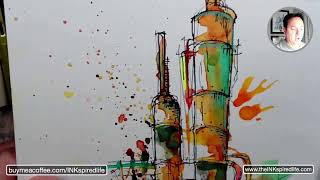
Artist Jason Nicholas sketches the Harbor Bait building in Boothbay Harbor with fountain pens, Sharpies, and watercolors, narrating his choices and introducing the LOOSE framework for loose-style architectural drawing. He experiments with ink bleeding and color mixing on different paper textures while answering questions about tools and technique.
Chapters
Hey everybody, hope you're doing awesome. Happy, um, Wednesday. Happy Wednesday night, hope you're doing well. 9:56 PM here in northern New Jersey. Um, yeah, popping on for a few minutes, just want to do my daily sketch. I haven't done it, so I thought it'd be fun to pop on for a few minutes and I'll do some sketching. I'm going to continue with the, um, harbor buildings shang-shack type of theme. And I see Linda is in the house. Linda H. Linda, hope you're doing well. It's always great to see you. Um, thank you for watching, and I always appreciate your, your positive comments. So thank you so much. Awesome. It looks like you're watching on YouTube. Fantastic. YouTube, we have made it over 400 subscribers. Yes, so excited! Uh-huh. D-Ray said, thought it was Tuesday most of all day. Sometimes it does feel like Tuesday all day, right? Um, I get it, I get it. Well, it is Wednesday, D-Ray. It is awesome to see you as well. You guys are amazing. So yeah, let's— I'm starting off. Does anybody notice what I'm doing a little differently tonight? I'll give you a second. I am starting off a little bit differently than I have been recently. And here's the answer. I am starting off with my Lamy pen. Typically I'm always, you know, using my Sharpie, especially when I know I want to you know, bleed some ink or some watercolor. I like to start with the Sharpie so all the black ink doesn't bleed. But tonight I just feel like grabbing a Lamy and just doing some sketching, and we'll see where we go with it. Great pen. Hopefully it works. It might be a little dried out. Linda says, thank you, I'm having a good week. Oh, awesome. And yes, I'm a YouTube channel watcher. Awesome. All right guys, let's do some sketching. So tonight's inspo is actually a building on Boothbay Harbor. As you can tell, I'm pretty partial to that part of the world. I love it. Um, this is called Harbor Bait, and it's right on the harbor. I love this kind of building here. Um, it's a fishery. Is that the word? Fishery? I think that's the word. If not, I just made that word up. But it's a really cool building. I have sketched it in the past. Tonight we're going to keep it really fast, loose, and wonky. I'm kind of timing myself. I don't have a timer on screen, but it's 9:59. We're just going to do a 10-minute sketch. I'm going to stop this at 10:10 wherever I am. And the light just went off behind me, so I know it's 10 o'clock. So let's just sketch this. There's a kind of a hopper system thing here. I guess they feed— I guess fish come down into a conveyor belt, goes down into this hopper piece of equipment, which is interesting. And there's actually a conveyor belt that kind of comes up this way, and it looks like comes up and something goes down. I I gotta, I gotta research this, guys. It's something mechanical, a hopper system with a conveyor belt. Any of my fishing gurus out there, maybe you know what this does. I don't know if you put the fish— like, you catch fish and you descale them, you put the descale stuff in there. Good God, I'm sorry, I don't know. I gotta research it. That's one of the cool things though about architecture and looking at buildings is I just love the aesthetics of buildings, and that sometimes is what draws me in to know more about the function and what these buildings do. So there's nothing wrong with without knowing, especially, you know, Leonardo da Vinci was a very curious, curious person, and that's That's how he learned so much. He was curious, asked questions, he studied. If you've seen his notebooks, I'm a huge, huge fan of his notebooks. It's okay to not know answers, right? Just be curious enough to ask the questions and to do the research and to do the studying. I kind of have this kind of building thing happening here. There's actually a really cool church in the background. I'm not going to sketch that today. I've sketched that church before. I'll do that another day. I just want to keep it to the kind of this building, and I'm just going to bleed the Lamy ink today. Keep it black and white for now. We'll just bleed some of this ink and see what happens. It's kind of a conveyor belt thing that comes up. Boom. There's a sign on the building here. And we have a little seagull guy up here. Actually, there's a bunch of them. I'm not good at my critters, as you guys know. That is a very bad seagull. But there is a seagull up there. Um, man, cool. All right, let's bleed some ink. We're gonna just have fun, keep it loose, light, breezy, and have a good time. Linda says, I love my Lamy pens. That is so cool. Yeah, Lamy. Um, the very first fountain pens I ever used were Lamys. I'm still very partial, and my first love is a Lamy pen. This is my cool black one. I think you guys— I know some of you have seen my cool green one. Here we go. So I believe I got this one in 2015. Came with ink that basically matched the color of the pen. Um, was a limited edition, which I didn't even know what that meant when I bought this back in 2015. Um, now I realize the ink was limited edition. I still have a little bit of ink left from 2015. I can't get any more. But this is a really cool pen. I love the color. So, Lamy, oh yes. Hey, Mickey's in the house. Great to see you, Mickey. D-Ray says, "Coastal sketching tonight." I am. Sorry I'm late, you're moving chickens into aircon building. It's 170 degrees heat index. Oh my gosh. Oh, aircon, aircon. I get air-conditioned building. That's interesting. So you're moving your chickens. I don't know much about chickens, but yeah, I could see, um, 717. That's crazy. OMG. So let's just bleed some Lamy black ink on this and just kind of play around. Here's an overhang, so I want to definitely bleed some here where the overhang might be. And I talk about intentions when I'm sketching. I don't always set them, but lots of times I will. And, you know, lots— sometimes my intention is just to either play with color, or maybe I have an intention to study different line types. Maybe this intention is to capture a certain shape or feeling, or sometimes the intention— lots of times it is just to have fun and create. And that's kind of my intention tonight. I just want to have fun and just play with some black ink because I haven't done just a black ink, uh, Lamy ink in a while. We'll see how it goes. Sometimes they're a hit, sometimes they're a miss, but there's always something to be learned either way. So even if you like— don't like something you're creating, that's okay. Just take something away from that. What didn't you like about it? What could you change next time? And then also pick something you do like. So I was— I sometimes feel like when we self-critique, we're too hard on ourselves. Um, don't beat yourselves down when it comes to this, you know, creative stuff. There's always something positive you can find, and there's always a lesson you can take away for sure. And I hear my little pup out there running in the hallway. Getting her energy out because she knows it's 10 o'clock and that's usually our bedtime. Cool, there we go. Got some black ink. This might be fun. I'm, you know, I'm gonna, I am gonna throw another color down because I have some red, or it's actually an orangey red color in this. This is an Etchr fountain pen. I've only used it once before, but let's bleed some red on here. Linda says it becomes a learning process. Yeah, Linda, exactly. It's a learning process. I'm just gonna throw some of this orangey color. It's called Cable Car, that's the name of the color from Birmingham Pen Company. So let's see what the blood— this orange and the black looks like. I'm laughing. My dog is, uh, she's running back and forth in the hallway. I can hear her. She's playing out there. I'm actually going to grab the bottle of this ink. I'm going to take some ink right out of the bottle because it'd be much stronger in color. This is cool. I'm just kind of liking the way it's drying here. I'm liking the way this is drying. I like Lamy ink. The black ink dries, and sometimes it tries a purplish gray. Sometimes it dries with some brown tones in it as well. If you look at this spot here, that's the Lamy ink. And after this dries, I'll come back and I'll add some detail on top of it with either a Sharpie or my Pilot pen here. Right now I'm just kind of outlining some shapes with the Lamy ink. I really do not think the learning process ever ends with creatives. Hey, Mickey, that's true. I think you're right. That's what makes creatives creatives, right? Um, I like that. We always want to know more, learn more. Uh, where's that? Oh, sorry, the color is called Streetcar, not Cable Car. So this is Streetcar Ink I'm gonna grab right here. And I just want to take some right out of the bottle. I just want the vibrancy. I'm going to put the cap on because I will spill it if I don't put the cap on it. There you go. You can see how intense it is right out of the bottle. Yeah, creatives are always— we're always learning, right? It's just part of the mindset. Creativity— part of creativity is mind— is mindset. How are we approaching things? How are we thinking about things? I'm actually working on a framework that I'll share with you guys. I, I'm just working on it, but this is a framework. I'm trying to come up with an easy way to teach loose style architectural sketching or urban sketching. And you guys are the first ones that are going to see this, so thank you for watching. Um, kind of ties into what we're saying about mindset. So I'm using the acronym, um, you're seeing here for the first time. It's just coming out of my brain. I was working on it today a little bit. We're going to use the word LOOSE. So, the L is for liberate, O is observe, the other O is on paper, S simplicity, E is embrace. I'm not gonna go through this in detail right now, but you know, let's talk about the first one, L for liberate. Liberate, when I write, when I mean liberate is to do loose style sketching. It's a mindset. You know, we feel like sometimes we have to be really rigid and precise. With artwork. We need to liberate that, free ourselves of that feeling, that mindset, um, be more open for interpretation. Don't be so rigid. So that, that goes, you know, back to where we're talking about the mindset stuff for creativity. So that's the first L, let's be loose. Like this sketch here, I'm very, very loose with the outlines building. Heck, we're going to bring another color in. I'm going to throw in some, uh, let's grab some turquoise watercolor here. I have some right here in my palette. You know, mindset. Another L for liberate would be, um, free yourself of thinking when you're sketching architecture that we have to replicate buildings exactly as we see them, that we have to replicate the colors. That is not true. If we're loose— I'm talking again for loose style sketching— you can put whatever colors you want. So that's exactly what I'm doing. This is looking much darker on screen, I feel like, than it is in person. It's not as dark as my— the images on my preview here. I'm going to pull some of that out. I just kind of want to stain some of the colors and keep them a little lighter. So when I sketch on top of it with pen you can pull out some details on it. Cool. Um, it becomes the what if. What if I do it this way? Or what if I use a color I don't like? True. Loving the drawing as well. Yeah, look, this is pretty cool. Zoom in, you can see it closer. It's just fun. So one of the things that fascinates me about color play, um, is watching it dry. I love watching ink watercolor. I love watching it dry, and I get excited, you know. Am I happy? I'm not really happy with the overall composition yet. It's kind of in its ugly duckling phase. A lot of my sketches and artwork have that ugly duckling phase where I'm like, oh my God, um, but I have no— I know by now that it will have that turning point where it changes. But that being said, I love the way this is drying right in here. Uh, let's use this as a pointer. I'm loving the colors happening right in here. Really, really cool. Um, I love the colors happening right here too. Boom, it's just so cool. Right, so let's start adding a little bit, just a little bit of detail. We're going to use a Sharpie, I think, tonight. Let's show some siding on this building just to start giving it a little bit of character and pulling out some of the shapes of it without adding too much detail. So this building actually has vertical siding. So vertical siding is this. Where's my scratch paper? Let's see, I took some notes today. I'm a big note taker. Here we go, right? So we have a building. Let's just do a box here with our basic generic house shape. So this has— this building is vertical siding. Sometimes it's called, uh, board and batten siding, rather than what we see mostly is our horizontal clapboard siding. So this has the vertical. So let's just get some vertical lines like this. I'm not measuring the spacing, I'm just laying down the lines. Again, I want to be loose, wonky, so I'm not measuring the spacing between the lines. Are they all perfectly vertical? Nope. And I'm sorry, guys, I do shift the paper around a lot when I'm sketching, so I apologize if I'm giving you whiplash by, uh, moving your neck. But there you go. So you can kind of see it's taking a little bit of shape just by adding some of that siding, and it would continue over here. Boom. We actually have a big door opening in here. I'm gonna break out a— I think I'm gonna break up violet. I'm actually going to use a, um, Varsity. Actually, let's use— yeah, let's use our purple Varsity and throw down some shadows with it. Here's our roof. I wanted to pull the— it's called a rake board, rake board here on the end of our gable roof. That's this piece. Then we have another rake board that comes down like that. And then I'm going to leave this kind of white for now. This is that conveyor belt hopper area. I don't want to mess with that. There is a sign we have on the building here. And then let's continue our vertical siding here. Paper's a little wet. Sharpies don't like to write on wet areas too much. There we go. So you can see just by adding some lines, it's starting to take more shape. Hey, Andrea's in the house! Good to see you, Andrea. Yay, I made it to another live stream! Yes, you guys are awesome. Um, Dearest is loving the drawing as well. I like that. Studying the Impressionistic movement will help the mindset of being loose. One of my favorite periods in art history. Mickey, that is awesome advice. I love that. Love that. Very cool. I believe all artists— I do believe all artists working with watercolor, ink, or colored pencils has ugly, tuckling faces. You build your painting. Yeah, exactly. Even Bob Ross, right? Um, for me growing up, I loved Bob Ross. Still love Bob Ross. But what really, I think, kept me engaged or fascinated by Bob Ross Um, not only his beautiful paintings, but he had always had that point in the show where his paintings transformed. It was just— I've talked about this before— a magical moment where they just took shape. And if you've watched his shows, you've watched him paint, you'll know what I mean. There's just that point of transformation that you're like Oh my God, this is incredible. And I'm not saying, you know, the end results I'm doing are incredible. It's that transition point that you're like, oh, aha, now I see it. That's so much fun when that happens. And it will happen. All right, let's throw down some purple. We've got a purple Varsity pen. And I want to create shadows with it, and I'm actually going to throw some inside here to create kind of a— like this doorway's open. So let's actually— let's do that first. I'm going to just draw some vertical hatch lines. Boom. And I'm going to bleed— I'm going to bleed this ink as well. This— that is true, he was incredible. Yeah, absolutely. Gotta love Bob. I'm going to zoom in so you guys can see what's closer. There you go. I'm just bleeding that Varsity ink right now, and I like the color combination of this purple with the orangey kind of tones we have going there. And I'm going to use it for my shadows. So I'm actually going to just throw some here for the overhang under the building. Sorry, you can't see that. Boom. Let's keep that there. I'm just kind of putting a little bit here and we'll bleed it. And this is just going to help to pull out an overhang, give some shadow. You know, the edge of our roof is coming maybe 2 feet, 1 or 2 feet past the face of the building. So this is a shadow line that'll help show that idea. Coolio. I like it. And then we're gonna— still hear my pup, she's still running around. Let's bleed some ink under here as well. Oh, I said I was gonna work on this till 10:10. My bad, I lost track of time. It's all good. That means we're having fun. See, now for me, this is really starting to take shape, adding these different colors. We're going to pull out some purple down here as well, maybe on these, uh, piers we have. I drew this building way too low on the paper. Like, this, this should have been up here more. It's okay. Well, imagine it's going down. These piers are going down into the water. It's okay to leave, leave it up to the imagination of the viewer. That gives them more buy-in into your artwork. They can participate mentally, right? Kind of make up, fill in their own blanks. I like doing that with my artwork rather than, you know, just kind of leave that white space, leave those blanks. It helps the viewer to just engage on a different level. It's cool. Yeah, I'm kind of liking it. Looking really good. Hey, thank you, Mickey. I'm glad you like it, Mickey. By the way, I, um, I mailed your sketch today. I popped it in the mail this morning. So what, today's Wednesday? I didn't get the— I didn't look at the estimate. Do I have the receipt here? I'm guessing maybe Saturday you would get it. So it is on its way to you. Again, thank you so much for your interest in that, um, sketch. Um, a lot of people like that sketch, so that is so cool, and I hope you enjoy it. Let me know what you think of it when you get it. I hope it's much better in person than it was on screen. I think you'll like it. I really want to pop some blue, more turquoise in here, so I'm just going to lay it on thick. I'm going to just dip into the watercolor and I'm going to just load it on this brush like there's no tomorrow. Boom, there you go. You can see I have mucho paint on this and I just want the idea of a patinaed roof. You can see, look at— I just— look how thick that went down, that color. And we're just going to do this here on here on the There we go. Awesome. This will take more shape when I fill in some of the details of what's happening there, for sure. Let's just throw some of that turquoise into our Purple. My little birdie up here got— I don't know what happened to my bird up there. I lost him. Cool. So can you— yes, having a Halloween look. It is. Yeah, this is, um, again, I'm just having fun. Not too cray-cray about this one. But again, I think what my takeaway is that I like— all right, let's wrap up with this kind of note here. So I'm going to talk about something I like about this. So self-critiquing. Here's how I like to self-critique. Number 1, find a positive takeaway, something you like about what you did. And number 2, find a lesson and a suggestion for improvement about what you did. So here's my takeaway. Here's what I like about this. I'm liking the color mixes going on, especially, um, I like what I just did. This is actually going to dry really cool. I'm liking the turquoise in the purple. This looks really awesome in person. I'm curious to see how that's going to dry. And I still love the color combination here. I just love what's happening up in this area. So that's what I like about this, or just some of the way the colors are mixing and drying. Um, what don't I like? Um, so yeah, I started with the Lamy pen. Here's my takeaway. I thought it'd be fun to start the Lamy pen today and bleed it. I, I'm— that's what I'm not digging. It's— it got too muddy looking. So this is really muddy in here. Lamy ink just got really muddy bleeding it. So my takeaway, easy kind of fix for me is, you know, start, start with a Sharpie. I'm confident enough with the lines I throw down with a Sharpie that I'm not worried about, you know, messing up. Um, start with a Sharpie so when I add water and water and inks, it— all that black won't bleed so much. And then where I want the black to bleed, I could come in with my Lamy, right? And I can just bleed that black where I want it. I have more control. Rather than outlining the whole thing with black Lamy. So that's my takeaway. Um, I still love my Lamy. I still will just sketch stuff with it in black and white, bleed a little bit of gray maybe, but when you go to mix colors, it's not really happening for me. So that's my takeaway, guys, on that one. Um, oh, thank you, Mickey, that's great. I appreciate that. I'm sure I will. I have the barn wood. Oh, cool. I can't wait to see Mickey, how that looks after you frame it. Please post a picture. That'd be so great to, to see that framed. Love it. Yeah, guys, let me know. What do you like? The takeaways? Does that make sense to you? What I'm saying? I'm curious. This is actually drying pretty nicely here too. Let's go closer. I love— I really love the way this is drying down here. And for me, that's so cool. That's exciting. I'm geeking out. Yes, I am geeking out on the way the colors are drying. I'm weird, but it's fun. I love, I love the colors. I love actually which— how this is drying in the shadow. I'm looking at it closely on screen now. I can really see the detail. That looks so cool. You can see how this is drying in here, right? It's actually— I have to say, here's what— here's what I— the more I'm looking at this, the more I like it. But I would crop it. Where are my frames? Let me show you guys. My frames might be too big. Let's see. Just grabbing some frames I have. It's too big. Dang it. All right, I can do it this way. I kind of like this. I would crop out— like, I kind of like just this right side of the building here. Something about it that I like close up. Oh, I hope the camera could focus on— my hands are a little shaky. I'm kind of liking that piece, maybe up to here. It's this part that's really got really muddy back here, this part in here. It's just too mucky. So this— there are some pieces of this that would be really cool if they were little vignettes of a painting. Very abstract, very loose. Maybe if I did something like this. Yeah, I'm kind of liking that. Even this is— so this is a 2-inch by 2-inch square. Cool. Hey, Chris is in the house. Chris, good to see you. Chris has a cube. Chris's cube is awesome. Is it all Sharpie or is it watercolor too? So Chris, yeah, this is a combination of, um, it's actually Lamy, Lamy Sharpie, and ink in here and watercolor. So it's 4 different things. So 4, yeah, totally 4 different things. Good question. Uh, Dira says, your takeaway makes sense to me. I am enjoying the reddish of the whole building. Yeah, you know, it is, it is very interesting. Yeah, I would, I would really just clean up this kind of mucky area here. I can do it, guys. There's a way I could bring this back. Uh-huh. And let's try it. If you guys want to stick around, stick around. Again, it's all about playing, learning, having fun. It's about the process, right? It's about— so let's go back to my framework I was talking about. Um, I'm going to be teaching a workshop with this framework And I'm gonna be— I am gonna be starting a loose style architectural sketching, a community. I'm gonna have an online community. It's gonna be like a paid community where we're gonna be talking about this stuff in detail. But if you go back to my acronym here, the E, embrace. For me, embrace means embrace the process. Sometimes we're just so focused on, is our painting gonna be beautiful? Is someone gonna love it? You know, that's okay, but sometimes we're too focused on that. For me, I embrace the creative journey. I'm embracing the process. That's what gets me on fire. That's what I love. I just love the process, throwing down the colors, watching them dry. Yeah. So part of this process is, look, can I bring this back? I'm going to break out white. I'm going to see if I can throw some white on here and pull it back a little bit. Let's see what happens. Again, that's, that's the E in LÜS, is embracing. Embrace the journey, embrace the process. And let's see, I might try, just for the heck of it, let's try one of these Faber-Castell Pitt Artist Pen. I have a B is a brush tip and C is chisel. Let's take the brush tip out. I've only used these a couple times. Sometimes I think, last time I used it I put a couple layers on. But can I bring this back with water? White. Let's try it. And when I say bring it back is I want to— I kind of lost— maybe this isn't going to be thick enough, this white. I also have gel pens. Where's my white gel pen? Here. I have the, uh, Uni-ball Signo gel pen. I love these pens, but they're kind of fussy. Something with the rollerball and the way the ink comes out. It's not— it doesn't always come out like I want it to. Well, let's, let's play with it. Yeah, it's kind of— well, you can kind of see it coming out. It's right. I'm kind of just trying to clean the edge up. I also want on this roof, I want it to be a metal roof. So I'm going to break out the Sharpie. Let's just sketch. When I do my metal roofs, we're just going to show the metal panels coming down like this. So it is starting to come back. Unfortunately, this Pitt pen, I think it's trying to mix with the watercolor, which is kind of cool. It's not as crisp as I wanted it to come out. Well, let me put the chisel. This is the chisel point. There we go. I'm actually liking it. I think, I think we got it, guys. I think we came up with a a, um, solution to just bring this back a little bit. There we go. I'm liking the chisel point better than the brush point. Let's throw some highlights. Maybe there's some highlights on this roof just to give it a little brightness. There we go. Yeah, much— I like this much better. Let me know what you guys think. Hey, Becky's in the house! Becky says, wow, that purple, it is awesome, isn't it? It's good to see you, Becky. So cool. You guys are awesome. Chris says, I actually like the missing part in the middle, the big holiday. Oh, thank you. So the big missing part is actually, um, believe it or not, this is a— this is a conveyor belt system. That comes up. This is a bait building, it's called Harbor Bait in Boothbay Harbor. This is a conveyor belt system and there's a hopper, which I'm gonna pull it out a little bit more with ink, but that's gonna stay white, but I'll pull it out with either my Pilot pen here or my Sharpie at some point. I'm still, I'm still on a search for the best white gel pen. This is my— this has been my favorite so far. I just wish it would come out consistently out of the nib. Um, these are interesting. These are cool on black paper. Um, it could always go with whiteout too, right? Just a good old-fashioned Whiteout. I don't have any, but that could work as well. Cool. Becky likes the green roof. Oh cool, so the green roof, Becky, is, um, turquoise. It's turquoise, mostly turquoise watercolor mixed with some other stuff, but it's mostly turquoise. Oh, Chris said the same thing. I've yet to find a good smooth white to use. Yeah, it is a challenge. I have the Uni-ball. I also have— I've used these too. This is kind of thick though. I've used art crayons. This is a white art crayon, so I've used them. There's another brand, popular brand of white gel pen. I can't think of what it is. Is off top of my head. I've used that one too. Mickey says, wow, that makes a difference. Yeah, thank you, Mickey. So it does. I agree. I want to add a little more purple in here. I just want to make this a little darker. And for the purple, so Becky, the purple I used was a purple— where is it? Here it is. So the purple I used was a purple Varsity pen, Pilot Varsity, um, and there is a touch of turquoise in there as well. But I just want to add— I just want to darken this up. I want to give a little depth to this opening. Maybe I'm— maybe I should have put the pen down and stopped, but let's see. Just want to add a little depth to this just so it has more of an opening kind of look to it. There we go. I think that's fine. Yeah, it's pretty cool. I'm liking it, guys. Um, use Doc Martens bleedproof white and sometimes a white Posca. Yeah, yeah, yeah, good point. I do have Posca here too. I forgot about that. Good point with that one. I do have a Posca paint pen. I don't know, do they come, do they come in narrower pen sizes or are they all this size? I'm fairly new to the— actually bought a package about a month ago from Michaels with a coupon. So I'm fairly new to the Posca pens. Let's try it. Nothing's imposcible. Hey, hey, Uni, if you're out there and you didn't come up with that slogan, hit me up for it. Let's talk. Imposkible. I like that. I did make that up. Yeah, yeah. So here's the— there's the, uh, actually I kind of like it. This is the paint pen. Cool, I like it. Linda says I use Posca white pens too. Oh, awesome, thank you, Linda. You guys are the best. White acrylic paint— white acrylic paint pen would be more opaque. Yes, agreed. Dr. PH Martins. I have— I own Doc Martens. For my feet, but I've never used Dr. P.H. Martin's ink. I must start to think about it. But I do love my Doc Martens. They make me like an inch and a half taller when I wear them. They come with a thin tip too. Thank you so much. My nose is itchy. Sakura. That's it, Linda. Sakura Gelly Roll pens. That's the other one I was thinking of. You guys are awesome. This is missing a color. It's missing, well, 2 colors. Let me know what those colors are and we'll wrap up. You definitely should be able to get one of the colors it's missing. Zoom out. You guys can see what my desk is looking like if you're interested. Here's what I got out. Boom. These are my watercolors on my left because I'm left-handed. This is what I got going, peeps. My frame thingy. Put my frame thingy away. So this is, uh, this is 4x8 Fabriano 1264 cold press watercolor paper. You can see the texture if I do that. Love the format, love the paper. Um, it has replaced kind of replaced my Canson. Yes, the pink. Chris said you get signature pink. Absolutely. It's missing the pink. Becky got it, the pink. You guys are amazing. It's missing the pink and it's missing one other color, so we're gonna add some pink. Grab my— got my pink here. So let's throw some pink on there. One other color. Yes, D-Ray got it. Yellow. I feel like we need a touch of freshness, brightness to this. So we're going to throw on some yellow. Linda's like, teal, teal. That would be a good color also. I like adding teal. I'm thinking it needs a pop of— so the pink is a pop of pow, and the yellow will be a touch of brightness or freshness. So, and let's see, maybe let's do that with color pencil. Sorry guys, I'm thirsty. Um, I like what Becky's saying, the yellow preppy pen, that's also a great idea. You guys are the best. Where is— let me just grab my neon yellow. I think we're going to— I think we're just going to go with neon yellow and neon pink Prismacolors. Um, Becky, I like the idea of the yellow Preppy. You guys know I love it. Um, it has a really nice yellow-orangey pop to it, which would be cool. On here, but I think I have kind of enough orange on here, so that's why I'm not going to use the Preppy Yellow Preppy for this. I think I want to go straight up more yellow. If I wasn't using that, I would like— I probably would use, uh, the Lemon Yellow right here, watercolor. I think it's Lemon Yellow that I've worn all the way through. I probably would throw that on. And we're going to get crazy with it. This is actually a sign up in here, so we're going to throw a little bit of yellow, pop it there. I kind of want to pop a little bit in here as well. And we have it here, and I kind of want to round it out, kind of ground it. Let's ground it back in here. That's it. That's all we're going to do for the yellow. Boom. I also have the pink on. Follow your gut. You are the artist. I like that, Becky. Yeah, got to go with our gut feelings, guys, right? Go with our gut. So let's throw on some pink. I did want to do some pink on here, maybe just a touch there. Boom. I'm thinking just a little bit here, a little splotch. Is that the word, splotch? Little splotch of it. If I don't change that song, Facebook's gonna mute me for some reason. I guess it's a copyright issue when it plays That Beethoven. There you go. So I just want to kind of fill in the sign with the word 'beat.' Um, yeah, I'm liking this, guys. I think it's a wrap. "It's your world, we are just visiting." Aww, and I'm so glad you guys are visiting. You have made my day. Guys, I think it's a wrap on this one. I like it. It came out kind of fun. Um, so again, let's go back to self-critiquing, which I did before. Thanks, Chris. I appreciate that. Looks great. Um, so we're gonna re-critique it. Because I didn't intend to keep working on it, but I'm glad I did. Remember, self-critiquing— this is like a broken record here— two things. One, always find something positive that you did, and then if there's something you don't like, that's cool, point it out, find it, but come up with a solution so that next time you have— you're ready to go with a possible solution, okay? So what do I like about this kind of final product? Um, actually, I kind of like the way it came together. I like that— I like that was able— I was able to clean it up in here because it was really muddy. If you go back and watch the beginning, if, if you missed it, this was really muddy because I took my Lamy, I bled it, and it got too mucky. So I was glad, happy I was able to take, you know, clean up a little bit with the white. Hard for me to say. Um, next time if I was to do something very similar to this, what would I do differently? Hmm, definitely the bird. Yes, there is a bird on the roof, the seagull. We can actually pull him back with some white, I'm sure. So I could work on that. Um, here's, you know what I would do different? Here's my takeaway. So next time if I do something like this, it's the composition, the layout. I made the building way too low on the paper. This really should have been raised up so I could have made these pier come down and at least taller so that you get more of a fishing shack look, that it's raised above the water. I have this way too down on the paper. So that's my critique and my evaluation for what would I change next time. Cool. Hey, you guys are awesome. I appreciate it. D-Ray says it's a wrap. It is a wrap, guys. You don't really want to hear me like do a rap, like a rap song, do you? I mean, rap my way out of here. So, um, guys, thank you so much for watching. I appreciate you tuning in. And Chris says, did you find it easier to work on hot press or cold press paper? Do I find it easier? Um, I personally like cold press paper because I like the textures of the paper. Um, I like to see the texture come through. So I'm— I would say I would use— I use cold press 90% of the time. Um, for me, it's a lot of— a lot of what I do is about the texture of what's happening. So for me, texture can be a tool. It's a really great question. I've done hot press. I'll show you an example if you want to see it. Actually, here, let's take a look here. You guys give me a second. I'm gonna pull off two sketches I wanna show you. So let's take a look at hot press, cold press here. Same subject matter. So these are industrial sketches based on the, the steel stacks in Bethlehem, Pennsylvania. Cold press, really thick. I don't— I think this is, um, what is the thick paper that comes in the front of the Kilimanjaro? It's that sheet of paper. I forget what the weight is on it, 300 maybe. Really thick. It has some texture on it. I like the way the texture kind of plays. If you look in here, you know, you can see the texture allows the ink and the paint to skip places and leave these white areas behind, right? That's one thing I like about cold press, is getting that same subject matter. This is, this is, um, hot press, really slick and smooth. I like the vibrancy of the hot press, that's one thing I will say. But for industrial, I'm kind of missing the grunginess of the cold press. Hopefully that makes sense. Hopefully that answers your question. I like them both, but I, I go to cold press mostly. This is— bye, see you next time. You will, D-Ray. It's great to see you in the house. Linda H, always great to see you as well. Chris, it was so nice that you popped in. Great seeing you. Um, Becky, I'm so glad you caught us today. It's great seeing you. Good stuff. Who else was in the house tonight? Or the hoose. Mickey, thank you for joining us tonight, Mickey. Always great seeing you as well. Scrolling through the names. If I miss anybody, let me know. Andrea was in the house. Andrea, if you're still out there, it's great seeing you. And if you're not out there, it was still great seeing you. Um, I think that's it. And if you were watching and didn't comment, that's okay too. I appreciate you. Thank you guys so much. Remember, keep paying it out, paying it forward out there. I like to say creativity for positivity. Um, yeah, thank you guys so much. Have a great, great night. I will be on again I'm not sure, Thursday, Friday. I'll be on again this week one night. Um, thank you guys so much. Take care, have an amazing rest of your day and rest of your week if I don't see you. Peace and live creatively. See you guys soon. I am looking for the finish button. I couldn't just say like, hey Siri, finish. Hit the finish button for me. Um, Cold Press, I really like Cold Press. Swipe up from the bottom to the middle of the screen and hold until you reach the app switcher. Then swipe up on the apps you want to close. Thank you. Siri actually just came on. That's a great way to end. Alright guys, take care. Bye. Thanks Siri. Uh-huh. Hey Siri, can you go make me a bowl of ice cream? Hmm, I don't have an answer for that. Is there something else I can help with? No, thank you. Okay. Yes, I'm having a conversation with my telephone. Do people still say telephone? Cell phone. Take care, guys. Good night.





