Inking Out Loud - Sketching
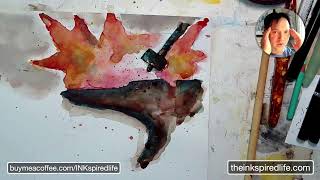
Artist Jason Nicholas sketches an anvil and hammer in ink and watercolor during a live stream, sharing his material choices and philosophy of leaving work intentionally unfinished. He uses Lamy pens, watercolor sticks, and 140 lb hot-press paper while answering viewer questions about composition, color mixing, and his teaching practice.
Chapters
Hey Cameron, good to see you. D-Ray, good to see you. Hope you guys are doing well. I just, I just dropped my brush under my drawing table here. Let me see if I can grab it. Hope you're having a great Saturday, Cameron. Happy belated birthday. Hope all's well. Hope you had a nice birthday. I am, uh, I am having technical issues now. My— one of my legs on my drawing board now collapsed. What the heck? Oh boy. But that's a good thing because I found the cap I've been looking for. Boom. So give me a sec, guys. I'm just— there we go. Hopefully that's working. Hope you guys are doing well. I'm popping on with a, uh, working on watercolor. Actually, I started this morning watching Roo. And I just want to kind of do some outlining with ink right now on it. D-Ray says, looking like Texas, looking like— oh, it does kind of look like Texas. Yeah. So this is actually— we're looking at an anvil. Let me— I'm just moving some windows here. I popped on quick. I didn't really organize my computer before I popped on. Got a lot of screens going. Now I can see. Just want to see what you guys are seeing. So this is actually an anvil here, kind of half of an anvil, or it's kind of cut off. A hammer. And then we have some kind of flames, forge stuff happening in the background. But yeah, I could definitely see the Texas vibe. That's cool that you said that. Oh my gosh, I gotta reorganize. I have so much stuff out over here. So anyway, I want to pull the outline out of this a little bit, so I threw down some Lamy ink. I just realized I have two different songs playing. Ah, there we go. I had Spotify on and then the music you guys are hearing on at the same time. I was like, what's that in my ear? I hear different music. But now we're good to go. That's what happens when you don't organize before you come online. So I just, uh, used some, uh, Lamy here just to outline this, and I'm gonna bleed it. I just want to pull the silhouette of this anvil out a little bit more, and it's not a complete anvil, right? Because it would really continue off to the right over here. I just wanted to capture part of it, keep it loose, unfinished. I love sketches that are really— and paintings that are unfinished, when you don't get to see the entire object. There's a couple reasons I do that. One is, um, sometimes it's easier to sketch or paint if I don't show everything. I'm not worried about all the detail. The second thing, probably more important thing, is it allows the viewer to kind of finish this in their imagination, in their brain. So I think it engages people a little bit more than having a complete object drawn. So I love just how it kind of fades out on the right-hand side. So that's kind of my reason why I like to leave these things unfinished. You may have noticed some of my bridge sketches the same thing. A lot of them are kind of unfinished on one side of the bridge. I want the person to use their imagination, you know, what's happening on the other side. Cool. So I'm going to use a Lamy to kind of outline his hammer a little bit more. I think I'm— I just had an idea to maybe bring out some watercolor stick maybe as well, grunge it up a little bit. Found the cap. I did. I found the cap finally. Yeah, it was under the drawing table, so I am glad it collapsed. The reason I like to keep the caps for my aqua brush is the water does evaporate out quicker without a cap on it. So especially when it's so dry in here in our house. Cameron says industrialization in and architecture, an interesting subject. Absolutely, Cameron, I agree with you. I love doing sketches that are of industrial type buildings, factories, warehouses, these old iron buildings with, you know, metal, corrugated metal on the exterior. I love all that stuff. Alright, let's kind of outline this hammer a little bit. My Lamy, I think, is clogged up. It's not flowing as well as it usually does, and I think last time I sketched on— man, I think it was the paper. The fibers of the paper may have gotten caught in the tip of the Lamy here. See if I can clean it off. I have a— let me zoom out. You guys can see I have a lot of— not a lot, but I have pens up here kind of off to the corner. I got to move these down here on the right for now. I just need more space, so I'm going to turn this as I'm sketching. Notice the corners or the edges are sometimes chamfered on these hammers. I guess this is a sledgehammer. This comes through here to kind of the end. Anybody knows, is it Is it a sledgehammer? Is it a mallet? Is a sledgehammer and a mallet the same? I need to learn the lingo. Cool. Here we go. Let me zoom back in. Sorry about that. So you can see I just added some lambie around the edge and I'm gonna bleed it now a little bit, which is add water on top of it. Ba-bum! Hey, so D-Ray, I hope you're keeping warm. This morning here in New Jersey, it was -1 degree. -1 degrees Fahrenheit when I woke up this morning. I think we're up to 19 now. Feels like 9 out, so we're getting some, uh, we're getting a bit of Arctic blast here today. Nothing like I'm sure you have had in Alaska, and we definitely have not had the snow you guys have had. Again, I'm trying to keep this in my style, so it's kind of loose. You know, I'm not trying to make anything very realistic. I don't do that. I believe that's why we have cameras to make— to capture something realistic. But I'm kind of liking this. I might— Let me break out the watercolor stick here and just add some of that to it. Um, I love the colors in here. We have some turquoise. I'll show you guys what we have on this. We have turquoise, not the colored pencil yet. I'll be breaking out the pencil at some point, probably towards the end. But I used a turquoise watercolor paint here. I used a little bit of this Red Oxide acrylic ink. Love red oxide. I have some sepia acrylic ink here as well. What else did I use on this? Underwater colors, I used some red, yellow, and orange, brown, and blue. And I used my Winsor Newton sepia marker a little bit here as well. So those are where the colors are coming from. So I'm gonna actually use a watercolor stick. I'm gonna dip it in a little bit of water. It's actually dirty water. Love to use dirty water. And we're gonna kind of sketch with it. Just gonna kind of outline this a little bit. You see my board is tilted, everything's going downhill. And also on a sheet of paper, I'll zoom out. You can see I'm just using the paper itself just to kind of test colors and stuff as I'm working down here. So we have some swatches. I don't know if you guys can see that okay. It's looking blurry on my screen. I don't know if it's blurry for you or not. Actually, let's add some water. I'm just wetting this here because I'm going to go over it with the watercolor stick. Oh my gosh, everything's rolling to the left.
This is—
something weird's going on. It never does that.
Here we go.
So you can see as I'm adding this, it's really kind of bolding the outline. I'm going to dissolve it a little bit just by going over it with some water, just make it run a little bit here, bleed some of that watercolor stick down maybe into the anvil itself. I think the edge is still reading pretty nicely. And this is kind of dark here. I'm imagining this to be in shadow. I kind of want this edge to be really dark. We're going to turn it and I'm going to just let it bleed down a little bit this way just to soften this edge. Cool. I don't want to get too fussy with this one, but I feel like I might be able to add A little bit more. I think that's enough watercolor stick on there. Boy, this definitely wants to be used. It keeps rolling to the paper. So I usually will add color on mixed media pieces. I'll usually add colored pencil towards the end. This is my favorite colored pencil color right here, Light Aqua. As you can see, this one has been well used. I have two backups right here in front of me as well. So let me let this dry for a sec, check in with comments, and we'll come back to it. I'm gonna blot a little bit of this off, just soften some areas up a little bit. Cool. Um, D-Ray says, glad you popped on with your anvil. Yes, I'm glad I didn't drop it on my head either. That would have been painful. Thank you guys for liking and sharing. The viewer, um, unorganized, we would never know except you told us. Oh yeah, well, you know, the truth has— the truth is out there. I'm very unorganized, especially before I came on. I have things everywhere here. I was grading, finished my grading for the marking period, and I needed a break. So that's another reason I popped on, just to change my state of mind. Um, Metal and Wood, oh man, you got, you got more snow. It's beautiful but a lot of work. Yeah, of course. Yeah, D-Ray, if you want to post pictures of your snow, that's cool. You can post on Inklings. Um, that's awesome. Might inspire someone to do, to do a sketch or a painting of a snow scene. Yeah, thank you for asking. You could definitely post on there. Well, I hope you're keeping safe and warm. Red oxide's a nice color using dirty water. Hey, thank you so much, D-Ray. You had posted some artwork the other day, it was awesome. I was, I was happy to see that you're doing some art, so keep doing it, keep putting stuff out there. Let it run, Jason. Tilt, tilt, tilt. It is running. Sorry guys, I'm just drinking. I have some coffee here, drinking a little beverage. Feel free to hit that like button, share this, that would be so cool. See if we can get more people watching, that would be awesome as well. So I'm streaming on Facebook and I should be on YouTube right now at the same time. Where am I going to put my coffee? I'll put it back here so I don't spill it. Alright, cool. So let's— you know what, I'm going to break out some colored pencil on here. Maybe we'll scuff up this Anvil. So why am I using turquoise on this? Well, I do love it, but I like the turquoise and sepia color combinations. I'm also trying to just get a kind of a rusted effect, so I like throwing this turquoise on here just to add a little bit of rusting. I think I also like the turquoise because it's contrasting. It's a cool color next to these kind of flames I have up here. So this is, this is not how I envisioned this piece to be in my head. I actually did sketch with pencil first, which I rarely do. You can probably see some pencil lines here. I did that because I really don't know how to sketch anvils without a reference or a sketch practice first. So I sketched the pencil lines and then I just went back and added my own thoughts to this. Originally I was picturing almost some kind of graphic or logo and I was going to have this be a sharp edge and just kind of cut this out. Where the flames were and then it just grew. So we'll see what happens. And this is just for fun. So let's throw some blue in here. Let's actually throw a little bit in here as well, I think. I'm trying to create a curved— let me zoom in for you guys here. So the anvil is curving, right, around towards the bottom. So just to give an illusion of that, I'm actually going to use this and just sketching some curved lines here just so it looks like it's kind of curving up a little bit. Just gives the idea that— so it's just not so flat looking, I guess. Again, this would be curving around these edges as well. So this would be curving, I guess, curving in this way. So I'm going to sketch in— this is where I can just add my loose style of sketching, right? Kind of come on top of the watercolor underneath, just show these lines. There we go, just roughing it up, adding some contour to it. The blue really pops against that dark background there. Um, even here, I think there would be a little curve right up in here. I need to learn the parts of an anvil, so I don't even know what all the parts are called. I'll have to look up a picture. But I think this kind of curves here, this curves up a little bit. Quick, loose, wonky lines. I don't want to overdo it. Let's actually do the same thing on this mallet here. It kind of curves. Let's see, how am I picturing this? This is going to curve kind of down this way a little bit. Saw right, you can see I'm just scribbling these lines on here. And even the handle here would have a curve to it. I don't want to get too carried away, but I think you get the idea. So if I zoom out, there we go. It's kind of what it's looking like. I do want to add— I don't know what I'm going to add there.
I don't know.
Let's see. Let's dip into— I have some watercolors here. Let's put these here so you can kind of see what I'm grabbing. So I'm putting some brown— actually putting some brown and blue right up in here. I like to make gray using brown and blue a lot, so I'm kind of mixing them up. I just feel like I want to throw a little— just another layer of color on here. I'm just dabbing it down. And I'm just trying to age, age this a little bit. Now if I could just de-age me a little bit, we'd be really good. But I'm just— I'm aging this up a little here. Alright, and sometimes I'll let it soak in and I'll pull some of that back and it's adding— adding a little texture. It's actually looking a little more like leather than metal here, which is interesting. I don't know why it's doing it. Alright, cool. I don't know how much more I want to do on this one right now. This one actually might be done. Cameron says, I've been meaning to ask, the project using light boxes you wanted to do in your classes, do you have an idea on how to go about that yet? So Cameron, great question. Um, no, I I'm not sure yet. So I don't know what project we're going to work that into. I do want to have them do that. Um, if I thought about it, we just finished building primitive shelters and hut models in architecture class. Small— excuse me— very small-scale models. That could have been a light— actually, um, no, it was one— maybe some of them could convert them into lightbox models. But yeah, definitely going to use that concept and that model sometime this year, but I'm not sure when. So that's a really good question, and I'm so glad that you shared that technique. Great question. Um, Durex says, turquoise, still liking the sketch this morning. Alaska time. Gotcha. What time is it in Alaska right now? I'm curious. I don't know the time difference. It's 4:22 PM here in Jersey, as we like to say. Someone likes to say Jersey. Um, hey, Jason's in the house. Jason, good to see you. Something other than a bridge? Yes. This is definitely something other than a bridge. I love bridges. I'm on sketch 68, so I have sketched 68 bridges continuous in the past like 65 days. So, um, sometimes good to step away and take a little break. So Jason, you are right, you're noticing I'm taking a break from a bridge. Bridges right now. I'm sure I'll do a bridge sketch at some point later today. But yeah, I never set a set number of how many bridges I was going to do, so I could stop any time. But, um, they're kind of fun to be sketching. Um, I've had some people connect with bridges. They relate to the places, they've been there. So it's been fun to hear comments like that, which is cool. And I managed to sell a couple of bridge sketches, which was fun also. But today we are sketching an anvil today. And a hammer. I do love the colors that are on here, very much so. It's looking pretty cool. D-Ray says light box teaching. D-Ray, yeah, so Cameron came in and showed us some models he made in college that are basically intended for light study of how light enters a building or a space. Very, very cool models. D-Ray says it's 12:20. Okay, awesome. 12:20 PM. I know, I'm sorry, this is kind of a dumb question. I'm guessing, or is it AM or PM? I should know. California's 3 hours behind us, so I'm imagining it's like PM right now, lunchtime-ish. Cameron said, if you'd like, I could help you with that when the time comes. You know I'm always willing to help. Ah, Cameron. Thank you so much, I appreciate that. Um, I might, I might pick your brain for some ideas, definitely. So in my architecture classes, we were going to start doing tree houses. Our new market period just started, but I had people express interest in using Chief Architect, and they wanted to design houses with that software. So right now we're starting to learn Chief Architect. In the architecture class, which is really cool. So we'll see where those projects go. But maybe, Cameron, we could do something. Maybe we can— I can have the kids model, do a lightbox model maybe of the house or a room in that house, and then model it on the software and Chief Architect with and compare them. So there might be some kind of crossover we can do. Jason Nicholas says, "What is this supposed to be?" It is a hammer. Yes, this is a hammer. Not necessarily Thor's hammer. His is probably cooler. So it's an anvil with a hammer and some forgery, some flames in the background going on. So that's exactly what it is. Very loose, kind of quirky, inspired by my friend, our friend Roo, who is an artist, metalsmith, is that the right word? Blacksmith? Metalsmith? I just think anvils are pretty cool. The whole idea of just forging and making things. Over fire. It's pretty interesting. So that's what we got, Jason. Cameron says no, no, no, not Chief Architect. Yes, yes, yes. Let me, uh, it's actually going over really well. My CAD classes has been doing it for a couple weeks. They're liking it most of, most of the time. So I'm getting some good feedback. Plus, you know, it's the software I use in my business and I love it. So I love that students are getting hands-on with the real-world software program. This afternoon, yes. Rooster Man, Jason Nicholas says. Rooster Man, um, yeah, Rooster Man though. So our friend Michael— so I'm saying our friend because some of you people that tune in are definitely fans of Mr. Michael Hahn, who is a great artist. He, he He's definitely known for his rooster paintings. If you haven't heard of him, check out his stuff. Alright guys, I think this scene might be done. I don't know if I want to do any more to the anvil. Um, We'll see when it dries. I might outline some more stuff or throw some scratch marks in with a pen, rough this up a little bit. So originally this was intended to be this size. I actually drew— I don't know if you can see it— there's kind of a frame right here. So it was originally going to be a painting this size, but I went bigger. Let's see if it fits in this one. Let's check it out. Maybe we can use this frame here. This is a 6x8 piece of cardboard. So if we cropped this image out somewhere in here, maybe— no, I wanna get more of the curve of the anvil. Actually, if we did vertically here. Mm, I don't know if I like that either. I kind of like the horizontal format. So maybe this will be cropped somewhere in here. Maybe somewhere in here-ish. Step away for a sec, see what it looks like.
Frame keeps—
it's not staying put. All right, that's good enough. No, it's not good enough. I want it higher. Trying to get more of that hammer in. Maybe it would— somewhere in there. Yes, he is awesome at watercolor. That is his gift for sure. Definitely. Let me know what you guys think. Do you think it's a cool cropped like this? I don't have any bigger frames that I could put on here to frame it out, or a smaller— do I do a smaller That's way too small. That's not going to cut it. I'm not sure. I'm not sure where I would— see, originally it was going to be this size here. Then I got— said, you know what, I want to show more of the anvil. I really love the colors that are happening right in here with this You slide it over a smidge. So I really like the colors that are happening here with the fire in the background. It's pretty interesting. I think there's a few possibilities with this landscape. Yes. Yeah, exactly. What is Chief Architecture? Oh, So Chief Architect is a, it's software for designing houses. It's CAD software, C-A-D, computer-aided design or computer-aided drawing. It's actually the software that I use in my business when I'm designing new houses, additions onto houses. So yeah, it's architectural design software. Pretty cool stuff. If you guys are interested, one day I'll come on and I'll do a demonstration. I'll do— just design something right on the fly for you guys. So if you're interested, if you're watching live, let me know. Say yes, Chief Architect, if you want to see a demo sometime. If you're watching a replay out there, put yes, Chief Architect, just so I know. I'd be more than happy to come on and do a little Quick demo. Not small, can it be bigger? Yeah, D-Ray, you're right, I need a bigger frame. This is, this is still a little too small. Actually, actually, this isn't bad, I have to say. I'm, I would be happy with this here, this size. But it's fun. That's why sometimes it's fun for me to go a little bit bigger, because then I have more options if I want to crop something out. This dried really nicely here. Let's zoom in, look at the details. I love the hard edge happening here. So this is just watercolor. Here you can see how some of the colors are mixing. Really, really fun colors in here. So yeah, it's kind of a cool little piece. Cameron says when designing the treehouses, you— I recommend you ask your students why they chose to do something. I find that's good practice. It just gets them to think more intently on why they designed something. Yeah, so Cameron, um, I'm always stressing in class that whenever you design something, when you put something down on paper or you put something down in 3D in CAD software, whether you're putting a window in or a color of a room or a piece of furniture, or the layout of a space, there always needs to be a reason for that design choice. You have to be able to justify it. As a professional, when I'm designing for clients, I have to be able to justify reasons for every single thing I put on that piece of paper or I put into that software. So I agree with you that you're totally right. There has to be a reason for adding something. And I don't accept the response, "I did it because it's cool or it looks good." That's a start of an answer, but it looks good because it makes the space flow properly. Or it, you know, stuff like that. You need to justify the reason. So I'm glad you said that. And that is definitely something that is highlighted. And I'm sure in college you have to do that for your presentations of your projects. You need to know, you need to explain why you designed things the way you did. Awesome. Cool guys, I think this one might be done. I keep looking at it. I'm gonna let it dry. And then I think I'll just come back in probably with— I don't know if I'm going to use my Sharpie. I think I'm going to use my Pilot pen and just sketch some lines on here and age it a little bit, kind of scuff it up in places. Wait till it dries. Also, this, this was done on hot press. This is 140-pound hot press watercolor paper, which I rarely, rarely use. I just kind of grabbed it this morning and was playing around, playing around with it, see how it would come out on hot press. I'm actually liking it. So there you go. That is our hammer and anvil for today. Hey, let me know if you guys have any last questions before I wrap up and head off in a minute or so, a couple minutes. I may pop on later tonight to do another sketch of a building, or maybe I'll do my bridge sketch live. We'll see what the mood brings us.
Just zoom out a little bit.
One thing I am noticing is I probably should have brought the edge of the— this should come out a little bit further in here on this side, but that's okay. I just noticed I picked up this Lamy pen and started sketching with it. That was just, that was just a habit. I didn't even mean to grab it. Sketch. Just shows how we are— we train ourselves sometimes. Once I grabbed this pen, I was just going to point with it, but then now I'm sketching. It's all good. I actually like the color in here. I feel like I want to just add some, a little bit of smokiness going on here, maybe some kind of ashes or something. Here. Things flying a little bit. Want to add a little bit of movement to this piece. There we go. So I just splattered a little bit on there. Yuri says, "My mood brought out my last sketch." Awesome. I'm not sure which one was your last sketch, but if it's the one I saw the other day, your sketches were pretty awesome. Definitely software computer settings, but not in our world of free art and creativity. So, That's why I love doing this kind of stuff here. And architecture, for me, it's a balance. Architecture's technical, precise construction drawings, um, where this can be whatever— crazy, loose, fun. Architecture design's fun also, but it's different. So I, I love just balancing both kind of sides of my brain out. Have a good day everyone, have to go. It's the teacher in us, bring out the red pen to point. Yes, I love that. I have red pens here, always mark them up, stuff up with them. Hey guys, you're awesome. I am going to head out, uh, so thank you for tuning in. Um, D-Ray, I appreciate you watching and commenting as always. Stay safe and warm. Cameron, thank you for watching. I appreciate your comments and feedback. Jason Nicholas was also live. Thank you, Jason Nicholas, for tuning in. Hope you guys have a great, great rest of your day. And if you're watching this on recording, hope you're enjoying it. Take care, guys. I'll be back on sketching sometime soon. Have an awesome day. Peace, and live creatively. I'll see you guys soon. Take care.





