Inking Out Loud - Sketching & Painting
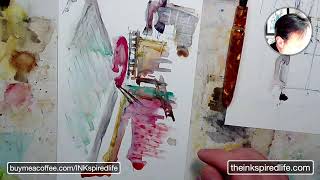
In this 2‑hour YouTube livestream, artist Jason Nicholas greets viewers (Cameron, Chip, D‑Ray, Heather, etc.) and shares personal updates before moving into a hands‑on demonstration of sketching and watercolor painting. He works on a covered bridge sketch, then switches to a new synthetic Yupo paper he won from Legion Paper, explaining its non‑absorbent, plastic nature and the discovery that the sheet has two distinct sides—one highly resistant to pigment and one that accepts color. Jason mixes his own watercolor palettes, experiments with blues, browns, purples, reds, and oranges, and demonstrates layering, lifting, bleeding, and the ability to re‑wet and wipe colors off the surface. He showcases a variety of inks (Apple Snail, Lamy, Sharpie, Preppy) and compares Yupo’s feel to Mylar and traditional hot‑press paper. Throughout, he sketches an urban perspective from a November photograph, using quick, loose lines, a Sharpie for outlines, and later adds ink details, while narrating his process, including cutting the paper with an X‑Acto knife, using scratch‑board techniques, and removing layers to reveal underlying forms. Jason engages the chat, answers questions about paper type, shares anecdotes about past architectural work, and reflects on the meditative, immersive quality of watching paint dry. He wraps up by thanking viewers, noting his follower goal, and mentioning upcoming architecture projects.
Chapters
Hey Cameron, hope you're doing well. Hope you're having a great night. Good to see you. I loved your pictures from earlier today. Cool stuff. I personally can't wait to get to see the shed and the— oh my gosh, what's the other building? I forget the other building's name. The big pine cone one. I'm drawing a blank, but I can't wait to get down there to see those buildings. They're really cool. So I hope you had an awesome, awesome day. And also the High Line. I definitely am going to walk the High Line this spring as well. Cool stuff. Hey, Chip. Good to see you. Hope you're feeling better. Chip says, looking good. Like the red with a seasoned roof look. Ah, cool. Thanks, Chip. It's great to see you again. I hope you're feeling better. Thanks for tuning in. Yeah, so I pulled out— this is a sketch I did maybe 2 weeks ago, and I just felt like adding some color on it tonight. So let me zoom in even closer, and I'm just throwing down some colors on this covered bridge. Uh, this is kind of cool what happened here, totally on accident. It almost looks like some kind of shrub or something in front of this church in the background. So that's pretty, pretty fun. Move this up a little bit here. But yeah, it's looking kind of cool. I don't know if I like this big red blotch here, so I'm just going to blot it out a little bit. I think that's better. So here's a close-up. I'm just dipping into my watercolors here, mixing my own colors up as we go. And I want a nice kind of dark shadow somewhere in here, so I'm just, just basically taking some blue. I could, I could use straight up blue if I want. I'm going to mix some brown in it, get kind of a dark gray, bluish gray shadow. I may even throw some red in there as well. So just kind of mixing up blue and brown and gray. That's not the color I want, so let's pour more blue in there. Maybe kind of a nice purple, purplish shadow under here. And these are some cross pieces, some cross bracing here in the background. I'm going to pull them back a little bit here. There we go. I like that look better, a little more modeled. And I'm going to add a little bit, you know, some of that red paint going on in here as well. I'm starting to get too fussy, I think, with it, so I'm going to leave it like that for now. And the roof is, uh, some turquoise. Let's see, you got some turquoise in there, some yellow. I don't know what color yellow this is, but I have to replace it. It's almost gone. Fortunately, I have a brand new palette in my drawer here, so I can just take the yellow out and replace this one. I really like that yellow color, so I have some of that on the roof and turquoise, a little bit of brown and some orange actually happening in here. That's the color I use for trying to get like a chipped, like an aged kind of roof look. And I'm going to pop— let's see, I think I'm going to pop some more red. I like the bright red here, that looks pretty cool. Do I want any more bright red anywhere? Maybe we'll just add a little more red, maybe on the back of this bridge, just to kind of bring your eye to the back here. So it looks like it's finishing. There we go. Cool. I kind of like the little darker here, a little darker here. And I think that's it for this one. No, it's not. Not yet. I might be getting to that point of too much, too muchness. And that's cool. One of the fun things about watercolor is you can, you can blot back while it's wet and pull some colors out. Uh, yeah, I think this is good. I don't think I'm gonna do anything else to this right now other than let it dry. Anyway, hope you guys are having a great Saturday night. Hope all's well. Popping on just kind of quickly here. I didn't do a sketch. Did I do a sketch today? My brain is so tired. I didn't do any new sketches. I've been working on a piece I'll show you. I actually finished up this morning. Let me zoom out. All right, let's just put this here and then I'll pull this out. So this, uh, this piece I finished this morning. Um, I really like the way this bridge came out. So I sketched this bridge over and over and over, something similar, not always the same. It's never the same, actually, but the same kind of view idea. Um, I don't know why I keep sketching the same one over and over again. There's something about it I like, find mysterious about it. This was actually very cool. This was new paper I tried. It's called Yupo, which is actually like a plastic. It's not even paper, it's a synthetic material. The colors, the, the watercolor, the ink just stays right on the surface of this paper. It doesn't go in at all. So you have to be patient with it and add layers and layers. But I like the way the layers are looking on this. Some of the colors came out really, really cool. So that was really fun to play with. And I think this one is done. But I was going to do another sketch on the same kind of paper. I want to do a little city perspective, I think. So let's just play around and sketch it and see how it goes. I'm going to move this out of the way. Actually, I'm going to move this over here so it can dry. So this is the paper I'm going to be using right now. It's called Yupo. I was actually fortunate enough to win it online from this company here, Legion Paper. I was doing an Instagram contest and, uh, for— I was one of the 3 people that they randomly drew my name from— drew my name or picked my name from. I don't know what I'm saying, but I got it for free. Um, you can see here it says suitable for watercolor, alcohol inks, acrylics. So I have watercolor on here, I have just— I use acrylic ink on here, um, straight up Lamy ink as well, Sharpie. So I've been just kind of playing around with it. So I thought I'd break it out again. Let's try a little perspective picture I have that I took when I was in the city back in November. So I'm looking at a reference picture. First thing is, can I get this out of the book without tearing it? There we go. Got it out. One of the nice things about this paper is it does not buckle when it gets wet, but it is so slick and doesn't absorb, so it has a totally different feel to it. Uh, let's see, can you see this? Maybe here. So I think I'm just gonna start with the Sharpie and just want to kind of sketch this view. I'll show you on camera. Let me bring over my image, see if I can bring it on screen for you guys to see what I'm looking at. So this is my reference image here. It's a picture I took back in November, um, interesting perspective looking up. You can see the Booth Theatre marquee here. So I'm going to do just a loose interpretation of this. I'm not trying to recreate this exactly by any means. That's why I take pictures, right? So I don't have to recreate sketches in detail because that's not what I like doing. So that's what I'm looking at. I'm actually going to pull it off here, so, because you guys don't need to see it. Um, really just sketch. It's gonna— I'm gonna do a real quick sketch here. Happy, happy to know. I will just use a little sheet of paper. I am talking, I'm talking to myself. I don't actually, I don't know. I think I'm, I think I'm gonna do a small scene. Let's use a frame here. Let's just give us a guide. Let's just kind of do half a sheet of paper so that way we can zoom in. You can see it closer. And I'm just messing around with this paper, getting used to it. So we'll just put this here. Let me sketch this with a pencil, just a rough, real rough idea of— so I'm sketching the rectangle. I'll probably go outside of this rectangle. It's just a reference. Alright, cool. And I'm gonna turn my camera because it looks crooked to you guys. Alright, awesome. Alright, let's just sketch this thing in Sharpie. So I want to keep this as really fast and loose. I'm thinking too much about it. Again, I'm just trying to capture the feel, capture some of the shapes. We'll play with this paper, see what it does. It's an interesting, uh, perspective I took actually. This is a challenging one to sketch here. We're going to improvise and just kind of have fun with it.
Cool.
Alright, cool. We got some brick happening here, kind of cap up top there. Got this Marquis sign is kind of here, it's red. Got some, uh, metal railings happening. There's actually a ladder that comes down here. Got a kind of an iron balcony happening in here. Comes across, we got some rusty metal stuff happening in there. Boom. Got some metal work. We have these big bracket thingies that are coming down. Big support brackets. I'm not doing this justice right now with all the detail on here, but I want to be just quick, loose capture shapes. You'll see, you'll see where it goes. We'll kind of bring this down in here, a little sliver of a building back in there. Got a big sign in the foreground there. All right, cool. Let's do that. Let's actually break that plane a little bit. Let's pull this down the corner. All right. And we got a kind of an edge happening here. We got some lines going here. I think that's good enough. And then let's just throw some colors down and just play with color for a few minutes. Again, this is quickly blocking out what I'm looking at. It's actually way off from the photograph. I don't really care because we're having fun. Hey, if you guys have any questions, let me know. I can't see the chat because I'm covering it. Now I can see the chat. Um, did you say hot press? So Chip, this paper is— I don't know if it's hot press or cold press. I don't think it's no press. It's actually right here, it's a synthetic material, 100% polypropylene. It's plastic. So basically I'm drawing on plastic. 74 lb weight, 9x12 sheets, um, white, and it's called Yupo paper. So yeah, it's— I would equate it to hot press only because it's extremely slick. And I'm going to zoom in close so you guys can see as I'm just throwing down colors how this does not absorb anything. All the colors dry right on the surface. So if I wanted to, I could actually come back to this. I could re-wet the colors on here and wipe them off. Um, it might leave a little ghosting, maybe a little bit of staining. Um, you can kind of see how we try— I was playing around with that on the side. I had— this was all yellow, and I wet it and I wiped some some of it away. So you do have to spray this if you want to maintain this. You do have to spray it with like some kind of clear coat, um, spray, because once you rewet it, it will move around again. Except for the Sharpie. I do have Sharpie on here, and the Sharpie I tried to wipe off and it doesn't. So it's a different feel, different— it's a totally different feel. From any— actually reminds me of Mylar. When I was back in the good old architectural days when I was working for other offices, when I first started, we would sometimes sketch on Mylar or draw our blueprints on Mylar, which is plastic. So we draw on plastic because it didn't tear like vellum. It was more rigid. Um, it took more abuse when it came to erasing. Stuff. Um, so it's kind of like drawing— reminds me of the good— those good old days drawing on that Mylar, just architectural hand-drafted stuff. All right, I'm talking a lot, I'm so sorry. Let's sketch here. Let's, uh, let's— I'm just throwing out colors first, so I'm not even looking at the photograph I have up anymore. I don't— not matching colors anywhere. I know there was a red sign here. But let's just sketch with— I have this fountain pen with some Apple Snail ink. Let's just sketch with some of this on here. Let's just play around, guys, and see what happens. I'm going to zoom in on some areas so you can see what I'm doing. And I'm just going to outline this. Let's just throw some of that on here. Maybe we'll pull some of that across here as well. I'll show you guys what happens when I add water to this. Um, so I'm not using clean water, I don't have any here, so I'm just using my dirty water, which you put down here so I don't spill it. And let's just bleed some of that ink I threw down on there. This paper does take patience. You have to wait in between. I mean, here there's at least 3 different layers of stuff I've added. So I waited in between layers to add more. So we'll see what we can see tonight. Alright, anyway, here. I mean, look, if you look, when I add this water, it is just floating right on the surface. Is— you can see when I'm trying to pull it down what it's doing, right? Um, which is kind of cool. You can have fun with it, and that's what it's about, just having fun and playing around. I'm going to zoom out a little bit more. Because I'm covering a little bigger area. There you go.
Let's go—
I'm going to throw, throw down some watercolor now. So I'm just going to grab from my palette here, let's wet it up a little bit, try to go for kind of an industrial vibe with this. So I'm going to kind of grunge— try to grunge it up. Let's see, let's start with some— oh, let's see some of those bridge colors I had before. I'm not going to be too fussy with colors on this. Actually, you know what I want to actually put some down, down some Lamy ink. Let's just bleed some black on here also. Hey D-Ray, how are you doing? Good to see you. Uh, are you moving over to this paper or just trying it? Yes, I'm just trying, I'm just trying it right now, to be honest with you. And I think I may have made a discovery with this paper. Um, and I could be wrong, there might be two different sides on this paper. I'm gonna flip it over and we're gonna try the other side for a second, um, because it wasn't this resistant when I used it on the other one. So this might actually have two different sides on it. Let's actually just cut this sheet. Let's cut it. Let me get my X-Acto out. Uh, got my metal edge here. Let's just kind of cut this in half. Hopefully my X-Acto is sharp. Right, cool. Let's flip this over. Now let's try this sheet. This might have two different sides on it. I can't find the cap to my X-Acto knife. Where the heck did I put it? I'll put this here. Note to self: do not stab myself with the X-Acto knife. Alright, let's do a sketch on this side here, see what happens. Actually, before I do that, let's just throw some color on here. Yeah, I think, I think— alright, so I just discovered that this paper has two different sides. One side, the one I was trying to sketch on, is extremely, extremely resistant. This side is actually taking the color, you can see. So, lesson learned. This, this paper has two different sides. Now we know. Let me show you how I can wipe this off. It'll leave some ghosting behind. So let's, let's do a sketch on here. Let's resketch. Good to know. See, I'm learning, I'm learning. So we're going to just do a quick resketch. And we had that big sign here that said Booth on it. It's kind of an oval shape. Boom. Some metal brackets coming down there. You know, ladder, kind of a ladder thing happening here. We had a a cornice, cornice piece, corner of the roof here. Cameron, if you're watching, I hope you know what a cornice is on a building. Assuming you guys have talked about that in architecture school. Cornice. Kind of get this building up here doing something. Boom. This building kind of continues like somewhere back in here. We'll bring it down. Have some metal pipe railing here, little platform area. I see this building in Cornish does something like that. This comes down in here. This building— Cornus does this and comes down. Kind of comes down like here, just continues through.
All right.
I think that's enough detail. Enough outline, I mean, just to throw down some colors. Let's try it again. You got this building with these windows kind of happening here. And we do have a grid. You have a grid up here, grid of windows in the background. All right, I think that's enough. Let's throw down some colors and take 2. Hopefully we're— So the color should stick, if that's right, or stick or stay on this and not bead up like the other one beaded up so quickly. All right, let's break out our Apple Snail ink here. Let's just wrap our cornice. Maybe we'll continue that down here. And then, uh, let's throw down some black Lamy for this building. We'll bleed that, kind of do this, just quick sketch this here.
All right.
Alright, just wanna play with the color now, see if it does what I thought it was gonna do before.
Rrrr!
Yeah, yeah, yeah, alright, I can already tell this is right. Yeah. Alright, so this is the correct side of that paper. You could see it's not beading up nearly as much as the other side. I was, I was perplexed. I'm like, why is this— why is the color not staying down? It was like, it was like a finely waxed car when it rains, which is the water just beads up. That's what the other side was doing. So let me zoom out so you guys can kind of see. I'm just playing around with this. All right, let's throw down some watercolor now. And my light just went off behind me. All right, so I'm just going to go for just some rusty colors and Just kind of throw them on here. Mixing up some orange, a little bit of brown. So you can just see it's just, it's just puddling up, which is kind of cool. Ah, let's, you know, let's throw some red down here maybe. I'm just figuring out— I have some blue here. Let's throw this down here. So for me, the fun of this is just letting these colors kind of just pool into each other. It just— and it dries and it looks really cool. You know, I can come back after it dries with my pen and my Sharpie or Precise Pen and pull out details. For now, I'm just kind of letting these colors just roll. It's really fun, actually. It won't be fun if I spill this ink that's in my hand. I'm holding a bottle in my hand, which could be dangerous. I can be a little clumsy. All right, let's, let's kind of tap it. So I'm just kind of tapping colors. I'm lifting and tapping. You put that over here. So I'm just kind of lifting and tapping to bleed colors together. The prison's kind of in the background there, so I want it to be kind of lost a little bit. This is that That was a big red marquee. So I hope you guys are doing stuff creatively. Um, Cameron, I saw one of your recent school projects. Thank you for posting. So cool. Your college project posts always bring me back to my college days. So it's always fun to see what you're, what you're working on. So I'm actually pulling some of this black off of here because this is where that red sign was, and I just, I do want to keep that red. So I'm actually going to use less water, kind of have some thick water, red watercolor on here. This was that big marquee sign here. So it's just kind of just about blocking in just different areas of color. My board is tilted at an angle. I like to draw watercolor at an angle so the water is kind of running down. Pooling in certain areas. You can see how it pools. We get some pooling effects going on there. You have to be careful though, especially where the wet areas are, especially me being left-handed. I tend to put my palm on the paper, so I gotta be careful because this does take a while to dry, and I just don't want to get too much of this watercolor. I don't want to smear it. I really don't want to smear at all. A little bit's not going to hurt. So we have some kind of railing thing happening up here. So this is looking kind of cool. Let me, uh, let it sit here for a minute, see if you guys have any questions, and let me check in with the chat. D-Ray says the bleed later will be a joy to admire once dried. Yeah, yeah, D-Ray, you're absolutely correct. That's, um, one of the things I love about this piece here. I love the bleeds. I love how they dried. It's a really, really, really good point. Hey guys, thank you for the thumbs up and the hearts. That's awesome. That is, that is kind of the payoff with this, is how the colors bleed and how they dry. So I do love watching paint dry. Not a joke. I like the— excuse me— I like that this is kind of very loose and abstract. Um, I might not get too crazy with too many colors. Well, I already got a lot on here, but I mean covering the paper with too much color. Um, I actually love how the way this is drying right in here. That looks really, really cool right there. Some things— some— one of the things I do like to do as I'm using this is as it's drying, I'll come back and I'll sometimes just lift off some colors a little bit. So don't be afraid on your artwork to, to remove layers. Right? Sometimes we think about painting and sketching— drawing is about adding layers. Another tool we have is removing layers as well. So don't be afraid to remove. So for example, I— this is drying really nicely, the colors in here, but I'm going to pull out off a little bit of these lines here because there's a glass grid on this building. You can't really see it. There's a glass grid on this building, and I'm actually removing some of that grid, some of that color where the grid is, and I'm dragging some of this color across just to create the idea that there's a grid. I do have the black lines there, but I think removing the paint It's kind of an interesting way to do it also. D-Ray says, "You've totally immersed yourself into this last one, didn't you? Loose and flowing." Yeah, let me bring that piece back. I can't stop. I have to be honest with you guys, I can't stop looking at this painting here. I'm kind of obsessed with this. I keep staring at this piece. Um, there's something— I just— something about it I really, I just really love. I mean, I could stare at this for a long time, which I have been doing today. And every time I look at it, I see— just see something different with a color, or the way a hard edge was formed, or the way water was dropped on this paper and just dispersed the color. You know, even the way this cable happened here and just kind of the wires. I just— I don't know what word to use to describe this, but there's something really, for me, really magical about the way this feels. This transports me to a different place when I look at this painting. I know I'm getting a little deep. But I can imagine myself being here, kind of old, rusty kind of structure. So yeah, so D-Ray, I love that you said that because it's very true. I did, I did immerse myself in that and I do immerse myself in it still and I keep looking at it. So this is looking like just a bunch of different patches of color. Which is cool. I like it. It's very loose. Um, when I come back and do the next layer, it'll start pulling— cleaning up, cleaning up in quotes— some of the areas to pull more building, recognizable building shapes out of it. Um, for me, this first layer is just about throwing down some color based on how I was feeling and how the paper was feeling today. And let me zoom in here. Just, you can see it's drying. And let me just show you guys. I kind of, I kind of geek out on this stuff. I hope the camera's doing this justice, but there's some really, really cool things happening. Where's my little frame?
There we go.
Let's frame this out a little bit. Right in this area alone, there are some really, really cool things happening with colors. Some hard edges being formed, um, as it's drying. So it's looking really cool. Um, this actually down here is drying as well. Let me move this. You can see this area here too, how that's kind of drying there. So it's, it's really a fascinating process to kind of watch. And it's even more fun sometimes you come back a couple hours later or an hour later and it's dried. I have to say I'm very excited about this. Hey, Heather's in the house! Heather, good to see you. Hope all's well. Um, Heather says, evening everyone, procrastinating making dinner, so popping in. Hey, thanks for popping in before making dinner. I hope you're making something Awesome. I took the easy way out tonight and we had Qdoba for dinner. I don't know if you guys have Qdoba out there. Qdoba is kind of like a Chipotle, but I like Qdoba better. Um, so I had a nice burrito for dinner and that was like over 5 hours ago and I'm still full. So hope you have a good dinner. Thanks for tuning in, Heather. Um, D-Ray says, um, not deep at all. The feel of a quiver for an artist is to either to close the window or add another stroke. Ooh, D-Ray, I love that. D-Ray is our wordsmith here. D-Ray is also an awesome artist, and I think smithing words is another art form as well. So thank you for always sharing your your words with us. Let me show you guys what I'm doing here. I was just talking about removing layers. Um, you can kind of see here, I'm just kind of taking some of that paint off just to get a grid look happening, right? So you can see I'm just— it's like scratchboard if you've ever used scratchboard. You know, it's, I guess, typically black, like a black ink, I guess, and it's on a whiteboard and you scratch the black off and you see the white underneath. This is kind of the same idea, we're just scratching away or wiping away. I'm not going to do all everything, but maybe, maybe I'll pull, uh, just a line across here. There we go, just to create the idea of these windows on this building. Uh, in college I did a whole project. Cameron would appreciate this. I did a project on a 24-inch by 36-inch piece of scratchboard, and this is how I did, I would say, 90% of the drawing right here with an X-Acto knife. It was— I wish I still had it. I kept it for so many years. I think I got rid of it. It was a, um, the project was we had, we had to design a farmer's market in, I think it was in Coconut Grove. Coconut Grove. Um, it was such a cool project, and I based mine on a kind of an old silo type of So a stone silo building, and I spent hours and hours and hours drawing with an X-Acto knife, scratching with an X-Acto knife. Excuse me, it's drying here. It was such a cool project. I gotta find it, or I may have it. If not, I may have pictures of it. I think it's gone now. I think I trashed it. So this red oval is kind of where that marquee sign was for the theater. This is drying here. I'm gonna— there were some brackets going back to this building holding that sign up, so I'm just going to dip into, um, what I want to do those with. Maybe I'll actually do the brackets with my Lamy. We'll just do some black Lamy ink for the brackets, kind of coming back like this. Oops, my Lamy— let's see if it may need ink in it. Actually, I think my Lamy needs ink, so we're not going to use the Lamy. We'll improvise. We'll just Actually, I have a black preppy here. Let's see, let's try the black preppy. I haven't used this in a while. Hopefully I can get it ink going on it. Just like a scrap paper here. There we go. That's pretty cool. I haven't used this preppy in a long time and the ink just came right out. That's a good sign. So these are kind of metal brackets that were going back supporting this sign. We're kind of looking at a view down, up towards these buildings. I gotta be careful because it's still wet down here. I'm getting stuff all over my hand. Um, let's see, there was a ladder structure in here. So we'll throw some Lamy on here— not Lamy, some Preppy ink— bleed it a little bit. So you can see as I go over this how the link's going to bleed, which is cool. I like that look. Actually, let's kind of soften this up a little bit here too.
There we go.
And that's what it's looking like, guys. Heather says, in grade school we would make scratchboard with crayon on paper. Ooh, that's awesome! I didn't even— never thought about doing that. That's such a cool idea. Scratchboard on, on, uh, with crayon. That's so cool, Heather. D-Ray says 24-hour with her sketchboard painted and spent hours and hours scratching out the picture. Yes, I did. It was a tedious project. A good sign the ink pen is working. It is a good sign. Thank you, D-Ray. I love this song. I don't know what it is, but there's just something about the song every time I hear it. Let's take a look at the— here's the first sketch I started on the other side of the paper, which really was not— which was extremely resistant to the color going down. And then I flipped it over. This side is more conducive. I mean, this is looking kind of cool though. Cool start. We can turn this into something. I'm not going to waste it. I'm going to bleed some of this Apple Snail color, which I love. Bleed some, bleed some more of it. And I think that'll be it after I do that. And we'll let this dry and wrap up for the night. Ooh, runaway pen, runaway pen! Love doing that, then got my kids to do one later on. Ooh, awesome, that is so cool. Yeah, I got to— I wish I could find that. It's driving me crazy now. I don't know if I kept it or threw it out. I'll look. I'll have to take a look. I know, I know where I took pictures of it at some point. That's weird. It looks like my red has white— looks like it has white mixed in it. How the heck is that possible? As my eyes are just going— my eyes are probably saying it's time to take a break.
There we go.
I'm just gonna pull out some red where that marquee sign is here. There we are. This is gonna be one of those paintings where less is more. Zoom way out. So you can see it. So there's actually red— there's some red brick down here in that photograph, I think. So I'm just trying to create maybe the idea of some brick happening down there, a little bit of texture. So maybe we have some kind of brick happening there. He's a man down in this area. I'm going to mix some red and blue. I want to get some purple. Purply colors happening.
Excuse me.
All right guys, I think that's gonna be a wrap for that tonight. Your SS, my eyes see that too. Excuse me guys, it is so dry in my room. I do have water. Hey, for once I actually brought water in here. Um, got some brick happening. Work some blue and red and get some purpley happening. Yeah. I'm trying to make some purple just to create some dark areas, some shadows. Yeah, so I think we're going to leave this here for tonight and let it dry. Again, we're just doing a quick abstract kind of city view here. It's kind of hard to tell what it is right now, but I think as it dries and add another one or two layers and add some ink on top of it, I'll pull out some more definable shapes on it, but it's still going to stay very loose and abstract. That's my intention. Hey guys, you're awesome. Thank you so much for watching. Um, also thank you for sharing this out there. I am 9 viewers— I'm sorry, 9 followers away from 1,000 followers on YouTube. YouTube? I'm so tired. On my Facebook page. YouTube, I'm quite a ways away from 1,000 followers. But guys, thank you so much for watching, for sharing, for, um, your positive comments in the chat. I appreciate that. Thank you for sharing what you're doing, your creativities, your photographs. D-Ray, I do— I know you've been hammered with snow, um, which kind of stinks for you, but I have to say, your photographs I love seeing those snowy pictures because we've had pretty much zero snow here in New Jersey. We've had a little teeny bit. So I am missing a ground covering of snow here. So your pictures get to take me to that place I wish I was in New Jersey only because I want a day off of school. But thank you so much, Heather. It's good seeing you in the chat. Hope all is well. Stay well. Appreciate you popping on here. Enjoy your dinner. Chip was in the house. Chip, always great to see you. Hang in there, feel better. And, uh, Cameron popped on as well. Cameron, I hope you're doing well at school and keep posting pictures. I love seeing what you're working on. Good stuff. All right guys, take care. Have an amazing rest of your night. Tomorrow's Sunday. Don't know if I'll be on live or not. I have, um, I have some architecture I could do. I have to do some real life architecture projects tomorrow. So, um, I'll be working. But take care, guys. Have a great, great night. Thank you so much. Peace, and live creatively. We'll see you soon.





