Live Sketching - Trying different paper
Jason Nicholas tests a Strathmore 140 lb cold-press watercolor journal before a New York City sketching trip, sketching a lighthouse with Sharpie, watercolor, and mixed media. He finds the paper's tight, canvas-like texture different from his usual looser watercolor paper and shares his detailed gear list for the trip.
Chapters
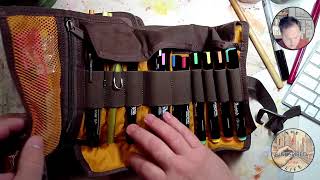
Hey, um, happy Friday, November 8th, 2024. Hope you're having an amazing day today. I am, uh, popping on for a short while here, um, and I haven't been on in a while either. You might be able to hear that, uh I've been feeling a bit under the weather and just haven't been, uh, coming on live at night, but it's been too long. I love sketching live. I love sketching in general. It's, uh, it's good therapy, it's good healing power, it sparks my imagination, my creativity. So anyway, I'm Jason Nicholas Nicholas with the Inkspired Life. Uh, let's just do some sketching tonight. So I'm actually headed out to do some, um, urban sketching tomorrow, and I forgot I had this, this kind of journal here that was sitting on my shelf. I haven't used it yet, so I thought I'd give it a little try tonight, see if I like the paper. Um, yeah, we'll see how it goes. So it is a Strathmore watercolor Journal. Let's see, um, 48 pages, 8.5 by 5.5, 140 lb. It is cold press. Um, I like the size of this. It's not that big, pretty easy to carry around. Um, I actually like the COVID on it too. It's got kind of a faux leather cover on it. So yeah, let's just do a sketch and see, uh, how we like it. I don't think the pages are perforated, so— no, it doesn't look like they are, so they would not be easy to tear out. All right, let's see, zoom in a little bit. Actually, let me move this out of the way a little bit. So one thing I can tell is that I'm going to need a binder clip because this page keeps springing back up. You see, this is very springy. I could probably bend, bend it back a little bit. But I'm just going to get a binder clip and clip it back. Fortunately, I usually have, have the clips nearby. All right, there we go. So I clipped that down. Perfect. Move these here for now. Um, what do I want to sketch? No, I haven't sketched a lighthouse in a while. Let's sketch a little lighthouse, maybe. And I'm just making this up. Start with a Sharpie. So the paper is cold press. It has a little bit texture going on it. Um, it's not as bright white as— here's kind of the normal paper I use. You can see it's not as white. All right, cool. We got some Sharpie down on here. Let's throw a little bit of watercolor on it. This is just going to be really quick, again, just to play around. I want to see what this paper is like. Um, let's just sketch in some stone. Maybe we have a stone base on our lighthouse, and we'll just bring that across here. All right, so we have like a stone base happening there. Cool. All right, let's throw down some color. It's going to dip into the watercolors here. Um, let's see, I want to— I do want to angle this up a little bit. What do I have to prop this up on? Uh, let's take this lid here and I'll put it underneath. There you go. So I'm going to prop that up at a little bit of an angle. That works. All right, just dip it into some turquoise. We'll see how, uh, how the color looks on this paper. We'll see how it takes the color. And I'm just going to throw some green Kind of on the ground here. So the paper is nice and thick, I'll give it that for sure. Hey, Linda's in the house! Linda says yes, green, just for you, Linda. I know you love green. I hope I hope you're doing well. I was thinking about you. And, uh, yeah, I hope you're doing well. It's good to see you on the chat. Cool. So, um, so this paper is, is interesting. The texture is, um, how do I describe it? Let me zoom in, see. I don't know if you can see it. I want to say it's kind of tightly woven. I don't know if that makes sense, but the texture here, it, it's It seems like it's very, um, almost tight, like canvas-like, whereas, you know, the typical paper I use is a little bit more loose with texture. This is a little more tight. So that's, that is one difference I noticed with this paper. Um, I'm not gonna say if it's gonna make it or break it yet. I want to see how it, how this dries. So I'm going to throw down some more turquoise on here, load it up a little bit. It's always fun to play around with different papers, right? Especially— it's also— it's really a fun surprise when you find, um, paper on your shelves or journals on your shelves that you haven't used. So this was a surprise I came across today. So I'm just— I'm testing it tonight. I want to see if I want to bring it along with me. I will be, uh, I'll be in NYC tomorrow. I'm super excited. I'll be doing some sketching. All right, cool. That's enough watercolor for now. Let that dry. Put this over here. I need like a bigger desk area here. All right, Linda says, um, hey, recovering from surgery. That is so— yes, I hope you're recovering well. Excuse me. Speedy recovery to you. Sending positive prayers and vibes your way for sure. All right, so that— we tested some watercolor on here, um, again. So this is what I'm using right now. I found this on my shelf today. I wanted to give it a try. So let's test out maybe some ink. Let me move this over here. Hey, D-Race in the house, great to see you. Hope all's well. What was I gonna do? Oh, ink. Silly me. I just have— I'm just gonna grab— I have a couple bottles here. We're just gonna go with— this is called Railroad Worm. I love that name, it's so cool. So this is almost like a, like a highlighter yellow. Actually, let's try something here. I want to, um, I'm going to blow this ink. Let me wet this here, throw a bunch on here. Just want to kind of blow it across the page, see what happens. There you go. Cool. I just want to play around there. Maybe some light beams coming out of the tower there. I hear my pup. I think I hear my pup outside the door. She's making like growl, growly play. I want to play sounds. Oh, Linda says, I have that SketchUp but I have not used it yet. Oh cool, Linda, that's awesome. Yeah, I haven't used it yet either, so first crack at it here. All right, I gotta move this. Here we go. I'm just— I'm finding because the flap here is open, I'm needing more room on the left-hand side, so I keep moving stuff out of the way. But you can— let's zoom in so you can see how it's kind of looking here. Um, really cool. I love the way the colors are drying down here. It's looking fun, guys. I can't believe we're in November. This year is flying by. It's crazy, so crazy. I was watching a live streamer from New York City, the NYC Walking Show. Check them out. But anyway, the decorations are going up in the city as we speak. Uh, the Christmas tree arrives at Rockefeller Center tomorrow. So it arrives tomorrow. I don't know when the lighting ceremony is, but it's— it'll be delivered tomorrow. How cool is that? So I just put on some brown ink. Um, so I like the way it's drying so far. We got a little bit of buckling, but that's to be expected with any paper when it's saturated. I need some— what do I need on here? Let's do some mixed media. Let me throw on— let's use some red here, and then maybe we'll try some watercolor pencils. Kind of want to do some red stripes here. Maybe we'll carry that red up here as well, do like a little band of red across here. Very cool. I love lighthouses. This is cool. I actually— I really like the red pen. I like the red pen over that yellow railroad worm ink. It actually has a nice kind of orangey color happening there. Pretty fun. And this says, uh, love the shadow over the windows. Yeah, so that's just blue watercolor paint I just dabbed on there. It could be a little bit darker for sure. Yeah, let's, uh, let's break that back out. So here I'm just using some blue right here. You know, lots of times we think shadows have to be black or gray. You can use colors, right? Colors for shadows. I typically like to mix up blue and gray when I make shadows, or sometimes I'll use purple. If I throw a little bit more on there, you could see It just pops that roof out a little bit more. And we should do some up here as well. Oh, I don't want to get too cray cray carried away with it, but I could also kind of pull that just along the edge here just to give it A little bit of a roundy look. So I just add that. You can see adding that blue on the right-hand side created a shadow. I left kind of white here, and it's darker as you go to the right to get that curved look. After it dries, I'll come back in with a Sharpie or, um, a Pilot Precise Pen, and I'll do my contour lines. Contour lines will add a bit of curviness to the lighthouse. Kind of digging it. I don't know, I might just leave the body of the house white and I'll add— I don't think it's dry enough yet. I'll add some lines for siding on there. I think it has to dry. So let's, let's throw down some colored pencil on here. Uh, so, so far I'm liking this paper. Hello, I see Jesco Studio. Great to see you over there on, uh, YouTube. How are you? Do you ever use alcohol inks? Great question. The answer is no, I have not used alcohol inks. It's something I've been wanting to try for a long time, but I have never used them. Let me know if you've used them. It's a really great question. One of the cool things about alcohol inks is I like how you can, um, how the colors can just dissipate, right? I don't know if that was the right technical word. I broke out an orange color pencil here. And I actually want to add some on here. I don't think it's dry enough yet. No, I gotta wait. That's all right. Dang nabbit. Let's do— I talked about purple. Let's break out some purple. Here we go. Let's try some of these watercolor pencils. I really like these watercolor pencils here. These are Distress. Let's grab the purple. I'm dipping it in water, actually. Hey Chip, great to see you! Hope all's well. Wow, you guys are popping on! This is so fun. It's good to be back on here, guys. Sorry it's been a while. It's, uh, I let myself get run down. So Thai was— yeah, I don't know what happened. Um, I'm getting better. I'm on the up, the upside now. So here's that purple. I dipped it in water. You can see what it does, right? It just kind of melts. It is fun to be back here. All right, cool. I'm actually— I'm liking this little sketch. I love what's happening down here, kind of the brown ink over the— we had some green on there. It's looking kind of cool. I haven't, uh, but I keep hearing how vibrant and flowing they are. Yeah, yeah, Jesco Studio, I, I hear the alcohol inks are so free-flowing. Your stuff is always really vibrant and loose. I love it. Hey, thank you so much, I appreciate that. I That means a lot to me because that is my goal, is to be really loose, uh, really loose and just whimsical and fun. For me, it's, it's mostly about the process, just enjoying the creating, the act of creating, the act of playing around. So I appreciate you saying that. It means a lot that you noticed that. So I think that's enough of the purple. I, like I said, I really like these Distress Color Pencils. A lot of cool colors in this set here. You know, you guys know I love rusty, grungy, weathered metal type of look in my aesthetics. Got great colors for that in here. Um, yeah, I like this one. It's called Patina. Right here, patina. Let's throw some patina down. So tomorrow I'm going to be going to, um, a place I have not been yet in New York City, um, ever. I don't think I've ever been in this place I'm going tomorrow. I'm trying to think way back to my early trips into the city. I don't think so. Yeah, so, uh, if you want to know, let me know in the chat. Say, let us know where you're headed. If not, I'll leave it as a surprise, but I'm super excited to go and do some sketching. And, um, yeah, it's gonna be really awesome. And getting a tour of a really cool, um, new building in this area. I, I feel like I need some more red on here. I'm going to break out this— this is called Fired Brick. I love the names of these colors. Patina, Fired Brick, Peeled Paint, which is this green here. It's called Peeled Paint. You know, just for Linda— Linda, if you're still out there, let me know. I'm going to use this Peeled Paint Green, we'll use that for Linda. Um, Speckled Egg, Black Soot, Picket Fence, Rusty Hinge. I think I love that name, Rusty Hinge. So cool. I'm going to throw down some of this. Is that Fired Brick? I did want to throw a little bit, I think, on the body of this building. I'm going to leave white space too. So that's that fired brick there. Cool. I don't want to overdo it with that red. I think that's gonna look cool. Love the bleed on the ground with the ink and green watercolor. I do. Yeah. Did I hear grunge? You did hear grunge. Yes, green. All right, Linda, for you we're gonna do some peeled paint right here. And I have not used this color yet, so this will be a first. I think I want to do some— I want to do some more green down here in the landscape. I'm literally just dipping this right here into the water. I like to call this sketch painting, where I dip the watercolor pencils in the water, and I just kind of sketch with them, kind of sketch paint. And since Linda's our green fan, I'm going to actually just— we'll just throw some of this down on this paper here. We'll see what it looks like. So it's kind of dry there, and dip it in water. This is it wet in the water. So that's called Peeled Paint. Interesting name for this color. I'm not sure why. Maybe, uh, maybe someone had like avocado green paint in their old 50s kitchen that was coming off the walls. But anyway, here's that green up close. I like it. It kind of reminds me of a— of the Sap Green watercolor I have over here. Sorry, I think it was off— lighthouse a little off screen there. I'm just throwing down some of that green. What the— just for the heck of it, I'm going to throw some on the roof. See how it dries. There we go, peeled, peeled paint. Yeah, this is a fun little sketch. I think that's good enough for colors right now. Um, I do want this to add a little bit of shading or hatching with my Sharpie, but it's still too wet, so I don't think I'm going to get to that tonight. And I do want to boldy out the outline of the boldy out. I guess that made sense. Bold— I'm going to say bold the outline of the building, or boldy out. All right, um, let's see. Sharpie. Should I Sharpie it? Actually, you know what, I'm going to use— instead of the Sharpie to outline, I'm going to use a just grab and go here. I'm going to grab and grow— grab and go with a Tombow. It rhymed. So I have a Tombow marker. We're going to use this just to hit the outline of the lighthouse, and I'm going to keep it kind of loose, loosey-goosey. I'll zoom in so you can see it closer. Um, I'm holding the pen— I'm going to hold the marker rather kind of further away from the end So I have more flexibility, more looseness, rather than holding it here. That's gonna be too tight. So I'm just kind of moving my hand away from the end, and I get a little more, a little more wrist action there. I have music on here. I just want to change this song here. Let's put this on. Alright, cool. Awesome. Here we go. Let's do some outlining on this. Right, you can see how that marker just popped this out a little bit more from the background. I think that's all I want to do on that. You know what, let's do a couple of sailboats out here. Maybe this is how I like to sketch sailboats. Really simple. I think I think I— I'm trying to think of where I got this. I want to say Peter Max. Um, I love Peter Max. I love his artwork, and I was really inspired at a young age by his— um, he had done like sailboat— sailboats in his paintings, and I really love the way he did his sailboats. Not that mine are anything as awesome as his, but just a quick gesture. Um, I'm pretty sure that's where I came up with how I just do a quick nod to a sailboat. If you don't know Peter Max, check out his artwork. His colors are just spectacular, the way they pop. My sailboats look a little— I'll have to add some more line work to them just to pull them out a little bit more. And let's add some more turquoise for the water. There we go. So let's just say there's some kind of water happening there. Yeah, yeah. All right, I think it's enough color. I can't really do anything now, anything else until it dries. Um, I'll probably do that later, or probably tomorrow. I can add some more detail on here. I'll add some rocks here as well. Um, we'll show some growies along here. Um, I'll add some siding and some hatch lines and contour lines to kind of make the lighthouse look a little bit rounder. Cool. When we purchased our house, it was all avocado green inside and out. As much as I love green, too much. That's so funny. Um, yeah, Linda loves the shadows over the windows. Thank you, Linda, I appreciate that comment. D is like, Peter Max. Yeah, Peter Max, amazing artist. D says, question, would you use alcohol inks on our watercolor paper? Great question. I don't think so. I think, I think alcohol inks would probably be more for, um, a hot press smoother paper surface so that the inks, the inks can run and flow more freely. I don't think they would run to run too freely on a cold press paper. They make it soaked in too much. So yeah, I think I would definitely try that on a slicker type of paper. Hey guys, that's it. I think I'm going to wrap up for now. Um, just want to come on tonight. I wanted to do a quick little fun lighthouse, and more importantly, it was just to have, uh, experiment with this journal I found on my shelf. Um, do I like it? I like it. Um, I don't know if I'm liking it as much as I like the Fabriano paper I use. The texture, the weaving is a little too tight for me, but again, this is something new. I haven't used this before. I'm definitely going to play around with it more now that I found it on the shelf. Um, I will show you what I'm— I will do a show and tell of what I'm taking sketching with me tomorrow if you're interested. Just put in the comments or give me a thumbs up if you want to see what I'm taking tomorrow. Quick show and tell. Yeah, we'll let this one dry and I'll come back and add some more to it. Um, don't be afraid to try new materials, new papers, new pens, new colors, new mindsets, right? Um, different approaches. You never know where it's going to lead to. So this one's good for now. I'm just putting a cap on here so I don't spill the water. D says thank you, great visit. Thank you, D, I appreciate that. It's always great seeing you. As I, I spill— I was putting the cap on not to spill water, and what did I do? I spilled water. But it's okay, it's watercolor paper. That was pretty funny, actually. All right, so we'll let this one dry. So here's, um, here's what I'm going to be taking tomorrow. Go do some sketching out in the wild, as they say. So I definitely will be taking my Lockbie with me for sure. Just going to grab my bag here. So I'm taking my Lockbie field journal, um, still my number one go-to carry, uh, carrying journal for for sketching, taking notes. Uh, what do I even have in here? I got some sketches in here, so I'll definitely be taking this with me tomorrow. I also have a section that's like a grid, dot grid section. So lots of times on my bus ride into the city and home, if it's not dark on the way home, um, I'll just write down notes and and brainstorming ideas in this journal. So love this. This always travels with me. So shout out to Lockbie. Um, actually owe them some homework. Um, I'm gonna take a Lockbie Quattro with me. I love the Quattro. So it's designed to hold like 4 pens, but I stuff it with color pencils couple Pilot Precise Pens in here, some Sharpies. I have tons and tons of backup Sharpies I always take with me, so I'm going to take this as well. Move this to the side. I know sometimes people are out, you know, want to know what my latest go-to stuff is for taking out in the field. So we have my Lockbee, that we have that. I'm also, uh, I'm taking something I don't usually take. This— I usually will just take these, but tomorrow I'm actually going to take this with me. Um, I'm taking a tool roll, and I'm taking it because I've been really liking these Sharpie creative markers. These Sharpie Creative Markers are so fun. They dry so quick, which I absolutely love. Uh, here you can see— you may have seen me do this live, livestream. You know, here's the Sharpie Creative Markers in action. This is a Brooklyn Bridge sketch. So I felt like taking these with me, so we'll take these and play around with them. I have a Lamy in here as well. Um, extra contact lenses because you never know. So I'm going to be taking this tool roll with me. What else? Um, I take a power pack with me for the phone because I take so many photographs that I burn through my battery— my phone batteries pretty quickly. So I'm taking that. What else, what else? Well, I can show you the bag. Here's the bag I'm putting everything in. So here's a cool— can zoom out more. Um, this is a cool little knapsack that I can fit all this stuff in that I just showed you. I also have extra binder clips to hold down pages in case it's windy out. Can't forget my sunglasses as well. And paper, as far as paper goes, I'll be using my Lockbie paper in here. Um, I'm also gonna— I also carry this little Moleskine, or Moleskine, or Moleskine, or Moleskine, however you want to say it. Um, I've been carrying these for years with me sketching. Um, this is a new one, actually just started last week when I was in the city. There's a Brooklyn Bridge. Um, I love this. This is so small, this fits in my pocket. And I have a really cool thing on my— so there's a little— this is meant to hold your cell phone, but I don't use it for my cell phone, so I actually just put this in here. So I carry a little Moleskine in there. How cool is that? Ta-da! I can also take an umbrella if it's going to rain. I have to look at the weather. I don't think it's going to rain. I hope it doesn't rain. So this is kind of a quick show and tell of what, what I'm going to be taking with me sketching. And it should be enough, probably more than enough. Like I said, I usually wouldn't— probably wouldn't bring this whole roll with me, but yeah, you never know. Just want to have them just in case. And of course Sharpie. All right guys, that's what I'm taking tomorrow. Thank you so much for watching tonight. I appreciate your time, I appreciate your positivity, I appreciate your comments, and, uh, most importantly, I just appreciate you guys for being yourselves. And yeah, let's just keep using our creativity for positivity. We know we could— we definitely could use it out in the world. So Anyway, we can make, make someone feel good or share some kind of positivity or love, even if it's a silent blessing to someone, please do it. Um, thank you guys so much. This has been a really fun episode of The Inkspired Life. I'm Jason Nicholas Nicholas, and I'll see you guys again real soon. Take care, peace, and live creatively. Awkward wave until he finds the finish button, and I found it.





