Make Memories Monday - Sketching Pemaquid Point Lighthouse
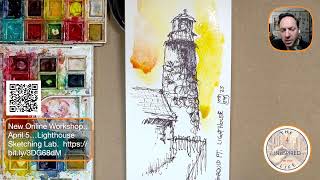
Architect Jason Nicholas sketches Maine's Pemaquid Point Lighthouse with a Sharpie and watercolor, explaining how drawing captures sensory memories: the sound of waves, salty air, rocks. He uses continuous-line stonework and a restrained yellow-orange palette, then invites viewers to his April 5th Lighthouse Sketching Lab workshop.
Chapters
Hey, Jason Nicholas Nicholas from The Inspired Life. Um, I'm an architect, a high school teacher, and I love sketching architecture. I love sketching buildings, whether they're imaginary or real buildings, and I love urban sketching, actually going into places like New York City, um, and sketching what's around me. I just— it energizes me, it fuels me. Another thing I love about sketching architecture is it's a great way to capture memories and to reflect on memories. And that's what I'm going to talk about and sketch tonight. Really, um, a really special place to me and my family is Pemaquid Point Lighthouse in Maine. We've been there many times and just something magical about that place. So I thought it would be fun to do a quick sketch of the lighthouse, um, as a way of practicing and getting ready for my Lighthouse Sketching Lab workshop on April 5th. It's virtual. There's a link on the screen. There's a QR code. I would love for you to join us in the workshop, or if you know anybody that would be interested feel free to pass along the information. We still have some seats left, and it would be so cool just to have, yeah, have more creatives joining us. All right, so I am going to sketch Pemaquid Point Lighthouse, um, pretty quickly, and I'm just going to show you how to sketch. I'm just going to use my Sharpie, and I am using, um, what's this, Fabriano watercolor paper. I love the format, it's 4 inches by 8 inches. It's a nice kind of landscape format or portrait. I'm going to do the lighthouse in portrait because I'm just going to capture the verticality of it. And it looks like my Sharpie might be leaking somewhere. We'll find, we'll find out if it leaks more. But if you're watching, feel free to say hello. I'd love for you to put your questions or comments in the chat. I'll be checking in and Saying hello. All right, let's sketch it. So this is Pemaquid Point Lighthouse, which we will definitely be sketching in the workshop. Let me sketch a little bit and I'll kind of just talk you through what I'm doing. And if you're just joining me for the first time, I like to sketch a very loose kind of style. So I'm not about precision, I'm not about accuracy, I'm about just capturing a place, a feeling. Um, even when I add color, I'm just adding color based on what I'm feeling in the moment. So you'll notice my sketch is very loose here. I noticed I started the lighthouse kind of with this part of the tower. Up here is where we're going to find a railing happening, and then we have the actual light happening up in this space. Here's the glass area. And of course we have the top of the lighthouse, which we're looking up at it, so we're just going to see that much at the top of it. Pretty cool, right? So this is quick, loose, fun, wonky. Again, this is Pemaquid Point Lighthouse. Um, sketching architecture is a way for me to capture memories and a way to relive memories. So as I'm sketching this, I'm really imagining being here with my family, the, the craggy rocks that are here, the smell of the water, the salt water, the sound of the waves crashing, the possibility of seeing dolphins jumping out of the water or even whales. Such a magical place. I, during the workshop, I'll be showing photos of this area, and we'll talk a little bit more in detail about it. So this is just one view of the lighthouse. We have a window happening here. If you notice the window, um, watch how I sketch this. I didn't even sketch the whole outline or rectangle of that window. I just hinted at it. I'm going to leave it kind of blank. I like to let my sketches kind of fade away and be incomplete. For me, when they're incomplete, that is a cool way to have the viewer kind of insert their imagination and imagine how this would be finished. So that's kind of a quick view of the lighthouse. I'm going to check in the comments and see if anybody's out there, and we'll say hello. Hey Sue, great to see you. Yes, Sue says, I'm looking forward to your lighthouse class. Sue, I am so glad that you're joining us. You're awesome, and happy belated birthday. Um, Sue Kane is an amazing, amazing artist, and man, if you ever get a chance to see her teacup paintings, they are off the charts. Sue, I appreciate you so, so much. You're amazing. I still remember some of our earlier, earliest correspondence when you were, you know, talking to me about, um, your— the architect and your family. We looked at some pictures of buildings in Australia. Such cool stuff. Great to— great to see you on. Hey Jody, great to see you. Hello, happy to see you're doing better. Lay house before our class. Yes, Jody, I'm so glad you're joining us in the class. Thank you, that's so going to be so much fun. So, um, Pemaquid Point Lighthouse is really made up of stacked stones, so I'm going to sketch some of those stones on here. And when I sketch stonework, I like to do it as a continuous line. I'm not trying to sketch every single stone. They're not perfectly shaped. By doing a continuous line like this, it's actually really therapeutic, um, but it also prevents me from wanting to be really— let me get a scrap piece of paper. Let's see, I'm an artist, an architect, a teacher, you'd think I'd have scrap paper here. Silly me, I have the back of a Post-it. Let's, uh, look at this. You know, if I could draw each stone you know, separately. This is really hard for me to do, by the way, and it looks cool. I'm sorry, you probably can't see it that well, but as I'm doing this, I'm really thinking about, okay, how does this one fit here? And there's nothing wrong with that, but I like to do a shorthand version where I'm just free-flowing with it. And I learned from an architect I worked from years ago, right out of college. That's how he would sketch stone on his, on his architectural blueprints. So we got the hint of stone. Sorry, my lighthouse is crooked sometimes when I sketch a sketch at an angle. And now you kind of lost that window, but so we can come back in and pull out some more of it if we want. We have some shingles on here, so I'm adding just some layers of materials just to add some life to it. Let's add some hatch lines. So this is a good example of just showing what we can do with a pen and piece of paper. I'm not going to add color to this one. In the workshop, there's no need to add color. I probably will be adding some for fun, but you can definitely do it with a pen or pencil. And just a sheet of paper. But I like to add a little bit of color on the workshop just so I can share my creative thoughts and process about how I like to pick colors out. I think that's looking cool. I like that sketch. Let me straighten it up so it doesn't look like the Leaning Tower of Pisa. Um, so that's Pemaquid Point Lighthouse. Sue, you're welcome. You are welcome. No, you are. Oh, Siri just thought I was talking to her. Hi Siri, I was talking to Sue, not Siri. Okay. Um, you guys are awesome. Yeah, Jody says happy to see you're doing a lighthouse before our class. Yeah, of course, it's good practice for me. I like to keep, keep in practice. Helps me kind of think through my thought process of what I want to talk about and just workshop and present things. And honestly, like I was saying before, I could never get bored of sketching this place because it brings back so many cool memories. And I will definitely— I think I might even be going here this summer, so looking forward to it. So I'm just adding some hatch lines. I'm going to zoom in a little bit, maybe get you guys closer to what I'm doing. Oop, let me, uh, play with the zoom here. There we go, you guys can see a little bit closer. So I'm just adding some vertical hatch lines just to create the idea of shadows, make the lighthouse look a little bit rounder. Um, I'm essentially scribbling these lines. If you can scribble, you can sketch architecture. I will believe that's true. At least sketch really loose, wonky architecture. And I'm going to stick with this. I'm actually going to shade in some of these. The, the building's actually white, it's whitewashed, but I'm just going to put some color, some shading on here just to give a little bit of variety. Again, we don't have to stick to the colors we see, we don't have to stick to the exact shapes. You know, recreating, it's for fun. It's, it's our imagination going wild. It's drawing or sketching what we want to. And that just sets me up for freedom when I think that way. I don't feel like I need to recreate this exactly as it is. If I did, I mean, I could do it, but if I had to do it, it It would slow me down. It would be more technical, like my architectural blueprints, very technical. This is loose, free-flowing, in-the-moment sketching. Cool. I'm kind of liking it. What do you guys think? If you have any questions or comments, let me know. This would— this is actually a little fence I put around here. I'm listening to music and I got a message that the music was moved to my iPhone. I don't know why. All right, cool. So that's Pemaquid Point Lighthouse. Let me zoom out again a little bit so you can see it. There we go. Maybe I'll do some growies around the base of the building. I like to do grasses or weeds growing up around the base of buildings. It kind of anchors the foundation to the ground a little bit so it doesn't look— so it does not look like the building is floating. Sometimes I have to slow down. I talk— I get so excited, I love this stuff, that I, I talk really, really fast. So for you guys in the workshop, feel free to always say, hey, can you slow down a little bit? I am more than happy to slow down. I tell that to my high school kids, just slow me down, because when I love something, I get so excited about it. Cool. I think this is a cool little sketch. I love it, actually. Yeah, and I'm not gonna even fill in the building here. Very cool. Let's just write on here, we'll write what it is. So this is Pemaquid— Pemaquid, I love that name by the way— Point Lighthouse, the place that holds a lot of memories for me, and a lot of future memories will be made here as well. What is today, March? I have to look at the calendar on the— all right, March 24th. So 0-3-2-4, and then the year 2-5. Cool. Let me see if there's any questions or other comments on there, and then, um, might be wrapping this up in a few minutes. Um, love it. Are you sure you wouldn't like to add a splash of color? You know what, Jody, Let's do it. I will add a splash of color. I was kind of thinking that, and I was thinking of actually doing the background so the building pops out. So let's add some color on the background and we'll leave the building black and white. That's something I haven't done in a while. Let's grab, uh, let me know. Let me ask you guys, do you want me to add some watercolor in the background or do you Would you rather see some Sharpie creative markers? Let me know, watercolor or Sharpie creative markers. I have some iced coffee here. Sue says, I really like your passion for what you do, it's inspiring. Thank you, Sue, and shout out to you guys because you fuel me up, you fire me up, and I appreciate that. Um, I hope, I hope it's what is called infectious enthusiasm. I really hope it comes through on screen, um, and you guys are picking up and feeding off those, those vibes. All right, Sue says watercolor. You got it, Sue. I'm going to turn around back here, over here, to just grab some watercolor. Boom! Got some water as well, and I got a brush. Look at that. By the way, sketching is also a great way to escape from reality. For example, let's just say we had to get our taxes organized, and that's what we should be doing tonight, but we didn't really feel like doing it. This is hypothetical, of course. And let's say that we just couldn't bring ourselves to the task. That's where watercolor and sketching can come in and be a kind of a nice escape from reality. Um, maybe not a responsible escape, but other stuff will get done. Sometimes you got to create in the moment when you're feeling it. Go for it. Um, carry around a little piece of paper or pen If you're feeling a moment, you got an idea, or more, you know, better, yeah, carry around a sketchbook or a journal. I love carrying my Lockbie here with me all the time. Capture it, just capture it on paper. It's always, for me, I always love to get it out of my head and onto paper. All right, we got some watercolors here. My favorite travel watercolor palette, the good old Winsor Newton. Cotman watercolor palette. There are some replacement paints in here, but you could tell it's well loved. I love this one. And we also have the bigger set. All right, and I have, I have dirty water as always. Tralala. All right, what should we do for the background? I'm thinking, you know what I haven't done in the back in a while? Let's do a, um Let's do like a sun, like a sunset or sunrise sky with oranges and yellows. And I got a napkin here so we can blot off my thingy here. Perfect. Blot off my paintbrush. All right, surprise us, surprise. All right, so here's how I like to do backgrounds. Um, first of all, I do— I like to put watercolor on at an angle. I like to use gravity as a tool and let the, the colors in the water kind of just run down and kind of blend together. But I'm turning it this way so that everything runs down away from the building. I'm dipping into my dirty water here, and I'm just going to throw some water right on the paper. Um, here's, here's the reason I always like to start with Sharpies, because I don't have to worry about the Sharpie ink bleeding when I'm throwing the water down. The ink's permanent, it's not going to go anywhere. So that is one of the reasons I love using Sharpies just for sketching. All right, let's dip in. We're going to dip into, um, good gosh, what are we going to dip into? We're going to throw down some some yellow. Hey, Chihuahua, is it 9 o'clock? Where did this night go? So I'm going to throw down some yellow on here, a lot of water. I really just want it to be kind of loose. I'm not going to color everything yellow. I'm just going to let it hang tight and let it do its thing. And I'm gonna— now I'm gonna grab some orange, and we're just gonna blot the orange down. Maybe here we'll throw some. I'm not actually painting it on, I'm dabbing the orange on top of the wet yellow. I'm just dabbing it down. I like to dab it that way. For me, the colors are blending in a way I like them. And I'm just— you can see I'm just letting the colors kind of run down a little bit. And I just picked up some water and I literally just throwing some— throwing down some water because I want the orange to kind of soften a little bit. I like how it's bleeding down here. I'm going to let it try to dry like that. It'll change, it'll it might run down when I flip the paper over. So I'll flip it over in a sec. We'll let it dry. So, so far we've just used two colors, yellow and orange, and I think we're just— that's all we're going to use. I'm going to get a little more orange, and I just want to intensify this area here. You know, maybe, maybe, I don't know, maybe that's our sun happening there. I don't know. I think, I think I'm actually going to blot this a little bit here because I want to turn the page around. So don't, don't be afraid to blot off areas with a paper towel or a napkin. And I'll turn around, we can see it. I don't know if that yellow is really coming out on camera. It might be. I have a lot of lights in here. We're going to actually feather this a little bit because I want to soften the edge. All right, I'm going to throw more yellow down. I'm really gonna— I really want to pop it on so it shows on camera. I think my lights in here are so— it's so bright that I don't think the yellow is popping on camera. So let's just pop it a little bit more. And I just took some water and I'm just dabbing the water a little bit, kind of swirl it, let it do its magic. I mean, I'm going to try something. Let me close this light, see if it looks better on camera. I don't know, can you see the— can you see it better now? I just kind of turned off a light. Maybe you'll see a little bit better. Hey, D-Rays in the house! Welcome, D-Ray. Hope all is well. Great to see you as always. Cool. So hopefully you guys can see a little bit better. And I think that's— I think I'm going to keep it really, really simple. I think adding the color in the background made the lighthouse pop out a little bit more. Maybe we'll just play around and we'll kind of just spin the paper. And sometimes I like to just move the paper around and swirl it and swish it and let the colors play together on the playground. It's like a color playground. There you go. I'm just going to soften that a little bit. Tada! So there you go. So that's a little bit of color on there. We'll let it dry, and then we have a lighthouse that was sketched in, what, about 20 minutes, I guess? Yeah, so we'll say about 20 minutes, we have a lighthouse sketch and we threw down a little bit of color. And there you go. And as I was sketching it, I was reflecting and remembering the fun times that we've had here, um, at the lighthouse. And more importantly, I was really kind of reliving the whole— using all my senses, right? Well, I don't know what I was— yeah, I mean, I was tasting the salty air, but kind of imagine smelling the salty air, hearing the waves and the people and the seagulls, um, touching the rocks, you know, walking on the rock outcroppings here. Um, obviously seeing all the beautiful surroundings, the lighthouse perched on top of them, the mountain— on the mountain, top of the hill. Yeah, so sketching is a really great way to recapture those memories, to unlock some of those memories, and to just put you in a different place. And that's one of the things I love about it. All right guys, you have any final questions or thoughts, let me know in the comments and I'm going to wrap it up. I appreciate you watching and commenting and being so positive and supportive. If you like this and you're on YouTube, I would love for you to like the video, give it a thumbs up, and subscribe if you haven't subscribed. Let's get the YouTube numbers up to 1,000, that would be so cool. I always appreciate you guys watching on Facebook as well. You're amazing. And if you know anybody that might be interested in the workshop, you know, let them know about it. It would be great to have some more people join us. Um, yeah, I have an idea that I might run past people that signed up already, so you might see an email from me or a Facebook message. Um, I'm just kind of playing around with it in my head. All right guys, let me check the comments. Sue says, amazing lighthouse pops forward with the colored background. Your description is amazing, I feel like I'm there. Oh, thanks Sue, that's great. I'm so glad. I'm just trying to share what's inside my brain right now and how I'm feeling. That's cool. Yeah, and, um, I agree. I think Jody, I'm glad you said that, put a pop of color. I kind of like how it pulls the lighthouse out. A little bit. And I didn't get carried away with the background, right? I just used yellow and orange and done. Um, sometimes I overwork things. Thanks, Jason, looks great. Thank you so much, I appreciate that. You guys are awesome. Enjoy the rest of your day or night, wherever you are watching this. And remember, you too can sketch Architecture one line at a time. Have an inspirational day. I'll talk to you guys, or I'll see you guys real, real soon. Take care. I appreciate you. Keep on creating good stuff.





