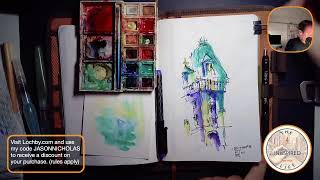
In this live, solo session Jason Nicholas of The Inspired Life demonstrates a quick, loose architectural sketch of a small section of the Biltmore Estate using mixed media. He walks viewers through his material setup—Winsor & Newton watercolor palette, Pentel Aqua Brush, Pilot Varsity pen, Sharpie gel pen, and Lockbee Field Journal thin watercolor paper—explaining why each tool is chosen and offering practical tips (e.g., cap usage, brush pressure, handling thin paper). Jason emphasizes a gut‑driven color palette (blue, yellow, aqua, purple) and a relaxed creative intention: simply “throwing down” color to unwind after a busy day. He shows how ink bleeds, how to add texture with hatch lines, and why he often sketches only a small architectural detail rather than an entire building. Throughout, he encourages viewers to use creativity for positivity, mentions his broader Biltmore watercolor series, and plugs a discount link for Lockbee gear.
Chapters
Hello, happy February 17th. It's a Monday night. Hope you're doing well today. I am Jason Nicholas here with the Inkspired Life. I love sketching architecture, all kinds of buildings, um, in a very loose kind of style. I use ink, watercolor, colored pencils, markers, all kinds of mixed media. So thanks for joining me tonight. I'm going to be on for a few minutes And I have a sketch here inspired by the Biltmore Estate in North Carolina, just this really small section of an amazing building. I sketched this, I think, last week online, and tonight I just want to— I think I'm going to throw down some color. I brought out my little watercolor palette here, and I'm actually using an aqua brush tonight. So, and I have a purple Pilot Varsity pen, so let's just throw some color down in here for a few minutes and, um, just have fun. It's a great way for me to unwind from a nice day off from school, very busy day. I'm trying to catch up and clean up and grow up and doing all kinds of, uh, responsible things, so it's a good thing. All right. Let's throw down some color. Let me know where you're watching from. So I love this little watercolor palette. It's from Winsor Newton. Um, you can see I've added some additional colors. They're not all the original ones, but let's just dip into it. I'm going to grab some aqua. Let's grab a— I have a paper towel. Actually, I'm just going to use I have a piece of watercolor paper here. Um, actually, before I add color, let me talk about the paper. This is very, very thin paper. You can actually see through it, so it's meant only for light washes. It's, um, I'll show you, I'll show you the paper here. So it's in, it's Lockbie Plain paper. Um, it's actually in my lock Lockbee Field Journal here. My— I don't know what I would do without this thing, to be honest with you. If you're interested in Lockbee and any of their cool gear, um, check out the discount link on the bottom of my screen. Um, I highly recommend them. All right, so let's just throw down some color here. I'm gonna start with some aqua. So the colors I'm using are not the actual colors that you would see at the Biltmore. I have a certain palette I like to use. Um, I often just pick colors kind of by gut feeling. And notice I'm kind of really loose going outside the lines, and that's cool. I'll often talk about setting some kind of creative intention before I start working on a sketch. Um, my intention tonight is just to throw down some color on here. That's it. Uh, I am not very neat with my watercolors. I mix them up in here and they get all over the place, and that's okay. I don't really mind that too much. All right, let's see, we're going to throw down some— sorry, I just dropped my phone over there. So this is a— I believe this is a Pentel Aqua Brush, which I really like. They're great because they're easy to travel with. You can fill them with water in the reservoir here. They come in different size tips. I— this— I don't know, I don't know if it's like small, medium, or large. This might be the large one. I usually use a medium one, which is I think here. Yeah, this is more of a medium one. Um, they last a long time. I've had this one for a very long time. Makshana, grab some blue. You will use blue to help with the shadows a little bit. I'm gonna bleed some purple on here. I could mix my own purple watercolor, um, red and blue, but I'm going to use a— this Varsity pen, and we're going to just throw some ink down and we're going to bleed it. With the water. So let's just kind of throw some of this ink, and I'll— you'll see how it bleeds. So you can see that, see what happens there when you throw down some water. I really enjoy using the Varsity pens a lot. Cool. All right, so we have some purple Varsity Pen. I have some watercolor on here as well. Love this aqua color. I'm gonna leave a lot of white space on here. I want to keep it really looking loose. Cool. I like the way this is looking. I often like to have a piece of scrap paper when I'm watercoloring just to clean my brush off on, and then I'll end up using this and doing some kind of sketch on the scrap paper. I really want to pop that yellow out some more. I'm going to clean my brush off a little bit more here and just wipe it. Let me grab some of that yellow and throw it on pretty thick. Let's see. There we go. If you, if you have not been to the Biltmore Estate, it's— I need to go back there. I barely, I think, scratched the surface. I was there for a very brief time. It was incredible. Um, just the architecture, the, the grounds there. It's really, um, really a treat. There you go. You can kind of see that yellow is popping a little more because I'm just throwing it really thick on the brush and not a lot of water. The Pentel Aqua brushes are great, but it takes a little bit of practice squeezing it, squeezing it, figuring out how much water to get out of it. But, um, you'll get the hang of it after you use it for a while. Cool. I think I like the way this is looking so far. I'm only going to stick with these colors that you see here: the blue, the yellow, the aqua, and the purple. I'm not going to add any other colors on there. And, uh, pro tip: your pen cap does not fit on the Aqua Brush. You got to use the right cap. And do make sure you keep the cap on them, just to protect the brush and also to hold the water in so it doesn't evaporate as quickly. If you have the cap off, it tends to evaporate the water out of it. So make sure you do keep the cap on when you're not using it. Um, I like this. I'm going to actually come back with the Sharpie, I think, and we'll add a little bit more, uh, maybe some hatch lines. I'll zoom in so you can see a little closer. There we go, it's a good shot. And I'm going to wrap up in a couple of minutes here. I'm actually going to switch to— so Sharpie markers do not like damp areas, so I'm going to switch to a Sharpie gel pen here which can handle the damp areas pretty well. So, uh, let me sketch. It's a little bit of detail here. Maybe some— we'll do some, uh, tiles in the roof, maybe some slate. I'm just throwing this down really kind of— there we go. This is just to add a little bit of texture to what's happening up here. Not going to get too crazy. So those lines just help to differentiate the roof material from what's happening below. And actually, we have— this is block work, stonework at the base, but I am not even going to show the stonework. I'm just going to leave it clean like that. Let's draw some hatch lines just to help with the shadows a little bit. So you do have to be careful. This, again, this paper is pretty thin, so I'll show you the other side and when I'm done we'll show you— we'll take a look, see how much bled through. But you don't want to rip it, so be really careful. I'm just kind of darkening these windows, and this is a doorway, I think, down here. When I sketch buildings, I don't always sketch the entire building. Actually, I very rarely sketch the entire building. I'll just focus on small parts of it at a time. Maybe it's something that interests me, uh, maybe it's a shape, maybe it's a color. So don't feel like you have to do the entire, the entire structure. That could be overwhelming and really stop you from wanting to sketch anything. I mean, you could focus on a door, a window, um, a balcony, a rooftop. So kind of, this is kind of more like focusing on the roof area here of a very small, small section of the building. Cool, this might be done. Here we go. So that is just a real quick color throwdown on this sketch of, um, inspired or inspired by the Biltmore Estate. Loving the color palette. I actually have done a series of watercolors based on the Biltmore. I'll post them at some point in time. I— there's some of my favorite. Actually, I'll pull one off the wall here. Actually, I can't get to it, so I will not pull it off the wall now, but I will post pictures of it at some point in time, and you guys can see the Biltmore sketches I've done before. All right, um, thank you for watching. I appreciate everybody out there for watching live, watching the replays, for sharing this, liking it. Um, yeah, it means so much to me. So just do me a favor, sometime this week let's spread positivity through creativity. That would be amazing. Just do something creative and get some positive vibes out there. Excuse me. All right guys, this is Jason Nicholas with The Inspired Life. Thank you for joining me tonight. Hope you have an amazing rest of your evening and enjoy your week. Remember, you too can sketch architecture one line at a time. Take care.