Monhegan Island Cottage - 07.14.2023
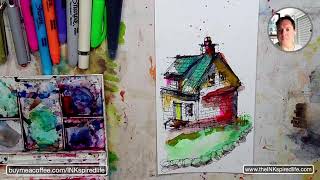
In this live YouTube stream, architect Jason Nicholas walks viewers through the initial concept sketching of a real lakefront cottage project. He begins by sharing his email for direct contact, then introduces the design brief, describing the site (lakefront with road, water, and a sloping lot), required program (open floor plan, kitchen/dining, living area, bedrooms, mudroom, large porch, basement walk‑out), and desired cottage character. Jason cites Aldo Rossi as a major sketching influence, showing Rossi’s loose, colored sketches to illustrate how quick, expressive drawings can generate ideas. He demonstrates his workflow using regular paper, tracing paper, highlighters, Sharpies, colored pencils, and watercolors, explaining why he starts freehand, sometimes prints a scaled plan to trace, and later adds watercolor washes with Aqua brushes. Throughout the session he iteratively refines a simple boxy floor plan into a more “cottagey” form—adding an L‑shaped porch, dormers, sloped roof, stone chimney, and varied material textures. Viewer comments shape the process: suggestions on mudroom placement, structural concerns, and color choices are addressed in real time. Jason also discusses his upcoming sketching community (a non‑Facebook platform launching in August), his content schedule, and how music influences his creative mood. The stream ends with a finished watercolor sketch of a Monhegan Island cottage, a recap of tools, and a call for continued engagement.
Chapters
Hey everybody, happy, um, Friday, July 14th, 2023. I hope you're doing well. Uh, I'm gonna be on just doing a little bit of sketching tonight. I'm gonna do something a little different tonight. Let me just kind of get this position is better. Hey Linda, great to see you. Hope all's well. No worries. Linda says, I need to send you my email address since I am not on Facebook. No problem. Here's what I'm gonna do. In the comments right now, I will put my email address for you. We can definitely do that. Hope you're having a great, great Friday. So my email is jason@jasonjnicholas.com. @jasonnicholas.com. So that's my email in the chat. Feel free to email me your email address. That'd be great. And we can connect and make sure I can get your mailing address so I can mail you that sketch that you won yesterday. So awesome job. So anyway, hope you guys are doing well. Um, look, I'm gonna do something a little different tonight. I I thought it would be kind of fun just to, for a few minutes, kind of walk through doing some architectural concept sketches for an actual project that I have that I'm working on. So, you're welcome. So that's what we're going to do tonight. And I'm just going to— I just have regular paper, nothing fancy schmancy right here. And I have One item that architects love, tracing paper as well. Not seeing it in the YouTube channel chat. Um, oh, no worries, I will, I will add it to the comments there. Um, or better yet, here, let's do this. Just give me a sec and then we'll get doing some sketching. Let's see, Jason at Jason— I'm going to put it right on screen here. All right, cool. All right, so, uh, no need to reboot. So it's right there on screen. That is my email address, so feel free to use that and let me know if you can see that on screen, and, um, I'll take it off when we're done. There you go. So jason@jasonjnicholas.com. Real original, real original email address, but it works. Well, this is— I got it. Oh, awesome. Perfect. Very, very cool. I will turn this off. So hope you guys are having a great day. We had— still have a little bit of thunder rumbling. So we had thunder and rain this afternoon. Just one of those days where nature needed a drink and it's all good. Um, so let's talk a little bit about kind of how— what do I do when I have a project and I'm designing something? So I'm not going to be sketching a lighthouse or a fishing shack or New York City scene. This is going to be just real kind of brainstorming, uh, sketching that I'm doing for a project. Hey, Karen's in the house! Great to see you, Karen. And what I want to start off with is I have a book that— by an architect that I love. This architect, he is no longer with us. I learned about him in college. His name is Aldo Rossi, an Italian architect. And one of the things I love about Aldo Rossi, not only his designs, I love his sketching. And this is a really great example of— he was an internationally renowned architect look at his sketches. Sometimes we think we have to have amazing and beautiful detailed sketches. You know, as an architect, we do quick, loose, fast sketches to get ideas out, concepts out. So we'll kind of go through, look at some of Aldo Rossi's sketches, his concepts. You know, he would do drawings like these. You know, not a lot of detail, but you can see shapes and forms. His buildings, he was very, very into kind of clean forms and shapes in his designs, right? You know, mixed media, I don't know. I see obviously ink, there might be watercolor, it might be colored pencil. I don't know all the mediums he used. Here's like a painting he did. This is obviously more— this is now a more detailed presentation type drawing. But when you're just brainstorming, you know, sketches like these are perfectly fine. So I think a lot of my style has come from the sketches of Aldo Rossi because he's something I was just— he's somebody I fell in love with in architecture school. Love the colors. Yeah. Aldo Rossi is really cool. I'll flip through a couple more pages and then we'll just do a Just a quick little brainstorming session. I mean, this is so cool. Look at the soft, subtle colors on here, right? Boom. Remove this for a second. This is a house that he designed, a single-family house in Seaside, Florida. If anybody's seen the movie The Truman Show, with Jim Carrey. I just watched it last week, I think, again. Great, great movie. Seaside is a place where a lot of internationally known architects designed houses, and Aldo Rossi was one of those architects who designed a house in Seaside, Florida. So, and then here's like an office tower in Mexico City. Yeah, he's definitely my wheelhouse. He is, he is. Thank you. I love this, just black and white, a little bit of color in the background. Maybe it's coffee stain or coffee wash in the background. All right, cool. So I just thought it'd be cool so you guys can see just kind of one of my influences, um, when I started sketching. Let's put this here. Alright, so here's, here's our design brief. My design brief. This is a real project that I have going right now. First time I'm sketching anything for it, so let's have fun. So we call this a program or a design brief. So here's my design brief, what I need to have in this house. And thank you guys for watching. I know it's a little different spin tonight, but I thought it'd be fun just to show you a different mindset. So first of all, it's a lake— it's a lakefront house. It's gonna be new. It's going to have— let's do a cross-section through the property. So I'm gonna slope it like this. This is a cross-section. A cross-section is slicing through. The property or a building. Imagine a birthday cake or a cake. You cut through the cake, you open it, and you can see all the layers inside, right? That's a section, a slice through it. We're gonna do the same thing through their property. So this represents kind of the ground. I'm just going to scribble this quick. So up here is the road, down here's the water. So the house is probably going to be something like this. Here's the first floor of the house. There's gonna be a second floor here. And just to keep it simple for now, just show a basic roof shape, an attic. And then down here we'll have a basement area that you can walk out of, right? So we have First floor, second floor, and a basement down there. So that's kind of the levels of the house. And you know, they want a very open floor plan, kitchen, dining area, living room, and bedrooms. We'll just keep it really simple. So that's kind of the mission. And the idea was to have a cottage house with a lot of character to it. So let's start off. I'm just going to do some quick sketching and just brainstorm a little bit. Hey, DB's in the house. Great to see you. Yes. Yeah. The Truman Show is a really good movie. Love it. I love it even more that I recently watched it. So floor plan, right? We could picture— sometimes I just start with a basic form. Kind of like I'm sketching. This is gonna be a floor plan view, so we're looking down at the first floor of the house. I'm just going to draw a box. It might change. It actually will probably change and be more interesting, but this will be the main part of the house. There's going to be a porch, the L-shaped porch here. Let me break out some colors. I got highlighters right here. So this will be an L-shaped porch. That wraps around the house. So again, this is the front of the house. This is where the water is. So there's gonna be a porch on the front that wraps around. Boom. One of the things they really wanted to have, was really important, is a very big mudroom space. So, let me just pull out these highlighters. You know, a nice big mudroom here maybe. We're gonna have some steps here that go up into the main door entry of the house. So this might be where the main entry space is. Just gonna whip out some other colors here. So we have the main entry space. Um, really important that I didn't sketch is a porch, some kind of a porch on the back of the house that looks out onto the beautiful views of the lake. So we're gonna have a Nice porch here. So this is called diagramming. I'm just diagramming the spaces and where they might go in the house. And then we have, I'm thinking the kitchen dining area, maybe in here somewhere. Put KD, it's gonna be open. Living area, probably in here, maybe somewhere. Living room. Uh, we need a powder room somewhere. So maybe somewhere off the main hallway we have a little powder room. This mudroom's probably gonna be a little bit bigger. We're gonna need stairs going up. I don't want the stairs in the back of the house 'cause I don't want 'em to take away the openness. We wanna be in here and look out at the views. So the stairs could maybe go off the entry, maybe here. Maybe there's like an L-shaped stair that goes up. Boom, big open living space. And then they said possibly a small office, so maybe here's our office space. That leaves this open for kitchen and dining. So that could be, you know, a possible layout, and got to start somewhere. And rather than me starting with crazy shapes You know, I like to start just basic because we can always tweak and refine it. This isn't to scale. I'm not worried about scale. I'm just looking at the idea of the locations of things right now. So let's make that kitchen, dining. Um, yeah, I think I have— that's, that's enough colors, I guess. So then maybe that's a layout. Um, Linda says, interesting, but I would not worry about being in the middle of the hill and the water mudslide. So not, not an issue, not an issue. Um, the way it's structured and built will be fine. This is a real common condition around here to have houses like this, what they're called, you know, with a walkout basement here. So that should be fine. It could be structured, but I could see what you're saying, cuz definitely, right, the water everything is going to want to go downhill. But we design it properly, the landscape would be pitched accordingly, the foundation walls would be waterproof and structured as necessary for that. So great point. Cool stuff. Karen, I see Karen is in the house. Karen, you're awesome. Thank you so much. I appreciate that. Thank you. Um, all right, so that's kind of a floor plan layout. Again, we're gonna just quick, quick diagrams. So let's kind of riff off of this. And let's just do kind of a little outside, maybe 3D sketch. We'll just actually, we'll just do a real small thumbnail sketch right on here. Right, so if I was just to look, say we're gonna, if I was to sketch just a real simple basic house, it's gonna be boring. Right? Trying to imagine the scale of it. And then we'll turn it around a little bit. This might be the front of the house. So maybe we have a porch here that comes and wraps around the side. So I'm kind of sketching. Right now it's a straight-on view, but we'll morph it into a perspective. So here's our porch. It goes around the side. We have some stairs coming up. Maybe there's a door here somewhere. Right, this is looking very, very generic, but it's a way— good way to warm up and just get something on paper. Uh, let's kind of morph into maybe a little— give it a little perspective here. Boom. Kind of come down here. Maybe the porch does this. That's our little perspective shot here. So the ground slopes down, right? I'm exaggerating here. Just some windows, boom, boom. I'm gonna sketch a metal roof because I'm gonna propose a metal roof on this house. And this would kind of just go up to the road, right? So that's a real just quick thumbnail sketch. Hey, Karen, great to see you. Karen's in the house. Welcome! We have two Karens. We have Karen C and Karen P. You guys are awesome. This is fun. Um, let me know, are you guys liking this? I know it's very different. I'm not sketching a cottage or a lighthouse or New York City or a fishing shack. Um, if you're into this, it's cool. If not, also let me know because I could shift gears. But I just wanted to kind of see, as an architect, how do I approach projects and how do I use sketching when I'm starting the concept or thinking of ideas for a project. So, you know, so I got this out of my system. Yeah, it's, it's a box. Not cool. It doesn't have that cottage vibe to it. So how could we kind of make this a little more cottagey? I didn't, I didn't sketch the second floor. I'm not worried about it because upstairs I need 2 bedrooms and a master bedroom. Actually, let's do a little Another little thumbnail sketch here. Let's just do a box again for the second floor. Let's say our stairs are here. Zoom in so you can see it better. Um, master bedroom. The client said that we want the master bedroom on the back. Um, we're actually starting to call them primary bedrooms instead of master bedrooms. So we'll have the primary bedroom on the back and a bathroom as well. With views looking out to the lake. And then come up the stairs into a hallway, and then maybe we have— they need 2 other bedrooms, so I'll break out colors in a second. This is kind of what I'm picturing. I'll show you with color. So I think we'll have a bedroom here, bedroom here. This is, this is going to be a bathroom. It's in a hallway that could be shared by those bedrooms. This would be the master bedroom suite here in the back of the house. So that's kind of how the second floor would lay out. DB says, like what you're doing. Oh cool, awesome, thank you. This is— I love it. All right, cool guys, let's keep doing a little bit of architectural concept sketching, just kind of getting the brain of an architect. I have never done this live, well, on YouTube. I've done it live with clients, but, um This is fun. So let me— if you have any questions, feel free to ask. Again, box. I'm starting simple. And here's a, here's a question I get asked a lot. Do I start my designs on the computer or freehand sketching? So freehand sketching is usually where I go first. But there's one thing to that. Sometimes I will, on the computer, lay out the plan to scale on the computer so I know the size of it, and then I'll just print that basic shape out and I'll trace over it with handy-dandy tracing paper, and then I can sketch to scale if I needed to. So I do, I do do that sometimes. But other than that, just concepts, just initially having fun, just all freehand. Um, all right, so let's kind of— let's make this a little more cottagey. So another sheet of paper here. So the front of the house, I'm thinking outside. Let's— one thing we can do to make it cottagey is instead of doing this Again, our two-story box. Here's, here's our floor levels here. Here's our roof. What we can do is we can make, um, lower the roof and put dormers. Do any of you guys live in a house, or have you been in a house where the second floor bedrooms don't have flat 8-foot ceilings? They have sloped ceilings in them. That's a real great way to get the scale of a building down and to get that cottagey look. So let's do— let's really exaggerate just for fun. I'm actually going to curve it a little bit, and we're just going to pull this back. And let's throw maybe some kind of a dormer here. That's going to go back like this. Maybe got some windows there. Boom, boom. Again, we had a porch on the front, so let's kind of do this. Actually, I want to make it lower, so let's do this. I'm gonna bring the porch around the side here. I'm gonna column, columns, columns. The house should come out a little bit more. And we're gonna slope the ground again. So here's the front, we'll say it's sloping down this way. We have some steps here for the front door, we got a front door. And then we have maybe some windows here. So look at the scale of that. It's starting to look a little more cottagey than this one, right? We have— we pulled the roof down here. Let's put some siding here so it stands out. So we pulled the roof out, we added this roof here. I'll color it pink so you can see it. We have a dormer. That kind of pops off the side, that adds character. And then we have our porch roof here, kind of wraps around. This is fun. See, I get to use colors too when I'm just doing concept stuff. And we got our porch. Um, porch will probably have steps going down here. There's going to be a porch on the back of the house. And maybe that porch— maybe we just continue the main roof of the house out. Just want a door here or something. So it just gives you an idea of what we could do. Pretty cool, right? Hey Becky, great to see you. Hey Arissette, how are you? Great to see you. Are they highlighter Sharpies? Yes, they are. Great question. I love, I love Sharpies too. I haven't seen you in here, so welcome. This might be your first time. So I always have a Sharpie. I always sketch with Sharpies. So I'm doing something a little different tonight. I'm not sketching a lighthouse or a cottage or a New York City scene, but I'm just talking about what do I do as an architect? How do I just have fun to start a project and come up with these quick loose ideas? So it's a cool way to show how sketching is, you know, it's— I use it in my profession as well. Right, so we could do something like that. Again, we're still kind of boxy. It's still, it's still this rectangular floor plan shape we talked about here. But we can change that, right? I could start adding— here's where the tracing paper will come in handy. And then I'm going to break out after this, and we'll do a— I'll just do another quick little building sketch. Maybe we'll do a fishing shack. To wrap up. Let me pull out a red pen so you can see this. There we go, I got red markers here. Alright, perfect. Alright, so instead of having a box— hopefully you guys can see, that's hard to see, that red— let me pull out a red Sharpie. Alright, so here we go, more Sharpies. Boom. Here. Right, so here's what we could do. Maybe the back of the house, maybe the dining area bumps out. Maybe the living area comes across like this. Maybe in the front of the house we have a little bump out for the mudroom here. Maybe the porch does this. So just by adding these kind of little jogs in the walls, we're now starting to create an interesting shape. Of the house. And how could that change the outside? Well, maybe, you know, maybe we have a bump that does this on the front, and this goes up. We still have a main roof here. Boom. This comes back, um, maybe I am getting crazy, but we could even do a bay window or something, or something on the side if we wanted, just to pop that out and give it some depth. So there's things you can do just to make the house kind of pull it a little bit here and there, just to give it more depth and interest. So I thought, um, that's all I'm going to show tonight. So I just wanted to give you just a small taste of You know, how do I approach a design project? And I'm a little more methodical about it, a little more, you know, thought. Sometimes, not all the time. Sometimes it's just about brainstorming and just putting stuff on paper. Maybe, you know, maybe I'll sketch, maybe I'll do like an interior sketch of something, maybe a little perspective inside. You know, maybe there's windows here, big transom windows, big window here looking out. Maybe the ceiling, we have these exposed beams up in the ceiling. Maybe over here is some kind of kitchen. Island or something happening. So, you know, I'll do some quick interior sketches as well, just for fun. Um, so there you go. Awesome. Uh, Linda says needs a brick fireplace running up the side. So Linda, I love that you said that. Believe it or not, the clients don't want a fireplace, so we're not going to have a fireplace in this house design. Yeah, so no fireplace, but good call. There will be stone on here and cottagey look. I will show you guys other sketches as I move the project further. This is the first time I even just sketched anything for it. I didn't even know Sharpies did highlighters. Yes, new here. Awesome. I love your work and have wanted to catch a livestream for a while. Oh, fantastic. I'm so glad you're here. My Sharpie dreams are coming true before me. Well, I'm so glad. I hope that this has been the highlight of your day. See what I did there? Now I just noticed all 5 people that were watching just left after I made that terrible pun. All right guys, let's sketch. I feel like let's do a fishing shack tonight. Let's go back to our main shacks. Um, if, if there's more interest, I could start doing just maybe some architectural series of sketch— of, um, videos. Just kind of walk you through the architectural design process. If I get enough interest, I would love to do that. All right, so, um, Eris, Erisette, just make you even happier because I want to Make sure you return, keep watching these live streams. There is a purple one as well that I have here, along with the standard, you know, black Sharpie and red Sharpie here. There you go. All right guys, so we're gonna do a Fishing Shack in Maine. Uh, this is one we did last week or earlier this week, I don't remember. I love the colors on this. Really fun, quick, loose. Again, this was done with, you know, Sharpie pen inks on here. I have some colored pencil on here as well. So that was a fun scene. And then here's another cool one that we did as well. Another mixed media ink and watercolor. So what are we going to sketch? Um, so I could use the 8x8 sheets or 4x8. Let's zoom out a little bit so you guys can see the whole thing. Uh, let's go with a 4x8 piece of paper. I like the format. So we're going to use Fabriano 1264 cold press. Love this paper, love the size of it. Really cool. Put this to the side. Um, let me— I'll pull up an image here from one of my trips to Maine. I'm still cringing from the pun, but you caught a clap. Thank you very much. I appreciate that. Thank you so much. I'll take any applause I can get. And keep moving forward, right? All right guys, that's what my high school students love about me, are my puns. That's why they keep coming back. Has nothing to do with grades, nothing to do with architecture or CAD design. It's the puns. They live for the puns. All right, so I'm going to pull up, uh, going into my photos here from Maine. Hope you guys are doing well. Let me know in the chat, how are you guys doing? Enough about me. I feel like I just made a weird cringe-looking face on camera. Um, let's see. Oh, I got a lot of— I have like over 2,000 pictures of Maine here. I did not prep ahead of time, so this is inking out loud where we just create on the fly. Oh, you know what, um, some really cool buildings. All right, I'll find something. I'm taking way too long. Um, You know what, actually, we're going to sketch. I don't know if anybody's been to Monhegan Island. Monhegan Island, uh, up Midcoast Maine. It's like stepping back in time. Incredible old structures and buildings there. I spent a day there, um, photographing and sketching. It was so much fun. So maybe we'll do a little scene from Monhegan Island. Yeah. All right, let me pull this image up. So we're going to sketch this little cottage on Monhegan Island. Cool building, right? Look at the details, the old weathered cedar siding, the shingles. Love the green roof and kind of the gray window trim. Um, I could sit here at this house and this view all day long. So we'll just kind of do a little quick sketch of this. So I'm going to start off with, like I usually do, a Sharpie. Let's do that. So I'm actually going to pull the image off screen so take a look at it and we'll move it, put it back down here so I can see it. And again, so I just use pictures sometimes as inspo. I'm not trying to replicate it, I'm not trying to match the colors, I just trying to get the character or the overall shape of the building. Hopefully that makes sense. So we're going to start with a Sharpie. Why? Because if I go back to add water and/or bleed some ink or add watercolor, the black lines aren't going to become all muddy because the Sharpie is not going to bleed, right? So that's why I'll often start with a Sharpie. Let's just kind of sketch and keep it quick and loose here. Cool. So this actually has a dormer on it, like we were just talking about in the architectural sketch. And the dormer area is going to be right here. So the dormer roof is there, kind of goes back, kind of pops out here a little bit, just comes down. We have windows. And then this kind of triangular piece comes back. Boom. It's kind of our dormer area. We have our little roof return here. The roof set up kind of a perspective, so come back like this. This roof would kind of end here-ish, comes down. Boom. We have the corner here. And then this actually goes off the page a little bit. It's fine. That does that. We have some kind of landscaping happening here. We have a little— let's see, we have a front door here somewhere. Window here. And then we have a couple of windows up in the peak. So this has that cottagey kind of scale to it. I was talking about with that lake house. Um, Linda, this one does have a brick chimney coming up it. So your instincts were absolutely correct, because that would definitely go with the look of a cottage, either a brick or stone chimney. This has a, this has a brick chimney coming up here. Cool. And this roof will just continue out a little bit. Sometimes I just like to let the buildings kind of just bleed out unfinished. Cool. So that's the overall shape of the building. So let's have fun and just throw some color on it now. Break out the— do some watercolors. "I'm sitting in front of my watercolors not doing anything. So pretty average day." That's cool. I hope you're watercoloring something. Break out those colors. Throw some down on paper. I'd love to see what kind of art you make. That would be so fun. Agree with Linda. Just go for it. I'm going for it. You got it. You gotta just— you just gotta just do it, right? Becky says, easy to go crazy talking, taking photos, and mean. It is, it's easy, definitely. I agree. All right guys, so here's my watercolor palette. It's well-loved, well-used. I am not a perfectionist. I am— think of me as like Oscar the Grouch when it comes to watercolor paints. Wasn't he very like messy? I think of the right character, right? Oscar the Grouch from Sesame Street. I'm not grouchy or green, but I think he just loved trash, right? So this is kind of trashy, but that's how I work. I'll mix colors here, I'll mix colors in the pans. I'm not a purist. It's all about just having fun in the moment, just kind of vibing on what you're doing. Um, this is a cool palette because you can do this if you want. Boom. Really cool. Where's my brush? So I have dirty water. I usually like to work with dirty water, so it kind of adds just to the vibe. Sometimes like kind of grungy, gritty stuff going on, so I like to use dirty water. I'll zoom back in. Boom. All right, let's throw the colors down, guys. Um, just trying to move this so you can see more of what I'm doing. What the heck, we're gonna grab some yellow. Idea is I want to keep this quick and loose, leave a lot of white space. Notice I'm holding the brush at the end. If I hold it up here, that makes me want to do technical detail drawing, detail work. Holding it further away keeps it kind of loose and flexible. Um, I kind of list— I kind of feel like listening to like Metallica right now, believe it or not. Just something heavy. I want a lot of energy. But yeah, YouTube and Facebook will, uh, copyright me if I was to do that. I mean, this is very nice and peaceful, don't get me wrong, but I just want to— right now I feel like having a lot of energy. Who's like, oh my God, what's he doing? That is not the color that was in the picture. Is anybody thinking that? Is It's okay if you are, because you're right, it just has nothing to do with the colors that were in the picture. And that's cool, I'm just doing my own take on it. I just want to throw down fun colors. You know, the photograph I took has all the realism in it, so I don't need to— I don't want to replicate it. I just want to replicate kind of what I'm feeling inside right now. Um, yeah, I'm gonna break out some red. Where are we gonna throw the red? Maybe we'll throw some red here. The cool thing— part will be when this actually dries. So I like the red, the yellow is kind of happening here. You can get really fun and just kind of clean our brush out, a little splatter. I have some turquoise in here. I'm gonna kind of dig into it. I want to put it on thick, so I'm literally— I'm just taking my brush in here, and you can see how I kind of wear out the pans of paint because I like to take my brush and spin it a lot and load it up. And I just want to be more intense up here on this roof, so boom, it's kind of a little roof that wraps like this. Um, and after the paint dries, I'll come back in and I'll add some details with my Sharpie or Pilot pen. This one kind of doing fast and furious. Let's make a nice purple color. We'll start to indicate some shadows on here. It's all wet on wet, so I love the way the colors bleed, mix together. They kind of do their own thing. That's what really gets me going. Of course, you can ask a question. Lynn's been to Bar Harbor. Very cool, that's a beautiful place. That— yeah, guys, always feel free to ask questions, put them in the chat. Absolutely. The palette is called used, it's a good sign. Thank you, it is used. It's— it is loved. The palette is well loved. This is what I mean, I, I will mix colors in here instead of in here. Here. I know it drives some people bonkers. All right, got a nice purple color. Let's just, let's just throw— I like to throw shadows where the roof overhangs would be. Boom. Maybe there, maybe under this dormer. Maybe we also have the some shadows on this side of the building here. It's kind of cool. Normally I would let some of this dry in between. I was— there's more orange on it. Yeah, yeah, of course. Yeah, of course you can ask a question. Never— that's what this is for. Anytime. Um, you tired laughing, you saw my travel watercolor kits, they look like they have not been used with a little circle hole in the middle of each of the colors. Love it, Linda, I get it. I'm loading up some of the orange on here because I just want to pop that orange here. Alright, that's enough color for now. Um, it'll be really cool the way it dries. And I want to add some detail. So if you look at this, right, I've kind of indicated the siding. I drew that on after. This was dry. Same thing with the roof, the metal roof. I just threw those details on after, and that's exactly what I'll do with this one as well. Becky says fall colors. Yeah, Becky, they could maybe have fall on my brain. I love fall. It is my favorite season. Let's throw down a— let's indicate some landscape here. I'm going to throw some green, sap green, I think. Yeah, Becky, I agree. Definitely fall colors. Hey, you know what we're gonna do? Heck with that. I'm gonna— I'm gonna live on the edge, guys. This is included with the price of admission tonight. I hope you're sitting. Are you all sitting? Again, this is free. I'm not charging extra. What the heck, let's use a Sharpie, throw some on here. See what we can do with it. Why the heck not? Sorry, I'm zooming in and out. Um, um, I got a brush that you're supposed to take out and about. It has a water cartridge you can fill, so it's portable to use. These— how effective do you think it might be? My concern is that not cleaning off properly afterward, mixing colors. Hey, Awesome question. I happen to have— I happen to have an Aqua Brush here. So yeah, I use them all the time. Um, if I show you my little travel thing here. So I have this— this is a really cool case from Etcher. Wasn't cheap, I'll have to be honest with you, but I hold— I could hold so much stuff in here and take it with me out and about. And if you look in here, I have Aqua brushes in here with water. So I'll mess around with it. I'll show you. We'll do it right now. So really great question. Love it. Love it. This one I actually have— I put a little bit of black in here. Um, but let's use the clear water. So I like the travel brushes. They're very convenient. You, you know, fill them with water before you go, and if you have a water bottle, you can, you know, refill them. They come in different sizes, as you know. You can get like a real fine point, medium point. I like to work with the medium points like this one. And the trick with these is just getting to learn how much pressure to apply when you squeeze the barrel, right? So let me zoom in. Actually, I'll do it right here. I'm just going to squeeze the barrel and you can see the water coming out, right? You see those drops? So that's just a little trick with it. Let's, um, I was gonna do the Sharpie down here. Let's throw some Sharpie on here, see if we can bleed it a little bit. There we go, right? So believe it or not, we can bleed the Sharpie. Kind of paint with it. So I really love the Aqua brushes. They're easy to clean. I just, you know, either have a napkin with me or paper towel, and you just, you know, kind of squeeze and just kind of wipe it, and then you're good to go. So you can actually see there's some blue or purple on there because I've used it before. So hopefully that answers your question. So these are Pentel Aqua brushes. There's another brand out there I've bought before. I don't care for it. It's— I don't know the name of it. It's kind of flimsy. I like the Pentel ones. I think they're built pretty well. I have— trying to find one here. I have some that are really old. But yeah. So hopefully that kind of helped. Thank you. Seeing example would be amazing. Yeah, I'm going to keep using it for a little bit. So let's, uh, let's bleed some more of this highlighter, just, just kind of indicate some land here. I kind of like the pop of green. I like the highlight. So I'm just diluting it with the aqua brush. So, Ariset, I would just, uh, just practice. It's really just getting a feel of how much to squeeze the barrel, right? We'll just— actually, I'm just going to finish this with— we'll keep using the aqua brush. I'm liking this green, guys. It's actually kind of fun. Sharpies do not like to write on wet areas, so if you want to do that, what I just did, You're going to want to throw the Sharpie down first and then bleed it. Um, colors in the barrel, not water. Oh yeah. So this actually a tinted. This is actually a fine point. I'll show them next to each other. So this is a fine point, and I tinted it, um, just to play. I wanted to see what would happen if I tinted it, and I didn't tint it dark enough. The idea is I wanted some gray. I wanted to make a gray color that I could just carry with me, so I diluted some black with water I mean, you can kind of see it now, right? I squeezed the barrel and put a lot out, so I just wanted a gray color. So yeah, you can, you can mix colors in here if you want, but I prefer just to use plain water. Cool. I like— guys, I love the way this is drying. Look at the colors. It's just so fun to see the colors drying and how they blended together. You know, I'm a fan of hard edges in watercolor. I love the hard edge here. Boom. This will look cool when I sketch some siding on here. We'll just— cedar shingles on the side. We'll show the window panes. And this hard edge is cool as well. I love this color here. You know I love rusty colors, and this right here turned out to be— turned out to be a really cool rusty looking color right in this small area. Boom. Pretty fun. All right, let's, um, it's going to blot some of this a little bit only because I just want to dry a little bit, pull back some of that color. Maybe there we go. And let's do some sketching. We'll try a Sharpie. If not, we'll use my Pilot. This is my other— I love sketching with the Pilot Precise V7. I also have my Lamy here. Um, we're gonna— actually, I'm gonna use the Lamy to highlight the outline of the building, make it darker. And I'll just show you how Lamys bleed and why I don't usually start with a Lamy pen. Right now you can kind of see the shape coming out as I'm kind of outlining this a little bit. Looks cool. I'm going to pull this roof edge out. So Lamy really pulled that edge out. Here's, here's what's going to happen. This is scrap paper here. I was sketching some flowers one day. Oh, and there's my pup. I was catching my pup one day. I don't do animals, as you guys, most of you guys know. I don't really sketch animals or people. But, uh, so I was playing around, just practicing. There she is. But, so let's show you here. So here's my Lambie pen. Let's just say I'm gonna draw a little house here. Lamy's bleed so intensely, so when I throw the water down, you can see how it's bleeding, right? Which I love that effect, but if I start with my Lamy and I throw watercolor on top, it just turns into a big muddy mess. So I'll either just add a Lamy towards the end to make things darker. And actually, I'm gonna— I am gonna bleed some of this to create a shadow a little bit. Let's do that. Let's bleed this here. So I just want to create kind of a little gray shadow with the Lamy ink. So There we go. Oh, I gotta change the song because Facebook will mute me. YouTube will copyright me. I just move that over here. Let's just go to, uh, let's just hit this playlist here. Cool. That's rad. Um, thank you, that does answer your question. Awesome. Especially love the blend with the Sharpie. Oh, awesome, very cool. I'm glad, uh, you're tuning in. That's so fun. Deborah's— hey, Deborah Spangler is in the house! Deborah, great to see you, it's been a while. Hope you're doing awesome. Linda H, she's like, the ones I put a color in, I only clean off with water and never change the colors. Yeah, that's a good way just to keep your colors separated. Gotta have Payne's Gray for DB. Yes, we need Payne's Gray for our beloved DB. She's awesome. She is awesome. Um, so what I've been doing for gray is I've just been kind of mixing my own right here in the palette. I like to take blue and brown. So let's just— I'll mix some up here. I got some blue, we'll throw here. So I'm using the Aqua Brush again. I'm being sloppy. I'm not even cleaning it off or dipping it in water before I dip it into the brown. So one thing about the Aqua Brushes is they don't— for me, they don't hold water. You know, this really sops the water up, this brush. So they don't really— it sops up the color. This doesn't sop up the color quite as much. There you go, I've got a nice kind of brownish bluish gray here. And let's just kind of— we're going to just give the idea of maybe some window panes happening here. It's going to bleed, but I'll pull these shapes out after it dries with some the Sharpie, so it's not a problem. Cool, this is looking fun. Alright, so you guys know that my signature color— that's thanks to you guys, we, uh, we determined this is my signature color. I love using neon pink somewhere, right? So in here I use neon pink colored pencil, just in— just in— I just kind of dab it on. We have it here, boom. And I don't mean dab like the, uh, the dance thing, so I just kind of dab the color here. Just give a little pops of color, add a little whimsy. So we'll throw a little bit of that on here. I feel like we're in Paris with this music. Not a bad thing. I would love to go to Paris with my sketchbook. So my biggest bucket list item, if you guys want to know, If you don't want to know, you can mute me. I want to travel Europe, to Europe with my sketchbook and just sketch and draw and watercolor and do inkwashes. Just all the amazing architecture and scenery. That is, that is my biggest dream. To be able to do that. How cool would that be? So maybe— I shouldn't say maybe— one day it will happen. So here I'm just throwing down some pink. I actually like the way this pink is looking next to the red here. Looks pretty cool. It also is a really good contrast with the turquoise here. And I usually throw in 3 places, so let's just pop some up here. Maybe at the top of the chimney we'll do a little patch of pink. That's cool. Starting to come together. I like it. Is this dry enough? Yeah, yeah, let's get some— let's do some cedar shingles on the side of the building. Deborah says, "I need to watch this one over. Love how the colors bleed." Oh yeah. Yeah, definitely. Yeah, you can definitely watch it on replay on YouTube or my Facebook channel— Facebook page— YouTube channel, something like that. Um, what is your watercolor set? So my watercolor set is— it's Winsor Newton. It's Winsor Newton Cotman watercolors, although I do have a Cheap Joe's Turquoise in here, and I believe this is a red from Cheap Joe's. The rest is all Winsor Newton colors in the pans. Oh, Linda answered. Thank you, Linda. That's so cool. All right, let's sketch some siding. Before I do that, let's just sketch some— make some kind of vertical trim boards on the corner here. I can't pull the windows out yet, it's still too wet. But so to do siding, I'm just going to really— I want to look wonky, so I'm drawing wavy looking lines here, right? So we have some wonky lines going on. I'm definitely going to pull out this front door too, more in the window here. Um, and then to make it look like cedar siding— cedar shingles, I mean— I'm just going to throw in some random verticals. As we enjoy this Parisian music and we're sketching Maine, we're just all over the map, aren't we? Story of my life, always all over the map. That's what— that's how us creatives are, we're always all over the place, right? So it makes it fun, man. Um, let's do Instead of a metal roof, I'm gonna— let's do shingles on the roof here. So same concept as the cedar shingles on the side. We're just gonna just notice the direction the lines are going in, just trying to make them parallel-ish, perspective-ish with the roof. And then we'll do the same thing, we'll I feel like I'm in the circus now. I don't know. Cool, right? So now you can see kind of the shingles. And when you start adding these lines, it starts to pull things together. We're not going incredibly detailed, but just enough so you can see the different materials this building's made out of. You guys are awesome in the chat. And let's just draw some— so if I decide to add some watercolor or an ink wash over the Pilot pen, I will get a little bit of bleeding happening. We're gonna sketch this. I'm gonna draw a little porch on the front. We need like a little kind of a landing area. You come out the door to this little porch. Something like that. I really— I want to pop this door out. I want to make it yellow, and we're going to use a yellow highlighter. We're going to make this door really just pop. Boom! That's our front door. You can see I have a little bit of green mixed in with that yellow. On the tip of the Sharpie. If you want, you could always— you could clean it off and just find a clean— just take a piece of paper and kind of wipe it down. And let's make some cedar shingles here. And here's our window. I'm going to pull this out We're going to make some black window panes here of glass. And I also want to kind of do the same thing here. Yeah, I did it. It was too wet, so it's looking all muddy. It's all good. I want— I'm going to zoom in. I'm going to do some hatch lines. I want to pull out this shadow. I could add more color, make it darker, but let's do some hatching, kind of just vertical lines like this, just to create the idea of shadow under the overhang. So we're gonna do some hatch lines. Like that. Boom. And we could do the same thing on the front. Oh, I didn't sketch a window here. Let's just do— we'll just do a— maybe a single window like this across that. So we'll do some hatch lines here and I'm gonna do some under this area of the roof too. Alright, this one's coming together pretty nicely. I like it. Hope you guys like it. Hope you're having fun tonight. Let me know. Karen says, "I like it." Awesome. "Do you ever use a ruler for some of your straight edges?" Not on these loose style sketches. Rarely would I use a ruler. But definitely if I'm doing more technical or precise drawings, I'll definitely break out— I have a ruler here. I'll definitely break out a straight edge. Either a ruler or a plastic triangle. But usually, you know, for these kinds of sketches, I like the loose, wonky, wavy look, so I try to stay away from using a ruler. So that's a great question. I'm gonna close that for a sec. Let's draw some growies. Actually, let's just do some hatching. I'll show some kind of Maybe wood planks on here. Little hatch lines here. Let's get some depth to that front kind of porch there. Let's show some growies. Boom. Now we're like doing a tango. Sketching a Maine cottage and listening to the tango. Gotta love it. This is fun. I'm cracking myself up. Alright, kind of want to dance actually. But you, you don't want to see that. My dog does not like it for sure. Alright, got some growies kind of happening here. I just, yeah, we'll just scratch some in like this. And I just kind of stipple. Stippling is just dotting. I'm liking this one. And we're in Maine, right? Let's do some rocks. This is kind of sketching maybe some kind of rock wall or something in the foreground here. So here's how I like to sketch rocks, rock walls. It's just, it's almost like a continuous line drawing. That way I'm not picking my pen up and drawing individual stones. So just to create the idea of we have a wall maybe in the front, and this could be a little grassy area, garden area maybe. Ooh, I actually like— I actually like that stone wall. And we're gonna do some hatch lines here. I might bleed some of these lines, actually. I'll show you. Let's bleed some of that ink, and I'll pull out our Aqua Brush, and we're just going to bleed that just to get some gray on that— those rocks, make them look a little 3D-ish. Let me zoom out. You can see kind of how it's coming together. I think this is the closest you'll get to Metallica. I love that. Yeah, I think you're right. Yeah, I'm just imagining like someone doing the tango with a rose in their teeth while listening to Metallica. Just weird image popped into my brain. That's pretty funny. I love that. Um, thank you again and again. Hey, you're awesome. Thank you again and again if you're thanking me, but if you're not, that's cool. I'm still gonna thank you. I think I have, um, let me go. So, I subscribe to a service called Epidemic Sound where I am actually paying to play this music on air. Um, let's, I'm going to switch it up again. We've, anyone want to listen to Christmas tunes? Just let me know. What do I have here? Let's, let's play this one. Yeah, now we're like in the circus. We heard that song already. This is fun, guys. I thought I had a playlist on here. It was kind of more heavy-ish. I'm not seeing it. There, we'll just go with this list on here for right now. Christmas carols is a fast way to get me to leave. Alright guys, should we break out the Christmas tunes? We don't— no, we don't want to scare our new visitors away, do we? I don't think so. No, no. Alright, we'll spare you the Christmas tunes. We'll spare you today. You know what I wanted to show? Maybe let's do a stone chimney. Let's just draw some stones up here. And I'm gonna, I'm gonna exaggerate this top a little bit, pull it up, give it a little more height. And I didn't do shingles on this. Yeah, I need to work on my music playlist here. Actually, I'm curious, you got everybody that's, uh, watching, if you could put in the chat what type of music do you like to create to? If you're sketching, painting, drawing, folding clothes— that could be creative, right? Can they do origami, I guess, when you're folding your clothes? Um, what kind of music inspires your art? Let me know. I'm all over the place. I I could listen to anything from Neil Diamond to Metallica. I love movie soundtracks. Hans Zimmer, he's an amazing composer for movies. Danny Elfman, love his music for movies. So, depends on the mood, right? What I want to listen to that day. Different music makes me do kind of has different outcomes for me. One thing I don't listen to is, um, is country music. I just never got into country. Let's get some shingles up here too. You know, classic rock I like. I love grunge. I love '90s alternative and grunge. You know, Nirvana, that, uh, I love that kind of music as well. I love '80s music. I mean, there's so much— I love so many different types of music. Kind of drives me. It drives me. Cool, guys. I hope— let me know, do you like this sketch? Should I do something for the background? To wrap up, should I do a color in the background or should I leave it white? Let's— let me know. Linda's like, alternative. Yes, that's cool, love it. Becky's like, Christmas in July. Merry Christmas, guys. Merry Christmas. Ho ho ho. You know, I do have a connection with Saint Nick. We kind of have the same last name. Just putting that out there, you know, Saint Nicholas, just saying there might be a connection there somewhere. Um, personally, completely depends on the project. I do graphic novels, so movie soundtracks are often top of the list. Oh, that is so cool! Graphic novels. Oh, that's, that's fascinating. Awesome. Yeah, I could see your music definitely impacting what you're doing. If you're doing like a Batman graphic novel versus a Charlotte's Web graphic novel, I'm sure I could imagine different— that was— those are bad examples, but different types of music for Batman versus Charlotte's Web, right? Um, that's so cool. Never says I like a lot, but I would leave it. All right, leave it. No background color. Okay. I really like to see him. Also, what about Jeff Buckley for some art mood? Yes. Yeah. A little bit of moodiness can go a long way. Love the colors. Leave the sky white. Oh, you guys are saying leave the sky white. Becky says you're related to Santa for sure. Becky, Becky, have you seen my waistline? Is that why you're saying that? Have you seen— you notice the camera is only from like here up. Yeah, maybe, maybe, maybe. I'm liking the colors too, although I am going to add— I want some— I want to add some of this yellow. I wish I knew the name of it. I don't know, mustard yellow I'll call it because I'm hungry. Um, somewhere this mustard yellow we'll throw on because I want to just pop— I want to just pop some of these colors out. You can see when they dried, they dried lighter. Here's a— check out the close-up. So it's time for me to go into geek mode and just say how much I love watching these colors dry and what happens in the magic of things blending and bleeding and drying the hard edges. That just— I love, love that. It's just— I know it's weird, but I love that. Excites me. Cool. All right, yeah, let's pop on some more color and we'll wrap up. So we have our Sharpies out. Guys, I'm sorry, I know I move this around a lot. I hope I don't make you seasick. I always move my paper, shift it. I can't paint like— and I can't draw and sketch stationary. I gotta keep— I gotta move stuff. Um, let's just grab some of this mustard yellow and lay it on pretty thick. I meant your generous nature and joyful spirit. I know, Becky, I'm just teasing you. Thank you so much. I should say that about you guys. You guys are all so amazing, so supportive, so positive. And so creative. Thank you guys for spending time and just encouraging out there. I love that. I really appreciate you guys watching and giving me feedback, and this is fun. Just want to add some yellow on the side here. You're like, kid, kid, stop it. You're doing— now you're going overboard, dude. Do you guys talk to yourselves? 'Cause I do all the time. I guess I call myself kid, I guess. I always imagine, whenever I say that, I always think of Harrison Ford, I guess from Star Wars. He was called Luke kid. So in my head, I'm Harrison Ford talking to me, calling me a kid. I want to— I do want to throw some— I want to tie in some of the colors here in the rocks, and I think it's going to help pull this together a little bit. And I'm going to just touch, just dab on some red a little thicker in some places. Yeah, this isn't the soundtrack of the playlist I thought it was. Oh well, it's all good. Do I want to do that? I want to do something with the rocks. I'm not sure. I'm just going to leave it for now and pull some of that back a little bit. I kind of like the yellow here. I threw some here just to balance them across. I threw some red here to kind of just maybe balance this a little bit this way. I think I'm— I think I'm going to leave it at this for now. I am putting the brush down. Boom. The Goldenrod color is Colonial Classic. Is that like— is that the name of the color? Let me know, Becky. Or do you mean it's just something you would actually see on like colonial buildings? It could be called that, because I really— I have no idea what— I don't remember colors, color names, so it's easy for me to think of different like foods. So we got like mustard yellow, ketchup red. Well, orange, orange, that's a given. Lemon, I call this lemon yellow. And turquoise, I know. Blue, it's blue. I don't know, maybe this might be ultramarine blue in here. Um, this is really dark green, like a forest green. This is some kind of brown, a brown brown. This, I'm not even sure what this is. You can see I've barely— I haven't used it and it's like cracking. This one here. Should we see what the color of that is? Let's try it. I have no idea what the heck that is. We're gonna learn something new, guys. I think this is ochre. That one here looks like a brown. What is this? Yeah, this is a— oh, this is brown. I have two different browns in here. Okay. Interesting. Now I know that. So that's a brown. What color is this one? Now I'm curious because I don't— I never use this color here. Some kind of green. This is fun, guys. We're just trying to figure out— I've had this palette for, I don't, I don't know how long. Oh, this is like a really kind of dark green color here. I kind of like it mixed in with that highlighter green. Isn't this fun? White. Does anybody ever use their white watercolor paint? So there's white in here. That has all other colors on top of it. Let's throw some white on here. Where would I put it? Maybe to highlight. If I want to maybe do a highlight somewhere, let's, uh, let's throw it on top of the rock here. Oh, it's actually kind of cool on top of the rocks, kind of going over that green and giving a little grayness to it. I like it. So there is a white in here. And then let's try the ochre. Oh, burnt umber. Yes, so maybe that's burnt umber. Thank you, Becky. Oh, it's a popular color for historic colonial style houses. Awesome. Dang, as an architect, I should know that fact. Thank you for telling me. Let's throw some of this— I believe this is ochre. Wasn't Shrek an ochre? You know, Shrek, that green guy? I think he was like an ochre or something. No, he was an ogre. On that note, all right, all right, now I'm getting crazy. I'm just, I'm throwing this down, which is, it's actually fun. I don't mind. I'm going to throw some back in here, kind of bleed these. I'm going to bridge the colors together. So when I, when I say bridge colors together, what I mean is I'll have one color here and I'll throw another color next to it and let them touch so they bridge together and they kind of join together. I'm sure there's a technical painting term for it, but I like to use the word bridge because you guys know I love sketching bridges. All right, cool. I'm liking this. I like— this is fun. Dang, we got tons of colors on here. Luna says the only white I use is Chinese white in the tube for mixing. That's cool. I was looking for a white the other day to throw on this sketch. I have my mailing— this is my pile of sketches to be mailed out, but it wasn't this lighthouse. Which is the one we use white on? Wasn't that— wasn't the cottage. Oh, it was this one. This bait shop. So I was looking for a white here. I ended up using— what did we use for that? We were using these Faber-Castell Artist Pen, the Pitt, the white color. Uh, we broke out a Signo, Uni-ball Signo white gel pen as well. So I don't— I maybe could have tried the white watercolor. I didn't think about that on this one. Cool. So these I have to put out in the mail. Awesome. Hey guys, let me know if you have any final questions. I'm going to wrap up as we throw on some Metallica. I wish. Um, no kidding. Oh, let's see. What is this? What is this song? No, let's see. Uh, I don't know. What's this one? This one. Let's play this one. It's called The Dark Wizard. What does this one sound like? This is The Dark Wizard. Maybe Harry Potter-ish music. Cool, guys. All right, thank you so much. So, um, we're done with that. Thanks for a nice welcome to the stream. Hope to catch it again soon. Yeah, thank you, Arissette. We appreciate you joining us. I'd love to see the stuff you're working on. Um, feel free to connect with me if you want. That would be so cool. Um, awesome stuff, Linda. Great to see you back in here. I appreciate you and your comments and It's always fun. I love the way you interact and participate. Becky, Becky, tell me about the colonial mustard color yellow. So Becky, it's always great seeing you as well. Becky is— Becky is one of the original Inklings from like, what, like, is it 2 years ago? Becky, when the heck did we start this? This is kind of Harry Potter-ish music, isn't it? Um, so Becky is in the house. Thank you, Deborah. Always wonderful seeing you. And Karen. Karen's one of those original Inklings as well. I mean, you guys were, uh, some of the first people in my online workshops that I did. That was so fun. I've been meaning to do another one, guys. I just honestly haven't had time to put it together. But I am starting it. So I'm working on a sketching community, an architectural loose style sketching community, um, almost like a Patreon type thing, but it's not going to be through Patreon. So that I, that I'm going to have up and running in August. I'll talk more about it, but I'd love to have some of you guys join that if you want. Be a forum where we can— I'll come on maybe once or twice a month Do some instruction, we'll do some online critiquing as well, our own private community. It won't be on Facebook. It'll be really cool. So more to come on that. Who else is in the house or was in the house? Bum bum. But if you guys are on YouTube, I appreciate that so much. We're up to over 400 subscribers. Thank you guys. I would love for you, if you like this, you know, give me a like. That would be so cool. If you haven't subscribed, I'd love to have you subscribe. I want YouTube to keep growing. Have I missed anybody else? I'm sorry, but you guys are awesome. Thank you so much. Remember— oh, Karen was in the house. Karen C. So Karen C, thank you for joining. Um, thank you guys so much. Keep paying it forward out there, you know, positivity through creativity. It's a wonderful thing. And I'll be on tomorrow night, Saturday night. I'll be on probably around 10 o'clock PM Eastern time. We'll do some more sketching. Have a great night, guys. Take care. Appreciate you all so, so much. I'll have a different playlist tomorrow. Peace. Oh wait, I just had an idea. Yes, if you guys have Spotify, I could actually put together a list, listen to it, and have you guys listen to the list on your own. While I listen to it here. We'll— I'll talk more about that. Anyway, you know me, it takes me an hour to sign off. Take care, guys. Peace and live creatively. I'll see you guys soon. Thank you. Peace out. Now this is the awkward waving outro until I can find the finish button as I'm looking at the screen. And the music stopped, so now it's an awkward silence as well. Take care, guys. Good night.





