Nubble Lighthouse - Ink Sketch
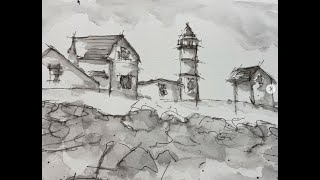
An artist sketches Nubble Lighthouse with ink, bamboo brush, and graphite on watercolor paper. They work through blocking the shape, adding rocks and shoreline, then build texture with stippling and wet ink bleeding. The piece stays simple and open-ended.
Chapters
Hello and Happy New Year to everybody. Hope you're having a great night. So I just wanted to start the new year off doing some sketching tonight. I'm just using pen and some water and I wanted to sketch the Noble Lighthouse. Lighthouses, they've always fascinated me. I thought it would be just something fun to do tonight. So I just really loosely sketched out the shape of the buildings, the overall forms. There's not a lot of detail here. I'm just going for just a feeling and having fun. So hope you're having a great night. So feel free to say hello and let me know how you're doing tonight, okay? So basically I just— I'm wetting the ink here. I'm just gonna kind of paint with it. This is a bamboo brush. Holds water really well. Just letting the ink kind of work its magic. My sketching style is very loose and playful. I don't know if you're an artist, and would you like to paint or draw or make? You'll notice I'm not coloring everything in with the ink. I'm leaving a lot of white space on here. Trying to be kind of loose with the brush in my hand. Just gonna add some lines here just to create some kind of rock formations or something in the foreground. Maybe the shorelines down here, very quick, loose lines again. Basically, I'm just kind of scribbling. And what I'll do is I'll add some water to that. We can do, uh, we can go over the water with our pen. See how the ink kind of bleeds in the water? Boom, there we go. This would be the shoreline down here. I'm just doing this on watercolor paper. So if you're watching, say hello, let me know who you are, give you a shout out. I appreciate you tuning in. As you do, my Art Stuff Live on Facebook. Just wanted to try out YouTube tonight. Trying to get a sharp point on the end of my brush here. Just because I kind of want to create some horizontal lines in here. Just kind of drag it across. They're very faint. What I might do is after this dries I could come back with my pen and just add some details on top of it. I'm darkening these areas where the windows are a little bit more. I'm gonna have a little bit of ink in here. I just want them to pop out a little bit more. Some windows up here. Do a lighthouse. There you go. So I just made those windows pop a little bit more by adding some dark ink in there. Just gonna bring my pen across here and create some roof lines. Zoom in with the camera a little bit. You can see very faint horizontal lines in here. I'm just creating a little bit of texture on the facade just to make it a little more interesting. If everything was just white or gray without lines or texture in there, it would be kind of boring. So I just want to have a little bit of— just a little bit of different surface on here. Sometimes I use a graphite stick as well. This is nice for creating areas of grey. I'll show you. So I'll either draw with graphite directly on the paper or I'll put off to the side, I'll just put a little bit of graphite on my board and pick it up. And let me just touch some areas in here. Become a little bit darker. I have too much water on the brush. Alright, so I'm just touching some random spots on here with the graphite. And adding these random spots here of darkness just helps to break this up a little bit, right? It's giving a little more character to it. I don't want to draw every single rock on here. That's not the goal. Just to, you know, just to create a sense of what's going on. A suggestion of what's maybe happening. I'm just trying to add some texture down here now, like in the foreground. So I'm just adding a little more graphite on the tip of my brush and it's called, um, stippling when you're just creating like dots. The idea with this is to be kind of very simple. I'm not using a lot of tools, not using a lot of materials, no colors on here, just letting, just letting the line work and different techniques kind of speak for themselves. Sometimes we think paintings and drawings have to be really complicated and have a lot of, a lot of stuff on them, right? But that's not always the case. Sometimes simple is better. When I do sketching and painting, I really try to keep things simple. Not all the time, but sometimes. I do abstract stuff too, and that can get real crazy, right? But something like this, I think I just want to be very soft, very clean. Kind of palette. I don't want it to be super, super busy. I definitely, definitely could go that direction, right? You can go real crazy. And I got a scrap piece of paper here. If I wanted to get nuts, I could just scribble on here, you know, add some black on there. If I wanted to throw some color on But this is a whole different— I mean, that's a whole different style. That's not what I'm trying to do tonight. Tonight's about kind of restraining. And sometimes it's harder to restrain and keep things simpler. What kind of stuff do you like to create? Do you draw? What inspires you? You know, for me creativity is everything from drawing and painting to even writing, designing things, making things. Creativity for some people is music. Cooking. It comes in so many different forms. But the secret is, or the trick is really, it's just not being afraid to express it and get it out and try it. I am not a professional. This is fun for me. That's really what it's about. It's just kind of connecting to yourself. Into other people by doing something that's positive. We definitely need a lot of positivity right now, right? Does that make sense what I'm saying? Let me know if you think it makes sense. As this dries, I might come back in and just add some more. You can come back a couple different ways. I could add more graphite on top to make areas darker and pop out. Or I can come back in with a pen, add some more details. I'll probably end up coming back in with a pen and, you know, for example, zoom in here a little bit. You know, maybe on this roof area I want to indicate some kind of roof shingles or something, so I'll just draw just some lines on there to indicate roof shingles. It's pretty simple, right? It's enough just to give, give you an idea, give the viewer an idea of what I'm thinking. I like when things are not so detailed because it allows for the viewer to kind of fill in the blanks and use their imagination. And it keeps them looking at your artwork longer, and it gives them a chance to explore and get lost in it. Sometimes we just all need some kind of escape. So just by adding some line works— line works— line work. There you go. It's, you know, pretty simple, quick scene. Didn't take too long to do. Now maybe we need to add something up here in the sky, maybe just to dirty it up a little bit. It's kind of bright. So I'll just dip my brush here in the water, get some graphite on it. Actually, what I'll do is maybe I'll just brush some water up here. I don't know if you can see it on camera, but just wetting the paper, clean water. Not everywhere, just randomly. And then I'll take some of that graphite, put it— get it on the brush, just kind of touch it. Get some more on it. There we go. And I'll just kind of bring it up here just to create some kind of a sky. I'm not trying to paint individual clouds in here. Just enough to break up the background so it's, uh, just not white. Let it dry for a sec. There we go. Call that one done for now. Thanks for watching. I hope you enjoyed this, and I'll be back with more. Have a great, great night.





