Short Sunday Sketch Session
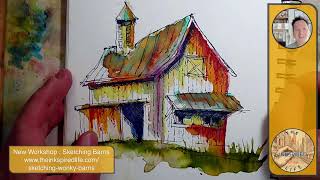
Artist Jason Nicholas sketches a wonky barn live using Sharpie, watercolor pencils, and colored pencils. He demonstrates hatch techniques, names his favorite colors like Salvage Patina and Rusty Hinge, and explains how imperfection gives drawings character. A virtual workshop on October 26th will teach others to sketch wonky barns together.
Chapters
Hey, happy, um, Sunday, October 13th, 1:04 PM here in New Jersey. Hope you guys are doing well. I'm, uh, popping on at a very random time right now, but I wanted to do some sketching and just kind of finish this barn up that I started earlier this week. So if you're watching live, that's great. Say hello in the comments, the chat. Let me know if you have any questions. If you're watching a replay, that is super cool too. Hope you're having a great, great day today. So I started this last week, or yeah, it's Sunday, so I guess it would be last week. I started this last week and, um, has had plenty of time to dry, so I can come back and I want to add some details. Um, just to give you an idea of kind of where we're headed, if you look at this barn I finished previously. You can see I've added some kind of some vertical lines here to show siding on the barn, some hatch lines for shadows. So we're gonna do that, we're gonna add some more to this one and wrap it up. Zoom in. There you go. Hope you're having an awesome day. So it is me and my Sharpie right now. I really like the colors on this. They're very kind of muted, soft here. We'll punch some of them up a little bit more. I think I'll bring some red on here as well over the orange, but we'll see, we'll see where we go. So this, as you can tell, this is not— I didn't even pre-plan what I'm going to add on here today. I'm just kind of like I do most of the time, just wing it. Just go with my gut feeling, and most importantly, just have fun. It's about having fun. I was getting kind of sleepy, did some chores today, still have more work I got to do, but I had a choice. I was getting really tired and I wanted to take a nap, but I told my brain, I'm like, hey, let's do some fun sketching. So you can see I'm adding these vertical lines just to show some vertical siding on the barn. The lines are kind of Morse code dash dots. Um, I like that broken line look. It just adds some character, and rather than just clean straight precise lines. We're going for wonky. And for me, wonky means whimsical. It means imperfect. Kind of like, kind of like me. Kind of like all of us, right? None of us are perfect. We're all a little bit wonky. So our buildings— buildings can have a lot of character. I'll give you a close-up just so you can see how I'm creating these lines here. There you go. It might be hard to tell, but I'm kind of, kind of wiggling the Sharpie as I sketch just to get I'll— let me do an exaggeration here on a scrap piece of paper. Here we go. Here we got just some scrap here. So this is kind of a close-up of what I'm doing. So to get these kind of broken lines here and kind of wiggly, I'm gonna exaggerate. This is what I'm doing. I'm literally taking the marker. And as I'm going down, I'm just— again, this is an exaggerated version, but I'm not doing this. That's a nice clean straight technical line. We're doing kind of wavy wonky lines, and that's how I'm getting those— that look here. It adds to the character, right? I want this to look kind of old. Um, I keep saying the word wonky, I know, but that's the goal. This isn't— this is not a technical architectural sketch or drawing by any means, which I love doing those, but for me this is just kind of fun outside of the box quick sketching. So there you go. Hey, I see Patty! Patty's over on the YouTube. Patty, good to see you! I hope all is well with you. I love your posts as always, and, um You are an inspiring creative. I appreciate you so much. It's great to see you over there on the tube. All right, let's add some, um, we could do shingles. I usually go for metal roofs on my barns. I like the look of standing seam metal roofs, or roofs. So let's do that. We're going to kind of follow this line. Notice my The roofline isn't straight here, comes down and flares out, and that's intentional. I wanted it to have, again, a kind of a wonkier appearance to it. I'm just going to sketch these in really quick here. Feels so weird to be out here on a Sunday afternoon, but it's fun. Sketching could happen anytime, anyplace, anywhere if you have this stuff. It's one of the things I love about this, um, it's going to call it a hobby, but for me sketching is really more than a hobby. It's almost a passion. It's some— it is probably a passion. It's something I just love, love, love doing. Let's add some hatch lines to give kind of a— some depth to this roof. There we go. So we kind of have like an overhang-looking thing there. I love this fun cupola on here. Let's do some vents on the cupola. Pisces, wonky lines are your favorite. We use broken lines in your barns in your watercolor class. Well, that's awesome, I am so glad. I use them in my sketching too. Good stuff, good, good stuff. I love when you guys share your ideas, your tips, your techniques. And that's why I'm on here, just having fun sharing what I do the way I like to do it. Everybody has their own unique styles, methods, techniques to get the kind of look that you want to get. It's all about just being playful, having fun, and throwing lines down. We need a Sketching Happens bumper sticker. Yeah, I love that. That's so funny. Yeah, my— we have the retro cup, right? Sketch Happens. That'd be so funny. We should put that on a sticker. I wish I had— I don't have one here to show you, but that would be so funny. Um, so you can kind of see, right, it's coming together a little bit at just throwing these lines on here. Zoom out so you can get an overall view. If you guys like this sketching style, you like barns, um, I have a virtual workshop, a Zoom workshop on October 26th where we'll be sketching a wonky barn or two. You know, it'll be in this style so you can get an inside peek into my creative process. And, uh, it's a really cool workshop. People can share what they're sketching on Zoom. We can all give each other feedback. They're usually very fun— well, not usually, they are, they're always fun. But, um, fun, and it's a safe, positive, creative environment where you should be able to share your artwork and not worry about judgment from other people. We, uh, we give positive feedback, and it's really— it's not even about trying to sketch my style. It's just to get you thinking a little bit differently about how maybe you're approaching your architectural sketching. So there's a link in the bottom of my screen. Feel free to click on it, or I don't think you can click on it, but visit it, and I'd love to have you in the workshop. So I think we have— that's for how many people? I think we have 5 people right now. I'd love to have more in there. I have, I have, uh, I think 20 is the maximum, so I'd love to have it filled with 20 people. And if you're not interested, maybe you can share it with someone you know. Cool, right? You can see it's coming together as I'm adding more lines to it. We are going to throw a little bit more color on here too. I want this to kind of look like it's a barn door's kind of slid open. This is kind of in the shadows back here, so we got kind of that happening. All right, let's throw some more color on here. Um, I'm going to play around these watercolor pencils. The more I use them, the more I'm actually liking them. So I have these cool watercolor pencils. Here's what the back of the tin looks like. And they're just fun to play with. They add a different texture, different layer, and I'm loving— I can tell you my, my 3 favorite colors right now are Salvage Patina, Rusty Hinge, and, uh, Fire Brick. I've always had trouble finding a red that I like, whether it's a red watercolor or color pencil. Um, my go-to red is here, the Pilot Precise Pen. I love using this for red, but this is a nice red too. So let's throw some on here, and I'm literally just going to dip. You see, I have my nice dirty water. I'm going to dip this in there, and we're just going to throw some down on here. That's just one way to use the watercolor pencils. There's so many different ways. I just, I do love dipping them into water. Same thing with, uh, if you see me using graphite sticks, I'll do the same thing. So for me, this is kind of like sketch painting, and I'm not going to get too cray cray with the red, but I think I'm just going to throw some there, and then we'll also throw some on the, um, door over here, the sliding door. And I'm going to show you, I'll zoom in on that texture that just happened, which is another reason I like to use the watercolor sticks. Let me zoom in. Color pencil, you could do the same thing, but look how it's picking up the texture of the paper here by just kind of dragging, very lightly dragging. It's kind of dry-ish, dragging it lightly, and it's picking up that texture, which is another cool way to show aging or distressing in your sketches. So you can see that, you see how it's drying there. I'm also going to break out some colored pencils. So my favorite colored color pencil in the world is light aqua. Love using that color. Um, I don't know, maybe I have two favorites. Neon pink is also a favorite. All right, they tie for first place. And sometimes lemon yellow. I have some other colors, but we'll just throw some on here. I'm just trying to get a patina to look on this roof, like aged kind of copper or metal here. So I'm throwing down some of this blue colored pencil on top. I like using colored pencils towards the end of sketches because they're resistant. So if I threw them down earlier and then I put watercolor on top or ink on top Nothing would happen in the areas where the colored pencil is. And I know that's a technique some people actually do that intentionally, but I'll come back and usually add colored pencil towards the end. So that's how you could tell, one of the ways you can tell I'm almost done with the sketch. Patty says, uh, you can count me in. Oh, awesome! Thank you so much, Patty, for signing up for the workshop. That is awesome. You are awesome. Thank you for always being part of the Inklings and helping, supporting, um, and sharing. Thank you. That's, that's so awesome. You made my day. You made my day. Thank you. You're an amazing, amazing person. Let's get some Rusted Hinge. I love these colors. If I can get a job naming colors, how cool would that be? That has always been a dream job, being the guy that names the paint colors or the colored pencil colors. How cool is that, right? Got some windows I'm going to actually just kind of hatch these in, but hatch lines are very close together. I just want to indicate there's some kind of glass panels happening. It's kind of— it's more of a scribble technique. I'm thinking this one's almost done, guys. I'm liking it. I like all the white space here, so that's going to stay that way. Um, I really like— check out how the landscape in the front dried. There, you probably see it there. I love the way this just dried. Wasn't intentional, it's just kind of the magic that happens when you throw colors down. Um, this was, I think, a mix of green, sap green watercolor, and then I used this ink called Boxcar Kiwi, and it came out really cool like that. Pisces, I'd like to learn more about how to use watercolor pencils. You're using them in your art therapy class, tend to make a mess, maybe using too much water. Yeah, that's possible. Um, so actually, you know what, maybe in the workshop we will, we'll talk about that. We'll talk about watercolor pencils. I don't know if, Patty, if you're just throwing the pencil and dipping it in water like I did, or if you're putting it down on paper first, kind of brushing it around. They can be very messy. I mean, you can see here, I actually even got some on me. Um, so if it's different— if you're dipping them in water, I wouldn't let— I wouldn't leave them in the water too long, just a quick dip. I feel like this could use some purple. I don't know why. All right, I thought I was done, but I'm not, so I'm gonna actually— I have purple watercolor pencil. We're going to dip it in. These are— these feel more like crayons to me than pencil. I know that sounds weird. They're— they are called watercolor pencils. Maybe I should read more about them, but I'm actually getting a crayon kind of vibe, almost like a, um, what are they called, the Caran d'Ache Neo— oh my gosh, I can't think of the name of them. I have some here. Sorry, I'm drawing a blank. They're somewhere in my drawer, maybe. Oh, I can't find them. I use them, I use them too. I used to use them all the time. Oh my gosh, drawing a blank, but it reminds me of those. I think Caran d'Ache might be the brand. Who the heck knows? All right, all right guys, so I kind of, I kind of like that purple. I threw purple down, it really is making it look like a deeper shadow. Let's do it along this edge also. I just dipped this in water and I'm sketch painting with it. Let's throw some in the shadow too. I think this will be fun. There again, I dipped it in water and I'm just kind of sketch painting. I'm not going to play around and move it with the watercolor brush. I'm just going to let it sit with a paintbrush. I'm not going to play around with the paintbrush. I'm going to let the colors sit. Whoa, I'm ready, I'm ready for winter break. All right, cool guys. I think this one is going to be, um, done. Let's, let's leave this here. Let me pull out the one I did the week before and put them next to each other. And you're going to notice the color palettes, a lot of the same colors are used, but the barns are going to look very different. So let's go out into zoom. Land. Move this guy here. I think I'm going to do the background on this one. I think we're going to— uh, not today, but I think I'll add a sepia background or cerulean blue background. And then here's the other one. Big difference is the orange on this was an orange ink that I threw down, so you get that really vibrant pop of orange, which I love. This is a little more kind of subtle. Um, I'm liking this too. Very, very similar color palettes but very different looks. Very cool. I should put this out for a vote. I don't know which one people would like better. If you're watching now, live or replay, let me know. Do you like A— we'll call this A on the left— and B on the right. So A, B, which one do you like better? This looks better in person than on screen. The screen's really amping up the brightness. It's bright but not as bright as the pic is showing it on screen. Cool. So these are examples of things that we will be working on in the Sketching Wonky Barns workshop on October 26th. I'm going to throw a link in the chat. Um, there's also a link on the screen. Feel free to click it, check it out. Let me know if you have any questions about it. I would love to have everybody watching in the workshop. That would be so fun. Let's see. Awesome. I think the link just posted. Cool. Um, Patty says we start up by sketching with pencils dry first and then adding touches of water with a brush so the color spread. Gotcha. That is definitely another way you could do watercolor pencils. I'm more of dipping them in water, sketch painting with them, and then also using, as you can see here, the texture, just more of a dry technique. Very cool. Hey, thank you guys for joining me on a Sunday. Um, hope you're having a great day. Hope everything is well where you are, and it's been so fun spending a few minutes with you today. I'm just taking a quick sketching break. You guys are amazing. And Patty says your workshops are so much fun. Thank you, Patty. Thank you. Um, and it has a lot to do, if not all to do, with everybody that shows up and has fun and just embraces the— their creative inner spirit. That's what the workshops are about— coming together, embracing, and sharing your creative spirits. Thank you guys so much. I appreciate you all. This has been The Inspired Life with Jason Nicholas Nicholas. That's me. That was kind of awkward. All right, take care guys. I will be back on again real soon, maybe even tonight again. Um, have a great, great rest of your day. Peace. Live creatively. Remember, if you can sketch lines, if you can scribble, you can sketch architecture. Take care, we'll see you.





