Sketch Something Saturday
Jason Nicholas, an architecture teacher and urban sketch artist, finishes a Rockefeller Center Christmas tree sketch live. He layers Sharpie outlines, watercolor, and ink, working on multiple sketches at once and using timers to stay loose. He treats mistakes as part of the story and encourages viewers to embrace errors.
Chapters
Hey, how are you doing? It's, um, Saturday, November 29th, 2025. Hope you're having a great day today. I'm Jason Nicholas Nicholas with The Inspired Life, and, um, yeah, I'm gonna sketch a little bit here on Saturday night, um, not for too long. I have a sketch I started last, uh, actually earlier this week that I want to wrap up. But, um, I hope you're having a great day. Hope you had a great Thanksgiving, and it's always fun for me to be here, um, live streaming, doing some sketching, doing talking, some positivity. Mindset, just good stuff. Um, hopefully I'm bringing it out and sharing positive vibes your way on this Saturday night and this upcoming holiday season. If you don't know who I am, my name is Jason Nicholas Nicholas. I am— I do many things. I'm a high school teacher. I teach architecture and CAD design. I love, love teaching. I'm an architect by trade. An artist. I love sketching architecture, urban sketching, you know, going to cities, New York City especially, and just sketching there. And we're gonna look at a sketch tonight, we're gonna finish a sketch tonight that was inspired by the Rockefeller Center Christmas tree. So let me know where you're watching from, I'll check the comments tonight as I'm sketching. And again, I hope you're having a great day today. Let's switch the camera to the Desktop view. Boom, there we go, we're back on desktop. I didn't know which camera to look at when I was talking to you guys because sometimes I use my laptop, sometimes use the one in front of me. Laptop is a better picture. Um, so this is a sketch that is inspired by the Rockefeller Center Christmas tree, which is lighting this week in New York City on— oh my gosh, Tuesday. Wednesday. I forget the exact day, and, uh, I can't wait to get into the city to see it with his lights on. It's going to be really cool. I might go next weekend, we'll see, but it'll, it'll be fun. So this is, uh, this is actually almost done. I, I live streamed this twice, two different kind of layers or phases or stages I did with this sketch. So what I want to add tonight is Um, I'm gonna add some snow on here, so let me break out some Sharpie creative markers. And I am just making sure that I am streaming, um, live like I should be. Awesome, it looks— looks like I'm streaming everywhere. Perfect. All right, cool. Hey Chip, great to see you watching from Charlotte. Good evening, great to see you. Hope all's well. Please let me know if I am lagging a little bit. I have been having some internet issues. So here's how I want to add some snow to this. I'm going to zoom in and I'm going to break out a white Sharpie creative marker. I don't know how well it's going to show, but let's, let's go for it. Part of the reasons I love, or one of the reasons I love sketching and creating, is, um Just being playful, trying different things. Some things will work, some won't work, but you don't learn unless you try, right? So here's a white Sharpie creative marker. I'm going to do a few layers on here. Also, if you're watching live, please let me know not only if I'm lagging a little bit, also if my music is too loud. My voice is being drowned out. I always appreciate the feedback. So I'm just going to go kind of plunk down some snow here. You can kind of see it popping up. I probably could have added another layer of either grayish blue or brown on the buildings in the background to make this top a little more. That's okay. Not aiming for perfection, just aiming for creation. Um, for me, anytime I can get something out of my head and onto paper, um, is successful. It's just right. It's just changing states from in here to on here. And that's, that's just one of my kind of personal intentions as I'm creating things. I like the way the tree came out on this. Chip, it's always great to see you. You're awesome. Thank you. I think you can get the idea of some snowfall happening. I hope you can. And this one might be done. We'll start another sketch. Uh, one of the things I really like about this is I, I kind of like the really abstract people in the foreground here. Um, I just want to outline the tree a little bit darker, I think. But I do like the abstract people happening. Um, it's kind of a frame here. The tree, and then I want the buildings to be in the background. So almost like layer 1 is its closest middle layer, and the furthest layer would be the trees. And I don't think I'm going to do— I don't think that's good enough for the, uh, although this is quite therapeutic, I will be honest, just letting the marker kind of hit the page. Hey, we can put some on the people, why not?
Cool.
All right, I think this one's done. I, I'm liking it. Where's the cap? You got it right here. All right, so this one is done. And then here's the one I did last year, actually, that I used as a model for this year's Sketch. So this is based on a picture I took last year when I was there in person. I sketched it, and then here's a kind of the one I did today on the right. Not today, this week. I like them, they come out really cool. All right, let's sketch something else. I don't know what I'm going to sketch, I didn't plan anything. Uh, that's what makes this fun. We're gonna sketch.
What are we gonna sketch?
Um, pro tip: make sure you put the cap on your Sharpies because they like to dry out pretty quickly. All right, let's sketch. Um, I'm just gonna let my pen marker move around and see what happens. It might just be abstract, who knows. If you hear me squeaking in the background, That is my pup playing with her new squeaky ball. Gotta love it. All right, so maybe we have some kind of a perspective going on. We'll throw some colors on and see where it takes us. You know, maybe we'll, uh, thinking of putting maybe a Christmas tree over here somewhere. I think we could do that. Maybe over here on the left. You got some kind of holiday tree happening on that side. And we'll see how this transforms as we add some— throw some color down on it. I'm just gonna break out some watercolor. I like this. I like to prop my pad up at an angle here. So tonight I'm using A— here's the paper I'm sketching on. Watercoloring. Boom. This is my go-to watercolor paper. I love it. It's perfect for what I need it for. And we'll just prop this up, I guess, with this. And I just spilled some water. There we go. All right, let's throw some water on here, throw some colors. Honestly, don't know what colors. Let's see, I'm just, I'm just grabbing and going. Grab and go creativity, that's what I love. Just use what I have here, don't think too much, just kind of grab, go, throw down colors, see what happens. Oh yeah, I spilled water in my watercolor palette. It's in the turquoise.
Oh well.
All right, let's see. Let's grab some orange, I guess. So anytime I'm adding watercolor or ink or colored pencil, uh, to these sketches— I call them sketch paintings lots of times— it's really loose, sketchy. I'm thinking layers, throwing different layers down. So if you look at the Rockefeller Center tree here, this was done in layers. I always— I'm gonna say always, but most time I'll throw down the Sharpie outline first, then I'll come back, add some watercolor, then I may add some ink on there. I may add some more watercolor. And I would come back and maybe add some Sharpie Creative Markers and then color pencil. So there's different layers and it builds up. So, you know, I sat down like 3 different times to work on this one sketch painting. Same thing here, this, this will not be done tonight. This is just kind of layer 1, just getting stuff down on paper, let it dry, see where it goes. And lots of times how it dries will kind of inform the next step. Sometimes we'll have, um, hard edges will dry. Well, actually, you can see one starting here. This will be a hard edge, so I might use that somehow to inform me of where I want to add a color or shapes I want to pull out. Colors are starting to mix down here, which is fun as well. So throw down your layers, throw on your colors, let them do their dance, let Let them tell their story and then come back, revisit, add more if you want, don't add any if you don't want, anything if you don't want to. Don't feel like you need to get everything done in one quick session. On the other hand, a good challenge is if you want to set a timer and see what you can get done. Sometimes setting a timer can forced me to be really loose because I got— I know I just got to throw something down in like 3 minutes. So that's a good exercise. That's a good way to work on your looseness is just work with a timer, you know, 3 or 5 minute, um, increments. Cool. What I want to do back there, what do I want to do? I'm going to mix up— let's see, I'm I'm not gonna dig out any ink right now. I'm just gonna stick with the watercolor. Let's make a— let's make— maybe it's made of purple. I will, I'll definitely come back and add some windows and doors on these buildings, pull out some more shapes on the buildings. Um, we're just setting kind of a base or a background right now that I'll build on. I kind of like the way this is drying here. Um, I love the puddling effect. That's why I like to work at an angle, let the water do its thing, kind of let colors run down the page. They puddle up. I'm gonna let it stay like that. I love the way things muddle up. Just, just an aesthetic I kind of like. Um, Chip says, do you use a portable dryer to speed things up? If so, make and model, or would you— oh, what make and model would I recommend? Um, so I actually, I don't, I don't use a portable like hair dryer, so that's a really good question. Very, very rarely would I— do I do that. So it's a really good question. I think one of the reasons I don't do it is, uh, knowing me, I would hit the button, put the power on high, and my paint would just go everywhere. Um, so yeah, good question. I just kind of— I have to be patient. Or sometimes what I'll do is, if I'm not patient enough, I'll actually just start another sketch. While I'm waiting for something to dry. Looking at the wrong camera. Boom. I'll start another sketch while I'm waiting for the other one to dry. So yeah, it's a really good question. Oh, I actually want to— I'm just blotting out some of the water that spilled in my palette here. There we go. Good question, good question. I always love when you guys ask questions. It makes me think about what I'm actually doing. I'm feeling this is at a point where maybe I think I'm gonna let it dry, uh, put it aside, let it dry, and I'll come back and then I'll start, you know, add another layer. I'm just gonna mix some of these colors here. I kind of like what's happening here. This is really interesting. This would be cool to see how it dries. Chip, one thing I will do sometimes though is I will blot if I feel like an area has too much water, it's too wet. I might, I might blot it dry a little bit, kind of like that. I just want to throw some more green on this tree.
I look back over and I should throw some brown in there, I think. The same old man in the corner looking, and I feel, I feel him staring right back at me, and I'm sipping on my latte tonight. I just think to myself, why am I here? What is it that I do? What is it that I do? Why don't I have heart for more? I just got a phone So I'm imagining looking down a—
maybe an alleyway or very narrow, narrow street. Maybe we'll make it have a European vibe as we develop it. Uh, so we've kind of a forced perspective going back this way, and maybe there's an archway that goes to a— maybe there's a garden, maybe there's like a hidden or secret garden back in here, or maybe it leads to a public park, right? We don't know. But I— what I like about this kind of setup, this kind of layout, is my brain right now is I'm trying to come up with, um, a story in my imagination of what, what is happening here, you know? Where, where are we? And what, what is going on in this scene? So yeah, I could definitely— in my brain I can see this as a, um, maybe an alleyway in maybe a hilltop town in Italy somewhere. Maybe I'll do a cypress tree somewhere, I'm not sure. But, but I'll add some, maybe some stone textures, maybe some cobblestone here on the street. So yeah, this will be fun to see how it develops, but that's what's in my brain now. It could definitely change the next time I work on it, for sure. I'll zoom in so you can see how this is drying. If there's any other questions, and then we'll wrap up in a few. Let me zoom in. If you're watching live, don't be afraid to say hello in the chat. Um, if you're watching on Facebook, Instagram, or TikTok, or YouTube, be sure to hit that like button or subscribe or whatever you need to be doing. I feel like I'm lagging. My computer's lagging, so we're going to change cameras. Give me a sec here. I'm switching cameras. Yo, I hope this camera is not lagging. The lighting on this camera is horrible. I am really not that pale. Um, I think the other camera was lagging, so sorry about that. I don't know what's up with it, but I'm back. We're gonna stick with this camera. And maybe that one's lagging too. If so, I apologize, guys. I don't know what's up with my internet, kind of has been stinky lately. Um, for beginners, do you recommend working on several different sketches at the same time? What would be the positive or negative effects either way? One progress as opposed to many? Um, great question. For beginners I, I honestly, I honestly do recommend— I would recommend working on several sketches at the same time. Um, I'm trying to step out of my own head, but let me talk about why for me it's good, and then we'll go back to the beginners. I think I have so much going on up here in mi cabeza. Mi cabeza. I have so many things going up in there all the time. So for me, a couple things. If I'm working on, say, maybe only two— I wouldn't do more than two— if I'm working on like two sketches at the same time, it's good because I can let my creative brain jump from one to the other. So while I'm waiting for this to dry, my brain right now wants to keep creating. So I would have another sketch out so I could work on it. A couple things that does for me: one, it's really great to get stuff out of my head onto paper. Um, it's also a way for me to keep the creative flow going. So when I'm in the flow, it's easy for me to keep— to create more things, which is interesting. As you can see, actually, I'm just looking at this as it dries. It's drying really nicely here. But maybe, maybe if you're working— if you're a beginner, maybe you're working on— you're focusing on one, but maybe you just have a scratch or scrap piece of paper next to you. A couple things you can treat— one is scrap paper, scratch paper. You can just test out ideas on it. You know, if I'm— maybe I want to, you know, test out ideas. Maybe I want to add like green here and I'm not sure, and I could just take the green, put it on my scrap paper, get comfortable with it on the scrap paper, come back. And lots of times that scrap paper will become another artwork without you knowing it, just by testing things on it. So that's kind of a, a cool bonus. Um, Yeah, I, I don't know. I just think having another sketch nearby allows you to try different things while you're in that moment. Sometimes it's hard for us to, to get back, get back and get back into the flow if you're interrupted or stop. Um, I don't know, think about maybe you're working on a— you're interrupted, you're working on something. How how long does it take you to get back into that thing you are working on, right? This way, if I have a couple things here, I am not interrupted. I can just keep going. Chip, I know that was not the best answer, but I will— I'm gonna ponder that. I just— I think it's a good way to keep— just keep loose, keep things moving, try different things out without worrying. So maybe that for a beginner, that second piece of paper is not a full-out sketch. It's more of a let's test things out kind of sketch as you're going. Yeah, this is drying really nicely, guys. I love the way this is drying. So cool. I'm gonna try to draw some cobblestone here. Let's see if I can get some of that sketched. Uh, do I need a Sharpie? This one may have to be replaced. Let's see. Of course, Sharpie will not work in the wet area. I'm trying to make the stones a little bigger towards down the bottom. As they go away, I want them to be a little smaller to create the idea of perspective happening. So the Sharpie does not like the wet areas. The Sharpie marker— you can use a Sharpie gel pen. Let's try this one. It's gonna probably be darker than I want it to be. Yeah, so I don't want to do that. I'll wait for it to dry. You can kind of see the cobblestone shapes happening, right? So let's throw in some I don't know, some cobblestone colors. I don't know, I'm gonna make— I'm gonna mix up some— we'll start with some gray, like a bluish brownish earthy kind of tone here. Got some brown. I'll show you what I'm doing. I'm just mixing up brown and blue in my watercolor palette. Boom. So I got some blue digging in. I'm a messy watercolor painter, guys. Look at my palette. Like, I'm dipping— I didn't even clean the blue off, I just went right into the brown with it. So it's just how I— it's how I roll. Um, I've had people in the past say things online about that. That. I was actually in a watercolor thing a few years ago on Facebook, like a group, and people were— let's just say it was not my group for me. People were in an outrage that I used a— I think it was a white creative marker to add some white space, or a gel pen to add white onto my watercolor. And, um, people were not nice about it in the comments, so I, I stopped showing up. And that's okay, they have their own style and they had certain maybe rules I didn't read about that, so I respect it.
Best dang cobra ever.
So I'm losing some of the definition of the stones, and that's okay. When I come back later with my Sharpie, I'll be able to pull out those shapes again.
Time's 8:04.
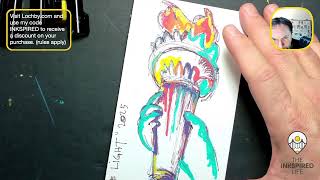
I'm gonna wrap up in a few. Yeah, Chip, I like your comment. I agree. Yeah, it's kind of like the second— yeah, if you have two, you could definitely take the pressure off. I'm worrying about making mistakes. That's why I've used one of them as like a scrap paper just to try things out. I think that kind of works. Um, it's taken me a really, really long time to, uh, not worry about making mistakes. You know, it sounds easy, especially if I'm just creating for me, myself, which is 90— I'm gonna say 99% of the time. I'm not worried about making a mistake. I've practiced and practiced and trained my mind and my my mindset to just go with it. Whatever I'm throwing down, just, just go with it, you know. Do I make mistakes? Um, yeah, maybe something didn't work out the way I wanted it to, but it doesn't paralyze me, doesn't stop me. I just keep rolling with the flow. And for me, it's just part of the narrative of creating a sketch or a painting. You know, if you look at my lines here, I mean, what, you know, what is this blip happening? What are those blips? What did I do there? I got a— um, that's okay. It tells the story of me being kind of frantic in the moment, scribbling things down, sketching it, getting out of my head. You know, there's a certain vibe, a certain energy with the lines. I want the energy to tell a story about how this was created. So I'm not trying— I don't try to cover it up. I'm going to leave that stuff. Sometimes it's a happy, um, mistake in quotes, and you can use it to your advantage. Yeah, so, um, I know it sounds cliché, but I don't— I really don't believe that there are mistakes. When I'm, when I'm doing this kind of stuff. Now if I'm doing a set of architectural blueprints, that's different. There I gotta be precise and right on. So yeah, it's a different, different type of creative problem solving. Cool. I actually, I actually really like the colors happening here. This is going to be fun to come back with my Sharpie and pull out some shapes on it, add some texture. We'll throw some windows. I'm imagining it's made a building here on the side, another building. I feel like this is leading down a pathway into some kind of garden area back here, so maybe we'll have some kind of focal point, a fountain maybe happening back in there. We'll pull out the building edges darker so we get more depth. Um, so back to layers. This is just round one, layer one on this painting. So I'm going to leave it here on that and let it dry. And I want to show you one thing, a show and tell, and then we'll wrap up. So let's move this to the side, we'll let it dry. All right, here's a quick show and tell. So what do I do when I'm sitting at the doctor's office in the waiting room, or if I'm on the bus to New York City? I, I am work— continuing to work on, um, Lady Liberty sketches. Actually, I could work on this because I didn't add some colors. Maybe I'll work on this for a minute. So here's one I started the other night. The other night— the other day at the doctor's office, got a couple of torches here. Um, maybe I'll throw down some color on this. I wanted to break out some Creative Marker just to pop some colors on here a little bit brighter, so I got some here.
Scream in the silence, but it's only me. Nobody hears me, nobody hears me.
I am going to turn the music up a little bit so I won't be talking for couple minutes here. I don't know, that's scary.
Art is of courage, lets the world spin. The barista just blinks, doesn't know what to He stands tall, shakes the dust of the judgment away. The hammer's in his heart, the hammer's in his mind. Smashes the doubt, leaves the rules behind. His bow voices her sound. All is of courage, let the world spin. While it's a ghost, it's never fair. Turn to leave, but I see a face. I say stay, it's not a race. No cash, just coffee. No brag, just me. A kindness bought me. What I couldn't feed. World's too sharp, it's getting old. Life feels heavy, can't grab hold. Then a voice cuts through the hum, says don't worry, man, you're not dumb. Now Cash, just call me. Now Strange is Grace. Stranger saw me and filled my space.
All right, I think this one is, uh, good for now. Good to go. Awesome. So we're gonna put that one aside and we'll see how this is drying. That's it, I think, for tonight. Boom. So you can see how that's drying. And, um, it'll be fun to see how this, how this changes when we start adding different layers to it. Thank you guys for watching. I'm Jason Nicholas Nicholas with The Inkspired Life. Until we meet again, sketch boldly, live creatively, and inspire endlessly. Have a great rest of your day.





