Sketch Something Saturday
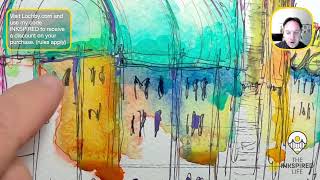
Artist Jason Nicholas sketches the Domino Sugar Factory in Brooklyn using Sharpie, watercolor, and markers on cold-press paper. He starts at the roof with fast gestural lines, layers media repeatedly, and picks colors by emotion rather than accuracy. He emphasizes wonky imperfect marks and leaving white space to breathe.
Chapters
Hey, it's Saturday, November 28th, 2025. I'm Jason Nicholas Nicholas with the Inkspired Life, where I love sketching, sketching architecture, just sketching, um, anything really, and just capturing the world around me one line at a time. Hope you're having a great, great day today. I'm gonna be on for a few, and yeah, let's do— we're gonna do a sketch tonight, and I haven't sketched this building in a while, and I'll show it to you in a sec. Let me just click this clickety-click and, um I'm just making sure I'm streaming on all the channels I need to stream on. Let me know where you're watching from, let me know if you have any questions or comments. And yeah, I think it'll be fun sketching tonight. So I have not sketched the, um, the Domino Sugar Factory in a long time, uh, one of my favorite buildings in NYC. Um, I just— it's in Brooklyn. I love this building so much. Here's a really kind of loose sketch I did of it. It has an iconic dome glass roof on it. So it was an old sugar refinery that's been converted into— I believe it's, um, all office spaces. So I thought it'd be fun, let's do maybe a sketch of this tonight and see where it goes, and maybe we'll throw some color down and just have fun. As you know, I love sketching. It's just a great way for me to unwind from the day. Um, yeah, so let's do it. So just let you know, here's what I'm sketching with tonight. I am sketching with a Sharpie. I am using 140-pound watercolor paper. Fabriano. It's cold press, so it has a little bit of texture. I like the texture on here, and I'm planning on adding some color, some watercolor, maybe even some ink at some point in time. So that's why I picked this kind of paper to start with tonight. And I would also have with me here, I have my bamboo brush, which I pretty much use— I'm going to say 99.9% of the time for all the watercolor and ink washes you see me doing. And then I have my trusty Winsor Newton Cotman watercolor palette. Got a couple of them here. This is, this is actually the first watercolor palette that I've ever used, like, traveling around with. You can see it's been well loved over the years. Not all Winsor Newton colors, there are some Um, gosh, it was Cheap Joe's. I'm sorry, I forget the name now, but Cheap Joe's paints, uh, in there. I think it's American Journey paints. So yeah, let's do it. I have my backup Sharpies, of course, because you never know when you're gonna need another one. So I have a few in here ready to go. Alright, let's do this. So when I sketch architecture, I'm gonna kind of walk through my process a little bit. I'm gonna talk more process than I think I usually do. I'm in the process of— I really want to put a beginner's course together for loose style architectural sketching. So I'm gonna be shoot— shooting out some of those ideas as I sketch tonight. And I'll see where it takes us. So, um, my style is very, very loose, as you can see here, and I accomplished that in a few ways. One is I'm just holding the pen loose, or the marker loose. Another is, uh, speed. Fast. So when I sketch really fast, it keeps me looser in my style because I'm not sitting there planning where every single line is going, where every window is going. If you look at this, the windows on here are just— they're gestures. I didn't even take the time to draw like rectangles. Um, and it's just my personal preference. So it's almost like, um, I was gonna say speed dating, speed sketching. Maybe it's like speed dating. I guess you're throwing out lines as quick as you can in a short amount of time. So we'll call it speed— speed dating sketching. Speed sketching. Yeah, we'll leave it at that. All right, let me know where you guys are watching from. Here we go. So I like to start usually at the top of the building. Why? Because for me, I find the roofs of buildings to be pretty— fairly easy place for me to start, start especially where they meet the skyline because kind of defines a shape. You can see the Sharpie has had better days, like my hair. Oh, now we're talking, much better. So I like to start with the top of the buildings usually, and I'm not going to say it's all the time, but I would probably 95% of the time. This is like a cool chimney we got going. Um, another Another pro tip for me to keep things kind of loose is I'm not worried about generating perfectly straight, beautiful, um, crystal clear lines or perspectives. I think sometimes we get hung up on wanting to be very technical when we're creating like a perspective of a building. And when you allow yourself to be loose and kind of wonky, there is no perfection. And that's the secret sauce. Think about it. If we're not sketching anything, we're not trying to be perfect, why waste time trying to generate precise lines, right? Be wonky with it. It gives you that kind of initial freedom. So I have some shapes going down kind of for the roof area. Building comes down here, does something like this. The chimney comes down. Another way my sketches keep loose or looking loose is I'll go over lines many, many times. As you can see, I'm adding lines on top of lines. I'm thinking of it as scribbling, right? Basically, it's just kind of scribbling here. Other times I'm slower and more precise and neater. 100%, 100%. It depends what I'm trying to do, what I'm trying to capture, where I am. If I'm out urban sketching, I usually sketch very, very fast out in public. So like, when I go— when I meet with the urban sketchers and when I see urban sketchers, I usually will sketch a bunch of scenes. I— just my nature. I don't have the patience to sit in one spot for a long time because I want it— I'm just curious. I want to explore what's around me. And we all have different preferences, right? Nothing wrong, nothing right about it. Just embrace who you are. Let your sketching conform to who you are. Don't— you should not conform to your sketch. Your sketch should conform to you because you're expressing who you are, right? I'm letting my thoughts, my feelings, my attitudes my environment shape what I want to catch, how I want to capture things. Hopefully that makes sense. All right, so we have the roof, boom, some of the building, got a chimney kind of coming down there. Maybe we have some arches. And this is a very fast, loose, wonky sketch, which is what I want to do. And I really just want to— I'm gonna throw some color on here. All right, um. So I start with Sharpie. Why do I start with Sharpie? Because a couple things. One, starting with a Sharpie puts it into my brain that once a line is down, it's staying. I'm not worried about having to go back, erase anything, because I know it's going to be permanent on here. I— for me, every line, every scribble helps to tell a story of how a sketch was created. So that's one of the reasons I love starting with a Sharpie. Second thing is, um, it allows me to go back and add watercolor or ink without worrying about the black Sharpie ink bleeding with water. There are times I want ink to bleed, black ink to bleed, but most of the time I will start with a Sharpie because allows me the opportunity to go back and add water washes without all this black kind of getting all mucky. Does that make sense? All right, so that's why I like to start with a Sharpie. Perfect. So I just kind of raise this at an angle. So I put— I propped this up at an angle, and it kind of helps with the style. I like when I add water and watercolor or ink, I like how You'll see, you'll see the colors kind of pool and drip down, and it's just an aesthetic I like. So gravity, gravity is definitely a friend when we're creating artwork. Use gravity as a tool. I'm just making a little room here. I'm gonna throw— I'm gonna just throw down some colors. Um, color selection. I get a— I get this question a lot. How do I pick the colors I want to use? And 9 times out of 10, I am not trying to replicate the color of the actual building if it's a real building like this one here. Um, I'm just picking colors I like to use that I have fun with, that bring me joy, make me happy, or Um, sometimes I'll go with my gut or feeling or emotion and kind of sketch— I mean, choose colors because of those reasons. And sometimes I don't have a lot of different colors with me. Most of the times I don't, actually, so I'm limited, limited with the color. Is this building yellow? Nope, it is not yellow at all. But in my world tonight, yeah, it's yellow. So I'm dipping into some yellow watercolor here. You can see as I tap the color down, you can see it's kind of running down the page a little bit. Um, as I'm adding color, I'm not trying to cover every single part of this sketch with color. I'm going to leave a lot of white space. White space is a great way, I think, to get people engaged in your sketching, and because it allows them to kind of fill in the blanks with colors that are missing and even lines that are missing. Um, if you notice, my building is kind of blank here, right? I should have ghosted it a little bit more, but I want the viewer— I want you guys to kind of use your imagination to fill in what's missing. Um, let's see, another thing that's coming to my brain is the idea of layers. So layers can mean a couple different things. Layers as far as sketching architecture, usually you start with big shapes. Um, so I'll do the outline of a building, usually like the roof area, some of the walls, capture the overall shape of it. That'd be the first layer. Another next layer, I would come in and probably add some windows and doors. After that, I would add some texture to the building, whether it's brick or steel or wood. So that would be kind of another like third layer. It's like layering kind of details. And when I say details, don't think precise precision. Just think of details as adding more information. A simple line like this, that's just— that's adding information, right? It's— it's— I call it a detail. It's adding some info. It's not— sometimes we say the word detail, we think precision. That's not what I mean. Another thing, as far as layers go, for the overall— I call it sketching or sketch painting sometimes— is grab some— here, this color is Sharpie first, then I'll come back in with some watercolor or ink, depends what I want to use that day, or lots of times I'll use both. So watercolor. After the watercolor dries, I might probably come back in with my Sharpie again, pull out some of the details, or, you know, some of the shapes more, add some hatch lines. Hatch lines are great for kind of adding like shadowing. After the hatch lines, I'll maybe— I might come in and add some more color again, or watercolor or ink, and then a color pencil. So lots of times I do all these mixed media sketches, and I like to add the color pencil, usually the last. And also, I forgot, another medium is Sharpie Creative Markers. I like to add them on as well. Just throwing some blue on there. I like the way— I like the colors on here so far. You can see how things are running down the page. I love that look. The domino letters are actually— I know they're yellow for real, so I'm going to add some yellow and I'll pull out the letters again with a Sharpie after it dries. Zoom in a little closer. There we go, might be better. I'm just letting this dry for a second here, and, um, Um, mix, switching up tunes. Cool. Yeah, I like the way this is drying. I love, I love the colors happening here. There's an aesthetic I also really enjoy, um, with this kind of style for me, and that is having these hard edges. So you see the way this is kind of drying here, it's called a hard edge. I like that look. Some people don't like— don't like it, but it's an aesthetic that I like to try to keep. In my sketches. I am trying to figure out something here. I'm sorry, I'm switching on to the— I'm just looking at Facebook online for a sec. There's a tech— I think I have a tech issue going on. Darn those tech issues. Maybe my internet being a little crazy. Yeah, I like the way this is drying. All right, so we're gonna pull out— I like throwing some red on here. So my favorite way to add red to my sketches is with a red pen. I love using the Pilot Precise red pen. It's just my favorite color, red color that I'm comfortable using. I like it more so than using red watercolor. I also do like using the red Sharpie creative marker. But here's what I'm going to do, we're going to Here's what I'm going to do. I like to sometimes outline my sketches with like a one color, like usually a red. Think of it as adding like a red bow around a package. So this is kind of my little red bow that's, that's going to tie this together. And I'm going to bleed some of that red ink. We'll add some more on top of it. There's just something I started doing I was looking for a way, I think, to outline kind of the buildings, outline my buildings. I thought this was just a cool, real fun, loose kind of technique just to pull it out a little bit from the background. Getting really cool orangey color happening here. So it's still too wet to come back with my Sharpie, um, my Sharpie marker. I could come back with a Sharpie gel pen. These are pretty cool. You can use them over damp and wet areas. Unlike a marker, Sharpie markers will not really work on the damp and wet areas. Here, I'll show you. Let's just Let me see if I can pull out some, uh, kind of hatch in some of these windows or darken them a little bit. So the paper is— it's damp, but it can handle the Sharpie gel pen. So I love New York City. It's one of my favorite, favorite places to go. And the Rockefeller Center Christmas tree was delivered, I think, yesterday. So it's there. I think it's, it's probably standing right now, and decoration is maybe starting on it. Um, how cool is that? There's nothing more iconic than Christmas in New York City with the Rockefeller Center Christmas tree. It is, it is special. If you see in person, it is really, really special. Um, it could also be really, really crowded, but you know what, don't let that take away from your joy. It's part of the holiday season. But yeah, I love, I love seeing the Christmas tree. Uh, I might— I was thinking of going tomorrow, but probably not. But I think in the next couple weeks I'll make a trip in before it gets too crowded for the holidays. And I'll probably go once during the— oh, let's see, I don't know if I'll have time during the holidays this year. Like, I'm gonna be off from school because I'll be away. For some, for some of that time. All right, cool. So now I'm just kind of adding some darker oranges on here, just thickening, thickening up the paint on the brush. Um, you might notice lots of times I'm not even really painting, like I'm not using a brush stroke, I'm just dabbing. I'll show you, let me grab some paint here. I just like to dab the color down, literally just dab. Not like the— not the dance, not the dab dance. I'm just dabbing the color on the paper. I like the way it's looking. Let me know if any questions or comments. I hope everybody's doing well out there today. It is so quiet on the chat. That, that's okay. All right, let's pull out some Creative Markers. We'll let the watercolor dry. Creative Markers don't really like wet areas either, but do I want it? All right, maybe we'll try. Um, let's see, let's go with my favorite color. In my video course, I will talk about how to, um, how different lines can tell different types of stories. There's different line styles I like to use when I'm sketching. So we'll kind of— we'll talk about that a little bit. This is a course that's been in my brain for, um, way too long. I should have had it— I should have done a long time ago, but it's never too late, right? I'm going to throw some purple down here where these kind of archways are. I can't believe it's November, guys. Holy cow, time is going so quick. I did a hike in Mike, uh, If you guys don't know what Hiking Mike is, I like to, when I'm walking or hiking, I like to just record myself, videos and random thoughts. So I recorded one about time today. I didn't publish it yet. And I also did one just about trying to figure out why do I like to go outside and walk? Like, what is one of the big draws for me? I feel when I don't do it, I feel weird. Like something's missing. So, uh, feel free to check that out. I posted it on— you'll see it on Facebook, Instagram, uh, and my TikTok channel as well. It's like a 5-minute, 4-minute video, just me kind of rambling about why, why do I like to walk so much. Cool. So I'm just throwing down some purple. I really like the Creative Markers. Um, these have been a really amazing discovery over the past year. Or year, maybe even a little bit longer, year and a half, that they've been a game changer in my sketching. This is cool. Let me know if you guys have any questions or comments. I'm gonna leave myself a comment. Hey, yes. Looks cool. All right, um, so notice a lot of white space on the bottom. The color is not going all the way down, right? It's stopping. Love it. This is perfect. I don't mean perfect as an amazing piece of, uh, sketching here. I mean perfect for my style. I love— I just love this edge here and how there's nothing happening. It's unfinished, and that's awesome. Don't feel like you always need to cover every square millimeter or inch of your sketches with stuff. Leave breathing room. Leave breathing room. I said it was a purple Creative Marker. By the way, this is, this is a win here. Let me show you. I know I talk about Lockbee all the time. It's because I'm an ambassador, and I'm only an ambassador because I love, love their stuff and legit use it. Um, this Venture pouch is a game— another game changer. Look at the creative markers I have in here. I've— I put this thing in my backpack whenever I go urban sketching. Um, you can see it's got some nice wear and tear on it. I like the way it's aging. But this— look at all the markers I could fit in here. This is pretty dang cool. And the other fun thing is if you flip it over, it's got like pockets and pouches here also. So yeah, this is a lot called the Lockbee Venture pouch. If you guys are interested in Lockbee or any of their stuff, um, there's a discount code on the upper left of my screen and you can get 10% off. Yeah, I love, love their stuff, so check them out. They are not a sponsor of the show. Be cool if they were, but, uh, I'm an ambassador, so if you do purchase stuff with my discount code, I get a very, very small, like, token of gratitude. But I just talk about it because I love their stuff. All right, cool. What else do I want to use on this? I'm going to let it dry. I think we'll do a couple more things and we'll wrap up. I'm just looking in front of me. You know what I haven't used in a while? Oh, I have not used this pen in a long time. I bought this when I was in Brooklyn a long time ago. Um, maybe not a long time ago, it was earlier this year. But yeah, let's use this pink. It's called a Feud, but it's O-H-T-O, Oto Feud Ball Bio. It's just in front of me, so I forgot to pull it out. Throw some of that pink on there. I want to be careful with the pink because I don't want it to get too, uh, put it everywhere. It'll get— it'll stand out way too much. So I'm just going to accent a couple places with it. That's actually enough for all I just want to add on there. But yeah, this is a fun color. I forgot I had that pen. I have a cup over here with a bunch of pens that I haven't used in a while. I love using ballpoint pens, gel pens. I am not too fussy. I'm going to kind of curve this a little bit more. There we go. Kind of liking this. This might be good for now other than just adding some hatch lines. Let me see if I can come back with my Sharpie and do that, and we'll get this done in one, done in one show here. Done in one. This is— no, where's the Sharpie that works? Actually, you know what, guys? We're gonna, we're gonna go with our gel pen to create some, um, some hatch lines, some shadow lines on this. Uh, not with this Paper Mate. Uh, this Paper Mate Profile, this pen and I don't really get along too well. So we'll move that to the side. This is the one I wanted. We don't get along too well. We, um, it likes to smudge on, on me a lot. This gel pen is a really nice black color. The reason I like to do hatch lines Instead of coloring things like solid black, um, hatching— the hatch lines have some spaces in between them so the colors underneath can show through. So it's just a, just a visually interesting thing. Yeah, this is looking good. Awesome. All right, I'm just checking the socials to make sure everything is still working and live. Awesome, so far so good. All right, we have two more songs. I'm going to wrap up. All right, let me zoom in. I think this one's done, guys. Let me zoom in and we'll, um, kind of see some of the details of it. How close can I get? Going to max, maximum zoom level. All right, just kind of pan it around. You can just see how this is kind of drying. I love I just love what's happening here, the way it's drying, the way the, uh, color is getting kind of pulled down into the fiber of the paper. Looks really awesome. I love the color combos happening here with the oranges and yellows, especially next to the blues. It looks pretty cool. Cool. All right, I was just looking to detect, make sure it's all working. All right guys, um, thank you so much for watching, and let me know if you have any questions or comments or thoughts. As you can see, it's— I don't know, this is so much fun for me. And I think sometimes we think we have to be perfect, have perfect lines when we're sketching architecture, and it's not true. You can be loose, you can be wonky, you can be quick, you can have fun with it. And you just have to start. You just gotta try, right? Hopefully you got some tips from me today. Be on the lookout for more. Videos and stuff coming up. If you're watching on YouTube, I would love for you to subscribe and follow me, well, on any of the socials out there. Um, let's do this thing and let's keep it going. All right, until we meet again, sketch boldly, live creatively, and inspire endlessly.





