Sketchbook Tour + Water Tower Sketch
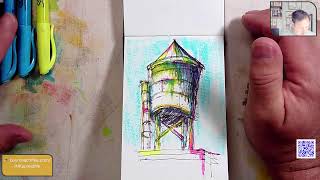
In this live YouTube session, architect and educator Jason Nicholas (Inkspired Life) gives viewers a tour of his pocket‑size Moleskine sketchbooks filled with New York City architectural studies, explains why small, portable sketchbooks are valuable, and demonstrates his on‑the‑fly sketching process. He showcases quick sketches of iconic NYC landmarks (Plaza Hotel, Statue of Liberty, Rockefeller Center, Domino Sugar Factory, Copper Building, Guggenheim interior, etc.), describing his use of Sharpie markers, colored pencils, contour lines, and shading to capture form, atmosphere, and memory. He emphasizes sketching as a way to embed a place in the mind, contrasting it with photography. The stream then shifts to a live demonstration of sketching a water tower, where he walks through contour‑line construction, shading for curvature, selective coloring (neon pink, chartreuse, sunburst yellow), and tool choices (Sharpie roller pen, highlighter, Prismacolor pencils). Throughout, he interacts with live chat, explains his artistic decisions, and promotes a free PDF checklist based on his SKETCH framework, inviting viewers to subscribe to his weekly “Inkspirational” emails. The session blends informal conversation, instructional content, and community engagement, highlighting his philosophy that the sketching journey—not the finished product—is the core value.
Chapters
Hello, hope you're doing awesome today. I'm, uh, here live on camera, and I just wanted to pop on for a few minutes tonight. And I'm actually cleaning out my studio. It is trashed right now. And as I was cleaning it out, um, I came across a couple of sketchbooks. I have so many in here. But I was looking through these and I realized, um, something. These are sketchbooks I've taken to me— or to me— taken with me to different locations I've been to. I think both of these are New York City sketchbooks, if I remember. And I thought it'd be fun just to take a quick look through some of these, and maybe we'll do a, a quick sketch. And I feel like sometimes we feel like we need to sketch big on big sheets of paper, and that is not always true. What I love about these sketchbooks, the size— or the size is great. These literally fit in my pocket, so easy to carry around. So they're both by Moleskine, or Moleskine, however you want to say it. We'll say Moleskine. One is a hardcover and one is soft. So let's take a quick look through some of these, and I'll point out maybe some of the locations and maybe some of the techniques that I use or what I'm thinking about as I'm sketching architecture. If you don't know me, my name is Jason Nicholas. This is the Inkspired Life. I am an architect by trade. I teach architecture at the high school level, and I am really passionate about sketching architecture in the built world. And one of the reasons I love sketching the built world, um, is for memory. It really helps me to capture a location in such a different way than regular photography. I love photography as well, but when I sketch something, when I put you know, pen to paper. There's just something magical that happens and I experience where I am in a different place and I remember it on a different level. So for example, I just randomly opened up to this one. This is the Plaza Hotel in New York City. Um, iconic if you know the movie Home Alone or Home Alone 2, I guess, which is the one where he was in New York City. I think it was the second one. This is the Plaza Hotel, really incredible structure. And I literally sketched this on site. I was across the street from it. And this is a really, really quick sketch, but I think I captured the essence. But more importantly, I really remember the day standing on the corner, people, you know, walking around, the sounds. This is— I was standing over by Central Park. It was actually a nice day when I went that day, and it just really brings back memories. So this is one really, one really cool example. Typically I'll use a Sharpie marker for sketching. I like to do that because you'll see in some of these, maybe in this one, I'm not 100% sure. Well, some of these I'll add a wash of or a splash of color, and the Sharpie will not bleed. The ink won't bleed. So that's why I like to sketch with a Sharpie pen. Um, here, let's take a look at this. I love the Statue of Liberty. You may have seen my sketches of it. I've done quite a few. These were some really early sketches I did when I went to go visit the Statue of Liberty. Let me zoom out a little bit. Again, this was done with a Sharpie. Really quick sketch. Just standing there, um, and I just wanted to capture a feel of it, kind of the scale of it. Is it pretty? But no. But you know what, I like this style. I like loose, quick lines to capture ideas, capture feelings. So here's one. We'll go through and look at some of these. I did a few. This one I added some color. So when I was there, I had my Sharpie And I also brought along some colored pencils. This was probably most likely the light aqua color pencil right here. I'll go a little closer and you can see. Notice the face. It's not there. The face is really, really hard for me to sketch on the Statue of Liberty. I've tried and tried and practiced and practiced, and I'm getting there. But my workaround is to kind of leave the face out, but— and you could still tell what this iconic structure is without all the details, right? I hope that reads Statue of Liberty to you. All right, cool. Um, some more just really quick. This, this was me trying to sketch the statue without looking at my paper, so I literally had the marker and I was just kind of doing outline as I was looking at the statue. And lots of times when I'm sketching buildings, I'll do that. I'll do a sketch where I'm just looking at the building and hardly looking down at the paper. And by doing that, just by kind of looking at the building and moving my pen or marker on the page, it's ingraining the building into my brain a little bit. So I'll often do that as an exercise. You'll notice also in this book I'm using both pages to kind of get the verticality of the structure. Here's another one. This I sat down, slowed down a little bit, was trying to do a little more, uh, controlled kind of sketch of it. I think I captured this one pretty good. If I go zoom in on the face, you can see how I try to capture the face there. And here's another really fun— just, I wanted to throw colors. This was, um, sometimes when I'm out sketching, I just want to mess around with colors. So this was a color kind of study. And again, another color study. And here's another one. So that'll just give you an idea of some of the things I like to sketch as I'm walking around. Here's a rock— Rockefeller Center. I'm not gonna go through all these. This is one of my favorite buildings. This is the Domino Sugar Factory in Brooklyn, in Domino Park. I was really lucky to be able to go to this building when it was under construction. So it was an old sugar factory that they rehabbed into office spaces. Um, it is an incredible, incredible structure. I love this building. I have sketched it a lot. And then bridges. This is a sketch from Central Park. Central Park, it's filled with these incredible bridge structures. I have yet to explore the entire park. It is huge. And then here, here is my favorite building. In New York City. It's called the Copper Building, and it looks like the letter H. This was me practicing perspective on it. And another reason or benefit for me when I'm using a small kind of sketchbook is I'm not worried about trying to capture an entire building. Here's a scene of the Guggenheim Museum, the part of the interior. I'm really forced to focus on parts of a building, something that really interests me. And when I don't have to worry about sketching an entire piece of architecture, it takes some pressure off and it allows me to be a little more freer, a little more loose. All right, let's see. And here's another copper building sketch. And this, this These two pages represent a sketch from— this is Bryant Park. This is the New York Public Library. Kind of comes over to here. We have the American Radiator Building. I don't know if it's still called the Radiator Building. A really incredible piece of architecture over here. And actually, it's not in the sketch, but the Empire State Building would be in the background as well. And this— I remember sitting here. I was sitting at a table in the park. I was eating, um, one of my special things I love to get when I'm in the city is a black and white cookie from Zarro's. So I grabbed that, went to the park, had an iced coffee and a cookie. I sat and sketched. So really, really fun things. And then this sketchbook here, and we'll, we'll do a quick little sketch in a bit, uh, St. Patrick's Cathedral. New York Public Library. This, um, here's where you can see where I'm just playing around with my fun whimsical colors that I like to add to my sketches to kind of make it my own. Here's one of Grand Central. I actually did a sketch of Grand Central this week or last week that I posted. Really, really amazing building. Here's the theater where Hamilton— is this where Hamilton is? I think this is the theater where Hamilton's playing. These I was trying, I was trying to do a really, really kind of scribbly technique. How does this one go? This one goes like this. This is looking underneath part of the High Line. The High Line is an elevated park. It's an incredible adaptive reuse project in the city. It's an elevated park that used to be an old rail system, but this is kind of looking underneath one of the bridges. All right, so that's just a quick little tour. Before I do a sketch, let me pop on the comments. I'm not— they're not on right now. Let me say hello to you if you're watching. Um, let me know where you're watching from. Iconic water towers. Maybe we'll sketch a water tower tonight. I haven't sketched a water tower in a while. Let's get to water tower. And this is the Shed Building over in Hudson Yards, another one of my favorite buildings near the Vessel structure in Hudson Yards. All right, cool. All right, so let's, let's sketch a water tower tonight. Hope you guys enjoyed that quick tour. Um, sometimes I think it's important for you guys to know where I'm coming from, what I'm thinking as I'm creating. It's not— for me, it's not really about the end result, believe it or not. Yeah, these look great and they're cool, but it's, it's really the journey, the process of creating that I really love the most. It's adding the lines, adding the lines, adding the color, creating the picture. All right, I'm very chatty tonight and I'm actually liking it, but let's do some sketching and I'll take a break from chatting. And feel free to ask questions. I'm looking for paper. My studio is trash, like I said. I'm— I have it ripped apart. I'm in the process of redoing it this week, so I'm looking for— well, you know what, we'll just sketch a water tower. We'll do a small sketch. So I have my Sharpie marker. I also have a Sharpie roller pen I thought would be fun to play around with tonight. So let's mess around with this pen. So let's— we'll keep this out as a reference if anybody wants to sketch along, and then we'll find a blank page in here. I like the hardcover ones because they're really durable and they're nice to keep on the shelf. And the paper is— it's a watercolor paper in here, and I like the thicker watercolor paper. That way I can add color, ink or watercolor, if I want. All right, let's do it. Put the comments on, get a drink, and then, uh, sketch. All right, there we are. Comments are on. Hey, D-Ray, I see you in the house. Great to see you, Karen. Great to see you as well, Karen and D-Ray. You guys are awesome. Thank you so much for tuning in. If anybody's on the YouTube channel, I would love if you put hi in the comments. I want to make sure that I'm— I am streaming to YouTube. As well as Facebook. Alright, so let's sketch a water tower. We'll use this as kind of a model, not going to copy exactly. And we'll sketch right here. I'm going to move this back a little bit. Alright. So the— one of the key things about water towers is they're round, right? To get that round look, I'm going to do these curves, kind of contour lines. And we'll sketch the edge. Maybe this water tower is set on a— it's on a rooftop of a building. So we're gonna just sketch kind of an edge here, a parapet wall. The parapet is the top part of the roof. It actually is a part usually projects above the roof, the flat roof area. So let's get to the parapet. The parapet here. I believe this on the left is a enclosed ladder to climb up. And access the tower if you need to. I'm going to move this to the side a little bit and let's zoom in on this one. There we go. So I'm trying to indicate maybe some metal panels. These are rivets. These are the seams where the panels might meet. We're going to say the bottom, this is pretty much all in the shadows. We're just going to scribble, literally just scribble, scribbling in the shading underneath here. And let's say the sun is coming this way, whew. So we're going to add a little bit of shadow over on the right side so it looks like it's curving a little bit more. As I'm adding these vertical lines, as I'm going to the right, I'm going to make the lines— I'm going to go over it again a little bit, but as I make the lines darker and closer together as it gets to the right-hand edge just to make it look a little more contrast. It looks a little more curved. This is some of the steel cross bracing, steel structure that's holding up the tank. Let's just add some other— some more shading, uh, on the roof here. So hopefully you can get a sense of this, um, water tower curving just based on, you know, two key things that make that curve kind of happen are the curved lines. I like to call these contour lines. So contour gives shape And then the other thing is the actual kind of shading that helps to get the illusion of the curve. I like this. Do I want to add color? Maybe, right? Like I said, I'm redoing the space in here. I got stuff everywhere, so I'm not going to go pull out the watercolors and everything. So I do have some colored pencils handy dandy, so let's just throw on I have here, I have that one. Let's throw on some water, uh, not watercolor. These are regular color pencils, regular Prismacolor color pencils. Love these so much. I'm not going to color everything. Um, sometimes think back to when you had coloring books. Right? When you were a kid, you wanted to fill every single part of that page up with color. I like a lot of blank space on my sketches just as part of the aesthetic, so I am not gonna color everything in here. Maybe we'll try to get a little bit of rusty, uh, texture or rusty colors on here. So this is a light aqua pencil. I have, uh, this is Sunburst Yellow, and then we're going to pull out here Chartreuse. Such a fun thing to say. Chartreuse. You guys want to say it with me? Chartreuse. I had no idea what chartreuse was until maybe about 2 years ago. I didn't know what the color was at all. Um, now I know, and I actually really, really love it. All right, let's use some Sunburst Yellow. I'm going to zoom in closer so you can kind of see The pencil going down. Let's, um, we're actually going to break out a highlighter. I do have a neon yellow colored pencil I could use as well, but we're going to just use a straight up highlighter on this. Um, let's see, I just want to wipe it off. It's a little dirty from using it before, so I'm just going to clean it off a little bit. Alright, let's try the color pencil. See if it's a little more vibrant. Yeah, there we go. Color pencil did the trick. Color pencil was a better choice than a highlighter. Highlighter is picking up the other colors underneath and it's kind of making it muddy, so that's why I switched to the highlighter— I mean, to the, um, that's why I switched to the color pencil. This one may— this one's pretty close to being done, I think. I am going to add one more color, kind of some kind of a color. It's become a signature color on my sketches, and I think most of you guys know what that color is by now. Ta-da! Neon pink. Gotta love it. And we're just going to pop it on a little bit. I love, I love mixing, um, these two colors together. I'll zoom in so you can see. Let me zoom in closer here. So I'm throwing down some of this pink on that yellow and it creates a really cool orangey color, which I love, love, love. All right. Usually I'll kind of throw down the pink in 3 places and I'm doing— my hand's kind of dancing around. A couple of reasons why. One is it keeps me loose. I'll zoom out even further. I'm not holding it stiff like a technical drawing, and I'm kind of letting my hand dance around. I am listening to music, so I'm kind of moving to that. Um, also it kind of tells me where to put the pink. Yeah, it's almost like a divining rod when you're searching for water, right? It kind of— or is a divining rod— is it— who— I think they're called dowsers. I think a dowser is someone that uses a divining rod to find water, or maybe even the stick's called a dowser, but the same idea. My hand's kind of moving around. It's going to find where it wants to put the pink. I know it sounds weird, but it works. I'm just letting go. You got to just trust and let go. So, you know, it keeps moving in this shape. It wants to do something over in here, so we're going to lay down a little bit there, and then it wants to do over here somewhere, so we're going to bring it down here. There we go. All right, I'll zoom in so you can see that closer. Right. So there we have a really cool water tower. I'm going to take a drink of water. I'm going to look in the comments and say hello and see if there's any questions out there. Thank you guys for watching. I really appreciate you so much. I'm actually— I'm going to pop something up on screen also. So just let's see. I just want to pop something up on screen for you guys in case anybody is interested. Here we are. I just got a copy and then I want to paste this, um, right here. Let's do a little text box, just kind of paste it in here. All right, let's add this. Here. So here's a link I threw up. This link, if you're interested in kind of getting in my brain a little bit, this link will lead you to a free PDF download of a checklist that I kind of put together based on a framework that I call SKETCH, S-K-E-T-C-H. The SKETCH framework is kind of how I approach a lot of my architectural sketching. And if you go there and download it, you can kind of just get into my brain a little bit. It's a taste. Throughout upcoming videos, we'll focus on maybe one letter at a time of the sketch framework, and we'll talk about that in more detail. So if you're interested, visit this link. It's a free download. I am going to ask you for your email address, that way I can give you access to the PDF. And I'll Also, I want email addresses so I can keep you guys informed of what's going on. I can share other tips and tricks. I started doing something called the Weekly Inkspirational, which I'm just emailing out with just one short mindset or sketching tip every week. And it's free. So if you're interested, go to this link and download the PDF and enjoy it. Thank you guys so much. All right, chat, let's see. I see Angel. Angel's in the house. Angel Runner. Hey, Angel. Uh, glad you're posting from YouTube, so now I know that YouTube is broadcasting tonight. So cool. Uh, you always surprise me with your love of vibrant colors and work. Hey, thank you so much. Yeah, so Angel, one of the reasons I actually love using vibrant colors is not only are they beautiful to look at, but for me, the vibrant colors equal energy. When I go to places like New York, New York City, there's so much energy there, and just by throwing down some color is a really great way for me to represent how I'm feeling about the location. So that brightness for me equals energy lots of times. So I'm really glad that you said that. Really, really cool comment. Karen says, nice. Thank you, Karen. Hey, you know what? Let's hold on a sec. We're gonna do this. Haven't done this in a while. Very cool. D-Ray says nice shading. Yeah, thanks D-Ray. I'm glad, um, I like that comment because without this shading I think you lose the sense of the curvature of the water tower. So, um, awesome comment. This is fun. Karen. Oh, post the whole thing about Chartreuse. Let's throw this on screen. Let's see if I can make this bigger. There we are. I got this weird box open on my screen, but let's see. I can read it over here. We have a whole thing about chartreuse. Awesome. Is it yellow-green or greenish-yellow? Is a color between yellow and green. Yeah, right here. There you go. That is chartreuse. Its origin is French. That's cool. Um, it was named because of its resemblance to the French liqueur Green Chartreuse, introduced in 1764. Similarly, Chartreuse Yellow is a yellow color mixed with a small amount of green Named after the drink, yellow chartreuse. Oh yeah, that's so cool. Thank you, Karen, for putting that history. Now we know what chartreuse is. Very cool. I had no clue. I am enjoying a nice cup of apple vinegar water. Um, I have to sip it, otherwise the vinegar will— well, anyway, all right. This is so cool. I look in the comments on there. I like that brightness equals energy. Cool. Yeah, thank you. All right, cool, guys. Those are some great, great comments and feedback. Let me know if you are on YouTube. I would love for you guys to hit that like button. If you haven't subscribed yet to my channel, please subscribe. Let's keep the YouTube thing growing. I think we're at 827 viewers— I'm sorry, subscribers. That is amazing. Love it, love it, love it. Hmm, I'm wondering if— no, I think we're going to leave it like this. I was just wondering if we should add a background on here, but I think I like it like that. Or we could play around with the blue highlighter. You know what, let's do it. We're we're going to throw down a blue highlighter background and we'll wrap up after this. So it's got a regular, um, Sharpie highlighter. Hello Sharpie, if you're out there Sharpie people, just know I'm always using your stuff and talking about it and loving it. That was an unsponsored comment. They are not a sponsor. I just, I do love their stuff. All right, let's throw down some Sharpie highlighter. Aha. The other one was dying out. I think this one has more, more juice in it here. All right, so we have some highlighter in the background for the kind of a blue sky. Um, just want to point out, I was kind of dragging the Sharpie lightly on the paper So you can see the texture of the paper showing through, which I like. It adds that kind of rough look I like for these types of sketches. The, um, I love industrial and grungy vibes in my sketching, so I just love that rough kind of texture behind. And, and here's a kind of another pro tip. I like using markers and Sharpies that are almost dried out because you can get really interesting lines with them. So you'll often see me sketch with some Sharpies that are pretty much, um, on the cusp of being out of marker juice, but I'll keep using them because you get really cool textures. Same thing with markers. So let's zoom out, and there you can kind of see what it looks like, the overall Karen says the blue sky is very effective, it really sets off the water tank. Oh cool, thanks, I'm glad you like that I added the blue sky. D-Ray says, do I hear grunge? Oh yeah. You heard Grunge. Might be time for me to step away, guys, from this one. So there you go, that is a Water Tank NYC, Water Tank inspired sketch tonight, mixed media. This is inspired from a water tank that you can actually spot, um, as you're walking along the High Line. So I think it came out really cool. Karen says she likes it. Oh, so glad you like it, Karen. That's awesome. Let's just compare that to the— where's the original black and white? Here it is. I think the black and white was here. This find the black and white sketch that I did, um, on location. We'll find it, we'll find that bad boy. It's in here somewhere. Here it is. All right, so this was kind of the one that inspired, um, I added the top on this one. In reality because you're— we were— I was down so low looking up at this tower, you couldn't see kind of the top of it. But here I wanted just to throw it on here. Um, I actually like it on here. I think it adds a little more character to it. So that's— you'll notice that's a big difference. But yeah, really fun sketch. All right guys, I think that's going to be a wrap for tonight. Thank you so, so much for watching. Thank you for the cool comments, um, whether you're watching on Facebook or YouTube, whether you're lurking in the background or commenting in the comments, it doesn't matter. I appreciate you guys all so, so much. I love your support, your energy, um, and it just keeps me encouraged to keep moving forward and doing and talking about what I love to do so much. You guys are amazing. Hope you have a really, really great rest of your Tuesday— yeah, your Tuesday night. My goal is to go on twice a week, so this was Tuesday. Um, it's gonna be Tuesdays and Thursdays or Tuesdays and Fridays, an optional weekend day. I think this week will be Friday. I think I might be actually headed into NYC on Thursday. So cool, that'd be— all right guys, keep using your creativity for positivity, and remember, you too can sketch architecture one line at a time. Take care guys, peace, live creatively, see you soon, peace out.





