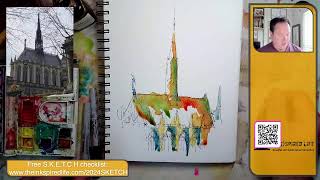
In this informal Sunday live‑stream, artist Jason Nicholas (Inkspired Life) sketches a portion of the Gothic Sainte‑Chapelle in Paris using a layered mixed‑media approach. He begins by outlining the spire and roof with a Sharpie, emphasizing a loose, expressive style rather than photorealism. Throughout the session he explains his workflow: starting with Sharpie outlines, adding ink, watercolor washes that pool and create hard edges, and finishing with colored pencil details. He discusses why he prefers Sharpies (no bleed, flexibility), his technique of tilting the paper for water flow, and his philosophy of leaving white space and using color intuitively rather than matching the reference. Jason shares brief historical context about Sainte‑Chapelle’s 13th‑century construction and compares its Gothic arches to New York’s St. Patrick’s Cathedral. He promotes his free "Sketch Framework" PDF, a weekly Inkspiration newsletter, and upcoming workshops, inviting viewers to join his email list. Mid‑stream he showcases a recent mixed‑media accordion sketch titled "My City Lines" featuring the Statue of Liberty torch, offering it for purchase. The stream experiences intermittent internet connectivity, resulting in a segmented broadcast, and Jason wraps up by thanking viewers and encouraging likes and subscriptions.
Chapters
Hello, happy Sunday, August 4th. Hope you're doing well. Yeah, I'm popping in here on a Sunday, which is kind of unusual for me. I just wanted to try something a little different, take a break from— well, I'm actually spending a lot of time going through my stuff here in my studio, cleaning, purging, reorganizing, and it's all a lot. So sketching is going to give me a little break from that. And I got— I saw this really cool photo right here from my friend Chip, and with his permission, he said I could use it to sketch. This is Saint— I'm not good with my French— Sainte-Chapelle, Sainte-Chapelle, in Paris, France. Um, really great example of Gothic architecture. The building, I had looked it up briefly, I don't know much about the history, but it was built in 1248. Holy moly, that's old. So I thought it'd be fun just to try to do a Uh, I am just sketching using this watercolor book here, and hopefully I'm back. I am having internet connect— connectivity issues. I don't know why. I'm going to keep plugging ahead and, uh, keep sketching. All right, cool. So let's sketch the Sainte-Chapelle church here. It is only a small portion of it, so I'm actually going to start with the spire and kind of work my way down. I'm using a Sharpie, and in case this one runs out of ink, I am— I am stocked. I am so stocked there, which is good. All right, holding the marker fairly loose and, and just kind of getting the top of that spire. I'm not worried about any kind of details. I'm just trying to capture kind of the shapes I'm seeing on that spire. And it kind of comes down here, maybe across. And then let's see, it goes— hits the roof somewhere here, comes down and across. I'm going to use something like that is what the spire does. Now I'm looking at the top of that roofline. Notice it's not horizontal on the paper, it's at an angle. So I'm going to try to capture an angle. This is meant to be loose style sketching, just trying to capture the idea or character of a portion of this building. And even if I don't fit this whole photo on the sketch, I'm okay with it. Again, we're just having fun trying to capture this. We got this cool angel, uh, sculpture happening here. I'm looking at where the roof edge meets the sky, and we have a slant, and we have another little spire here. I'm not going to fit that second spire, so I'll let it kind of bleed off there. Boom. Over on this side, we have another kind of small spire kind of coming up, and there is a building in the foreground. I don't know if it's— I think it's a different building. I'm gonna leave that out. So it's got kind of the roof area there. It's this parapet edge coming down. And now I'm just looking at the roof itself. Has some lines, it kind of does that. And then we're going to come across. And we have these, these, these pilasters. That are built onto the side that help hold the walls in place. One thing I do when I'm sketching, especially a building for the first time, is I'm looking more at the actual building, or the photograph in this case, than the paper itself as I'm sketching. It just helps to give my, um, give me a little more focus, kind of eye-hand coordination, trying to see, capture what's there. It's, I guess, kind of a feeling thing. I know that wasn't very technical, but trying to just describe what's going through my brain as I'm doing this a little bit. So we have this pilasters. Yeah, they're spaced more equally than I sketch, but again, loose, wonky. Let's try to capture some of this the best we can and just have fun with it. Those are my— that's my intention for this. Of course, Gothic architecture, one of the main features are these arches here, so you definitely want to show some of the arches. They're kind of pointed on top and curve out. It's amazing and mind-blowing to think about, you know, a structure such as this being built back in 1242 through 1248, right? The technology that was so different than what we have today. Uh, this is a spectacular piece of architecture, and my dream is to go here, go to Paris and sketch, draw, sketch, paint. That is on my list. So maybe one day you'll be able to join me on a sketching excursion to Paris. How cool would that be? So you can kind of just see it coming together a little bit. Yeah, we got stuff going on here. I'm not going to worry about that. I like to leave kind of the edges of my sketches kind of blank and bleed off a little bit. This reminds me a little bit of one of my favorite buildings in New York City, St. Patrick's Cathedral, which I hope to be seeing this week, doing some sketching of. St. Patrick's Cathedral is just an amazing, magnificent structure to find in a city surrounded by these skyscrapers. And the buildings they're building today, their architecture is questionable on some of them, but their— the heights, it's just seeing a Gothic cathedral in New York City amidst these skyscrapers, it's just— it's really quite a sight. Sketching the roof here, some of the materials. So you may have noticed I kind of work in different layers, the first one being the roof. So usually we'll start with the roof area, then I'll hit some overall outlines or shapes of the building, then I'll start adding some details like windows and doors. And then if we were to add color— I don't know if I'm going to add color to this one today, right now. Then I would start throwing down some ink and some watercolor on this. You know what, I think I will. Well, yeah, let's throw down some ink on it. All right, cool. So we have some outlines happening. And I got, let's see, a watercolor palette here. I have a brush. I'm gonna just grab and go with whatever's on my table here. So let's just throw down— I have some ink here as well. Let's grab some ink. I usually like to put my paper at a slight angle so that the water and colors can kind of run down. I like the way it looks. I like it dribbling down and kind of pooling up with water in certain areas. I am not— I am not even looking at the picture. I'm not trying to capture the color that's on the picture. I'm just painting with a palette that I like to use. It just brings me joy. And we have the photograph to capture exactly the way it is. So my goal is just to have fun and just grab and go with colors I like using. And sometimes I'll, you know, lots of times I'll just try new things. If you want to know a little bit more about my mindset and how I approach sketching architecture, I have a free PDF guide you could download. I call it the Sketch Framework, and in that, it just kind of gives you a little bit of insight into how I approach sketching. It's a taste into my brain. Does that make sense? It's a look into my brain. It's a taste into my sketching recipe. That would make more sense. But yeah, if you want to check it out, there's a link on the bottom left of the screen for a free PDF download. If you go to that link, you'll just have to enter your email and I'll send you the PDF. And so I have it, I have it here. It's kind of a little one-pager. But I'm constantly working on refining it. But yeah, that would be so cool. So feel free to do that, and I will not spam you. I'll send— if you join my email list, I will send emails about upcoming courses or online workshops or in-person happening soon. October, I'm trying to put one together for October, so We'll see how that goes. Um, I'll keep you up to date on that. And I do send a weekly Inkspiration newsletter out. It's free, just with some pointers or just some motivation and encouragement to keep you creating. All right, cool. So we got some colors going on here. All right. And you can see what I was talking about, where colors just kind of pool up here. And I'm probably just gonna let it dry that way. I like what's called, um, the hard edge it creates. A hard edge. You can kind of start and see it here. There's a hard edge forming as it dries, dries up. Going to put this up a little bit more. There we go. It's 143. Cool. So I'm going to wrap up in 7 minutes. I like the way it's looking. I know I want to throw down— let's throw down some— I want some blue on here. I want to just create a little bit of, a little bit of darkness. Maybe create the idea of some kind of, uh, shadows happening on here. So I'm using blue to do that. I also like the way the blue plays against the yellow next to it. I'm gonna leave that. I love the white. I'm gonna leave a lot of white space on here. Don't feel like you need to cover up every single inch of your sketch here with color. Let it breathe. And it's sometimes— it's a just a gut feeling to know when, when to stop. All right, let's zoom out. So here's what it's looking like. So right, so you can see first we added some Sharpie marker, threw that down. Why Sharpie? I get that question a lot. I typically will start with Sharpies because if I'm going to come back and add— let me start over. If I use a Sharpie, it gives me the chance to come back and add color or ink and not worry about any black ink bleeding. So the Sharpie for me is my go-to, I would say 95-97% of time, to start my sketches with. So that's why I'm always talking about them and using them, because it helps, um, gives me that freedom of coming back and not worrying about any black ink bleeding or running. Um, I really like the way this is drawing. I kind of love that pop of orange happening here. So I'm going to let it dry and zoom in here so you can see it drying even better. So after this dries, my next step will be to come back in with either a Sharpie or sometimes I'll break out a Pilot Precise Pen and I'll come back and just sketch and add some detail. Maybe pull out some shapes a little more, maybe add a little more detail on here. Again, the idea is not to be photorealistic, but just to capture the idea or essence of a building. So I'll come back, add some details with these on top of the color, maybe throw down more color. And I will typically work in colored pencil as well. So it's, it's marker, it's watercolor and colored pencils are the main 3 types of tools I use when I'm sketching. I love creating mixed media pieces. So while this is drying, let me do a quick show and tell. I wanted to show you what I made yesterday. I think it— I think it's really cool, actually. I'm going to zoom out. Let's move this over and let me break this out. It's right here. So this was a cool Um, mixed media sketch I did yesterday. So it's called My City Lines. It's a work in progress. Let me unfold it. So the idea is I want you to kind of follow this line down as I open this up. That line comes in and travels down and around, and what I ended up making was a sketch of the Statue of Liberty torch. It's about 20 inches long. You can see there goes down to the bottom there, but it's really cool. So this would be really fun to just kind of take and you could hang it out on your wall or up on your wall. You can kind of hang it on your wall. Really, really fun piece. I love, I love the way that this part came out. The flames and the top of the torch, I think, look really fun. So yeah, so this is kind of the first in a series of these accordion-type sketches I'll be doing. Yeah, so this is also available if anybody is interested in purchasing this original. Let me know, just send me a DM or message here and we can talk. But yeah, this has come out really, really cool, so I wanted to share that with you guys. All right, so it's been almost 20 minutes. Let's do a quick sum up. I know my internet's been wonky in and out. I don't even know if I'm live now, but let's wrap up. This may have been streamed in like 3 different parts. Anyway, thank you for watching. I appreciate you guys. If you liked it, give me a thumbs up. Feel free to subscribe if you like my channel. I have lots of other videos, so be sure to check out some other ones. And here's what it's looking like as it dries. Thank you guys for joining me on this Sunday stream. I appreciate you so, so much. Yeah, so, you know, I like to approach sketching the world around me one line at a time. This is Jason Nicholas Nicholas of the Inkspired Life. And hope you have an amazing rest of your day. Take care, appreciate you watching.