Sketching Wonky Barns
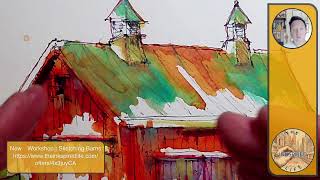
Jason Nicholas demonstrates a mixed-media sketch of a weathered barn using Sharpie pens, watercolor pencils, and washes. He layers colors like Rusty Hinge and Salvage Patina, uses wavy lines and dash-dot strokes to suggest aged wood, and leaves white space intentionally. A preview for his October 26th Zoom workshop.
Chapters
Hey everybody, how are you? Happy, um, October 8th, Tuesday. Hope you're doing well. 8:04 PM in the Garden State. I hope everybody's hanging, hanging tight. And, um, yeah, with this crazy weather that's incoming, that's happened Positive thoughts go out to everybody out there. It's, it's cray cray. Um, let's, uh, let's escape for a few minutes here and go into the world of sketching. Sketching for me is a great way to not only exercise my creativity and imagination, but sometimes it's a good way to change my state, kind of escape for a few minutes and see what happens. So I'm working on this barn that I started last time I was on live, a couple days ago I think. So I wanted to come back, just add some more to this, wrap it up. Um, and this is kind of an intro to a virtual Zoom workshop I'm having on October 26th where we'll be sketching barns. I'm just calling it like the— what is it called— Sketching Wonky Barns. Pretty simple name. So, um, If you're interested in that, there is a link you can see on the bottom left of the screen, and also I'll put it in the chat. Um, hopefully this is working. My internet is not working, so I am actually, uh, what's that— what's it called when you tie into like your phone data? So I'm linking my computer to my phone right now. I don't know how the stream is going to be, but I figured I'd give it a shot. Nothing's gonna— nothing's gonna set me back. When I want to create, I'm going to create. Um, here's the barn we started last time. This is mixed media. I use Sharpie pen, I use some different color inks on here, and also some watercolor. Boom. So it's dry. I wanted it to dry. I'm going to come back and add some more detail. I want to add some of the barn boards on here. I think I'll use my Sharpie for that. And we also— we might also break out some of these watercolor pencils that are kind of fun to use. All right, let's do this thing. Um, I'm trying— so I know it's a very vibrant, bright barn. I actually like it, but I'm trying to make it look a little weathered, and you can see that really good here. That was by putting color on, then going back over it, taking some color off with water. I think it turned out really cool. All right, let's just do some vertical kind of board, uh, barn boards here. I want them to be fairly light. I'm not going for straight beautifully, perfectly straight lines. They could be wonky. You can see I'm exaggerating the wonkiness. I'm actually jiggling my pen as I'm bringing it down on the page, kind of almost like a wave pattern. And that helps to create that look of something kind of old, maybe an old, uh, hand-hewn barn board here. The lines also don't have to be continuous. They can be broken, or sometimes I like to call them Morse code lines, kind of dashes and dots. That's just another great way to get the look the look of a line, but it adds character. It's not a precise technical line. So there you can kind of see it happening here, those dash and dots. Let's zoom back out a little bit. So just by adding these lines, it's, it's adding to the character of this kind of aged, dilapidated barn. It could be a little more dilapidated. Maybe I could add some holes or holes in it, or on the side or on the roof, maybe. Feel free to ask me questions, leave comments. I'll be checking in. What time is it? 8— it's 8:08, so I'm gonna wrap up at 8:30 here. If I don't give myself a hard deadline, I can do this all night, which is not a bad thing unless I have to get up in the morning for school. Then it's a bad thing. I need my, uh, beauty rest. God, God knows I need tons of beauty rest. I'm just going to copy and paste some text in the chat. All right, I want to pull out these windows a little more. They kind of got lost a little bit. So we'll just take our Sharpie and add an outline here. I'm going to pull out this door a little bit here and I'm just going back around the edge. I'm just adding some diagonal hatch lines, um, to show kind of a shadow on the side, give a little more interest— interest to these roof cupolas. We'll do the same thing underneath this roof overhang here as well. Let's break out some of these watercolor pencils. A couple different ways I like to use these. We can use them just dry on the paper, then add water, kind of paint with them, or just leave them on there dry without water. Um, I like to dip them in water sometimes, so let's just dip them in water. This is called Fired Brick. I want a little bit more red to this. Let's see what it looks like. So I'm literally just dipping this watercolor pencil in some dirty water. Love dirty water. Let's see, um, let's just throw some down on here, and I'm not going to cover it um, everywhere. I just want to add touches of this red. I'm actually— I'm really liking the way it's looking. Let me zoom in so you can see the texture. So here it's nice and wet, and then here you can see it's drying a little bit and it's picking up the texture of the paper in here. And I like that. It's adding to that kind of aged— it's adding character to the, the wood siding. It's adding some texture. That's probably a good word for it. And we're just going to kind of touch it in places and not force it, just let it go with the flow, just kind of throw it down and see what happens. Even here, I'm just letting it puddle up, and we'll let it dry like that. I'm, I'm liking this red on top of the orange. I think it's I do love the orange color. Why am I adding red? It's a good question I'm asking myself. Why am I doing the red? Um, my gut feeling to add red, so I'm not going to fight it. I often just listen to my intuition when I'm creating. I don't, I don't like to fight it, and I just think it's adding another layer of interest on top of the orange. Right, you can kind of see what I just did here. I'm going to leave a lot of white space, just let that kind of breathe. I don't want to fill every little space in. Here we'll just kind of do a little dry texture, and you'll— you can see how it's picking up the paper. This is cold press watercolor paper, it has a little bit of texture to it. And the pencil is picking that up as I gently go over the paper. All right, cool. Let's do some more over here as well. Let me zoom out. There we go. What inspired the original colors of this is fall. I love the fall season, so that's where the orange kind of came from. The leaves are changing here quickly. I don't know when peak season is, but it's got to be getting here close— getting here close— getting here soon. Um, I just love the fall. I'm going to add some more yellow to this, I think. All right, cool. That— I think that's enough red. I just wanted touches of it. I'm lying, it's just a little here, maybe on this bottom edge, just to kind of balance it. I have some here and then here, so I thought that would kind of finish it. That is enough of the red. We're gonna put it to the side. Um, I have two other colors of watercolor pencil. I have Rusty Hinge. God, I love the name. Love industrial vibe. I love rusted metals. That's my, that's my groove. If I could sketch just industrial buildings with weathered steel and metal, rusty metal, patinaed copper roofs, I would be in my glory. And then we have Salvage Patina. So we're going to— let's add some more Salvaged Patina to the roof. Let's see, let's touch it down in some places we don't have any. Oops, there we go. Let's even bring some of this color up onto the cupola roofs. Maybe these are coppered— these were copper and are kind of weathered here a little bit. There we go. So I just added some of that patina up here on the cupola roofs as well, or ruffs. When I went to school, um, when I went to college down in Miami, I somehow I started saying ruffs instead of roofs, so I'll switch back and forth. Um, this is actually very cool. I just threw some of this on top of that red we just put down. I love the contrast of colors, right? Just these little splotches of color on top of that red right in here. That's the kind of stuff I just— I love these little— what's the word? Not nuance, but I just do love these look kind of little layers of, uh, mixed media. It's a good way to just pull out some other textures as well. Let's see, um, I want to add some yellow. I think I'm going to grab some lemon yellow watercolor paint. This is how I add a pop of freshness, um, to my sketches. Think of cooking and using lemon zest, right? It adds that kind of brightness to your dish. Same thing with, with watercolors and mixed media sketches. This lemon yellow, just add a little pop of freshness, a little bit of zest. I'm just lightly pulling the brush down. Just want to create a little more texture in these barn boards here. All right, I think that might be enough yellow on there. That's what it's looking like. I think it's almost done. Let me just break out some colored pencils and throw those on, and we'll call it a day. It's 8:24, 6 more minutes. Let's see what we can do. Let me know if any questions or comments, that would be amazing. I would appreciate it. I think this one is done, guys. I like it. I don't want to overdo it, so I think I'm going to leave all that white space. I'm not going to even do the back on this. I was thinking of a sepia color, but I think I'm going to just leave it white for now. And yeah, I think we're going to call this one done. Let me zoom in and Show you kind of some details close up and then we'll wrap up. I really like the way the roof came out on here. I love the colors, um, I love the hard edges you see around here, especially up in here. Um, you can definitely see some different layers happening, which is cool. All right, let's zoom out. And there you go, we have a wonky barn. So thank you guys for watching, I really appreciate your time. If you like these kinds of sketches, um, definitely check out the workshop I have coming up on October 26th. It'll be on Zoom. We'll sketch a wonky barn or two. I'll kind of You'll get, you'll get inside my sketching brain more, my creative brain more, where I can share my personal tips. And what's cool about the Zoom is we can all see each other. I can see your work, you can share it on screen if you want, we can give each other feedback. It's really interactive that way, and it's a really fun and supportive and positive place to create. Together. Thank you guys so much. Have an amazing day. Remember, if you can sketch lines, if you can scribble, you can draw and sketch architecture. Appreciate you all. Stay safe and keep being positive. Have an amazing rest of your day. Peace. Live creatively, and I'll see you soon. I'm Jason Nicholas Nicholas with The Inkspired Life. Take care, guys. Usually I wave with this hand and I can hit the finish button. It's a more graceful transition. There you go. Take care.





