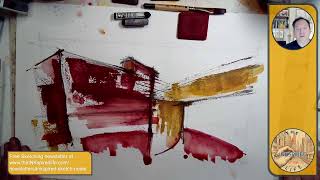
In this live Sunday sketching session, artist Jason Nicholas steps away from his usual Sharpie‑based workflow to explore a more experimental, fast‑and‑loose approach he calls “sketch painting.” Using water‑soluble graphite sticks, ArtGraph chalks, and a large sheet of 140‑lb Canson watercolor paper, he demonstrates how to dip the media in water, apply it wet, and build up layers that blend like watercolor while retaining a sketchy line quality. He frames the piece around a Brooklyn‑inspired perspective of the Brooklyn Bridge meeting a library, starting with a simple box‑frame to establish perspective. Throughout the stream Jason talks about the importance of breaking routine, taking creative breaks, and embracing messiness as part of the process. He interacts briefly with a viewer (DB), answers a question about the durability of chalk sticks, and shares his intention to achieve an industrial‑grungy vibe inspired by bakery interiors. The session ends with Jason encouraging viewers to keep sketching, share their work, and stay positive, hinting at future community gatherings.
Chapters
Hello, happy Sunday! Hope you're doing well. I'm gonna sketch for a few minutes here. I wanted to, uh, take a break before I start making dinner and sketch. Yeah, um, you may notice something different about my setup. I am not starting with my trusted Sharpie. Um, figured I wanted to do something different, different style, so I broke out some graphite sticks here, uh, some ArtGraph chalks over here as well. So let's just sketch for a few minutes. Um, this is going to be a Brooklyn-inspired sketch, um, based on a location where there's a Brooklyn library and Brooklyn Bridge kind of meets. So let's do some sketching. Starting off with just a little frame outline here. It's going to be a perspective. I usually like to start perspectives with a box, a frame area, kind of keeps me a little more focused. Um, also I'm not feeling like I need to cover this entire sheet, which is 12 inches by 18 inches, which is a pretty good size. Um, I'm used to sketching much smaller, so changing things up a little bit here in different ways. I'm using different, um, materials that I don't usually use.
There we go.
This is a water-soluble graphite stick. I like that it has kind of a wide edge on it. It's not finely pointed. That's going to keep me looser with my sketching here. This is a very fast sketch. I don't want to think too much detail about it. If I was using like a pencil with a fine point, or even a fine-pointed Sharpie, I would be thinking probably that I have to sketch in more detail. This is the underside of the Brooklyn Bridge here. There's a building on this side here. Again, my goal is to be quick, fast, loose, and just throw some lines down and just have fun, really. Um, I'm gonna dip my graphite stick here and dip it in water, and I'm gonna do what I like to call sketch painting. Let me move my coffee cup. There we go. And I like the way this looks with it being wet. It's going to dissolve on the paper. I like the marks it leaves. Um, some of it sticks, some of it's thin. It's really— it has a sketchy look that I like to it.
Cool.
Um, this stuff is messy, so as you can see, I'm definitely wearing it. It's not art unless you wear it, and I am wearing it. So be prepared to get into it, get a little messy, um, and that can add to the fun. All right, um, I got that down. Let's add some— I want to play with some of this Art Graph, um, these chalk sticks.
Let's just go.
I'm just going to grab and go. Let's try this color. And these you could also use dry. You could also, um, they're water soluble, you can use them wet. I personally like to dip them in water, so I'm just dipping this in here. I like to call this sketch painting, where I'm dipping this in water and kind of sketching and painting at the same time. Let's bring this building back like that a little bit. I'm using a piece of 140-pound watercolor paper. Um, it's Canson. One of the cool things about these Art Graph chalks is the shape. You can do wide things with it, they have fine angles. You can do fine angles like I did here. I just kind of use the side of it and lightly brushed on the paper. And today's session is about just playing around with materials I haven't used in a while. Sometimes we get set in our ways, we get stuck, we get rigid, and for me, when I do that, the creativity stops. So I need to mix things up every once in a while. I even took a break. I haven't taken a break from sketching in a long time, and this past week I took a break from it. I really didn't do too much of it. And that's okay. Sometimes our brains just need that stopping point. Hey, DB is in the house! DB, how are you? So great to see you. So great to see you. Uh, let's see, I'm just gonna break out another color. I think this is ochre. So I dipped it in water, you can see it's wet. [FOREIGN] Here's an example of just kind of pulling it down. You can kind of see the effect it's creating. Pretty awesome, right? This is so fun, so fun to be doing this, um, with a different material. Let's see, I know I have this bridge structure under here that I'll want to show eventually. I want to do this, I'm thinking. I don't want to think too much. I want to create on the fly. This is actually a very cool industrial brick building on this side, so we'll eventually be bricking it up. And a good color for brick is the Sanguine color. First, I think it's Sanguine, Sanguine. I never know how to say it. Sanguine, Sanguine. Um, but you'll see it has that cool kind of bricky color. I'm just going to brush some of this— not brush, but Drag some of this on here. DB's Greenhouse, I do that too between pencil sketching and watercolors, right? So sometimes we just need to take that break or switch— yeah, or switch materials up. I'm just laying down some blocks of color here. Um, so this is a test in bravery when it comes to throwing down colors. I am literally just throwing this down with no game plan, but you know what, that's what I'm loving. It's just, it's fun to kind of wing it. So you got a sidewalk thingy, it's kind to see if I can sketch this in. Let's kind of do a line like this. Maybe— there you go. So my sidewalk thing there.
Cool.
So right now it's looking a little bit cray cray and that's fine. This is, um, going to be a sketch that's about adding layers, so this is just kind of the beginning. I am looking for my paintbrush. Where's my paintbrush? Paintbrush, paintbrush. I am not seeing— let me check in here. Negative. Ruh-roh. All right, let's see. I don't know where that paintbrush is, so I'm gonna grab this one. Looking for my bamboo brush I always use, but I can't find it. So we're going to grab and go with this nice little brush here. We're going to switch the tunes up a little bit. Let's see, I have the wrong contacts in, so I cannot see unless I put these things on. So I'm looking, squinting at my screen here. Let's see.
Oh, let's try this one.
So I want you guys to see what, you know, when I add a brush, water on a brush, you can paint this, move it around, blend things together a little bit. Normally I like to work at an angle, so this I don't have this paper on anything and it's laying flat, so I'm just gonna tilt it up and add water. But I love, I love the color here. It's so cool. I want this sketch to be— have an industrial grungy kind of vibe to it. So that's, that's my intention for this one. Um, usually I'll set an an intention before I sketch. Say I had a couple intentions. One was to use, uh, materials I haven't used in a while. And number two is I just wanted to make something industrial-ish. I was looking at some bakeries online today and I saw a couple pictures of bakeries that had an industrial vibe. That's what triggered me wanting to sketch today. So you never know where your inspo is going to come from. This is a nice brush. This is actually the first time I've used it. Maybe, maybe the second time. What is it? Uh, it's from Cheap Joe's. It's from Cheap Joe's. I honestly can't read the number on there. Maybe you guys can see it. Um, it is a nice brush. You can see the colors are running down the page as I add water, and that's exactly what I want it to do. Same thing here with this building edge here is against the sidewalk.
Cool.
This is definitely one I'm going to have to let dry in between layers. So I am noticing, as I'm— usually I use a rounded bamboo brush. Um, I do notice as I'm using this flat brush with a square end My brain's thinking more detail. It's thinking I need to have more precise, clean lines, which is pretty easy to do with this. Whereas the bamboo brush, I feel like I can be much looser with. And that just might be a mental, kind of a mental or mindset thing right now. I'm gonna blend these colors together. I want to get So it's an orangey color. For those of you guys that have watched me before, you might recognize the whistling music from the whistling cowboy sketches I used to do at the end of every livestream. I stopped doing them and I don't know why. That's the music I have going. So we need to revisit the Whistling Cowboy with his companion, his dog companion Retro. They should, they should make a comeback sometime. This is going to be a sketch where you're going to see how my thought process is. You're going to see a lot of lines on here. Um, how do I say this? Kind of a lot of like background type of lines, like how I'm just creating things, which is, which is what I like. For me, lines are layers of stories. It's like a history of how this sketch was created. You know, I could have taken a pencil, sketched this scene out really, or blocked it out with pencil and then erased some of the line work. But this, I'm just throwing it down there. There's no erasing, and I like that. It's just forcing me to Keep going, not thinking about stopping and being perfect. All right, cool. DB has a QQQ. QQQ, are the chalk squares easy to break? That's a great question. I don't know because I've never broken any. So yeah, I have never broken these. I'm gonna say no. If you want to intentionally break them, you can definitely do it. Snap them or even score them with an X-Acto knife, maybe score it and then snap it off. Um, I have not broken these, so I don't think they're easy to break, but they are breakable. Um, these— this is an ArtGraph stick. You can see, you can see I broke this one. I snapped it, um, which I don't mind because I kind of like the effects. You can use this to your advantage. Look at the jaggedy edge on there, right, versus the smooth edge here. So by snapping this, you can use, um, get different line points and cool, cool things happen. All right, this might be at a point where I'm going to let it dry before I do much more to it. It's very loose, very wonky, but once— which I love— but when it dries, I'll start adding another layer. Um, I'll start adding some detail. I might use watercolor stick here to start drawing in some detail. I also have markers out. I don't know if I'll use these, these brush markers, so they're nearby in case I need them. And you know what, our friend Mr. Sharpie may make an appearance at some point in time. We'll see. All right guys, thank you so much for watch— watching. I was gonna say washing. I already did my wash today. Um, thank you guys for watching. I appreciate you so, so much. So this is just step 1 in what'll probably be like 3 different layers on it. Um, have an amazing rest of your Sunday. This has been Jason with the Inkspired Life, and remember, you too can sketch architecture one line at a time. Keep using your creativity for positivity. We need good things out there in the world. We need good people and good vibes. You guys, share your artwork. It goes a long way. Take care. Have a great, great rest of your day. Take care. We'll see you. DBU, it's great seeing you live here. Take care. Hope all is well. I will be, uh, we'll put together an Inklings get-together sometime soon. So that would be fun. Be well, take care, peace out.