The INKspired Life - Architectural sketching
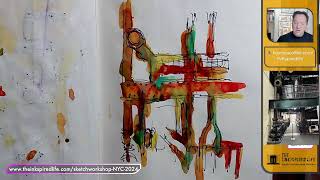
In this live YouTube session, creator Jason Nicholas (The Inkspired Life) walks viewers through his preparation for a one‑day architectural sketching trip to New York City, showcases a newly 3D‑printed desk‑organizer prototype, demonstrates his sketching process using Sharpies, inks, and watercolors, and introduces a structured "SKETCH" framework for architectural drawing. Throughout the stream he engages with the chat, answering questions about sketching challenges (symmetry, depth perception), favorite structures to draw, and tool preferences. He also promotes an upcoming April 20 workshop on NYC sketching. The video blends a casual, enthusiastic tone with instructional content, offering detailed gear lists, design iteration commentary, and personal reflections on creativity and imperfection.
Chapters
Hey everybody, happy, uh, Friday. Hope you're doing well. Friday, April 5th, 2024. Hey, I'm Jason Nicholas Nicholas with The Inkspired Life, uh, here live on this Friday night. Gonna be a little bit of a different type of show. I'm not starting off doing any sketching. I thought it would be really cool just to bring you guys along with me while I'm kind of getting stuff organized for some sketching I'm going to be doing tomorrow. I'm planning on heading out and going to New York City and doing some sketching. It's going to be really awesome. I have a friend who's going to be meeting me. He's an amazing live streamer. He has a show called the NYC Walking Show. His name is Sifat. He's going to be joining me for a little bit tomorrow and actually helping me by taking some video footage of me sketching. So anyway, here's a— I'm kind of just thinking out loud and putting stuff together. You can see my desk has a bunch of stuff on it here, so I'll walk you through just what I'm thinking of taking with me tomorrow. And after that, I actually have a, um, well, kind of a— I want to test out a prototype with you guys. I designed and 3D printed something earlier today and, uh, want to share it with you guys and let me know what your feedback is. So cool, hope you're having a great Friday. So I want to travel really light tomorrow. Weather's gonna be kind of chilly, so I'm not gonna be spending a lot of time outdoors sketching. I'm really going in tomorrow just to get some video footage, just to show, show you guys what do I do when I'm in the field and how do I approach sketching architecture. So I'm gonna travel light, and here's a couple of things, or a few things I'm planning on bringing with me tomorrow. I think I'm going to bring— I'm definitely bringing my Loughbee Field Journal. I've talked about this all the time because I actually love it so, so much. I may take the planner out here and just put another pad of paper, but I do have blank paper plain as well. And this is fun for traveling. It's really cool because it has a strap here so I can hold it in my hand. I'll usually take a binder clip. Actually, it's supposed to be windy tomorrow, so it's good to have clips. I can clip the paper down, and then I'm left-handed, so I actually would hold it in that hand, and then I could kind of take my Sharpie, boom, and just do some sketching. Yeah, so I'm definitely gonna bring this. This is thin paper, it's not a thick watercolor paper, but I could do light washes, and I think that's all I really would need. To do tomorrow, just get some lines down and maybe throw some washes on. So this will be really cool. Um, you can see it has two pens in it, so I'm going to definitely bring a Sharpie. And I love my Pilot Precise pen, so I'm bringing that as well. Um, this has a bunch of pockets in it, and let me show you what I'm going to be putting in the back pocket here. So I'm going to be taking this battery pack with me. I love to have an extra battery pack, especially since I take a lot of pictures and shooting video is going to eat up a lot of my phone battery. So I had this cool little battery pack which will actually fit really nicely just in the back of this, this little pouch area. And I added a Ziploc kind of feature in here. This is homemade Ziploc and it works when I get get it to line up properly. Um, but yeah, otherwise Velcro is another way to get that to stay shut. So I'm gonna bring, bring that with me as well. Um, and it does have some pockets in the front. I usually have a couple binder clips in here, and I also like to keep a small pocket-sized sketchbook. I think this is a Moleskine. Yeah, you can see there, Moleskine. Some people say Moleskine, I say Moleskine. I'm not sure exactly how to say it. I think it might be Italian, so I say Moleskine. Um, you can see I brought this to NYC a bunch of times with me already. Here's some sketches I've done. There's like a sketch I was working on of the Vessel. These are just really quick sketches, urban sketches I like to capture while I'm there. And this is just a perfect size book to to do that with. Here's the sketch of the shed building. So this I like to keep in here as well. And I do cut up some pieces of watercolor paper. I have a few in there in case I do want to do some, uh, watercoloring. And I'll typically have a Post-it notepad in there. So that's what I have in my Lockabee journal. Let me show you what else I'm going to take. Let me know where you're watching from. Let me know if you felt the earthquake we had here. Epicenter is about 50 miles from where I live. We felt it shaking a little bit. Fortunately, everybody's safe. Um, I don't know how the epicenter is doing. I think it was a 4.8 earthquake, so really, uh, I know my West Coast friends like Karen— hey Karen— um, feel a lot more earthquakes than we do here in New Jersey, but it was kind of just an interesting sensation for sure. Alright, so I'm bringing this with me tomorrow sketching. Ta-da! Like I said, I want to travel light tomorrow. I have this really cool Etchr field case I could bring and set that up with an easel and everything, but I'm going to save that for the spring and summertime. Tomorrow I'm just going to pretty much just stand and sketch in place. Here's what else I'm going to bring tomorrow. So this is my Lochbie Quattro. Quattro means four, but I fit more than four pens in here. I'll bring in a black and red Pilot Precise pen. Um, I'll bring a couple of watercolor pencils, my favorite colors. And I did a whole video the other night on just what I keep in here when I travel. A couple of watercolor— actually, I usually will put those point down, safer travel that way. So we have that. Of course, I will bring a Sharpie. I always like to have extra ones. I'm I am paranoid with my pens. I always have more than enough with me. Um, we're gonna bring a purple Varsity pen. Just throw the Lamy in here as well. Um, I'm gonna bring an Aqua Brush. We'll talk about watercolors in a minute. And what else? I feel like there's something else. Oh yeah, usually I'll bring up my— a Lamy, like a yellow Lamy or something. But, um, you know what I'm gonna bring instead? I'm gonna pop in a highlighter. I just saw one here. Here we go. That's a Sharpie highlighter in there. So I'll bring this little Quattro case with me, zips up nice. So, so far I'm taking this and this with me. Karen says, I remember the 1989 quake, the parking lot pavement rolled, shaking the parked cars. Oh, that must have been so scary, Karen. I, I can't even imagine something like that. We just had a little shaking and baking going on here, um, nothing major at all, but it was just kind of weird to feel, feel that here in New Jersey. Wow, I can't imagine being on the West Coast. So I got these two cool items. What else we're gonna take? We are— I'm talking about me like as a third person, or Plural. Yeah, I am going to take, um, so for watercolors I'm debating. I think I might take my trusty, well-used Winsor Newton watercolor palette. I'm not gonna be doing a lot of watercolor, but I might just throw some something down. I like this, it's very small. I did just get this and I'll be posting a video on this soon. I did an unboxing. Um, Winsor Newton travel palette. I'll just go through kind of quick here. It has a detachable kind of container you could put water in. Sorry, the lighting is kind of bad. This is a blue color. This is cool. I'll show you what that cap is for. Here's— well, just open it up. It has a little watercolor brush. So this is a water container. Put some water in there. That's the main reason I got this was because I like the fact that I can put water in there and it has a little palette mixing area on it. This will flip open. Ta-da! You can see we have some nice brand new watercolor pans in there. This is unused. And I have a— has a sponge in there for cleaning your brush off. Um, without the sponge, you could fit 2 more pans in there if you wanted to. Oh, I'm just noticing these slide. Okay, how much do they slide? That's not bueno. So I'm going to keep that in there so they don't slide. Um, and the other thing I like about this, it has a kind of a little ring on the bottom so you can hold it while you're doing your painting, right? So it's a pretty cool field travel set from Winsor Newton. Definitely shop around online. I have seen prices range from like $24 or something all the way up to like $80 for the same exact thing. So shop around. Another cool thing I did not show you is you can clip that right to the end. So it's a pretty cool little travel kit. So I'm not sure if I'm bringing this or this one. I think I'm probably going to bring my, my well-used one. I love this. It fits right in my pocket. Um, I also can fit it in here if I wanted to stick it in here. So I have fit a lot in this one field journal. Look at that, it's packed delicious, filled with fun stuff. All right, so we got this and this. What else am I bringing tomorrow? Hmm. I will show you the backpack. Here's my little field. You guys, I don't know if I can get this all on camera, probably not, but move this. So this is a cool backpack, it's called the Waterfly. Cool name, right? Um, I like it, it has a side pocket. You can put an umbrella in there, or this is actually in here a portable stool that I could sit on, the tripod stool. So you can put that in there if you want. Inside, plenty of pocket space in here to put stuff. Ta-da! Ta-da! Nice easy access zippered area here. You could put your headphone AirPod or whatever wires through here if you wanted to. It's just really small, convenient, and easy to carry. So I'm gonna— I'll be putting all my stuff in there. I might as well do it now while I'm talking. So I can just kind of put my field journal in there, although I have to be honest with you, I usually I usually just carry my field journal. I keep it out most of the time, but I can put it in here if I want. It fits in there. And then I'll put the, um, Lok-B. There's a little pocket in front. I can put the Lok-B in there and I'm good to go. That's all I'll need tomorrow when I'm out and about just doing some sketching on site. Hey, D-Ray, great to see you. Hope all is well. So hope you guys like that little inside tour. There'll be more. Uh, you'll eventually be seeing some video footage, um, of me out there sketching. All right, let's put this to the side. I'm going to grab a drink of water because D-Ray says drinking water. Right here. Yes, D-Ray, so you're absolutely right. I am going to actually bring some water with me and keep it in the backpack. Thank you for reminding me. Hey, Chip's here. Awesome. Um, all right guys, I'm gonna— I want to do some show and tell. I'm actually pretty excited to show you something that I designed, 3D printed today. I haven't tested it yet, so you— I'm doing this live. So in the design process, this is going to be called, um, I just printed the prototype Prototype's like the first go-around model to get feedback and to try out. So let me show you the prototype after I drink some delicious water. Hint hint, this is my favorite water to drink. See what I did there? Hint hint. Um, I love this water. All right, next, here's what we're doing. Welcome. So I have to be honest with you, this is actually the third Third one I've printed, I've printed much smaller versions which I will bring out as well. This is kind of a little design, so now we're talking some design stuff. I don't really talk much about my design, love of design, my design skills and architectural design, but I also love product design. Um, more and more I'm actually going to be focusing on that. Next year in my CAD classes, we're going to be doing product design. Anyway, I have another camera shot. Maybe this one will be better. Let me see. I'm going to turn on my side camera shot, so give me a sec. I just got to get this camera kind of working a little bit. Chip, I'm so glad you're here. It's great to see you. D-Ray, Karen, I love you guys being here in the chat. Thank you so much. I'm just messing around with the camera here. All right, here we go. Let's— I'm gonna bring a different camera so you can see this better. Let's add this one. Let me see, how do I do this? Go to my camera switcher. All right, here we are, side view. Let's start with— we'll start with the small one. All right, so you guys know I love New York City. I wanted to create some kind of file holder and office organizer for my desk. So this is the very first one I printed, pretty small scale. Um, it's really good for organizing and holding Post-it notes. Hold it up a little bit so you can see. I have some Post-it notes in here that are falling out because I'm holding it crooked. I got some Post-it notes in there, and then I designed these little areas that I cut out. So you can see a paper clip in one. I was thinking you could put maybe, uh, pencils in another one here, but printed it out and I'm like, no, it's, it's a little too small. But it was really cool just to see what it would look like. So on my 3D printer, I forget, this was probably about— I'm trying to think of how long it took, maybe 2 hours to print this. Cool. All right, so let's— so after printing that, here's kind of my brain design thought process. Hope you guys are digging this. I know it's kind of a different path than sketching. I'll do some sketching in a few minutes. I wanted to upscale it, so I'll show you the upscaled So this was the next size I created right here. You can see it's taller. Um, pretty cool. I got some paintbrushes up here and I got some pencils in here, right? So hopefully I can fit the big one on camera. I'll give it a try, but it's pretty cool. And here, check out the Statue of Liberty. So I wanted to play with that and I wanted to have a Post-it note holder. So I'm like, okay, maybe we could design something like this, just kind of holding it in the book there. Or another way to do it is you can put it up kind of in the crown in the arm. So I thought that was kind of fun, but I designed this little area up here that really didn't work that well. I can actually move this camera. There we go. This is interesting. All right, how do we do this? Ta-da! I have this little compartment that was designed to put paper clips in, and it's too small. This area is too small here, so I had to redesign this little kind of pocket area. This is really interesting, trying to move the camera and point in the right direction. Yeah, holy moly, that takes some skill. Um, so that didn't work. So let me show you the last version, or the most recent version. I hope you guys are digging this. All right, so here's the one I just printed. Awesome! Hey, what? Karen's like, wow! All right, here is the latest and greatest version, v3.0. It's fresh off the printer. There's some cleanup I didn't do on it. You could see some, uh, It's kind of strings hanging down here off the Statue of Liberty, but I can clean it off pretty easily. So here is V3.0, much bigger, and I'll talk about some of the design changes. So you could see if I do this, I got an opening here and an opening here. So let's— I'm testing this out live, guys, so we'll see how it goes. We're in this together. All right, so I got a pencil. Let's put some— so I figured we could put some pencils in here, maybe a marker or something, I don't know. All right, so that works. We can put some pencils in there. That's cool. Um, in between, uh, let me grab a folder. I have a folder here somewhere. Actually, I did want to try it with this. See if this works. So I designed it so you can put folders vertically in there if you want, right? So this is actually my reMarkable 2 tablet, which is a whole nother video because I love it. So I can put my reMarkable 2 tablet in there. That's actually pretty awesome. So if this fits in here, I could definitely fit file folders in the other slots. Right? All right, cool. So that works. Um, here's an exciting feature I really want to show you. Let me grab— all right, I have these cutouts. So this building maybe is not in New York City. I kind of created my own thing here. The idea is just to make a skyline, so I wanted to be playful. So I have, you know, field journals— I love field notes, rather. I also love my The Lockbee Field— the Pocket Journal pads have that as well. So I made these little slots. I thought it'd be cool to see if I can get— oh yeah, it works! How cool is that? So I can actually fit these field notes in there. Yeah, yeah, yeah! All right, that works. I'm excited, I'm excited. Um, I have more slots in here, so if we wanted to put maybe more pencils or paintbrushes or something, we could do that in that part. What else? This is a cool feature. This is a— I'm really curious to test out. Let me see if I can get the camera up there. Yeah, that's better. I have to get some paper clips. So I have this little kind of tray area that I would want to put paper clips in and grab them. So let me grab a paperclip. Hope you guys are digging this so far. Hope you like the fact that my camera is now— has now fallen. There we go. Uh, paperclips, paperclips. Uh, let's maybe thumbtacks too. All right, so I have some paperclips and thumbtacks. We're going to put them in, see if it works. All right, so I have them in there. So the idea was this is at a slope or an angle, so it's easy to kind of pull out thumbtacks. I don't want to pinch myself, so maybe it's really better for just paper clips. Hey, I did it! So that actually works. So I can keep paper clips, they're easy to slide out. Love it, love it. That's fun. All right, so far so good. I'm liking version 3.0. You see, all right, now we have the Statue of Liberty. Um, again, I wanted to maybe do something fun with Post-it notes. Of course, you can put the Post-it notes here if you wanted, or they can fit in this slot. A lot of flexibility. I was trying to be silly and wanted to do something fun with the Statue of Liberty. Aha! Oh, it works! So this is not a full book of sticky notes, maybe a third, but that seems to fit and hold in there pretty well. So there you go, that is, that is my NYC skyline desk organizer. Oh wait, there's one more, another feature I forgot about. Um, I also want to do something with the Chrysler Building here, make it— oh wait, I got two more things. Hold on, I forgot. Uh, the Chrysler Building, I'll do something maybe in another design iteration. All right, I forgot. Hold on, let me take this out. Um, yeah, I forgot. So actually, this building here is the Empire State Building. So I made it so it has like a removable lid on it. Pretty cool, right? See if it's snug and fits in there. Yeah, it actually locks in pretty good. So you could put stuff in there and put a lid on it if you want. So if you want a secret compartment, maybe. Although you can tell it comes off. Um, so that was cool. So I made a little removable lid or top. We'll keep it on. And then the last feature I just remembered, if you look in the top here of the, um, One World Trade, there is actually a hole right here. So let me show you what that— here's the intention of that. I don't know if it's going to work. Um, I thought it'd be fun just to maybe stick a There you go. Stick a pencil in there, or maybe a— I don't think this paintbrush is going to fit. Nope. Uh, this one might. We'll see. There you go. You stick a paintbrush in there. Ta-da! So there you go. That is my NYC-inspired desk organizer right there. Ta-da! So I'd love to know in the comments if you're watching live or recording, let me know what you think. Um, hint hint, if there's enough interest, I would, uh, be more than happy to sell these. I'm thinking about maybe selling some of these. So there you go. So Karen says, are these made using CAD and a 3D printer? Yes, yes. So I'll use software called Onshape, that's the CAD software. Then my 3D printer is, uh, you could take this for a little tour. Well, maybe you can see it. Sorry, my office is a mess, but you can see my 3D printer in back corner. It's a great, great question. Switch her back to the desktop view. Um, the race has clips. Yep. And Karen says very cool. Thank you so much. Yeah, I thought this was really fun. So this took about— how long does it take to print? 5 hours? 6 hours. I had to look online. I think this was about a— I think this was about a 6-hour 3D print, but this is going to be well used back here. I'm trying to reorganize my desk, and I dig this. So there you go. So that's just a little inside my 3D printing and design world. Hope you found that really interesting. I thought it was kind of cool. Sorry, yeah, I'm putting this here. Some of these slots could be needed A little wider. Definitely fit file folders in there. All right, ta-da! All right, I'm back at the desktop. Let's do some sketching. Hope you guys are all doing well out there. So when we last met— oh, I got to get my— I have to take my field journal out because I need it. Ta-da! Where is it? Here it is. All right, just show you guys what the last sketch— this was from yesterday. So if we open this up, um, so if you watch yesterday, this is a sketch inspired— inspired, see what I did there? By the, the power plant in Spokane, Washington. Really amazing, uh, building example of adaptive reuse architecture. Took an old steam plant, converted it into restaurant and office spaces. So this was really, um, just very loosely inspired by that space. And here's another one from that space. So I thought maybe we just block another one out and continue that series. Let's flip that over. And this— so this paper is thin, it does buckle, but it can— it does bleed through a little bit. So I still love using it. All right, let's do another sketch. Ta-da! Got my Sharpie right here. I don't know if I should put this camera on. I don't know, because my hand would be blocking. If you guys want to see this view, let me know. I don't know if this is helpful or not. I have— since I have this tripod thingy, we can try it. You definitely don't want to see my big belly there. Trying to tilt this. I have— don't have the camera live yet, but I don't know if I'm gonna get this to— get this to be the angle I want it to be. Let's see. I'm just messing around with this tripod over here. Uh, maybe. Nah, I don't think I'm gonna do it. We'll just do the overhead shot. This tripod's being a little wonky with me. All right, I'm back. Let's do another sketch. All right. Um, very cool. What fun. You did a great job, Jason Nicholas Nicholas. Thank you guys so much. I appreciate your comments on that design tool. All righty, so let's go to Spokane, Washington. I'm actually going to open my pictures up. Um, let's see if you're watching on Instagram. Hello! I'd like— love for you to say hello in the chat. It looks like, uh, Carla— Carla Mezart joined. Hopefully I said that right. Is over— Carla's over on the Insta. Very cool. Alright, I am opening my photos. Let's— you can look at this while I'm doing that. So, if you notice this sketch, these are not the colors there. These are my own fun interpret— interpretation of the colors. Well, not even interpretation, it's just my feeling and kind of my vibe. So, very loose style sketch there. Cool. Let's go to my pictures. I'm going to pull up another image. I probably took 100 images of this place. Definitely want to go back. I may have an opportunity to head back there this summer. Uh, let's see, and whatever image I could pull up on screen so you can see kind of what I'm looking at. Uh, let's see, maybe we'll do this. I'm not sure which one to do. Uh, maybe we'll just grab this one. Sure, let's grab this one. All right, let's mess around with this one here. All right, so we're gonna use this as our inspo for tonight's sketch. Alright, so I am looking at the reference picture, just moving some screen things around. Alright, cool. Starting with Sharpie, right? So why am I starting with the Sharpie? That way if I come back in and I'm gonna add an ink wash or watercolor wash, the black lines are not going to get all muddy and bleed because Sharpie is permanent, right? This is a Sharpie Ultra Fine. If I'm lucky, this will be the other one. No. All right, there's an Ultra Fine and there's an Extra Fine. I prefer the Extra Fine point, but we'll use the Ultra The extra, the extra, extra fine is actually a little wider. All right, here we go. All right, so when I'm looking at this, I'm just seeing some shapes, right? So the first thing I'm seeing, and I'm seeing this kind of beam across here, let's just sketch it. Well, actually, let's start with there's a circle kind of pipe thing up there. We got this beam kind of thing coming across here. My lines are wavy, they're wonky. We kind of have another piece here. I just want to throw in some lines to start with. These sketches are really, really come to life when the color starts going down. Get these really cool pipes happening. Get some kind of a railing up here. I'm not counting all the vertical and horizontal pieces of the railing, I'm just sketching. What else we have? This railing kind of has some inset rectangles with a grid on here. Got some doodads happening here. Let's see, I'm looking over here. We got some kind of pipe things coming down, some kind of splits. Looks like a wish— maybe a wishbone or something. If you could make a wish right now, what would you wish for? What would you wish for? Throw on some diagonals, some angle lines back here to give a sense of perspective. This building has so much going on inside, so many components and pieces and angles and lines and shapes. Um, it's really incredible. Can spend hours and hours and hours looking around here and not see everything. It's kind of my impression of it. This pipe is kind of coming back here. The more you look at, the more you see. And I'm not trying to capture every single thing I see in this photograph. Again, just trying to get in like a feel of what what's going on. And I do want to sketch some of the— let's do them up here, I guess. Let's just show some of the rivets, the bolts in here. All right, awesome. I think that's good for now. And now I think I would just want to throw down some color, and I'm just gonna grab and go. Hope you guys can see that okay. Karen, thank you as always. I always appreciate the stars you sent on Facebook, so thank you so much, means a lot. All right, I'm just grabbing, going with colors I have right here in front of me. I have some Rusted Rivet ink. Oh, I just thought of something fun I could do. We could do the ink cam. Oops, here we go. Let's see, let me see. Should we do the ink cam? Or am I gonna end up spilling it on myself? What does it look like? Gonna move that window. I'll probably end up spilling it. All right, I'm just being silly now. All right, here. All right, we have the InkCam. You guys want to see the InkCam? Here it is. We'll just throw it up as a small window on screen. It's about having fun, right? All right, let's do this. We're going to bring on the InkCam. Let's change that one to— you don't want to see me, we want to see that one. Ta-da! There's the InkCam. So you can see me dipping in, getting some ink. Hey, you got to have fun, right? So I'm just throwing down this Rusted Rivet color here and there, not even looking at the picture anymore, cuz this is the part I just want to just let things go. Whatever happens, happens. Kind of dealio. All right, cool. So you can see my dirty water. Actually, if I turn it here, you can see even better with dirty water happening. I happen to have this ink out. Let's use some of this. All right, we're dipping into— this is a color, it's called Rail— Railroad Worm. I would love a job coming up with color names. Fun, fun would that be? So I'm just throwing down some of this Railroad Worm on here. Mixing it in. One thing I didn't do was put my— I like to usually sketch at an angle, add colors at an angle so colors run down the page. All right, I am going to cap this because I will spill it. Let's cap up this one. Alright, let's throw down some watercolor. Uh, yeah, if I had a camera up there, I could have the watercolor cam on, but this isn't gonna help. I don't think you can see this, it's too low. Nope. If we do this— nope. Oh well, it's the thought that counts. We'll get rid of that. There we go. All right, let's throw down some watercolor on here. If you guessed I was going into the turquoise, you would have been right. It's the industrial vibe I go for. I tend to use the same color palette because I think it's cool, makes me happy. Dang it, you got to be happy when you're creating your artwork. Right? And for me, that's one of the reasons I love loose, wonky art, because I feel like I can't make a mistake. It's wonky, says it right in the name. If I was trying to sketch a real-life image of this based on the photograph, I'd be freaking out right now. So that's why I just love quick, loose loose, wonky. For me, that just equals more playfulness. Cool. Hope you guys are doing well. Let me know in the chat if you have any questions or comments. Did I miss anybody coming in? If I did, I'm sorry. Um, let's see, Chip has a question. Let me bring this up here. Where are my YouTube people? I have no YouTube viewers. Facebook, you guys are winning tonight. You're winning. Wow, you guys are amazing. Love it, love it. Chip says— let's see, Chip says, what do you— what do you find the most challenging to sketch? Like when you see it, you say, oh boy, here we go. The most challenging to sketch. Yeah, you know what? The thing I find most challenging to sketch are symmetrical buildings. Anything that has symmetry, right? Symmetry is something that's balanced on the left and right. It's a mirror, like a mirror image. When I see something symmetrical, I kind of freak out because you see what I'm sketching. It's very loose, very abstract. Nothing symmetrical about these. When I see symmetry, my brain automatically goes into a mindset of, hey, this is symmetrical, this building symmetrical. You have to sketch it symmetrical. Everything on the left has to match everything on the right. It's a mindset thing. But that for me is like, oh yeah, I don't think so. So you will— you won't see me sketching too many symmetrical buildings. So I like to go for wonky, wonky buildings. Great question. You know, so an example I'm thinking of is, I guess, take a neoclassical building like the White House. Very formal, very symmetrical, very balanced. So for me, it's really— it's always a challenge to put a wonky spin on that. Great question. Love it. All right, I'm throwing down some more colors and just dipping in. We're going to go into— I'm going to bring out some red on this one. Why not? And what word of advice would you use when it happens to us? Okay, great question. So if you see a subject and you're like, oh man, what would I tell myself if I was going to sketch the White House? My first reaction is, no, it's symmetrical. I'm wonky. The next thing I would say to myself is, okay, I can do this. As most architecture, break it down into the big shapes, right? A lot of it's mindset. We shut ourselves down. Right away, recognize you're shutting yourself down, take a step back and be like, okay, I got this. Look at the big shapes. Or maybe don't sketch the entire building. Maybe a window. For me, maybe it would be a window on the White House, or maybe a column in a window. So you could either look at overall shapes or even just break down the building into different components or parts. Keep it simple. Um, that way you're not overloading your mind. Hopefully that helps. Good thing we don't get dizzy. I know, my camera work, right? I know, it's my camera work. You know, I need, I need a camera dude. I did try to get my son involved one time and helping but yeah, let's just say I tried. Um, all right, we got this cool beam. What do I want to do with this? Orange? We're going to orange it. I'm going to orange that and just grab some orange. Orange you glad I said that? Boom. And I liked when I brushed across that these colors kind of bridged and connected to each other. And this is just layer— this is round 1. After this dries, I'll come back, add more color, add some ink details on top. But I have orange here, I want to connect it. So now that I have it here, I want to do it here, and I want to do some up here. Just to bring your eye— or actually, maybe up here— just to bring your eye kind of traveling this way with the orange. So we got that happening there. That might be it for this round of the sketch today because I need to dry before I can come back and add more stuff on it. While you're— yeah, while I'm moving the camera angles. I know, it was almost like I was almost recreating the earthquake today when I was shaking the camera. Um, awesome. All right guys, I think I'm gonna wrap here in a couple minutes. Um, Angel's on over on the YouTube. Angel, how are you? It's been a long time. Great to see you. Let's give it up for Angel over on YouTube. Awesome. Um, so I'm gonna let this dry for a few minutes. If you notice this one from yesterday, right, I, I came back today and added some more ink lines to it to kind of finish it out. So this one has to dry before I do that. Uh, what is QQQ. Chip has a QQQ. Yeah, Angel, it's been a long time, but thank you for joining. So great to see you. Uh, Chip is asking, what is the one structure that you have not sketched that would be the pinnacle for you? Whoa, Chip, I love that question. I have— let me think about that as I'm sipping. Some water. What is the one structure I have not sketched, assuming I could go anywhere in the entire world? I, I added that part, but I'm imagining you, you would allow that. Holy moly. Wow. I have to be honest with you, nothing is— nothing's jumping out at me right now. Hmm. All right, Chip, I'm going to have to come back to that because my head's spinning. I could tell you a place. So let me start with a place I absolutely must go and sketch is Venice. Venice is on my bucket list. I absolutely must. Oh, I just love another answer. Venice is a place I've been dreaming about going to for years with a sketchbook in hand. So I would love to go to Venice. Now, here's a— to answer your question, a building, a structure I would absolutely love to sketch, it would probably be the most challenging thing ever, would be, uh, in Barcelona, the, the La Familia Sagrada, uh, Cathedral. I'm, I think it's a cathedral. La Familia Sagrada. That is supposed to be finishing construction, I think, in 2026. It's been in construction over 100 years. Don't have any pictures to show you right now, but Google La Familia Sagrada in Barcelona by architect, uh, Antoni Gaudí. It is an incredibly elaborate, amazing structure. I would be more interested in sketching the interior of that than the exterior. So great question. All right, this is drying. Let's see if we can add some more colors on here. One thing I didn't throw down, I have some apple snail ink here. We'll throw in. Angel says, love your art. Thank you, thank you, Angel. I appreciate that. I have a question. What do you think about most when sketching? Proportion, perspective, or scale? Really great question, Angel. I probably would say perspective. I think most about perspective, and I don't try to recreate accurate geometric precise perspectives. I just want to get a feel of space, depth of space in a perspective. If you look at this sketch from yesterday, right? I just try to create a little bit of depth and perspective. You could see it here with these lines kind of coming back, and I have these lines here kind of coming back to a one-point perspective. Um, really great question. Love it, love it. Keep those questions coming, guys. Um, I look at proportion first and everything else come as it may. Yeah, I could see that proportion is also a great place because proportional will allow you to start with big shapes, big masses, and then you could break things down into smaller pieces, right? So I think proportion is a great place to start also. Love it. Jerry, great, uh, great quick sketch. Thanks, Jason. As you're thinking about structure in the whole world, blah blah blah, that Chip asked. Venice, exactly what I was thinking. Thanks, D-Ray. You were thinking about Venice. So cool. I did do a sketch maybe 2 or 3 years ago of a canal in Venice, just based off a photograph. I don't know where the heck it is, or I'd pull it out. It's probably on my Insta page somewhere. I don't think it came out very good, if I remember. All right, so I'm throwing down some Apple Snail ink. I want to create more industrial grunginess. So I think this is cool, just layering these colors on top of each other. All right, it's time for some lemony yellow zestiness on here. I'm gonna wrap up in a few minutes, guys. I have an early start mañana. All right, where did I put— oh, here it is. I'm so silly, like, where did I put it? I'm gonna dip in. So you guys know when I say zestiness, I'm talking about throwing some yellow, like a lemon yellow color. That's a little bit of freshness. I'm gonna change up the tunes. Warning, this isn't— I'm gonna put on some peppy stuff. All right, cool. Pepping it up a little on this Friday night as I ramp up to wind down. That makes sense. It's even possible to do I am— I like to throw this lemon yellow on pretty thick, as you can see here, and I can come back and I'll pull out some more of those ink details with my Sharpie after this all dries. So don't be afraid to cover over your lines, it's part of the dealio. Yes, he just said dealio. All right. All right, cool. Uh, Chip had a question yesterday about how do I know where to throw color down. Hopefully I gave a good answer to that yesterday. It's very random. It's random but not random. I kind of am just going with feeling, but I'm also trying to connect colors usually in diagonal paths. And choice of color is just kind of in spur of the moment, how I'm feeling. Like, I'm throwing red on here. Yeah, and does— there does come a point where I can throw too much on. Like, I think it's enough color on this one. I think I'm going to let it dry and it's going to be ready for some Sharpie on top of it. Cool. All right guys, before I wrap up, I want to leave you with, um, well, first of all, I do want to plug my workshop that's happening April 20th. Uh, we're going to be sketching, uh, some architecture of New York City. I'm going to walk you through my sketch framework and just kind of talk to you about how do I approach sketching buildings in New York City. So So that'll be a great fun workshop. There's a link on the bottom of the screen if you're interested. Let me talk to you, I wanna talk to you really briefly about the sketch framework. So sketch, S-K-E-T-C-H, right, sketch. I'm gonna lower this here a little bit. So the sketch framework, each letter stands for something. S stands for Seek Inspiration. It could also stand for Select. So Seeking Inspiration is— I have my notes here— is where I would teach you how to— where we would learn how to crush blank paper syndrome by looking for inspiration in your surroundings, such as buildings, nature, and artwork, and other things just to fuel your creativity. That's the S. Specifically for architecture. Select a building, choose a structure, um, a part of a building. Just select something to get started. Don't be afraid. Uh, the K in SKETCH— K stands for keep an open mind. So approach sketching with a mindset of curiosity, um, and embrace seeing the world in wondrous almost childlike ways. So when I'm sketching stuff like this or this, I'm really just trying to think fun, whimsical, like what would a, you know, what would a child be thinking when they're seeing something, right? They— as the older we get, the more closed our minds get and we think things have to be a certain way. When you're young, you don't feel that way. So K is keep an open mind. E, embrace imperfection. This goes back to Chip's question about what do I find challenging— symmetrical buildings. Why? When we see them, they look perfectly balanced. Um, so for me, when I go to sketch something that's symmetrical, I have to remember to embrace the imperfection because that's my style. It's not going to be perfectly symmetrical and balanced. So I love that. So I'm never looking to create, sketch, draw something that's perfect. Perfection is a whole other conversation. The T in sketch: take a loose approach. I like to take a— use a loose, sometimes shaky hand style. So you'll see, you'll see my hand kind of shaking a lot if I'm sketching, right? I'll hold the pen usually farther, far away, and I'll just kind of be quick. Shaky with it. I'm going to exaggerate here. That helps to add to that loose style I like. So take a loose approach. Um, the C in sketch, um, capture personality and energy. So New York City for me is about energy, capturing the energy and the vibe of the city. You'll see in my sketches a lot of, uh, here, let's bring this up. This is a sketch of the Copper Building, which I'm going to be seeing tomorrow. Yes, in person. Um, love it. But anyway, try to capture the energy, the fun, the colors. Uh, lots of times I'll splatter the drawings. So capture the energy, the personality of this building that I tried to capture was— is, is wonkiness, the angle of the building and the two buildings connected by this bridge. So for me, that's the personality of this building, are the fun, the wonky, playful angles here, and the connection between the two buildings. And the H in, uh, in sketch is really simple: just have fun. Make it about fun. Be experimenting with your stuff, playing around with your tools, your colors, your papers. Um, don't be afraid to change something you're doing. It's really about embracing the process, having fun with it. You can see I get excited when I talk about certain things. It's just fun, guys. It's therapy for me. This is— it gets me thinking in different ways, expressing myself in different ways. Sometimes I'm not really good at expressing me and myself and my thoughts, and I find sketching for me is another way of expressing myself. All right, guys, so that is the sketch framework really quickly. We'll be talking more about it in detail in the workshop. Um, awesome. Let's go back, see if there's any final questions, and we're going to wrap up. Let me know, did you guys like the sketch framework? S-K-E-T-C-H. A lot of it might sound common sense, um, but as Brendan Burchard says, a guy I like to follow, he's a renowned personal development guru, he says common sense is not always common practice. Sometimes we just need to be reminded. All right, Chip, which do you consider harder, depth perception or shadowing? I think for me, harder to grasp would be depth perception. Um, shadowing for me Trying to find a good example here. We'll just bring out the copper building again. Shadowing, for me, I find pretty straightforward. For me, it's a lot of hatch lines to create the idea of shadow. Um, depth perception is, is definitely harder to grasp. So for example, in this building, I was trying to create a sense of depth, especially on this piece here and underneath the bridge. But this kind of works with shadow, right? They work together. So by creating those hatch shadow lines, I'm trying to create a sense of depth with this. This right now is pretty flat. This doesn't have a lot of depth on it. But when I add the shading or the shadows, you'll see it take on more depth. Hopefully that helps. Guys, you are awesome. I love the questions. Thank you for making me think about what I'm doing because when I step out of my head, It just makes me a better creative. Sometimes we get locked in our own brains, and outside questions, outside feedback is, um, it's awesome for growing. And I know I want to keep growing, being better and better. Um, and when I say better, I'm not comparing myself to anybody out there. There are amazing, amazing, amazing, incredible artists, sketchers, urban sketchers I just want to make myself better today than I was yesterday, or better tomorrow than I was today. Just comparing me to me. And that's the comparison trap. That could also be the C in the sketch framework— comparison trap. I'm going to write that down. It's pretty good. All right guys, you're awesome. Hey Karen, thank you for being in the house. I appreciate you. Thank you for sending me, uh, stars on Facebook. It means a lot. D-Ray, you're awesome. Thank you for always writing down what I'm saying. Um, it's helpful for me when I go back. Chip, love your participation, your questions. You always have me thinking in different directions. You, you're awesome. Uh, Angel was over on YouTube. If you're still there, Angel, I am so glad you joined us, and I appreciate your, your kindness about liking my artwork. And I loved your, um, your questions as well. So thank you for being on YouTube. Hopefully you'll give it a thumbs up and more people can find this video. Thank you. Uh, who else was in the house? Did I miss anybody? I don't know. I don't think I did. If I missed anybody or you're watching and didn't say hello, that's okay. You're awesome too. All right guys, thank you so much. I, uh, Chip says great night, love the intimacy of this time. Hey, thank you. Hope you guys enjoyed it. Hope you liked the beginning when I showed the— what I'm planning on taking tomorrow, my little sketching setup for tomorrow. And hopefully you liked the 3D desk organizer, uh, I think I designed and printed. So let me know, I'd love to know your feedback on that stuff. Peace out, guys. Take care. Keep using your creativity for positivity. Yeah, I'll see you guys soon. Take, take care. Peace out. And I'm still looking for an outro tagline. Something will pop up. All right guys, take care. I just realized the music stopped. Finish button, it's right here. D-Ray, got it. D-Ray's like, hmm, thinking of a tagline. Yeah, you know, I always used to say peace and live Creatively. Just knocked my phone off the desk. Peace and live creatively. I like it, it's cool, but I want to come up with something more catchy. Maybe— I don't know, I'm thinking too hard. All right guys, take care. We'll see you soon.





