The INKspired Life - Architectural Sketching
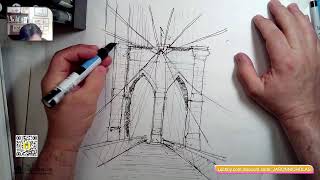
Artist Jason Nicholas sketches the historic Steam Plant in Spokane live, starting with Sharpie outlines and layering watercolor washes in turquoise, orange, and yellow. He uses Tomoe River hot-press paper, a binder clip to hold his journal open, and embraces mistakes as part of the process. The stream mixes instruction with chat interaction and a preview of tomorrow's Brooklyn Bridge sketch.
Chapters
Hey, happy Thursday. Hope you're doing well today. It's 9:14 PM here in New Jersey and I'm on, uh, gonna do some sketching. Maybe for 15 minutes. It'll be a quick session, but, um, yeah, I haven't sketched this week and I thought tonight would be a fun time to jump on. So if you're watching, let me know where you're watching from. If you have questions, comments, I always love to see, um, see you guys in the chat. Hope you're doing well. So today I'm going to sketch And I don't usually pre-plan these. I didn't pre-plan, but I think I want to sketch, um, yeah, I think I want to sketch the Steam Plant in Spokane, Washington. Incredible building. I'll pull up a picture here and I'll share it with you guys. Um, I love the interior of this building. It's so cool. So I'm going to continue a series that I've been doing with this building. Um, so I've been doing everything right here in my Loughby Field Journal. Love this. You might notice something interesting. There's a binder clip here. So I've had people ask me, why, why do I have a binder clip on here? I'll talk about that. This is a, uh, I was working on a sketch of the Brooklyn Bridge. I might be doing something with this on my live stream tomorrow night, so let's put it over here for now. But cool. Anyway, so I have a binder clip, so when I take this with me and I'm out sketching, um, it'll help keep the pages open for me. So I'll show you that. But here are some sketches that were inspired by the steam plant in Spokane, Washington. I'll zoom in a little bit. So the colors you see are not the colors that are actually there. Um, this is, this is a color palette I love to use when I do like industrial type of sketches. Really fun, vibrant colors. Here's another one, but, um, nice to have some New York City stuff in here as well. Let's go to a blank page. Ta-da! This is actually inspired by the outside of the steam plant building. So let's just do this. I'm going to use the binder clip. I'm just going to clip this down. This is really helpful, especially when I'm out in the field and I'm sketching and it's windy out. It'll help keep the pages in place. I usually have two. This is a clip here as well, so you should have a couple of clips to keep things in place. All right, let's see. I don't have my comment window open, so if anybody is watching, I need to open my comments window. All right, so here's, uh, here's the sketch— I'm sorry, the photograph— that I'm going to kind of work off of tonight. So this building was actually a steam plant that did power Spokane, Washington. Um, now it's a converted building. It has restaurant and it's a pub. It has offices and there might be some retail space. I'm not exactly sure about that, but it's a mixed-use building. It's been repurposed. It's incredible inside. There is so much happening. So this will be the reference pic, and I'll just keep it over to the side while I'm sketching here. Let's see, I'll put in this box. All right, cool. All righty then, let me just— I have to open my comment window again. Thanks for joining me, I hope your day is going well. Let's see, I'm on my software Ecamm. Show windows. Where is my comments reactions? Ta-da, got it! Hey, I can see the chat now, and it looks like Sheila's in there. Excuse me, allergy season's here. Have you ever seen or sketched Seattle Gas Works Park? Sheila, no. It sounds intriguing. I'm gonna have to Google that when I'm done. Um, yeah, I'm not sure what that is. I may have seen pictures, but yeah, I have not. So the only thing I've sketched in Seattle, um was the public market there. And that was based on a photo that a fellow Inkling and friend, Linda S., had sent to me. All right, I'm gonna sketch this space. Here's what I'm looking at inside. There's all kinds of beams and pipes and whatnot happening. So I'm not gonna copy this exactly. I just wanna get the essence or feel of what's happening. So first step, I'm going to take my Sharpie because I will come back and add some ink or watercolors like I did on these sketches here, and the Sharpie ink will not bleed. So I just love starting with Sharpie. Also, um, when I use a Sharpie, it's going to sound weird, but I am not worried about making mistakes. And if I used a pencil, I would be sitting there, I would be very careful if I had a pencil, even the though I could erase it because I know I can erase it. And once I know I can erase something, I can draw, erase, draw, erase, and keep— and it just never— for me, I would not make progress. Sharpie, I lay it down, it's down. If something goes wrong, it's not wrong for me. It's just a record of the sketch. It's just part of the process. It's just kind of how I just view that. All right, I know I'm chatting a lot. First thing I'm seeing that's capturing my— catching my eye, I have some diagonal kind of beams happening up here in the ceiling. So this is gonna be kind of really quick and loose. So I kind of have a beam here that's doing something like this. Uh, there's another one. These beams are helping to set up kind of a perspective of what's going on. I do have this really massive kind of ductwork here. So let's just sketch this. Kind of comes down, bends down like this. Almost looks like the letter J. And I love the letter J. Why? Well, because my name starts with a J. Um, so we have some— I like to call these contour lines. It just helps to show the shape or show the curve a little bit. So we have that pipe there. There is this big, big, big beam that's like in the foreground here. We're just going to sketch it like this. So I'm just blocking in shapes. Um, I tend to work with— on my sketches, I tend to work from the top down, and there's no particular reason other then it helps to prevent me from smearing things. Um, maybe that's why I do it. I never really thought about it. I usually start from the top down. I actually— I know why. When I do buildings, I start from the top down because of the roof line. I I usually want to capture the roof and where the roof meets the sky really kind of defines the shape. It stands out. It's just a good place to start. So I kind of have a beam here. I have a door thing happening here, an opening. You get this cool window. I love this building. I was really fortunate enough to go to a workshop here. For a few days, and I still did not get enough time, or I did not spend enough time looking around, um, this, this building. I could spend hours and hours and just get lost in the— just the details, you know, the steel beams, the pipes, the textures, the brick, the tiles, the steel stairs, the walkways. This is This is architectural eye candy for me. So you can see I just kind of have some lines going. I'm going to zoom out a little bit so you can see the full page. And I might add some more. I'm looking down here. I do see a just really defined line edge here for the tile floor. So I'm just going to draw that in. And we're just going to continue it like this a little bit. Oops, there we go. So this line here, and then these kind of steel beams doing this, are helping to set up a perspective that's kind of going into the back. See, I could— I, I really should have angled this down more, and I'm going to do it. This is what I meant by kind of documenting the history of a sketch. So I really wanted to angle this down, and that's fine. I'll take this and I'll just pull these lines down here, and I'm fine with it. I can do detailed sketches if I slow down and take my time, but lots of times I just like to really sketch a little faster because I just like to get into the flow. But this summer I'm going to work on slowing down and Brian live streaming some kind of slow, a little more slow, a little more detailed sketching just so you guys can see that side of things as well. We got this kind of thing. See, the more, the more I'm looking at this, I'm seeing a lot of things popping out, and my brain is saying, yeah, capture all of it. That's the logical thing, but I don't want to do that. I need to really selectively edit out features I feel are kind of going to tell the story or show a vibe that I want to catch here. All right, we've got a pipe there. All right, I think that's enough just of an outline. We'll add a little bit of colors. Hey Sheila, thank you, you will love it. Oh yeah, I'm going to check it out. Becky S is in the house. Becky, hope all is well with you. Great to see you. Love when you guys pop on, it's always so fun, fun for me to see you. So these, these, you know, these sketches started out the same way. This actually had— let's see. Yeah, I was just looking at the amount of line work. This one may have had less line work. This has a little bit more lines happening than this. All right, cool. All right, let's throw down a little bit of color and then I'm going to wrap up in a few. Minutes, I'll zoom in. All right, so I have my watercolor palette here, and I have my dirty water. This is 2 weeks old maybe. And got my brush here and have some ink. So I'd like to, uh, One of my favorite color inks for this industrial— excuse me, this industrial vibe is— I love this Apple Snail color ink. It's just off the charts. It has kind of a caramel color to it. So I'm just going to dip straight into the bottle. We're just going to throw some down on here. Oops, actually I gotta wet the brush a little bit first because it was dry. All right, let's do that. Let's dip it in. Here we go. Um, and I'm just throwing the color down. No, I'm not trying to match anything in a photograph. So this paper in my LAMY is Tomoe River paper. It's a hot press. It's just, you know, smooth paper. It doesn't have texture. I forget the weight of the paper. It's on the thin side. I just want to connect this. It's on the thin side, so I'll show you the back of this in a sec. I want to connect these here, just kind of like a Z pattern. All right, cool. I think that's good for this color for right now. So if I flip this over, you can kind of see the ink isn't going through, which is awesome. It does ripple the paper a little bit, so I do like this paper for these kinds of sketches. Um, can't really throw a saturated amount of ink or water on here, but it works for what I need it for. It's kind of these color washes. Um, I asked— I'm going to zoom in. I actually don't mind. You can kind of see the paper here, it's kind of buckling a little bit, but I don't mind that. I kind of like the way it's just catching the ink in there. For me, I just add some texture and can add to that look. All right, so that was Apple Snail Ink. Um, if you guys have been watching me long enough, you might be able to guess the next color I'm going to use. So my next color is one of my favorites in watercolor and color pencil form. I love aqua. I guess turquoise. I forget the exact name. This might be turquoise. I know on my colored pencil it's light aqua. Let's see, hold on. Oh, it's not in this one, it's in the other one. Yeah, it's light aqua. All right, cool. So let's just throw some of this on. Yeah, I'm gonna, I'm gonna throw some in on top of that kind of brown color, the caramel color. I'm gonna let it turn greenish. This is only step 2. Step 1 was inking in those lot kind of outlines. Step 2, I start throwing down some color, let it dry. Step 3 will either be adding more color, or I'll come back with my Sharpie or Lamy pen or Pilot Precise Pen, and I'll just add more details on top of the color, just black ink. So I just, I really want to throw that kind of aqua there, so I'm kind of intensified it, really laid it thick on the brush. All right, that's cool. Next, I want to dive into, um, let's use some orange. So I have some orange right here just in the watercolor palette. I'm trying to hold the paintbrush kind of loose, so I'm holding it towards the end so I have more kind of freedom with my wrist. Yeah, this is looking cool. This is going to dry really nicely here. All right, so we have some orange on there, and now I'm gonna dive into some yellow. Just turn that off. Uh, there we go. Oh, I turned the wrong thing off. Oops, that's okay. Just wanted to close out so you can kind of just see the watercolor palette a little bit more. There you go. So you can see I'm just grabbing some of that orange, pretty heavy on it, on the brush. Now I wanted to go to actually use some yellow. That's what I meant to do. So let's dip in and, uh, Lemon Yellow. This is how I add some freshness, some zestiness to this. Just, we'll pop some yellow in here, and I like this kind of lemony yellow color. I'll throw some on the floor here. I learned— I've learned with color just to go for it, especially since I'm not trying to match the existing color. I'm just kind of using a palette I like. I don't have to worry so much. I don't need to match a precise red or orange or blue. I'm just grabbing and going. And that's just one way I've kind of gotten some confidence to throw color onto sketches. I never used to throw color on anything. I always felt like I needed to match what was there. Once I, once I kind of got rid of that mindset. I, I'm just— I've— it's freed me up a lot just to have fun, really. And that's why I do this. It's one of the reasons I do it. It's just fun for me to get up here, get the creative brain going, get into the music, kind of escape from the day a little bit, or wind down from the day. So you can kind of see how it's looking there. Uh, it's going to dry pretty nicely. What else, what else? Another thing I like to do is just kind of grab and go with what's right around me. I don't know if I can zoom out far enough, but You know, I just want to use stuff that's right here on my table so I'm not searching, looking for something, because then I might lose the flow or the state I'm in. So if I just grab and go and create, boom, it just, it just comes easier for me, keeps me in a groove. If I have to stop and then go look for a pen or a certain color I just kind of get out of the rhythm a little bit, and it forces me to be more creative, be kind of more spur of the moment, just grabbing and going. I like to call it grab and go sketching. You know what, I'm going to throw— I don't usually use red on these, but on this kind of palette. But yeah, let's pop some red on here, see what happens. I'll let it drip down there. Red is one of those colors that's like, once you throw it down, it's, it's on there. You're not going to miss it. I already got a little bit of red. Uh, there's a color I do want to use. I'm almost out of it in my pan here. It's blue. See if I can sneak any out of this little pan here. I don't know if I can. If not, I have been using, um, we could jump to this actually. I have a, I have a blue preppy maybe we could use. Let's do that. I don't really have enough watercolor paint for the blue, so let's have a preppy— let's do some preppy blue. And we're going to bleed this, so I'm going to just kind of throw some ink there and we'll add water to it. Maybe you can just see I'm bleeding that blue. Um, so this is a Pilot Preppy. I like the Varsity better. If you— I'll show you why. Look, look what I'm trying to do here. I'm trying to kind of dip or dab the Preppy in the wet area because I want the ink to bleed out. Preppies aren't so good at that. So if I can find my I'm just grabbing and going here. If I could find my, uh, those are my markers. See, this is what I talked about, like getting out of the flow, but that's okay. Let's see if I can find it. Is it in here? No, no, no. By the way, I love these Lockbee tool rolls. These are amazing. These are really cool. I've showed them before. I have so much stuff. I have a couple of these. This one has all kinds of goodies in here. I have another one with watercolor markers. Really, really cool stuff. I can't find my Blue Varsity. That's okay. I'll do, I'll do a demo another time when I can find it. Yeah, the, the Preppies don't really work well in wet areas, whereas the Varsity, I can't— I can dab into wet areas, and I like that a lot. This will be cool. Let's just throw some blue there and let's bleed it a little bit. Becky says looks awesome. Hey, thank you, Becky, I appreciate that. So great to see you. Becky is an awesome artist. One of my favorite, favorite things that Becky does are horses. I love Becky's horses that she, she draws and paints. This is kind of cool. I'm, I'm liking this. I'm liking the, the kind of geometry, the patterns on here. It's fun. Let's see. What else do I want to throw on here? I'm just going to grab more of this turquoise. I just really want to— I want to pop some of this out. And I'll zoom in before I wrap up. I'm going to wrap up in about 2 minutes. I'll zoom in and show you guys how this is drying. Uh, there's an area on here that I'm really loving. It looks so cool. I'll show it to you. And I'm just kind of sketching with the paintbrush here, just sketching in some lines. All right, I think that's good for the colors for now. I need to let it dry before I come back and do the next step. Um, I'll probably— next step from— look, I'm thinking it's going to be to add some detail, Sharpie details. After that, throw a little, little bit more color, and then I'll grab some of my favorite colored pencils and go on top of that. Let me zoom in and show you how this is drying. Let me get my little frame out of here. So a pro tip for me is, um, I like these little frames. I just cut like a 2-inch and a 1-inch square, and I like to just hold them over parts of these sketches. Um, they kind of create these really cool mini paintings, and it's also a great way just to focus on the lines and the colors in areas. So let me zoom in a little bit more. And then this is the area I'm really loving right now. I'll use a small square here. Hopefully showing up on camera pretty well. I love the colors happening inside that square, especially the way this is all drawing. It is— it looks so cool in person. I'm also loving this in here. These are called hard edges, how it's drying. I love the hard edge happening. You can see it happening here as well. What else is looking cool on this? This area is drying pretty pretty nicely too. There's some fun colors. There's actually a little bit of sparkle happening. I don't know what that's from. It's like a little shimmer happening in here. I don't know if it's— I don't know if that's being picked up on camera. Let's see if I do this in person. It's— and it's not shimmering. Some of it's shimmering because it's wet, but there's a dry part here that kind of shimmers a little bit. I don't think the camera and the lighting is going to pick it up. I'm trying. It's kind of— it's in this area here, which is really cool. So yeah, I was actually telling my students in class today, like, um, I want to start a YouTube channel just for watching paint dry because I love watching paint dry. It sounds crazy, but I love it. This excites me. To see how these colors are drying. They're transforming, uh, it's changing the character, the feel of things, um, randomly. I love the randomness. So who out there would watch a YouTube channel about paint drying? And there probably are some already, I haven't even looked. So we'll see, I'll do that in my, uh, free time. Becky, you're welcome. It's so true, Becky. I, I love your artwork. Your horses are my fave, um, but I love everything you do. You are so talented. Um, for me, Becky, whenever I think of Becky's artwork, I think children's books. I think illustrations for children's books. That's for me. That's your style. Love it. Cool age metal patina. Yeah, right. Yeah, and that's, that's one of the reasons I love the colors I'm using here is to get that kind of industrial look. So I'm glad you said that. Very cool. Let me know if you guys like this in the chat. If you're out there watching, feel free to say hello. Give me a thumbs up. If you're shy, that's okay. I do appreciate you guys watching and lurking in the background. I was a lurker, you know, I would go on to YouTube channels, watch people do stuff and just kind of sit in the background. There were some live streamers, like New York City live streamers. I would watch them and lurk. Then I started, you know, coming into chat, asking questions. And now for two of them, I get to be a moderator on their YouTube channels because I asked them and they knew I participated. I sent positive vibes in the community. So It's really cool. So don't be afraid just to say hi in the comments. It's all good. Becky says, I would be down for watching paint dry. Yes, love it. This is so cool. So I'm going to put this aside. This is a wrap for now on this one. And let me just give you a sneak peek of what I think I'm going to do tomorrow. So let me move this. Again, this is what I think I'm going to do live tomorrow night. I'm not 100% sure, but let me move this for a sec. Um, some of you guys may have seen me— I know Becky, we did this in a workshop once or twice. So I have the Brooklyn Bridge here. It's fairly large sketch. You can see my hand here. And I like to do— this is tracing paper. I like to use these markers on tracing paper, and you almost get a really cool stained glass type of effect. I might have one here I can pull out. I know I have them, have them somewhere here. Time to go to the magic drawer. Doo doo doo doo. We need some magic drawer music. If anybody wants to recommend some magic drawer music, let me know. I hope I can pull it out. If I can't pull it out now, I'll definitely show you tomorrow. Womp womp womp. Let me check one more drawer. Ah, got it. Perfect. Found it, found it, found it. Here we go. Here we are. So, so I call this my Inky Inky Night series. You might be able to tell why. The sky is kind of very loosely inspired by Mr. Van Gogh. Or is it Van Gogh? This is tracing paper with these markers, and you get a really cool effect on it. I haven't done this in a while. I thought it'd be fun maybe to try it here on this Brooklyn Bridge. This is actually on Yellow Trace. You can see kind of down here. So I thought we'd, um, try it on this one. So yeah, it's called Inky Inky Night. I've done, I think, 4 of these. I've— I sold one, I gave one away, and I think I sold one. Oh, I love these. These are so cool. They are delicate though because they're on really thin tracing paper. So let me put this back in here and then we'll wrap up. I need more magic drawer music. All right. Um, yeah, so here we go. So we have— I have a whole series of these markers. You can see I haven't used them in a while because they're actually dusty. So it's been a while since I've done one of these. So yeah, so I think tomorrow night I might play around with this a little bit. I can't give you a little sneak peek. Let's just throw some glue on here. We'll just throw it here, I guess. Warning though, if you do ever use these markers, they are— wow, make sure you're using them in a well-ventilated space. They do stink. And this is— this technique is about— it's definitely about adding layers, and we'll talk more about that tomorrow when I work on this. Um, this again, here's a— here's when, when, um, watching this dry is where the magic happens. Let me zoom down. It might be hard to tell, but it's drying, and as it's drying, it's doing some cool things. My finger just locked. That was weird. I just had my fingers kind of I had to unlock it. Um, you can see I'm just dabbing this down, but it dries and does cool things. And this is a process that's meditative but takes a while. All right guys, so that's what's in store for tomorrow. Becky says, I would be down for a while here watching paint dry. Yeah, awesome. Hey guys, thank you so much for watching. I appreciate you. Um, hopefully you enjoyed tonight's start of this sketch here. Um, keep using your creativity for positivity. I do appreciate all so, so much, and my plan is to be on tomorrow night. So thank you guys, enjoy the rest of your evening, have a fabulous Friday, and I'll see you soon. Peace and live creatively. This is Jason Nicholas Nicholas from The Ink Spire Life. See you soon, guys. The finish button's right there. Take care. Good night, guys.





