The INKspired Life - Architectural Sketching
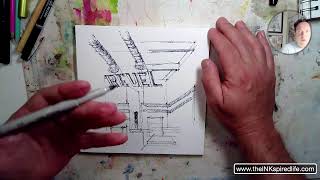
Architect Jason Nicholas sketches the interior of Revel 66 Coffee in Spokane with a Sharpie, explaining his process for perspective, neon signs, and exposed ductwork. He uses contour lines and hatching to render different materials, and plans to add watercolor later. The sketch connects to an Architecture 2 class assignment where students redesign the school store.
Chapters
Hey everybody, hope you're doing well on this, uh, Sunday evening. Hope all's good. I'm just popping on for just a few minutes here. I didn't do any sketching today, so I figured I'd pop on and throw some lines down on paper. Um, yeah, I hope you had a good weekend. So I'm actually sketching a coffee shop that my friend owns in Spokane, Washington. Um, really cool little shop. I had the chance to go there, man, I guess 2, 3 weeks ago now, maybe probably 3 weeks ago. Cool little place, and I figured I'd just do a quick sketch. Just kind of block it out a little bit. And the name of the shop is Revel. Oh my gosh, 66 Coffee. So you could see, actually, you see the letters here that say Revel. These are really cool neon lights over here that hang from the ceiling. So I thought that would be cool to try to sketch that on here. So we have a perspective view looking kind of back into the place, and I'm using a Sharpie because I want— I might add some, uh, color to this, maybe watercolor or an ink wash. I'm not sure yet, but I like to start off with a Sharpie pen in case I add ink or watercolor, then the black ink won't bleed because Sharpies won't bleed when they get wet. Anyway, hope you guys are doing well. Yeah, this is so much fun. My Sharpie is kind of dying. It's running out of— running out of ink, which is okay. Hey, Becky's in the house! Becky, I hope you're doing well. It's always great to see you. I had the pleasure of seeing a sketch— I think a scrapbook, I'm sorry, a journaling book that you custom made. So really cool. I loved it so much. Really, really, really awesome. Yeah, my Sharpie is really running out of steam here. I might switch, I might switch over to something else. We'll see. So this is kind of a counter area. There's a big showcase here happening, like a display case with some kind of maybe pastries in it here. Yeah, the Sharpie has had it. Next. Next Sharpie, please. Yeah, this one's a little better. Awesome. So cool, we have a display case happening here and we have some tables going on. Now, that'd be fun to sketch this perspective just to see if I could get a sense of depth, kind of a tight little area I'm working with here. It's coming up pretty cool. Yeah, this Sharpie is much better. The other one was, uh, was telling me it was time to retire. Even Sharpies need to retire once in a while. I need to retire soon, like go to sleep. It's been a long day, a good day, but a long day. Got some stuff done and have school tomorrow, which is awesome. Love it, love it. And this is a— some kind of cart here that's— it looks like it has like, uh, maybe plates or utensils in it hanging out there. Cool. And up on the ceiling we have these cool beams coming across, and we also have some ductwork. Here we go, some kind of exposed ductwork, ductwork in the ceiling for the heating and cooling. Has that cool industrial vibe to it, which I love so much. And these ducts kind of go— not ducks as in quack quack, but ductwork. We have these, this ductwork that kind of comes like this across the top of the ceiling, and, uh, it's curved, so I'm gonna kind of just move my paper a little bit and do some contour lines on here just so it looks like it's rounded. So I'll turn it over. You can kind of see what I did there. So we have a duct coming back like that. I do love this industrial look with the exposed ductwork. I'm actually— we're incorporating it into a project I'm working on currently, and I, I did a little bit of it in my house. We had a garage— well, it used to be a garage And then we bought the house. The previous owners converted it into a, a kind of rec room area, but it really needed a lot of work, so we ripped it, ripped it out. This was before COVID well before COVID We ripped it out and, uh, redid it, and I put this cool exposed ductwork in the ceiling. That was fun. We get some more ductwork coming across here. Boom. And I'm just gonna again just kind of do these contour lines just to give the illusion that these— this ductwork is curving here. There you go, you can see it right there. I might curve it up a little bit more. I'll add some shading and shadows. So it has even more depth to it. At some point I'll do that, but I think for now you can kind of get the idea, kind of see what's happening. This is a little hallway that goes back in here, some sort of a hallway back in this area. There's a door back. Let's see, there's a door back in here. Cool. Now we have a counter over here. Pretty awesome. And then the— this wall is, uh, let's see This is kind of some kind of like wood paneling going around. There's a lot of stripy things happening, so we have light wood and then these bands here are kind of a darker I'll hatch them in. These are dark bands that go across. So I do that, you can kind of see the bands. Let me do some hatching in here as well. And then those bands do wrap around the side here. I'm literally just kind of scribbling this in here to get— just to create the idea of, uh, just darken it up a little bit, those bands. And we have some going across here as well. Cool. So we kind of have the start of it. Uh, I like the way it's looking. Definitely want to come in and add some darker lines in places. Pop some of the shapes out more, um, add some depth here to these, these awesome letters. I'll do that right now just by adding another line here. There we go. So I'm just shading this in to create some depth on these letters up here hanging from the ceiling. You can actually see that. Let's see, you can see the— see it coming across there. You can see it across the top as well. Cool, there you go. I think the letters are popping out a little bit more. Cool. Let's see, I'm just checking some tech here. Checking the tech. Let's see. All right, let's see. All right, just clicking some buttons. There we go. Make sure we're still on. Becky says very cool. Hey, thank you, Becky, I appreciate that. Yeah, this is looking pretty cool. Um, I like it. I'm gonna add some shading, I think, on this ductwork here just to make it pop a little bit. And I just realized I didn't put put any music on tonight. Usually have music playing. I think it's on. I don't know if you guys can hear the music or not. Beefing it up a little bit. Let me know if that music's too loud. I'm gonna be on for a couple more minutes here. Um, so I want this ductwork to look rounder, and I think to do that I'm gonna just add some shading here. You might have noticed I did turn the page or the paper sideways here just to give my hand a better angle to get these kind of curved lines going on. So I think that's helping to give it a little more rounded look to it. And then we'll do the same thing over in this area as well. I probably should have exaggerated the curving even more, but that's okay. I think the point— I think it's, it's okay. I think it's getting the point across. I definitely feel like it could have been even more rounded. I could make it thicker if I want to, and it does continue down this way as well. But I think that shading helps a little bit. So it was really fun as I did a sketch outside of this, um, outside of Revel when I was— when I got there, before I was meeting my friend there. And, um, it was awesome. I did a really, really quick sketch and gave it to, to my friend the owner. And it was— it's always fun just, you know, doing a sketch, giving giving it to someone. I just think it means something when you're able to create something from your— with your hands and your imagination and from your heart, and you give it away. I just think it's a really special way to connect with people. I used to always make my Christmas cards, um, for years and years and years, make Christmas cards and and give them away, and I haven't done it in so long. It was just always— I remember there's just the fun of the reactions of people when they got their Christmas cards. It was so cool. I guess I just, I just have never made time to do it in the past. I don't know how many years it's been since I've done Christmas cards. 8? Maybe 9. Yeah, this is looking cool. I think it's— I think it's starting to come together. I like it. As I'm adding some more ink and lines to it, it's starting to take even better shape. And let's see, I'm gonna just sketch a couple lines in here. There are shelves in this glass display cabinet. So my Architecture 2 students are starting a new project this week, um, where they're actually going to be helping to redesign our school store. How fun is that? So they have a sketchbook assignment this week to sketch a small store, and I gave him a bunch of different ones to look at. So I figured I would do my homework and sketch a small shop as well. So I'm doing— so you guys are watching me do my homework live right now. Got my homework going. These are beams in the ceiling here. I'm being a little bit neater and cleaner than I usually am. It still has that loose wonky look to it, but the lines are— I'm just realizing it— they're a little more straighter than usual. I don't know if you guys have noticed that, and that's cool, there's nothing wrong with it. But my hand is— I'm just holding the pen a little bit tighter, I've noticed. So as I'm holding it tighter, I'm drawing my lines a little more precise. So when you're sketching, if you want to keep it loose and wonky, hold your pen, your pencil loose. Sometimes I'll hold it really far away from the point, like back in here. Sketch very loose. If I want it to be tighter and cleaner, I'll hold, hold it closer to the end here, and I could hold it, um, much more sturdy, and the lines are a little bit cleaner and tighter. So you can play around with that. Move your hand around where it is on the pen or the marker, and you can get different effects depending on how tight you hold it. So tonight I did notice I'm gripping it a little bit tighter and a little more precise than usual. Cool. But it's good, I like it. Sometimes it's cool to mix things up. All right, this is kind of a glass showcase. One of the way architects like to show glass and sketches is kind of have these hatch lines going like this. Just to indicate maybe some glass happening here. There we go. So we got some glass in front of that display case. All right guys, I think that's a wrap for tonight. So, um, thank you for joining me. It's 10:34 PM. I gotta head off to Sleepyland. Hey, Linda H is in the house. Good to see you, Linda H. Hope all's well. Thank you for joining. Um, you guys are awesome. Thank you everybody for watching. Becky, thank you for your comments. Linda, it was great to see you pop in as well. Uh, I am off to sleepy land and, uh, yeah, feel free to go back and watch the, uh, replay and I'll probably do more work to this. This one is not done yet. I feel like I'm gonna come back and add some more line work to it. And, uh, probably a splash of color here and there. All right guys, thank you so much. I appreciate you all. Take care, have an amazing rest of your evening, and happy Monday to you. Take care, have a great, great night. Peace, and live creatively. I'll see you soon.





