The INKspired Life - architecture + urban sketching
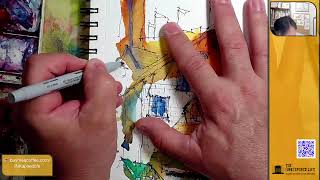
In this live YouTube sketching session, Jason Nicholas walks viewers through his ongoing mixed‑media rendering of a historic building (likely the Old Faithful Inn/Yellowstone Lodge). He demonstrates how he builds the drawing step‑by‑step—starting with basic line work, adding hatching for shadows, and layering color with Sharpie, watercolor pencils, colored pencils, and a red Pilot pen for accents. Throughout, he explains perspective tricks, composition framing (zooming in on windows, doors, chimneys), and how to simplify complex architecture by focusing on smaller sections. Jason also shares practical tips (rotating the sketchbook, using light vs. heavy lines, revisiting areas to pull out details) and his artistic philosophy, emphasizing the “ugly‑duckling” phase, persistence, and the value of stepping away and returning to a piece. The stream includes frequent audience interaction, acknowledgments of viewers, and real‑time troubleshooting of internet/streaming issues, which he uses as a chance to model resilience and keep the creative momentum.
Chapters
Hey, um, happy Tuesday! Hope you're all doing well. I thought I'd bring you along for just a little quick sketching session. I'm gonna keep working on this sketch I started, oh man, 2 days ago? I can't remember. Maybe it was a day or 2 ago. Um, I thought I'd come back, maybe just add some more details with my Sharpie. This is based on a picture sent to me by my friend, uh, Michael, and I think it's— I don't— I think it's the Yellowstone Lodge Inn or Old Faithful Inn, something like that. It's a really incredible building. So let me know where you're watching from and if you can hear me okay. I was having some internet issues before, and, um, I tried to get on earlier, but it was not working. So right now I'm just sketching some— these are brackets that are helping to hold the roof overhangs up, and they're actually, um, looks like they're made out of branches. Hey, I see D-Ray is watching. D-Ray, hope all is well. Great to see you. So this is a dormer area here. Let me zoom in a little bit. That's probably better. I'm going to sketch a couple— there's a couple windows in here, it looks like. So let's show some windows happening. We have some more windows down here as well. So hopefully you can see as I'm adding some of the, the inky details, it's coming to life a little bit more. It's getting a little bit more character. Let's do some hatch lines because there's some definite shadows kind of under this overhang, which I have purple, uh, watercolor pencil here, but we're going to do some hatch lines on top of it. I'll zoom in closer and you can see how this will help give it a sense of even more, um, depth and shadows. Just by doing these diagonal hatch lines on here. We'll do the same thing under this overhang and make some room here as well. I'll zoom out so you can kind of get a better look at it. So I think it's coming together really well. I like the colors. These are not the colors of the building. The building is very brown, and I just kind of went with my color, the palette I like to use, um, bring my own twist to it. And I, I do like the way it's turning out. Hey, Chip is in the house! Chip, great to see you. Hope all is well, man. Awesome. I appreciate you guys tuning in. This— it's so cool to have you watching. Thank you so much. Yeah, I was trying to get on man, about 45 minutes to an hour earlier, and my internet just— I— it wasn't— didn't have the, um, upload or download speed, whatever it needed to work. I have no idea what's happening, but I am here now. Thank the Lord I can do some sketching. Well, I would have sketched anyway, but it's, it's more fun to come on live and just to share you with you guys with— I know what I'm working on and maybe put some tips out there and do a little bit of motivation, because I love— I just love doing this stuff, and I hope my enthusiasm is infectious and it catches on. This is coming out really cool. I'm liking it. I'm going to leave this kind of really blank here on this side. I like— I do like all the white happening as well, but I do need to add a little bit more whimsy to it. So I'm just thinking about breaking out some colored pencils I have here. Maybe we'll throw some colored pencil down on here. This is some kind of door down here. Let's just show some hatching in here as well. Give it a little bit of depth here as well. I do want to capture some of the texture or materials of this, this chimney, which is, um, it looks like it's logs. Looks like it's logs, almost like a log cabin look. For this chimney. So I'm imagining obviously there's some kind of air clearance between the, the wood and the actual flue of the chimney, but it's a really cool, um, it's a really cool aesthetic. I'd love to read more about this building. And then we're going to bring some down in perspective, kind of down this way. Make sure I stay on camera here. I'm going to rotate my book so it's kind of easier for me to sketch. Don't be afraid to move your paper around or your sketchbook around. Turn it, spin it. It's often really helpful to try to create lines instead of twisting and contorting and bending. I am not that flexible, so it's easier for me to turn this. I am noticing though the top of my chimney is My perspective is, um, this is more of the right line here, not that piece. It really— I really want to come down at this angle to give the idea of depth. That's kind of cool, I'm liking it. Just to give the idea that was— there's a material on there, it's not stone, it's definitely wood. Is there stone? There is stone on the base. Under these windows. I kind of just dropped— I kind of stopped this here. It does continue a little bit down to the ground, but maybe what I'll do is I'll just show— let's see, just thinking in my head here a little bit. Um, let's sketch a little bit of the stonework that's under these windows. I want to keep it really light. And loose. I'm almost thinking of going with pencil. I don't usually say that. If I had a fine liner here, I probably would grab it. Actually, maybe I have one. Hold on one sec. Do I have any fine liners? I have a whole drawer of them here, I think. I don't know what small— the small size I have is. I just want these, the stones here, to be pretty light. I could do it with my Sharpie if I just don't push down too hard, but let's see if I have a small— no, I'm looking for a smaller— it's okay, we'll just, we'll just Sharpie. We'll Sharpie it. This is just a case where you just gotta toughen up and just throw it on there. Toughen up there, Pilgrim. Who is that, John Wayne? Just toughen it on up there and throw down the ink, Pilgrim. All right, all right, that was bad. I know, I know. Um, I used to do really good impressions in college. I would do a mean Sean Connery. Um, oh my gosh, who else would I do? Oh, I did a lot of impressions. Carson, I used to, I used to try to do a Johnny Carson impersonation. I'm trying to think, way back when I used to love, um, Reagan, President Reagan impression. Yeah, that's what we did late night in the studios when I was working on my architecture projects. I'd work on my impressions. Really weird. All right, but I digress. And that's fun. It's fun to digress sometimes, right? Just throwing some window kind of grills in here a little bit. So that's all I'm going to do for the stone, just to show a little bit happening. I kind of, I kind of like less detail. I like the unfinished look. I'm really digging this one. T-Ray's like, "Pilgrim." All right there, Pilgrim. Um, yeah, this is good. Fortunately, I can sketch architecture pretty good, uh, better than impersonations. We have some flags. Let's throw some colors on. I'm going to break out, um, some red there. Looks like there's red flags on top of this building. So for the red, I'm going to use my favorite way to, to show red on sketches— a red Pilot pen. So let's just throw some on here. I don't know if I'll, I don't know if I'll bleed the ink or not. I might not bleed it. We just keep it kind of like this. Looks like there's an American flag up here. We'll just kind of show some stripes on here. Maybe something like that. Yeah, this is cool. I'm actually liking the sketch. Yeah, he's going to do— he's going to throw down red somewhere else. Let's do it. Alright, cool. Put a little bit of red on there. You know, this color had to come out sooner, sooner or later. Alright, cool. Hey, thank you, D-Ray. Yeah, I'm having internet issues. I appreciate letting me know that. Yeah, I don't know what's up with the internet service. So I appreciate letting me know. Hopefully, hopefully you guys don't lose me. I appreciate you sticking around the best you can, so thank you so much. If not, I get it. Darn internet. Hey, Paula Loves Art, good to see you, Paula. Hope all's well. I might be having some, uh, streaming issues, Paula, since you just joined us. Some tech issues. I don't know what's up with my internet signal, but I appreciate you being on here. Just going to turn this. I want to do some— so this is, uh, looks like some kind of shingle siding here. I don't know if it's cedar shingles on here. Maybe let's add a little more texture, just do some verticals. I'm holding the Sharpie really light, kind of just dragging it. And let's pick up some of these verticals a little darker just to pop out some of these shingles. So lots of times these mixed media sketches are kind of about going back in and pulling out details, pulling out shapes you see, um, because after I put the initial color down, sometimes you lose some of what's happening. So you could always go back and pull it back out. You'll see me sketching over the same areas multiple times. I'll kind of go in here, um, you know, you'll— the lines are kind of really loose and almost messy looking, which is cool because I like it that way. So I'll go back over lines and try to pull them out, but I'm not trying to trace over them exactly. Again, that just keeps it really kind of loose looking. I was coming here and pull out some of these, these panes of glass here. I'm not coloring every single rectangle Again, just keeping it— just kind of hinting at what's happening. I like to hint a lot of times rather than fully detail. For me, um, hinting is a great way to, to kind of have you or the viewers look and participate in the sketch more, kind of use your imagination, fill in the blanks. And I just wanted to pull out these kind of these branches, branches, these brackets. That are underneath the roof overhang. So I thought this turquoise would be a cool way to pop those out. Watch you do the same thing here. Just want to pull these out a little bit. Cool. If you are still streaming, let me— if you are online and I'm streaming, let me know. Is my signal really, really horrible? I'm just curious. There we go. I like that. This one might be done, guys. This might be done. I kind of like it. Um, let me see if I can pull out a frame. I may have to visit Big Box Store soon and just buy some frames or some mats. Just— I just like to look at these and frame different sections out. I'm looking for my bigger black mat. I don't see it. I'm just doing a tech check right now. Alright, we're gonna keep moving forward. I think I'm still streaming. Back to the stream. So far so good now. All right, thanks, I appreciate that. Cool. All right, let me— I can close this. All right, I was just checking out YouTube to see if it was actually streaming still or not. All right, cool. Let's zoom in and see this thing framed up. You know, if we just even frame this kind of section out here. What I love about this is that, you know, it's not the entire building by any means. This building's huge. I love just focusing in on parts of buildings and exploring those. I think that's a lot of fun. It's also a little less overwhelming when you go to sketch a building. That way you're not thinking, hey, ah, I gotta sketch the entire thing I see. That's not true. You can just pick a window, a door, a small section, a chimney. It doesn't matter. Pick something that really interests you and just kind of zoom in on that section and break it down, kind of like I did here with this sketch. So that's kind of just a, I guess, a pro tip for one way to kind of conquer your fear of sketching buildings. Yeah, don't feel like you need to sketch the entire building. Now if you want to, obviously do that, but it's not necessary. Let's try— I want to try even a smaller little framed area. Sorry, I keep zooming in and out with the camera. All right, I even like this kind of composition here is kind of cool, right? The chimney kind of is just running off here. Let me— if I shift it over a little to catch— I think I like— yeah, something like that looks kind of, kind of cool. Let me a little bit down. Yeah, I think I like that. Has some really interesting colors happening on here. I like the windows kind of going up at an angle, the vertical of the chimney. I like the white space on top and the white space at the bottom kind of balances off a little bit. So that's pretty— a pretty cool way to frame it there. Yeah, I'm focusing with the frame. Yep, D-Ray's got it there. Paul says, love it. Hey, thank you, Paul. That's so cool. I appreciate it. You know, let's move the frame down a little more. We could focus on this part of the building. I don't like this composition as much. It's very heavy, very, very heavy. Very— it needs to breathe a little bit. I don't think this is breathing, whereas this For me, this is breathing by having the, the space on top, the white, and down here as well. Just for fun, let's do a horizontal composition. No. Shift it over this way a little bit. Maybe something, maybe something like this could be interesting, this kind of frame. Again, we have kind of the white and the color here kind of balancing each other out a little bit. I don't mind that for horizontal, but this, this really is meant to be a vertical composition. And again, here's the, here's the whole thing. Hey, Donna says nice painting. Thank you, Donna, great to see you. Thanks for popping on. Yeah, I, I like this one. I think this one's done, guys. I don't want it add anything else. Yeah, not— I don't even want to do like a background color, like a sky or anything. I just want to, I think, just keep it white. I really am loving how it just kind of dies off here and the other side, and also even the bottom. I love that. Rather than doing this, let me get a scrap paper here. You think I have enough scrap paper? I do. So, you know, I could have done something like this. Let's really do a simplified— here, I'm going to just draw just a real simple kind of structure here. Boom, boom. Let's do a stone foundation, put a ground on there, and I'll show you what I'm thinking, what I'm trying to point out. All right, let's say we have a quick little building here. All right, so this is completely all finished. You can see it if I put a frame around it. It's, it's done, and there's nothing wrong with that. This I like because it's not done, right? I don't have those hard edges around the whole building. No, I'm not going to do it. I was thinking adding some more purple on here. I don't, uh, the rest is— I agree, vertical. Yeah, this is— this came out really cool. It def— it had its ugly duckling phase. Like most artwork, most sketches, there's a point where we're like, oh my God, this does not look good. Um, but you gotta work past that point, right? Don't let that stop you. I was there. I hit it with this. I'm like, oh my, this is not cool. Um, and that's when you step away and come back to it. And right, I, I really think this finished, uh, pretty solid. So we all have the ugly duckling phase in whatever we're creating. It doesn't matter. Push through it and you'll end up with— you'll be surprised with the results. You might not love it, and you may— or you may really, really love it, but you don't know until you push past that point. So don't give up. You could always walk away and come back to it. This is the only thing that's kind of bothering me a little bit, is I mucked up the top of that chimney with these lines. But I don't think— that's another reason I'm kind of framing it, is to cut that off. But that's okay. So I know, I, I know what I messed up on it. Um, one of the reasons I was doing a red line here was I was trying to bring your eye to follow the red. You want to bring this down a little bit. I still think it's really awesome. All right guys, let me know if you have any final questions, comments, or thoughts as I wrap up. I do appreciate y'all watching. This is always This is what I love doing. It's, it's my thing. Um, really cool. What else do I want





