The Inkspired Life : Loose Style Architectural Sketching - Biltmore House : Part 1
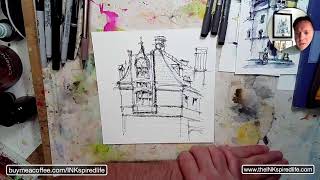
In this 90‑minute live stream, artist Jason Nicholas demonstrates his “loose‑style” approach to architectural sketching by working on a section of the Biltmore House, a French‑château‑style estate in Asheville, NC. He explains why he favors quick, freehand sketches over precise technical drawings, outlines his preferred paper size (8" × 8" Fabriano), and walks through his personal toolkit—including Sharpie markers, Lamy ink pens, Preppy pens, Winsor & Newton Cotman watercolors, Prismacolor colored pencils, Pilot Varsity and Precise V7 pens, Aqua Brush, and Liquitex acrylic inks—while sharing a link to his website’s tools page. Throughout the session he sketches the roof, dormers, chimneys, and stonework, using a Sharpie gel pen, hatching, and texture techniques to convey depth and character. Jason engages with the live chat, answers questions about supplies, discusses his creative “zone” experience, and reflects on the historical and material aspects of the Biltmore House. He also mentions future ideas such as live cathedral‑sketch sessions and references past workshops. The stream ends with gratitude to the community and a reminder that his content is supported via Amazon affiliate links.
Chapters
Hey everybody, happy, um, Wednesday night, August 9th. Hope you're all doing well. It's 9:17 PM here in the Garden State of New Jersey. I hope you're doing great. Um, wow, I see some people popping in. Arrowsack, great to see you. Glad to catch you again. Yeah, I'm so glad you're in here. It's awesome. Linda H: Hello Jason and everyone. You're so polite, it's awesome seeing you as well. Um, we got— hope you guys are having a great day. I probably said that a thousand times, but I really mean it. Um, I repeat myself a lot. Um, yeah, so I'm popping on doing some architectural sketching, loose style tonight. You guys know I love loose style architectural sketches, and here's a couple of examples, and then I'll tell you what I'm gonna work on tonight. Boom, boom, and boom. Let's see if I get them all on screen. I think you can see all those. So what do I mean by loose style architectural sketching? Let's zoom in on these a little bit. So this is the Biltmore House located at the Biltmore Estate in Asheville, North Carolina. An incredible, amazing, awesome, inspirational architectural masterpiece in the style of a French château. It's a 250-room estate and I believe it was built gosh, the late— I want to say like 19— I'm sorry, 1890, like 1895, somewhere in there. Um, and these are really loose style. It's no hard lines. I didn't use a ruler, I didn't use a straight edge, so they're not meant to be like technical architectural blueprints. These are really meant to be quick, fun loose, whimsical ways of me just to capture the spirit or feeling of a building. Um, I'm going to bring a picture on screen. I'll show you what I'm going to use tonight as inspiration. I had the fortunate pleasure of going back— going to here back in March for the first time. I need to go back. It's, it's like an 8,000-acre estate gorgeous. I didn't— I barely scratched the surface. I was only there for like 2 hours or 2 and a half hours. Um, but yeah, I mean, look at these lines. There is not a straight line on here, which is fun for me because being an architect, I do technical drawings that are very, very precise, but I love having this other side that's really free. So that's kind of just a quick intro, so you know why I like loose style sketching. I'm gonna bring this image on screen that I'm gonna use tonight. I'm gonna do another sketch right here of a part of the Biltmore Estate. It's just a very small piece on the front of the building, the left wing facade here. And lots of times with architectural sketching, I like to focus on just parts of the building. I could do the overall building, and I've done a sketch of this, the overall, but it's fun just to narrow in on a part of it, you know, whether it's a section of a building or a window, a door, or a chimney. So it's really fun just to focus on different areas of architecture. And today I'm going to do a quick sketch of, of inspired by this. It's not going to be exact, it's not going to be the same color. I might leave it black and white I don't know. I honestly have not planned it. The only thing I did think about is what size paper I want to sketch it on. So these sketches here— let me take this off screen for a sec— these sketches are in 4x8. I love this format. It's a nice vertical format. In this case, you could do horizontal as well. These are Sharpie and some watercolor, so it's a mix, mixed media piece, and a little bit of colored pencil, I think. And that was done on this paper here, it's Fabriano. I'm going to use the same type of paper, but I think I'm going to use a square format. This is 8 inches by 8 inches, so, uh, we'll sketch on this tonight. All right, very cool. And I'm only going on a very, very short time tonight. I'm limiting myself. I'm trying to— I could go on for an hour or 2 hours easily, but I'm trying to compress my time a little bit to force me to be quicker and looser that way. Cool. Let me look if there are any questions before I get sketching here. Since I caught you today, I'm going to be art shopping this week and would love some basic inks to start with, just like you do. That's cool. Sometimes you use pens and stuff. Do you have some basic recs? I do. So, um, I'll go over a couple things and also share my website link with you. If you go to my website, I'll pull that up now. I have a whole page of things I like to use, all right, on my website. So I'm going to pull that up and put it, put it in the chat. Just give me a sec here. So it's www.theinkspiredlife.com. Um, so go to the home page, it's on there, but there's also a page right here, check out my tools and materials. All right, boom, I'm copying it. I'm going to put it in the chat as we, as we speak. Isn't this fun? I'm just going to click on this icon and we're back here. All right, cool. So I just pasted in the— so if you go to that link, there's a kind of a list of supplies and things I like to use, um, which is cool. But I can go through what I used on here, on this. Actually, we'll use this as an example. Um, so this, like I said, was created with really minimal amount of materials and supplies. This was done Sharpie. I love Sharpie pens— markers, sorry. The reason I use Sharpie markers is because if I'm going to add ink or watercolor or wash to these sketches, the water is not going to make the Sharpie bleed. So that's why I typically would start with this Sharpie. If I want black ink and I want it to bleed, which I do do quite often, I'm looking for my Lamy pen. Where the heck is it? Here we go. I like to use— here's my Lamy pen. I like to use the Lamy ink, black ink. This is fun for bleeding. So I'll typically use that. This should be on that sheet as well. Um, watercolors, I like to use Winsor Newton. This happens to be a Winsor Newton Cotman watercolors. Uh, this is a travel kit you can get from them. There are some, some replacement colors from Cheap Joe's. There's a turquoise in here from Cheap Joe's and a red as well. Um, but I typically will use Winsor Newton. As far as other inks that bleed, um, I'll kind of just pull this out for a sec. By the way, another product I love, and this is kind of a plug for Lochbie because I actually love their products. This is a Lochbie, um, pen case. I have it crammed with a bunch of stuff. It's cool, puts stuff in, travel with. So in here I keep another ink I like to use for bleeding, are these Preppy pens. So I have a bunch of Preppy pens. Um, I like to use Aqua Brush for traveling, filled with water. So I have an Aqua Brush in here. And then, um, color pencils. The brand I like to use is Prismacolor. I think it's upside down, sorry. Just turn, just turn your head. Um, no, it's Prismacolor color pencils. They're not watercolor pencils, they're just regular color pencils. I know you asked for inks, I'm kind of going down a different trail here, so hopefully that's okay. Um, another ink I like to use are these Varsity pens by Pilot. Pilot Varsity pens. Um, flare pens as well. I think we've talked about Sharpies. I like using Sharpie highlighters. And an ink pen I love sketching with is right here. I love using Pilot Precise V7. There's a V5 also. I think there might be a V3. That's the diameter of the nib or the point. I like to use V7. Which is kind of a— it says right there, kind of a fine point. So V7. Um, I also like to use Pilot Pen red pens for bleeding red ink or sketching with red, and their blue ones as well. What else? I have a bunch of other inks. I haven't used them in a while. Um, acrylic inks. Sometimes I'll work with acrylic inks, Liquitex acrylic inks. Different colors. I haven't used it. I actually haven't used them in a long time. And another brand I like to use is Birmingham Pens. Birmingham Pen Company. I don't think these are on my website on the list yet. Cool company. Not cheap inks, but I don't use them a lot. I mean, they go a long way, so, and they're good quality stuff. Hopefully that helps. This is kind of a quick rundown of some of the things I like to use. I may have left some stuff out. I start— recently started using Sharpie gel pens. This is a really cool Sharpie gel pen, retractable point. Um, has a real nice dark line to it. Actually, you know what, maybe Maybe we'll sketch the builtmore. Maybe I'll sketch with this gel pen, play around with it tonight. Cool. All right, that's fun. I love geeking out and talking about that stuff. So fun. Um, so let me just— I'll do some sketching. I'll come back and look at the questions in a few minutes. Just pull up my image here. Cool. You guys are awesome. By the way, if, if you guys happen to go to my page I shared with my tools, and it— there are links there that'll bring you to Amazon. And if you actually buy from my links, I get like pennies. I don't get a lot of money. I get a little bit of money. Amazon does not raise the price, so it doesn't matter if you buy it through my link or not. It's going to be the same price. But if you do buy through my link, I'll get a little, just a little bit of a kickback towards me. And again, it's, it's really not a lot, but you know, could add up and I can get another pen maybe with it. So I'm just throwing that out there. All right, let's get some, build more stuff. Can you guys see that my screen is set up differently on my computer? Am I zoomed in too close? We'll find out. So again, I'm going to be trying something different. I'm going to sketch with this Sharpie gel pen just for the heck of it. So when I sketch architecture buildings, I usually like to start with the top, the roof area, and work my way down. And I'm actually looking— in this case, I'm looking at that reference picture because I can't sketch this building from memory yet. But just look how this gel pen, this really just glides on here. Pay attention to how my hand moves when I'm sketching. You'll see I'm holding it very loose. It's almost kind of shaky, which is great because that's kind of the aesthetic I want. I like that loose, shaky look. So I'm kind of working with this roof area here. There's a cool piece coming out here. This building is highly intricate, a lot of details. They had a, um, Biltmore had a whole, I guess, like a mini town set up with craftsmen that he brought over. I believe from Europe, to craft a lot of the features of this building. You know, this French château look was something you wouldn't find commonly, still wouldn't really find commonly here in the US, but he had the wealth and means to set up a village with these craftspeople. Really cool. So this is probably the fifth time I've done a sketch of part of this building. And I haven't sketched this part of the building at all yet. And sometimes the first time I sketch a building or part of a building, it's even looser because I don't know the building that well. I don't know the features or characteristics of the area I'm sketching that well. So it's gonna be very loose, very wonky, and I like it. I like that. You know, this building, this French château, parts of the facades are very symmetrical, very, very balanced. You can see this piece is not centered, it's not symmetrical, and I don't mind it for this, this sketch. Sometimes when it— you have a symmetrical facade and it's off-center, to me it just adds a layer of interest and wonkiness to the sketch. We got some windows or something happening back in here. This is a little balcony kind of overhanging here. I'm not gonna fit the whole tower in that picture, so we're just gonna do the top part. And there's some perspective, so to give the idea that there's some depth, this angle's back. We're going to exaggerate into some angles coming back like that. Boom. Got some windows happening here. I'm not even sketching the entire rectangle for the windows. I'm leaving it very, very loose. We have these horizontal bands of stonework. This kind of ledge happening here. So I wanted to show that a little piece of the building comes across and down here. There's an archway. Something there. Boom. Um, really cool chimney up top. That's what this thing is here. It curves, actually. This is the top ridge of the building. We have a little dormer. So dormers are little projected areas off of roofs. You see them on houses a lot. Sometimes they're called doghouse dormers if the roof has a doghouse shape to it. You have this like little window dormer area on the side. There's actually another one. This is a perspective. This is interesting. There's actually a line here. Not a lot. There are lions as in animals, though I meant line for a line of dormers. There are lions in the front of this building. Sculptures of lions. And I ain't lying about that. See what I did there? Gotta throw the puns in, guys. And then there's a really cool chimney that I would love to sketch here. Got a little section here of the chimney, little cap on it, and the chimney comes down kind of steps out a little bit, and we have a horizontal roofline back in here. So we'll zoom out a little bit so you can kind of see. I just captured part of the building here, very quick, very loose, very rough, but very fun. Got a railing thing up here with what kind of ornamentation on here. I mean, I could literally spend— I could spend 4, 3 hours, 3 hours. Not me, I'm exaggerating. I could literally spend on these chimneys if I want to really detail them, yeah, maybe 3 or 4 hours. The chimneys themselves are so sculpted, so detailed. Each chimney is like a person with its own special character. But that's not what this sketch is about. It's not about all those details. There's some kind of a— almost looks like a cross-shaped finial up here. I love this. There's a cool arch right here. Boom. So that's just a real quick outline. Of it, and this is on 8x8 paper. Let's, let's, let's go to the comments and see if there's any questions out there. I do see that Becky and Karen popped in. Hey guys, great to see you. That's a couple of my original Inklings there. You guys are awesome. I miss, I miss the Inklings, uh, in our Zooms so, so much. I haven't made the time to, to do one this summer, and I should have. All right, I've just been so jammed with, um, working on some architectural projects this summer. It's been— and no complaints, it's been a good thing. I need the work. Cool. Um, I'm gonna see, uh, look at the comments here and we'll do a little more sketching. Linda says, I enjoy being in the zone. When I am sewing the book pages and the COVID Linda, that's so cool. I'm glad you're working on your book and it's going well. Right. Being in the zone is one of— ah, what's the word? One of the magical things I love about being in creative mode is that zone where it's just I don't know how to describe it. You guys know, you know it, you've been there. It's like something almost takes over and does the creating for you. Like, I don't know if you believe in God or divine spirits or whatever, but it just feels like some kind of force takes over and does the creating and you just get lost. And it's the most amazing thing ever. So that's cool. I love that, seeing the word zone. I love that Arisa, yeah, is working on a graphic novel. Um, Arisa, I know I saw some of your, your sketches, um, your character creations. I love that. I'm so jealous because I don't sketch people. To me, buildings are my people, and I love sketching them because They sit still for me. They don't move. Anybody that does people, kudos to you guys. It's so— that's such an amazing talent. I love building with sketch marks. It's movement and energy lines that bring the building to life. It reflects personality in a way. Arseth, yeah, I love that comment. We're going to add that to the screen here. Can we do that? Look at that. Boom. This is fun. Yeah, I think that comment really sums up kind of how I feel when I'm sketching or approaching these really loose style building sketches, that kind of energy, you know. You know, some people think it's too loose and maybe that's okay. I— but that's what I like. So I'm glad you said that, it's a great comment. How do we get rid of that? Boom, there we go. Cool. So now that I have the pen on there, got some wonky lines happening. What do I want to do? Um. Let's— I have a little bit of time left, it's 9:39. I'm only gonna be on for maybe a few more minutes today. I don't know if I'll add color on this today, I might actually save that for another time. So what I'll do, I'm just gonna add in some of, um, we're gonna do some hatch lines. I'm gonna create some shadows just using this Sharpie gel pen, which I'm really digging. I know Becky— Becky is another pen addict out there. So Becky, I, I'm actually loving— I don't know if you have used these, the Sharpie gel pens, but I'm actually really loving it. This is a cool color. I've just— I found it in, um, I think Target. Was it Target? Maybe Michaels, Target, somewhere. Where was I? No, Staples. I actually found this— I bought this in Staples. I rarely go in there, Staples, anymore, but I just happened to be in there last week. I'm like, let's— like, you know, whenever I go to a store, I can't pass up the, uh, the pen section. It's a problem. It's an ink— inkdiction, like an addiction. Addiction, it's an inkdiction. But it's good, it's okay. Without ink, there would be no— I don't know, writing? I guess if we never had ink, there would never have been writing. Someone could fact-check me on that one. I'm not sure, just thinking, thinking out loud here. Uh, so this is a balcony area here. I want to make it look like it's popping out a little bit, so I'm just going to do these hatch lines under it, just create a little bit of depth. On these sketches here, I didn't do a lot of hatching. Actually, here you can see some, just some hatching under the roof overhang here. But I did purple. This is a good example. I did purple watercolor on here to give that sense of depth in some areas and shadow. So I'm going to actually use the same color palette, I think, on this one if I decide not to keep it black and white. Um, another thing, let's just sketch some of these— this has slate roof on it, so let's just lightly sketch some texture on here to indicate the slate tiles on there. If you notice, look at the lines of that. I'm just lightly dragging my pen across the page and I'm letting the texture of the paper allow the pen— the ink lines to kind of skip here. Sometimes I call these, uh, like Morse code lines. They're kind of like dashes and dots. Or I call them broken lines. That's really just the texture of the paper showing through, and it just adds again to that kind of character, that loose style. But these are— I'm going to put together a slide. I think I did— I know, I think I put together a slide presentation of this building with some of the photos I took and get a little bit more into some of the history. I'm definitely going to do it with my architecture classes this year. I want to show them some of the buildings and places I've been fortunate enough to visit and just kind of hopefully get them excited and let my enthusiasm show through as I'm talking about this stuff. And as they're designing and creating their projects, I think it's just really a great way to, to engage with students is to share, you know, your personal experiences. You know, why do I love— why do I love this? I mean, this French château in North Carolina is like— you get there. I'll see if I can pull up just an image when you— the kind of first view of the building. But so you can kind of see as I'm adding some more lines and shading and the window areas, I'm just kind of darkening a little bit in here. It's just adding some more character to the sketch as I work on it. My hand does tend to dance around a little bit from area to area. I'm not really methodical and say, like, I don't work on all the windows at the same time, or I don't do all the chimneys at the same time. I honestly kind of bounce around, and that goes back to Aroset's comment about energy. It's just how I'm unleashing my creativity. I'm just kind of— it's how my brain works. I'm kind of like a pinball brain, right? I'm just bouncing all over the place. But for me, I think again that adds to this style that I just love my sketches to look like. You know, they're a work in progress and I love that. They're not polished and they're not refined. The building, the real building is polished and refined, so my sketch does not need to be that cool. I think I actually like the way this is looking the more I'm working on it. Who else is in the house? I see Angel's in the house. Angel, good to see you. How are you? So it's good to see you pop in. Fantastic. How— Angel, how's the cathedral coming? Great question. I love when you guys are engaged with each other. It's so cool. It's so fun for me. Another really cool thing about this building is the copper on here. These are actually copper roofs, or roofs. Roofs on these dormers here. And that's one of the reasons I like using this turquoise color. That's— has just to kind of hearken back to the idea that it's copper that's been patinaed over the years. It's kind of like this color in here is copper as it weathers. Excuse me. I think Statue of Liberty, the color of the Statue of Liberty. So it's hard for me to imagine the Statue of Liberty was actually like beautiful, like copper, you know, pure copper, and it's just weathered into this, this awesome patina and greenish color. That's another thing I love about architecture and buildings is just the way they weather different materials. Weather and add character to the buildings. Now, if I could only age as beautiful as the Statue of Liberty, that would be awesome. Although she has had some work done over the years, new torch put on. I'm sure she's had some areas of the copper replaced. I think she's been cleaned, some broken glass fixed. There are these some kind of details, and I can't even tell, there's some kind of details up in here. I'm just kind of showing these lines like that. So the main building is made out of, um, big blocks of stone. If someone out there— I don't Boy, what kind of stone is it? Granite? Limestone? I should know. Big blocks of stone. And I'm just gonna lightly just show some blocks on here. Now I could switch to a different pen if I wanted to do like really fine lines. I have, um, these Staedtler pens, they're like Microns. Come in different points. Actually, we'll use one, I'll show you. So if I want to do a finer line, I could pull one of these out. It's a 0.5. What else do I have? Just grabbing what's right here in front of me. 0.05, this will be a real— see, a real thin point on there. And that way I just want to lightly suggest that there's block work on here, or stonework. Again, we're just adding lines to show some of the detail of the materials the building is made out of. I'm not counting how many blocks there are, how many courses— courses are how many levels of block there would be. I know in the picture there are many more than I'm sketching here, but again, that's why for me, that's why I take a lot of photographs. Not only do I love photography, but that captures the actual real building, whereas sketching is for me, it's just capturing a feeling, a memory, a moment, a place and energy. Hopefully that makes sense. Cool, guys. I think, I think I might, um, wrap this one up for tonight. Let me just show some hatching here, kind of just scribbling some lines at an angle just to create the idea that this part of the building, this detail, is projecting out. And this is a great way to do that, just these hatching lines or shading lines here, kind of scribbly. There is some depth in here that's not really being showed, but if I go come back and add this— stay with the same color palette, add the purple I could add that on here to help create some of that depth as well. Cool. Let me check and see if there's any other last comments or questions, and then I'm gonna wrap up. But, but, boom! Jason Nicholas Nicholas, the way you've sketched, it gives such a gothic vibe. Love it. Oh, awesome. Thank you, Arisa. I appreciate that. Really cool to hear. It's an interesting idea. I love the geometry and proportion proportions of such large spaces. Yeah, cathedrals. Oh my gosh, uh, I want to visit, um, oh my gosh, why am I drawing a blank? I know this building. Holy cow, I'm drawing a blank, guys. My memory brain shuts off after 8 o'clock. Cathedral. Gaudí, still under construction, Spain. Oh my gosh, what is the name of the cathedral, guys? It's iconic. I can't think of the name, I'm drawing a blank, but I want to go there so bad. It's on my bucket list. I can't remember the name of it. Oh, La Sagrada Familia. Got it. I want to go visit, uh, Sagrada Familia, uh, I think it's in Barcelona, Spain, by Antonio Gaudí. An incredible cathedral. OMG, if you don't know the building, La Familia Sagrada, you gotta check it out. That's all I'm saying. Uh, we in one of my work online workshops, I think Karen and Becky were in the workshop, and we actually did sketches that building. I don't know if you guys remember that. That was fun. That was fun. It's not an easy building to sketch at all. Maybe I'll do it on line one time. That would be so cool. I enjoy the fact that lines are not perfection. Yeah, yeah, Linda H, that's, that's exactly right. It's— that's what it's— for me, it's what it's about, not perfection. Exactly. Sacred Family. Yes, Becky! Ding ding ding ding! 10 points. Becky just got 10 points. Um, you got it. My bucket list cathedral is the Duomo in Florence. Oh yeah, how— yes, what an amazing building, Angel. I love that. You know, it'd be fun to do a series of sketches with, uh, these cathedrals around the world. That would be, that would be tons of fun. Hmm, hey, we got some good like Parisian music on, which is great for this French château we're sketching. I didn't plan that, although I did put on the international music playlist. I knew there would be some French music in there. Alright guys, that's it. It's a wrap for me on this one for tonight. You just said let's do it, Angel. We should, you should do that. Maybe we'll start, maybe I'll think about it. You can do an online sketching of certain cathedrals and we'll do it like about live YouTube and come on and sketch one, just quick, loose, fun type of sketches like I normally do. That could be interesting. Karen's like, yes, I do remember. Oh yeah, yeah, um, I'm gonna go back and look. You guys, I've missed those guys. I really missed those Zoom work— those workshops. They were so fun. Cool stuff. Becky says, I've been to Duomo in Saint Peter's. Becky, I am jealous. Becky, can you describe in one word your experience at the Duomo? One word. Eris says good night. Hey, good night. Always so skilled in your work. Hey, thank you so much, Eris. Good luck to you and keep, uh, keep moving forward with your awesome artwork. Thank you for tuning in. Linda says sounds awesome. Take care, Eris. Have a good night. Um, you guys are amazing. I think that's a wrap for me. I said that 10 times, but guys, you're awesome. Becky says, wow, that's her one word. Love it, love it, love it. Good night, Angel. Great seeing you. Thanks for memories and line work. You're welcome, Andrew. Thank you for watching. Becky, it's great to see you in the house. Linda H, I appreciate you. Arissette and Karen, you guys are all incredible. Thank you for watching and tuning in. And liking these and sharing these videos means a lot to me. Um, would I miss anybody else that popped in? If I did, I'm so sorry. I'm just scrolling back here. Uh, again, I think somebody may have asked, but this was 8 inches by 8 inches is the size of this paper. I couldn't even remember the word paper. See, my brain's tired. Um, the creative brain is always turned on. It's the memory brain that turns off once in a while. Good night, guys. I appreciate you. Good night, all. Linda, um, thank you, uh, for your positivity. And Angel, you guys are amazing. Becky, all of you guys, thank you for your positivity, your community. Karen, I want to thank you. I know you sent stars on Facebook, and I appreciate when you do that. Thank you so much, that's so helpful and goes towards buying some new pens. So thank you. Take care, guys. Keep paying it forward, you know, positivity through creativity goes a long way. And I will be on again, I don't know, I don't have a schedule, as you know. I'm sorry about that, but take care, guys. Peace and live creatively. I will see you real, real soon. Have a great, great night. Where's the camera? Am I waving? I don't know. Am I waving the right camera? Which camera is on? I think it's this one, right? Good night, peeps. I am looking for the finish button. I, I removed stuff on my computer screen. There it is. Good night, guys. Take care.





