the INKspired Life - loose style architectural sketching
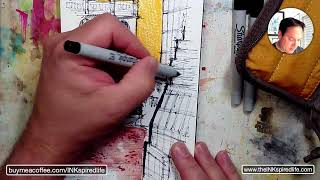
Jason Nicholas sketches a New York City rooftop with mixed media, starting with pen and ink on a Moleskine watercolor album, then layering watercolor washes and colored pencils. He walks through his process live, answering chat questions about color choices and techniques like hatching for shadows and using sanguine chalk for brick texture.
Chapters
Hey everyone, hope you're having an awesome, um, Thursday. It's great to see everybody. I am on, uh, just to do some late night sketching. I just cracked open a new watercolor album right here. Moleskine watercolor album. Um, what's cool, I don't know if you guys have used Moleskine, but if you do, or if you haven't, check out the reverse side of the wrapper. There are some cool grids on here, some measuring protractor angle devices, even a little diagram how you can use this as a compass. To make round circles. So it's really— it's pretty cool. So always check out the other side of the wrapper. Linda, good to see you. Hope all is well. And D-Ray, good to see you also. Yeah, so I am gonna sketch, um, a New York City inspired scene, and the reason I broke this book out is I kind of like the proportions because I want to do a nice vertical scene. I was going to use the Fabriano, which I love this paper, love the proportion, but I felt like just sketching on a different texture paper. I always have one of these small Moleskine. I say Moleskine. I don't know if it's Moleskine, Moleskine. I don't know how to say it. I think it's Italian, so I say Moleskine. Try to sound— let's try to sound European with that. Anyway, I like the texture of this paper. I just love the way it feels for doing quick, loose sketches. Um, you can see this has been to New York City with me a few times. Got some Empire State Building, also some Statue of Liberty sketches in here as well. So I thought it would be cool just to sketch on a bigger version of that paper. So let's do it, and we'll start here. I guess I might need my binder clip. Just to keep this laying flat. We'll see if it stays. We'll give it a try. I mean, how you guys are doing, it's always good that you pop in here. Uh, Linda says, I do use them also. All good here, hope you are well also and have a great weekend. Hey, thanks. Yeah, everything's going great. I am just so swamped with, um, with work, which is good architectural work. I'm not complaining. Just, uh, a lot of work to do, a lot of deadlines, so it's all good. All right, I'm just trying to get this thing to lay flat. It's kind of bent up a little bit. So here's the scene. I'll bring it on camera. This is what I'm gonna— this is what's inspiring my sketch tonight, is a picture I took. Uh, there we go. Let me zoom out. So this Picture is a really cool view. I was able to take a tour of a building this week called the Textile Building, which is 295 Fifth Avenue in New York City. It was an old textile building that's now being converted into office spaces. But this was one of the cool views outside of the window, one of the windows there. And I love just the— this view with the buildings and the cool little water towers, uh, right there in back. One of the other things I love in New York City is you, you'll see these, uh, on the brick wall here, you'll see signs. So I guess this was like Joseph J.S. blank something men's neckwear, I think it says back there. But I love these old faded signs. But I'm going to do a quick sketch and just, again, just riff off of this a little bit and not try to copy it. So that's my inspo picture for tonight. Cool. All right, you guys are amazing. Let's do some sketching. I am talking a lot, but that's okay. All right, so I'm going to use a Sharpie. I also have my Pilot ready. And, uh, let's see how it goes. There we go. So make sure I can fit this on screen. So you might notice when I first start sketching, if I'm looking at a— you typically, if I'm starting with a picture, photo, I kind of play out In my mind, it's not also— not always with the photo, but lots of times when I sketch, I'll play out with— play out in my mind where I kind of want things to be. So you might just see my hand kind of moving around with actually drawing, just trying to get the feel of some of the angles maybe on the— in the perspective, or some of the shapes I'm looking at. It's just kind of an also great way just to loosen up a little bit, you know. Sometimes I shake my hands out like that, or I'll let it dance around on the page, or I'll do med ink-tations, which I've talked about before, but I'm more than happy to talk about again. Alright, cool. I'm gonna keep this one kind of fast and loose. Which is kind of normal for me, as you guys that have watched know. I'm— it's kind of what I'm all about, right? Definitely not doing precise drawings. The Sharpie might be on its way out, but that's okay. I like the look of the kind of the dried pen on here. This is kind of an interesting building thing happening over on this side. Boom. And then somewhere in here, I'm gonna draw this building in the background. Got the crown, or the parapet of the building, and we got another one coming up vertically here. So I'm kind of looking at the negative space a little bit. So negative space is the space between the buildings. So this kind of comes here, and then we have another sliver up here. So it creates that negative void. There's buildings here, uh, this is a building over here. Cool. And then I really want to do the water towers in here. That's kind of, for me, one of the focal points. I love water towers, they're just so cool. So I'm just drawing some curved or concave— I like to call these contour lines just to give some shape to the water tower. We got a metal platform here because there is a water tower friend for this water tower, so we've got two water towers here. Yes, water towers can have friends. Especially in Bob Ross's world. This one's a little bigger here. A little beefier. There we go. Again, I'm gonna draw some contour lines. Just to give it the idea of some curves happening. We got this platform, it's going back in. It kind of actually goes back at an angle here for perspective. And this is sitting on top of a brick, that brick building I showed you before that had the sign on it. It's interesting, it kind of cuts down like this, back up, boom. We got some kind of chimney happening here, metal flue pipe coming up through here. One of the really cool things about New York City is, uh, yeah, the architecture is beautiful, from the ground, but when you go up in buildings, the higher up you go, there's a whole different landscape, a whole different cityscape on these rooftops of these buildings. Um, I just, I love getting these viewpoints where you can see these things like these water towers and these vent pipes and chimney stacks coming up. It's just really, really cool. It's a different way of looking at things, different kind of perspective. This is a real interesting classical looking building, big arches on it. But again, I'm not going to sketch all the details, but we'll just kind of pull out some arch shapes here. I could spend hours just drawing this one building here in the background if I wanted to get really detailed. We got some really cool arch openings. Boom, boom. And then what's cool is kind of in this piece we have 3— 3— we have all these, uh, smaller arches happening here. I don't know the name of this building I'm sketching right now. I will find out. It's a pretty cool building. And then here we have, uh, this is some kind of really funky modern glass building. So we have these glass panels kind of happening in here. This part of the building comes down at an angle. Boom, and then we have more kind of cool glass panels happening down here. And you, um, this is just a first kind of sketch. I'll come back later, darken some things up. I don't know if I'm going to add color to this one or not. I definitely want to pull some of these edges out, make some things read a little bit better. This is some kind of a railing, metal railing or something happening. I'm not sure what that is, but it looks cool. We'll just sketch it. Yeah, this— my Sharpie's definitely losing ink. But you can see we kind of have just a little scene started there. Let's go to the chat. I have to move my window over. Uh, here's a trick to getting them laying flat: fold down each page front to back, then back to front again. Fold down each page front to back and then back to front again. Let's try that. Did I do that? Ah, that helped! Thank you so much, that definitely helped. Uh, at the center of the book top bottom. Gotcha. Hey Cameron, good to see you, hope all's well. Cam is in the house. Cool. All right, let's, uh, pull it. I'm actually going to use— let's bring out the Pilot pen here and we'll do some— there we go. I think I'm going to keep this one just black and white. I don't know, maybe if I add color, maybe down in this area I'll pop kind of the brick part out here and leave everything else black and white. So the reason I'm thinking about it is then if I'm not going to add a wash of color on top of this, I don't have to worry about all of the, um, Pilot pen bleeding. I do like when it bleeds, but I don't want to be a big muddy mess. So that's kind of just why I'm thinking about, you know, if I'm going to add like watercolor or ink, other colors on this. Let's just kind of shade some of this in a little bit. I'm going to do this really quick. So just to help indicate the idea of windows, I just like to shade in some of these areas where the glass would be. And back here we do have some vertical glass elements happening. A little parapet happening here. Some windows in this building in the background. Um, I really do want to pull these water tanks out. This looks actually like there is— what is this, some kind of cell phone beacon or something? I'm not sure what this is here, but it looks like there's a ladder maybe coming off of here. Cool. Boom. Really cool. So I'm just adding some shading, some lines, hatching, create illusion of these water tanks being round. Boom. Let's just do some hatching here, just just to give some depth to this kind of little overhang here. I want this to be quick, loose, scribbly looking. There's not— there is nothing wrong with scribbly, um, especially for me when it comes to sketching architecture. It— a lot of it does look scribbly, and I, I like that. Has an energy. Scribbles have an energy to them. And New York City definitely has an energy to it. It is incredible. I just love it. It's an incredible place. There we go. So that's that building in the background. Yeah, you know what we're going to do? Let's throw— I'm going to break out some of the, the tailors, the ArtGraph I call it tailor's chalk. I think that's what it is. Let's, let's break out some of that, and we're going to use the sanguine or sanguine color, which is a red color. And just— this is a brick building. I just want to pop that part out just for fun. So let's do that. Let me just add some more scribbles on here. Um, the chimney coming up here. This building kind of does that a little bit. There we go. And then here we have some, just some rectangular windows. I just want to scribble these in. In the background here. Notice I'm not drawing rectangles for those window openings. I'm just— I want to give a hint, a hint or an idea that there's some kind of windows going on there. And just kind of continue down here. One of the things I like about sketching kind of loose and fast is it picks up the texture of the paper underneath. And it helps to give— you can kind of see in here, the lines are not very precise, they're not very clean, they're kind of broken up. And that just really goes with the aesthetic that I personally like. So I try to let some of that texture of the paper play in as another tool in the art bag here. The magic art bag. Break out the tools. You know, sometimes I say gravity is our friend. Gravity is a cool art tool when you're watercoloring or inking, letting things run down. Well, the texture of the paper is just— it's another tool we have in our bag here. All right, cool. I'm liking the way this is looking now that I kind of went over it, right? I mean, just check this out. You can see the contour lines pretty good here in the close-up. Really quick, just kind of curves. And the same thing I do with the hatch lines for the shadow, kind of did this and then I brought them down further to the right to create the idea this is curved. It's not as defined here, but I would start shorter and then kind of bring these lines down longer so it looks like it's kind of curving. I just, I love going back over lines. I'll go over them many times. For me, it adds another layer of texture and interest. So there you go. Pretty cool. That's a pretty cool, fast little cityscape. Let's check the comments, see if you guys have any questions or what's going on over there. Then we'll add a little bit of red to this and we'll call it a day. Where is my chat window? Last thing I see is Cameron says, "Hello everyone." Thank you, Cameron. Hello to you too. I just do want to— there are some openings up here. I just want to kind of loosely sketch them in. Alright, so let's break out the red. I think it's in my drawer here. Yes, it is. So this, I think this will be fun. Let's add this on. This is ArtGraph. So you can read the tag. Boom. Is it focusing? Focus, focus. I don't know if it's focusing. Um, so this is what I'm going to use. The color is Sanguine. Sanguine. I don't know, I always say sanguine because I think of linguine, and who doesn't love a good bowl of pasta? Um, here's the, uh the Art Graph, and I'm going to use this, and we're going to add some red on here. So let me just break out some water. So I am starting off with dirty water, which is what I like to do usually. Just keeps that kind of industrial grungy look I like. And let's grab a brush. Which is right here. Boom. And we'll zoom in a little bit. Cool. So a couple of ways you can use this, many different ways. One way is you can just scribble, sketch right on here, and then add water, which I'll do. I'll show you. You can keep it dry if you want. You don't have to add water. It is water soluble. So I'm just kind of throwing it down a little bit. And I'm going to leave a space there, and we'll add some water to it, and I'll show you how cool it's going to look. Make sure I have a paper towel around this stuff. I got a napkin here, that works. This stuff can get kind of messy, but that's what makes art fun, right? We can be messy. So look, as I add the water, you're getting a really nice brick color. So, and I'm not going to just— I'm going to leave it uneven. You could actually, while it's wet, if you can come back on top of it here if you want. Oh, actually, I just had an idea. Let's wet this a little bit more. So I thought of a way I can kind of create a bricky, a bricky kind of look to it. So while it's wet, if I do this, let's see if we can get some bricky— I don't know if that's a word— some bricks. I'm just dabbing the edge of this down. I'm going to let it just dissolve and bleed in the wet areas just to create the idea we have some brick here. So it's a cool way just to let the, let the water kind of dissolve it a little bit. So you're getting some texture on this facade here, right? I don't want to draw every single brick. I just want to hint. So if someone's looking at this, they can understand that this is a brick material. And I don't know, I might just leave it— I might just leave it at that for now. Zoom out. The idea is I just want this to pop here. I might add a little bit more Sanguine, but, but I'm actually going to put it on my board off the paper, and I'm just going to lift it off the board kind of like a— my palette here, and we're gonna lift it and then just kind of dab it on here just to give a little unevenness to this. That's looking kind of cool. I think I'm going to leave it at that for now. I don't want to overdo it. Linda said they didn't have that at the Blick store I went to in Boston. Oh, um, so I actually got some off of Amazon and then, uh, Cheap Joe's I bought, I think I believe bought this at Cheap Joe's Art Store. So you can check out Cheap Joe's for it also. Hey, D-Ray says, going on dry then adding water, window brick color. I like, thank you D-Ray, that's so cool. Yeah, I'm liking it too, guys. I do want the water towers to pop also. And, um, what do I want to do for that? I'm thinking, I'm thinking, I'm thinking, uh, maybe a rusty color. Maybe we'll get like a— some turquoise and maybe— yeah, let's make like a rusty color and just pop out those water towers. So I'm going to start with— let's see, I'm going to take some turquoise. I don't know if you guys can see the palette here. I'm going to take some turquoise and I'm just going to mix a rusty color. Maybe we'll throw some turquoise in there. Oh, I hear my pup out there. I'm going to throw in some orange as well. I'm going to throw some orange in there and some turquoise. And let's just go with maybe that for now. A little more orange. So you can see the color I'm kind of mixing up here. I think we're going to throw that on. Hmm, I want more turquoise in there. So we can definitely do that. So that's what's cool about watercolor, right? It's just coming in through— just throw some turquoise on there. And again, I just want these to be pulled out a little bit. I could have painted them yellow and really had them pop. But I might come in with my colored pencils when it dries and make them pop even a little bit more. Let's throw some orange on there. So I like the way— I like the color right here that's happening. Oh, Livia's out there growling. That means she usually wants to play. She hears me in here talking. All right, cool. Yeah, I think that's fine for what I want to do right now. So I'm going to let it dry and then I'll come back in with my— let's see, we'll come back with, um, not that one. Where's my— I got so many things out here. Where's my light aqua? Oh yeah, yeah, here it is. So I'll come back with my light aqua when it dries on top of that, and then I'll probably throw in my trademark neon pink somewhere also, and I'll do a little bit more hatching. But that is, that's it, guys, on this one for now. Jody says, turquoise, please, let's have some fun. Yeah, I agree with you. Jody, good to see you, welcome. Linda's like, "Gray." Blue! Uh, yeah, so you guys are all kind of in the same ballpark I'm in, same mood. I'm gonna let this dry, art down here, I like the way it's puddling. But yeah, it definitely needs a pop of the turquoise. Unfortunately, these colored pencils don't like to play well in the wet areas. I want to wait for it to dry, but this will really help pop it. And I love the color combo of this turquoise with the, um, sanguine— sanguine, however, however we say that word, I'm not sure. Water tower needs to pop. He's thinking. I am thinking, D-Ray. Always thinking. Don't— and there you go. This is kind of cool. I do want to pull this edge out of this building more. So we're gonna get funky crazy, I think, and we're gonna get funky and use maybe— oh, should we use one of these bad boys and pull the edge out, or should we go a little subtler? So the word subtler, they're Tombow markers. I think I'm going to go a little subtler and not use the black one. I just want to shade a little less of a black, but let's kind of just— I just want to pull this edge out. So you can see that's just kind of giving— setting these water towers back a little bit. By pulling this out. And that's the reason I wanted to darken this edge a little darker. There we go. That's cool. I like it. And then I'm going to pull out— after this dries, I'm actually going to pull out the shapes a little. Uh, well, some of it's— I can sketch some of it, but we're going to pull out the towers, and then they're gonna pop a little bit more. This I'm gonna leave. I want this kind of in the background. Hopefully that makes sense. So welcome to Inking Out Loud. It's called Inking Out Loud because I am thinking, I am inking out loud, trying to get what's in my brain out onto paper. Do you think, uh, would purple be too crazy? No, purple actually would go really well. Purple would be great on this. Um, I would use it for shadows. So I would take a purple and I would throw it in wherever I want shadows. I would either— I would either mix a purple. If you look at my palette here, you can see I like to mix purples up. Or I'm looking right now at a purple, uh, Preppy. Pen. Actually, I'm sorry, this is a Varsity pen. I could bleed some purple ink there, or I even have a purple Flair pen here as well, or colored pencil. So it's a great idea. Purple would go great, uh, for shadows on here. So it's definitely not crazy. Purple is your fave color? That's so cool! Purple is a great color. You think you leave color centralized right there? D-Ray says, you think you will leave the color centralized right there? Yeah, so good question. Let's zoom out. I think I am in this one. I think I'm just, uh, I just want to draw attention to kind of this piece, the water towers and the brick. So I think I'm only going to have the color here, believe it or not. So it's a great question. Yeah, I was debating in my brain whether I should do that or not, but we're gonna— yeah, we're gonna leave it this way for now. I could always come back and add more color later if I want. I'm just kind of running this— running the color up a little bit. There we go. We'll let it bleed back down. Yeah, also come in with Probably my, um, actually I think I'll use a Sharpie for this. If I just do some horizontal kind of texture on here, it's still a little too wet, but I'm going to come in and draw. I'll show you on scrap paper. Let's draw on back of here, but So I'll probably come in and draw it. Sometimes for brick, I like to just go— kind of hard, I'm drawing in the air here— but real fine lines like this. And then I could just come in and do some vertical where the mortar joints would be, where the bricks meet. I would just do a real quick texture like that across here, and it'll help this give a little more interest on this, a little more detail, um, on that part. Cool. All right guys, I think this might be a wrap for tonight on this one. How long have I been on? Let's see, just over a half hour, so that's perfect. Um, yeah, I am— felt— I have to tell you this, I am, I am feeling, I'm feeling like I want to add yellow back here. I don't know why, but where the sky area would be, I'm picturing yellow to pop the buildings out. We're gonna do it. All right guys, we're gonna do it. We're living on the edge. It's only paper. Um, let's grab some yellow watercolor and just go around there. Let's see what that looks like. Unfortunately, I'm out of— almost out of my lemon yellow in there. You can see I've worn— wore it out pretty well. So we're going to grab this yellow. I'm not sure what it's called, but we'll try it. Oh, oh, oh, wait, hold on a sec. Second thought, I have this color pencil. Let me pull this out. Second thought, how about I might use this? This is called a Sunburst Yellow. I might— let's see, let's do that. We're gonna use some colored pencil. Just changing it up. Let me sharpen this bad boy. Hold on a sec. Please use this one. So yeah, we're gonna just throw some colored pencil back there. Jordy says do it! Thank you for the encouragement, guys. I appreciate it. And it says, awesome, looks good and yellow. Yeah, let's do it, guys. Oh yeah, just— all right, I'm gonna, uh, mute the me and the microphones for a sec because I'm gonna sharpen with— this is a great sharpener, guys, for colored pencils. But let me just— oh, you guys don't care, do you? I can't— I don't know where the mute button is, so I am going to sharpen this. Hold on a sec. All right, there you go. It's sharp enough to where I need it. I don't want my dog to start barking hearing the sharpener. Yeah, let's do it. And I'll even let some, you know, the texture of the paper show through. That's fine. I think this will kind of help just to— this was that negative space I was talking about earlier. Between the buildings and above the building here. I think I'll just help pull this out a little bit more. You can see the texture of the paper. I like that. That's fun. I love using color pencils, watercolor, and ink. I love doing these mixed media sketches. And, uh, this art graph. Cool. There we go. Let me zoom out. Yeah, yeah, right? You can see how this is kind of popping now. That worked. I like it a lot. Good stuff, good stuff. Just thickening it up a little bit here. Cool, there you guys go. Let me know, do you like the yellow? Yay or nay? Give me a yes or no in the chat for the yellow. Do you think it was a good good addition to the sketch or not. And this is still a little too wet for the aqua. Just going to go in my playlist over here for a sec. Let's see. I was going to change it, but we'll let it play out. All right, cool. We got a yay, we got a yes, a yay. Awesome. I'm going to zoom in on this so you can see close. So I'm going to throw in some turquoise on here. It's still, it's still too wet in areas, so it's not going down the way I want it to. So we can kind of see just a little bit I put on there, what it's doing. I need to be patient. Be patient, let it dry. Um, cool. You can get an idea of where it's, where it's headed. Cool. All right, guys, needs a blending stump though. Linda says needs a blending stump. You know, I know what you're saying, but I, I'm kind of liking the texture. Um, I kind of like the texture of the paper showing through on this, so I do have a blending stump, but I don't think I'm going to use it. Could also use my finger, right? So I get it, but I'm, I'm liking that texture showing through, so I'm going to keep it. I always appreciate you guys' comments. Hey, Linda S is in the house! Good to see you, Linda S. Oh, this is actually dry enough down here. I think I can sketch on some of that brick I was talking about. Let's try it. Linda S, hope you're doing well. It's always awesome to see you. So I'm kind of bumming a little bit about my Sharpies. Um, there are two different kinds. There's a Sharpie Says extra fine point, and there's another one that's called ultra fine point. I don't know if there are different years. I don't know enough about that, and I probably should, but I like the ultra fine points, and I don't have any. It's a different tip. Um, I think the ultra fine would be good for what I want to do now. I think it's a smaller, thinner tip. Do I have any here? Let me take a look. Um, let me just— I got a bunch of Sharpies in here. Let me just randomly pull one out and see what it is. Extra fine, extra fine, extra fine. Where's the ultra fine? Extra fine. I don't even know if I have any ultra-fines. I don't know if they make them anymore. Oh, what? I just found one! Hey, I found an ultra-fine! Yeah, yeah, yeah, yeah. So here's the difference. I like both, but they're different points. I don't know if you could see that. How can I show you guys? It's not focusing. So you can see the one on the bottom is the, um, Ultra Fine, and the other one's the Extra Fine. It's very confusing. So I think this tip is going to be good for the bricks, so I'm glad I found one. That's cool. Notice that these lines are kind of broken up. They're not very technical, straight, continuous lines. You might— can barely see them. And I like the broken lines. Sometimes I call them Morse code lines because they're long dashes and dots. Um, that's a great quick way for me to represent a brick kind of material on a building. Oops, my finger keeps hitting the edge of that. And I'm trying to really lightly drag it across so that texture picks up on the paper, kind of like I did down here. This is a really good example down in here. And then we'll just put in a few vertical pieces here where the mortar joints would be. Gives it a little bit more interest, a little more detail. Trying a little too dark, so I'm going to hold it a little bit— press a little bit lighter. And I'm randomly putting these in, no rhyme or reason. Cool. So now you can see it has more texture. Zoom out. This is— I'm doing well. I've been with the grand loves a lot, so busy. That's awesome. I know I've been seeing some really cool pictures and things you guys have been doing. That is so awesome. Enjoy your time. That is what it's about, right? So, so cool. Love it, love it. Always make time to be with the people you want to be with and to do the things you love doing. Sometimes life can feel like a big chore for me, just something to do after something to do after something to do. And not a complaint, just an observation. And that's why you've got to make the time to do the things you love doing or be with those people. That's why I try to make time to sketch every day, even if it's for 10 minutes, because it's something I just love doing. It sketching centers me. It brings me— it just, it kind of grounds. Sketching is a way of grounding for me, keeps me centered. And I'm going to talk more about that very soon. All right, cool, guys. I hope you, uh, hope you like tonight's NYC inspired— see what I did there? Inspired, um, cityscape sketch, kind of focusing on some rooftop vistas here. All right, cool, awesome. I think this is done, guys. Um, Mickey, hey Mickey, good to see you. Sorry I'm very late. Good evening. It's all good, you're not very late. You can't be late if I didn't tell you what time I was going to be on, so it's awesome. Welcome. Um, thank you guys so much for joining. I am Gonna wrap this one up for tonight. So tonight we just sketched a really kind of quick little cityscape scene using Sharpies, some colored pencils, and a little bit of watercolor and our Art Graphiteller chalk stuff. Thank you so much for your likes and sharing, everybody. I appreciate you all. It's always fun for me to pop on and see you guys pop in here too. So, um, Mickey, you can go back, watch the replay, and that would be awesome. I'm so glad you were able to join though. Hey guys, keep paying it forward. Like I say, like to say, use creativity for positivity. Um, yeah, you guys are amazing. D-Ray, great seeing you. Mickey, And Linda S and Linda H, you guys are awesome. Jody was in the house as well, I appreciate that. Cameron popped on. Um, yeah guys, I think I got everybody. Take care guys, I'll be back real soon. Peace and live creatively. I'll see you really, real soon. Take care, have a great, great rest of your night and enjoy your Friday. Peace out. And then the Finish button, the End button, really is covered by a window, so I gotta move it. So, D-Ray, I really am moving a window to find that Finish button. I swear, I swear. All right, window's moved. Finish button's right, right down there. Good night, guys. Take care. Oh, by the way, uh, feel free to like this, and if you're on YouTube Love for you to share this, give me a thumbs up wherever you are. Let's put this out there. I'd love to get more people watching and having fun and just being inspired to get out there and sketch the built world around us. It's a pretty, pretty cool thing. Take care, guys.





