The INKspired Life : SKETCH(ing) Blueprint
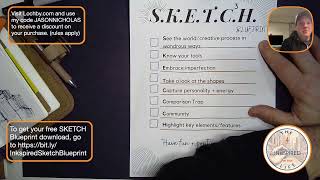
Jason Nicholas breaks down his Sketch Blueprint framework for architectural sketching, a mnemonic covering mindset and technique from seeing with wonder to capturing a building's personality. He uses the Empire State Building to show how reducing complex forms to basic shapes makes sketching accessible, and emphasizes process over perfection.
Chapters
Hey, happy, um, January 20th, 2025. Hope you're having an awesome day. I wanted to come on here real quick, um, and kind of answer a question I sometimes get, and that is, how do I approach sketching architecture? Um, it's a question I get a lot, so I put together a framework that I just want to share with you. Um, we'll go through it just quickly here, and it kind of gives you a glimpse into my mindset, um, my creative process, maybe some of the things I'm looking at as I'm sketching. So let's, uh, go to the desk cam and let's kind of take a look at this sketching framework. Um, so here you can see on my desktop I have the sketch. I call it the Sketch Blueprint. It's actually Sketch to the Third Power Blueprint. You'll see why in a second. So I kind of outlined, using the word sketch as a framework, some of the things that go through my brain and how I approach sketching. And the first one, the S in sketch, I have, see the world and the creative process in wondrous ways. Um, just be curious when you're sketching, you're out there observing, looking at the world, see in curious, wondrous ways, almost with a childlike sense of wonder. Um, it really opens up your mind just for accepting and looking at things differently. And for me, that's just one of the ways I like to get inspired. When I'm sketching. The K in sketch: know your tools. So, you know, I know I love using Sharpies, I know I love using colored pencils, I know the papers and journals I use. It's something that takes time. So know your tools and be open to try different tools as well. I know if I want to sketch a black line that's not going to bleed if I add watercolor or ink, I know I'm going to grab a Sharpie. So it just comes with experience, um, but just try different tools out. I'll be going into more detail with these and throughout some of my live streams, but I just want to give you just a quick overview of the sketch framework. If you are interested in downloading a PDF of this framework You can do that by visiting this link I have on the bottom of the screen. If you go there, it's going to ask for your email address and a name, but you'll be able to download this sheet. It's a work in progress. There will be updates and modifications. It's, it's a living document, but this is where it is right now. So we have the S, the K, the E. E stands for embrace imperfection. I feel like sometimes we are trying to sketch a building and make it perfect. Um, that could be a real roadblock to even getting started. Just embrace those little happy accidents. Um, expect them, they will happen, and that's just part of the whole journey, the whole process. So Learn to embrace imperfection. The T in sketch is take a look at the shapes. Um, really basic, I know, but sometimes it's good just to be reminded of the basics. Yeah, break complex buildings down into shapes, right? Um, I have here, I have a sketch of the Empire State Building, well, the top of it. You know, when I'm looking at buildings, I'm seeing almost, you know, almost like a triangle for the the, um, the top of the building here, the spire. I'm seeing some rectangles, some box shapes. So break buildings down into shapes. You can use these— this framework for any kind of sketching, really. So that is the T, take a look at shapes. So I have 3 C's. That's why I have the C to the third. The first C is capture personality and energy. Buildings are stagnant, right? They're not moving. Well, most of them are not moving, but they all have some kind of quirkiness or personality about them and a sense of energy, whether it's a peaceful Zen energy or a vibrant energy, right? So try to capture the personality. So When I do my New York City sketches, my lines are often kind of really quick, jaggedy lines. That's one of the ways I like to capture the energy of something I'm sketching. New York City is a very energetic place. So that's the first C. The second C is comparison trap. Don't fall victim to the comparison trap. Um, when we compare ourselves to others and we think we're inferior or even better, that is not really a good place to come from when you're creating. You can look to other people for inspiration and ideas and motivation, but when I'm— when you're comparing yourself, sometimes you shut down and you don't want to sketch, or you don't even want to show what you're sketching to other people. It's a real kind of way to pigeonhole yourself when you start comparing yourself all the time. You can look for inspiration, but don't compare yourself. Be the best you that you can be. Bring your A-game the best that you can. Um, that's what it's about. Any kind of artwork is about expressing who you are. So I'm not trying to express, you know, artist Joe Schmo over here. I'm trying to be me. The third C, community, that is huge. Find a community of like-minded creatives, artists, um, people that are positive. You want to be able to get feedback on what you're doing in a place that you feel safe and confident and just all-around great vibes. So surround yourself with a community of people you trust, people that you get really great vibes from. By sharing not only what you're creating, but sharing your feedback and advice to other people is huge. It, it is the connection that ties us together, that brings us forward into you know, nothing but positive light and positive spirit. And we could always use positivity, right? So see, the third C is community. And the last thing is the H. I actually have two H's, so this might become H squared. Um, the first H is highlight key elements and features. So we'll go back to the Empire State Building. When I look at the Empire State Building, for me, a key feature is the spire, the top of the building. Don't be afraid to pull that architectural element out that you see that, um, or attracts you in a building. So, you know, it might be, um, the spire of the Empire State Building, or we have the spire of the Chrysler Building. Or maybe it's the arches inside of Grand Central Terminal. So highlight key elements and features. And the last H I have, and I— this is probably the most important, um, advice or guidance I have on this sheet, is have fun and a positive attitude and enjoy your day. God, have fun with the process. It's— don't be obsessed about the end outcome. Enjoy the journey. I would often say that, um, for me personally, it's not— it's not about A, it's not about getting to— it's not about Z. It's about the process of getting from A to C to Z. Um, I gotta do my alphabet over again. Um, it's that journey, that in-between, um Some people call it the messy middle. Yeah, there's a messy middle. There's an ugly duckling phase when we're sketching. I have it all the time. But there's a transformation in that middle, that journey that happens that could be really magical. Um, enjoy the moment as you're creating what you're creating. Don't always focus on the end outcome because this goes back to E, embrace imperfection. If you don't get that perfect image you have in your brain, you're going to be disappointed, right? So learn to have fun with the journey. All right guys, so I just want to share that with you. That is my Sketch Framework. Um, again, if you're interested in getting a copy to download, if you go to that link, um, on the bottom left of your screen or right here. I'll point to it there. Um, feel free to do that, it would be great. Um, like I said, it's a living document, a work in progress, and this is kind of where my mindset is right now with how I approach what I'm sketching. All right, thank you guys. Uh, this has been Jason Nicholas Nicholas with the Inkspired Life. I appreciate you all so much. Remember, use your creativity for positivity. Take care. Peace out. See you real soon.





