The INKspired Life - sketching architecture
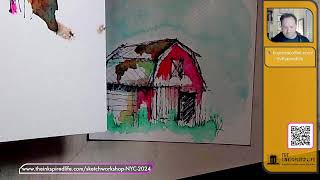
In this unscripted live stream, artist Jason Nicholas walks viewers through a spontaneous sketching session focused on New York City's Copper Building. He demonstrates his workflow—preparing paper at an angle, using binder clips, Sharpies, Lamy pens, Winsor Newton watercolors, and Cheap Joe's inks—while explaining his color philosophy of “riffing” rather than reproducing exact hues. Jason introduces his personal SKETCH framework (Seek inspiration, Keep curiosity, etc.) and shares tips on line work, hatching, and “bridging” colors with water. Throughout the stream he interacts with the chat, answering questions about materials, color usage, and his creative process, and promotes an upcoming architecture‑sketching workshop (April 20) with giveaways sponsored by Lockbee. He also sketches a barn, discusses gambrel roofs, and showcases a series of Copper Building sketches, offering them for sale. The session blends practical demonstration, community engagement, product plugs, and promotional content, revealing Jason’s informal teaching style, artistic preferences, and entrepreneurial activities.
Chapters
Hey, happy, uh, Wednesday, April 3rd, 2024. Hope you're doing well. It's, uh, rainy, rainy, rainy, and rainy, uh, weather here in Northern New Jersey. But that's okay. I'm on spring break this week. I didn't mind the rain, personally speaking, because, well, it kind of forced me to stay inside and get some stuff done in here. So I've actually been cleaning out my studio, moving some things around, reorganizing, all that fun stuff. So there you go. I hope you're doing well. I'm going to do some sketching tonight. Um, for a little bit. You might see I already have a sketch down. I did this sketch, I think, last night online, and I thought it'd be fun to throw some color down. This is the Copper Building in New York City. Um, I love the Copper Building. It is so cool. It has a sky bridge. It kind of looks like the letter H. Really, really fun building. So let's, uh, throw down some color for a few minutes. And yeah, there we go. I am just looking for— I like to have my paper up at an angle when I'm adding color because I like the way the colors kind of bleed down and mix and muddle and puddle at the bottom. So let me get something to do that with. Let's see, I'm gonna grab this, a piece of cardboard, and So I'm just gonna actually just kind of clip this onto a piece of cardboard and I'll put something underneath it. By the way, best office supply invention ever, besides the pen of course— binder clips. So many uses for binder clips. Let me know if you like them, if you like binder clips as much as I do. Put it in the chat. There we go. All right, let's prop this up at a little bit of an angle. This is unscripted, unrehearsed, as you can tell. I just— here we go. All right, cool. So again, this is the Copper Building. It's right along the East River, um, very close to the The 34th Street Ferry. I have never been inside. I've walked past it a few times. I've taken a bunch of pictures of it. It's just, for me, it's just, I just love it. It's one of my faves. And I will be seeing it again real soon, either Friday or Saturday or Sunday. I head back in. There you go. So you might notice I have some of the black inks bleeding a little bit. That's when I use my Lamy pen right here. The Lamy ink will bleed with water. When I use a Sharpie, the Sharpie won't bleed. Here's my trusty Sharpie right there. Cool. So I have a question that I'm asked a lot. It has to do with colors. And actually, it's a comment I get is the colors I use aren't the colors that the buildings really are. And that's— yeah, that's true. I kind of just like to riff off the colors. I go with my kind of my gut feeling. There's a certain color palette I really like to use. And I don't feel the— I don't feel it necessary to replicate the exact colors because for me that's what photographs do, right? Photographs capture the details. This is just my kind of take on the building. Sorry if I keep pushing that off the page. All right, so let's see. I threw down the first color I threw down. This was actually ink. I'll show it to you. This is called Rusted Rivet. Love the name, Rusted Rivet. And it's, it's pen ink, but, um, so you can put it in your fountain pens. I like to actually just paint with it. And then I'm also using— I have Winsor Newton watercolors here, except for the turquoise and the red. Those are Cheap Joe's brand. Everything else is Winsor Newton. You can tell it's a really well-used palette. So I'm just kind of dipping in here and throwing some stuff on. Let's see, I'm going to grab some orange. I think orange is actually the first color I had to replace in here. See, it's pretty— a pretty new pan in here. And I just like the— this color combination with the orange and the rusty colors. I like to call it grunge. I like to have kind of a grunge style lots of times. So we're gonna grunge— we're grunge-ifying this a little bit. I just like the look of old industrial weathered buildings. Even though this is not— it's a fairly new building, I think from 2017. I could be wrong with that, but just, just popping these colors down is a lot of fun. Awesome. Awesome. Next, I'm going to grab some yellow. I always feel like this color palette needs some freshness to it. For me, yellow has a bit of freshness or zestiness to it. Think of lemon. You add lemon to your cooking, right? It has that kind of freshness to it, that zestiness. So for me, the yellow paint does the same thing. Should we zoom in closer? Let's see. I'm going to push this down and zoom in. Ta-da! I think you can see a little bit better. So we'll kind of sketch in some yellow. So when I say sketch it in, I'm kind of— I kind of think of almost drawing with the paint. You can see how this is actually looking kind of cool in here. I like how these colors all kind of bridged together. That'll really look interesting when it dries. So just— I kind of threw in a stripe of yellow there, and I'm gonna I call this bridging. I'm sure there's a technical art term. I, I'm not really sure what it is. I, uh, never had formal art lessons, so I call it bridging when I just connect colors together with a drop of water or a dab of water. And I love bridges, so I thought it'd be kind of cool to call it bridging. Light a little bit. Cool. I love this color that's happening right up in here. It's really, really deep. It's going to come out really cool. Let's see, what else do I want to add to this? Um, I definitely am going to throw some turquoise down after this dries a little more because I want the turquoise to be really vibrant, so I don't want it to mix in with the wet. Oh, I'll wait for that to dry. Yeah, yeah, yeah. I'm gonna grab some of, uh, this yellow color right here. I'm not good at remembering color names. I kind of just grab and go. Go. This is like a mustard yellow or marigold yellow, so I'm just going to grab some of that. There we go. I'm just going to kind of tie these together here, throw some of that up top. Mixing in a lot of that black ink is kind of bleeding. So typically I will— I'll start my sketches with a Sharpie because I like to add water or ink and watercolor, and I know the Sharpie ink will not bleed. And towards the end, I'll come in with my Lamy and I'll throw some dark lines on, and that's what you can see bleeding right up in here. Yeah, this is really drying very nicely. I like the way this is looking. Very cool. I hope you're enjoying this. Let me know if you have questions or thoughts or comments. I would love to know. Let's see. I should be live on YouTube and Facebook, uh, and Instagram. I should be live on 3 channels right now. Cool. All right, so here we have the copper building. It's— I'm gonna let it dry a little bit. I'm going to zoom in. I want to show you some things that are happening as it's drying. I am that guy that loves to watch paint dry. I know it's crazy, but it's true. I find it exciting. Um, I just love the way the things that happen. So here's why you can see I like to have my sketch at an angle. I like when all the colors run down and they kind of puddle and pool at the bottom. So it's a, it's a really cool look. Let me go down a little bit. You can see how this is drying right in this. Let me get my little frame out. It's easier if I can show you this way. Here we go. So I just cut out some squares on a piece of, uh, it's like cardstock, I guess. And if you look in that small square, you can kind of see the colors in there. I love the way that's drying. And we have the same thing kind of over in here, these colors. And let's go down a little bit. Pretty cool. I am really digging this color in the upper right. Very, very much so. And then I love the way this is drying here as well in that area. Pretty awesome. All right. While that's drying, let me grab a couple of, couple of other things from the box here. I'm definitely going to be popping on some neon pink. Neon pink seems to always somehow work its way onto my sketches. So definitely be using that at some point. Probably also going to use this light aqua color pencil. And one of my other favorite colors that has not made it on here yet is Preppy Yellow. Hello, Preppy Yellow. Although this Preppy Yellow ink cartridge is empty. So I gotta break out a new one, but, uh, there you go. So we'll let that dry for a minute. Uh, let's see, actually I'm going to add some hatch lines. I'm going to pull out a Sharpie here. Let's just add some hatch lines. So hatching is a great way to create depth and shadows, keep your sketches looking loose. So you can see I have some hatch lines here at an angle. We're gonna throw some more on there. I just have to be careful. I don't want to put my palm in the wet ink. I've been known to do that many, many, many times. So there you go, you can see I'm just adding some more just to give a little more depth. And then underneath this pedestrian bridge, the sky bridge here, we'll do the same. So there we go, we have some hatch lines. Hey, D-Ray's in the house! D-Ray, great to see you, hope all's well. D-Ray is in the hoose. Let's throw some windows down on here. So Sharpies do not like to write on wet, damp surfaces. So bye, Mr. Sharpie. Let's throw some windows on with, um, here's our Pilot Precise V7. Love, love these pens. And we're not going to sit here and draw every single window on the building. Here's how I like to show windows. I'm literally just going to come in here and just kind of throw down some lines. I'm not drawing rectangles. I don't care if they look wonky, they're crooked, if they're not complete rectangles. I like the look. Hey, D-Ray says V7, the best. Go ahead, run that palm through it. Yeah, well, you do know what I say, right? It's not art unless you wear it. So am I wearing any art today? I have some pen marks. I guess that's considered artwork. I don't have any ink on my palm yet though. Let's throw down some more windows over on this side. And honestly, I'm just throwing them down randomly. There's no rhyme or reason. I guess, I guess my rhyme and reason to do it randomly is it just makes it look more interesting than trying to get precise symmetrical windows that are lined up. I tried— I'm trying to capture an energy or a feeling in the city. I feel like things are random, you get more of an energy. If this was a symmetrical building, everything was balanced, that'd be different. Excuse me. Uh, in the Skybridge also, we'll just sketch some windows. In here as well. There's a grid. I don't have a photograph in front of me, but I think there's a grid in here of windows. So we're just going to sketch, maybe do something like this, and then we'll just do some lines here. So we just have kind of a grid happening. And then maybe I'll just throw in some, uh, some ink on some of these grid lines, right? So now you can see that has a little more energy to it. I think throwing those grid lines across horizontally helped to tie the left and the right halves of the building together. You have that line that just kind of connecting the pieces. Duree says, where's your water, kiddo? Oh yeah, um, I don't have— I don't have any in here actually. Good, good question. Um, so there you go, that is the copper building. Let's throw some pink on there. This one I think we'll call call it a day. What I'd like to do is, um, I'm gonna bring over some of the other copper building sketches I've done and just kind of put them next to each other. It's always fun to see how these things look. They're all going to be— well, we'll see, they should all be different. So we're going to pop on some pink. So when I throw pink down, I usually do it in 3 places. So we have 1, 2, and I'll zoom out. So we have 1, 2, and my hand— I kind of let my hand move around and subconsciously it'll tell me where it wants the last one. So I'm ending up down in here somewhere with it. So let's just throw some, maybe, maybe down here, just a speck. There we go. Cool. So we have our neon pink on there. I mentioned earlier I'd throw some light aqua on, so I love light aqua. Let's throw some on there. Let me zoom in a little bit closer again. So here we go. Um, I like to use Light Aqua. Actually, I'm zooming tighter. I'm, I'm loving this color happening right here, and I think Light Aqua is going to look awesome on top of it. So I am just going to throw a little bit on here. Maybe we'll do it kind of in the corner, and you'll see that aqua kind of pop out against that rusty-looking background. So there you go, right? You see how that aqua just— it's popping. Pretty cool. Now let's throw some more aqua on here as well. I don't want to get too cray cray, so kind of like the pink, we'll throw it maybe down in maybe 3 places or so. Seriously, maybe, maybe we have one down in here. There we go, we got pink! And here is the aqua. Oh yeah, we sure do. Yeah, I like the way this is looking. It's looking pretty fab. Um, let's— oh, you know what, let's throw down some highlighter. Just got a regular highlighter here. This will be the highlight of my day. Get it? The highlight of my day. Thank you very much. I don't charge extra for the puns. Puns are included. Batteries not included. Except in this case, puns are included. All right, cool. All right, I think that's enough colors on this one. You can kind of see it. So let me grab a couple of my other copper building sketches and let's just take a look at them next to each other. We're gonna wrap up, wrap it up. D-Ray, it's so good to see you. Thank you for being in the chat and commenting. I always, always appreciate that. I hope you're doing well. I'm just putting the lid on my water so it doesn't spill. All right, let me grab, uh, let's make some room. All right, so we got this one from tonight. I'm just grabbing 3 more right behind me on the bulletin board. Here you go. So these are some other Copper Building sketches I've done, right? You can see the same form, the H-shape, the bent top. Um, and actually these two are interesting. I can't zoom out anymore. I guess I can. Let's do this. So we have these two are the same basic view, and then we also have these two which are in different views. So there you go. So these, these are all the copper building. You can see the colors palette here and here are very similar. Well, one on the left and the one on the right. Pretty cool. Um, I like the colors in here. This is interesting. This is purple, orange. Right, you can see it better. So very interesting colors, but I, I don't get bored of sketching the same buildings over and over again. It— they're always different, whether it's the colors, the angle, the wonkiness level. Um, there's always something different, which is so fun. Dere says we haven't had a spill in a while, but be cautious. That's right. Well, like the two on the right, my right, so that would be— so I think you're talking about these two here, right? Yeah, they're very cool. I like them too. I really like this one a lot here. I like that it's really wonky, the proportions here. Um, I think they also call this the Dancing Building. It almost looks like, uh, two people dancing. So very, very, very cool. All right, let's put this one back here. We'll zoom in on this one so you can see how it's looking. Oops, too much. I love playing with that zoom button. So yeah, that one and then this one were the— were similar views, right? Hey, DB's in the house! DB, great to see you. Hey, me, finally got our internet back on. Awesome, I am so glad your internet's working. Welcome, it's great to see you. My internet's working too. My internet was wonky the other night. I don't know what the heck was happening. It also do with your mood at the time, how to paint, create. D-Ray, great observation. Yeah, totally depends on my mood, uh, my energy level, music I'm listening to, how hungry I am, all that stuff. It all combines to get different results, and that's why I just like to kind of let it go and see what happens. Instead of trying to force something to be a certain way. So that's a really great point, love that you said that. So cool. DB says we had a storm come through. Yes. Oh well, I hope you are safe, DB. I'm glad you're back online. We've had some wicked rain here for the past 2, 2 and a half days. It's been crazy. Let me put that there. Maybe I'll do one quick sketch. It's 8:55. I'm gonna wrap up at 9:00. So what should we sketch? Let's put this here to dry. Uh, maybe we'll just go freeform. I have nothing particular in mind. I'll just kind of cut loose and we'll see what happens. Yeah, I was doing on the back of— this was fun. We were playing around with, uh, water towers. The other night, but I'm just going to use the back of this for scrap. We'll just sketch a little something something. So I am super excited for this workshop I have coming up on October 20th, um, where, where I'm gonna be walking— we're gonna be walking through New York City. Architecture and sketching a few things, maybe some iconic buildings, maybe some not so iconic buildings. But the idea is really just to take something that looks really crazy and complicated like New York City, the buildings, the architecture, and we're gonna conquer that chaos and bring a little bit of serenity to it in a wonky sketch style. So I think it'll be fun. Uh, if anybody wants more information about that There's a link on the bottom of the screen. You could see that. Feel free to go there and check it out. It'll be awesome. All right, let's just do some sketching here. I was gonna— this is freeform, guys. I'm not trying to sketch any building particular. Maybe we'll end with— I don't know, we'll see what happens. Let me know in the chat, is this looking like any type of building? This is just happening on the fly from my imagination. I have a feeling of where it might be headed, what type of building, but you never know, it might take a twist. So we're just kind of free-flowing here. So you, you might notice I, I go back over the same lines a lot, and I'm not trying to trace over them exactly. As you can see, they're very— this is very fast, very loose, very sketchy. And for me to, to help get that look is going back over the lines. It's also my brain just kind of thinking, um, almost subconsciously, hey, like, where, where should we throw down the next line, right? So this is Sharpie in case I do want to come back and I want to throw down some color, some watercolor or ink on this. I don't worry about all this black ink bleeding. Maybe it's, um, some kind of church building. Hey, Chip's in the house! Chip, great to see you. Hope all's well. It's great to see you, Chip. So sometimes it's fun after sketching a building I know, like the Copper Building Just do something totally crazy that from my imagination, or sometimes I'll do the opposite. I'll start with something totally imaginary just to get the juices going, the energy going, the flow going, and I'll do this just random kind of jump on real, really quick and fast and furious, and then maybe I'll go to like a copper building or the Brooklyn Bridge or something that I more familiar with. This is looking very cool. I'm liking, I'm liking all these loose sketchy lines here. Pretty fun. Dearest says, I go over the lines quite a bit. Oh yeah, yeah. Uh, Chip says— I'm sorry, DB says, thanks again for helping me with the barn roof. Hey, no worries. Yeah, so DB We were talking about gambrel roof lines. I'm going to change the music up. Let's put this list on here. We're talking about gambrel roof, right? If so, if we have a barn, uh, actually— oh, I mailed it. I sold the one I sketched the other night. I was going to show it to you. Gambrel roof kind of has this. So DB, remember, kind of flat and steeper, right? Flat, steeper. Sometimes I curve them to give a little more character, and I want to throw a little perspective on this. Let's just kind of bring that line down in the angle. We'll bring this kind of back more horizontal, like connect the dots here. I'm matching this angle here. Then we have this piece. So what I'll do is if I want to try to mimic the same angle I'm doing here. I'll actually— I'm not literally drawing on this. My— I'm holding the pen over this, but I'm doing this to get it in my brain and in, uh, kind of my hands memory, bringing that angle over. So I'm going to do this and I'll come over and I'll do the same thing, just doing the same motion. And that's kind of a trick I like to do just to Get the angles similar. And this is wonky, we're not looking for perfection. Um, I think perfection for me sometimes can kill my creativity because I'm so focused on everything having to be exact. Um, and that's cool in the architecture world when I'm creating blueprints and designing buildings and technical drawings that have to be exact, but this is my other world where I can just kind of cut loose a little bit. Huh, yeah, we went from this to this. Um, so fun, so fun. We got just kind of a loose barn happening. One thing I didn't sketch on the barn we did the other day is kind of the hay, the hay door. Hey, door. The hay door up here. Um, so we have the gambrel roof. Gambrel, that's gonna be on the quiz, so remember gambrel. Let's sketch the door here. So DB, this probably looks familiar. This is very similar to the barn we sketched the other day. I'm not looking at the other one, but it looks something like this if I remember. Um, this is the door. We're gonna say the door is slit— slid open, so I'm gonna hatch this here. Just do some diagonal hatch lines just so it looks like shadow, so it's kind of dark inside the barn. So let's do that so it kind of looks like the door is open. D-Ray says you're a CAD machine. I am Cadman. I am Cadman instead of Batman. I'm Cadman. Watch out, Joker, Cadman's in town. I got your line. I'm gonna straighten you out, Joker. All right, that's, that's me trying to be like Cadman. You know, instead of Batman. Um, one of the cool things about Barnes to make it look wonky wonky, right? So let's do some vertical. I'm going to hold my Sharpie kind of towards the end, so I got more flexibility in my wrist. This is rough cold press paper, so it's going to pick up the texture of the paper, which I like. I'll zoom in so you can see it closer. So we got wonky wavy lines. The lines are not solid, they're kind of Morse code, dash-dot line, dash-dot. I knew I'd get that out. Dash-dot lines. Here's another fun thing. Who says all the boards on the barn have to be vertical? What? Let's do some horizontal ones. Why not? It's an old barn, maybe it had a repair. Done at some point in time. Pretty cool. And let's show some, uh, let's do some shingles on here. You know what, I don't know, I'm gonna do some diagonals here. Maybe these are old, it's an old tin roof. No one says our lines can't be at an angle, right? And we got some kind of old tin roof happening on that barn. I'm digging it. He definitely amazes himself. I do amaze myself. You know what, you gotta have fun. You know, this is all about bringing the fun for sure. I love that, it's so funny. Um, you guys are awesome. So there we go, and I'm doing the same thing kind of up in upper roof, but just closer together. Pretty awesome. I am missing some barn boards here. So again, I'm going to hold the pen, the marker, really loose. It's extra fine, like me. Get the point? I'm going to let that one sink in. Ahem. Here we go. Yeah, I know, I've gone crazy. And so I'm going to mention again this workshop because coming up on April 20th, I am super excited to be back doing some workshops live online. Um, it's going to be really cool. The link's on there if you want more. If anybody wants more information, click on the link, email me, put— send me a message. I'd love to see you guys there. It'll be fun. This is looking really cool. Let me zoom out. So we went from— this is— so this is kind of how my brain's running tonight. We went from the copper building in New York City to a really quick kind of church-ish building to I think DB said something about the barn roof and then we started sketching a barn. I think there's a lot of lessons that we can learn just from this little barn sketch, just about lines and how lines can just do different things. Let's do some more hatching and I'm going to show you how to make it look like there's an overhang under the roof. Get the point? Thank you, D-Ray. D-Ray's laughing in the chat. That always makes me feel, uh, what's the word? Not vindicated. What's the word? Oh my gosh, there's a word. I can't think of it. I love that. All right, here's how we're gonna do it. Same Sharpie. We're gonna just do more hatch lines. So here's the edge of the roof. Um, hopefully you guys can see this. I'll try to do it with my hand out of the way. We'll go this way then. I'm literally just kind of scribbling underneath that roof overhang area. I'll do it again. I'm not trying to color it totally black for the overhang area shadow. I like to leave lines in between the white space. It adds that loose, sketchy kind of look I like. I could, I could have taken a Oh, where— here we go. I could have taken my Sharpie here, this thick Sharpie marker, and colored a black line under there. Um, but for me, it would have lost that sketchy kind of look. But maybe I'll do that here, under here, just to— just at the edge of this door, just to push it back a little bit more. I don't know, do you guys think I should add color? Let me know what you think. Do you want to see some color on this barn, or should we leave it black and white? Um, yeah, I'm going back to the workshop again. I know I'm all over the place. I am so sorry, I'm excited. Um, I am going to be doing 2 giveaways during the workshop to people that are live there in the workshop, um, courtesy of Lockbee. Lockbee, as I talk about them all the time because I have their products, I love their stuff. Lockbee has— is kindly donating 2, um 2 of their products that I can give away during the workshop. So how cool is that? So this happens to be my— one of my Quattros. Um, so that'll be a fun thing to do, to have a give— 2 giveaways during the workshop. So shout out to Lockbee for, um, for sponsoring that. Really, really excited and looking forward to, um, our relationship growing and developing and continuing down the road because I love their stuff. Let me— I gotta bring my field journal out. I'm not trying to turn this into a commercial, but this thing here— I don't know if I could fit it on screen. You can tell it's well loved. This field journal has gone to so many places with me. A lot of history here. I just use it for sketching, like no tomorrow, taking notes. I actually put a planner in there today. I was going to start using it as a planner also. Really, really just amazing product. I mean, I could put— there's pockets in here for stuff. There's pockets in here for stuff. Sketchbooks. There's a pocket here. There's another pocket in the back. I actually added— this is a cool mod I did on here. I added a Velcro— not a Velcro, you know those locks you have on those like plastic bags? You kind of push them and zip them closed. I threw one on there. So Lockbee, if you're watching, I modded this. Um, really cool because I like to put my portable, uh, charge battery pack in here and I can close it and it'll stay in. So pretty cool product. Anyway, yeah, so if anybody is in that workshop, you're— you'll possibly win a Lockbee product. All right, cool. Let me go to the chat. Should we add color to this barn sketch? Um, not sure what word he's missing. Yeah, I don't even— I want to say corroborate, but I don't— is that a word? Corrobor— Corroborate. I don't even know what the heck the word was. Corroborate sounds like— I don't know, like you're stealing something. Um, yes, add color, DB says. Okay. Chip says, still sketching with the pen you gave me, love it. Oh, the one in Princeton? Awesome, Chip. Chip, man, I hope we get together this summer. I want to see you and sketch with you. It'll be So much fun. Workshop giveaways— Lockbee has been generous for special giveaways. They have been. Also, if anybody's interested in Lockbee products, I have a special discount code right here. Doing a lot of plugs tonight. If you go to the Lockbee website and you want to buy something, you can get 10% off with— they made the special code for me. Um, Jason Nicholas. Wait, that's me, that's my name. That's the discount code. So I think you can get 10% off up to 5 products from their page. But yeah, feel free to do that, um, and enter the discount code if you ever buy anything from them. All right, this is fun. I, I figured out how to pop things up on screen with the text. So watch out, world. Um, really cool. So D-Ray says color— I mean, DB said color, so let's do color. I'm going to, um, throw down some red and throw down some red. I like using the Pilot Red ink. Let's do that. This is fun music. Before I do that, I am actually going to take a picture of this in black and white. Let me grab my phone. So pro tip: take pictures of your artwork before you add color, then you'll at least always have a black and white version you can go back to if you want. So put this— get some good light on that because I kind of like the black and white on this. This is a good example to show for different line types. Cool. All right, let's throw down some color now. So we're just going to use our Pilot pen and got some water here. Throw it on. So, Krabby, yeah, I do need a sip of water. I didn't bring any water in here with me. It's all good, next time. All right, DB, you asked for color, here we go. I'm not sure if I'll bleed the ink yet or not. I may. Yeah, let's bleed it. How many of you guys out there know about my SKETCH framework? Kind of my guide to creating loose style architectural sketching. So it's an acronym using the letters S-K-E-T-C-H. TCH, sketch. There we go. So we've got the red happening, and the first letter is S, right? Um, give me a couple things. So S for me, one of the things it means is seek inspiration. If you're, if you're looking at a blank sheet of paper or a canvas you don't know where to start, just look around. Look around wherever you're standing at that point in time. Take a look around, um, and be curious. I think curiosity is something that we sometimes tend to lose the older we get. Be curious about your surroundings. And you don't have to— you're looking at a building, so you're outside, you don't know what to sketch, right? Um, look around. You might see a building, you might be afraid because it looks big, it's overwhelming, there's a lot to it. Just pick a part of that building, right? Your inspiration can be maybe a door, a window, maybe it's a board on the building. This is looking cool. I really like the red ink. Um, let's throw down some— okay, I'm going to throw down some turquoise on here. So I'm just dipping into turquoise watercolor, and I kind of— I want to make like a rusty color roof, so I'm going to start with turquoise. And I'm not doing the entire roof, I'm just kind of patching it down here and there. No, maybe some of that color, it's gonna run down here a little bit. So to get a rusty look, I'm going to throw down some orange on top of that turquoise. And again, I'm just kind of dab it in places. Let me be able to take some of that color and we'll just kind of throw it down in some other places as well, just tie it together. So we're getting kind of a rusty color happening there. Now I'm going to throw down some yellow. QQQ Chip says, what is your advice for folks like me who many times use too much color? I love the way you only color certain angles. Oh Chip, that's a great, great question. That's an awesome question. I'm just throwing down some yellow here. So let's see, what is your advice for folks like me who many times use too much color? I guess so. Here's, here's one of the things I like to do with color. I don't know if this is gonna help or not, but I I tend to jump around with color. So for example, I know this barn, it's a red barn. Um, when we say that to ourselves or we say it out loud, it's a red barn, what are you picturing? A barn that's red, right? But that red barn doesn't have to be red everywhere. So I tend to take color and I'll put it down in kind of sporadic, random places and leave a lot of white. Even though originally my brain wanted to color the whole barn red, I have to edit myself. So I think that kind of goes for me with the loose, quick style is I'm very jumpy with my brush. I'll zoom out so you can see what I'm talking about. Let's just throw some color down on this sketch up here. I'm just gonna grab turquoise. Um, so if I was being very methodical and thinking about this, I would be painting like this. This is, this is me being— trying to be slow. It's hard for me to be slow. Okay, so now my brain's saying, all right, well, this is a blue building, so Now I got to make this blue because this is blue. That's if I'm slow brain. If I'm going to be quick, I'm going to say, hey, wait, um, let's grab some yellow. Like, no, it's a yellow building, but you know, maybe there's just some here. Um, you know what, maybe I want to balance that yellow a little bit. So there's some logic going on, you know. I have some there, so maybe I want to balance it and have some kind of down in this area. Bring your eye diagonally across the painting, and maybe there's a dab of it right there. So I'm trying to bring your eye across diagonally. It's hard for me to say that word. Diagonal. Oh my God. Yeah, that word. I'm thinking Diagon Alley, but that's from Harry Potter. Diagonal. Whatever. So, Chip, hopefully that makes sense. My brain is saying, all right, let's throw this color down. Let's grab some red just for the heck of it so we can do it again. All right, so, you know, maybe I want a touch of red up here. Maybe I want some of that red to bridge in with that blue, kind of tie those colors together. Now that I have red here, you know what? Hey, I want to throw some down here. Bring your eye kind of down here a little bit. And sometimes I'll play connect the dots. Here's, here's how we connect the dots. We're going to bridge all these two colors together, right? So I'm going to take that red, just take a wet brush. I'm going to Bring it to that spot I had there, and we're just going to bring it down like that. So now I just created a line of red on there to tie it together. Hopefully that helps. It was kind of off the cuff. It's a great, great question, Chip. I love when you ask me those questions because I think I have to think about my process. Um, it's always great to reflect on what you're doing, so Thank you, man. What was that word? Diagonally. Red barn, I think of brown muddy, D-Ray says. Yeah, you could do brown muddy, kind of like this color, right? So we have our rusty roof. I'm just touching some more orange on there. I'm going to leave that turquoise. Um, I want to look like it's kind of running down, so I'm going to tilt this up. I'm actually just dragging my— my brush down there a little bit so it looks like it's dripping down. Cool. Your brain is tired to try and analyze in words what you do from within. There you go, D-Ray, I know what you mean. Cool guys, let's throw another color down on here, we'll wrap this up. Let's kind of anchor the building to the ground. We have nothing happening. Let's, let's do some green, green, but I'm actually going to use a green Pilot pen and we'll bleed some of it. Yeah, my brain is tired today because, um, I exercise my brain in different ways today. Like, I had to, like, rearranging my room here a little bit. I installed a— I hung my— mounted my monitor up on the wall, so I put a bracket in the wall. So I was exercising different parts of my brain today, um, and working on promoting this course and my website stuff. So sometimes it's great to work your creative muscles in different ways. Cool. There you go, I got some growies happening. Let's bleed some of that a little bit. So I'm just adding some water to that Pilot Green ink. So you can see, let's move this down. Ta-da! We got a little cool little barn happening, and I'm gonna wrap it in 9:30. I said 9 o'clock before, didn't I? Holy moly, I'm having fun. I may be tired, but I am having fun. All right, cool. Um, just taking the pen, just throwing— showing some growies on here. You guys know I like my growies in front of the building to help anchor the base of a building to the ground. Cover up that base with these growies. I'm liking this. This is a cool little barn. You guys think— let me know if you like this barn. It's pretty small. Let's see, this is— we'll call it 3— well, the paper's 4 inches wide, so let's zoom out. Let's say it's like 4 by 3. 4 by 3-ish. I know this opening is too big, but see how it would look if I had a— let's do it that way, right? That's better. Looks kind of cool with a black mat around it, doesn't it? I probably would add some cerulean blue around the outside just to pop the barn out a little bit, give it a little bit of sky. I think that looks kind of cool. TB says, I love the barn. TB loves the barn. Well, you know what, TB, guess what? You are going to be the proud owner of this barn. It's coming your way. I'm so glad you like it. I'm going to mail it to you. Um, I appreciate your suggestion of of— you mentioned the Gambrel roof, and here we ended up with a barn. So thank you so much. I will mail this out to you. I think this has the bonus water towers on the back. Yeah, I don't want to flip it because the— I can flip it, paint's wet. But so it has the bonus water tower sketches on the back and the church at the top. I'll send you this whole sheet and you can cut it if you want, however. You can— I'll send this whole piece to you, and I appreciate you, um, giving a suggestion of the gambrel roof. Um, with that being said, DB, do you want me to add cerulean blue behind the barn or just leave it the way it is? And to do that, I would just use my— I would use this right here. I would just take this Winsor Newton watercolor marker and I would just throw it in the background. No way, thanks so much! You're welcome. Hey, Linda S is in there, in that— in there, in the house. What's up, Linda? Good to see you. She said smaller, smaller. I am not the tiny master like you. You are amazing. You Your tiny barn would be spectacular. Plus, my ducks are too big to fit in a tiny barn. I don't have ducks, and I don't even know if— do ducks even live in barns? Hmm, not sure. Linda, it's great to see you. D-Ray says, like the barn, black frame, good framing. Oh, good. So just let me know, cerulean, should we add some blue? To the background. And if we do, that'll be the wrap for tonight. Just enjoying this nice music. All right, so here is how the copper building dried. If you want to take a look, one last look at it. Here's the overall. This would look cool with the black frame around it. Hold on a sec. Ta-da! Look at this with the black frame. This looks really cool. And this copper building can be yours. How much for— $27. $27, you can have this really cool original Copper Building sketch. Let me know if you're interested. But this looks really cool. The mat— mat is not included, it would just be the painting. Really cool. Let's zoom in so you can see some of these colors up close. I'm loving this color up here, this rusty orangey color with the aqua colored pencil next to it. Really fun. I'm loving the hard edges here. You can see them. Linda is definitely the tiny master. I agree. This dried really, really nicely. Yeah, I think this came out really cool. See, do we want to look better off-center? No, not that way. Maybe off-center to this way looks better. I think this way. I like this because we have this big mass here. I think the white on the right would balance that if it was off-center. Oh yeah, I'm waiting for an answer about this guy. I'm waiting for an answer about this guy. Hey, Cameron's in the house! Cameron, hello everyone, he says. Cameron. Great to see you. Hope all's well. $27. I'm also waiting to see if anybody wants to buy this sketch. You see me winking? Um, there we go. Let's just say the taxman— I'm waiting to hear about my taxes, so anything I could sell will help. Oh, I'm just guessing. All right, I'm doing the blue sky. I just decided we're doing it. We're throwing down the blue. Why? Why not? So here's what I like to do. I don't know if you can see this, but I am actually throwing down the watercolor marker off to the side. Ta-da! What? He's coloring the board instead of the actual sketch? What is he doing? The man's gone cuckoo. But there's a reason, there's a method to my mayhem. I'm actually going to lift that color off the board and we're going to throw it on. The reason I do that instead of putting the watercolor marker right on the dry paper is it'll, it'll leave a stain and I won't be able to move the color around. So that's why I like to lift it and place it. I could also have added some water to the paper and then threw down the blue. I'm just going to kind of go up here. And now that we have a layer on, I'll take, I'll take the brush and I'll just kind of dab it down now in some places. Oh yeah, D-Ray, thank you so much. I forgot about your shorthand there. The asterisk means I said it. I appreciate you doing that for me. You're awesome. I just changed the playlist. I guess this is barn type of music. It's salsa and salsa is made with fresh veggies like tomatoes and onions, peppers which grow on a farm and farms have barns. So this music, we can tie this music in. Not that we need to. I just love it. It's fun. All right, there we go. So you can see how I'm throwing down this blue and I'm dabbing it in here to create the look of kind of clouds in the sky. Let's soften that edge and we'll just kind of swirl up here. So DB, feel free to do with what you want with this, trim it, cut it wherever you want. And I think it's all I'm going to throw on the background, just a little wash. No, you said it. Why, why, why not? No, you said it. Linda says love the blue. Linda, that's so cool. Look how the blue is drying. Can you see little cloud formations kind of happening? You got some hard edges going on. Now you're talking. DB says, going to hang the barn in my kitchen and the church building in my TV room. Oh, that's cool. The church, I didn't really do much with the church. It's kind of blah. I mean, I wouldn't be— I wouldn't feel bad if you if you trashed the church, or instead of trashing it, maybe, um, one of your grandkids can color in or something. I really didn't— this was just to show kind of my thought process about throwing color down. I'm just popping on some red. DB's like, oh my God, why'd he do that? Oh, we can lift it off. See? Oh, there you go. It's great just the way it is. Ah, all right, cool. I'm not gonna touch it though. Awesome. All right guys, I'm gonna wrap up. It was so awesome watching you— watching you. Yeah, I am tired. It was so It was so awesome having you guys out there commenting, watching me sketch. Yes, I have loopy brain. Um, very cool. So we went from New York City to the farm all in an hour. And that's one of the other reasons I just love sketching architecture, because we can travel the world, travel to the neighborhoods, travel to the burbs anywhere you want, all just by getting your— getting what's in your head out onto paper. Cool. Hey, Deborah! Deborah is in the house. Deborah, great to see you. Deborah says thank you for sharing. Deborah, thank you for popping in, that's so cool. Um, T-Ray says dab dab dab. Like the dance, like the— how do we— I don't know how— I forgot how to dab. Um, Linda says you need ice cream. I do, but I don't have any here. I have popcorn left from last night. I made leftover. I might eat that. Um, thank you, D-Ray, for being in the house and your comments. And Linda and Deborah and DB, always great seeing you. Chip was out there, and Cameron, it was great seeing you pop on also. And for anybody else that I missed or is watching the replay or watched and didn't comment, I appreciate you guys also. Thank you so much. Have a great, great, great rest of your nights. Tomorrow's Thursday. I don't know if I'll be on tomorrow night, maybe, but Friday night I'm trying to go on Wednesdays and Friday nights. I'm trying to make it regular. Um, very cool. And if you'd like, uh, feel free to share the link out. It's on my Facebook page. I'd love for you to share info about the workshop out there. Um, I want to get— let's get more people signed up. And thank you to those of you that signed up for it. You're awesome. Take care, guys. Have a great, great night. Just put the lid on my container. I have a lot of show-and-tell, other stuff, but we'll save that for another time. Take care. By the way, look behind me. I changed my wall back here. I have a, have a bulletin board. I'm hanging some sketches up there, so you will see those sketches changing over time. Cool stuff. Bye guys! Finish button. I also changed the layout on my computer screen, so D-Ray, I am really legit trying to find the finish button. I moved all of my windows around. Plus I just like this music. All right, keep paying it forward with positivity through your creativity. And remember, you too can sketch architecture one line at a time. Take care.





