The Inkspired Life - Sketching & Painting : Inking Out Loud
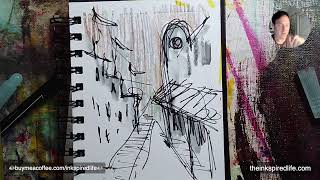
In this 2021‑08‑21 YouTube livestream, artist Jason Nicholas hosts an informal, English‑language sketching and painting session titled “Inking Out Loud.” He demonstrates a range of drawing materials—including pens, watercolor markers, colored pencils, and brushes—while working through a city‑scape sketch and several small‑format studies. Throughout the session he engages directly with chat participants, answering questions and sharing anecdotes. He covers practical classroom‑prep tips such as using a label maker, gives a brief tutorial on architectural scale‑ruler techniques, and promotes an upcoming 30‑day sketching workshop. In the closing segment he reflects on moments of creative blockage, showcases a “color randomizer” method to add spontaneous pops of color, creates a quick perspective scene, and discusses the value of reviewing his sketch timeline to see artistic progression. The livestream ends with appreciative thanks to the audience and an invitation to continue creating.
Chapters
Hey, hope everybody's having a great Friday night. TGIF. I'm Jason Nicholas Nicholas here with the Inkspired Life, and tonight we're going to be inking out loud for a little bit, so I'm just gonna pop on and do some sketching, painting, something creative. Hope you guys had an awesome, awesome Friday. So let's just play some music and get to some warm-up and see what happens. Let's see, I have a bunch of different playlists here. I don't know what I'm— I'm in the mood for this one. It's called Quirky Fun, the Quirky Fun playlist. So let's play it and see what happens. Hey, D-Ray, good to see you. Thanks for popping in. Hope you're having a great day today. So, I'm just actually sketching on the back side of this sketch here. I figured I would just use this sheet of paper and sketch within this box and play around for a little bit. There we go. I'm thinking too much. I don't want to think, I just want to do. Sometimes if I think too much and try to pre-plan, I get kind of locked up and frozen and kind of like a creative block. I know that sounds kind of weird. So I don't often try to pre-plan what I'm going to be doing on Inking Out Loud. It's really just kind of spur of the moment, off the cuff sketching and stuff. You know what?
Right here.
Hey, D-Ray, yeah. D-Ray, you see the crane. So, yeah, as I was sketching this, yeah, I saw kind of this crane shape happening, so I kind of played around with that. So, maybe some kind of a city looking up, you know, towards the top of some buildings in the city, a cityscape, skyline, you know, some kind of construction going on. So, it's so cool that you picked up on the crane there. Awesome, I'm glad you saw that. It's exactly what I was intending. Well, I didn't start off intending it, but that's what I saw happening. So cool, I love when that happens. I love when you guys see things that are happening in these sketches. It's always so fun to see where your imaginations take you. So I'm using my Lamy Safari pen right now, and I like to use the Lamy when I wanna bleed the ink. So you can see I'm kind of bleeding the ink, and I'm trying to maybe define some buildings happening here. And then you might see me switch over to my Pilot Precise pen. This doesn't really bleed, so that's kind of why I'm kind of switching to the two different ones. So cool. Hey, Heather K, good evening, good to see you. Hope you're having an awesome Friday.
Zoom in this way a little bit, be better.
Let's see, there we go. I just wanna do that and then I'll do that.
All right.
So I'm gonna stay a little close so you can kinda see the pen strokes and the lines a little bit better. Yeah, so we'll just turn this into a crane in the background. You know, the cranes usually have some— I gotta be careful even though it's a quick, just playful sketch. It's kind of wet there and you can already see here we got some ink right there. So what do I say? It's not art unless you wear it. So, got some art here, guys. It's officially right there on my palm. You might notice some gold flecks on here. So this is just the backside of something I was working on the other day. And I have to get some gold— actually, the gold flecks are from this Disney castle I did yesterday. Really quick loose sketch of the Disney Cinderella Castle. Cinderella Castle. This was done with a brush pen and some acrylic ink. And some of that gold paint ended up here, and that's okay. Kind of goes— sometimes I like to create these kind of grungy scenes that have like a mood, like a dark kind of industrial mood to them, so I don't mind if things splatter or splotch on the page. This and That. That's the technical terms. Splatter Splotch This and That. Sounds like, uh, maybe a recipe book or something. I don't know if I'd want to eat that food. Should we use the graphite stick? So I laid down some graphite stick. I'm just trying to create some maybe windows on this building over here on the left. Hope everybody had a good, good— actually had an awesome week and you did some things that you enjoy doing. Maybe you accomplished some things you had to get done. You got to chill out and hang out with your friends, family. Maybe you just took a quiet walk somewhere. Always try to make time to do something, you know, something you like doing, even if it's just for 5 minutes, 10 minutes. Otherwise time slips away too fast. So I try to make it a habit to do some kind of sketching every day, even if it's just for a couple minutes. I'm not always online doing it, but I do sketch. Plus, I just love it. I think it's become a habit at this point. I'm just doing some brush strokes here with my aqua brush just to give some movement to this building. Maybe, I don't know, maybe the paint or something something's kind of just— maybe it's weathering down the facade, just kind of dripping down that way. I'll move closer, you can kind of see it better. So you can just see I'm just real light brush strokes right over the graphite I laid down. Hey Deborah, good to see you! Thank you for popping on. Awesome, you guys are amazing. So I always love you guys watching, so thank you so much. I'm kind of tired. I've had a really busy, crazy week, so you might hear it in my voice, but I love seeing you guys. So, but I am just going to chill out this whole weekend. I need it. I've been spending every day this week in my classroom for about 4 hours getting ready, organizing, prepping. I discovered the beauty of a label maker. Um, it's one of those Brother P-Touch label makers, and I think I've seen commercials where the guy is like addicted and he labels everything including his dog. Well, I was kind of like that guy today with this. I'll show you the cool label machine. All right, let me grab this So I got this cool little show-and-tell time. Show and tell. So I got this cool Brother P-Touch. It's called the Cube Plus. So it prints out labels, which is awesome. But, you know, so I'm labeling like— we have flat files in these storage drawers for my students' drawings. I'm like labeling all their drawers, labeling the cabinets. I labeled— we have a like a tool cabinet on wheels. I even labeled it "Tool Cabinet." Like, duh, everybody knows it's a tool cabinet, but yes, yeah, I was having so much fun I labeled the obvious tool cabinet "Tool Cabinet." I should, for the first day of school, make myself a label that says "Teacher" and stick it on my forehead. Although I should make one that says "Teacher" for all the students because actually They are the real teachers in the classroom. That's what I feel. I learned so much from them, which is incredible. So I don't see students as just students. I value them as teachers. So maybe I need to buy some more labels for this thing so I can print one out for everybody. Anyway, so yeah, I know it was a little, little tangent we're going on. See the label in there? That was my day today, labeling, organizing, and I've been just having fun setting things up. I'm allowed to be in my classroom this year. I wasn't allowed in there last year due to COVID regulations and no windows in my classroom, but that is the past, this is the present. I have been cleared to be in my room this year with our fresh air ventilation system.
Super, super excited.
And back to the sketch. I know I go off topic. Crazy week, I bet. Label maker awesome. Hey, thank you, D-Ray. Yes, label maker was awesome, is awesome. And I didn't know that you could So much fun. So I'm going to play around with this a little bit. I'm debating whether or not I'm going to add some— I think I will.
I'm going to add maybe—
I don't know, actually, I'm on no fence right now. I don't know if I'm going to add any background. I was thinking about adding maybe some sepia in the background just to frame it a little bit, make the buildings pop a little bit. So maybe I'll do that. So let me know what you guys are up to. What are you up to today? What are you up to this weekend? Anybody have any fun plans? Or not fun? Well, hopefully they're fun plans. Me, at this point, sleeping in late sounds like a fun plan. Huh. Yeah, this is kinda cool. I like this. So, I like how— D-Ray, I love how you saw the crane in the background. Awesome. That was so cool. Yeah, I think I'm feeling some sepia, so let me break out my sepia pen. Actually, it's a sepia watercolor marker. Tricks here. Remember to label label maker. Hey, that's a— Thierry, you're awesome. Yes, right here. Label maker. I like that. No, no, no, no. Actually, that would be awesome. I should, I should do that. Hey, you gotta have fun, right? Even if it's making labels, you gotta try to bring the joy no matter what you're, what you're doing. Even if it's most tedious task. It's all about mindset and how we do things. Alright, so I got my— this is a Winsor Newton watercolor marker, and I'm gonna just throw down some sepia on here. Play around with that. Loving this music. I have my kind of movie soundtrack music list going. Picking up this brush. This brush has a— gotta trim some of these. Bristles that are kind of flying off the end here. Put that to the side. Maybe I could do some kind of collage or mixed media piece with the label maker, incorporate it on this. I'm just inking out loud, guys. I might be nuts, but maybe we'll try it. Maybe we'll do some kind of collage thing, maybe make some labels and put them on here.
We'll see.
This music right now reminds me of— this part reminds me of Edward Scissorhands a little bit. If you guys are into music or movie music and you know who Danny Elfman is, this has a Danny Elfman feel to it. I'm a huge fan of the music movie soundtrack music. I love Danny Elfman. He's an awesome composer and just an all-around crazy dude. And Hans Zimmer. I love the music of Hans Zimmer. So I'm very, very inspired and influenced by movie soundtracks. What we're listening to right now are just cover— and not really covers, they're, uh, I don't know what you call it. It's music, but it's not— they're not from movies because that would be copyright issues. So these are just people that made their own kind of dramatic music tracks. I like the way it's looking. So it's getting kind of a grunge look. I'm gonna have to turn off the light, I think, because it's getting washed out on screen. Let me turn this light off. You can see it better. I don't know if you guys can see, it's kind of hard to sometimes show this stuff on camera with the lights, but just— you can definitely see it up here. It kind of has a sepia grunge look, and I love, I love the hard edge here, how it's drying. Hopefully, you guys, let me know if you can see that okay or not. Maybe if I zoom in, I'll show you this small section. I think you can see it there. Hey, Karen, good to see you. Welcome, Karen. We got Karen B and Karen P back to back. Karen is joining us in the house. Hello, Karen times 2. Good to see you guys. You're awesome. I'm just gonna stay on this close-up so you guys can get a better sense of the sepia as I'm putting it on here. You'll also notice I'm putting the sepia not directly on the paper. Sometimes when I do that, it kind of stains the paper and I can't move it around. I want to be fluid with it, so I like to put it down on this palette board I have here, and I like to just lift it off there with my brush and add it on. So that's something you might see me doing a lot when I'm working, especially with watercolor markers. I like to throw them down on a palette and then lift the colors off. It's just a personal preference, you don't have to do that. That's what's so cool about this artwork is you can do whatever you're doing. Do what you want to do, right? Just because I'm doing something doesn't mean you need to do it. It's just, uh, I love riffing off you guys. Everybody has great ideas and tips and pointers. It's just so fun seeing how people do their guitars. There you go. I do have another color that's popped in my head I want to add to this. Can anybody guess what color? What do you think I'm going to add to this next? I just had a color pop into my mind. Let me know in the chat what color do you think I'm gonna add to this next. I didn't bring one. Blue! Karen V says blue. Ooh, D-Ray says yellow. We have a winner! It's yellow! D-Ray, you nailed it! Awesome! It is yellow. I have to find my yellow. Where is it? There it is. So I'm going to add some Sunshine Yellow on here. Awesome guess! I have a backup one because if I think this one's almost empty. Good guess! Woohoo! 10 points for D-Ray! Awesome! Yeah, I feel like I just want to pop some— I don't know, maybe it's kind of a twilight time of day, maybe there's some lights on somewhere. I'm also debating if I want I'm not really debating. I am not debating. I would be very bad at debating and trying to make a point, back up my point.
It's too logical.
It's too logical for me. There you go. Just gonna throw some sepia down here. I kind of like this slender building happening. Sepia just to pull it out a little bit more. I like that. I like the way this is drying.
It's looking pretty cool.
Do I get a sticker? D-Ray, you get a— you get a— here's what D-Ray gets. D-Ray, you're gonna get a— D-Ray gets the smiley face award for the correct answer. You get the red smiley face award. Congratulations. So fun. Two stickers. You guys are— that'd be kind of cool to get like some stickers made and mail them out, like do some kind of contest or something. That's like— that could work. So I am going to You'll notice I really stick to this aqua brush a lot. This is a medium tip aqua brush. Here it is. Um, I'm not going to use this now, but I also— the other brush I like to use is a flat 3/4-inch brush when I'm doing larger areas. I have a fun bamboo brush here as well. Alright, let's put some yellow on. And these are some, um, some yellow over here as well. I'm just kind of just placing it on here, and I'm not going to put it everywhere. I'm gonna throw some down over— throw some down there. Most of the times I'll just take the ink— this is watercolor ink, actually.
Most of the times I'll just take it right from the cap and paint with it. Yep.
And I'm thinking, I'm trying to be a little too careful. I want this one somewhere with the music to go, just kind of dance with the music. Well, I'm not gonna dance. Let my hand kind of dance around. Of course the music stopped as soon as I said that. Music, come back! There it is. This is a fun piece of music called the Ghost Pirate Ship. I just heard it for the first time the other day. My wife just sneezed. Bless you! My wife just sneezed in the other room. I'll get her on camera here enjoying the show. I've tried to get my— actually, when I first started doing these like 3 years ago, my son would come on and— He was my technical producer, so he would help me behind the scenes. But he has not— he's not regained— he's lost interest in it. So one of these days I'll try to get him back here, get my technical producer back on the scene.
We'll see.
I can't force it. He's a great kid, but right, we all have our different interests. Red Bull. We'll get Red Bull on camera one day. Red Bull is on cats. Fun. Look, you guys know the movie Vacation with Chevy Chase, right? National Lampoon's Vacation, I love it. We could do like the, uh, thinking out loud version of that show. Cool. I think that's enough yellow. I think that's all I'm gonna put on there for now. What are you all going to go over in your upcoming sketching workshop? Hey, Karen, great question. So the next workshop is going to— I'm planning on starting it September 1st. It's gonna be a 30-day sketching workshop. Sketching challenge/workshop. So I'm going to be giving topics, either 1 or 2 topics a week, and it's going to be sketch journaling. You know, one topic might be something like, you know, this is probably not going to happen, but maybe the food. Like, sketch some food or something you ate or something you love eating that's inspires you, sketch that. Sketch a place that means something special to you, you know, maybe a quiet place. So I'm gonna give topics out. And then what's gonna happen is we're gonna meet on Zoom once a week at the end of the week. And we're gonna do show and tell. And if you wanna show what you sketched that week and talk a little bit about why you sketched some of the things you did. That would be great. I think it'd be an awesome way for people to get to know each other. We could see everybody's different kinds of— their thought, your thought process, your creative process. You know, I'm not going to tell you to use watercolor. I'm not going to tell you to use markers or crayons. You can use whatever medium you want. So it's really going to be a sketch journaling type of workshop, and What I've been finding in the past workshops is they've been awesome. Maybe you guys have seen some of the work they've put— some of the people have been posting their castles, their cottage sketches, their buildings. Incredible, inspiring stuff for sure. So it's kind of a collaborative workshop. You know, I'm kind of structuring it, but it's not really about me running it. And about me teaching. It's really about everybody collaborating together and creating our own individual sketch journals. I know it's kind of vague. My homework this weekend is to put together an outline and the course and more information, and I'm going to be releasing that information hopefully Sunday or Monday. So thank you for asking, Karen. We got dimension with yellow. Yeah! I like the yellow on here. So I think this sketch is good for now. I'm gonna leave it at this and we'll do a different one. I'm gonna let it dry. I really wish I could show this better. It's kind of faded out, I think. I love the movement on here. It's kind of just the line work, just kind of vertical here. You know, I didn't try to keep really clean brush strokes. Kind of looking lightly bleed out there at the end. This yellow is a little bit more brighter in person. I think I would like to pop the crane out a little bit more, so I might work on this piece, pull the crane out just by adding some ink to it. Other than that, I think it's a cool little city skyline sketch. Yeah, so let's— we're gonna let this dry and I'm gonna switch and do another sketch. I'm— oh, look what I got. I got sepia or— oh, I think I got Nook all over this page. That's all right, it's kind of cool. So I'm just using my Canson XL watercolor 7x10 spiral-bound book here. This is my go-to for when I do want to do just quick watercolors or even just pen sketches. 140-pound. And I love— I probably say this a lot, but I do love the spiral-bound notebooks because I can open them and the page is flat. I can flip them over if I need to. So I'm definitely a spiral-bound fan. I have to say those words, it sounds kind of weird. Spiral back, okay. Um, cool. Actually, I'm just looking, let me zoom out so you guys can see both of these together. Sometimes I like to compare different things I've done and see if some things are similar, some things are different. As I'm looking at this, you know, what I see in common is I see very loose pen and brush strokes happening in both of these. They have— both have some yellow hint. These are actually gold on the Castle, gold paint. This is the yellow, but it has a similar kind of feel with the yellow and golds popping out in it. You'll also notice on here When I do windows of buildings, lots of times they're just rectangles or squares, not even perfect rectangles or squares. So if you look at the Disney Castle, you know what I mean? These are my openings. I'm not actually drawing the entire— "wikitongue windows." I'm just showing squares. I think that's enough information for these quick sketches so you understand we're looking at a window. And you can see the same thing happening here. On the left, right? So you can see the similar characteristics there architecturally. Um, I also notice, you know, the conical roofs, spires on the castle. They also have an angle kind of on the skyline here as well, and this conical-shaped roof on this building. So what I think happens Lots of times it's subconsciously. Sometimes the things we've worked on, you know, before will translate through into other artwork to create other sketches in subconscious ways, maybe planned, which is kind of cool to see how things develop. Awesome. I know I'm talking a lot, sorry about that. Sometimes I'm chatty. 9:17, I'm gonna wrap up at 9:30. So let's do another sketch. Spiral books for sure, although the bonded books look so cute. Yeah, yeah, the bound— I know what you mean about the bound books. So I have this, actually it's funny, I have this, here are these little bound sketchbooks which are pretty awesome. This is a ProArt sketchbook, very thin paper. It's not really meant for like watercolors or saturating with water, although I have done some light washes in here. You can see the paper's all wrinkled. Yeah, I know what you mean. I like these books as well. They just look a little more formal. You reminded me that I pulled this little book out earlier. Pretty simple sketchbook. And I was gonna just do some small sketches tonight. So maybe we'll do that. Bring out the small sketchbook. Hey, hope you guys are enjoying this. If you're having a great time, let me know. Give me some thumbs up. Say, "This is awesome," or say, "This is not awesome." Whatever you wanna say in the chat, I'm always here for you guys. If you have questions or comments, let me know. I love how you guys talk with each other. Alright, we're gonna change up the tunes. We're gonna put something a little fun and peppy. We're gonna go with our jazzy soundtrack here. Pick up the tempo and we're gonna do some really small sketches. This book is only 4 inches by 6. So we have a 4 by 6 little sketchbook.
Don't—
we don't always need to create a Biggest I've worked on was 24 by 36. Now, in architecture, our drawings, our typical blueprints, are always printed out— not always— typically printed out on 24 inches by 36-inch sheets of paper. One of these days we're going to sit here and we're just going to do some architectural technical drawing on Thinking Out Loud. If you guys think that would be cool, let me know. Would you like to see some technical architectural drawing where I'll break out some rulers and triangles and we'll do some architectural drafting, which is really another type of art form. This is very, very thin paper. You can see that from the—
All right.
I think I'm gonna use my, uh, Pilot Precise Pen. Deborah, "Hey, I love Sketchbook Journals." Thanks, Deborah. Karen Binder says, "Awesomeness." Yes, I love the "ness" at the end. Thank you guys for your awesome comments. Deborah says, "I love the drafting for sure." Hey, that's awesome to hear, Deborah. Thank you. Yeah, I've been wanting to do that. I actually just— I haven't done a lot of architecture this year. I've been focusing on school, but actually one of my clients has come back to me after a few years and we started a house design for him. He came back this weekend. We're wrapping up his drawings for his house design, so it's fun to get back into architecture mode. I'm not drafting it by hand, I'm using CAD. I'll even share with you guys some of the CAD drawings that I do. You can see a little bit of the technical CAD computer drafting stuff and how we can make 3D images using that. I think that would be kind of cool to demonstrate along with some kind of hand drafting. Teacher, with the rulers, we will have to know the numbers on them. Yes, with the rulers, will we have to know the numbers on them? Hey, good question. Yes, so This is just a regular ruler. This is not an architectural scale. Turn this light on his hands.
There you go.
So this is a regular— this is a metal ruler, actually. I have architectural scales, which we could definitely talk about. So this is an architectural scale. So see where it says 1/4? So that means every 1/4 of an inch that we draw— wait, I'm going into architecture. Wait, how did that happen? I'm slipping into architecture mode. All right, let's talk about this for a second, guys.
We can do that.
Give me some practice. Let me zoom in. We'll just use this sheet of paper. So every 1/4 of an inch that you see on this ruler is 1 foot 0 inches. So for example, if you start here, it's kind of weird, we're working right to left. So that's zero. That would be 2 feet. That would be 4 feet. That would be 6 feet, 8 feet, 10 feet. There are other numbers on here. There's all kinds of different architectural scales. Let's just focus on the quarter inch. I'm gonna show you. So say I wanted to draw on this sheet of paper a room.
What could I fit on here?
Let's just do a 10 by 10 foot room on this paper, right? So we're going to draw an architectural scale of 1/4 of an inch equals 1 foot, 0 inches. So if I come down to this piece of paper, clear some room out here. Oh, this is actually laid out. Does this lead out to a quarter-inch grid? Ah, look at that! That's so awesome. Zoom in closer. So actually, this paper is set up so that each one of these dots, from one to the next, is a quarter of an inch, or one foot.
I'll show you.
Alright, so let's just draw— running— oh, actually, the lines are not a quarter inch. So I can't use the dots. Anyway. We're going to say that's 0, and we're going to make a 10-foot, a 10-foot square, our room, right? So I'm just putting a mark there. So, so that's 0 feet, and you can see where the 10 is, so that's 10 feet. We'll go the other way down here. Hey guys, thank you for letting me practice. I need to practice this because we'll be teaching this. I'll be teaching it very soon. All right, so you can see, so I'm going to go down 10 feet. We're going 10 by 10, so we're back to the zero. Um, see, it's behind my little coffee thing there, but the number 10 is right here. There's 8 feet, 9 feet, there's 10.
So I'm just going to draw that.
So that's where that ends. So this is 10 feet. This is 10 feet here. And I mean, I can— I'll do the same thing on this side just so you can see what I'm drawing. Sorry, it's off camera. Bad teacher, I'm getting this off camera. There we go, it's better. So 0, 2, 4, 6, 8 feet, 10 feet here. Right, and I can just connect these. So we just drew a 10-foot by 10-foot square. So this is 1/4 of an inch equals 1 foot 0 inches. If you were to use a regular ruler, so on a regular ruler or every quarter of an inch is a foot.
So here's 1 foot, 2 foot, 3 feet, 4 feet.
We got the Toy Story music going, or Monsters, Inc. music. All right, so hold this here. Try to hold these next to each other. All right, so I have the rulers on top of each other. So if you see the zero, the white scale, and you see the 4, that's 4 feet. You look above it on the metal roof, you see 1, that's 1 inch. So we have 1/4, 2/4 or a half, 3/4, 4 quarters, so that's 4. I know it's just quick play-by-play. Hope that made sense. I will not charge extra for that ruler. You guys are awesome. Oh, you've seen them. Yeah, D-Ray, you've seen these. Yeah, these rulers are confusing. There's so many different scales on them, you know. So most architectural drawings will be at the quarter-inch scale. If you look, slide over to this side, this says 1/8. So what that means is every 1/8 of an inch equals 1 foot. So if you start at 0, 1 feet, we have 2 feet, 3 feet, and 4 feet. So the 4 is 4 feet, 8 would be 8 feet, 12 is 12 feet. All right, cool, so that's what we're doing. Hey, good night, Karen, good to see you, thanks for tuning in. I always appreciate your time.
Alright, cool.
Alright, let's do a little sketch of this fox. I'm gonna use, uh, some colored pencils since this is really thin paper. Just wanna throw down some color. And I'm off the page. Sorry about that.
Here we go.
We got some kind of a red, maybe some kind of a carriage house structure happening here, carriage house building. And we'll have some brown going on here. You know, I'm not gonna use green. I like to use colors when they're not expected to use. So, you know, we always think, typically think of the ground either being green grass or brown.
Why can't we have purple, right?
Make it fun, playful. This is a world we're just having fun creating our our own, using our imagination here. I think when you use colors that people don't expect, it adds a sense of playfulness, a sense of whimsy to what we're creating. This is like a tree in the foreground. Let's see, I'm just working with colors I have right in front of me. Orange, orange, orange. Sure, we'll do orange. We'll do some orange here. You know, I'm getting a little crazy now. Get crazy, live it on the edge. Hey, welcome to UA, anytime. That was just a quick little show and tell of architectural scales. Real quick. I will— we'll do a formal lesson sometime. Formal demonstration. I love these color pencils. These are Prismacolor colored pencils. Which really lay down nice. They're really nice for blending colors together. They're not the cheapest colored pencil, but you really get what you pay for, and I love the quality of Prismacolor pencils. So thank you, Prismacolor. You can kind of see what I'm doing there. Back on listening and learning. Deborah is back on listening and learning. Thank you for sharing. Hey, Deborah! Thank you for watching. I appreciate that. You're so awesome. You guys are all awesome.
This is a quick little sketch, you know, using some colored pencils.
Oh, my pen hurts. My pen ran away from me. Zoom in.
Cool, there we go.
It's just a quick little fun sketch, some different colors on there, kind of playful. Good night, D-Ray, good to see you. Teresa says thank you. Hey, you guys are awesome. So I think I'm gonna do my final exiting sketch. Do that. That red is powerful. Yeah, this is— what color red is this? I have a couple of different ones. I don't know if I can read this. My eyes are— I can't actually read what this says. What if I zoom it up here? I can't see what color this is. It is definitely red. It might be carmine red. Maybe you can read that. Let me know. I can't actually read that. I love this color red as well. Oh, this is carmine red here. This is the carmine red.
Carmine Red.
Let's do a little red test here. This is the Carmine Red. This is Carmine here. Say hello to Carmine. This is that color I couldn't— I didn't know the name of it, but maybe they're both Carmine.
Interesting.
This doesn't feel like a Prismacolor. Color.
No, this—
I am red orange. This is red orange.
I could read it right.
So we have a red orange and we have a carmine. We have two funky guys we just sketched. So let's make them into something. I always love drawing spires and church— church spires. Oh, it's turning into a castle, it looks like. All right, or cathedral, maybe. I'm just having fun with colors, that's all.
Cool.
Hey, Carmen Red is one of my favorite colors. Hey Becky, good to see you.
Welcome.
Yeah, they do look the same. I totally agree. The Carmine and the Red Orange look the same on the paper. I can't tell which is which. Although they look different here on the pencils themselves.
So it's really weird.
Um, I love the Carmine Red. I don't think this is a Prismacolor, this one, because it's not Coming down as smoothly as the Prismacolor. Here we go. So there's just a couple little sketches. I just wanted to show you that, you know, sometimes it's cool just to have a little tiny sketchbook around. Easy to carry around. Again, this is 4 inches by 6 inches. Do all kinds of little fun things in these books. We don't always need to work on big sheets of paper. These are cool for just getting ideas out quick. So, awesome, awesome. And I hope you enjoyed that little demonstration of how to use the Architectural Scale, which we'll work into another lesson.
At some point in time.
You guys are so cool! Let's see how our first one is drying, and maybe we'll do a little more on that, and then we'll wrap up with our whistling cowboy song.
Just looking—
I never— I always forget to bring a drink of water in here. Silly me.
There it is.
Alright, so let's see how our sketch is drying. Forgot the word. So Becky is just joining us. Hey Becky, we created— when I say we, I mean me and the Inklings out there. Consider you guys part Jason Nicholas was part of the team. We were working on a kind of a quick little grungish industrialishness-ish-ish. Obviously the sketch of the skyline with— not really skyline, we have a vignette of a skyline, buildings here and some kind of a crane out happening in the background. So I think what I want to do, I want to kind of pop this crane out a little bit. This is what's kind of— not bothering me, but something I want to kind of fix. This is— the crane's getting lost in this area here, right? So I kind of want to define it. What I'm going to do is, let's use the Lamy pen so I can bleed the ink. And we're just going to kind of go on the outline here and just pull the crane out.
You'll see what I mean.
I just got a really fun idea. I was thinking of— maybe I should pour some colored pencil. This is my favorite colored pencil color. I probably say this a lot. This is a light aqua. I love this color. I'm just pouring out some light aqua on Pardon the sharpening sound here, I'm gonna sharpen the pencil. This is free, free for the price of admission is you get to hear the sound of the sharpener. So enjoy. Here we go. I love this sharpener, guys. It is small, convenient, actually holds a good decent amount of shavings in it. It's pretty good. It's powerful. Battery operated, so I love that it doesn't have to be plugged in. Yeah, I'm feeling like we're gonna add, you know, let's do the crane and we'll add some color to it. Now let's switch our music. Let's go to the International Mix. Oh, is that what we were listening to? I don't know. Anyway, you can see I'm just going to kind of go along the bottom edge of the crane with the Lamy pen and then I'll—
should have brought out a little further, but we can do that. It's our drawing, right?
So put some X's here. I'll go that further because I want to just do our little, you know, Crane thing hanging down. Yes, my brain shuts off at 3 o'clock. My memory, the crane thing hanging down there, uh, the chain, the cable, the cable, that's the word for that.
Cuckoo.
I'm cuckoo.
All right, here we go. Cuckoo cuckoo.
If I was a bird, I would be a cuckoo cuckoo. Cuckoo bird. If you guys were birds, what kind of birds would you be? I think I'd be the cuckoo bird.
I'm definitely a cuckoo bird. You ever think about that?
What kind of bird would you be? There we go. So now we got kind of a little crane thingy, kind of happening. I think the crane, you can see it's a little bit more defined now that I added the ink, letting it bleed.
I'm gonna touch—
did add some paint here. I'm just gonna kind of touch it lightly and then come back to here. There we go. So I think that kind of helped, makes it a little bit Pigeons! Becky, would you be a pigeon, or do we need pigeons in the scene? How cool would it be to sketch a little pigeon sitting right here at the edge of the frame? Hmm, you guys know me and my birds. My animals. Maybe I'll think about the pigeon. Come back to the pigeon. I'm not really crazy about the top of this. I'm being fussy. I'm usually very fussy with these sketches. Come on, there's something up here.
I think there's a little more detail.
There we go. I think I like that a little bit better. I could go for a baguette. Baguette right now. Wait, it's made of—
pâtisserie.
Pâtisserie. How do you say pastry in French? French?
Pâtisserie.
All right guys, I'm doing it. I'm throwing down some of the blue. Yeah, I like that blue on there. It's looking pretty cool. Falcons sometimes live on skyscrapers. Hey, there you go. That's right, falcons are the symbol of my school. How cool would that be? I'll have to work. I'll definitely have to work a bird on this crane somehow. Oh wow. Paris to Chicago, music. Yeah, we're kind of all over the place, which is fun. I'm loving this. This blue on here, I think it's really—
I love—
I'm loving this color palette, guys. You know, I'm a color geek sometimes. This looks awesome. I'm just looking, staring at the screen here, the image on screen. Actually, the image on screen looks— it's pretty much dead on to what I'm seeing in person. Usually it's washed out. That looks really good. I don't want to overdo it with this blue as I put more and more down. You know, I don't want to get too cray cray with it. I'm going to do some vertical strokes just to kind of tie things together a little bit here. I like the vertical feeling of this piece. That's why a lot of my brush strokes on this are intentionally vertical because I just want to have a tall kind of feel to it. That looks really cool. Does it give a metal sense of color? Yeah, it does. So it gives kind of a weathered metal kind of feel to it, which I love. Good point, D-Ray. Karen says, "I like it." Thank you, Karen. Yeah, it really does have kind of a metal look, which looks awesome. Oxidation of copper, Vicki says. Yeah, exactly. You guys got it. I mean, I could throw down some copper ink on here, but I don't want to. I don't— I kind of like what's happening with this. I do have sepia on here. I could throw down a little more sepia in places if I wanted to. But this is— I think it's at the point where I'm just gonna leave it where it is for now. And then I could always come back and add to it, right? I do want to show you one thing on here. I don't know if anybody picked up on this. This came on when the countdown timer was on. I started working on this, and I'll show you what I did in case you missed it. Um, let me actually zoom in. Again, this goes back to— we were talking about how things subconsciously happen, right? Just going with the flow. When I started tonight, I took out this lead holder. It has this multicolored lead in here that you can take out. So it's really awesome. I love using this. It's fun. It's like the— I think I called it the color randomizer. 2.0 or something, because all the fun colors. But when I did this, I had this ruler and I just started this right here. You can see this line right here. Let me zoom in again closer.
There we go.
So if you see that line, you're gonna just— I was just like, piece of paper, I said, I'm gonna just play with this for a while, warming up here. The color actually on here is a copper color that came out of the lead holder, which I feel like maybe kind of set the tone. This one line set the tone for the random sketching that happened to where we are now. So sometimes it's just— it can be a color that sparks a drawing. Drawing, or it could be a simple line.
It could be anything.
So don't ever fear the blank page and be paralyzed and don't do anything because, like I said, you can just do a line, look at a color, it could be music. Anything can just trigger you to get started. Yeah, I'm just looking at the colors. I think that was cool. I feel like I want to add another more structured line. But I don't know what color it's going to be. Again, it might not be the color of copper. That's fine. It's random on here. I feel like I just want another structured line here.
There we go.
So you can see I just added a line here. It's kind of cool. You know what, I should add another one. Should I have another here in the corner? I could. It's kind of mimic this, but I kind of— I'm going to leave it. I kind of like this line, kind of says, right, this is the top, it's stopping. And I like the bottom is just continuing, right? We know the buildings are continuing down. So if I were to put a line across here draw it, I feel like it would just cut off our imaginations and say, okay, that's it. I want people to imagine these buildings continuing down, just being very, very tall. Cool. Hey, I hope you guys like these sketches tonight. I hope you enjoyed this quick skyline sketch. This is awesome. I did it on the back of this this one, so it's a two-for-one. Interesting, I actually like this better. This was sketched to metal music the other night, which is fun. I'm just warning you, I'm gonna do an all-metal music show one night. It's gonna be just metal, Metallica-y type music. See what happens that night. It'll be fun. Cool. Alright guys, so let me make some room here. We're gonna Get ready to our outro cowboy whistling song. Yes, Cut Off Imagination, like you said. Thank you, D-Ray. Karen, good to see you. Yes, you in the morning, have a great night. Thank you for watching live. Um, D-Ray, the white is catching my eye as well. Yeah, so I like how you're seeing, you know, the white spaces on here. Absolutely, those were left intentionally. You guys up here, Ru talking about holidays in your artwork. So these were intentional white spaces in here. I love the white spaces. Good point. Good catch. Bottom line would anchor too much. Yeah. Becky. Good. I'm glad you guys kind of agree with what I'm saying. Don't want to anchor it.
Yay.
Metal show. Becky's like metal show. Yes. Yeah. It'd be fun. We're going to do it. I love it. I love all kinds of music. Most kinds of music. Some music I'm not really into too much, but, um, you know, I always say I love everything from Neil Diamond to Metallica. I love it all. Alright, cool guys, so thank you for watching. Let me get my cowboy sketchbook out. We're gonna wrap up. I'm reminiscing. This was from this week. This was a fun piece as well. I really need to start putting dates on here. The year when I do these. Uh, month.
I usually like to put the month and the year.
Just so if I look back I know when I did these. So one of my projects projects this weekend is to take all— I think I showed you guys my— did a show and tell of my art drawer. I'm going to take all of my art pieces out and start documenting them, photographing them, and putting them up on my website in my gallery store. So a lot of these original pieces you see are going to be available for purchase. Something I've been wanting to do, just haven't gotten to it. This is fun. I really like this one. I'm sorry, guys. I'm just— sometimes I go back and look at things. This is— this really dried incredibly awesome. I love what's happening. Again, if you look closely, we're back to the rusty colors again, right? We have the cyan blue here. We have sepia tones. So you can see You can see a lot of the colors I like to always work with. This was a little different because we had the— oh, what's that red color? I don't know what it's called. The red orangish color. I think it's called like— I'll look at it— Orange Flame or something.
What's it called?
Oh, Inferno Orange. So this was our Inferno Orange color. Really fun piece. Oh yeah, oh, D-Ray, you reminded me, I forgot about the label maker. Yeah, yeah, yeah. Wait one sec. Hey, if you guys could stick around for another minute or so, like a couple minutes. D-Ray, I forgot I wanted to use a label maker on the other sketch. Yeah, yeah, that's awesome, I love that you said that. I'm gonna use a label maker on all the drawings here. Painting, sketches, sketch paintings, whatever you wanna call them. Alright, so Becky, you missed it, and if you're just joining us now, you may have missed, we talked about labeling and how I'm being very label happy in my classroom this week, especially today. I labeled the obvious toolbox, toolbox. We're gonna label the teacher and we're gonna label all the students, teachers, and labels as well. Although we really should label. Who said a label maker? I think D-Ray said to label the label maker, so you really should label these too. Um, okay, let me use my phone. So this is kind of cool, I can use my phone wirelessly to do this. All right, I'm going to ask you guys, what labels should we put on here? We could maybe put a couple. I need a suggestion. What labels? I'm gonna make a little collage or something. Labels. So give me some ideas. And while we're doing that, let's get my app open on my phone here and connect the printer. You guys would like to see a demo? I can definitely do that. So what should we label this thing? Here's Jason Nicholas' label tab. There's an app on my phone I can use to—
first I gotta connect it.
Connect it with Bluetooth. Technology is awesome, guys. Cold Metal. Ooh, I like that. All right, Cold Metal is one label. We're going to use Cold Metal. Any other ideas? Any other label suggestions? We're going to put Cold Metal on here. All right, I'm connected to the printer. With my app. So there's a cool app in case you guys want to see. There's a cool app here on my phone. See, I wasn't kidding. Right here, tool cart. Labeled my tool cart, tool cart. The drone supply cabinet, I labeled. I have a huge metal cabinet on wheels that had some paper in it, put paper on there. All right, but we're gonna do I'm gonna label this. Let me get a blank label on here. What's also cool about this app, if you look, there's all different pre-formatted labels you can do. Brother, if you're watching. This is a Brother P-Touch. Quarters. Ah, let's see. I'm gonna mix it up. Let's use this one for the cold metal one. Alright, let's do this.
So we're gonna put cold.
Do all caps on it. We're gonna put cold. We're going to do bottom. We're gonna put metal. Space it out. You guys like this little demonstration?
Alright.
Oh no, I changed it wrong. Do it again. More cold at the top. And the bottom we're gonna change. We're gonna put metal down here. I think it's spelled right.
There we are.
Whoa.
There we are.
Alright, so we got Cold Metal. Oh, my Fitbit said it's time to start winding down. Great, the bed just told me to.
Okay.
So we're going to print that one.
So it won't—
you'll see it come out of the label machine a little bit. Oh man, why is the label— is label maker weird guy? I love that.
Awesome!
He's awesome. I'm gonna do the same thing. That's so funny. Frigid Build. Ooh, that's cool. I like cold metal. We're gonna go with cold metal, and if anybody has any other suggestions, we'll go with those also. So here's the cold metal. There we are, we got the cold metal label.
We want it—
I kind of want it vertically, actually. We'll put it off something down here, the lower brain. Let's do it. Right there. Boom, done. All right, we got a label on there. Cold Metal, I like it. Kind of like how this line comes down, it's almost at the center with that black vertical line. Stone Cold, left side, lower Awesome! D-Ray is name happy. You're coming up with all these really awesome names. I like Frigid Build. Stone Cold I like as well. These are really good. Frigid Build. Yeah, you know what, let's do— we can do Frigid Build also. Actually, you know what, I'm gonna leave one label. I think if I have two, then I'm gonna have three. It'd be kind of fun to do like a collage of all different labels, but we can always add this. We're gonna leave it at Cold Metal. We're gonna move on to our last sketch for the night. So thank you for your suggestions, guys. Awesome. This is a fun piece. I really like this sketch. Alright, it is now time. For the cowboy. D-Ray said collage. Yes. Speaking of collages, I need to do mine for my— our workshop. Becky, I saw you turn in your collage. It looks awesome. What a fun collage. It turned out so well. So D-Ray, in our last workshop, our last assignment was to make a collage using paintings and sketches that other students did in the class or even your own. You could print them, cut them out, and make collages. So that's so cool. So Becky, thank you for sharing your file, your finished collage. It looks awesome. I'm gonna get online. All right, so it's whistling cowboy time, guys. I'm gonna wrap up. I'm getting tired here. Thanks, I had fun with it. Awesome, I could tell. Yeah, it's always— Becky's artwork is always so fun to look at. It's very— it's either very happy and colorful or spooky. Becky does really cool Halloween types of scenes as well, so I'm looking forward to seeing more of those as we get we get closer to Halloween and the fall. For sure. Alright guys, let's break out the Whistling Cowboy sketchbook.
Here it is.
Last night's here for a recap in case you didn't see it. This is what we came up with last night. And again, if you're just joining us here on Inking Out Loud, basically I'll just use whatever is on my desk. That we used during the night. And I'll just try to do a quick, I guess, what is it, a minute and a half, 2-minute sketch as I listen to the Cowboy song. This little Cowboy song. Oops, oh no, wait, was this last night's? Guys, I think I'm crazy. I think this was last night's. My bad. Yeah, this is from last night. We are— oh no, we're out of paper. That was the last sheet of paper. I can use the back of this one. Actually, you know what, we're gonna do one right on the back inside cover.
Why not?
Alright guys, hey, I hope we got the spooky soon. Yes, I love the spooky stuff, so cool. Hey guys, thank you for watching. I appreciate you all so much. Feel free feel free to always share this out with your friends. You know, I'd love to keep this growing. You guys are always so fun and inspirational, so thank you for that. I appreciate it. So I will— I might be on tomorrow night for a little bit. Thank you so much, guys. Hope you had a great week. If I don't see you tomorrow or over the weekend, have an awesome, awesome weekend, and always just keep hanging forward with your creativity. Okay, each have it. You guys are amazing, so thank you. Um, with that, let's head to the Cowboy Song. Haunted Lighthouse is brewing. Ooh, a haunted lighthouse! That's awesome. I, I, I would love to sketch watching the Power Lighthouse also. They have just inspired a really fun idea. So cool. I'm finding the cowboy song. Love this music. Alright. Hey, you guys, thank you for watching so much. Appreciate, appreciate you all. Here it is right here. Got it. Alright, it's whistling cowboy time.
Enjoy.
Peace and live creatively. See you guys real soon. I'm a bit stuck here.
There we go.
Thank you guys, have a great, great night. Peace with creativity. I'll see you guys real soon. Take care. And hey, I think I can find the button. Oh wait, pause. I'm not leaving. One sec, one sec. I just thought of something. So, when I was sketching this, you probably heard me say, "Oh man, I got stuck," right? I didn't know what to do and I forgot I have this out, right? I wanted to add some color somewhere on here. So, fortunately I had this color randomizer laid out here and I just used that to sketch with. Just add a pop of little color on here. So, this is just a quick scene. And I hope you guys like these little perspectives to end the show with. I think they're a lot of fun. And it's just a great exercise. It'll be really fun to go back and look through a timeline just to see how all of these have kind of progressed. I don't think I have them all in this book. I think it goes back to like where this Stadium One was. Anyway, thank you guys for watching. I appreciate you all so much. Peace out. Have a great, great day or night. Whatever time it is. Bye.





