The Inkspired Life - Sketching & Painting : Inking Out Loud
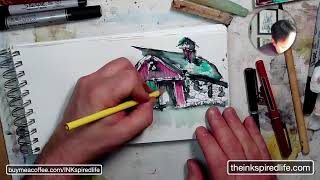
In this 10‑minute livestream, artist Jason Nicholas greets his online community, announces his daily "bridge sketch" ritual, and walks viewers through two bridge drawings and a barn sketch. He revisits a Bear Mountain Bridge (Sketch #50) by adding ink bleed, hatching, and depth using Lamy ink, Apple Snail ink, and graphite. He then creates an imagined bridge (Sketch #51) on rough Arches Aquarelle paper, experimenting with graphite, sanguine, neon yellow, and unexpected blue pigments while discussing paper texture, ink flow, and his intention to have fun. Afterward he switches to a larger sheet to sketch a whimsical, "wonky" barn, detailing a gambrel roof, stone walls, cross‑bracing, turquoise door, and turquoise/red accents, using Pilot Precise, Sharpie, Lamy pens, watercolor markers, and ink bleeding techniques. Throughout, Jason interacts with chat participants (D‑Ray, Jennifer, Cameron, Linda, Karen, etc.), answers spontaneous questions about heat in Arizona, shares tool tips, and emphasizes setting a creative intention, improvisation, and enjoying the process. The stream ends with a recap of the two bridge sketches, a look at the drying barn, and a thank‑you to the audience.
Chapters
Hey guys, happy Friday! It's 10 o'clock— wait, 10:10 PM here, Friday, January 20th. Hope you guys are doing well. It is time for a daily bridge sketch, so I figured I'd pop online, see who's out there and say hello. Hope you guys are doing well. Let me put some music on here. Oh, where is— I have Spotify on. Let me pause Mr. Spotify here and we'll play some music we all can enjoy. Awesome. Hey, I see D-Ray's in the house. D-Ray, hope all's well. Always great to see you. I hope you're keeping warm with your snow in Alaska. Um, good to see you. Hey, Jennifer says cheers from Freezing Arizona. Ooh, what are the temperatures in Arizona? I'm curious to know. Jennifer's always great to see you, hope you're doing well. Cameron is in the house. What is up, Cameron? Uh, it's so great to see you. I think— I don't know if you're back in school yet. If it's not this week, I'm guessing next week. I hope you're doing well. Down in the 30s in Arizona, a freeze warning out. Oh my gosh, that, that is cold for you. 30 here is like nothing, so, uh, I hope you're keeping warm. This is kind of a dumb question, but do you have heat in your house? Do houses— I guess I don't know. I really don't know if— I assume air conditioning is kind of a standard thing. I don't know if heat is a standard thing in Arizona. But I hope you're keeping warm. So this is a sketch I did last night, the Bear Mountain Bridge in New York State. And I thought it was finished. Until I took it out today and looked at it again. I just wanted to bleed some ink and give it a little more character, um, than what it had on there. So I'm just bleeding some ink tonight on it, but I'm going to do a different— I'll do another bridge sketch as well. But I just want to throw down some ink on this one here. So I'm just bleeding some Lamy ink, and there's also some Apple Snail ink that was still on the brush. You can kind of see it on here as I wipe it off, and on here, the yellowish stuff. So I don't mind that there's black mixed with that color. It looks cool to me. These are little— these are lamppost fixtures on the bridge. So just bleeding some of that ink, just give it a little more definition, a little more character. And now I'm just kind of brushing some dirty water on here just to kind of fill in this. I'm trying to create some depth so this part of the bridge is in the— kind of in the distance. And I'm just brushing some of that dirty water on here. Cool. There we go. Ooh, I like that. Just moving, letting the ink flow and let it move around a little bit. There we go, that's fun. Let me create some shadow under this bridge. I had some hatching lines, but we'll pull some ink down as well. I'm not gonna overdo it. I'm gonna, I actually wanna blot a little of this back in here. There we go. Cool. Uh, Cameron says, I bet you're back in school. You already got your first project in studio. I hope it's a fun project. If you want to share, I'd love to know what your first project is. Feel free to put it in the chat. You know what, just, just add a little bit to these cables coming down here. Let's kind of swoop them down, swoop it this way. I kind of wrap it. I think that one's done. That's done. I'm not going to do any more to this one. We'll let it dry. Yes, Jennifer says I have an electric radiator. Oh, that's good. So I'm glad you're keeping warm in freezing Arizona tonight. So here you go, this is the Bear Mountain Bridge. Started last night. Just add a little more ink bleeding here. Um, I like the way it looks, so let's put it aside. We'll let it dry and we'll do another sketch. Let's hold it up so you can kind of see it. And there you go. All right, let's break out some paper and do a fun sketch. Just going to do an imaginary bridge, I think, tonight. I don't have, um, any particular known bridge in mind. I did break out this paper which I haven't really used too much. This is Arches Aquarelle watercolor paper. It's really rough texture. It actually says "rough." 140-pound. So I thought it would be cool to mess with this. I don't know how well I can sketch on this with a pen. It is really rough. Let's mess around, see what happens. I also have— I might actually use some graphite, I think, tonight. So maybe we'll keep it loose and we'll just start off with a graphite sketch and we'll see what happens. So this is bridge sketch 51. 51 bridges in a row. I have not taken a break in 51 days from doing a bridge sketch. Pretty cool. Zoom out a little bit. There you go. D-Ray says, not a silly question after all, Jason Nicholas Nicholas. Yeah, I wasn't sure, you know. I don't know. In Arizona if heat is a requirement in houses. I wouldn't think it was— would be. It's good to know. Hey, Linda's in the house! Linda, good to see you. Hope all's well. So here we got a graphite stick, just gonna keep it loose, some kind of bridge sketch here. I know, Linda, I saw a post you got some carpenter pencils, the big square ones. I have a bunch of those somewhere. They are— they're a hoot. To sketch with. I love sketching with Carpenter pencils, so I can't wait to see what you sketch with them. Alright, let's do it. Let's just sketch, uh, let's see. I'm going to just keep this really loose, and I'll show you how rough this paper is in a second. Turn my music up a little bit. There we go. Guys, if I'm shouting, let me know. I have my music up pretty loud in my ear. I'm just kind of feeling musical tonight. Well, I always feel musical. I just have it cranked up tonight. Let's see, so we have kind of a bridge coming out this way. It's coming down here. It's coming down this way a little bit. I want this to be fast, kind of loose here. I should have put a timer on. See what happens. So I'm gonna smear this graphite stick like I usually do with my— anyway, you can see how rough this paper is. Look at the graphite, look at the marks on the paper. This is really, this is seriously rough paper. I could probably use it as sandpaper. If you listen to it, let's mute the music. Listen to the texture here. So it's pretty, pretty darn rough. All right, let's just, uh, let's paint with some water again. So sometimes I talk about just setting an intention when you start with a blank sheet of paper and you want to create something. Um, the intention could be something as simple as, I just want to have fun. It could be a mindset. Attention can be something as detailed as I wanna sketch, keep sketching until I perfect the scale of a building. Intentions can be whatever you want it to be. My intention tonight, guys, is just to have fun. If this looks awesome, great. If it doesn't, great. I just wanna throw some graphite down, maybe some ink, and just play around for a few minutes. If you set an intention, then you have a kind of a focus and a goal. If I had fun, then I know I was successful for me. I usually have fun doing this stuff. Sometimes I'm thinking too much, so— see what happens here. Maybe we have another bridge way in the background here.
Guys.
D says listen to rough texture of paper. Yeah, my intention was to have fun tonight. Go blah blah blah. He almost got too serious on us. I was getting serious? Me, serious? Never. All right. Maybe sometimes. Yeah, there we go. So I'm just trying to capture the idea of a bridge. I think I have the general bridge form right, kind of have the horizontal structure here where the roadway is. I've got my cross di— my, uh, X cross bracing. Have my tower pieces here. And I actually sketched a little bridge kind of in the background here. Um, I like the way this is kind of all dripping to the bottom. I'm going to let this dry dark. Down here. And this is just graphite. Oh, you know what? I have the other graphite. I'm gonna break that out. I have the different colored graphite. Let me see if I can grab some of that. Boom boom. It's here somewhere. Where is it? Oh, here it is. Ah, let's break out some of this other graphite. What color do we want to use? Hmm, I know I like this wine color. I forgot— sanguine, sanguine. Pull some of this out. All right, about to get messy, guys. I'm already wearing my artwork, right? It's not art unless we wear it. So I am definitely wearing it on my palm. Graphite and I have a love-hate relationship. I love to wear it, but it hates being on me. Alright, so I'm gonna take this graphite and just sketch with it on here.
Let's—
should I zoom in? I think I'm close enough. I'm gonna sketch in some of the cross bracing here. So the paper is wet. We'll see how the graphite melts here. I kind of want to wet this and we're going to let it bleed into the other color. Into the, uh, what is this? Graphite? This is graphite color. What is it called? Well, it's a graphite stick. I don't know if there's a certain color to it. I guess graphite is the color. Duh. Alright, here we go. Silly me, I want to blot this a little bit there. One of the cool things I like about this paper is it can hold water pretty well. This is— my paper is very saturated. It's just starting to buckle now. So it's a thick paper. But for me, it's going to be really fun to see how it dries with the texture. I've only used this paper maybe 2, maybe 2 times before today. So we'll see what happens. Let it dry for a little bit here. I do want to, I think I want to blot a little bit of this back here. There we go. Cool. See if you guys have any Qs for me. Nope, we're good. No Qs. We'll keep moving forward. If you have any Qs, let me know. If you need any tips of the day, if you guys have any pro tips, suggestions for art, for word, for positivity, feel free to put it out there. I'm actually literally just going to take— this has a nice sharp edge. I'm just going to kind of just dab it down to get straight lines. Maybe we'll do that for the cables here instead of me trying to— oh, there we go. Actually, I like this. So we'll do I kinda like just stamping it here. It's kind of a cool effect.
I'll take it.
So I'm literally just stamping the edge of this. The paper's wet, so I'm just kind of tapping it down. Very cool. I like it, I like it, I like it. All right, awesome. I like this color. I'm liking that pop of the sanguine. I could look that word up. Is it sanguine or sanguine or sanguine like linguine? I'm not sure how to pronounce it. I'll say San— Sanguine for now. That doesn't sound good. Sanguine. Anyway, I like the color of it against the graphite. Pretty cool. I think I'm gonna let this dry for a sec. Let's do some— let's do something down here. Some kind of water. What should I do for the water? I don't wanna— do I wanna break blue out? What do you guys think I should do for the water? Should I do blue? Should I kind of stick with maybe a graphite for the water? A sepia color for the water? Let's see, what are my choices? Let's take some choices out here. I'm not sure what direction to go in. Uh, let me do— this is This might be too blue. I kind of want to keep like an industrial vibe to this. I know the blue would make the bridge pop more, but I don't know if the blue is right for this one. Yellow. I don't want to do yellow. Hmm. Other colors. Maybe the Apple, maybe the Apple Snail color, which is this color. It's kind of a yellowish brown. Maybe— let's see, where is it? I'll grab it just in case.
There you go.
Hmm, alright, here's what we're gonna do. Alright, here we— I'm kind of mumbling. Sorry guys if I'm mumbling. This is kind of how I roll sometimes. I kind of talk to myself, I'll mumble. I'm just trying to think, what color blues do I have? I don't know. Wow, I don't usually take this long to think. So if I'm thinking too hard about something, that means I need to move on. I just kind of like to do it on the fly. So I'm gonna— I'll come back to it. I'm not gonna do that right now for the water area. For now, I will just kind of bleed. Some of the graphite color that's on here. Maybe just dirty water. Oh, what the— did you guys just see what happened? Let me zoom in. I have no idea what just happened. I did not put blue on anything, I swear, and this color just popped out. This is blue. I'm gonna zoom in. Where the heck did that come from? I don't have any on my hands. I mean, I picked up a blue bottle. That is really weird.
Um, okay, that's—
I am, I am really baffled now. How did that happen? Is it, is it a sign? That's really, that's really creepy. I don't know, I don't know how that blew Show it up. So I decided I'm just going to lay down— I'm using my sepia watercolor marker. Just put some down on my board here, and I'm just going to throw this on here for now. That blue is really a mystery. Well, I kind of like it, actually. Where'd that color go?
I—
let's try this color. Alright guys, I think this one's done for now. I just want to let it dry for a little bit. Maybe, yeah, I'm gonna let it dry, then I'll put some more, come back with some more line work on it, top of it, just to clean some things up. Yeah, so this is just a fun sketch. I was playing around with some different colors. Wasn't crazy about the blue I put here, but it's there. We'll figure it out. We can work with it. But yeah, I wanted to see what this blue would look like. I actually do like the color. I love the color of the— kind of the red colored graphite here. And I love the technique of using the edge of this to create the— kind of looks like the cables here. There should be more in the background for the other cable. If I wet this a little bit, maybe we'll see what happens.
That's fine. Cool.
Yeah, this is, uh, this paper is really different to work with. The texture on it is so rough. I'm not used to it. I was afraid I wouldn't be able to really sketch on it with my Lamy pen. Or the Sharpie. So that's why I went to graphite. I thought it'd be fun to just do like an all graphite, all an ink sketch here without using a pen. But I am curious to see if I can throw down some Lamy on top of this. Or maybe I'll just try it on the other side after. What the heck, let's flip it. So the other side is smoother. One side's rougher. Rough, the other side's a little bit smoother. So I can definitely write on that side with a Sharpie. I should be able to put— write with a Sharpie on here just to pull out some details and see if it works. So I'm just— I'm sketching some kind of maybe finials or on the top of the bridge here. Sharpies don't like to write on the wet or damp paper, so I can't really do any detail here. I might come in with a Sharpie and do some hatching just to add some shading, some shadows. This is a little bit drier up here, so I can hatch that in a little bit. I'll zoom in so you can see what I'm doing. Yeah, my Sharpie is not really digging this paper too well. Let's try the Lamy pen, see what that does. I know a pen would work well on here, actually. I think my Pilot Precise would work on here pretty well. No. Womp womp womp. Oh well, there's no ink. Is there any ink in this one? Well, I don't think there's any ink in this one. I have a backup. Let's try this one. Alright, there's ink in this one. Yeah, this one's rolling on better than the Sharpie. So that's good to know. I just want to pull out some lines here for the cross bracing just so it pops a little more. I want to show some of this structure that I'm imagining here on the bridge. So I just like to do these X-shaped, like, cross bracing here. And a good way to do that is to come back with pen on top, which is looking good. And I'll do the same thing on the sides here. I'll try to pull out a little more structure. So I'm just gonna go down here, just making some cross bracing. We'll even do a layer across here as well. As we explore the Wild West— I don't know, every time I hear the song I think of the exploring the Wild West or something. It's not a bad thing, it's a good thing. Here I have to make a decision, where is this piece coming down? Maybe in here somewhere. Yeah, so just by adding this pen on top, it's starting to pull the structure of the bridge, just add a little detail, but it's still keeping it really loose and wonky looking. Hey, Karen's in the house. Karen says, late but here. Hey, it's good to see you. You are not late. You definitely aren't late. You guys can never be late if I don't say what time I'm coming on, so you're right on time. If this was my class and the bell rang, then you would be late. You are good. So good to see you, Karen. Hope I hope all's going well with you. There we go. Zoom out a little bit. Yeah, so I'm just coming back on top with this, with my pen, and adding some structure here, some lines. And let's add a, just add a line under here just to pull out the bottom of that bridge a little bit more. I feel like I was just riding a donkey down the Grand Canyon with that song. I'm going to call that the Donkey Ride into the Canyon. I don't know why, but that's what that song just made me think of. Which might— I don't know, I kind of feel bad for the donkeys. I don't think they want to carry me down some steep hills or slopes or rocky terrain paths. I'm going to change the music up, I think. Just want to sketch some structure in here as well. I'm imagining some kind of— what am I imagining here? Some more structure. There we go.
Cool.
You could hear this pen drag across the paper. That's how rough it is. Yeah, I like this. I like now that I'm adding this pen on top, I'm kind of really liking it. Dearest, is the graphite red really bleed? Uh, the graphite red really bleeds to get great effects detailing. Yeah, I'm liking this, this red graphite. It's a pretty cool color. I don't know if I want to do much more to this. I like that it's really, really loose. Let's take a frame out and take a look at it. Just clean up some of the pens I have. Pens, I have like 1, 2, I have 3 Sharpies up here. See if you can see my desk. We'll do a little show and tell. So this is what I'm working with on my desk right now. I have a Pilot Precise V7 pen, love that. Actually have 2 of them out. One wasn't working. I have 3 Sharpies, extra fine points. I prefer the ultra fine points. Actually, here's the ultra and here's the extra. If you guys want to know what the difference is, let me know. I could show you, but there's an ultra fine and some extra fine points. I've got graphite here. This actually goes in here, but I I like to break the graphite sometimes in half because I like having a rough kind of edge to work with when I'm sketching. So sometimes I'll actually just snap the stick right in half and see what happens. Well, it's kind of— it's smoothed out a little bit because I've been using it. I have a sepia watercolor marker, and I have these two Lamy's. I didn't use these Lamy's tonight. One has, um, one had Apple Snail Color Ink. The other one, ooh, let's see this one. Is this the yellow? I forget what's in this one. Oh, this is that neon green color stuff. Do I dare put it on here? Do I dare not to? Let's do it. Let's zoom in. Look at that. This is, so here's an example, guys, of having fun. This has like this really— it's like an— I forget what it's called— neon. I think it's like a neon yellow or green or something. Let's throw some down on here and maybe pop out some areas and see what it does. So this is actually sketching pretty okay on here. With the Delamme, you might have issues. It might clear up— clog the tip if it grabs some of the fibers. It clogged it a little bit, but so far so good. It's not really showing up on camera, but I can see the yellow here in person pretty well. Actually, I actually kind of like it. I think maybe it needed a this vibrant pop here. I definitely would get rid of this blue if I could. I don't know what I was thinking. Um, I do know what I'm thinking. I can actually— I could work that into a shadow with more graphite if I just show the bottom of the bridge in perspective. Bring it down into here and I could just make this all into shadow. So I can, I can work with that blue if I want to. All is not lost. There you go. I just popped some of that yellow on there just for the heck of it. It actually looks— I think it looks okay. Right, so this goes back to what I said before about just setting an intention. You know, when you're starting an art piece, my intention tonight was fun, just have fun. Well, I guess two intentions. One is I needed to do my bridge sketch. Second intention, it was to have fun. So This is bridge number 51 in my series of bridge sketches. Not— excuse me— not totally completed. I will come back and finish it at some point in time. All is not lost. That is right, D-Ray says, all is not lost. Pretty cool. I feel like doing one more sketch tonight. And you can see my left-handedness did leave a smudgy trail on the paper. Right back in here we have some smudge happening. Definitely have some on my palm, and that's part of the fun. Cool, guys. Where should I put this to dry? Um, guess back here. We'll throw it there. Where is our sketch we started with? We'll take a look at it, see how it's drying. Oh my gosh, I have so much stuff in here. Here it is. So this is what we started with. We'll see how it's drying. So I decided to bleed a little ink on here. I started it last night, it was just Sharpie, threw some Lamy, it was just bled it. I like it. It's quick, it's loose. First time I tried sketching the Bear Mountain Bridge. Um, I just had fun with it. This was— that was Bridge 50. Cool. So, so far I think this sketchbook is the— all bridges. All right, let's sketch something. What are we going to sketch? One last thing. Ah, let's grab— do I have any paper left in here?
I don't.
I'm just looking for some paper to grab. What do I want to sketch on? The man says as he looks around, I have some travel sketchbooks, I'm trying to save those. Uh, Canson. I don't have any Canson sketchbooks. Um, I want a bigger sheet, I think. I think I'm gonna do maybe some kind of buildings. Hey guys, don't mind me, I'm just looking for some paper. I definitely have some in the magic drawers. Oh, I have the Kilimanjaro. Actually, do I have any sheets left in here? I have the Kilimanjaro pad, but I don't— I think I have some sheets in here. Oh, this is cool. I don't know if you guys— this was— man, I did this with Rue one day when Rue was doing— this may have been last year. I didn't date it. I forgot about that one. It came out really cool. Wait, we're looking for a blank. I'm a little disoriented. What do I have in here? Uh, I could use a backside of something. That's a really thick piece. I have some main sketches in here. Uh, this looks like scrap. Oh no, this is the back side of the fiddle. Fiddle I like. Here we go. I kind of wanted a bigger sheet of paper, but let's play with this. Actually, let's do— this was a— I tried to do an ink. I had a— I carved a— what do you call them? What do you call it? You carve like those stamps? I can't think of what it's called. Anyway, I carved a block out and did like an ink press. You can't really see it. Didn't come out that good. There's a building. It's actually a barn. But anyway, we'll call it scrap and we'll use this side.
Alright, cool.
Maybe we'll do— actually, maybe we'll just do like a barn. Some kind of barn sketch. That sounds fun. Haven't done a barn in a while. Let's change the tunes up.
It's 10—
it's 11 o'clock. Holy cow. Here we go. I'm just going to sketch a quick barn here. Sorry, I was kind of sketching off camera there. I had no idea. I just looked. So I'm sketching a barn roof. Aka Gambrel, Gambrel roof, G-A-M-B-R-E-L, I believe. Gambrel roof, otherwise known as a barn roof. Ah, let's see, should we walk— let's make it a wonky barn. Let's have some crooked walls going on this. Let's exaggerate it. Let's see, how do I exaggerate it? Let's just do here. I'm really exaggerating it. That's okay, maybe it's a stone wall on the side of the barn. So we have the stone kind of walking out here a little bit. We have kind of a stone wall that wraps the corner here. And we have a wood kind of frame happening. Let's draw our eaves.
Hmm.
I'm looking for— I don't know, I'm in a fussy music mood tonight. I will just play this. This is what I was thinking, but we'll go with it. All right, all right, cool. So we have some kind of stone wall on the side here. Door's kind of there. We'll just throw some landscape. Maybe there's a hill coming down here on the side a little bit. Let's throw a big old barn door in here. Actually, let's draw the track. Now let's do the— let's see, let's just do a nice big opening here, maybe. Maybe the barn door is going to be kind of partially open, so we'll have it kind of sliding past the wall of the building. This is our barn door. Here's our opening on the right side. Let's do a, uh, kind of a hayloft door up here with our cross bracing, just like we had on the bridge, our X. Cross bracing. If you notice on barns, on the doors, you'll see this X pattern a lot. Um, that's to help hold the door, keep it square so it doesn't rack and twist like this. The X's keep— try to keep it locked vertically and horizontally. So you'll see that on barn doors as well as bridges. Oh, let's make a nice big— let's do a nice kind of— let's do a window that's kind of just a slot window, let a little bit of light in that barn. I'm going to continue the stone around. I like to do stone sometimes as almost like a single line drawing, not picking my pen up too much. Drawing, tracing back over. I kind of like that look for doing stone, and I learned that from the first architect I worked for, or actually second, my friend Mr. John B. Johnny B. I haven't seen Mr. B in years.
I gotta—
I should reach out to him one day. Alrighty then, we're gonna play something. I'll put this one on and then— so our barn door has to slide on a track, right? So it's hanging from a track. Perhaps this is the track kind of here, it continues behind the door. This will be our opening. I'm going to bleed ink on this here. So we'll make sure we have a little shadow happening. So there you go, so we got kind of a barn happening there. Let's bleed some ink. Dier says barn sketch coming up, it's 11 o'clock. It is, I'm up past my bedtime, don't tell anybody. Where— actually, I need a drink of some water. We going— hmm, nice so far, thanks. I'm glad How'd you like the bridge so far? I mean, the, uh, the barn. They both start with the letter B. Barn, bridge. Oh my gosh, that's so good. I'm so thirsty. I'm just looking for a paper towel. All right, here we go. All right, so I'm just dipping this brush in some water, and we're just gonna bleed ink on here, let it— let it fly. And there's still some blue on here, I don't care, that's fine. There's actually blue ink in the water, and in this water here it's kind of dirty, I don't know if you can see it. We're just gonna use it, it's here, and it might create some fun colors. Here we go, let's just pull that out. Boom. A little detail on the ridge coming out a little bit. I want to make this kind of look like it's— the barn door is open, there's some shadow going on inside the barn. Boom. I like the way this is running under the overhang. That's a nice deep overhang. This window, we're going to bleed some of that ink as well. Make it look like there's a window there. Let's even— let's bleed some of the landscape here happening. There you go. So you can see the blue mixing in with that black.
Cool.
I don't mind it at all, actually. Do I want to pop another color on here? Do I want to break out? I do, I do. Or don't I? I'm thinking about breaking out, uh, my red Pilot pen and bleeding some red on here. I need some color on the barn, right? Let's go traditional barn red, and we'll just use my, um, Pilot Precise Pen. We'll just bleed some red. How do we want to do this? It'll mix with the black. I don't want it to be too muddy, so I'm actually going to leave a space between the black and the red here just so it doesn't get too mucky looking. We'll bleed some of that. I'm gonna use my Aqua Brush, I think, for this. Being a little too careful. Alright, well, black met red, now we have gray. The beauty of colors. But I don't mind it. After this dries, I'll come back and sketch some barn— vertical barn boards on there to give it some detail, like some siding detail. I really like these Pilot pens for bleeding, for their red color. That's cool. Should we do the— you guys think we should do the door red as well, or should we do the barn door a different color? Let me know in the chat what color should we make the barn here, the barn door. Red, different color? I'm curious to know what you guys think. I'm open for suggestions. Actually, I can kind of sketch in some You know, show some barn boards like that for now. Actually, we'll add some red in the cupola as well. Let's pull that back.
Cool.
Nitrate is high. Blue yard. Yeah, yeah, we have a blue yard going there. You can grow some good corn in this yard. Let's get some— I'm gonna use my Sharpie. I'll just get some shingles on here. I don't want the ink to bleed, so I use my Sharpie. Alright, it's a little too wet up there, but I've got some kind of rooving— roofing going on. Rooving. Just get some lines on here to show shingles. Just quick. Cool, it's looking like a barn to me. What do you guys think? Oh, the pressure! Door red or blank? Thank you, D-Ray. Um, I've decided the door is going to be— the door is now going to be, um, turquoise. We're gonna put a turquoise door on there. We're gonna throw some turquoise on here, make that door pop. Let's pop some of that. Unfortunately, my turquoise has other colors mixed in there. There we go. So we— I wanted the door to pop a little bit, so we have turquoise on there, which is cool. And actually, yeah, just put too much black ink up here. Maybe when it dries more, I'll throw down some turquoise on that roof. Oh, let me— I'm gonna put a thick layer on my brush and just kind of go over top of that. Let me pull it back a little. There we go, that worked. Cool. There we go, that looks good. Let's just gray these bricks up a little bit. Bricks? This stonework. Uh, we'll bleed this ink a little bit over here. I don't mind that there's some turquoise on there still. It's cool with me. We definitely need to add some growies around the bottom of the barn. I'll do that with, uh, a pen. Some growies down there. We'll add growies on the hill. Yeah, this is looking pretty cool. I like it. I want to bleed this a little bit so there's a shadow under the door rail. We'll blot that just Pull it back a little bit. Cool. You know what we'll do? I think we're going to throw some turquoise on that roof. Alright, let's see if we can sketch some growies. I might need my Precise cuz the paper's wet. Sharpie won't sketch too well on that. So we'll just, uh, that's how I like to show growies. I just, just kind of do some vertical lines like this. I like to show these kind of flowers or weeds growing up in front of the building, kind of covers the Foundation helps to anchor the building to the ground a little bit. When it actually sketches on the paper, you could see it better. My pen is not working there. That is not working there. Oh, I think this is the one that didn't have ink in it. I had two of them out.
Let's try this one.
There we go. Yeah, I grabbed the pen that ran out of ink. Silly me. Show some kind of here as well. Maybe we'll make these barn— these doors look like they're wonky a little bit. There's some separation going, so I'm going to show some black in there. Maybe we'll do a little here. These doors are old and beat up. It's time for replacement. I think someone said that to me today, actually. No, I'm kidding. We're gonna sketch some hatch lines here to make some shadows under the overhangs. We're gonna do some verticals for our barn boards coming down here. This is some texture to that facade. Boom. So you can see how just all these little, all these little ink things I'm adding are adding some detail. When this dries— is it dry enough? I want to just get some— clean this up here a little bit. So when you bleed ink, you'll, you'll definitely lose some of the detail. You could always come back and add it, so I'm not afraid. This is cool. I do want to do some hatching here, give this a little more depth. Cool, there you guys go. We have a kind of a wonky barn happening. That was fun. Turquoise door, should have answered. Just kidding. Lines for shingles. I hope you— yeah, I hope you guys like the turquoise door. I thought it would be cool. I like how turquoise looks against the red, so I'm happy with it. Turquoise bricks, turquoise growies. Oh, for Pete's sake, he's not done with the turquoise! No, no, turquoise just for the roof and the door. I, I did restrain myself, I swear. You see how it's drying there? Love the V7. Yeah, guys, highly recommend. I've been sketching with Pilot Pilot V7 for years, black and the red. Really, really great. I mean, this— I have to say, this is all I used to sketch with, was the Pilot Precise pens. So, and then I discovered my love of Sharpie, then I discovered my love of Lamy. And then I discovered my love of other ink colors and watercolors and colored pencils and watercolor markers and, and, and, and highlighters as well. I mean, the list is endless. But sometimes all you need is a pen and some paper and you're good to go. You can't go wrong with that. I think this is done, guys, except for I want a pop of yellow somewhere in here. I think he does, he does, he does. And I think I'm gonna do it with this neon yellow colored pencil. I want to sketch like there's almost some kind of light on inside the barn. Maybe, maybe it's— dust is setting in. Got a little glow coming from inside here. I don't know if you can see that on there. Just a little glow, maybe a hint through the window here. —and the cupola. There's some light up in the cupola here. And that's it, just a little bit of a hint of a light inside. Maybe there's a candle lit. Maybe the cows are reading a book by candlelight. As they get ready to sleep, they're reading a cow— what would be a good cow bedtime story? I have no idea. Do Cows Count Sheep to Fall Asleep? Oh, that's a good name for a book, a kid's book. I just claimed it right here, guys, live online. Do Cows Count Sheep before sleep. A farmyard bedtime tale. If only I could sketch animals. Anybody out there wants to collab, let me know. I can do the backgrounds, I can do the architecture stuff. You guys are awesome, I think I'm gonna wrap up. D-Ray says you were waiting for a pop of yellow. Ooh, so cool. I hope you liked it, I hope I didn't, I hope I did it justice with the pop of yellow. I think it's kind of fun. Imagine something's happening in the barn. Yeah, this is drying pretty nicely, guys. Um, I would like to do something around the outside here. I don't know what color to add, so I'm going to leave it that way for now. And this was just a fun sketch on a scrap piece of paper. And why is it scrap? Because I was practicing ink block blocking, ink block stamping. Is that what it's called? Hey guys, you're awesome! Thank you very much for watching. I hope you have an awesome rest of your Friday. If you can count how many times I said awesome during tonight's video, let me know, because I probably said awesome an awesome amount of times. It is probably the word I overuse the most, would be awesome. Although if I say you're awesome and I'm talking to you, I sincerely mean it. It is not overused. You guys are fun. Thank you so much. Have a great, great rest of your Friday. I hope to be on tomorrow doing some sketching. I probably will pop on and yeah, I think it'll be fun. So let's just wrap up and talk, take a look at our barn, and we'll see how our bridge sketch looks. Oh, two bridge sketches since This is how this one's drying if you want to see it. I was going to look at the frame on this one, wasn't I? Let's frame it. That frame's too small. Eh, not liking it. I'm going to say I'm not 100% cray cray about this one, but again, my intention was to do my bridge sketch and have fun. And I got to play with different texture paper, different materials, so that was cool. So that's Bridge Sketch 51, and then Here's the other one we had to wash too, all for the same price of admission. You guys are awesome. Thank you, D-Ray, for being here and all your positive support and energy. Keep warm in Alaska. Jennifer, if you're still on, positive thoughts your way. Hope you're keeping warm in Arizona on this 30-degree night. Hey Linda, I know you were popped on. If you're still here or watching a replay, thank you so much. I appreciate you. Yeah, and I don't know if any other names I saw tonight. Karen. Oh yeah, Karen was in the house. Karen, if you're still on, thank you so much. I appreciate you as well. And, um, just, just guys, just keep being your creative selves. Thank you so much. Have a great, great night. Peace. Live creatively. I'll see you guys soon. Have a great night. Finish. One, two, three, and broadcast.





