The Inkspired Life - Sketching & Painting : Inking Out Loud
Artist Jason Nicholas resketch a 1993 NYC skyline drawing on the 22nd anniversary of 9/11, using continuous-line ink and watercolor. He demonstrates his favorite tools and explains how urban sketching captures memory and embeds it into art.
Chapters
Hey everybody, happy, um, Monday night. Hope you're all doing well. Um, it's kind of a somber day, the 22nd anniversary of 9/11. And, um, yeah, um, not gonna get much too much into that, but I just— prayers and peace and love to everybody out there on this, uh, this day. What I thought I would do is something really, um, something I haven't done in a long time, and I'm actually going to— I'll show you the original right here.
So, by the way, let me know where you're watching from. Let me know if you can hear me okay.
I have a different setup going.
Hopefully the mic is loud enough and all that fun stuff.
But here's what I thought I would do tonight. This is, um, I've showed this before and this is— I've done thousands of sketches, not that I've counted, But it's got to be, it's got to be in the thousands. This is my absolute favorite, favorite, favorite sketch I've ever done in my entire life. This sketch was done back in 1993. I'll show it to you here. Let me just get it a little closer. You see the date on the bottom right there? It's hard to read, but it says, says, uh, 6/9/93. So I sketched this back in 1993, um, as a young architect intern. I worked in Hoboken, New Jersey for a summer, a really incredible firm that has continued to grow and grow, and they're doing amazing stuff right now. But I had a lunch break, and you know, as a young architectural student, I had my sketchbook with me, like I still do to this day.
And I took my sketchbook, went for a walk.
I know it was kind of a rainy, overcast day. Went up to Stevens Institute in Hoboken and was able to look out across the Hudson River and see this really, really beautiful view of New York City. So what we're looking at here, and what really captured my attention, were the Towers. Ooh, I have a sketch on there. The Twin Towers right here.
So this was sketched, uh, urban sketching before urban sketching was even a thing.
So I did some urban sketching, captured this really quick, loose, um, skyline scene that I just— like I said, I treasure this, this sketch. It's my absolute favorite I've done out of 1,000 sketches. Um, that same day I did another sketch as well, um, right here. So I sketched another part of the skyline, and here we have the Empire State Building, and then way, way back in the distance you can kind of see the Chrysler Building here. So one of the things I love about sketching architecture and locations is that it really sticks in my brain. You know, I love taking photographs, so I love my camera, I love my phone, and cameras are great and you can be very artistic with them and they capture the detail. But when I sketch, there's something magical that goes from my hand, you know, onto the paper, into my brain, and into my heart, which is really cool. So you guys are awesome.
Hey, Becky's in the house! Becky, good to see you. I'm gonna put my camera on if you guys wanna see me.
I know I don't have my camera on. So give me a sec, we'll put it on here. But let's see, give me a sec. Which one is it, this one?
Boom, there I am.
Hey guys, how are you? Like I said, I have a little bit of a different setup, so if I'm not looking directly in the camera.
But when I sketch, something magical happens and it really sticks in my brain and in my heart.
I mean, I can remember being here when I was sketching this on this rainy day, you know.
I can remember, um, going to architecture school and just thinking about my future and what would it be like to be an architect, you know.
So sketching has— it means a lot to me. It's more than just drawing a picture. It's ingraining— it's ingraining a memory into my heart and soul.
I hope that makes sense.
I'm not trying to be dramatic. But sometimes people ask me, why do I like sketching?
Why do I always draw?
Um, I love it. I just really, really love it. So I'm just practicing what I'm preaching, guys.
So tonight, I know I'm talking a lot, but in, uh, memory of 9/11, I want to revisit the sketch I, I did right here.
Sorry, revisit my sketch and resketch it.
Never did this.
It's not going to look the same, and that's cool, and that's what I want. Let's just see what happens and, uh, sketch the scene. Okay, so let me know what you guys think.
Uh, I will make the volume louder.
Hold on a second, guys.
Let's see. Uno minuto. Let me get the, uh, mic going here. Testing 1, 2, 3. Can you guys hear me better? Let's see.
Hey, I don't know if you guys can hear me better or not.
I, uh, I'm not sure what's going on with this microphone. Give me a thumbs up. Can you hear me? It's better. Awesome. Um, thank you for bearing with me as I'm trying to get this microphone to work. Let me keep trying a little bit more. Can you guys hear me better? Thumbs up, thumbs up. Better, better. All right, I hope that works. You guys are amazing, and I apologize. I don't know what's up. I don't know what's up with the, uh, tech. Hmm. All right, I got a thumbs up, so it's better. That's a lot better. Awesome, thumbs up. Hey, thank you guys, I appreciate that. Cool, you guys are amazing. A little bit of tech issues. Let me zoom out here. All right, so here's what I'd like to do. I'm gonna resketch the scene you see on screen, right? So I don't know how much you heard of what I said before, and I don't want to bore you and go through it again, but I'm going to resketch this scene from, uh, 1993, and we'll see what happens. So let's do it. Let me know where you're watching, and if you have any cues, put them out there. So I am looking at my sketch. I'm going to move this down here. Let's move this on screen. So you have to bear with me. Like I said, I have a different setup in here, um, and I actually didn't, didn't test it out before I came online. Silly me, what was I thinking? I'm actually going to try to sketch this as a one continuous line sketch. So I'm looking at my reference image, or my reference sketch that I did way back when, and I'm just using my Pilot Precise Pen right now.
It's a V—
I think it's a V7 pen. Sometimes I use a V5, and I'm just kind of doing a single line here, and we'll come back and add some hatching and shading. And I just want to be really loose and fun with it. Kind of have a shoreline down here happening. So I'm just going to come back over and just add some details, more lines to this, and sketch it out. And here are the World— uh, here are the Twin Towers. We got one here, we got the other one here happening. You have these kind of horizontal bands happening here, another one there. And for windows, I'm just gonna do little tick marks, kind of just indicate some windows happening in these buildings. This isn't about details, not about accuracy. It's just about having fun, just letting the lines do some talking. Let the lines do some walking, let the lines do some talking. And I already know that nothing's going to beat the original sketch because that's where my heart is, but this is just a fun exercise just to see where it goes. Again, I've, I've had the pen mostly down here as a continuous line sketch. I did lift it accidentally when I was doing some of those windows. We got some buildings kind of happening here, a little bit smaller. All right, cool. So you can kind of see we have a just a quick kind of scribble outline here, very loose, very, very different than the original, which which is cool. Um, hey, Doubled in the house! Doubled, great to see you. Thank you for the thumbs up. I guess the sound's working. Yes, you guys are amazing. Becky, thank you for letting me know. Also good to see Becky and the Overseer. That is a lot better. Thank you guys. Uh, D-Ray's in the house. D-Ray, great to see you. Very cool. Thank you guys for letting me know about the sound. Hopefully the video quality is okay. So I'm just going to come in and I'm going to add some hatch lines on here. I just want to darken some of it up a little bit, kind of create some shadows, a little bit of depth, and you'll see it's hard— starting to take a little more shape. And there's some little buildings happening in the foreground down in here. We're just gonna suggest something down here, sketch some windows. I like how really loose and scribbly this is. It's looking kind of cool. Awesome. And I think so, since I did this with my Pilot, I think I'm going to just bleed let's bleed some of this ink on here a little bit. So I'm going to add some water. So I just have some clean water in a jar and just grab a brush right here. Let's just bleed some of this ink and play around with a little bit with it. I do want to move the original sketch here. I don't want to get it wet again. So here's— if you're just joining us, welcome. Um, this is my original sketch from 1993. Ree. This is— this sketch is priceless to me, so, um, I got to take care of it. I got to rebind this sketchbook. It's pretty old and beat up, but I'm going to move it to the side so I don't get any water and stuff on it. All right, let's bleed some ink. And I don't know if I caught it in time. Yeah, it's bleeding a little bit. It's not bleeding as much as I want, so here's what we're gonna do. I have my Lamy pen. I'm gonna throw down some Lamy ink in here. This is a Lamy Safari pen. It has black Lamy ink in it. You can see right there, Lamy. This will bleed, so hopefully there's ink in here. There might not even be ink in here, to be honest with you. Looks like there's a little bit, so I'm just, I'm just kind of scribbling some ink. Yeah, I think it's actually the cartridge is out, so we'll just go with what we threw on there. But you can see how that ink is bleeding, and I just want to create an edge kind of where that— where the edge of the city hits the Hudson River, just to give it a little definition there. And since my Lamy is out of ink, let's, um, let's break out the graphite stick. So I have a graphite stick. This is water soluble, really cool. So if I add water to it, it's going to bleed. This will be fun. So let's throw some of this on here, and let's throw some in here, and we'll do some kind of sketch painting with it. Uh, let's see, I actually am listening to some music on Spotify here. I just want to go back up a song here.
There we go.
And I just want to add this graphite on here, just to— I want to grunge it up a little bit. I'm just feeling kind of more of a grungy vibe with this skyline scene, and I like using graphite because I can kind of rough it up, get some texture out of the paper. So there you go, it's just a real quick loose NYC skyline showing the Twin Towers on. I don't think I'm gonna do any more on that one. Hey, dear, have a great night. Good to see you. Becky says, good to see our old friend the graphite stick again. Yeah, awesome. I'm glad you like the graphite stick. It's one of my faves. Awesome. So this was a fun little sketch. I'm going to do one other thing. I'm not sure, I didn't pre-plan. I did kind of pre-plan I wanted to sketch this. Let's do one other thing. Let's see, we'll just use, um the same paper. And since we're doing— we're like in a New York state of mind, let's do, uh, just gonna go to my photos. So I have, I have so many photos of NYC. Every time I go, I take tons of pictures. Let me, uh, pull up— I know what I want to sketch, but let me see if I can find an image. So let me know how you guys are doing. What are you working on? Are you guys creating anything? Are you painting anything? Manhattan. I don't know. Let's see if I can find a picture. Let's see. Um, hey, Siri just came on. Hey Siri, how are you? Oh, Siri just came on, was helping me with something. You guys are awesome. I'm just looking to pull up a picture here. I won't take too much time. I don't see—
um, let's sketch.
Let's do a bridge, I guess. Oh, here we go. Never mind, let's do this. Let's, um, I'm just gonna pull this picture on screen if it lets me. What the heck? Hey, hope you guys are doing well. Thanks for your patience. Siri just came on again. Here we go. Boom. My Siri keeps popping on. Oh my gosh. All right, I can't get the image on screen. I'm not sure why, but I'm just going to start sketching it and maybe you guys can guess what I'm sketching. Alright, here we go. It's another iconic NYC building. Now let's try the one continuous line idea again. So I'm practicing. I'm really looking more at the reference photo. I know it's not on screen, but I'm looking more at the reference than I am at the, uh, piece of paper. And I'm just playing around to see, just get a feel of it and move the pen around and just be really loose and fun and whimsical with it and just see what kind of style we come up with just by playing around, right? I don't know if anybody could ID what I'm sketching here. It's only part of a building, it's not the whole building. A little perspective because we're looking up at it. And then we have these window— these ribbons of windows happening here. Same thing here, we got more ribbons of windows. So again, this is continuous line sketch, which is forcing me to be kind of loose with it. And that's, it's just a great way to practice being loose. So try these continuous line sketches. Got another bank or ribbon of windows here vertically, and we got a little bit of shadow going here. This kind of comes back a little bit. This piece comes back a little bit here. Up in here I have these vertical pieces. This cool Art Deco style finial happening at the base of the spire. And we also have more ribbon, uh, window ribbons here. And then let's just add some verticals here, give it a little bit of shade. And there we go. So it's kind of a quick, loose, fun sketch of— dun dun dun dun dun— not the Flatiron Building, no. Hey, Ghost is in the house. Ghost says, "Wow, you're good at drawing." Hey, thanks Ghost, I appreciate that. So I really learned how to sketch buildings back when I was an architecture student, and ever since then, for— I'm not going to do the math, but for many years I've just loved sketching buildings. And this is just a fun loose style I'm trying right now. But yes, it is not the Chrysler Building. Becky actually did a really cool drawing of the Chrysler Building, which I, which I have in my studio here. So this is the top of the Empire State Building right here. It's just a little piece of the top. I didn't draw the whole spire at the top because it would definitely continue off the page. And I didn't continue the building down. So, and the idea is, right, I'm kind of started a phrase: if you can scribble, you can sketch architecture. And this is a really good example. I'll zoom in. This is— these lines, it's a scribble, right? It's a continuous line, most of it, very loose, very wonky, very wiry looking. And, uh, I, I love it. Whenever I sketch New York City, I feel energy, and I feel like this quick, fast, loose style captures that energy of the city. And I had to learn how to sketch fast in architecture school because we had to get our ideas out and get feedback from our professors. We didn't have a lot of time because we were competing with, you know, other kids in our studio. So we had to be able to get our ideas out quick onto paper in order to get feedback from our professors. So that was a, you know, where I kind of developed sketching really fast, quick, and loose just to get the ideas on the paper here. Hopefully that makes sense. This actually came out cool. I, I really like it. I just want to pull this edge out here because it kind of pops out in front. And I'm sketching tonight with, uh, this is my Pilot Precise pen. I love using the Pilot pens for sketching, and you guys also know I love Sharpies as well. Cool stuff. So it's great to see some new names in the chat tonight. See Doubled in the house and, uh, Ghost. Awesome, thank you guys for tuning in.
And the Overseer here.
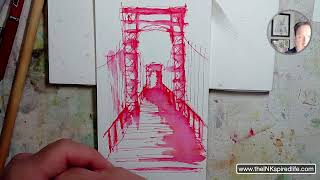
Um, I— it's great. I'm getting some new followers. I love that. Uh, almost up to 500 on YouTube, guys. Yes, so close. I think we— I think we're at 485 last time I looked, somewhere in there. Hey, Linda H is in the house. Linda H, how are you? Good to see you. Um, I use this style of yours for my Tuesday night project. Oh, Linda, that's awesome! What did you— what did you sketch on Tuesday night? I'd love to hear. So awesome. Hopefully you guys like this kind of down and dirty sketch of the top of the Empire State Building. I'll leave that there, and maybe I'll just do one more because I want to wrap up at 10, so I can probably do something really quick. What do I want to sketch? Let's do, um, let's do a bridge. So some of you guys have seen this. This is something I sketched in school. I'm also a— I teach architecture in high school as well as being an architect. But I sketched this in school one day when I had a real short amount of time. So on a post-it, I did this cool bridge. Um, it's almost become a logo or an icon for me, this view, and I've done so many different versions of it. So let's just do something really fast, kind of based on this view of the bridge. It's not any particular bridge. It looks a little bit maybe like the Manhattan Bridge, if I had to pick an NYC bridge. So let's sketch that. I'm actually just going to sketch on the back of this. By the way, I am using— this is the paper I'm sketching on tonight. I'm sketching on 1264 Fabriano watercolor paper, 140 pounds. If I go close, you can see the texture on the paper, and I like sketching on cold press paper because I do love the texture showing through. It just kind of adds to the look I like. And when I do watercolors— see, I think I have one here. Uh, well, here I have this one here of the Biltmore. Um, I just love the texture of the paper showing through on the sketch. So this is a watercolor wash over Sharpie pen. All right, let's sketch this bad boy. Let me know if you guys are liking this tonight, and, uh, also let me know how my volume is. Is it— is my volume still okay? Like I said, I have a new speaker— I mean, a new microphone— and I didn't really test it. I just kind of came online. All right, let's sketch a bridge. I'm gonna take this image off of here. Uh, here's the screen. All right, cool. That's why I couldn't add the image before. Uh, Ghost says, look again, you're at 491. No way! Awesome, that's so cool! 9 away from 500. Let's get 500 peeps. Subscribing. That would be awesome. Sorry if you only see half my face too. I didn't adjust my camera, but you're not here to look at me, we're here to look at the sketch. Let's do a bridge. So it's gonna be a perspective view of a bridge. Um, I'm just gonna play around. You know what, let's break out— I have a red Pilot pen. Let's sketch some red. Why not? Nothing says we always have to sketch with a black pen. And I am listening to some Green Day right now, which is cool. I wish I could play for you guys, but I would be copyrighted. So when I'm sketching my bridges, I like to start with kind of a framework of a bridge. Again, I'm being really loose and wonky with it intentionally. So we kind of have our frame in the foreground, and then I know we're going to do a perspective looking down towards the end of the bridge. So what I like to do in the background is kind of mimic another frame back in here, really small, and I'll have an arch like this. Cool. So we have kind of an arch within an arch, right? All right, let's just sketch some of the frame. Let's just do some cross bracing on here. Boom, boom, we got some bracing going on, or cross, uh, bracing going on there. And then to create that sense of perspective and depth, I'm going to sketch kind of the, the walkway or the road here going back a little bit. It's going to come out this way like that. I think I'm going to bleed some of this red ink as well. And then we're gonna have some cables coming down here, just kind of swoop them like this. Swoop our cable back in the background. We're gonna have a cable coming like this. I know some of you guys out there have actually purchased some of my bridge sketches, and they're all, they're all unique, which which is what I like. They're based on the same concept, but they all look different. These are the kind of the cables in background there. And here's a really cool tip for, uh, perspective to get a sense of depth. I'm going to shade, I'm going to put lines on the walkway here. So let's say this is a pedestrian bridge, okay? Maybe we have wood planks going back. So anything in the closer, the planks are going to be bigger. And as we go further back, they're going to get smaller. Not measuring anything. And hopefully you guys can see this. Hopefully I'm all on screen here. We can zoom out a little bit more. And I'm just going to— there we go— sketch some planks in. And as I go back, they're going to get closer together. So you can kind of see, and actually as I go back further, I'm going to shade it here. So that just helps to give a sense of depth just by having these lines a little wider and you get closer together as you go back. Great way just to get— create the illusion of some depth on there. Um, this is really quick and down and dirty sketch. I could do guardrails on here if I wanted to. So we have some kind of railings coming back in here as well. Let's get some verticals. And the same thing applies on these railings, so These are kind of the— think of a deck railing. These are the balusters here, or sometimes they're called spindles. And as they go back further, they're going to get closer together. Again, just a sense of depth on there, right? Um, what else? Let's see if we can bleed some ink on this. So I'm just going to grab my water, and where'd I put that brush? Here it is. Let's see, uh, Linda says the word prompt for the week was dark, so I drew the inside of a cave with rocks all around it. That is awesome. Hey, the, the FNAF guy— if I said that wrong, let me know— the FNAF guy, that watercolor painting looks awesome. Oh, thank you so much. Yeah, let's keep this out here. So, um, I did a whole series of, of watercolors. Let me show you guys some more, then we'll come back to our quick loose bridge sketch. Uh, where did I put these? I think I put— they're in my drawer here. I'm looking, looking at my magic drawer. Here we are. So these are based on the Biltmore Estate, um, in North Carolina. This is— and these are just different parts of the Biltmore House. Um, so the colors you're looking at are not the actual colors there. It's just my interpretation or feeling when I was sketching these of the colors I wanted to add. My sketches are never about creating exactly what I see because that's what photographs do for me. It's about just quick, loose, fun, being in the moment. So here's one sketch of the Biltmore. I really like the way the series came out. Here's another one just kind of focusing more on a rooftop area. So these are mostly Sharpie ink. And the reason I use Sharpie is because it won't bleed if— when I add watercolor or ink on top of it, the Sharpie pen won't bleed. Um, so I like to sketch with Sharpies. Uh, here's another view. So if you notice, I try to use the same color schemes in all these just to tie them together as a series of paintings. Because, uh, my goal is to eventually sell these one day, and I'd love to be able to go to the Biltmore Estate and be like, hey, could I sell some original paintings or, you know, prints or something? It would be cool. And then this, this is the first one I did, and I think it's my favorite one right here. So really, really cool series. Um, and these are just— I love doing these ink wash or watercolor wash types of architectural drawings. And then here's a cool one inspired by the, uh, oh my gosh, where are we? San Francisco? No, no, Washington, right? Oh my gosh, where are we, guys? I'm drawing a blank. I think we're in Seattle. This is the Seattle, the public market in Seattle. And this was a fun one to do. If you look at this, there's not a lot of definition of ink lines like this one. The ink is very kind of loose, and I let the colors speak louder than the, the black lines on this one. So you could sometimes just punch out shapes with color to create what you want, and that's basically what this one is. Whereas here, for me, I think the line work is calling out the shapes more. So there's two different ways to approach it. Hope you guys like these. Hey, DB's in the house! DB, it's always great to see you. You're awesome. Um, watercolor art is amazing. I would love to see more of it. Hey, Doubled, thank you so much. So there you go, I just showed you guys some more. Um, I have an Insta. If you guys are on Instagram, you can go to the dot ink, I-N-K, inkspired.life.artist. It's a mouthful. You could also go to my website, theinkspiredlife.com, and have links on there. You can definitely see more work. Chris is in the house. Chris, great to see you as well. Welcome. Overseer says the mixing of colors is incredible. You guys are way too kind. I— what I also like about these is not a lot of different colors, right? We have some turquoise happening, um, so we have some yellow happening on here, and we have gray, a little bit of grayish purples happening there as well. So sometimes simple colors can go a long way. Now, on the opposite side of that is this here. Let me show you.
Let me just grab this.
Here's an example of something that's a little opposite. So a lot of you guys were following along when I was sketching, um, uh, scenes inspired by the steel stacks in Bethlehem, Pennsylvania. Incredible, incredible facility. Old steel mill that is no longer in operation. It's now a kind of historic landmark. But I was— I am so inspired by that place. I created my own kind of version and take on it. Notice it has a kind of my signature. I like to work in this neon pink on sketches just to make it fun, whimsical, and have a cool vibe. But there's a lot of different things happening on this compared to this, right? So it depends on the subject, it depends on my mood, um, where I'm going to go with it. Am I going to keep it simple, you know? Am I going to keep it just black and white, right? Like my original sketch I showed you here from 1993. The sketchbook is a gem. Here, here's a World Trade Center. Right, simple black and white, which I'm partial to, and I think this will always— this will always be my favorite style. But I didn't really— wasn't comfortable adding color and showing what I was doing with color until a few years ago. And it's got to play around and have fun, guys. It's all about your attitude and your creative mindset. Um, you guys are amazing. I'm gonna just see if I can add a little bit of wash to this, and I gotta wrap up because I have school tomorrow and I gotta get up early. Hopefully it's— let's see, I just want to bleed some of this. Usually I like to have, um, my work tilted at an angle, so let me just throw this underneath. There we go. I really like this Pilot Red ink, so whenever I want to do some kind of ink wash with red, I'll typically use my Pilot pen. I've tried other reds and this is the one that just appeals to me the most. So I'm just adding a little bit of wash on here, give a little bit of interest. And that's what's fun about these bridge sketches, kind of my go-to sketch. I don't want to say kind of— it's almost kind of a logo for me, I would say. But they always all turn out different based on color and how loose I sketch them. I love the way this— check out how this is drying. This is really, really cool. I love this way it's drying here. It's going to have a cool hard edge here as it dries, and I love having a hard edge. I think— I don't think I'm going to add any other colors to this. I think I'm just going to keep it red, red and the white background. We're just having fun, guys, just playing around. So let me know if you have any final questions as I wrap up. It's really cool seeing so many new faces out there. Thank you guys, awesome. Almost 500 subscribers. Yes, that is, that is sick, as the kids say. That's sick. Um, it's really, that's awesome. I love it, love it, love it. Only because the more people that can— that follow, I feel like I just want to make a positive impact. I want people just to learn, know they can have fun sketching, adding color. Um, yeah, I just want to spread that kind of positivity through creativity. So that's my main goal, guys. All right, cool. I'm gonna— I'm gonna leave it at this for now. I like it. That's how it's looking. Um, I think it looks amazing. I don't know how you can make art this good with such ease, Ghost says. Ghost, I love that comment, and here's my response. Um, I've been doing this for a while. So maybe that's why it looks easy. But even to this day, most of it for me is just— it's what I call creative mindset. It's really just putting your brain in the creative game. And, um, I like to say, say, um, just see the world in curious and wondrous ways. Um, right? Just kind of explore and have fun with what you're doing. And I think when you're having fun, things happen. Do I always love what I do? No, but I learn from it. I have fun when I'm doing it. I learn from what I don't like, change it, and keep moving forward. So part of the battle, part of the game, is just creative mindset. And yes, yeah, you have— you gotta draw, paint, sketch Sew, make things out of clay, whatever you do creatively, you do want to do it regularly to keep those skills going. And creativity is a skill also. Um, yes, some people might be born with more creative genes, but we all have the ability to be creative and learn creativity and develop creative skills. So I don't know if that helps, but that's kind kind of a little just off top of my head, uh, response. How long have you been drawing?
Overseer.
So yeah, so I first started drawing when I had— all right, so this is how it started. I had a, I had a pretty bad accident when I was in third grade, so I was like 6 or 7, and this accident left me unable to participate in physical education and going out, out on the playground with my friends for half of a school year. So for half of a school year, I would have to go into the nurse's office. So while my friends were all outside, you know, at the playground or playing kickball, I was inside by myself with the nurse. And that's when I just started drawing. Things. I used to love to draw at that age. I would draw cars, so I would draw like these spy cars. Um, and I used to love drawing maps, believe it or not. I'd have these like battle maps because we used to play army as kids and all that stuff. So I'd make these cool battle maps. And what was awesome is when my friends came in from the playground, I could show them what I did while they told me what they did. So I was able to connect with them. And we were able to talk about my drawings. Um, so I started way back then. Then I kind of stopped drawing for a very long time, and I never took any art classes. I didn't— yeah, I didn't take any art classes at all until I got to college. I always knew I wanted to be an architect, and in college is where I really rediscovered my love of drawing, and it's where I developed my architectural sketching. So to answer your question in a short way, I'm trying to do the math in my head. Let's see, I graduated college in— let's see, yes, I'm doing the math in my head silently here. What year is this? 2023. I don't know, 30 years. Let's say 30 years plus or minus. So I've been sketching for 30 years. Um, hopefully that helps. You are a master of what you do. No, thank you, DB. No, I appreciate you saying I'm a master, but, um, I'm not a master at what I do. I'm a student. I'm always trying just to learn something. Um, so I love what I do, and hopefully that shows through, but I am definitely not a master. I'm always learning from other people. Learning from myself as well. But I appreciate the kind words. Hey you guys, I'm gonna wrap up. I have to get ready for school tomorrow. Um, this is really, really cool. It was awesome seeing so many new faces here on YouTube. So thank you guys on YouTube. I thank you for liking. Hopefully you guys like this. If you do like it, give it a thumbs up. Um, also subscribe if you haven't, if you like what you're seeing, so you can stay in the loop because I'll be doing more sketches. And yeah, everybody on Facebook, you guys are awesome. You guys are my, uh, Inkling Posse. It's where we all started on Facebook. Uh, Becky and DB go way, way back. Not that you're old, but you guys have been with me from the beginning. Thank you, guys. Ghost, have a great night. Overseer, have a great night. You're welcome. DB and Becky, great to see you. Chris, great to see you as well. Uh, did I miss anybody? We had Linda H in the house. Linda, you're awesome, I appreciate you. You guys are all awesome. We had someone named Doubled Doubled. That was the first time I saw you, so thank you for joining. And D-Ray, of course, D-Ray. D-Ray goes way back too as an original Inkling. Thanks guys, take care. I'm out for the night. Uh, peace and live creatively. I'll see you guys soon. Take care. Enjoy your Tuesday. If D-Ray was on, she'd be like, hit that finish button. I'm looking for it. Good night, guys.





