The Inkspired Life - Sketching & Painting : Inking Out Loud
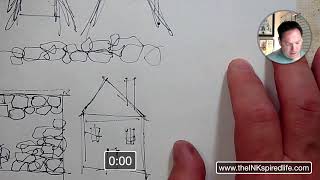
Jason Nicholas sketches St. Patrick's Cathedral's Gothic doorway live, layering graphite stick, watercolor pencils, and Prismacolor markers on Fabriano paper. He shares his materials, explains how he uses hatching and water-soluble graphite for depth, and talks through why quick loose sketches beat over-planned architectural drawings.
Chapters
Hello everybody, happy, um, Saturday evening. Hope you're doing well. And also just let me know if, uh, you can hear me and see me okay. I've been rearranging some of the stuff here on my desk, got a different microphone, and I hope you can hear me and hopefully the music's not too loud. So if you can check in and let me know in the comments, that would be so helpful. But I hope you guys are doing well. Welcome to the Inkspired Life, where my goal is to just have fun sketching architecture through a very quick, fast, loose style. And tonight I'm going to do a— I think I'm going to do a sketch that's inspired by St. Patrick's Cathedral. You can see here on screen I have an image, a picture I took. Man, when did I take this? I think earlier this month. I was in New York City. I love New York City, by the way. I find that place, uh, is so inspirational. The architecture is amazing. It's just a whole different vibe and dynamic than where I live. So every time I go in there, I'm just so captivated by just the sounds, the people, the sights especially. So that's why I'm always sketching New York City. I just find it really, really inspirational. So this is a cool, um, kind of image looking up at one of the doorways at St. Patrick's Cathedral. So let's just have fun and sketch this tonight. And if you're on live watching, let me know where you're watching from. I'd love to know who is out there. And I'm just going to move some things on my screen so I can see the comments. Hey, Arissette's in the house! Great to see you. Late Saturday sketch. Yes, mic is perfect and music perfect. Thank you so much. Yeah, I know, uh, last time I had some kind of sound issues, so if the music is creeping up there, let me know. I love how often you choose Gothic architecture. That's interesting you said that. I— that's really interesting. It's not a conscious choice. But it's cool that you've noticed that pattern. So tonight I'm going to be sketching— let me zoom out a little bit— I'm sketching on a 4-inch by 8-inch sheet of paper. It's actually a pad here. Um, this is Fabriano 1264, 140-pound cold press watercolor paper, if you want all the tech specs on it. I love sketching on this. This— here's an example— this is a bigger sheet of paper, but Here's a sketch I did of a bridge in Central Park and a couple of little vignette sketches we did the other day. And then I'll show you this one here. This was inspired by the Central— I'm sorry, the New York Public Library. And one of the reasons I just love sketching on this paper, I like the texture of it, and the texture of it allows the line work to be kind of really loose and bumpy and missing in places. So that texture just kind of adds to the feel of what I'm trying to create. There you go. Enough with the tech stuff. Let's sketch. Oh, you guys are awesome. Hey, D-Rays in the house, great to see you. Um, you know, I'm gonna switch tunes since we're sketching this Gothic, this cathedral, this beautiful building. Let's put on some chorus music or choir music. So I actually have a little playlist that says choir. This is Hit It and Sketch. Um, I'm gonna make the picture a little smaller so it doesn't cover up what I'm sketching here. I don't usually leave it on, but I'll leave it on screen. And I'm actually going to take the tape off the pad. That way it's just flat on the table. Otherwise my hand is kind of hanging up off the edge of the sketchbook. All right, let's do this thing. And I'm starting with a Sharpie. And why? Because I love starting with a Sharpie in case I want to add ink or watercolor and bleed things. This black ink won't, won't, uh, run and cause a big muddy mess on the page. So if anybody's new is watching me, you'll see that my sketching is not going to match the image, the picture. Uh, the picture is really just for inspiration or or ink inspiration. This Sharpie is kind of drying out, which I like, so it's forcing me to kind of grind it on the paper a little bit harder, and that's fine. I do want to capture the kind of this pediment up here and then this striking, striking opening, this cool Gothic arch. So, Ariset, one of the things I really do love about this type, this style of architecture, I love the Gothic archways on cathedrals. I think they're amazing. And look at the scale of this. I'll bring the picture up a little bit. Just check out the scale of this doorway in relationship to the people, right? We have some people here. I mean, just look at that opening, just to give you a sense of how big the building is. I actually am going to close the picture. There we go. All right, we have some doors happening here, some sort of column. And we have some just lines kind of repeating in here to create a sense of the depth of that opening. There's different reliefs or different layers on this facade. And facade is just another word for the kind of the outside of the building, the face of it, or the skin of the building. And with this sketch, I'm just trying to give a sense of, uh, that we are kind of looking up at, up at it. So I'm going to make these lines, I'm going to really exaggerate this angle, kind of pull it out here just to kind of distort this view. Cool. And I thought it would be fun to sketch this again, but we're going to use, uh, not a Sharpie, we're going to use something else to sketch it with. Again, I just want this to be kind of really quick here. And let's just give it some hatching lines just to help give a sense of depth. So these hatch lines are really— I'll zoom in so you can see a little bit closer. Hatch lines are these lines that are separate from each other, and without coloring an area in black, totally black, it's a great way to get a sense of depth on here and some shadow. If I was to color this solid black, which you can definitely do, um, it might draw too much attention to it. And I like the loose scribbly look as well. You'll hear me use the word scribbly a lot because a lot of this is scribbling, right? And then I know we can all scribble on paper. If you can scribble, you guys can draw buildings. And my goal is to help, uh, kind of inspire you guys to give it a shot and don't be afraid. So I sketched some people down here, and I'm actually going to color the doorway opening. I'm going to not color it, I'm going to hatch it black, and I'm going to go around where those people are. Well, this head here will pop out. You can kind of see a little white head sticking out there. I should have left a little white area around that head and I kind of messed up a little bit. But you know what, part of loose style sketching is embracing the imperfection because for me, loose style, there is no perfect. This is not like a technical architectural blueprint which I've drawn many, many, many— I've still drawn many, many, many of them, and I love them. But those are precise. They have to be technical exact. This doesn't. So this is all I'm going to do on this one, I think, just to give you a sense of this Gothic arch, this kind of cathedral. And then we're going to do a sketch this, but I want to use a different, um, medium. I'm not going to use a pen. Something I haven't used in a while, and I'll break that out in a sec. And we're going to leave this one really loose, unfinished. I'll zoom out. You know, I left— I didn't do any detail here, it's all white. I didn't add anything down here, it's white around there. And I like that because it gives breathing room around the sketch, which I think is really cool. So let's flip it. Actually, we'll do it on another sheet so we can compare them. Hey, let's check in with the comments. Um, D-Ray says that is huge after seeing the people for scale. Yeah, right, it is, it is a definitely a huge building. Um, that's one of the cool things I love about being in New York City is the scale of the architecture, the scale of the buildings is it gives you a whole new perspective and feeling on things. Um, hey Mickey! Mickey's in the house! Good to see you, Mickey. Hope all is well. Good evening. Looks like you have been trying— you have been having tons of fun so far this summer. Yeah, Mickey, I've been having a really, um, I've been having a really, really cool summer. So We usually take a trip to Maine over the summer, but we didn't go to Maine this year, um, for a few reasons. For good reasons. We adopted a beautiful puppy and we didn't want to travel with her yet and or be away from her, so we kind of were sticking around home. And, uh, my son started driving, so, uh, we had a car and all that cool stuff happened. So that's kind of why we've been sticking around, but I've been doing some day trips I've taken a few into New York City, which was awesome, and also to Princeton, which was really cool. And I've been hanging out, and yeah, it's been a great summer. I go back to school in 2 weeks. Is that true? Is that true? I'm off all next week, and then we start up the week after, so not 2 weeks. Um, all right, awesome. I get the huge sense of height. So cool, Arrow that says. Yeah, it is gigantic. It's been so hot here in Oklahoma. 2 days ago, heat index was 100 and— what does that say? 125. Holy moly, that's crazy. Well, I hope you are keeping cool. I love cathedrals. Acoustics are amazing. Yeah, aren't they? Oh, new puppy. Yeah, we got a beautiful new pup. Her name is Olivia and she's 10 months old. Um, we think she is a Border Collie and Dalmatian mix. Beautiful, beautiful pup. I posted pictures of her on my Facebook page if, if, um, you know, or even on my Instagram if you ever want to check her out. All right, we're gonna do two things. One, we're changing the music because I need more peppy music, and two, we're gonna sketch the same picture I just had up, but I'm going to sketch with an ArtGraph stick, graphite stick. I haven't used this in a while. This is actually a new one I pulled out. I can't find my beautiful old round— rounded aged ones. They're somewhere and it's driving me crazy. But I thought it'd be cool just to sketch with this, um, and see how it looks. Right? So here's the pen one, and then we'll go to this. So, you know, I'm, I'm assuming the sketch is going to be much looser because look at this, I'm working with a square tip. I could use the edges to sketch with as well, but, um, let's just go, go for and have fun. Well, let's put on some different music. We'll go back to I just call this the Epic List. I— it's the one I usually listen to. All right, let's do it. Hopefully you guys can see this okay. Boom. And by the way, this is— this graphite is water soluble, so maybe we'll even break the brush out, add some water to it, move it around a little bit. So whenever I— typically before I actually start sketching, you'll see that my hand is down here moving around, doing a little dancing, loosening up a little bit, getting in the mindset, getting in the mental mindset, uh, kind of loosely, roughly planning out where I might start sketching and where things might fit. So that's why I'm kind of jittery and nervous when I first start sketching. You don't see anything, lines going down. It's kind of a, uh, I guess it's just a routine to get me kind of in the groove. Hopefully that makes sense. You'll see golfers do it. Not that I'm a golfer, but before a golfer goes to hit the ball, they'll kind of stand up there with the club and they'll waggle it around a little bit. All right, let's sketch this. Again, this is a graphite stick. If you notice— hopefully you can see it and notice that it might be a little light on camera. We'll take care of that. When you start adding some water, it'll darken up. If you can't see it that well right now, got our kind of pediment here at the top of the arch, which is key. And we're going to sketch our This kind of steps back a little bit. Boom. You got this other pediment up here happening. There's a little arch up there. One of the cool things about graphite is you can definitely see the texture of the paper coming through. I, I, and I like that look. Doorway happening down in here. So that's just a real quick outline. So for the heck of it, let's, uh, have some clean water. I actually said clean water, can you believe it? Usually using dirty water on purpose because I love the way dirty water looks on the effect it has on the sketches. But I start— I have some clean water for once. And let's, uh, just spread some of this graphite around and we'll play around with this for a minute or so. But let's put these next to each other before I start doing that. You can just kind of see Definitely, right? This is really, really loose. It doesn't have any details, very outlined-ish. I've not used graphite sticks in a while either. Interesting. Yeah, Mickey, I, I love graphite sticks. And it's got a bamboo brush here with some water. And we'll play around with this for a couple minutes here. For me, this is what's really cool and fun about using the graphite sticks, is letting them— let me, um, then bleed with some water. So fun. And I'm just kind of outlining some areas. And one of the other cool things I love to do with graphite sticks is I'll actually dip it in water. You can either put the water on the page or you can dip it in water. I like to dip it right in there and just sketch with it. So I kind of— I call this sketch painting because we're kind of doing both at the same time here. On the wet areas, you can just kind of dab it down and hold it if you want, let the graphite melt on there. Sometimes I'll just blot it down as well. It's looking kind of cool. I love the, uh, a lot of the white space on here, and I'm gonna— let's see— throw some on here. Cool. And there you go, it's just a quick graphite version. And here's the pen version. Same scene, two different mediums. Very, very cool. Hey, DB's in the house! DB, it's awesome to see you. Hope all's well. Very, very cool to see you. Uh, what interesting technique that I'll have to try and experiment with. Yeah, definitely try the graphite stick, you know, use it dry like we did here. You can dip in the water like I did as well. Add water on the page. Let's, um, let's just play around with this some more. We'll just flip it over. So I'm just going to play around. Let's just throw some water on this side. I'm just throwing down just clean water. And let's just sketch with the graphite stick, see what happens. I see DB's in the house. DB is, uh, extremely talented when it comes to graphite, using pencils for drawings. DB has— I've seen some amazing, amazing pencil work. So I am just sketching with the graphite, and if I let it sit in some areas— let's see, let's just put this here— let it kind of melt a little bit, or I dab it. You can just dab it down as well. So I'm actually sketching, um, a New York Public Library inspired scene. Here you can see where it's dry going down on the dry paper. You can tell because of— you can really see the texture of the paper coming through here. Uh, is this a super rectangular pad you've got? Seems almost letterboxing size. Oh, let me zoom in. Yeah, so it is. So this, this is actually 4 inches by 8 inches. Um, hold on, I can pull this out and show you the covers right here. So this is the pad I'm using, Fabriano watercolor paper, 4 inches by 8 inches. I love this format. It's a really cool format. It's small, easy to carry. Um, it's great for me when I'm doing buildings and I want to do really tall perspectives. Um, you can also do really cool landscapes horizontally. It's a nice format paper. And I'm just washing this with some water. So I'm just, just trying to give a little bit of depth to this. This is an urn here, so I want to just make it look like it's curved a little bit. This is actually a shadow line right in here. There's a doorway back here. I love, I love when you add water to this graphite. It just makes things really pop. It will dry lighter. You got some stairs kind of happening here. There you go, created just a little vignette of part of a building doorway and urn in the front and some steps going up to it. I like watching you. You are not afraid to try new things. Oh, thank you, DB. I appreciate, I appreciate that so much. Yeah, it's, um, it's just a mindset. It's just, you know, I'm here out to have fun. Um, I've learned to embrace imperfection, so otherwise I would be sitting here looking at the blank page. Here's how this one dried. Hey, just for the heck of it, let's throw some color on this. Um, got some colored pencils here. Let's grab some. Why not? See what it looks like. Um, no, not magenta. I'm looking for maybe this one here. Nope. Where's my red? There's a red color I really like to use. Um, where the heck is— I've been cleaning up in my studio a little bit, so things are kind of not where they used to be. Not all the things. Where's my red color? Of course we got pink, we can always throw down. I'm looking for a color, it's called Process Red. Process Red. I love that, the color of it. It might be in one of these things here. Nope. What the heck? Well, maybe we'll use Magenta. That stinks. I really wanted to use the red color. Dang, that's all right. Yeah, let's throw some mint juleps on here. Why not? I just— I thought the, um, would look cool against the gray here. And these are just regular water— not watercolor pencils, they're just regular colored pencils. They're not watercolor. Notice, uh, here's a kind of a tip. Notice I have both ends sharpened. So I do this in case I'm out in the field. I like to carry these with me, some colored pencils. And if I don't have a pencil sharpener, if I sharpen both ends, I don't have to worry as much if I, you know, one of the ends happens to snap. I kind of have a backup one. What's he doing? He's putting pink on there. No, he's gone mad. There we go. Cool. What the heck, let me just break out the pencils here. We'll keep adding some colors. Um, got a cool blue one here. Chartreuse. I love chartreuse. I never knew what chartreuse was or had to say it until a couple of years ago. Um, I always thought chartreuse was like a not a pleasant color, but I really like this greenish color. Sorry if you can't see it. There it is. Let's put some chartreuse in here. Maybe in our scene we have some greenery going on here. Got some growies happening maybe there. I mean, we got some popping up over in here at the base of our cathedral. There we go, we got some growies going on. This is a neat color. This is called Sky Blue Light. So since it's called Sky Blue Light, let's throw some in the sky here. I do love doing mixed media sketches. You know, with ink, watercolor, and colored pencil. I'll just throw some around here just to frame it a little bit. Yeah, we're just having fun, guys, playing around with this quick loose one here. Awesome! And I need a pop of brightness, so we're going to just go with some yellow. Uh, let's grab a Lambie. I haven't used Lambie in a while. Oh, I haven't used it in a while because I have to put ink in it. Want, want, want. So we won't use Lamy, we'll just use our Pilot pen here. So let's get some peeps here, get a sense of maybe a bit of scale happening. I feel like we need some stairs here. And I'm just throwing some texture. I want to indicate some kind of stone on the facade of this building, so I'm just doing some horizontal lines. Cool, there we go. So we, um, just kind of made this our own, right? We just started off by a picture inspired by St. Patrick's Cathedral, right? Here's our pen one we did, pen version, real quick, loose, rough. And we just tried to do— we did the same thing with just graphite, and then we're just playing around adding color. Just want to show you guys, you know, it's fun just to throw down colors and Is this a keeper? I don't know. I don't— probably not, but that's fine because, you know, just by playing around this, I got to see, you know, how does this pencil look on here? How does it work with the graphite? I mean, you could see it's blending with the graphite in certain places, so I'm learning as I'm just throwing this stuff down on here, and that's really my goal with this one here. Pretty cool. Hey, Chip's in the house! Chip, great to see you. I'm late but loving the colors. Hey Chip, thanks a lot, man. It's good to see you. That is totally interesting. Thank you, Mickey. So hopefully it's making sense, guys. Um, I guess my main goal, one of my main goals is for me personally is to consciously not sketch perfect straight lines when I'm sketching architecture. That is my number one priority, um, unless I'm doing a technical drawing, or there are times I will want to be more precise, I, I admit that. But when I'm doing things kind of fast If I'm sitting here trying to draw everything really precise and mapping it out and measuring it, it's just going to slow down my brain. My creative brain is going so fast that it's really my hand trying to keep up with my brain, and that's what forces me to really have to be quick. I could slow everything down, take a step back You know, I could have spent 2 hours on this easily and made it really precise, a lot of detail. But it's hard for me sometimes to slow my brain down. Why? Because I'm so excited when I'm doing this, when I'm out in the field sketching buildings. I'm just so excited, um, in the studio here. I'm so excited, so I just go. I've learned to embrace that excite being that excitement. Embrace it, go with it, and use it to help create the style that I like to create. Hopefully that makes sense. Yes, I'm getting deep. You guys are awesome. Hey, uh, Chip has a question. Tell me the color pencils again. Yes sir, I like to use Prismacolor right here. Prismacolor Premier. Hopefully it focuses. Prismacolor Premier color pencils, and they're not watercolor pencils, they're just regular color pencils. And I wish I knew where that Process Red color was because I love it. I wanted to use it, um, but we may do, right? We kind of grabbed and went. Cool, guys. So we have these sketches here. I'm going to do one— oh, we had started— messed around with this as well in the back, all graphite. Um, look how it's drying, by the way. It's drying lighter, much lighter than when I first added water to it. And I actually like the grays that it's drying here. Uh, so no, the watercolor pencils don't bleed. I'll show you. Good question. So Focus, focus, focus. There we go. So I'm just going to get some water. I got some water on my brush here. Boom, got some water on there. So you'll see the pink is not bleeding. So they're— the colored pencils will not bleed. You can get watercolor pencils, which I have one here, I think. Is this watercolor? I can't— let's try it. I think this might be a watercolor pencil. Let's see, this is just for fun. Let's just throw some here in the sky and let's add some water on top of it. Yeah, so this is— that blue one is a watercolor color pencil. Oh, I like the way it's blending in with that blue. Actually, that's pretty cool. Let's do more of it. And this brand is— this was a free sample I had gotten. I have to be honest with you, I can't— trying to read it. Albrecht Dürer. Albrecht Dürer by Faber-Castell. Albrecht Dürer, Faber-Castell. This is an actual watercolor Pencil. Let's throw some more of that blue on there. I kind of like— Chip, I'm glad you asked the question because now it's, uh, gotten me use this. Is that proper grammar? Gotten me— when I say gotten me use this, that, folks, is why I do not teach language arts. Um, but yeah, I'm glad I picked that up because this is actually pretty fun. Just out of curiosity, let me see if it's— paper's wet. Yeah, so when the paper is wet, you can go over the wet areas as well, and it's basically just melting onto the paper. Cool, man. See, gotta just play around with stuff. I'm going to show you guys something that kind of helps me to, to be playful. Let me, um, zoom out for a sec. A little inside studio peek here. Let me see if I can move this stuff. So one of the things that really helps me just to be playful not hold back is I'm able just to continuously grab and grow. I have this cool— boom, let me, uh, if I could turn it this way. Can I zoom out more? Hold on a sec. Yeah, I have this cool stand. So this is— this was— this is meant to hold Tombow markers, which are these right here. These are Tombow markers, really cool. I'll show you those another day. But this awesome. It's like a caddy, right? A pencil caddy. You can pull it out like this. I know I can't get the whole thing on screen, or I can fold it up. And I just keep this right here in front of me, and there's so much stuff in here that it's easy. Like, when Chip has to color it right in this thing, boom, I pulled out this pencil and I was able to grab it. If I had to search for it, go through my drawers, it would take too much time and I would just not want to do it because I'm lazy. I just want to grab and go. Um, and I got to keep up, you know, with some of the creative— the creative mind, it goes so fast in my brain here. I'm trying to keep up with it. I don't have the patience to look for something. Um, and that kind of slows down the creative— the flow of being fun and playful. So that's kind of just like a little inside tip of how, uh, one of the things I could do just to keep me going. And by the way, I love the way this is drying. This is looking really cool. The colored pencil on top of that— the watercolor colored pencil on top of the regular colored pencil. It's looking really awesome. I love the different blues happening. Let's add some more. I'm going to make it even darker up in here. And actually, I like the white space. Um, you just put a little more in here. My water's over here. Boom. So I can just dip and— so I can just dip and go. And if you don't have room for a caddy like that, just you you could do this, right? You can just take little containers. I use these Talenti containers. You can just throw things in here and have it there and grab and go. These are Posca paint markers, which I haven't really used too much, but another thing you can just grab and go. Um, Mickey says Prismacolor is what I use. Awesome. The blending ability is quite amazing. Yeah, right? It really is. D-Ray's laughing. Like Derwent pencils. Yeah. Did you get to get that from Amazon? Uh, the Tombow thing I actually got at Michael's. I had a coupon for it. I got the Tombow case at Michael's. I, I don't think it was cheap. I have to, I don't I don't remember, I think it was like $30, it could have been $40, but I know I had a coupon for it. So yeah, I know you can get that at Michael's. The double blue shade really adds depth. Yeah, Chip, I agree. This, I have to say that my favorite thing about this entire process tonight was this right here. Actually, I like this little vignette right here, just kind of the top of this cathedral here and then the sky. This is really beautiful. Look how it's drying too. And I love the texture of this Fabriano paper showing through. I just love that. Look at those looks there. I love that it's uneven, right? It has interest, variety. It's not all one shade. It's not smooth. It's rough. Kind of like life, right? Life is like that. It's not smooth. Life has its bumps. And we can either see those bumps as being bad, holding us back, negative, or we can see those bumps as maybe something that bump us forward, keep, keep us moving, or even changing directions. Bumps don't have to be bad, like the bumps on this paper. Right? It has variety, it has interest, and I love that, that, um, loose look to it. Oh my gosh, I'm getting deep tonight, guys. Must be tired. Um, what else is going on in the chat there? Uh, the touches of pink make it almost alive, like blood. Ooh, Arisa is getting deep on us too. That is cool. Yeah, that's kind of— yeah, I could see what you're saying, right? But I have to say, if— let me zoom out so you can see the whole thing. I, I would— I'm happy enough to do this. Just where's my magic frame? Do I have one? Yes, I do. This one's too small, but that's okay. All right. Yeah, it just looks cool. I was just going to— I was going to frame this here so we could just focus on that sky area. Be helpful if it's on camera. There we go. Just focus on that sky for a minute. Really cool. Deep is good. Chip says deep is good. Chip, Chip, when it comes to deep, Chip, you are like— what's the deepest place in the ocean, man? You are deep. You are an awesome, awesome, awesome person. My, my depth is, is like a droplet of water compared to your ocean of depth. I see. I was trying to be deep there intentionally and it didn't work. Bad analogy. You're awesome. Thank you for saying that. Loving the results too. Hey, you guys are fun. Probing questions through your art adds meaning. Yeah, I love that. Yeah, good stuff, right? Takes it to another level, which is fun. Guys, I'm up for doing one more quick sketch. If you're out there and you want me to do one more sketch, please put in the chat, yes, one more. If you're on YouTube, I'd love for you to give me a thumbs up. Maybe we can get more people watching. That would be fun as well. Um, just put in chat yes or thumbs up. Let's go, let's do another one. I'm up for it. And Chip, I'm glad you're here. I will be starting the Princeton Sketch Series in September. September. I will give a release date on that. So thank you for helping to inspire that idea. Yes, one more please. All right, you got it. One more, one more for you guys. Yes. Um, before I do that, I'm gonna get a drink of water. And I have a technical question. Number one, I— like I said, I move things around. Number one, do you like to see the picture or my picture on the screen as I'm sketching? My face up there moving. I don't know if that's important or not in videos. I guess when I watch people, I do like to see it, but I don't know what you guys think. Number 2, I feel like I'm looking off camera a lot. Um, it's because I have put a new microphone to my left and I keep looking at it, and that's annoying me. So I got to figure out the setup so I don't do that. Let me grab some water and we'll sketch something. You know, since Chip is here, maybe I'll pull up, um, a Princeton doorway. Maybe we'll just sketch a doorway. How cool would that be? So I posted on Facebook today some pictures I took in Princeton. Fortunately, I was with the door expert that day. He opened my eyes to a lot of cool things on campus. So Chip was really pointing out cool things for me to look at while we were walking around Princeton, Princeton University, especially the doorways. And he had something there because I'll bring up some images. Those doorways were spectacular. Oh my God, here we are on one of the most prestigious Ivy League universities probably in the world, right? And we're looking at the doors. Come on, how cool is that? All right, I'm going to pull up some images here. And just for fun, we'll just do on the back of this one. We'll use this side. Uh, let me pull up some images for you guys, or at least one image of a doorway. Um, I think I posted like 5 on Facebook today. I have a lot more But just for tonight, I don't want to go through all the pictures right now, but I will pull out— let's see. All right, I did a Princeton pictures. Here's a cool one. Let's do this one. Yeah, check out this doorway. How cool is this? Now I have two things I'm looking at this here, and here's my brain's thinking. One, yes, I definitely want to sketch it quick, loose, fun. We'll do that tonight. I'm actually going to set a timer, give myself, I think, 3 minutes. The other thing my brain's telling me is this would be really cool to do a slow sketch, a detailed sketch. And I would do that of this incredible ironwork on the door. That's something that would be really fun to capture. You can see on the top and bottom we have this amazing ironwork across here. So yeah, there are other times I wanted to sketch things more slow, more precise, and there are. This is one of those things I would love to do that with. For tonight, we're going to stick with quick and loose. I'm actually going to keep it up here. So starting in September, I'm going to be doing a sketching Princeton series once a week— once a month, or twice a month maybe. I'll come on and we'll just pick a photograph, we'll talk about Princeton a little bit, and the time that was out there and my memories of Chip carrying around these two loaves of bread with him most of the day. Um, love it. And we'll have fun and I'll have an image up and you guys can sketch along with me, and I'll just try to do it slow and break it down how I'm approaching it. I know a lot of these inspired life sessions are just me thinking quick sketching. All right, let's zoom out so I can show you the page. All right, so I'm, I'm literally just using the back of this one here, and we're just gonna— we'll do a Sharpie sketch. And I said I was going to set the timer, right? So let me set it. Let me give myself 5 minutes on this, and let's look at the questions. Let me drink some more water. 1. Eris says, I like to see your face. Yes, because generally it feels more personal. Thank you very much. So I gotta work on looking at the cameras here. Wait, am I looking at the wrong camera? I am pointing at this. I should be looking there. So I'm looking at the camera. All right, cool. Thank you for your feedback. 2, looking at camera doesn't bother me because we know you're working, and that's I'm here to see. Awesome, thank you, thank you for your feedback. 3, misinterpreted the first question. I like seeing the reference image also, doesn't need to be huge, but it gives me an idea of how you're reinterpreting the scene. Thank you, that's a great point. Hey, Drew Williams is on! Drew, welcome, how are you? I love your loose style of drawing, painting. It's something I struggle with. Hey Drew, thank you for tuning in. I think this might be the first time I said hello to you. Appreciate, appreciate it so much. Yeah, so, um, no worries if you keep watching. Um, I like to give pro tips and ideas and suggestions and how to be loose, so stick with us. I appreciate you watching. And get that water. I got it. I know I'm talking a lot. See, I told you I'm excited when I'm doing this stuff. Um, how would you go about sketching the different color of stones? Chip, are you talking about different color stones? Chip, are you talking about on a cathedral? Are you talking about this image with the door? I'm not sure which image you're talking about. By the way, this is a sketch based on the Princeton University chapel building, just a small part of the front of it. This was a real quick loose sketch. Yeah, Chip, let me know what you mean about the colors. No, the door. Oh, the door. Okay. How would I go about sketching the different color stones? That's a really good question. So let's zoom in on stones you're talking about. Yeah, I would. Um, so great question. So number one, so when it comes to colors on scenes, um, let's see if I can pull out some examples. I don't usually sketch the color that we're looking at in life or on the photograph. So actually, let me pull these sketches out here. These are sketches I did of the Biltmore house in— where is it? Asheville, North Carolina. Correct me if I'm wrong with the city, um, North Carolina. Hold on a sec, let me make this smaller. So these are sketches of the Biltmore. This is not the color of the Biltmore at all. So when it comes to color, I'm just throwing down color that I'm feeling, I'm kind of vibing with in the moment. So I wouldn't worry about coloring all those different stones. I probably wouldn't— would probably just give them all one color maybe and treat them as a block of color instead of individual stones. Especially on a— if you're drawing on a scale like this, the stones would be so small, right? But if we're focusing really, really close on something, maybe then I would give each stone a little bit of a different color. I hope that helps answer the question. Um, that's another reason I like to start off with just a pen and a Sharpie pen, because I'm not worried about the color yet, and I don't always add color like, you know, like this one here, I didn't add any color. If I start thinking about the colors I'm going to add here before I start sketching, for me it's just going to slow my creative brain down that I've been talking about. I got to sketch it first, get it on paper, then I'll come back and say, all right, let's add some color. So hopefully that answers your question, but, um, yeah. Cool. All right guys, let's put the timer on here. Let's give it— let's do a 5-minute sketch. By the way, thank you guys, uh, for YouTube guys out there. I'm really trying to expand on YouTube and Facebook as well, so I appreciate the YouTube— YouTubers— YouTubers for liking, subscribing. Yes, I'm trying to buy time as I'm looking for the timer to set on my screen. Where the heck is it? Okay, here it is. I got it. Not 10 minutes, we're going to set it to— did I say 5? Um, duration here, 5. Just clicking some settings on the software. All right, we hit add, it should be 5. We're going to restart it. All right, so here's our timer. So, let's do a 5-minute sketch of this. Again, quick, loose, fun. And let me slide that over. And again, it probably won't look like the photograph, and that's cool with me. All right, let's go. I will stop talking and sketch for a few minutes. I will say I'm looking at a very small picture. But we could do this. So again, I'd like to— I said I wasn't going to talk, but I'll talk through it. I've just moved my hand around, loosening it up a little bit, getting in the mindset, trying to figure out where I'm going to place— roughly place some things. So if Drew is out there, one of the, one of the things that helps keep me loose, one is I'm kind of holding the pen a little further away from the tip. If I hold it closer to the tip— I didn't start the clock, look at that— if I hold it closer to the tip, my lines are going to want to be more controlled. So I'm holding a little further away. The other thing is I'm looking at the photograph a lot instead of the paper, and I'm just moving my pen around, um, on the paper. I don't know if that made sense. All right, let me hit that start button. Go! Boom. So we definitely have that arch shape there. I want to get kind of— got these kind of arch shapes here, kind of inset a little bit. I'm not counting all these inset pieces here. Does it go in 3 layers, 10 layers, 100 layers? I don't know. If I start counting those, I'm going to again slow down my creative brain that just wants the pen to keep moving. I do love this curved piece at the top. This comes around and we got this cool little piece at the bottom. We got something over here. I can't tell exactly what they are, but we're just going to kind of indicate what— we got something happening there. I do want to get a perspective sense on this. We have the stair, there's a landing area kind of flaring out a little bit, and on the door itself, so Yes, kind of an oval shape here. Got some metalwork. Boom. I'm looking at a small picture, which is really forcing me to be even looser because I can't see the detail. So starting looking at a small image again will help you to be loose. Got some vertical lines on the door for the wood panels, wood planking. So we kind of got that going on. Boom. Um, we have a perspective, we have this coming up here a little bit. Across, maybe kind of angle there. Boom, up a little. Maybe this comes across here, out, back, back, back, angle, angle. I'm not going to sketch that. I want to create a sense of depth. I have 2 minutes left, plenty of time. One of the things that does pop out on the door are these These kind of, uh, round— gosh, I'm an architect, I don't know the name. I don't know the name of these pieces here. The, uh, round metalwork that protrudes out of the door. And I'm not counting them, I'm just randomly putting them on here. I'm sure they're, they're definitely in some kind of a pattern. But I'm not concerned about the pattern right now. Again, when I do a slower, more technical drawing, then I would want to have more information. Um, let's just create a sense of depth. I'm just going to hatch in some lines in here. We're just going to keep with Sharpie on this one. I want to create the idea that these arches are kind of stepping in. I do want to pop this one out a little bit more. So I'm slowing my hand down a little bit as I'm bringing this line so I could slow it, get a little more control on it. And let's just do some hatching on here as well, get some hatch lines. We got a minute left. I do want this door shape to pop, so I'm going to go around the edge a little bit. And again, to help keep it— another thing that helps keep it loose is I'm going back over lines, but I'm not tracing them exactly. They're wonky, they're loose. And I like that. So I'm going to pull out this ironwork here, and then we have the step. I like to do vertical lines here for hatching, our vertical hatch lines, just to indicate we have a little bit of height going on for the front of this landing area. And I'm just going to do this just to give it a little bit of depth. So, I'm going to shade it so it looks like it's going back a little bit. And 21 seconds. Got the hand— the handle over there. What else do I want to pull— call my attention to? I don't— I could show the— you have some block work going here, some stonework kind of going in back here a little bit. All right, done. So that's just a real quick loose sketch based on that photo. Um, I like it. It's fun, it's loose, it's wonky, it's not accurate. The shape of the door is off. I mean, it's more rounded in the photo, mine's more pointy. Um, and that's cool for me. When I sketch something for the first time, it's really just a general survey and just trying to get the feel of what I'm looking at. So next time, if I come back to sketch this, my brain will be like, oh, okay. I've got to make this a little bit more rounded. It's a starting point. And sometimes I just love the starting point, I leave it, I move on to the next thing. But at least I have a kind of a reference library in my brain, or I can even mark this on here if I want to take notes, right? I could be like, um, more rounded. Take a note and just point at this so next time I sketch it, I'll know what I want to do differently. But I wouldn't have known unless I did it, right? But I like this one. This is actually— came out cool. So yeah, so we'll be doing a sketching Princeton series once or twice a month starting in September, and these pictures I took and, uh, talk about the campus a little bit. I mean, if you guys have any final questions before I wrap up here. Bum bum bum. Um, Eris says, I don't think people on Facebook can see me, but definitely also want to know about stone sketching. I never know how far to give it as a suggestion versus filling in all the lines. Oh, Eris, good question. I'll, um, we'll talk about that. And when we wrap up, I'll just— I'll show you kind of how I like to draw stone. Let me just get a piece of paper here. Where the heck is it? I'm just looking for some scrap paper. Use some computer paper here. Close that. I'll just give you a quick thing of how I sketch stone. Um, Chip says, ah, so again, not try to duplicate the pic, right? Yes sir, Chip. I never try to duplicate the picture. For me, it's a starting point. I don't, I don't try to duplicate it. Um, that's why I take a lot of pictures. Pictures are, for me, are how I duplicate it. Got all the details. I captured the moment exactly as it was. Um, so yeah, so it's just for me, it's a mindset thing. Picture for me equals inspiration equals freedom to create what I want to create out of it. Hopefully that makes sense. You know, if I'm drawing an iconic building like the Eiffel Tower, you know, I'm not gonna— I'm not gonna draw my Eiffel Tower like this. Say I'm looking at a picture of the Eiffel Tower, right? We all know the shape of the Eiffel Tower. It's kind of like an A. Just do that. Kind of like an A, right? I'm not going to draw the Eiffel Tower like this because I want people to know it's the Eiffel Tower. Um, so for iconic buildings, yeah, you do want to get— you definitely want the overall shape or outline to be similar to what the real one is. All right, that's an Eiffel Tower. Um, what are we gonna do? Stonework. Let's do some stonework. Uh, hey, Linda's in the house! Linda says hey. Hey, Linda, good to see you. That's a good question, Arisa. By the way, I don't know if people on Facebook can see people on YouTube and people on YouTube can see Facebook. Can you guys see each other on the chat or no? It's a really good question. D-Ray says, like you being with us, having you on camera. Thank you, D-Ray. Donna— sounds weird when I say Donna. DB, I like the blue door. Yes, the blue door is cool on the, um, Biltmore, right? Awesome. Hey Drew, thank you for watching. Thanks for the video. Take care. Have a great night. It was great seeing you. Chip says nope, I can see Facebook chat. Oh, Arrow said you can see the Facebook chat. Chip says I— you can't see YouTube. No, we can't see each other's. No, we can— no, we cannot see the YouTube peeps. Um, all right, I gotta figure out a way. There's a way that I could stream so I think you guys can see each other. It would be fun. Have to run, Mickey. Take care, love the session. Take good night to you, I appreciate your time. All right, quick thing about stone and we'll wrap. Let's just draw, let's just draw. When I say the word house, house, what comes into your brain? What shapes? This is something I do with my high school kids the first day of class. I have them all draw a house, and it usually looks something like this. I didn't make it big enough for what I want to do. There you go, that's a house. All right, but that's not what I wanted to do. All right. Let's just draw, um, a wall. Pretend we've got a wall here. So when I draw stone, first of all, I don't usually like to draw all the stone. I like to leave a lot of white blank space. But the stone I do draw, I like to almost think of as a continuous line. So I'm not drawing— say this is a stone wall— I am not drawing Or if it's round stone, right? I'm not drawing each individual stone like that. Um, one is it would take me a lot of time to do. And again, let's go back to that— the creative mind. My creative brain's so fast, it wants to keep moving. Um, so I wouldn't draw stones like that personally. So I like to draw them as almost a continuous line. I'll just do it kind of like that. Right, so I didn't lift the paper pen up, and you could do the same thing. If I want a more rectangular, I can do it. Or if I want more rounded, I could do that too. So it depends on the look you want to do, but I would leave white space. I wouldn't do— let's just finish this wall. You know, I might leave some space in here just like that because I think it just adds more interest and it lets the viewer use their imagination to kind of fill in this area. Um, so I do like to leave a lot of it out. Hopefully that made sense. That's just a quick quick little 101 on Stone. Uh, you have a Restream but that share— you have a Restream but that shares Facebook onto YouTube chat. Oh, Restream bot. Sorry, bot that shares Facebook onto the YouTube chat. Yeah, thank you. Yeah, so I have— I'm using Restream, so It is feeding Facebook to YouTube, but it doesn't feed the YouTube over to Facebook. Got it. I'll screen cap and show you. Oh, thank you, Arissette. I appreciate that. It's a great technique. Thank you for showing me. Yeah, you're welcome. Uh, drawing stonework can be very therapeutic, believe it or not. I love drawing stones. And you could pick your pen up, obviously. It doesn't have to be continuous, 100% continuous. And I have to give a shout out to my first employer out of college. Um, he, he's the one that drew stones like that, and I picked that up from him many years ago. All right, you guys are awesome. Thank you so much for watching. I appreciate you all. Hopefully you got something out of tonight, which I hope you did. Whether it was just hanging out and chilling, that's fine. If you got a technique or a tip, that's cool. We're just chatting with each other and you enjoyed it, that's awesome too. You guys are awesome. Next time I'll share my, my new framework I came up with um, based on the word sketch, S-K-E-T-C-H. And I'm trying to figure out how do I teach what I do, loose style and the mindset. And this word acronym sketch, I think, is, uh, might be a really good starting point. So we'll talk about that very soon on an upcoming podcast. Thank Thank you guys, take care. D-Ray says, wrapping up, thank you Jason, enjoyed sketches, the 101s, and our visit as always. D-Ray, thank you so much for your positivity and support, you're awesome. Um, I said thank you for your participation in the chat, your questions, love that. Same thing with Chip. Chip, uh, your participation, your questions are great, they get me thinking, and I need to think about what I'm doing, and it's not always easy to explain, but I'm trying. So thank you guys. Linda S, you are awesome. I always appreciate seeing you, one of my original inklings out there. And DB as well. Gosh, you guys are— uh, yeah, I can't say enough about all you guys. It was fun having Drew on here for the first time. And if I missed anybody, Mickey was in the house. It was great having Mickey. I don't know if I missed anybody. If I missed anybody, I'm sorry, but you guys are great. Take care. Keep using your creativity for positivity and peace and live creatively. See you guys next time. Have an awesome rest of your night and an awesome Sunday. Take care. I am, I am looking for the finish button here. It's all the way to the right.





