The Inkspired Life - Sketching & Painting : Inking Out Loud
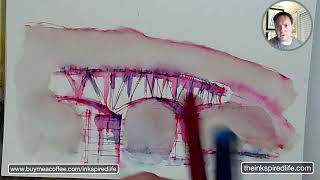
Artist Jason Nicholas sketches the Rockpile Road Bridge in Sonoma County with red Pilot Precise pens and watercolor washes, explaining how line spacing and vanishing-point construction create depth. He demonstrates materials like Pentel Aqua Brush and Fabriano paper while answering chat questions about perspective and planning beginner tutorial videos.
Chapters
Hey, Jennifer, good to see you. Hope you're feeling well.
Thanks for tuning in, appreciate it. Hey there guys, happy Saturday! Hope you're doing well today. I'm on really shortly, briefly, shortly, whatever the word is. I have to do my bridge sketch. I didn't do my daily bridge sketch, so I thought I'd pop on for 10-15 minutes and do a quick sketch. Feel free to ask comments, say hello. You guys are awesome. Don is in the house. Always good to see you, Don. I really appreciate you guys so much. I'm going to put on some holiday music. Let's listen to holiday music. Hope you guys can hear me. Let me lower that. Whoa, you guys, sorry if my music was cranked up. You may not have heard me. I'll start over again because I didn't realize I had it turned up way, way high. Anyway, happy Saturday. Hope you're doing well. I see Jennifer is in the house. Jennifer, great to see you. Hope you're, uh, you're feeling better. Um, hang in there. And Dawn, always great to see you as well. Thanks, guys. I forgot I had the volume turned up on the music. Uh, so I'm going to sketch a bridge. I have a picture here of the Rockpile Road Bridge in Sonoma County, California. Got it. I'll actually bring it— you can see the image, I'll bring it on screen. So this is, this is kind of the reference image I'm looking at on my end. I'm going to do a real, real quick loose sketch of this, uh, this awesome bridge. Uh, one of my friends sent me a photo of it and I think it's pretty cool. And I kind of like the view that it was taken from, so let's see what happens. I think I'm going to sketch, um, I'm just going to sketch with a Pilot Precise pen. Oh, you can't see it because it's behind the picture, but I'm going to turn the image off. There we go. So I am basically just going to be sketching, I think, with a red Pilot Precise. Why the heck not? Just want to, uh, try something different. Hope you guys— again, I hope you guys are all doing amazing today. Let's sketch this thing. So I love sketching with Pilot pens. I typically have a black one that I always carry with me. I've been sketching with these pens since my college days. Um, let's just do it. I'm thinking too much. I just want to kind of sketch and have fun. So I created a holiday playlist of music here from, uh, I pay, I use Epidemic Sounds to stream music. I have to pay for it. I figured why not create a holiday list, although this is putting me to sleep. I love it, but I am, I'm sleepy enough. I think I need something a little peppier. I'm going to skip. I'm, I might be skipping around a little bit with the music tonight, guys. Just going with the flow. Uh, let's see if we can find— is this one— try this one. I need some more peppy. This one sounds peppier. This pylon's kind of way in the front here. Let's, uh, show some of this bridge structure. This is actually coming out to here. That looks like there's a So we got a tree line, but there's a road that kind of comes down here somewhere that must connect back to the bridge. There's a lot of trees kind of covering that up. And, uh, let's just do our bridge structure. Let's do— I love bridge structures. Want this to look like it's kind of in the distance, so I'm just kind of putting the lines closer together. Over here they're going to be further apart. So it looks closer to us. There you go. We have some mountains kind of happening in the background here. All right, cool. Here we go. All right, let's bleed some of this red ink. Hopefully you guys can see that. I'm going to zoom in closer. That's probably better. Awesome. D-Ray's in the house. What's up, D-Ray? Good to see you. Chip's in the house. What's up, Chip? Great to see you. Chip says hello, Inksters. Ooh, that's fun. Let me know if my camera's blurry. Let me try focusing it. There we go. So again, just this is a real quick thing. I'm only going to be on— it's 10:08. I am actually going to put a timer on screen, um, to force myself to get this done quick. Uh, let's see, where's my timer? My brain, my brain has like— I am so tired. Uh, creativity, like I always say, that's always turned on, but my brain is like, oof. So bear with me, trying to find the timer on here. It's somewhere on my screen. There we go. 15 minutes, I'll be on for 15 minutes, we'll say. There we go. Because I can't stay up too late, I need to get some sleep. All right. So we got a little countdown on, we'll sketch for about 15 minutes or so. If you guys have questions, put them in the chat and I'll definitely take a look at the chat. Either take a look while I'm sketching or I might just At the end we'll do a little Q&A, so if you have Qs you can put Qs in there for me. I might not look at them until I'm done with this. I'm actually going to break out— I have a blue Pilot pen as well, Pilot Precise, so let's add some blue and create some purples. Purple's happening. I think just for fun. I love, I love the way the blue and the red are mixing. I'll zoom even closer. I just love the way this is bleeding together. For me, that's the excitement tonight about this, is just the colors doing their color thing. Gotta love when the colors are doing their color things, right? That's what makes it so fun. A little color dancing going on. Swirling colors, having fun. I'm not forcing them. Well, I'm coaching, I'm kind of coaching the colors. Give them a little coaching by throwing down the water and a little direction to head into. So we're coaching, coaching the colors. I kind of like that, coaching the colors. Give them a little bit of guidance with the water and say, we want you to dissolve here. If you notice, I'm not drawing continuous lines, I'm kind of dabbing them. I call these broken lines sometimes. That helps to create a kind of loose and sketchy— I don't want this to be very detailed. So we can do a lot with different line types when we're sketching, and I talk about that in my workshops. I've talked about it here before. I might— actually, I should put together just a short— maybe I'll do a short video about line, different line types and how we could tell stories with them while we're sketching. Cool. Yeah, I like the way this is looking. What do I want to do in the background? Let's see. I don't know if I want to bleed red. I'm not sure. There's some water happening down in here.
Cool, there we go.
We have some water happening. Let's bleed some of that. I'm just using my, uh, Pentel Aqua Brush. This is actually— there's a big tree kind of in the photograph. There's trees right in here, so I'm just going to leave that blank for now. 9 minutes 39 seconds. Kind of fast, loose, quick. Boom, boom. Debating what I want to do in the background. I don't know if I want to leave it white. I want to add something. What are we going to add? Let's see. Thinking out loud, thinking out loud. Sepia. We're gonna use the sepia. Where's my sepia marker? It's gotta be here somewhere.
I don't think it's in here.
Where are you, sepia? Here it is. And I'm going to do my— the technique where I like putting the watercolor marker on the board, lifting off the board, and throwing it down on the page. Uh, let's use this brush. I have my dirty water. Oh, I could just use the dirty water too, couldn't I? Let's see, what is that going to look like? I'll zoom out. You guys can see what I'm doing here, right? So I have my dirty water. Let's start with that, see what it looks like. It's actually not bad. I'm getting a sepia. It's not— it's a little brown, a little brown, but I want more, I think. There we go. It's gonna be a quick, loose wash in here. Cool. All right, let's go back to that, some Christmas, some holiday tunes. Let's try, uh, Here we go. You know what, I'm actually gonna color this in also. I don't really need to show the— I'm not trying to show the roadway. I really just want to showcase this bridge. I'm going to leave all that white space where you see it. Cool. DRA is doing the color thing. Yes, awesome. I am going to— I want to grab some graphite here, graphite stick. I feel like I want to add some on here. Alright, cool, 5 minutes. I'm not going to do anything with the sketch. Let's look at some cues and see what you guys are talking about. Ooh, this is a fun song. I remember this one from last year. Alright, I got to sketch this. I like this song. It's fun and quirky. So, I'm going to just do something fun and quirky. Right on this piece of paper. I don't know what we're gonna do. I haven't done a skyline in a while. Let's throw in some red also. Alright, cool. I haven't done an abstract skyline in a while, so that was fun. Just kind of let the music take over and yeah, that was awesome. Just used my red Pilot and I still have some blue Lamy ink in here. That was pretty awesome. Hey, buh buh buh bum, Chip says, "I would love to hear sometime how to create depth perception with lines. Beginner's class, go." kind of way. Again, there's a class kind of way, of course. Yeah, uh, Chip, that's an awesome request, so I will go over that. Let's— not tonight, but I'll put together something quick. Um, this is a good example what I did last night just to show you how to create depth. I mean, I think you're talking about perspective, so this was a really quick, loose way to do perspective. Actually, I'll do something quick tonight. Let's do— I'm up for more sketching. If you guys are up for more sketching, let me know. Give me a thumbs up or put in the chat, "More sketching." Share this out there. I'll stay on for longer and maybe we'll do another city street thing. Just a real quick, quick one. And I can talk about kind of how I try to get some depth in this. Let me know in the chat. Cool. D-Ray, D-Ray, we've got water. I love D-Ray, he's always commenting and writing down what I'm saying, which is, D-Ray, that is so helpful to me. You have no idea because I don't even know what I say when I'm talking up here. So I love going back and I'll read the comments and I'll see what you wrote. So shout out to D-Ray for doing that. Thank you so much. And I hope you're keeping warm in Alaska. We, uh, we're getting— we're due for some snow here tomorrow in NJ. Nothing major, a little bit of snow, maybe. Snall? Yes, we're getting snall here in New Jersey tomorrow. Some snow. Oh my gosh, my brain is crazy. All right, um, hey Cameron, it's good to see you. Good to see you. Chip says please. Awesome, yes, thumbs up. Dawn says yes, yes, perspective, thumbs up. 9 degrees, 9 degrees in Alaska. Ooh man, keep your toes warm. All right, cool. We'll do a little something something. So before I do that, let me put this aside. I wanna talk about this here, this sketch painting. And my timer is at zero. That's okay, I'm going to stay on for a little bit longer. And let's just put on— I don't know, I'm gonna, I'm gonna really— I've been very fussy lately with my music. I don't know why, like very, very fussy. You know how, um, you know how when you first got that, your first remote control When you first had cable television when there were maybe 12 different channels, then it went to 100 different channels and you just sat there with your control flipping and flipping and flipping through different channels, watching a minute here and you're like, no, I want to watch something else. You flip, watch another thing. It's kind of how I've been like this week with music, like on Spotify. I think I just have so many things I like to listen to that my brain's like Which one, which one? So I'm kind of very jumpy with my music. I'm just gonna play this. This is my favorite playlist. We'll hit this one. So this, I have to say, this has been getting a lot of great response on Facebook. I'm actually— it's really a cool thing. I wasn't expecting that. People are loving this scene. I'm not sure what it is and why people are liking it so much. I mean, I like it. I think it's really cool. But I wish I knew. I wish I could reproduce more of this kind of artwork that people are really into. So I don't know if it's the style, the colors, connection with a place maybe, combinations of those things. So if you're someone that's like this or you know, on my post, I'd love for you to comment what is— what do you like about this sketch, just so I can get in your brains a little bit. Um, yeah, I love this. So let's do another little Streets. Now let's see, I think I'm gonna rip this out of the book. This one's gonna be— I'm gonna sell this one, guys, or auction this one off. This is, uh, too many people like this one to keep for me to keep here in my sketchbook. So let me just take it out of here so I don't ruin it. By the way, I have to say, this Fabriano sketchbook, the perforations work in here really, really well for taking a page out, uh, much more easier than my Strathmore— not my Strathmore, my Canson sketchbooks. So I like the perforation in the sketchbook. Yeah, this one's done. I'm not doing anything else other than, uh, let's sign it. And then we'll do another sketch. We'll do a perspective thingy. Um, we'll sign it with Sharpie.
I like this one.
I like to sign my things sideways. I'm just gonna sign it here. Usually put a heart and then my name. And then the year. All right, so this is a completed piece. All right, so let's start this sheet of paper. Um, I'm trying to zoom in. Let me bring this camera down this way. I think you guys can see that better. What do I want to sketch with? I like the way that bled. I guess, yeah, we'll sketch with— we'll use the— hopefully the ink's not running out in here. We'll try it. D-Ray says, "Oh boy, snow. Keep it over there." D-Ray, I will keep the snow. I'm kind of being selfish, but I hope we get a couple snow days this winter from school. Um, must be the radio. Yes, everybody loves the radioactive tree. That's exactly it, Cameron. Don likes them because they're evocative of Christmas without being blatant. Oh, I have a sense of nostalgia, kind of like going downtown for the Christmas parade. Hey Don, I love that feedback. Thank you so much. That's cool. It's really cool for me to hear that. D'Ray says, "What makes this yellow tree with perspective so popular?" It actually moves you. It moves you, drawing you into the sketch. Yeah. So, yeah, D'Ray, that's exactly right. So, when I was talking about this last night, you know, I created the illusion of perspective with these kind of, you know, angled lines coming down. And then I put this pop of color here just like you said. Because I wanted everybody to see that and your eyes to kind of go into the picture. Boom. To this point. So the color, the lines and the color definitely help. So I'm so glad you said that. Alrighty then, let's do something. Um, so this is a process that's really hard for me to express. Get out of my brain because it's, it's just something I've been doing, uh, so naturally for a long time. So I'll try to talk it through. So this is probably not a recipe you want to make at home yet, not until I can break it down. My goal is to break this process down into a simple, easy-to-follow short video followed by a PDF, something I want to put together and create. So I'm just inking out loud here. So when I'm looking at this, I'm not looking at a reference picture. There's no cityscape, nothing in front of me. I like to imagine a point somewhere. So I'm just gonna put a point here. You guys probably won't— actually, let's do this on a sheet of tracing paper. Let's do this on a sheet of tracing paper. So just imagine I have a point here somewhere. I'm not going to get into all the technical perspective terms other than calling that the vanishing point, target point. I'm exaggerating, I just want you to see where that point is. And then I'm imagining looking down a street, buildings on the right, buildings on the left, something in the distance. So I'll typically— some of you guys have seen me in the past sketch a box or a frame. I'll do that often. I'll have my point there, and then I'll say, okay, I want my buildings to kind of start— maybe the bottom of my buildings are here, and it's a connect-the-dot kind of game. Although you don't always see, you don't, you're not going to see the lines I'm drawing now, but it's a kind of a connect the dot game. You can lightly block these out, but typically I'll just kind of do something like that. Then I'll think, okay, here's the bottom of a building. I'm going to keep this simple. I'm just going to do one building on this side. So here, and maybe the building ends right here. That's my building. Boom. Um, in my brain, I kind of know like the scales like of a person. So let's just say I'm going to do a sidewalk here. So again, connect the dots. My sidewalk's going to kind of come here a little bit so it looks like it's going off the page, going back to this point here. Then I'm going to imagine where a door would be. So I'm going to say I'm going to have a door on this building, kind of— here's the vanishing point, slightly below that, maybe here somewhere. But again, it's going to connect back to this point. That's kind of my door. And then let's say the top of this building— I like these cityscapes, you know, flat, flat roofs. So let's say my top of my building is somewhere here, and that would kind of connect to this point. So kind of go up at an angle like that. And then let me just throw some windows here, and I'll, I'll add some water and bleed it so you can see it better. Same thing with the windows. I'm imagining, okay, there's a window here, maybe again it would kind of come back to that point. Maybe there's another window, it comes back to that point. Boom. Vertical lines, quick, simple, and maybe some details to top of the building. Alright, cool. Alright, so that's a building. Let me add some water. This is tracing paper, so it's gonna probably buckle big time. And I'm just coloring this blue so you can see the building facade happening. Um, next thing in my brain is, okay, let me just say there's some Opposite side of the street is here. The bottom of my buildings are gonna be here somewhere. Again, I'm gonna keep it simple. Let's just draw another building. I can cheat and actually make it all the way up here so I don't show the top of it. But I won't cheat. My pen is running out of ink. Maybe. All right, let's just say this building is higher on the left end. All right, we're gonna get our Sharpie out because I think we're gonna ink. So let's do something like that. Boom, boom. Gonna have my door over here, kind of even with that or below that line. Let's get the door there. We throw a window here. Again, guys, I apologize, this is kind of quick, off the cuff. So I made two— my building has two higher stories. We just shade this in so you can see it. Let me take a highlighter so you can shade it quicker. We'll do this side yellow, I guess. So these— creating depth is about the lines, the angles. So these angles are really helping to go back. Oops, that's out of ink. Let's take this pen. Let's use red. Let's imagine this is Let's just say we have a road. This is going to be a road coming back. Here's our sidewalk here. I didn't make a sidewalk on this side, did I? There's a sidewalk here. Another thing to help create the idea of depth, anything that's closer to me where I'm standing is going to— the lines will be further apart here. On the sidewalk. As they go in the distance, the lines are going to get closer together, create the idea of depth. Same thing on this side, further apart. And then you just— and I'm not measuring it, I'm just sketching it in. It gets— lines get closer, so it creates kind of a depth. Let's say our focal point in the background is, uh, we'll just do another building. Maybe there's a church in the background with a steeple. So maybe this is coming back and there's a church. I like to show stairs on my cityscapes. I have stairs going up to a— some kind of a church over here. And since we're kind of looking straight on at the church, there's not going to be any perspective or depth to it. It's just kind of a flat view of it because we're looking straight at it. You have a bell tower up here, some kind of cross, some kind of, uh, tall thin windows. Maybe there's a cool arched doorway going into our church. Arched opening. So notice the church is just a flat— in architecture, it's an elevation drawing. So it's a flat elevation drawing. You're looking straight at it. So these roads, again, the scale is off here, guys. These, this should have been wider and more street between the sidewalks, but I'm just trying to create, uh, give you an idea here. So hopefully that kind of helped. That's really quick. Let me shade the background so you can see. I just want to kind of shade where the sky might be back here. This is a funky, funky color combination I'm using. Maybe there's some kind of light— I'm just imagining some kind of light fixtures on this building. This one's a little closer, so it's a little bit bigger than this one. Kind of these light fixtures hanging down, maybe. Kind of give a little more definition to this roof. I'm going to create an overhang on here. Just give a little more character to that. Sorry. There you go. And maybe we have some brickwork here. Even when I do the brickwork or stonework, I'm trying to keep that idea of connecting back to that vanishing point, that target point I started off with. Is it accurate 100%? Nope. It's just to create the idea of depth. So I'm coming back to this kind of target point here, even with the brick lines I'm showing. I'm gonna pull this edge out so you can really see it. Man, I'm digging the blue Pilot pen tonight. I haven't used this in a long time. Create maybe a kind of a depth for the doorway here. Maybe, maybe that goes back in a little bit. Alright, cool. So that is a quick down-and-dirty street perspective, uh, off the cuff. Hopefully it made some sense. I'll put together, uh, some kind of better tutorial and a PDF kind of sheet. Um, that could be something I could do over winter break. Hopefully that helped, guys. Let me know. Chip says helps so much. All right, cool, Chip. I'm so glad it helps. I'm so glad it helps. And this is one of those things that's just been up here so long that, uh, trying to get it out and explain it is, I find, challenging, which is really an interesting process for me. It's a good challenge. It's, it's all about teaching, right? When I teach my high school kids, it's getting things out of here and explaining them in a different way. So it really, it really makes you think about the process of things, which sometimes we take for granted. I know I do. So I don't take things for granted as much as I used to. I just, I feel like I want to play with the sketch. It's Make it cool—
make it cooler. Just adding some texture to these.
Buildings a little bit. So, oh, one thing I did forget. So that the tree was the kind of the focal point here. Um, I didn't call attention to this enough, but my focal point in here really was— I didn't do a good job of calling it out, but the doorway or opening could be the focal point for this. Maybe there's some keystones on here around the edge of the building. So your eye is kind of meant to be drawn back to this. I could have, you know, thrown a— I could have left this as white space, popped a color back in there if I wanted to. I'm just looking to see what I have that— I think I'll just leave it white, but that's kind of the idea, being drawn back to this point. I'm just having fun bleeding this. All right guys, let me know if you have any other cues before I finally wrap up. I appreciate you all so much. Thank you for watching me, tuning in. We'll see how the bridge dried, my quick bridge sketch for the night. I'm just messing around, adding some water on this watercolor paper. Seeing what I can— if I can create anything cool with it. Trying to create the kind of a wet look here on the road. Very narrow. This is like a lane for a scooter. Maybe it's— maybe we get a scooter down there, or maybe someone could pull their red wagon down here. I don't think we're fitting cars down that road, but it could be a European city, right, with a really, really narrow alleyways. That weren't designed for vehicles. So maybe, you know, maybe we can give this a European vibe. I could have done that if I made some— maybe we created like cobblestone. Let's add some cobblestones on here. So let's see, uh, cobblestones. Let me use I'll use red and we'll break out the blue again. So maybe this is an old cobblestone kind of street happening here. So if you want to keep the idea of distance and depth, I'm going to make the cobblestones bigger in the foreground, and as I get— go back, they're going to get smaller. So I'm sketching on the wet tracing paper, which might tear. It's not really meant for this kind of application, but the stones might get smaller in the back and they're bigger in the front. So that's helping to create the idea of the depth again. Ooh, that looks cool. All right, it's getting— it's— this is getting more of a medieval vibe, guys. What do you think? Kind of an old medieval town with this narrow alleyway. But I'm having a blast working on this. This is so cool. Uh, tracing paper is part of my blood, sweat, and tears and creativity since 1989, my first year of college architecture school. Tracing paper was a must. I have tons of rolls of it here. It is just part of what I do in the creative process. And it's actually— it's holding up fairly well. It's really wet and I haven't torn the paper yet, so I'm actually surprised. This turned out to be kind of a fun, just quick, loose scene. Maybe there's some kind of base on this building. Right, cool. There we go. Um, Mr. Nick is Brunelleschi 2.0. Thank you, Cameron. Brunelleschi, wow, I heard that name, and man, since architectural history class. Brunelleschi's dome, right? Wasn't he famous for the, for the dome? Cameron, what building was What building did he— is he known for creating the dome on? Um, she was a focal point. Yeah, uh, Jorge Alberti. Thank you for wonderful visit. You're welcome. Oh, he's not finished. Yeah, D-Ray, you know me, I keep going on and on and on. Chip says the shadowing seems to be a major ingredient to depth. Yeah, the camera doesn't like focusing on this too, does it? Just know it keeps going out of focus. Yeah, so shadowing as well. Um, I kind of— I'm trying to keep things a little bit lighter in the foreground, so that's why I left a lot of white kind of space. And as I go back, it's getting a little bit darker. So yeah, so shadowing— so it's lines, focal point, shadowing— all definitely contribute to the depth. Good point, Chip. Cobblestone helps. Yep, definitely can be, but not always. There you go. All right guys, if you want to, um, if you have any last questions, let me know. At least we're going to wrap up. This has been fun. Let's take a look at the bridge sketch we started with. This is going to dry nicely. I'll keep this one. Where's the bridge we started with? Here's the one we started with tonight. So I, I could honestly say I'm not crazy about this one. I don't, I don't like that I added the sepia. I should have— I should not have added the background. I liked it when it was all white. But again, this was my quick 10 or whatever, 15-minute bridge sketch for the day. So as long as I met my objective, I got my bridge sketch in. And sometimes it's about learning what you don't like in the process, right? Um, it's— we focus on— I would like to do two takeaways: something I liked, but I created and something that I would not have done or something I could improve. So I always have— try to have 2 takeaways, at least 2, with everything I create. So what I do love about this, I love the red and blue ink, Precise Ink on here. I love the way it bled together. And I am happy with the overall shape of the bridge. I think that came out cool. Cool. What I don't like is the background, the brown sepia. I probably should have just left it white and just left it at that. So those are my two takeaways from this piece. So always, always learn something for what, for what you work on, and always, um, always commend yourself for something you created. Also, sometimes we as creatives, we beat ourselves up too much, and we don't honor what we're doing, honor the process, embrace the process. Don't always— I hear people drawing and sketching, painting, and just criticizing and hating everything that they do. That's not a really good— I don't think that's a good creative mindset. You can get stuck in go down a bad path if you're always negative about what you're doing. You could be realistic and not like things, but suggest a correction. But also compliment yourself about something, even if it's— even if you're like, oh man, I did a quick sketch in 5 minutes, that's awesome. You know, whatever it is, take— I suggest those two, uh, takeaways. Hopefully that makes sense. Um, he designed the dome, yes, at the Cathedral of Florence. Absolutely. And there's actually a good book, it's called Brunelleschi's Dome. I actually, I shouldn't say if it's a good book or not, I haven't read it, but it's supposed to be an amazing book. Maybe, maybe, maybe I should read it one of these days. Um, we'll see. This background is driving me crazy. What do I want to do to it? To make it more fun. Uh, I don't— IDK, IDK. When in doubt, break out your light aqua colored pencil. Or not. That means my, uh, Actually, I don't know. Yeah, yeah. All right, cool. We're gonna leave it. We're gonna leave it alone. Hey guys, you're awesome. Thank you so much for was— what— washing— for watching. My brain's tired. I appreciate y'all so much. I hope you have an amazing Sunday wherever you are. I hope it's peaceful. I hope maybe you are aiming to get stuff, uh, stuff done at home. That would be awesome. Um, yeah, just hope you have a great, great day, and I appreciate you all so much. Thank you for watching, questioning, commenting, sharing, and liking, whether you're on Facebook or YouTube. This should be going to YouTube. Take care, Dawn. It's great seeing you. Cameron, thanks for popping in. D-Ray, great seeing you as well. Chip was awesome having you in the house as always. Jennifer, uh, it was awesome seeing you. And if I missed anybody, I am sorry. Take care guys, have a great, great night. Peace and live creatively. I will see you guys really soon. Take care. That was good timing because the music just ended. Well, now it just started. Take care guys.





