The Inkspired Life - Sketching & Painting : Inking Out Loud
Jason Nicholas paints loose watercolor cottages and windmills with his chat community, sharing wonky architecture tricks like curved siding and exaggerated peaks. He uses acrylics mixed into watercolor pans and emphasizes the creative process over finished work, previewing an upcoming workshop to build a collective wonky village.
Chapters
Hey Karen and Becky, how are you? Hope you guys are doing awesome. Happy Wednesday, middle of the week, one of my favorite days of the week because not the beginning, it's not the end, it's the middle. Sometimes the middle of the week is underrated. You guys are awesome. Becky says, wow, this entrance music, feel like I'm at the movies. Yeah, I'm— that's awesome that you said that. These are— I call this playlist Hero Tracks. It's very movie soundtrack oriented. So good pickup on that. Hope you guys are doing well. I noticed my head was kind of cut off. I had a little— there we go. Hey, that's better. Not that you need to see my entire head, but I do. It is all there, believe it or not. You guys are awesome. Thanks for tuning in. So I'm just doing some warm-up, little loose sketches here. So let's enjoy the music for a minute and let me just sketch this little scene of some wonky buildings. I love that piece of music. I could sketch to it all day long. It has such drama to it. And this one as well. I love this piece. So I just broke out some watercolor, actually some acrylic paint. The blue I use is Cerulean Blue acrylic paint. I just kind of put it in my watercolor pan. And right now I'm using some watercolor. I'm just kind of mixing it with the blue a little bit just to get a grassy color.
Happening down here.
So the color— actually, let me tilt it up. The color is really distorted on camera. I'm going to turn one of my lights off here. I think it's too bright. That might be a little better. It's a little washed out on screen. Maybe I should turn it down. Maybe you can see that's a A little bit better right there. I think you can see it. Cool. Hey Heather, good to see you popping up for a minute. So awesome. Thank you to see you. Hope all is well. Hope all is well. So I also have this, some kind of pink acrylic paint in here. Actually, I think it's called Rose Color. So let's throw down some of the rose and see what it looks like. So when I put the colors into my watercolor palette here, I thought it was tubes of watercolor paint, but they're actually or tubes of acrylic paint. And it works for me, works just as well as watercolor. I do like, for me, acrylics. I've worked with them a little bit more. For me, they're a little bit more vibrant, but it's just a personal taste or choice. Is that the word? I don't really taste my paint because I'm sure it doesn't really taste that good. So this is just some of that rose color I'm kind of throwing down a little bit. Acrylic paint's very thick, so I am watering it down. Sometimes I like to throw like a magenta or— let's try this pink or this rose in the sky here. Lots of times I'll mix cerulean blue with a magenta, and I'll put it in the sky and get a really nice purple colors happen. Just kind of dabbing in the, uh, rose color paint. Just creates a little more interest in the sky for me.
Hope you can see that.
Actually, I'm gonna move this back a little bit. Maybe that's better. Zoom down. There you go, that's kind of a better shot, I think. So this is just a scrap piece of paper I had in my drawer. Um, I think it's scrap 140 40-pound watercolor paper. It's probably Canson. It has a tear in it and stuff, but I found it laying in a drawer, so I said, you know what, let's break it out. All right, what are the colors? Most of them are bright. Let's do, uh, I want to use yellow. So this is a This is a Winsor Newton Cotman watercolor palette. So I've used Winsor Newton watercolors for a long time.
It's just my go-to.
And I love these travel palettes they have. I have a couple of them. This is a bigger one. I have a smaller size one somewhere as well. Place to store your brush in here, which is cool. Built-in mixing palette. This is actually a little water tray, so if you take this out, you can hang on the side, whatever side, if you're right-handed or left-handed. Trying to figure out how to reuse it. Let's see, this opens up, so you have like a little thumb palette. You want to hold it like this. I need to zoom out with the camera first.
For a sec.
There we go. Further, further shot. There you go. So it's cool. You can put your little fun palette here. This is a little area where you can put water in. You want to mix palette. I honestly have not used it this much in this fashion. Too much, but you can do it. And this actually pulls out further, so you could put more mixing, more palettes for mixing down here. It's a pretty neat little palette. I've had it for a while. I don't remember the cost of it. I've gotten a lot of good use out of it, as you can see. And I can't close it. What the heck? That's weird, I can't close it all the way for some reason. Good thing this isn't a live commercial or something. There you go, got it.
Cool.
And that is— watercolor palette I like to use. So let's just finish up this little painting and we'll do a quick ink sketch tonight. And we're gonna switch up the music after I finish this one. So what are you guys up to on this beautiful Wednesday? Let me know in the chat, what are you up to? Hope you had a great day. Hope you made time to do something you love doing. This color I'm I'm using is actually another acrylic paint. It's blue. What kind of blue is it? I'm not really good at remembering colors, to be honest with you. Uh, ultramarine. This is ultramarine blue. Or as I like to say, blue. It's like a dark blue. Dark blue, light blue. I'm just kind of throwing it down on here just to add some shadowy areas. What lurks in the shadows? Is that from a TV or a radio show? Was it called The Shadow Man?
What lurks in the shadows?
So these are kind Quick loose sketches. I love, I love these old kind of wonky buildings made out of stone, maybe something you might stumble on out in a European village somewhere. They just have a lot of charm to them, very fairy tale-ish.
Character.
Unlike a lot of modern architecture, which is really boxy, and I do love modern architecture as well, but some of it is very, very boxy. I'll show you some of the modern architecture at some point. I love charming, whimsical, fairy tale buildings and structures. They just take my imagination to are really cool places and stories. And some of you guys, when you're looking at my paintings, you guys come up with your own stories of what's happening in the scene. I mean, I love that you're inventing, using your imaginations, trying to figure out who might live in these buildings, who might visit these buildings. So I love that you guys do that. Karen, your ink doesn't bleed when moistened?
And—
oh, so this, uh, I'm using a Uni-ball Vision Elite pen. Let's test it out here. So let me go to a— let me zoom in. If I go to a kind of a spot here where there's some ink, let me put some down. After— when you first lay it down, it'll bleed a little bit. I don't know if you can see it. So it is bleeding, but after it dries, we'll find a dry spot. You know, the more it dries, the less it's going to bleed. These Uni-ball pens. So fresh down, they'll bleed. After a while, they won't bleed. Um, you'll see me use a Sharpie a lot. When I don't want any bleeding, I go to Sharpies. So that's a really good point. Hey, you worked all day, now just relax. Karen, you worked all day, I got you. Well, thank you for relaxing and tuning in and relaxing with some creativity. I love that. I'm taking some downtime this week. School ended last week and I am literally, my brain is fried from school. So I need a mental kind of break. I'm laying low. Chilling even though I do have my own college homework I need to be doing and I haven't touched it. My brain just needs a break from school. It's a very crazy school year. I'm so glad you're tuning in and relaxing. That's one of the reasons I love doing artwork, creativity and painting and sketching. For me it's really good therapy. I think you heard the song, I think the song's repeating a little bit. So I hope you guys are liking this little scene that's happening. I'm not going to introduce any other colors than the ones we already see here. So I have this rose color, I have the two different blues, And the yellow. Cool. Alright, I think this little scene is done. I like it. I'll let it dry. Hey, took your son to the dentist, now time to doodle a bit. Hey, awesome! I hope your son's dentist appointment went well. Clean bill of health, no cavities and stuff. And doodling, yeah. I love that it's doodle time. Definitely break out some colors and doodle. I love your— Becky, I love your whole country fair paintings and your whole storyline. It's so awesome. I love it. So keep that up. So cool. So cool. You had asked about events that you people like to see. And I think I wrote down funnel cakes, but another thing I thought of is like a pie-eating contest or something. That would be kind of cool to see. Everybody loves a good country fair, right? So really cool stuff. You guys are awesome. I know I said I was done with this. I'm still playing with it a little bit. Alright, cool. So that's a fun little scene. Like the colors a lot on there. And this is a really small— I'm not drawing— what size is this? Let me get my ruler out. I would not be a good architect. If I didn't have some people who were nearby, right? So here we go. This is like 7 inches by about 4 or so. 7 by 4. "Pies are their own food group in my family." Yes, I love that. Pies should be their own food group in everybody's family. Pies are awesome. I love a good apple pie, my favorite. Apple caramel, apple pie with caramel in it. Thank you, the colors are fantastic. I'm glad you like the colors. Cool, guys. All right, so I'm gonna break out another sheet of paper. Actually, let me show you this. I did this sketch earlier today, kind of a quick sketch, ink, and basically the same colors. Just to compare. Let me zoom out. So, you can kind of see these two different subjects. One is a bridge, right, and one is kind of wonky buildings. But it's the basic same color palette that I have on both of them. So, it's really interesting just to to take the same colors and apply them to different types of subjects. So pretty cool. So this was done on just real thin, what you call just kind of sketch paper here. Not really meant for watercolors, but I did put a little bit of watercolor on. This is actually part of the, you guys, I know you guys have seen these, this pad, the Kilimanjaro that our friend Ru always uses and recommends. So I've been trying it out, this Kilimanjaro pad. That is the back cover. So I did this painting in there. This was a lot of fun to do. This is watercolor and pen, black pen and white pen on this one. And this was a sketch I did after, just on a sheet of paper that's between the watercolor proofs. So I thought maybe we'd do a sketch on the— on the jar of paper here. I really like the texture of it. Cool. So I'm gonna take a little drink of some iced coffee, I'm gonna switch the tunes, and we're gonna sketch something else. Don't know what, but I will start with a Sharpie. I have 3 here because my Sharpies have been fussy lately. They're not working all the time. Maybe I just need to replace them. So it's hard for me I need to get rid of my Sharpies. Hey, so if you're watching and I didn't say hello, hi out there. Hope you're having a great Wednesday. I always appreciate you guys watching. Always feel free to leave questions and comments and chat with each other. All right, so I made some iced coffee tonight. I got this really cool Yeti thing that one of my students gave me. He graduated and he left me a little gift, which was so nice of him. This keeps things really cold. So here it is, Yeti. I love the color, it's like a copper color. So good stuff. Pardon me for drinking it on camera. Alright, I'm going to put on this track as It's called Le Café something something. Totally different vibe, right? This actually could almost be like somewhere in like France or the Provence or something like that. I'm gonna look at it.
Alright.
So this paper is really, is really rough texture, which is kind of cool to sketch on with my Sharpie. Can we guess what I am sketching here?
Oops, sorry.
Hey, D-Ray, good to see you. We got some scribbles going on. Scribbles and windmills and country cottages. Oh my, I want to whistle so bad, but you guys I don't want you to hear my whistles because I am— they will not be in tune. Or I'd love to break out my accordion, but I don't have one. I'm just loving this music. This is so much fun. Cool, I think we're just going to play with the same colors we were using before. I'm going to stick with the same color palette. We'll just break— use them again on this painting. I have some Aqua brushes here, medium-sized tips. I also have my 3/4-inch brush here I'll use. And I don't know if I can get the palette in the shot or not. We got some words on this one.
Great windmill, thank you.
Thank you. If you have Disney Plus, go to National Geographic option. Episode 1 of Europe from the Air is how I do it. I do have Disney Plus, Becky. I'm gonna check that out tonight. I'm gonna do that. Thank you for that piece of advice. That sounds awesome. Yeah, music is fun and enjoyable. Thank you, T-Ray.
Cool. Alright, let's just do it.
Taking some clean water, using my 3/4-inch flat brush. I love to use this brush, it covers a lot of area. Now we're just going to start with some sky color. I used that cerulean blue, this was acrylic paint. So we're just going to throw this down again. You can see the building forms popping out against the blue background. Color looks a little more— on screen the color is a little washed out. It's not quite as bright as it's showing on screen. —And I want to be loose with the paint strokes, and I'm actually going to blot some out in here to create kind of cloud-like formations. There we go. Cool. And as it's wet, I'll just touch some cerulean blue on some places here just to give some variation to the background. So I like the wet-on-wet technique because I like when colors bleed together. I'm gonna let it dry a little bit. I'll come back and add some of that, that rose color, I think. Dipping into that rose color right now. Again, this is acrylic paint mixed with watercolor, so the rose is acrylic, these two blues are acrylic, and the rest is all watercolor. And that's because I was squeezing— I was squeezing watercolor paint into the palette. You know, I love using acrylic, so it's all good. Actually, I think I like using acrylic more than watercolor because I can control. I feel like it's more vibrant sometimes, and I wanted really bright, vibrant paintings. I'm just touching down this rose on the background. So you'll notice that my pen is not bleeding because it was the Sharpie. I did that intentionally. Also, I don't have any Band-Aids, so if it started bleeding, we'd be in trouble. All right, gotta get, gotta get one dad joke in today. That was my dad joke. I'm mixing some yellow and blue just to get some kind of green. Going on here. Hey Patty, good to see you. Jeannie, hey, good to see you. Hope you guys having a great, great night. I always love when you guys pop on and say hello, so thank you so much. It means the world to me that you guys would take a few minutes out of your busy schedules to join the fellow Inklings there in the chat and say hello. So thank you guys so much. So I think similar to this color palette, I'm just gonna use yellow for the main body of the buildings. The paper is really wet, so it's buckling big time over here. I think we'll do some yellow windmill blades here. I'm going to use some of the dark blue for the doors and windows. And I know I said what color blue it was before, but I totally forgot. Oof. Looks good. We'll go with dark blue. Also, I can use the dark blue just to kind of create some shadow— shadowy areas. I'm putting it right over the other paint. Everything's still a little wet on here, so I gotta be careful. It's not art unless what? It's not art unless you wear it. There we go. I am wearing my— I am definitely wearing this one. I'm gonna move this up a little bit so you can see it.
That's better, keep it in the frame.
Hope you guys are enjoying this fun little windmill scene here. And I want this just to dry a little bit. I don't want it to get too mucky. If I keep adding wet on top of wet, it's just gonna get a little mucky. So I'm gonna let it dry for a sec. I'm actually gonna blot out a little bit here, I think. There we go. Just create a mottled kind of appearance. I like the way this is drying. Pretty cool. Let it dry for a second. Hey, Jeannie says I'm a bit late. Love the wonky windmill. Hey, thanks, Jeannie. I appreciate that. Yeah. It's looking pretty cool. After it dries, I'm going to put more watercolor on it, and I'm going to definitely come back with probably my Uni-ball pen and add details on there. I'm just giving it a minute to dry. Hey, Karen, you like it? Thanks, Karen, that's awesome. I appreciate it. I'm glad you like it. That's cool. Just grabbing some of this more— this rose color paint here. Add, add some for the stones on here. And I'm not talking about Mick Jagger, not those kinds of Stones. Get the stones on the window. And this just looks like a fun place to kind of go chill, kind of a peaceful place. I've always been fascinated with windmills ever since I was a little kid. I just, I find them, their architectural beauty, you know, they're totally, were designed as functional buildings, right? But I find them to be architectural treasures. A lot of the buildings that, you know, have been created, the most beautiful ones, are ones that are functional. They were designed to, you know, do something, have a purpose, not to be just a mega mansion or something, right? Look at barns, for example. Barn buildings, right? Total functional functionality here in the US. A of them, wood barns. They weren't designed to be these showplaces, but they've become— they're architectural gems. The craftsmanship is incredible, you know, or sometimes they were just thrown together out of what was around, out of necessity, but the structures have an aged kind of charm about One of my fantasies is to buy an old barn and re— and to convert it to a studio space. I've been wanting to do that for a long time. Create like the ultimate studio in an old barn building or an old fishing shack up in Maine. One day, one day, we'll see. I'm just touching this cerulean blue down in places here. Maybe add some texture to the roofs, or roofs.
I'll zoom in so you guys can see what I'm working on here.
I love this, this glue. Fun music tonight. Love it. We went from cinematic movie music to jazzy French music. Oh, I think it just ended. Alright, let's click on, I have a soundtrack here. Let's click on the Interna— I call it the Internationals. D-Ray saying hello to Karen, Jeannie, and Becky. You guys are awesome saying hello to each other. I love that about you. Awesome. Master of color. Ooh, Becky, that is so kind of you. I don't feel like I'm a master of color, but thank you. I'm just kind of painting with what I'm feeling, to be honest with you. I wish I I wish I had a scientific reason or method of determining the colors. I kind of paint by my— paint by gut. You've heard of paint by numbers? I kind of paint by gut. But I always appreciate you guys and your kind words and support. So thank you so much. Really digging this rose color. Actually, I want the windmill to dry a little bit, the blades, and I'm gonna come on top of it and add some pop of color. It's starting to turn a little mucky. Still too wet. See how many colors we have. We have dark blue, the light blue, yellow, rose. That's 4. I'm not counting the colors I've mixed here, so 4 colors. I don't usually like to add more than that. I'm feeling like I need some kind of gray or brown or a few tones. So I'm going to grab some brown here. I just want to throw some earthy tones down in here just to kind of ground the buildings. Nope. Yes, I guess, pun intended. I feel like by just adding this kind of brown underneath, it's gonna anchor these down a little bit more to the landscape.
Let's throw in a floating around so much.
There we go. I don't really need too much in there. This will be fun to come back and add details on with a pen after it dries. That's cool. I don't want to do any more brown than that. So I added some up here just to anchor the buildings down. Kind of felt like to me they were floating a little bit. My hands are not that orange. They look really orange on camera. That's weird. And under here you can see I added the brown. Zoom out so you guys can see a little bit better. Cool. You got nose color, thanks! My gut also knows ice cream really well. It knows chocolate chip cookies really well. It knows pizza really well. Went for my annual physical today and my doctor will confirm that my gut knows those 3 things very well. Something I need to work on— taking off some weight. Um, you like the European vibe tonight. Hey, thank you, Patty, that's so cool. "Nice jazz." Yeah. This is fun music tonight. "Feels like we're traveling." Hey, I like that, Becky. I'm so glad. You know, that's one of the cool things about sketching and painting for me is it can take you to places in your imagination. It's one of the reasons I love sketching and painting. "Funny, your physical's tomorrow." Well, good luck! Good luck at your physical. Yes, yes, my doctor has definitely said cut back. And next month I go to my cardiologist. Fingers crossed on that one. It's been about 3 or 4 years since I had my stent put in. 2017. You guys are awesome. So I'm just letting this dry for a minute. I don't want to muck it up. Actually, I could try putting some pen detail on here. One of the things I like to do is kind of pop out the edge of the windmill. So I'm just bringing it— just redrawing over the lines that are there, walkifying it. One of the ways I like to walkify things is go over the lines that are already there, but don't trace over them exactly. Just use them as guides. Make them look loose and scribbly. I'm going to zoom in so you can see, I can show you what I'm doing here on the roof area.
Hopefully you guys can see this.
I'll try to keep my pen out of the way. So even the roof, I'm going to kind of making jaggedy edges here, just so it looks like there's some texture, some kind of shingles happening. Can you see that? Add some hatching, maybe some shadowy lines happening there. I'm waiting for the blades to dry. I'll come back and kind of pop those out more. So then when I see One of my secrets for creating loose style sketching— you might want to make a note of this— one of my secrets is go back over the lines you've already drawn, but don't trace them exactly. Freeform over them. I'm going to show you up here on these roof lines. We'll go even closer. This is the added bonus for you guys for tuning in on a Wednesday. They're eyebrow windows, dormers. I'll show you how I make those. All right, so here we go. So you can see it. So watch, I know my big hands in the way here, but I'm just going to make— see the line that's already here for the roof edge? I'm just going to go back over it. Kind of jaggedy. I don't know if you can see that, it's almost like a pine tree kind of look here. But I'm making it jaggedy just so there's texture, it looks like there's some kind of shingles happening there. This actually is a roof, a roof dormer. This is what they call like an eyebrow window. These are gonna be some— this is wood siding. Another secret— you guys are getting a lot of secrets today— another secret for wonkiness is doing this. I'm gonna use the back side of this scrap paper. All right, here's wonky tip number 2. These are some of the tips we'll be talking about in our workshop in June. July, the Wonky Castles and Cottages workshop. Here's another tip. Now let me just draw, this is a basic, everyday, when you say house, this is probably, if I said, what is a house? This is probably the symbol or shape that comes in your mind is something basic like this, right? Door in the middle, blah, blah, blah, some windows. Okay. Alright. Anyway, let's call that a house. So one of the ways I like to make houses, or to make buildings wonky is— I'm gonna do two of them. I'll have House A and B. So, alright, we're gonna do this quick sketch, right? Alright, cool. Alright. So one of the ways, um, normally, you know, you draw your siding on a house would be like this, very straight horizontal lines, right? Maybe there's an attic window up here. So one of the ways I like to make laundry How's this? Is— instead of doing your horizontal lines like this, I'll— I'm exaggerating here big time. I'll just make them curved. Maybe even up in the peak. You know, if we have the straight side of the peak here, I'll even sometimes just curve the peak area. So that's one of the ways I like to make buildings a little wonky. Just a tip, instead of doing your siding like this, make it wonky, make it kind of curvy looking, right? Two very different types of character. If you look at— here's an example. Grab one of my books here. So this is the Welcome Home book I did. This is not a shameless plug. But if you look at House, our character here, you know, you can see I did it in the peak. I have the wonky kind of lines going there. Let's see if there's another sketch. You know, another way I kind of made House wonky is not only the curves here, but if you look at the sides of the house, they're not perfectly straight up and down, they flare out at an angle, right? So these are just some tips for wonkiness. Here you can see it on the Cat Lady's house. So the bottom's a little straighter, but up here is a little wonky. So those are just some tips of making wonky style style buildings. Why wonky? Wonky is just fun and playful, and it lends itself well to cottages and castles for, you know, fairy tale type of drawings and sketches and paintings. That's why I love it. Just playful. Cool. Zoom in. We're gonna add a little bit more down here. Hope you guys are enjoying this. Let me know if you're enjoying it. Give me some thumbs up out there. Make sure you share the love. It's always great to see you guys sharing stuff and all that fun jazz. Love this music. It's making me want to really break out some fluorescent oranges and yellows and pinks. But that would be for a different sketch.
Love, love, love this music. You know what's really cool?
If I actually take a look at this, just was looking at this, uh, look at this area up here. This whole corner is just the way it's drying, it's really awesome. I have this whole entire page here, right? But this part right now is my favorite part of the whole painting. I love— hope it focuses. Hit the focus button here. There we go. All right, you can see it now. This is a good shot. You can see You can see the texture of the paper, which I love. You can see details I'm putting on the roof areas, loose, loosey-goosey lines. Look at the way this is drying. That's awesome. You get a good sense of the different colors kind of mixing here. Sorry, my hand's a little shaky. This would be good to add some splatter too. There's a little bit of splatter happening, but definitely will come back and splatter it up more. Here's a close-up of the windmill. Music makes this night even more fun. Hey, Jeannie, that's awesome. I love that. Patty, you saw those eyes up there. Yes, they are staring at the vineyard. Ooh, this gives like a vineyard type feel or something. So cool.
Let me zoom out a little bit.
I have to practice my flamenco dancing. Love it. Um, Penny, they remind me of fun houses at the amusement parks when I was a kid. Always crooked floors and walls inside. We would laugh all the way through because you couldn't walk straight. I love that. What an awesome memory. What a memory that is. Awesome, awesome memory. Hey Becky, maybe you could put like a funhouse at your country fair. That would be so cool. Good memory, Patty. That's some serious weather going on there. There is serious weather going on. Awesome cloud, thank you. Yeah, yeah, it's really, I love the way it's drying. Awesome effects. Sometimes you get lucky, right? Things— just let things happen when you're painting, sketching, drawing, cooking, sewing, whatever, planting, gardening, sporting, whatever your creative outlet is, music game, does that work? Let it flow. Let the creativity flow. Things happen. Things happen. They really do. It's hard to let go. That's one of my biggest challenges, just letting go and letting things happen. But the more I'm doing it, the more fun it is. Just enjoying the moment, savoring the creative act. I'm not even really worried about what is this windmill going to look like when it's done. I don't know. What are these cottages going to look like? Like, I don't know, I'm just having fun creating it. That's why I love doing this. So yeah, that's just my take on it. You know, if I'm trying to recreate a historic building or a specific architectural design, that's different, right? I have a specific end goal in mind. Um, you know, maybe I'm recreating a drawing of of Frank Lloyd Wright's Fallingwater, an accurate historical drawing. That I know what I want it to be like. I have a goal, right? These— this inking it out loud stuff, it really isn't about an end picture or vision. It's about the process and the journey, and that's what I find really exciting about artwork. Artwork for me is the journey. Sorry if I repeat that a lot, guys, but that's just a takeaway I really would love everybody to get from watching what I'm doing. And I'm not saying it's right or wrong, it's just my take on it. We're all different. And I do, at times, I do have goals, for sure, specific things I'm creating. Tonight I'm just playing. Chattin' with you guys, listening to the music. The music is totally feeding into what I'm doing. Do you want to pop these windmill blades out more? Kinda got lost a little bit here. You know, I don't know, is this an anatomically correct windmill? I don't know. Can they have 4 blades? Do they need 5? Maybe they need an odd number of blades. I'm not sure. Um, but the idea is it's a windmill, right? We can all tell what it's supposed to be. Maybe it would probably look better with another blade on it. That's okay. You know, if I want to do specifically windmills, I'll look at pictures. I'll study them. Study their history. And I can create more accurate murals. It's looking cool. I don't know what else I want to add to this one right now. I think I'm going to let this one just dry, put it aside. Hey, it's all coming together. Yeah, Beck, it is. Thank you. It's all coming together because you guys are just out there always inspiring and encouraging. Cool. This is a fun piece. Let's put it next to the other sketch we did. The sketch painting, ink wash. Right? You can see we basically kept the same color palette going. You know, we could almost connect this together as a continuous scene. And a couple reasons we could do that is one is the color palette is the same. So that ties them them together. The other thing is this loose sketchy style of the buildings is the same, so that style ties it together as well. You know, if I wanted to, I'm picturing it would look pretty good over here to make it continuous. You know, maybe I would put it like somewhere in here. Just pretend this is one piece of paper. And what I would do actually to make it look more continuous, I would take— you see this line here for the, um, kind of the hill in the background? Comes up. I would take that line and I would continue it here, like on the background here. Just so it looks like it runs onto that sheet as well.
So there's some continuity, and I bring that—
this kind of land would kind of flow down into here. So this definitely could be one scene. Pretty cool. Um, in our workshop in July, we were going to be doing wonky castles and wonky cottages. And we're going to be building up towards the final assignment, which is going to be creating our own little wonky village. So this is kind of a small peek at what we're going to be doing, is putting together our different elements we make into a little village scene. So hope you find that cool. Hey, how is the, uh, kumajara paper holding up? So I have to say, the more I use it, I love it. I love the texture. It does buckle like any other paper. You can see it buckling here. So it's pretty— it's putting up pretty well with all the water on it. I have to say it's not buckling as much as I thought it would. I am loving the texture of this paper. First time I used it, I wasn't sure. Second time I liked it more. This is only the third time I've used it. I like it even more. So a good question. I like the Kilimanjaro paper. This was the Cottman paper. So you guys can see it. This has a very— it has texture, but it's more smooth. I say Cottman. Canson watercolor paper. This is my go-to paper, but I'm liking the way the— look at the clouds here. You can see the texture here and smooth here, right? So you get different effects with it. Finding the smoother paper, I can get more vibrancy on it.
That's a rougher paper. Good questions.
You guys are awesome. Wonky Dam. Yes. We need to make a wonky dam somewhere. Wonkydom. Maybe like Wonkydom, like a town, like kingdom. Wonkydom. That would be awesome. Cool, so this one's drying up. Let me zoom in and then I'll do— I'm going to end tonight, I think, with, uh, let me pause this song. I like to end with that song. It's actually that whistling cowboy kind of song. So I'm going to do a quick sketch to that song and wind up the show for tonight, inking out loud. So I hope you guys enjoyed these watercolors we worked on. Quick, loosey-goosey watercolors. I'm just going to get out I have my small little sketchbook here actually. Move this over. So this is just a regular sketchbook, very thin paper meant for pen, pencil, colored pencils as well. Really not really meant for watercolors. I've done some marker stuff on it. Here's a stadium with some marker on top of it. So it held up to that. Some other little sketches in here. I like the music. I won't put the music on, I'll come back to that tune later. Let's just put a— hit the jazzy button for a sec.
Some other little quickly sketches.
These are some marker sketches from the other night. Kind of a barn.
What else do we have?
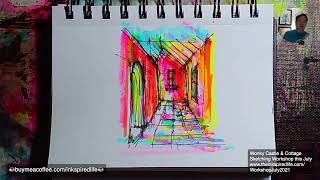
Ah, this is a pagoda-type structure. So let's just do a sketch in here. Maybe we'll do one or two. I wanna do thumbnail sketches. So thumbnail sketches are very small. Come thumbnail sketches, if you look at your thumbnail, right? So I'm gonna do like a thumbnail perspective sketch. Zoom in. We'll see where it goes. This is fun music. Cool. There we go, we got a quick little thumbnail sketch there. So this is actually pretty small. This is only— zoom out, you can see it. Bigger than I thought it would end up being. It's about 3 inches by 2.5 maybe. Started off with just some ink and then I broke out some of my Sharpie, Sharpie, Sharpie, Sharpie highlighters. Love using them for sketching and adding color, quick pops of color. So this kind of, I was playing that music before. Let's go back to the international music. I know I'm jumping over. Let's see if I can find, here. So this kind of music, I'm thinking bright, vibrant colors. And that's kind of what inspired me just to add the color on here. The music was in my mind from earlier, so I want to go down a bright and vibrant path with it. Hey, Deborah, good to see you. Thank you. I'm so glad you're watching. Awesome. D-Ray gave me a thumbs up. Thank you for the thumbs up. So cool. Got your orange and pink combo. Nice. Yeah. Yes, Becky, I always find a way to work in my orange and book combo. That is a go-to, as you know. I have a few different go-tos. That is definitely one of them, one of my combos. You make this look so easy, and I know it isn't. Hey, Deborah, thanks. It's, uh, well, I appreciate that. Just, it's just practice, practice. Just been doing this, you know, for a long time. And the color, the color stuff is something I haven't been doing for a long time. I'm just doing it, to be honest with you. I've always been afraid to add color. If you look at my old sketchbooks, everything's in black and white. The past couple years is when I've started really not even worrying, just throwing colors down, playing around. So that would— my advice would be just be playful. Look at this as playtime, creative time. Just have fun with it. You guys are incredible. So I'm going to do one more little thumbnail sketch. I'm actually going to do it on the same sheet of paper. There's this little space here. Patty loves tiny art. So Patty, I'm going to put your comment up here for a sec. Let me riff on it. Yeah, I have to say My favorite artwork that I personally create is really small sketches. I have my sketchbooks here.
Let me pull out one.
This is one of my favorite sketchbooks from years ago. This is from back in college, and I just want to show you— my favorite sketches to this day that I've created created are in this sketchbook. Some of them, I should say. These are really loose conceptual sketches. This is from 1993. Here's my ruler. If you look at this little— this is a little elevation sketch for a college project. We had to create a— in addition to an Art Deco museum in Miami Beach, we had to create our own addition to it. Anyway, this is a front sketch of what I was doing. But if you look at it, it's only an inch high by like 4 inches wide. I love that. Let me see if I can find the drawings in here that really pop in my head here. Some of them. Yeah, right here. This page is etched in my brain. It's from 1993. I still have these images somehow in my brain after all these years. They're not beautiful. This isn't gonna sell for a million dollars. It's not even probably gonna sell for a dollar, and that's okay. Because to me, it's priceless. And why? These little thumbnail sketches— let me take the comment off here for a sec. Boop-a-doop-boo. These thumbnail sketches, especially this one here and this one here, have created a sense of captured— it's a moment in time, a sense of place, and a sense of wonder in my brain about this place I was trying to design and create. So this is exterior entry stair. So you have stairs coming up into the building, you have some doorways, overhang piece here. The black in the background is kind of sky. When you look at that, you're like, "What? There's no— it's like scribbles." Yeah, they are scribbles, but all you need to do is scribble to create something that'll last for you, make an impression. You know, this— I love this drawing, this little sketch. It's just a stair going up. Very abstract, right? There's not a lot of detail. Some walls here with some small windows. Maybe it's a gallery stair. Doorway in the background. Another little piece. There's actually a skylight roof up here. So I guess the point is, um, for me, I love small drawings, and they make a really big impression. Here's some interior sketches here. Interior lobby with curved— something curved— block wall of stairs, glass block wall of stairs. Here's the interior lobby. Look, it doesn't— that doesn't say cooking. Looks like it says cooking. Looking towards entrance door and ticket area, right? So these are snapshots in time, vignettes. Sometimes we call these vignette sketches. In architecture. Very small thumbnail sketches or vignette sketches. Vignettes are capturing a scene or the idea of a scene. You know, this is a very bad attempt at a sculpture or something, but the name of the museum is the Bass Museum. So I'm glad you made that comment about small drawings because these are the most powerful sketches I have done for me and that have lasted with me since, like I said, 1993. So just because your artwork is big, you know, big is awesome, I'm not saying there's anything wrong with it, but it doesn't have to be. So, and it's cheaper to do smaller sketches. Cool, thank you for letting me riff on that, guys. I hope you don't mind. I know the music stopped and I'm not drawing, but I just wanted to riff on that for a second. "Thank you, Jason Nicholas, messing with my phone." That's so funny. We love kitties. We have one in our house. He's awesome. "I've been painting 3x3 watercolor scenes, so much fun. They are like trading cards." Oh, Patty, that's so awesome. That is really cool. Very, very cool. Yeah, right? And small art is easy to give out. It's easy to hand out to people. Rip it off. Here you go. Enjoy painting. Enjoy your sketch. "Love the beautiful thumbnail sketches. I do them when I plan to air paint, decide how I'm going to crop my subject. Ooh, I'll do a square, rectangle, and panorama, then decide which one looks best." Patty, that's a great tip. I like how you do the quick sketches to lay out your scene. Totally makes sense. That's an awesome idea. "Cool small sketches. Did you develop them into bigger drawings?" Yeah. Some of those were developed into our final project back in 1993, into a technical set of architectural drawings, which I would love to show you guys sometime. If you're interested, let me know. Just give me a thumbs up or put in the chat. I'll share the technical drawings I did for that project, and I'll show you how this thumbnail sketches came and played a part in the final project. Good questions. All right guys, I'm gonna do one more sketch. I'm gonna play the, uh, That sunset music, I call it Western sunset, riding in the sunset tune. I wish I knew what it was called. I just have to find it. I don't know the name of it. I should. Hmm, Streets, is this it? No. Hmm, oh, I think it's called Sombrero. My Sombrero, that's what it's called. Cool. Yes, share. Okay, cool. Yeah, definitely. I'll post. Yes, please post your thumbnails. I'd love to see them. If you wanna post them here on our, you know, Ink— was it the Ink and Wash group? Definitely post them. I'd love to see your sketches. All right guys, I'm gonna wrap up with one little thumbnail sketch. We're gonna play the kind of the outro music. I'm working on developing this into a more formal type of show. So thank you guys for tuning into the Inking Out Loud sessions, and we'll get a little more formal with the beginning, middle, and end and all that stuff, but it's still gonna be fun. Alright guys, so I'm just gonna say my goodbyes now. I'm gonna do a sketch and play some music and head on out. So thank you guys for being positive, fun, supportive. I love you guys chatting with each other, asking me questions, and It's just so awesome to riff off you guys. I appreciate all you do. Thank you for sharing your creativity with all of us as well. So positivity— was it creativity for positivity? Something like that. Guys, have a great, great night. I'm gonna do one more quick sketch and I'm outta here. Peace and live creatively. I will see you soon. Take care. Let's put this sombrero I just like ending with this piece. It's dramatic. Let's see what I can get— let's see what I can sketch while it plays.
Alright guys, have a great night.
See you soon. Take care.





