The Inkspired Life - Sketching & Painting : Inking Out Loud
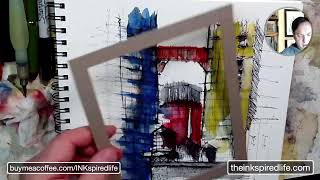
In this live YouTube stream, artist Jason Nicholas thanks viewer Linda for sending a lightweight Japanese Sailor fountain pen and uses it to experiment with line weight, nib angle, and ink bleed on a NYC cityscape reference. He demonstrates how the pen’s dual‑point nib can produce both broad brush‑like strokes and fine lines, discussing how angle affects thickness. Jason sketches the cityscape, adding water towers, brickwork, and a skybridge, then switches to watercolor, applying Winsor & Newton Cotman palette colors (blue, yellow, orange, red, sap green) on various papers (Strathmore sketch paper, Canson 140‑lb watercolor paper, hot‑press paper). He layers washes, lets them dry, and plans to add ink hatching later. Throughout, he engages with viewers—Linda, Jennifer, Chip, D‑Ray, and others—sharing gratitude, music references, weather talk, and offering to mail finished sketches. He concludes with a whimsical cottage sketch on a small 3×9‑inch landscape watercolor sheet, describing color mixing for gray, blue shadows, and orange highlights, and outlines future plans to continue using the pen on different media. The stream blends instructional art demonstration with casual conversation, showcasing material exploration, real‑time creative decision‑making, and community building.
Chapters
Hey Linda, good to see you. Hope all's well. Happy Tuesday night. Awesome. Hey Linda, thank you so much. I have the pen here that you sent. I'm actually gonna play around in a couple minutes. So thank you so much. This was such an awesome— what a surprise in the mail today. So thank you. It's— it feels really cool. It's so light, so I can't wait to play around with it. I really, really, really appreciate it, and thank you again. Really cool surprise. It made my day. Hope you're doing well. So hope everybody out there is doing okay on this Thursday, Thursday night. I'm tired. I'm actually exhausted from school. It's, it knocks me out. It literally knocks me out. I'm just so tired. But that's because I put so much into it. So that's not a complaint. But if I sound tired, it's because I am. But you guys are amazing. So I'm just sketching. I'm looking at a reference picture I took back in November in NYC, just in a real quick kind of cityscape sketch because I want to play around with this cool pen that Linda sent to me. So we're going to play around with it, we'll see how the ink bleeds. Um, so it's a Sailor, I don't know if Sailor is a company, it's made in Japan, I don't know if you can even read it. I can't read what this says. Um, but it says Sailor Japan. Very, very lightweight fountain pen. The ink cartridge looks almost like a, um, oh my gosh, what pen? Ah, it's a refill cartridge. I can't remember what pen it looks like. One of the ones I have here. So we'll, uh, see how it works. And the really cool thing about this is there's a If I can show the nib. Camera's blurry, I don't know why. Why is the camera blurry? The nib is cool. It's, I guess it's a calligraphy pen, so it has this really fine tip needle on it. I'll show it closer in a few minutes. So you can draw thick broad strokes and also really thin strokes with the nib. So it's, it's pretty awesome. So I'm excited to play around with it. This is the stuff I live for. So cool. Linda says good evening. You're most welcome. Thank you, thank you, Linda. I love, I love your artwork. I love those little mini, um, house scenes you've been doing. So cool, so amazing. Really, really great stuff. Very cool. Let's just draw some lines on this building here. There's like a row of windows, kind of. Not honestly not sure what building this is. This was a picture taken when I got out of the bus on at the Port Authority bus terminal, walking down the, um, to get down into the actual Terminal, this was a view I had looking out. I want to say it's a parking garage, basically that is like the parking garage structure. So I'm not sure what building this is. Um, pretty cool, but there are these really cool water tower things happening here. There are actually 3 of them kind of here. Sketch the tops on them a little bit more prominent. There we go. So we had some water towers kind of happening. Nice old brick building here in the foreground. And then we have— what do we have? Let's get another kind of thing happening down in here. And then we have some verticals here. We'll turn this over. That binding spiral binding thing's hitting my hand, so let's just sketch some verticals here. Right now I'm listening to that song We Are the World. You guys remember that? We Are the World. I forgot how many artists came together. Incredible, incredible talent all packed in one room. Um, love it. I've been, I've been listening to songs lately, songs that are I don't know, songs that are, I guess, have been written to, um, for like support and fundraising. It's really cool stuff. Anyway, off topic. All right, I got a quick little outline. Let's break out that pen, we'll zoom in a little bit, and we'll play around with it. This is— I remember that video song. Cool. We Are the World. Yeah, Google it if you guys, uh, YouTube it, watch the video again. I just watched a little— not a little, it was like an hour-long behind the scenes. I forget, good gosh, who was the host of that? They showed the making of the song and the video. Jane Fonda? I forget who it was. I think Jane Fonda may have been the host of that, uh, when they did that. But I divorced Jennifer. Cheers from Arizona! Good to see you, Jennifer. Hope you're doing well. Alright, cool. So here's— let me zoom in so you guys can see the tip of this pen. It's pretty cool. I've actually never sketched with a fountain pen with this kind of tip. I'm guessing it's meant for calligraphy, but I don't do calligraphy. But we're gonna sketch with it. So you can use it broad, or I guess you can rotate it and use the fine end. So let's give it a shot. Jennifer, last time we spoke it was chilly in Arizona. How is it? How is it in Arizona now? Hopefully it's not as cold. So let's see, this should be good to go. I put the cartridge in. We're expecting snow here in northern New Jersey tomorrow. I am hoping it rolls in early enough so we have a snow day. So keep your fingers crossed for me, guys. I don't know if it's a sketch, so I am using Strathmore. I haven't used this book in a while. I'm actually— I'm running out of paper in my other sketchbooks. Gosh, where the heck— what is this one? This is a Canson, rather, watercolor 9x12, 140-pound. That's what I'm sketching on today. Alright, let's play around and see what happens. Actually, let me sketch some lines in. Let's sketch— there's brick in here. Let's see if I can get some brick lines. So this might work better on smoother paper. We'll find out. Here we go. Actually, let me zoom in so you can see what's happening. This is brick on this building. I'm just lightly dragging this across, playing around with this pen. You can hear it picking up the texture of the paper. Just flip it over to the other pointy side. I'm gonna try this also on a piece of hot press paper to see if it works better on a smoother surface. I'm thinking too much. Let's just play around for a few minutes and I'll see how it goes. I do want to see if it bleeds. So we got some bleeding from the ink cartridge happening. So I'm just throwing down some lines here just to indicate there's some brickwork happening. See, I want to get a really thick line here. I want to pull the edge of this building out. So I'm using— uh, this is cool. So I'm using the flat part of that nib, get a really, really thick line if you want. That's cool. Let's do another thick line here. Look at that. Bang! Really, really thick lines. So that was cool. So I'm learning as I'm using this that depending how— what angle you hold your pen at on the paper, you can get different thicknesses of lines. So if I'm kind of almost at a 45— it's kind of hard for you guys to see, but it's like a 45-degree angle. I get really thick lines if I lower it. See what happens, or if I raise it. Let's see, 45 degrees. A little less than 45, I'm getting kind of thick, thickish lines. So you gotta play around with the angle of the nib. Maybe if I think of this less as a pen and maybe more as a brush, if I change my kind of mindset with this. I really want to pop this. Let me zoom out some more, guys. I think I'm zoomed too close. Ah, there are some lines on here, so let's sketch. So I just flip the pen over strictly using the fine point. I'm just getting these really thin lines here. And this is just a quick— we're just playing around tonight, guys, with this pen. So I'm kind of smudging things over here. It's all good. It's not art unless you what? Unless you wear it.
Boom.
It's officially art. I'm wearing it. We have some really thin lines in here.
Cool.
Jennifer says still chilly. I hope you're keeping warm. I hope you're definitely more Linda says we're expecting 3 to 5 inches. Ooh, that's awesome! If you like snow, that's awesome. If it's not, it's not awesome. I don't know what we're expecting. I honestly haven't been looking at the weather. I don't want to get my hopes up. I'm going to pop some music on. I'm only going to stay on for a few more minutes, but, uh, let me turn off— I'm actually listening to Spotify. Let me pause it and I'll put some music on for you guys and for me as well so we can all listen together. There we go. I think we're just gonna— I have some— my watercolors out. I'm just gonna throw down some maybe some watercolor on top of this.
Let's see this here.
Runaway, runaway brush. Need a bigger table. All right, let's see. Or smaller sketchbook. All right, I think we could see that. That's cool enough. Yeah, let's throw some color down. What the heck? And we'll just see. I'm just gonna use whatever colors are in the palette and just mess around. I'm actually running out of this yellow. It's okay if the, the black ink bleeds. I don't mind. We're just playing around. Very cool. After this watercolor dries, I'll come back and add some more ink on top of it, uh, just to pull out some of the details. So I'm just kind of throwing in some blocks of color for now. I kind of like the way this is drying on the right with the yellow. I do want to blot this out a little bit here at the bottom. There we go. Cool. And since I need to do a bridge sketch today, I am gonna throw a skybridge on here. Right up in here. I'm gonna do that in a Sharpie so it doesn't bleed. So let's just throw a skybridge like right in here. There's a bridge connecting these, uh, these two buildings here. And we'll do something fun. We'll give the bridge maybe some kind of angled structure supports here. And this will be my bridge sketch for the day. Little cityscape, little bridge scape here. Yeah, this will be a fun sketch to come back and throw some more details on after the color is dry. Zoom out, you can see, kind of see a little further away what's happening. I don't know if I want more color. I think I might just leave the color where you see it. Actually, I might add some color here at the sky bridge so it pops out, but I think everything else I'm going to leave is black and white. Pretty cool. This is beautiful blue color. Thanks. This is— I don't know the name of it. This is the blue that comes with this Winsor Newton Cotman Series watercolor travel palette, I guess you call it. So this is the blue that just comes with it. So I don't know the name. Um, almost all the colors are in here except I think the red and turquoise are colors that came with this kit. And I've had this a while, and you can see the yellow is just now— just running out of that yellow now, actually.
Excuse me, I'm just going to get a quick drink.
I'm debating what color to do the sky bridge. Do I want to introduce another color? Maybe. I don't want— I was thinking yellow, but then it would look like here. Blue. Um, what do I want to break out? Maybe we'll just throw some orange. I'm feeling orangey. I'm gonna make Skybridge orange. So, it's done with Sharpie, so the black won't bleed. Just throw some orange on there. Why not? So we have a little bit of the black ink bleeding from this building. And I don't mind it. Now I look at— I should have done it red. Hmm, I'm overthinking it. No, we'll keep it orange. It's fine, we're just playing around. Cool. Grab some more of that yellow and it's drying a little bit so I can come back and Pop some more yellow on here. It's one of the fun things about watercolor washes, just coming back and adding— just adding some layers on top.
I'm just—
I'm throwing down some thick red, not a lot of water, just real, real thick here with the red watercolor paint.
Cool.
So let's bleed a little bit of that black ink. Just pull out some of the horizontal here, some horizontal lines, only because I want this piece to kind of be more in the front. So I want to just pop out these lines a little bit darker.
Cool.
So you can kind of see the overall what it looks like. Alright, cool. I think this one is good for now. I have to let it dry and come back and add some ink details. Um, so yeah, so it was fun playing with this pen. So thank you, Linda, for sending me the pen. Fun sketching with. I'm definitely gonna, you know, keep using it and playing around with it some more. We'll try it on just a regular— we'll try it regular, like computer paper sketching. I'll try it on some hot press as well, continue using some watercolors. I'm I'll actually, once it dries, I'll come back with the pen and I'll probably just sketch in some details with it as well. Cool stuff. I might use it to hatch in some shadow lines after it dries. And maybe I'll even pull out some of these, some of these windows areas a little bit more here. Some hatch lines. Hey Chip, good to see you. Hope all's well, Chip. You can never be late if I don't tell you guys what time I'm on. Um, I appreciate you tuning in, man. Hope all's well. It's always great seeing you. All right, I keep fussing with it. So this, I think this will turn out to be a nice sketch after it dries and add the details on with the pen. I'll definitely pull out some of the vertical lines that we lost in here and some of the horizontal lines as well. Yeah, it's pretty cool. What else do we have? I have a couple more sheets in here. This was a cool little section I did of the Brooklyn Bridge last night, quick sketch. Just a Sharpie pen. I really just wanted to capture just a close-up area a little bit. I could even have left this piece out, I guess, if I wanted. Yes, but that was a fun sketch. And then we have our Skybridge here, so This would be bridge. If I could, I guess I could technically count it. It's a bridge, Skybridge, but it's really a small part of the bigger sketch here. But this would be 55, 55, 56. I don't, one of those numbers. Now I'm just fussing. I feel like doing another really quick sketch of something, so if you guys want to stick around, I'll do another quick sketch. I'm not sure what I'll sketch, but we'll figure it out. So let me move this to the side and we'll let it dry a little bit. Uh, let's see, my paper, let's see. I'm out of— what do I have here?
What's this?
No, that's too thin. I'm just looking at my paper selection I have here. Oh, I have another one of these books. That's cool, I forgot I had another one of these. I just found it. I think I ran out of all the pages in here. I love this size sketch paper. Watercolor paper. It's, um, what size? 3 inches by 9 inches, so it has a really cool landscape format. Really small, you can see a pen here. Maybe we'll do a little sketch scene of something. So let's flip it open. Alright, what do I want to do? Alright, let's just sketch and see what happens. I'm thinking too much. Uh, I'm gonna start off with a Sharpie this time, as I mostly do. Nothing, nothing is popping in my brain. So usually when nothing's popping into my brain, I'm thinking way too hard instead of just doing it. So I just need to do it and stop thinking. So this may end up just being an abstract thingy, which is fine. Just kind of feel the music and we'll see what happens. I don't know, we have maybe this little kind of cottage, wonky cottage here on this piece of paper. I wanted to do the vertical, use the vertical format of the paper. So, I sketched a kind of a cottage or part of a cottage here. Throwing down some grassy area at the bottom with Sap Green watercolor. Uh, let's do a turquoise roof on here, so maybe there's some kind of metal roof we have happening. Jason Nicholas watercolor going on. Really, I have tons of water on that. Zoom so you guys can see a little bit closer what I'm doing. Cool, so we got some turquoise happening. Ah, let's see, we're going to do the main body of the house. I'm just going to use what's in the palette here. Um, let's pull out some yellow. Let's use the rest of the yellow up in this pan. Fortunately, I have another brand new one of these, so I know I have that yellow color. Um, which is cool. I just— because I don't know the name of it, so if I wanted to buy this yellow, I wouldn't even know what it was. But fortunately, I think I have a brand new one that I can just grab. So let's throw down some yellow on this cottage. Why not? Let's mix up some blue and brown. We'll make some gray. We'll do that maybe for this— some of the stones. We won't add color on everything. We'll just do a wash on some of them. Put a little bit more blue in there, I think. So I like, I like mixing my own grays with, uh, blue and brown because sometimes I like it to have a little more blue in it, sometimes I like it to have a little more brown in it. So here I'm trying to add a little more bluey blueness to it. And I'm gonna splash it down, and I'm actually gonna blot it, some of it off. I kind of want to stain the paper for a minute or two, and I'll blot it back. And I'm just randomly just picking out some stones here. I feel like I want to add some darker— let's add some brown in here. And I want to— I definitely want to leave some white space in that stone. Zoom out. Sorry, I'm a little close here. So I'm going to just pull some of that back, stain the paper so I can lift it. I'm gonna make, make more of a mottled effect. I really like what's happening with the color right down here. Uh, this area is looking really nice. I think there's a blue and brown. It might be hard to see on camera, but this is kind of looking like, like a nice patch, kind of like the effect I really was hoping for. This bamboo brush really soaks up a lot of water. So sometimes I think I add too much, if that's possible. I think I do add a little too much water once in a while.
Let's pop some down here.
Throw some blue in there. There we go. There we go. So I sometimes like to use blue for shadows and window, window openings. So I'm actually going to take some straight-up blue in here, straight-up blue, and we're just going to throw that down for our shadow. Now take some of that blue and we'll actually put it in where the windows are. Right, don't think of shadows as having always to be black or gray. Shadows are made up of all different kinds of colors. So there we go. So we have some kind of blue shadows happening in there. This is a hard one to show on camera, the whole at one time because of the length of it. I'm actually even just throw some shadows down here, some of that blue, just to create a kind of anchor the base of the building to the ground. I like to show some shadows, and then when it dries, I'll sketch in some growies. I'll just, uh, let's see, that's looking pretty good. Sorry I keep zooming in and out, guys, but there you go. I think you can see it better. Cool. All right, so we have a fun little whimsical cottage there. I want to add a pop of color at the top of the chimney, and we're going to break out— you want to break out— yep, let's do some orange up there. Just— I want to pop some color, so I'm going to just put a pop of orange at the top. I might even take some of that orange, add some water, and we'll throw some orangey shadows maybe in the brickwork. We'll use our combined orange with some of our gray color we mixed. Just give a little bit of variety to the stone. I may have said brick, I mean the stonework here. So we're just popping in some orange with a touch of the gray. Don't really need to be careful with it. Yeah, actually I like that. And that orange will kind of tie in with the cap, the chimney cap. And we'll just do some more down through here. Just kind of randomize it. I think this is going to dry pretty nicely. So I'm literally just dabbing the brush on the paper, barely Not really doing any brush strokes, just kind of dabbing.
Cool.
Let's throw down a little more turquoise on this roof. I like the way it's drying. I just want to pull some of it out a little bit, maybe the edge. Alright, let's zoom in. I'll show you guys how this is looking. Hope you're doing well, and I'm gonna wrap up. So here we are, just a fun little cottage sketch. I'll just kind of pan down very quick, loose. I'm liking the stone colors kind of happening in here, like what's happening in here as well. Oops, so you can see the turquoise roof, the blue shadow areas. I threw some orange in as well. And I really actually like what's happening here, this at the base. You can see how it's drying. And there you go, it's a fun little cottage sketch. Awesome! Stones are so cool. Hey, thanks, Linda. I'm glad you like the Stones. Awesome. What's your favorite Stones song? What's your favorite Rolling Stones song? I think one of mine's "Give Me Shelter." I like that song. Give me— right, it's called "Give Me Shelter." Give Me Shelter.
Cool, guys.
All right, let's see how the other one's drying up. Maybe I can sketch some details on and wrap up. So here's a fun little cottage sketch. We'll just put here. How's this? Crazy. This was our crazy one for the night. I threw down just really primary-ish colors on there. Let's see if I can sketch some details back on there. Let's see, let's zoom in.
We'll just kind of—
you want to pull back in some of these windows here. Still a little damp, so Sharpies don't really like writing on wet surfaces too much. Let's try there. Let's add some hatching here for the shadows. Let's say this is in shadow, this piece here. And clean up this a little bit here. So we've got some shadows kind of happening. On this building here, I definitely want some shadows. I want some shadows happening kind of back in here. So I'm just going to hatch them in. I can feel that the paint's wet underneath my palm here, so I might be smearing it and smudging it along. All right, so we pop some shadows on there. So these are the details. This is— I love this part, adding those, the lines and the cross-hatching, it really starts— it really adds another, um, level, and it's still loose, right? I'm still not trying to create tons of detail. I feel like I want to do something with these windows. I kind of want to give them some vertical lines here. Here we go. I have these brackets kind of under here. We'll hatch in a little bit there. I lost a lot of the line works— line work here, so I'm gonna— let's get some back in. Just trying to bring back these water towers a little bit. There we go. Cool. The tower back here, we'll kind of bring that back with some curvy lines. Here we go. So I think I was able to pull those water towers back with outlining the edges. Uh, what do I want to pull out in here? Maybe we'll just add— maybe we'll add a little detail to these windows, just breaking this grid down a little bit more into pieces. In my brain right now, I am asking the snow gods for a snow day tomorrow. Only be— only so I can have it to catch up on schoolwork. That's sad. I'm asking for a snow day so I can not have a snow day, but to catch up on schoolwork. Man, that does not sound cool. There we go. So you can see I'm just adding lines to the grid here just to indicate there are some windows on this facade without actually drawing them. Just doing it with a grid. Mm, I want to do something with this. I don't know what to do with this building down here. Maybe I'll just try to bring back some of that brick. There's a shadow. I have a— an edge here, so there's a shadow line I'm going to hatch in. I see some hatch marks here for a shadow. Under this edge of the building, this ledge pops out. So kind of that ledge there. This is kind of an overhanging platform. Let's actually do— give it some structure here. So I start off with the reference photo and I've just to lay it down, but now I'm making it really my own. I'm not even looking at the photograph at all now. I added things that weren't on the picture. Man, time flies when I'm sketching. Very cool. All right guys, I think I'm done with this one. Cool little piece there. D-Ray's in the house! Hi, Inklings! D-Ray says we're building with brick stones. You can't always get what you want. Yeah, Linda. That's a great Rolling Stones song. That might be my number 2 favorite song. You can't always get what you want. And that's one of the fun things about sketching and adding color. You don't always get what you want. And that's what I love. I love the random randomness. Cool guys, I'm gonna wrap up. It's almost 9:30-ish. DeRay, so good to see you. We're building with brick, love it. Um, yeah, let me zoom in. This is a hard one to get on camera. I think it's probably the best view. Let's throw a little framing test here. Would I frame pieces out? Maybe. This is more of a fun piece than anything else. It could look cool if you frame out some sections. Let's get a bigger opening. How about this one? Let's try that one. I'm really liking that blue on here. I think if you crop it, it could look better. Better-ish. Let's try this one. Uh, this might be a good size right here. This is actually an interesting composition. Notice I have— I'm kind of squinting. I have one eye closed as I look at it. Hmm. Looks much better with both eyes closed. No, I'm kidding. There we go. Coolness. And then here we go, guys. Here's the cottage. It is wet and I just tried to pick it up. Two fun sketches tonight. Thank you guys so much for watching. Linda, thank you again for sending the the Sailor pen right here. Actually, let's sign my name on here with the Sailor pen. Let's just sign this one. Let's play around. All right, I'm just going to sign here. We'll put a Do my heart thingy. I wish I knew calligraphy. I never studied or practiced it. I'm sure this would be so cool to learn how to use for calligraphy. Cool, guys. Hey, you're awesome. D-Ray was in the house. D-Ray, so good to see you. Hope you're keeping warm. D-Ray says better-ish. It was better-ish. I love the strategy of adding -ish to everything-ish. It just has a sense of forgiveness about it, a sense of interpretation. So ish makes the world go round better, I think-ish. Um, this is Linda, great to see you as well. Um, Jennifer was in the house, and Chip, great to see you guys also. I do appreciate you all. Um, yeah, I'm just looking at this reference picture. All right. You guys are awesome. I'll be back on sometime during the week, and, um, have a great, great rest of your night. Happy Tuesday. Stay well, stay warm, stay creative. There you go, I like that one. Talk to you guys soon. Be well. Peace out, Cub Scout. Take care. Yes, a sense of forgiveness, for a sense of forgiveness-ish. Love it. Like the one half of a house with the blue roof, signing with a gifted pen. Oh, oh dear, I like this one. Yeah, I really zoomed in, didn't I? That's really zoomed out. Cool, this one came out kind of fun. Kind of fun. Love it. Hey, D-Ray, D-Ray, if I don't have your address, send— if you want to send me your address in the comments or a private comment, I will be more than happy to mail this to you. I would love for you to have this little cottage sketch if you'd like it. So just, uh, in the com— just send me like a message on Facebook I don't know if I have your address or not, and I'll mail this to you if you like it. It's yours, just for being so awesome. You're always on and supportive. Thank you so much. And Linda, you will have something your way very, very soon as a thank you for the pen. I do appreciate you guys. Take care, have a great, great night.





