The Inkspired Life - Sketching & Painting : Inking Out Loud
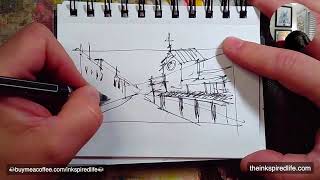
Jason Nicholas, an architecture teacher and former Disney Imagineer aspirant, sketches a tower-on-stilts concept while testing materials like Blackwing pencils, Strathmore watercolor paper, and Winsor Newton watercolors. He shows how different pens and papers behave together, answers viewer questions, and announces a new livestream schedule for Wednesdays and Fridays.
Chapters
Hey, DB, D-Ray, good to see you guys. Hope you're having a great, great night. Hey, Becky, good to see you as well. Hope you guys are having a great night. Hope you had an awesome Wednesday, wacky whimsical Wednesday. Zoom in a little closer. So I'm just sketching with my Pilot Precise Point V7 point pen, some quick loose sketching. I don't know, I'm picturing some kind of a tower or treehouse structure or structure up on stilts, maybe in a forest somewhere. It's kind of what I saw when I was just sketching this. So what are you guys up to? I'm seeing some amazing creative artwork that you guys are posting. I love what I'm seeing. You guys are awesome. Also, thank you for the kind words. You guys have been saying a lot of kind words. I really appreciate everything you guys are saying, and I don't deserve all those kind words, but I feel the same about you guys. You're awesome. You're paying it forward. You're exploring your creativity. You're painting, you're sketching, you're doing whatever makes you feel positive and bring some positivity to others, right? That's what it's about. So thank you guys so, so much. So I got the dramatic heroic playlist going right now. I'm just sketching. So this is, um, actually it's interesting. Let me find the COVID here. So I found this the other day in my plethora of art supplies. Supplies that I just pull out randomly here and there. Anyway, this is a Strathmore Watercolor Sampler book. I don't even know where I bought it, to be honest with you. I've had it for such a long time. But it's really cool if you look inside. Well, it says sampler, right? So I guess I don't need to explain that. Sampler— oops, I can't open the COVID So it has all these different types of series of paper, and I'll just show you kind of index here, which is really cool. I've been trying to find really different watercolor paper. I like my Canson XL, that's my go-to all the time, but I'm trying to find other paper as well. So I'm glad I stumbled on this in my drawer the other day. And it has just regular kind of thin sheets of computer paper, then it has different Watercolor. It tells you on the back what kind of paper it is. So I didn't use this one yet. Let's see, what did I use in here? Kind of been skipping around. So here's one I used. This was actually Neptune Tinted Watercolor, cold press, 140 lb. So it has a kind of a beige tint to it, and I did the sketch on it. It's painting. I really like the 400 series Strathmore series. It has a nice texture to it. This one has a lot of nice texture. This is— this I was trying some acrylic paint on this sheet of paper. This is actually kind of a blue. Oh, it tells you here the color. I just realized it. This is a tundra green tint on this one. What was the other one? Sand, right? This is a sand color. So this is just regular paper I'm sketching on now, but the next sheet is 400 series. It's called Sunset Snow, so it's almost like a pink. I don't know if the camera's really picking it up. It's kind of a pinkish hue on there. So this is a cool way if you're trying to explore papers, you know, you could find these sample books. That way you don't spend any money on a whole entire pad of paper. That you might not like. So I recommend going with the sample route. How many times did I say sample in the last 2 minutes? Probably a lot of times. If I only had a nickel for every time I said that. But I guess that's why I'm nickel-less. Get it? Nicholas? Oh, that was a bad dad joke. Hey Susan, hello, nice to see you from Texas. Very nice, thank you for joining from Texas. I hope, uh, hope your weather is great. Hope where all you guys are, hope you're keeping cool. I know here in New Jersey we're having a heat wave. I think most of the country's having a heat wave right now. So wherever you are, I hope you're keeping cool the best you can and, uh, don't overdo it in the heat. I cut the grass early today, probably I guess it was like around 9 and 10 o'clock, and it was still brutal out there. So just don't overdo it and stay hydrated, guys, right? So this is a quick loosey-goosey sketch. I'm imagining a tower or building somewhere in the forest, maybe. Be a cool place to go, like Airbnb type of place to stay. Staying, chill out. It's in the woods of Maine somewhere. There's kind of a cliffy, rocky area that slopes down, you can see it's kind of built on there. Pretty cool little sketch. You guys are awesome. I'm gonna switch the music up and put something a little more fun and jazzy on. There we go. This is really thin paper, so this isn't meant for like watercolor. This is computer paper basically. So what I'm gonna do is I'm gonna add some background on here. Um, what am I gonna do? Actually, you know what I'm gonna do? DB! Look what I have right here. Courtesy of DB, I have a Blackwing pencil right here that I'm actually gonna use. I'm just gonna lightly sketch kind of a grayish tone in the background here. Let me zoom in a little bit. So let's play around with this pencil. I'm just gonna do kind of a vertical chin. Really light. So you guys that have watched, you know I'm into using markers and I don't really use pencils that much. And it's only because I've just gotten away from pencils over the years. When I was in architecture school, we were just always sketching with pens, and that's my go-to, and I love it. But I have to say, this pencil feels— I like the weight of it. It's kind of a nice feel in my hand. It's lightweight. One of the cool things I like about this is This is really awesome. Built-in eraser here. So, I'm definitely gonna be playing around with more of the pencil. And I just want to shade this background slightly.
DV8 is the master pencil. There we go. So you can just see a very, very, very light shading.
Going on.
One of the cool things about pencil is you can just layer it and keep layering it and get darker and darker.
You can erase it too if you want, right? Yeah, that's just— you really need some white in the rings. Cool. Kind of blend it with your finger, blending a little bit.
Cool.
So I think just kind of by Adding the gray tones just makes— made the building pop out a little bit more. Actually, I'm going to take the pencil and I'm going to use it to add some shading. I like the way this graphite goes on the paper. This is a really nice pencil. Let's do some shading on the overhang here.
This is a little balcony area.
Kind of cool to stand over here and just kind of chill out. A little closer so you can see it. I like the combination of the graphite with the ink on this sketch. Use the nub to soften the pencil.
Thank you, Melon.
Hey, oh yeah, I have the blending, the blending nub. Where did I— I know you were kind of the center of blending though, too. Is my shoulder in the way here? I don't pay extra for the, uh, oh, I don't know if you can see my shoulder. I don't pay extra for the arm shots here. It's all included in the price of admission. You can see my arm and everything. Does anyone here have a bluntie?
Hmm. There it is.
Hey, thank you Susan, I appreciate it. So this is the blending nub. I guess it's made out of rice paper. If I remember, Don had said that. So I'm gonna use it, just, I did use it once before. Just kind of use it and try to blend some of the pencil together. Oh yeah, I see how it works. I'll do it down here, but I'll do it close. Zoom in tighter. I'll just kind of hit this area, you can see what happens when I go over it. That's really cool. I like how it's all blended. I guess this, I guess you can either cut this or maybe it looks like it unwraps maybe. So that's one of the cool things when you guys tune in is that you can see me experimenting with things I've never used before. So this is kind of new territory for me. I hope I'm doing it justice, DB. Cool. So you can see how it's all blending. Pretty awesome. This almost feels like a, like one of those paper straws. That you get at some restaurants. Actually, I want to go up here. I've had a little bit of this graphite in the window area in here. There's another window here. This is really awesome. It's a whole new texture and feel for me. I like how I was able just to add a little bit of the gray on the window areas with the blending. Nub. You cut the top. Gotcha. They make stronger nubs. I didn't have them. This is great. Thank you so much for sending this my way. So I would just snip it.
Scissors here.
Let me just snip it. There we go. So you can change the point if you want a wider point, cut it there. I guess you can cut a tapered point as well. Awesome, very cool. And here's kind of—
here's the whole image.
Yeah, thank you. So this is cool. Let me actually test out the eraser as well since we're playing around with it. Let me zoom back in. Hope I'm not making you guys dizzy zooming in and out here. I could do this and really make you dizzy, but I wouldn't do that to you. I'm not that mean. Alright, let's zoom in and out. Let's play with the eraser on it too. Give it a go. So what's cool is, you know, what you can do is you could erase areas, I guess, to create highlights so the paper underneath can show. Obviously you can erase it to create mistakes, but in art there are no mistakes, right? You can always embellish something that went wrong. That's kind of something I've Far enough, Stinks. All right, let's zoom in down here and let's try the eraser. So I guess you could keep it in the end or you can take it out, is it either way? Just keeping it in the pencil here. So you can kind of see all that. I'll take some of this area, some of this out in here as well. It's pretty cool. I like the eraser. So I guess if you take it out and you need to expand the eraser, you can kind of just get a metal here and pull pulled out. I see when you clip it back in, it will grip it. That totally makes sense. Getting it, getting it. So DB, thank you so much for sending these pencils my way and the blending nubs as well. I really appreciate it. It's something I definitely want to play around with more. You know, I'm left-handed, so I gotta be careful. I always get smudge things so easily, right? It's not art unless what? Unless you wear it. Guess what? I'm wearing some graphite. It's now art.
I'm having so much fun with this pencil, I can't put it down.
Actually, I can't stop drawing with the pencil. Oh, somebody stop me. My Sharpie's getting jealous. My Sharpie over here is like getting a little jealous. Stupid thing. It's making weird faces at me. See, but Sharpie— so pens and pencils can live together in harmony. See on the sketch, a little bit of both going on. So that's awesome. Here's kind of the final one. We'll move on. I think I might play around with a sheet of paper in here. So we have this— I'm going to play with this, this pink Sunset Snow color tinted watercolor paper. And what I think I'd like to put on here is— actually, I'll see if you guys can guess. What do you think would What color do you think I'm gonna put on this? It's actually a pink tone. It's not really showing up on camera. Change that a little bit. If I dim this light a little bit, it'll show better. Yeah, it's hard to get this pink to show on camera. Gray! Ooh, I like the gray idea. Gray is a cool idea. I was thinking gray, but you know what? I think I have a gray watercolor stick. Graphite doesn't color as well as black. I think I have a gray one in here. Hold on a sec. Yeah, this is, um, this is called Graphite Gray. I don't know, it's probably blurry on screen. So this is a Daniel Smith Graphite Gray extra fine watercolor stick. Let's play around some of this Graphite Gray on here. I like that idea. And I'm just going to break out an aqua brush. So I like to use these medium tip aqua brushes. This is a Pentel. I like the Pentels a lot. I bought this brand here, Brand X. I don't even know who made it, to be honest with you. It's not really that great. Sometimes you get what you pay for. It was very cheap. I mean, it gets the job done, but it So I don't like the brushes kind of fraying a little bit, so I just like to throw over Pentel. Alright, let's do some sketching on this. I also have just some clean water here as well. So I think I'm just gonna sketch on here and then we'll kind of Add some water on top. And I just want to play around with this. I'm not gonna force any shapes or anything to happen here. It's really— intention is really just to play with this graphite. Watercolor sticking on this paper. I like the dry texture, kind of the ridges on here happening. See it? So that's the texture you get when you kind of just lightly drag it on the paper. So I'm liking the texture a lot. And I love this music.
Cool.
I'm just going to take my work brush and just go over some of these lines on here, see what happens. Yeah, Gray was a great suggestion. I like it. I like it. My other— I was gonna go with sepia. I always like the combination of sepia and pink together. But I'm liking this gray actually. It's very chic. It's a chic kind of look. And what I like to do sometimes with watercolor sticks is once the water's down, I'll just then draw on top of it. What I like about doing that is the marker marker, the watercolor stick, will just bleed. So you can kind of see just how it's bleeding there. This is adding in the watercolor stick on just a wet area. Maybe this is a building on a— somewhere on a pier or something. These are kind of the pilings of the pier coming up out of the water. Maybe it's low tide right now. Maybe there's water happening down here. "Love the AquaBrushes when I travel." Yeah, Susan, AquaBrushes are awesome for traveling. I totally agree with you. They're so convenient, right? Just make sure you fill up some water in there and you're ready to go. Totally, totally agree with you about that. So when I travel, Not as much as I would like to. Hopefully I'll do more. I always have a sketchbook with me. I'll have aqua brushes with me. I'll have a Sharpie with me. I'll have my Pilot pen with me. Or the other pen I use is a Uni-ball pen as well. And I love just sketching. We go to Maine, we used to go to Maine regularly. I loved going to Maine and just sketching. The harbor and sketching the boats and buildings, lighthouses, beautiful. So when I'm sketching this, it's kind of reminding me of a building that I might see somewhere in Maine, kind of raised above the water here. Maybe these are actually— it's like a rocky base happening here. Not Rocky like the movie, but like rocks. But I love— I mean, I also love going to places like Disney. I love sketching the buildings. I would almost rather just walk around Disney with a sketchbook and sketch than go on the rides. I know that sounds kind of weird, but I love the design. I love the architecture.
I just—
you know, the thought and the storylines that Disney has created. I'm actually wearing my Imagineering shirt. Imagineering. A dream job of mine would have been to be a Disney Imagineer and help develop the concepts for the parks and the buildings and the rides. It would be so awesome to do that. I love being a high school teacher and being an architect as well. Sometimes we all have that one job, that one career maybe we didn't do that we wish we kind of had done. But I get to create, you know, buildings in other formats. I get to sketch them for you guys. I get to teach architecture to high school students and design buildings for clients. So I'm still doing the things I like to do, although I'm not really doing a lot of architecture stuff with my business these days. I just don't have the time with teaching. I want the time to dedicate to do great jobs for my clients. I do still have a business going, and I just keep it a little bit quiet right now, but that's okay. This has turned out to be kind of a fun little building. I keep saying— I know I keep repeating myself, but I feel like this is a building that can be on the water, just kind of a shack or something, a fishing shack. I'm just not— I'm not gonna put a lot of detail in here. I'm liking this paper. It's holding up pretty well as it's getting wet. It's not buckling too much, just a little bit. The texture I love on it for sure. It has a nice— you can kind of see me flicking it here— it has a nice kind of quality to it. It's kind of rigid. And actually, the gray looks really awesome on this light pink background. Sunset snow background. Paper texture makes for extra stony stonework. Yeah, Becky, you're right. That texture—
let's zoom in.
Absolutely. You know, we're letting the texture of the paper do the work for me.
Just kind of fun.
Maybe we have some birds, maybe seagulls or something kind of just flying around up here. So my seagulls look like the M's in like the McDonald's arch. They are, they're my interpretation of seagulls. Now I'm thinking about Big Macs. I don't know why. I will not paint them gold. They will not be golden arches. Cool. I do want to see how the Sharpie and how the Pilot pen feels on this paper as well. So let's break out the Pilot pen. Let's just throw some lines on here. Let me zoom in and I'm just gonna throw some details on here and see how the pen feels on this paper. I'm liking it. Yeah, so the pen is gliding pretty nicely on the paper. I shouldn't say gliding, it's a rough— it has some texture to it. It's rolling out nicely here. Yeah, thank you, Larry. It was awesome. Uh, I don't know about you guys, but I am seeing a penguin. This building is looking like a penguin to me. Do you guys see that? Or am I just going crazy? It's looking like a penguin. It is now the Penguin House. It's pretty funny, actually.
There you go.
You guys know I don't— can't do a— draw or paint animals very well, but maybe if I do them as buildings. Animals as buildings. Interesting concept. I like the way the pink paper is showing through. It has a nice little glow to it. Sorry, it's not really showing up on camera that well. Hey, I hope you guys are enjoying this. Hope you're having a great, great night. I'm debating if I should add another color on this, but I kind of like it this way. I don't know if I want to add anything else. I think it's a fun little sketch. I am liking this paper a lot. So let's go back, let's go ahead and rewind here. So we did this sketch, a regular, just I'm gonna get a sheet of sketch paper. As you can see the texture on, which is awesome. Some of the other colors in here, I don't know if I'm gonna paint on these tonight or sketch on them, but this is a, some kind of blue. Arctic Ice. I should have did the penguin on this one. Arctic Ice. This is a nice warm gray. This is their 500 series paper. I'm guessing, and I could be totally wrong, the higher the series number, the more professional it is. The texture also seems to be— as numbers go up, the texture gets rougher on the paper. This has a nice feel to it, this 500 lb. It's probably more expensive too, I'm sure, as the series numbers go up. Oh, it even says here, it says "rough." What's cool about this book, there's descriptions about the paper. Manufactured on a Fourdriner paper machine. This paper is hard größerer, greater water holdout, improved color lifting and blending. 100% cotton, acid-free. So that's nice, the sample book does have a description on the back. This is actually, this is smoother. There's a description on this one. That's still 500 Series. But it's smoother than the other one.
I'm not going to go through all these.
They have a whole other thing, Aquarius II Watercolor Cold Press 80 lb. That's interesting. So this is 80 lb watercolor paper. This is really thin. The unique combination of cotton and synthetic fibers allows this lightweight sheet to resist buckling and the need for stretching. The lightly textured sheet is appropriate for all levels of expertise. Millwood pads and sheets, cotton/synthetic blend. Let's play around with this one. Let's do something on this. Why not? I'm gonna do a couple— I'll do this little small sketch up top. Let's see, what is this? Aqua Brush. I'm just going to start off with a Sharpie sketch, I think. Hey, if you guys have any questions, let me know. If you're enjoying this, let me know. Hope you're having a good time out there. Hope you're getting some good info. Hope you're learning along with me. That it's fun to try different pencils and pens and papers out. Just get you a really small perspective type view here. This paper is very, very smooth. Alright, cool. I just want to throw some lines down here. Let's break out some watercolor paper. I think I'm just going to use a— let's try this graphite stick. Actually, I have a Cerulean Blue watercolor marker. Let's use that first. Just throw some color on here. Wow, this paper is really smooth. It's just gliding on here. Yeah, it's so thin you could actually see it does bleed through. That's our color marker. This might be good paper for just really quick kinds of sketches. See, we also have some, some Chartreuse. That's pretty good. Some of that, throw that on as well.
Jason Nicholas.
So I love drawing these little perspective scenes. It's just a really quick way to capture an idea or a scene of a place. So this is just something I'm kind of imagining right now. If you're out in the field and you're doing sketches in a journal, these perspectives are a great way just to capture the overall shapes and forms. Maybe some, uh, some buildings and even some landscape elements. Maybe there's some trees happening in the background here. Kind of long spindly trees. So the color's not really blending that well on here. It's kind of getting sucked through the paper, so it's not really— kind of see here, it's not really blending that well on this paper. Show that graphite stick to you, how that works on here. Wow, brush is dry. Yeah, this paper is not— this is not great paper if you want to blend colors and stuff together. Really just laying down individual colors. That's why we have a sample pack, right? That way we can just try different things. I think it still needs to cool out a bit. Ah, that looks rich as. I couldn't resist, I had to break out the Sharpie highlighters. They're calling my name on this one.
Oops.
Sharpie is not working. I always find it hard to throw away my Sharpies when I stop working with them. I don't know why, I feel bad about getting rid of them. Wish I could repurpose them into something. Sharpies also do not like to write on wet surface, so that's why I go to the Uni-ball or the Pilot pen. They're usually pretty good at writing on, you know, a damp surface. So these are like some tall cypress kind of trees here. We had to draw these trees in our architecture projects in architecture school. One of my professors was a master at sketching anything, but especially— he did these really funky cypress trees in all of his projects. So of course we showed them on our projects too.
There you go, cool little scene.
We got Sharpie! D-Ray says we got Sharpie. Yes, we got Sharpie, absolutely. My faves in the whole world. I cannot live without my Sharpies. They're so beautiful. I am swooning over Sharpies. Did you ever think you'd see a grown man swooning over Sharpies? That's tough to say fast. Grown man swooning over Sharpies. Try saying it 10 times fast. Swooning over Sharpies. Swooning over Sharpies. Swooning over Sharpies. Swooning over Sharpies. How about a grown man swimming over Sharpies and Sharpies, wobbling scissors. A grown man selling scissors. He sells scissors and Sharpies and Sharpies by the seashore.
I don't know.
I don't know. Cool. So this is a fun turn up, just a fun little sketch. These thumbnail sketches, a.k.a. really small sketches, they're called thumbnail sketches. You know, they're both a lot bigger than my thumbnail, but a bunch of thumbnail sketches. These are my go-to types of sketches. I love doing these. I could sketch these kinds of size sketch all the time. Again, it's a quick way to capture an idea, to capture a location somewhere, you know. If you want to just capture colors or shapes. Pretty cool. So this is, you know, I'd rather use my Strathmore paper. I don't know if I would actually, you know, have a use for this type of paper. I'm sure other people have great uses for it, but for my taste, I'm not really I don't think I need to buy it anytime soon. I mean, I have some more space. I can try another sketch down here. Let's see, what should we try? Actually, you know what? Let me try actually watercolor paint on it instead of the watercolor marker. See if it has a different effect. So I'm just gonna lay down, I'm not even gonna sketch, I'm just gonna throw down some watercolor on here. You guys can see that on camera. "If you watch the back-to-school sales, Office Depot runs Sharpies on sale." Hey!
Don't be—
I'm gonna start saving up, looking out for the back-to-school sales. Thank you, that's an awesome tip. Love that. Alright, so let's just throw down some color on here. So I'm, uh, let me zoom out so you can see what I'm doing. This is just my Winsor Newton travel watercolor kit. I love this kit. I have a smaller version of this somewhere that I have that I use as well. I think I ran out of paints in that one, so this is really cool. This comes out, in case you haven't seen this, this is a little water tray. So you can kind of clip it on whatever side you want, left or right. This pulls out. I honestly have not used it this way too much, but you can hold it as a palette. Zoom out a little bit more. And boom, here you go. There's even a little paintbrush thing in there, so you can just kind of do this. Let's try it. Let's play around with it. Um, I ran out of water in my aquabrush, so I'm just dipping into regular water right here. Just throw down some color on there. I'm gonna wipe this color here. This is out of a tube. I put some other blue in here. It's kind of hard right now to come out. Let's try this. We can make our own gray, right? Put some orange and blue together. You know, I'm just throwing down colors to see how this works. So this regular watercolors are blending better than the watercolor marker, so that's for sure. Let's switch to— let's put some international tunes on. Wait, did we just have this on? Yeah, maybe I did. Now we can play this track. I replenish some of my colors here. You could also mix the colors in the pan, in the trees here, if you wanted to. I pre-mixed something, but— Focus a little more here on my blues. There we go. This will loosen up a little bit. Oops, just dropped my brush. So the colors are They're bleeding together down here. I'm not sure if I flip the page over you can see it going through. Actually, no. A little bit. It's starting to bleed through a little bit on the other side of the sheet of paper. I'm gonna throw down some fairly dry paint here. Let's see what it looks like. This is just kind of dry on dry here. I'm brushing on. Alright, there we go. We have some color on here. Interesting to see how it dries. Flip it over, you can see the back. So it did bleed through a little bit here. I'm surprised it's not really bleeding through more. It's pretty wet. So you get a totally different look with this kind of paper, right? There's no texture, it's pretty smooth. Very little texture, I should say. It's pretty smooth. Look at the plaid colors and pattern happening there. So what I want to do is I want to kind of sketch on top of it, maybe a little sketch with a pencil. Take out the black wing pencil. I have a slightly— I have a light gray Sharpie that looks cool when sketching old stone statues. Ooh, Becky, a light gray Sharpie. I am uber jealous. I gotta get me one of those. I am going to Michael's hopefully tomorrow. I gotta stock up on some of that Canson paper. That is so cool. I will check that out.
So this is wet.
Let me see if I can sketch over it with a pencil. Try to pull out a skyline from From the colors here, turn into a nice skyline scene. Wait, this pencil is really nice. It's just kind of colliding on here. It's actually working kind of pretty well on the soggy parts of the sketch. I'm surprised. Madras Plaid Manhattan. I love that. Awesome. Cool stuff. Susan said thanks. Hey Susan, you're welcome. You're welcome. Fascinating to see how you layer different chairs. Thank you, Beck. I like this. Madras Plaid Manhattan. That's awesome. Yeah, cool. So this is, um, I have to say this, I really like the way this is looking. Paper's buckling pretty badly actually, it's pretty wet. But the way the color is kind of, I can't explain it, how it's not, I can't explain how, it's just the way it's drying. You see It's almost like the tech— there's— since there's really no texture, you see little specks of like white coming through, which is interesting. It was a bad explanation, I know. I'm sorry. I'm sorry about that. Yeah, it was, uh, I'm at a loss of words actually. It's looking pretty cool. Got a little bit more on this. I'm really loving the pencil look on this as well. What I like about using the pencil versus the pen, you know, or pens, um, is that I can control, you know, the darkness, how much shadowing and— where he is. Like, if I want this kind of a shadow line back here, I can just lightly put it in if I want. Whereas if I was to use my pen, it would be hard to control that. Love this music. I think the music has definitely kind of inspired the fun and the colors that are happening on here. Hey, thank you, DB. I do, uh, do like it. Zoom out a little bit more. So, just so you know what I'm thinking out loud here, what's going through my head is I'm just looking at this as I'm working on it. And I'm just looking at areas with shapes that were formed by the colors or the white space. You know, and incorporating that somehow into the sketch or help inspire what I'm doing. So you know, I see back in here some white space going on. So I'm gonna kind of use that shape, use a little window area back in here. So I'm letting the pattern and shapes just give me form, some of the things I'm doing. Maybe we have some peeps going on back here, down at the bottom. Just idea of these people crowding or gathering. Right? "Never thought pencil would look great over watercolor, but it really does look cool." Yeah, Becky, it does. I totally agree with you. I never thought about it. I'm really enjoying this pencil, this look. I like the fact that you can control the darkness of the pencil much easier than a pen. If I want to really lay it down, I can kind of grind it in here in places. Zoom out a little bit, you can kind of see the whole— whole picture there.
I'm drinking water.
Hey, thank you. Yeah, I think the people are okay. They work. They just give an idea of something happening here. Gives the buildings more of a sense of scale, just having some figures down in the bottom here. So that helps. Obviously the drawing is so small we don't need detail people, but just little figures. Hey, thank you, Donna. So it's drying, it's still buckling, we'll see how it dries. Just grab a drink of water. Sorry about that. Oh, 9:20, so I'm going to wrap soon. Yeah, I have to say, I think this is my favorite thing I did Tonight, actually, I really love the colors that are happening down here. Actually, the whole thing seems like it's working.
It's almost time to sharpen this.
Where's my sharpener? I'm gonna mute this so you don't hear the noise of the— that's right, guys, I'm gonna sharpen my pencil. Giving you a warning. It's part of creativity, right? The sounds. It's not just about what we're seeing, it's about what we're hearing, it's about what we're smelling, what we're tasting, I guess, right? It's about all the senses. We're engaging all of our senses. So we're gonna further engage our sense of sound with the grinding of the pencil sharpener. So bear with me.
Cool.
This is actually, this is a pretty cool little pencil sharpener I've had for a few years. It's called PowerMe, it's battery-powered. I haven't actually had to replace the batteries since I've had it. Pretty cool. You can see the shavings are in here. So I use this a lot, you know, for the colored pencils. How do I take this off?
Haha.
I'm in demo mode and I can't get the cap off. Oh, I pull it out. Well, I don't want to pull it out because I don't want to get all over the touchscreen. Well, too late, I just did. So it just comes off like this. And then you dump it in the trash can.
Grab it.
So it just kind of pulls out and you snap it back in. I like it because it's pretty small. And it's pretty easy to move around. Look, Jason, let's incorporate these into the sketch somehow. Pencil shavings.
I don't know.
If we had a wet paint or something, we could maybe use them for texture. Alright, cool, so this was a fun sketch. So I think what we're gonna do is I am gonna get ready to To wrap up, we'll play my favorite outro music that I've been liking lately. Let's take a look at what we've done tonight. Do a little recap. Go up a little bit. So we started with this quick sketch. This is just regular kind of sketch paper. And, um, this was pen and pencil, just quick, easy, goosey way to sketch. And if we played around, thanks to DB and Pencil, and you tip about using a blending nub, so use the blending nub to kind of soften some of these and blend some of this graphite. And from there, we— this is 140-pound Sunset Snow colored paper. There's a nice little pink tint to it. Try to zoom out. I just push that button. Silly me.
So this is cool.
I like the texture of this paper a lot. Becky pointed out, you know, it does make for nice stonework for sure. I like to have this kind of what I call a grungy kind of look texture So it really adds to that. This is nice paper. Then we went to this sheet of paper, very thin, 80-pound cold press watercolor paper. Very, very thin. You can see it kind of went through with the watercolor markers. This is the back side of this. Didn't go through too bad. This might be good for quick fairly dry watercolor washes. Awesome. You guys are great. I always appreciate you watching and tuning in and sharing the love and being positive and supportive and seeing what you're doing. Creativity is off the charts. I love it so much. Let me also look at this next here. So this is a Cool watercolor palette. Winsor Newton is the brand. Winsor Newton is my go-to watercolors. I've been using their watercolors for many, many years. I'm always happy with them.
Cool.
So guys, keep paying it forward with your creativity, right? So creativity, use it for positivity, and it's also just fun. Let's have fun with what we're doing, whether it's painting, sketching, drawing, cooking, baking, sewing, gardening, dancing, music, Jason Nicholas, um, it doesn't matter, acting. Just have fun and enjoy your craft. And the best part about it is the journey. Enjoy the journey. You know, I didn't know where this was, where any anything was gonna go tonight, and I just had a blast just playing around with the colors. I wanted to really highlight them. Okay, you guys are awesome. I'm gonna switch and play my Sunset Western tune on the way out here. I'll do one sketch. I'm always trying to race the clock and do these little perspective sketches with the music. I'll show you what I did, what I've done here. And here's an example of one of our little Western outro quick sketches. I'm sure there's other ones in here too. Oh yeah, this was one on top. This is one up here. This was one here as well. So there's just a fun way to end the viewing. There's another one. So starting in July, I have a regular schedule. I'm gonna post it tomorrow. I will be on Wednesdays and Fridays at 7:45 PM to 8:45 PM. It's gonna be called the Inkspired Life in the Creative Studio Live. So we're gonna do some live streams for an hour on Wednesdays and Fridays, a little more structured content. I'll still be popping on randomly doing like tonight, like a "thinking out loud" session, just popping on, just talking and stuff. So look for those. Anyone that's in my workshop, which looks like a reunion party from the last workshop, which is awesome. So guys, we are going to be meeting on Saturday We're using the same private workshop page we just used for the last workshop, so everything's there ready to go. I will put an announcement in there about the time and the Zoom link and all that. So we'll be meeting via Zoom, and we'll have Facebook up when we are going to be doing our show and tells. So that's how that's going to work. Hey, you guys are awesome. Yeah, Don, yep, Don on the— class starts Saturday. Saturday. The cowboy music's playing, I didn't sketch yet. I gotta redo that. I knew it was playing, I'm talking too much. Yeah, so the class does start Saturday. I'm gonna post something on our private workshop page that we just had before with times and all that stuff. I can't remember if I said 7:30 or 8. I think it's 8 o'clock PM Eastern time. 8:00 to 9:00. 9. So 8 to 9 would be our session, and then when we do show and tell, we'll go 8 to 10. We'll do an hour of session stuff, and then we'll do an hour of like show and tell. Hey, you guys are awesome. Thank you so much. We're going to go back to that cool Western tune because that's my outro music. I missed my cue. Redo. Let's redo this. Reroll the credits backwards. That's my backwards sound effect. You guys are awesome. Thank you so much for watching. Becky, Susan, nice seeing you here. I appreciate you. D-Ray, DB, you guys are all awesome. If you were here and I didn't see you— Sue! I didn't even see Sue pop on. Hello, Sue. I totally miss Sue being in the house. If you're still here, Sue, awesome to see you. I didn't even see you pop it in. So cool. Sometimes I do that, guys. I miss people popping in and It's totally on accident. But Sue, you're awesome as well. You guys are all awesome. Thank you so much. Let's play that Western tune, a decent sketch. Let's see, I don't know. I just use whatever is around me and just go for it. Let me zoom in. Hey, hey, Sue says hi to me. Hey Sue. Let's just stick around another extra couple minutes, right? Sue, I don't know when you tuned in, but it's good to see you here. Yeah, glad you were able to catch some of the show. All right, let's play the music. I am looking for it. I'm trying to sound like Clint Eastwood. Go ahead, make my day. I don't know, I think he wasn't in a lot of Western movies, Clint Eastwood. I really never watched Westerns. I do like this music. Alright, let's do it.
Have a great night, guys. Take care.
Peace, live creatively, see you real soon.





