The Inkspired Life - Sketching & Painting : Inking Out Loud
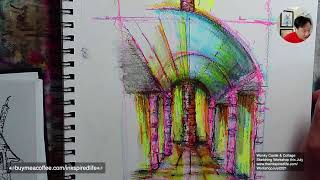
In this 90‑minute YouTube live stream, artist Jason Nicholas (Speaker A) demonstrates quick, loose sketching using Sharpie highlighters, Uni‑ball Vision Elite, Pilot Precise V7 pens, graphite sticks, watercolor sticks, acrylics, and an Aqua Brush on Canson 140‑lb watercolor paper. He explains how he establishes perspective with a vanishing point and draws a barrel‑vault (curved) ceiling, creating a sense of depth in a corridor‑like scene. Throughout the session he interacts with viewers (Karen, Cheryl, Art of Nassim Ahmad), answers questions, and shares personal anecdotes (coffee break, his son’s subscription, music choices). He showcases his sketchbooks, revealing wonky cottages, castles, clock towers, lighthouses, and architectural studies from recent workshops, and mentions a recent sale of a piece. Practical tips are offered, such as cleaning highlighter tips, using a document camera, and selecting heavyweight watercolor paper. The stream ends with a brief wonky cottage sketch, a wrap‑up, and a reminder of his creative‑positivity motto.
Chapters
Hey, I hope everybody's having a great, great Saturday night tonight. I am Sharpie highlighter sketching tonight. Hey Karen, good to see you. Hope you're having a great, great night. Thanks for tuning in. So I just broke out some Sharpies, some highlighters, doing a little sketch here. Perspective view, maybe looking down a corridor. I'm not sure, I'm not sure where the view is yet. I hope you're having a great Saturday. Let me know what you're up to on this awesome, awesome day. Hey, Art of Nassim Ahmad, thank you very much. Thanks for tuning in from YouTube. Good to see you. I appreciate that. Hey, Karen, perspective is fun. I love aerial perspective but find it challenging. Yeah, perspective is— I agree, perspective is challenging. So if you notice, I have a box drawn here. I always like to start with some kind of a frame. Just imagine you like looking down a view, down a corridor, down a street. And I have a frame, so I wanna keep my view kind of in the frame. And then I pick a point. I'm not— this is gonna be really technical, but I call it— it's called a vanishing point here, kind of where you're looking, where your focus is. You see that point I have right there? I'm just kind of connecting lines to that center point, so everything's vanishing, coming back to that main point. That's how I'm establishing kind of the angles that you see on here. Again, this is really quick, loose. This is definitely not a technical drawing. But that's just a real, real quick way of how I kind of lay out perspective sketches. Maybe I'll do another one, ink it a little bit with black pen. But I just wanted to break out some highlighters and just do some coloring, just some quick loose sketching. Thank you guys for watching. I appreciate it so much. Again, see, even my floor lines are kind of— I mean, it's not perfect. My points here, I'm trying to bring them kind of back to that point to just give the illusion of depth. Hope the colors are showing up okay on screen. Let me know if you guys see the colors okay. Zoom it down a little bit. There we go. Hopefully it's picking up. These are fluorescent colors. Sometimes the camera, the lighting doesn't always show the colors that great. I'm gonna hold it close so you can see it for a sec. I don't know, maybe this is like in a— I don't know, maybe it's an old city street, like an arcade you might find in Europe. You're looking down the arcade. Not like the arcade with Pac-Man in it, but like the arcade, a covered walkway, a tent with shops in it. So maybe you're looking down here and there's some kind of focal point at the end. So I'll play around with that. Maybe it'll be some kind of statue or obelisk piece. "Colors are vivid." Thank you, Karen, I appreciate that. Thanks for letting me know. I like to play around with colors and experiment. Here's an acrylic piece I've been working on. This is just acrylic paint. So I'll be using this for a background. I'll come back and I'll do some sketches over it, maybe with a Sharpie or watercolor stick, I'm not sure. But I'll sketch something on top of this. So this will be the background for a future artwork. Just acrylic paints, some fluorescent pink, fluorescent yellow, what else do I have in here, some oranges. So yeah, sometimes I just love breaking out the colors and just being really vivid. And sometimes you guys that have watched before, you'll see I just do things in black and white. There's a little sketchbook here. I was at the dentist today and wouldn't I sketch? Here's a little sketchbook here. So here, this is real simple like black and white sketches I did today while sitting at the dentist office.
Um, ink and pen.
And my true love is just ink, you know, using a Sharpie or a Uni-ball Vision Elite pen and just sketching on paper. That's my first go-to. I love sketching with ink. Where are my pens? Speaking of which, so Uni-ball Vision Elite is one of my go-tos. I'm sorry if it's not Focus, camera, focus. It doesn't want to focus. Now, Uni-ball Vision Elite is one of my go-tos. I also like the Pilot Precise V7 pen. Actually, maybe I'll break out some Sharpie. Let's see. Actually, let's use a Uni-ball. Sometimes Sharpies don't really work well on wet surfaces, so that's why I like to pull out this pen. I wanna add some line work to this. My camera seems like it's out of focus. It's weird. I'm just gonna zoom in a little bit. Do something with it like the last one. Yeah, exactly. You say, yeah, Karen, remember that one? I'm gonna exactly do that. I'm gonna transform it into something. I'm not sure what yet. Yeah, so hopefully you remember that last piece. That piece has been sold, which is awesome. Someone purchased it, which is incredible. So I was so honored that someone wanted to buy a piece of my artwork. Awesome stuff. So I'm just gonna break out the pen and just draw, go over here and just add some details. Keeping it very quick and loose, kind of abstract, not trying to recreate anything specific. Just gonna let my pen dance around a little bit on the sheet of paper. Very wonky lines. It's kind of my style. I like to keep things loose and wonky looking. I just like saying wonky. It's a fun word. Let's all say it together. 1, 2, 3. Wonky. So this is a curved ceiling, AKA barrel vault ceiling. If you ever hear the expression barrel vault ceiling. So, you know, so by adding some pen lines, it's just pulling things out a little bit more. Ah, let's see, I'm gonna break out a graphite stick. I'm just gonna add some kind of gray, maybe some shadowy areas on here.
Cool.
So I'm using my Aqua Brush here, which has some water in it, graphite stick, kind of grunging it up. I like the grungy look, so adding some just other layers on here. I'm gonna actually break out some blue and look on screen. Here, I'm just gonna throw some blue on here. I like the blue over the pink. It has a nice purple kind of look to it. Just trying to keep it really loose and fun. Sometimes I think colors have to be very lifelike, right? Try to replicate something that we know. And the purpose of this is just to have fun and play around with different colors. I'm not trying to recreate any specific place or building, just some kind of a feeling. Leave it up to your imagination to decide maybe where this is happening. "The black ink really makes the colors pop." Hey, thanks, Karen. Yeah, adding the black just helps to pull the details out. It gives edges to where the color happens, so you're right, it does make it pop. Yeah, that's awesome, great observation. You know, the more layers you add, sometimes the cooler things look. Or sometimes things could look maybe too messy, but it depends what you're going for. And this is really just quick and loose, just having fun. There you go. So let that dry for a sec. So this is watercolor paper. I think it's 140 pounds. Let's take a look. It's Canson Watercolor Aquarelle. Aquarelle? How do you say that? Aquarelle? Let me zoom out for a sec. Boom. There you go. This is what I'm using. Canson Watercolor Aquarelle, 9x12 sheets, 140 pounds, cold press, heavyweight, performs beautifully with all wet media. So here's what I'm using. It's actually not buckling that badly. It's a pretty nice paper. It has a little bit of buckle going on here. It is fairly saturated. I think it will dry nicely. I'm gonna let this dry for a sec. Is that a yellow pen? Yeah, so the yellow pen, this is a highlighter pen. So I'm using Sharpie pens. I have a Sharpie yellow highlighter, pink highlighter, I have an orange one and a blue one. These are all Sharpies. I love me Sharpies, as everybody knows. Sharpie, Sharpie, Sharpie. Always have Sharpies. So yeah, that's a Sharpie. Good question. So as you can see, I'm using the Sharpies and I am just putting water on it to kind of brush it around, almost like watercolor paint. Move this up a little bit. Let's see, maybe somewhere in there.
There we go.
I have this new document camera I'm working with, so I'm getting used to it. There we go. Now you can get a good scene, a good sense of what I'm doing. So I added actually some yellow down here as well on the kind of floor area. Maybe some kind of reflection happening from what's happening above it. Let's put some tunes back on. I have, uh, let's go put some dramatic cinematic music on. Excuse me, I have to get a drink. I have some iced coffee here. Just need a little drink. So if you're watching, be sure to say hello so I can say hello back to you. Don't be shy. We have awesome people in the chat. Karen's awesome. We have a new visitor, Art of— let me see if I get this right— Art of Nassim Ahmad. So if you're still watching, thank you so much for tuning in on YouTube. I really appreciate it. I will be sure to check out your YouTube stuff as well. So thank you. I appreciate that. It's always fun to see where people are watching from. This is some fun dramatic movie music. If it's too loud at home, let me know. I can turn down the— I can turn the volume down a little bit. I have it cranked up on my AirPods because I love it. If anybody knows Tim Burton or Edward Scissorhands, this kind of has an Edward Scissorhands, Tim Burton kind of feel to it. This piece. This piece of music, not my drawing. But Tim Burton is a really cool artist. If you like any of his movies, be sure to check out his sketches or his sketchbooks. He does some really wacky artwork. Pretty cool stuff. This kind of sounds like Harry Potter music a little bit too. One thing though, if you are doing this with highlighters, the tips will get kind of dirty and with other colors on them, so you might want to scrap a piece of paper to kind of wipe them off and clean them off. I think I'm gonna let this one dry. I feel like it's almost done. For now, I'll let it dry. I might come back and add a little more to it in the future.
Cool, so we have a little, uh, perspective going on here.
Actually, I want to add something while thinking about it. I'm just dipping my brush here in some water. I just want to put some graphite on here and drag it across. Maybe there's some kind of flat ceiling plane going on in this area, similar to the side. It's like a flat ceiling area. Actually, maybe I'm not done. Just had another idea too. Let's see, uh, let's Let me zoom out a little bit here. Here's something you guys don't usually see me do too much. I have to bring a straight edge out. I want to project this kind of tower piece here. I want to bring it up a little bit. You rarely see me do this. Guidelines. There we go. Unless I'm doing like an architectural technical drawing. Oh, I must have— I almost dipped my Sharpie in the water. That would have been funny. Hey Karen, you have your sister watching from Morgan Hill, California. Hey Cheryl, welcome! Thanks for watching, Cheryl. I appreciate it. Hope things are well in Morgan Hill, California. Sounds like a cool place. Awesome. If you guys have any questions or comments, feel free to put them in the chat. Always appreciate the inklings watching. Hey Cheryl, thanks Cheryl. I like the bright pink color of your avatar there with the C on it. That's awesome. I love that color. So cool. Thanks for watching. Thanks for watching. It looks like you're watching on YouTube. That's cool too. Yeah, I'm trying to grow my YouTube viewers. If you ask Cheryl, if you like this, feel free to subscribe. Subscribe and like my YouTube page. That would be so awesome. I think I'm up to 64. I actually got my son to like my YouTube channel today. He subscribed to it. So, um, not easy for a 15-year-old to like his dad's YouTube page, but he did it. He's awesome. It was really cool that he did that today. Hey, thank you, Cheryl. That's awesome. Appreciate it. Thanks, Karen, for spreading the word. So here's Lil's perspective. It's actually not quite Lil. Turned out to be A big sketch, I thought it was gonna be smaller. So what I was just doing is I didn't have this little chimney thing on the top. So when I was sketching, I had this piece kind of here. Maybe it's like an old factory chimney or something. So you're looking down this view through a space that has a curved roof. Maybe there's a chimney that kind of comes up. Through it. I just wanted to bring it up through the top to finish it. Thank you, Cheryl, appreciate that. You guys are always so kind. I might— this one might be done for now. This one might be done. I said that before. Yeah, yeah, it's with highlighters. Yep, exactly. Just using some Sharpie highlighter pens. Well, and also I'm using a Uni-ball Vision Elite pen. I use some graphite stick here as well. And water and brushes. There you go. I didn't break out the watercolor stick yet. Usually I'll come back and put this on last. I'll add some detail with the watercolor stick. Eh, let's just do it now. Let's just keep working on this little piece. 9:02. Probably onto 9:15. 9:15, wrap it up. 9:15 Eastern Standard Time, daylight time, East Coast time. Yeah, so this is watercolor paper, 140-pound. It's Canson watercolor, 140-pound. I've had this sketchbook for a long time, this watercolor book, and I just kind of pulled it out again the other day. I'm liking the paper, I'm liking the texture on it. So part of the purple, if you guys see the purple on my hand, that is actually not paint, that is from my irises out in my front yard. I was propping them up before I came in tonight, they were all falling over from the rain, so I was propping them up with some steaks. Not the kind you eat, although that'd be good. I am hungry. Laundry. So this is the color of the iris, the flower. It's this beautiful dark purple color. So it actually has stained my hand. If I could bottle it and paint with it, that would be so cool. Karen, show her some of your drawings. Karen's requesting. Sure, yeah, what I'll do is I'll pull out some sketches, sketchbooks, we can do that. Well, we'll start with this sketchbook. I don't even know what's in this one. We'll take a look. So, well, actually this is what I'm working on right now. Almost finished with this one. This is more of an architectural— this is more of a technical type of drawing. It's not as loose as my regular sketch style. This is one I'm playing around with right now. Graphite, watercolor stick, and this is actually red fluorescent paint. It looks different on screen than here in person. It's red paint, fluorescent acrylic paint. I also have an arm's length here. Let's see, what else do I have in this book? This has a mishmash of things. Here's a perspective. Thank you, Cheryl. So cool. This is a perspective I did in— I just finished teaching a workshop back in May. Awesome group of people. We were doing Zoom and Facebook. We have a Facebook Live private page for the workshop. But we were talking about sketching architectural buildings and we did a quick lesson on perspectives. So this was from that class we had done. These are, uh, what else do I have in here? So we have that. What else, what else? I'm just gonna go in my drawer and pull out whatever I have in here. You'd think I'd be more organized, right? What else? This is a— so I'm teaching a workshop in July. No, wait. June? No, July. I'm all over the place. This is June. In July, I'm teaching a workshop on wonky castles and cottage sketching. So I'll show you some of that stuff. So this is a wonky castle sketch. This is ink, acrylic paint, watercolor, ink. Let's see, here's a quick pen sketch. Here's some— these are some wonky cottage sketches. So I'm hoping to make a calendar with the wonky cottage sketches I've been working on. I need to organize my drawer here over this summer. Here's another perspective sketch from a while ago. Another perspective sketch. Another perspective sketch. Sometimes I'll do just like some architectural elements or pieces. This is— this was a, like, like a clock tower. This is a clock tower. This is different media here. It's got a text from my son. It's awesome. He needs to be picked up soon. Definitely that. So we have that. Here's another piece. I love spires, church spires, castle spires. This is a This was a fun piece. I was just— it's like a fire— it's a fire tower. I was playing around with how do I get fiery and smoky kind of looks on sketching. A couple more. There's a lighthouse. This is loose. I like to do very loose style sketches. This is a very loose kind of cityscape. Here's a building I made up, some kind of— looks like a Scandinavian type of building to me, like a Scandinavian church maybe. So that's just a few things I pulled out of the drawer. But yeah, so hopefully you enjoyed that quick show and tell. So I have a— the common theme I would say with most of my things is art. It comes down to something architectural, whether it's a skyline or a lighthouse or a piece of architecture, walls. That's a common theme. So thank you for your nice compliments, I appreciate it. Very cool. So I'm gonna wrap up in a couple— 9:15. I have to go pick up my son. What was I working on? Oh, and this I think I showed before. This is an acrylic piece I've been working on, just a background, and I'll be doing something on top of it. I'm not sure what. We'll have— this will be on standby. I might do something this week, next week, next month, next year. I'm not sure. I have a bunch of these kind of in my drawer and I pull them out once in a while.
Just on top of it.
I'm trying to find the one I was working on. It's right here. It's in this book. Silly me. There you go. Alright, so I'm gonna do a very quick sketch in just a couple minutes. I'm gonna use my small small sketchbook here. Yeah, thank you, it'd be cool. I'm gonna zoom in, this is just a real small sketchbook, 4x6, very thin paper, not meant for watercolor really, not even meant for markers, so thin. Let's just sketch something quick here, the last couple minutes. Hey, you guys are awesome, I always appreciate your time and watching. Good stuff. All right, let's see, I have my Sharpie. My Uni-ball here. I think that's a close view, just looking on the screen. I'm gonna slide over so maybe eliminate some shadows.
There we go.
Maybe I'll do like a wonky cottage sketch. Hey Cheryl, you're welcome, anytime. I'm more than happy to do show and tell. Lots of times I'll just bring out old sketchbooks and I'll I'll bring them out here and I'll flip through them and just show you guys what's in the sketchbooks. I'll do that for inspiration. Sometimes I look at a blank page like this and I have no idea what to do. And one of the things I'll do is I'll pull out a sketchbook and say, "Oh," you know, something might trigger and say, "Hey, try this." Maybe it's a color, maybe it's a subject matter, maybe it's a style. So I'll think of that, the old sketchbooks.
Alright.
Actually, I'm gonna use my Uni-ball pen, I think. I think my Sharpie's a little dried up there. So this is a very quick, loose sketch. This is how I draw stone. Maybe some kind of a building here where the roof comes down at a funky angle. There's a wonky chimney on it. And at the side here, the roof kind of swoops down a little bit like this. Cir— maybe there's some kind of circular window on the peak. Maybe it has like a timber frame kind of thing happening. Up on the gable peak. There's shingles up here. Let's, let's do— maybe it swoops down here. There's like a column here, kind of a porch. Let's see, maybe there's a, some kind of crooked door. So I like, when I, I like to draw crooked doors, nice crooked windows, just makes things a little bit wonkier, adds character to it. Maybe we need some kind of windows up here. We have 3 just kind of narrow windows up top. I'm gonna make the bottom of this building, I think, stone, and this top half might be—
this is timber up here, I think.
So this is a very, very cool building.
Quick.
So this is all gonna be stonework. I like to make the bottoms of the buildings angle out, almost like they're kind of growing from the ground. Sometimes I'll just shade my doorways in black, the windows I'll shade black. —on a quick sketch like this, just so they pop in the circle. A little bit in there. And actually, maybe we'll put like a little window down here. And sometimes I'll do these brackets. So a bracket that kind of comes off the building, curves, and maybe it comes under the roof hang, overhang. So there's like a bracket or something on there, kind of supporting the roof a little bit. Sometimes I draw— these are called finials at the top of the building. Drawing finial, the word finish, so finial kind of finishes the roofline. Sometimes they're used as lightning rods, sometimes they're decorative. This could be some stucco in here, so I'm just dotting this in. There you go, that's just a real quick, loose, wonky sketch. Wonky cottage. Awesome. So, hope you guys are enjoy— hope you enjoyed this. I'm gonna wrap up. I'll show you the first thing I was working on here. We'll kind of do a— I always like to go back and just do a wrap session. Let me know what you got out of this. Put it in the comments. What is the takeaway? Something you either learned tonight, something inspired you. Not just from me, but maybe from each other in the chat. Let me know what your takeaway is. What did you enjoy about watching tonight? I always like to look at the feedback. And if you enjoyed it, feel free to share this. Karen, again, thank you for sharing this with Charles. I appreciate it. I love you guys sharing stuff out. I like, one of my mottos is It's like creativity for positivity. So I like to pay it forward and I hope that my creativity and stuff can make some people just feel good by looking at it. Cool. So this is the highlighter one started tonight. Has some graphite on it, some pen on it, and it's just using highlighters. Yeah, a quick perspective type of view. On watercolor paper. And then this is the quick sketch we just finished up. Cool, guys. Hey, thank you so much for watching on this Saturday night. I hope you have an awesome, awesome rest of your weekend. I really appreciate you all so much. Karen, thank you. Hey, you learned a different way to do perspective and use the Pilot. Hey, awesome. I'm so glad, Karen. Yeah, so I'll I do these perspectives every once in a while, so the more I do them, I'll keep explaining what I'm doing. It's up here. Sometimes it's hard to get it out of here, out to you guys, so you know what's going on in my head. But that's why I call this Inking Out Loud, because it's just me kind of thinking, inking, talking about creativity, art, positivity, motivation, personal growth, all that fun stuff. It all ties together. Thanks guys, appreciate you so much. Peace and live creatively. Thank you so much. Have a great night, have a great, great Saturday, or, and Saturday and Sunday. Sometimes it all blends together as one big day. Take care. Thanks again. I can never find the finish button. Boom, got it. Thanks





