The Inkspired Life - Sketching & Painting : Inking Out Loud
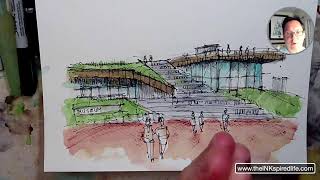
In this livestream, artist Jason Nicholas conducts a live, informal sketching session of the Statue of Liberty Museum, demonstrating his workflow, materials, and rendering shortcuts while interacting with a chat of regular viewers. He explains how he uses Winsor Newton watercolor markers, sepia washes, brushes, and a Sharpie‑based line foundation to capture glass, steel, brick, and the green roof. He shares perspective tricks for stairs and overhangs, and offers a “pro tip” for drawing glass with diagonal lines. Throughout the session he answers chat questions, troubleshoots a split‑stream glitch, and shows a series of personal photographs of the Statue of Liberty, its torch, the Freedom Tower, Brooklyn and Chrysler bridges, and surrounding skyline, sprinkling historical tidbits (e.g., the original torch’s lighthouse experiment, patina protection, drone restrictions). He discusses his artistic philosophy of interpreting photographs rather than copying them, announces upcoming New York sketch‑in‑the‑city workshops, a student‑artist community event, and invites viewers to future sessions. The tone is conversational, instructional, and enthusiastic, with a supportive, community‑focused sentiment.
Chapters
Hey everybody, happy, um, Tuesday. Hope you're doing well. May 9th, 2023. I see D-Ray's in the house. D-Ray, hope all is well. Hope things are going fine in, uh, North Carolina for you. Great to see you. So I'm popping on just to do a quick sketch. I haven't done my daily sketch yet, and, um, it's early enough where I figured I'd pop on just for a few minutes. And do a sketch. So I am, I am sketching the Statue of Liberty Museum real quick, loose, kind of my style, as you guys know. Patty's in the house. Great to see you. Hope all's well, Patty. Long time no see. It's always fun seeing you guys pop on, so thank you so much. So this is Statue of Liberty Museum. It's kind of a very modern looking building, and I'm just messing around with the shapes, just kind of sketch it quick here. This area I'm sketching right now is just a big glass facade here. And behind this glass is where the original Statue of Liberty torch is showcased, right inside the museum here. What I like about this building is it's, it's kind of built into the landscape. So you have these stairs that come off of a kind of a big public plaza. You go up the stairs. And up here, this is actually kind of a grassy area on top of the roof of the building. So the building is kind of split. There's part of the building here on the left side where I'm sketching, split by these stairs. The stairs actually go— the building continues under the stairs and then we have this piece of building as well. Patty says, quietly waves to Jason Nicholas Nicholas. Guys, let me know if my music is too loud. I did crank it up before I started tonight, um, only because I was being selfish and I really wanted to hear it loud in my AirPods. So if it's too loud, please let me know in the comments. Back here, way in the distance, there's actually some high-rise buildings way back in here. Oh my God, this is fun music. This is that grassy roof area over here. You can go on this roof building here, great observation deck, really cool views of, um, New York City skyline from here. Let me sketch a— let me sketch a person here just to get a sense of the scale of what's happening. Some peeps kind of in here. We got some peeps up on the roof, kind of smaller. There we go. Just to give a sense of the scale. If anybody knows the name of that classical piece of music, let me know. I should know it and I don't know what it is, but I love it. Hey, there you go. So it's just a quick kind of perspective sketch happening. Becky's in the house! Becky, good to see you. I love when you guys pop on. This is so fun for me. Let's see, I may add just a little touch of color just to pull out the roof, metal roof areas here. I think it'll help read, make the perspective read. It's a brownish color, so we'll I haven't used sepia in a while. Let me grab my sepia. Where is it? My sepia watercolor brush, where are you? Oh, sepia, here it is. Yeah, yeah, let's do this. All right, so we're gonna break out the sepia.
Cool.
Hey, Elaine is in the house, good to see you. Football as well. She said— wow, you draw people really fast. Thanks. I think it was the music. The music got to me. Um, just really simple, just simple figures, not a lot of detail, just to give a sense of the scale. But thank you. All right, so here's what I like to do with the sepia. If you guys don't remember, I love using these watercolor markers, Winsor Newton, but I don't use them directly on the paper. I'm going to move this over. You can see my palette here. I like to put the color down on this palette and just lift it off and put it on the paper. If I put the watercolor marker right on this cold press paper, it's going to soak in and it's hard to move around. Kind of stains it. So that's why I kind of start down here and I brush it on here. It gives me a little more freedom so the watercolor can kind of glide. Would help if I had a brush. You guys might be surprised to hear this, but look, I actually have clean water for once. I finally changed this water. I had it sitting here for probably 3 weeks before I cleaned it. All right, what am I doing? All right, let's grab this. I'm just gonna grab my brush. I don't have any paper towels though. I think I have a cloth I can wipe this off with. All right, let's brush on some of the sepia, and I'm just going to brush it. This is actually where the metal roof overhang areas are of this building, kind of in here. I'll zoom in. I just want you guys to see how I— what I do to sepia. I think you can still see it here a little bit, and I'm going to throw some more down. And I forgot to turn off my notifications. If you're hearing beep— if you're hearing little dinging sounds, that's my email dinging.
All right.
So it's a pretty cool building. This is concrete. These are concrete stairs. Maybe I'll go, um, a little bit of color. How about— should I use— I want some kind of gray. Let's use a brush. Let's use a Tombow. I'm gonna break out a Tombow. I haven't really used these too much, to be honest with you. You, but I just want to throw some gray down where these stairs are. Stairs continue across here and they kind of come down. So you can see, just add a touch of gray. And then I have grass on the side, so let's throw on some— let's just keep using watercolor markers. I have Winsor Newton Sap Green. Right here. I think it's sap green. Yes, sap green. That's my favorite green color. We're going to do the same thing. We're just going to throw it down on my board and we'll put it here. That way, you guys, I think it'll— you'll get a better sense of what's happening with the landscape and how this building kind of sits in the landscape. And that's one of the things I really admire and really liked about seeing this building. I'm hoping to go back here to the Statue of Liberty in August on a trip, just to go back and do some more sketching and photography. Um, I just— I was just mesmerized by being on location at this place. Really cool. And we have the grass kind of continues up here. This is that roof area I was talking about. So by adding color now, you can kind of see what the landscape is doing. And this is a big brick public plaza down here. It's actually curved. I'm not gonna even draw the curve, but I'm going to throw down some just to indicate the brick color. Which should I use for that? What could I use for the brick? I'm gonna break out I think for the brick color I'm going to use a graphite chalk here. Hope you guys are doing great. Sorry, I'm not looking at the comments. If you're commenting, I'll take a look in a minute or two. Throwing down some of this graphite only because I want to just add a little bit of color so you can see where the people are standing. It's okay if there's some green on here. We'll just kind of— this is a good color just to show the brick. Do just a quick wash on here. So this is a— this is an example of doing kind of an architectural sketch with a really quick wash of color without getting into a lot of detail. And my goal is just to establish a sense of location and the scale of the building and how it sits in the landscape here. Cool. Becky says, fancy water tonight. We have fancy water. It is not clean anymore, but it's clean-ish. I know, like, I'm living on the edge using clean water and putting my hand on a wet brush. Um, you guys are awesome. Here's a sepia. We're going with sepia watercolor markers. You got it. Looking good. Thank you. What could he use for brick? Graphite. Yeah, I think this is a good color, this graphite chalk. While it's wet, I'm just gonna lightly glide the graphite chalk kind of on top of it a little bit, and I'm going to smooth it out, and we'll call it a day for the brick. I don't want to overkill it. I may have just done that by adding more color. It's okay. If I had paper towel, I think I would blot out some of the red, but I don't have a paper towel, so we're gonna— we're gonna live on the edge again and just leave it on there. My gut wants to blot some of that off. I could use my shirt. I could use my nice blue shirt. That'd be great. Um, Patty waves to Becky even though I can't see you. You can't see Becky? What's going on? Holy cow, weird. Can you guys see each other in the chat? Let me know. Is there like a chat glitch that I don't know about where people can't see each other? It's very possible. There was a recent update with the software, so let me know if there's a glitch, if you guys can see each other or not, your comments. I hope you can. All right, cool. Um, and then we have the glass here for the building. What should we do for the glass? You know what, I'm just going to keep using the watercolor markers. Let's just show some blue on the glass. So I'm going to use— what color is this? Cerulean blue. And we're going to just tint those windows with some blue. You know, maybe it's just reflecting a nice blue sky. All right, let's, let's throw on some of that cerulean blue. So you can, you can see why I will often start with a Sharpie pen. There's glass under here, it's a little bit darker. But if I didn't use the Sharpie to start with, this black ink would all be— well, unless it was a non-soluble ink, it would all be bleeding, right? If it was water-soluble, it would would be bleeding. Whoa, I will try that sentence again. I use a Sharpie so it doesn't bleed when I'm adding water, otherwise it would turn into kind of a big muddy mess and I don't really want that. All right, cool. Hopefully that made sense. I'm going to leave some white here on the window area. I'm going to add a little more. I want to darken some of it.
Jason Nicholas and Mark Jacobson.
So I am taking the watercolor brush and marker and putting it directly on the page. Um, I don't mind doing it when the paper is wet because it'll move a little bit. Let's just add some here. This is kind of dark in this area. I'll come back and add some hatching in ink just to indicate some shadows, but for now, here we go. I kind of like that so you can see the glass. Hey Jennifer, good to see you. Cheers from Arizona. Love that, love that you watch from Arizona. That is so cool. From Quartzsite, from Quartzsite, Arizona. Quartzsite, it sounds like a kind of rock or stone. Love it. Linda's on Facebook and can't see YouTube comments. Okay, thank you, Elena, for telling me. I don't think I have anybody watching on YouTube now. If you are, let me know, make a comment. Um, don't see her comments in chat, Patty says. Maybe she's not on Facebook. Yes, so I am streaming live on Facebook and YouTube. It looks like Becky is watching from Facebook. Hmm. Oh, Becky says, found you guys. Now you can see everybody. Weird. I'm not sure what's going on with the chat. I'll have to figure that out. I'm glad you found us. All right, I'm going to add, um, it's not quite dry enough yet. I do want to add some hatch lines. Maybe we'll do that anyway. So I'm just going to grab my Precise Pilot, Pilot Precise V7 pen. Um, love this pen, as you guys know. And let's just The shadow under here is really interesting because the overhang comes out at kind of an angle. So I'm going to actually just sketch this in. And then I'm going to hatch some vertical lines to show the shadow under this roof overhang. Paper's a little wet. Pilot doesn't really like to work on the wet page. But you can see just adding some shadows helps to create some depth on here. And this, this is mostly under shadow, this whole thing here. So I'm going to throw in a bunch of hatching lines on this piece. Hatch lines are a great way to add texture, to show shading. I like to use hatch lines because it keeps my sketchy kind of look. I could break out a black Sharpie and color that black. I could use a Tombow and color it black, but I just like to leave the hatch lines. Because I'm, I'm a huge fan of line work, and I think it just keeps that loose kind of look. There's a very, very small overhang on this side, so it's going to really make this small here. You know, this is quick and fast and loose and very sketchy looking. Sketchy in a good way. This is an elevator up here on top, so you can take an elevator to the roof if you need to. And, uh, I'm just going to show some growies in here. This is grassy area, but just show some, some growies. And we'll do the same thing on the roof area here. I love architecture. I love buildings that have these green roofs on them. They're pretty amazing. And they have to really be structurally sound to support the weight of the planting, weight of any soil on there, any, any stones for drainage.
This is—
these are doors on the bottom. Let me sketch them in here. There's some kind of doors down here to get into the museum. This is the main entry area through here. These stairs go across. That's stairs going up.
Cool.
And this, this actually says Statue of Liberty Museum. I am not going to fit that all, so I am just going to put Museum on here. I should have spaced it out more. That's okay. So we have a sign that says Museum. And for the glass, there's a really cool way to show glass on architectural sketching. I'm going to zoom in even closer. Whoa, it just went upside down. What the heck? I didn't know I could do that. Um, here's a cool way to show glass. So just showing glass by just doing these kind of diagonal lines here. So if you want to render glass or just, just kind of indicate it on your buildings, that's a cool way to do it. There you go. Patty's like, growies! Yes, you guys love the growies, love it. Um, it appears you are streaming under the Inspired Life Sketching and Painting and as Inking Out Loud. Really? Thanks, Becky, that's interesting. Huh. Well, hello everybody, welcome to the chat. I'll figure that one out. I'm not sure why I'm streaming in two different places. That's cool. Hey, Heather's in the house! Heather, good to see you. D-Ray says enjoying this. Thank you. Your viewers are split between the two different streams. If you're on the left stream, raise your hand. If you're on the right stream, raise your right hand. If you just did it at home, that's awesome. But I couldn't see it. Um, all right, so I'm on two different streams at the same time and you guys are split between them. Good thing I'm not like fishing in the stream because I, I don't know, would I catch half a fish in each on the left side and right side? How would that work? Thank you for telling me, Becky. Yeah, I knew something weird was going on. I didn't update to my software. There must be a setting I got I switched on or I need to switch off. I appreciate that. I went through some more sepia on here. I want to darken this roof a little bit. So I believe this is actually steel. It's probably Corten steel panels that they use for the overhangs for the roof. So let's grab the sepia and we'll throw a little bit more on. And let's see, I'm not going to throw so much water on the brush because I want it to be darker. So I'm going to just roll my brush on the sepia, throw it on my board, and touch it on here. There we go, that's better. I really should have threw a little bit of red, but I'm just trying to keep the color palette. I could have mixed some of this red with this to get kind of a rustier look. Yeah, it's weird. I don't know why the stream is split. Sorry, guys. This one might be done.
I kind of like it.
It's kind of simple, simple washes on it. I don't want to get too crazy with it. Enjoying the music? Hey Patty, I'm glad you like the music. Heather's popping in for a minute. Awesome. Both on Facebook. Becky says yes, really like the glass. Oh good, Patty, I'm glad you like the glass. Again, that's kind of just an architectural cheat, or let's say pro tip, a pro tip for architectural kind of rendering. You can see it closer there. Um, look at the stairs here as I get close. You can see I didn't carefully draw every single stair. I didn't even draw all the edges of the stairs. I kept it kind of loose, but I hope— my goal is that in a quick way I was able to create the idea of stairs happening here, and hopefully you guys can tell these are supposed to be stairs, stairs going up. It's almost like an architectural shorthand without drawing every single stair. Actually, what's cool about the stairs is I forgot there is some, there's some like planters going up here with grass, grass is growing out of them. Let me throw a touch of green on those. Maybe, let's see what it looks like. There's some touches of green kind of going up these stairs a little bit. Which I don't— I forgot I had this. I can just blot out with this. I just want to blot back a little bit. There we go. Maybe we'll just kind of darken up some of this grass a little bit. Awesome, there we go. Let's see. This one might be done. Yes. Yeah, I know. I added, I added some more. I actually, so I wanted to add some of this gray just to help add a little depth to the shadows here. So that's another way you can add shadows without making them all black. You know, I just threw some gray on here. I think it worked. I like how you left white space in the forms of people too. Oh, cool. Yeah, thank you for noticing that. I, I didn't want to color the people in with the brick color, so I just left them as white pieces. I'm glad you noticed that too. You guys are picking up stuff. Dear is like architecture shorthand. Hmm. Hmm. It is architecture shorthand. Hard edge of the brick red is nice. Yeah. Right, Becky? Becky likes the hard edge happening here. If I was— if I wanted to, this is actually a curved terrace or plaza. I want to keep it simple. If I start trying to show the curves of the brick, I think it's going to get really busy because I really want the building to be the focus. So if I showed all the lines here in the plaza, it would— I think it would take away from here, just make it too busy. Hey, DB's in the house! Good to see you. DB's like, oh, like this! Oh, so cool. So this is it. Um, I'll show you a picture. I'll bring a picture on screen if you guys want to see it. Just put in the chat, say yes or no. Do you want to see the photograph I was using as a reference? So if you let me know in the chat and I'll show you guys what I was sketching. DB's like, yes! All right, let's show you guys. Lena's like, yes! All right, here's the reference. So here's why I don't show the reference at the beginning, and sometimes I don't show it at all. Um, I mean, I probably said this a bunch of times, but people will be looking at the photograph, looking at what I'm sketching, and then telling me, not in a rude way but nicely, that what I'm sketching isn't matching the photograph. Which is great because I don't want it to match the photograph, but I think sometimes we're so fixated that we have to copy everything we see exactly. Like we see it. That's not what I do when I sketch. That's why I take photographs. My sketching is my interpretation, my loose, fun, whimsical style of interpreting what I see in a photograph. So I just want to throw that out there as why I don't always show my reference pictures. All right, so let's drag it on screen. I should be able to drag it on. Let's see. Boom! So here you go, this is the reference. This is a photograph I took when I was there back in April, I think March, April, I think it was April. You could see the museum, it's a really cool building. So you have it, you know, the left side you have the stairs and the right side the building continues under the stair. So the stairs is essentially part of the roof of the building. And what I like about it is that it's just not a building sticking out above the ground like an— like a— like the Statue of Liberty. It's not like a museum piece sticking out of the ground like a monument, right? Statue of Liberty does that, and it's supposed to do that. This, they're trying to soften it make it a little more— make it more eco-friendly, kind of blend it into the landscape. So it's not that it would compete with the Statue. The Statue is the opposite side. If you're standing on those stairs looking straight ahead, you would see the back of the Statue of Liberty. Let me know if you guys— do you guys want to see some pictures I took of the Statue? Say yes or yes statue in the comments and I'll show you some of the photographs I took while I was there. But so that's kind of the building I was using for inspo tonight. Yeah, it's a very cool museum. I wish I knew the architect. I don't really know, and I haven't researched who designed this, when it was built. I really should. Um, I agree, adding more will take away from building. Thank you, D-Ray. Patty says your watercolor teacher says if you're going to copy the photograph, why bother painting? Yeah, exactly, Patty. That's my take on the whole thing. Very cool museum, has a Frank Lloyd Wright feel. Yeah, it does have a Frank Lloyd Wright vibe. That is so cool you picked up on that. Love it. Yes, please. Yes, please. Yes.
Cool.
All right, let me show you some statue pictures. Let me go to my photo album and I'll pull some out for you guys. Let's see, I took lots. All right, so it's show and tell, guys. Hope you're ready. Let me show you the view. Of the back of the statue from that plaza area. Let me see if I can get a good shot. Here we are. So this is the view if you're standing on the stairs of the museum looking straight ahead. That's what you see. That's the back of the Statue of Liberty. You have this incredibly tall, um, flagpole as well. I mean, check out the size of the statue and the size of the people. This thing's huge. I'm trying to remember how tall it is. If anybody knows, 250 feet, if I remember correctly. I could, I could be totally off with the math, but I think it was 250. I'd have to Google it to be sure. So that's the back of the statue. Here's a really cool shot. Let me show you this. I love this picture. I never realized the Statue of Liberty had a foot positioned like this, right? So her heel is raised. I'm really fascinated with the close-ups of this building and the details. Uh, not building, well, It's a statue. I guess it's a building because you can go inside of it. I did not go inside though. You have to buy your tickets way in advance. I had no idea, so I was not able to go inside. But check out the upturned foot. Really cool. And I'm also mesmerized by the fabric on the draping metal panels that look like fabric on the statue. Just incredible. And the colors, OMG, I am in love with the colors. I— to me, this, this is perfection. Not only for what it represents, not only for the engineering, not only for its artistic craftsmanship, uh, it's just, it's just really incredible. Pictures don't really do this place justice. Let's see, I'm not going to show you all the photos because I, like I said, I took 100 photos at least. Um, I'll show this one here. So let me show you, I'll show you a few more. If I'm boring you guys, let me know. I could show you these. Let me zoom in. So this is a picture on top of the museum roof. Area. Looking out to the left, all the way in the back, I don't— you can't see my pointer, but you can see the Freedom Tower. If you look at the point of that building, it's kind of up to the left. The Freedom Tower is there, um, which is the nickname. The official name is One World Trade because that's the address. But we all know it as the Freedom Tower. Really cool, really cool piece of architecture. Here's a, um, here's a better picture of the Freedom Tower here. It was an overcast day when I went, which I liked because it added to the atmosphere. You could also see the Statue of Liberty if you look to the left of the Freedom Tower. The Statue of Liberty is hanging out.
Cool.
All right, let me know if you want to keep going. She's a lighthouse, Becky says. So Becky, I'm glad you said that. So the torch does not light up at night. They have, you know, they have LED lights up lighting the statue. There was a point in time where the original torch, they cut holes in it to try to turn it into a lighthouse. I'll show you the picture of the torch in the museum. They cut holes in the original torch, but there was an issue. The hole— they cut holes, they put glass in there The glass failed, it wasn't sealed properly, the torch started leaking, so they had to take the original torch down. I'm gonna— I'm sorry, let me put another picture up here. Here's kind of a side view. So I'm walking around to the right side of the statue. I'll be walking around towards the front. Pretty cool pose. Oh, I like— I love this picture. Let me show you this one. Check out this picture. Oh, it doesn't— here we go. I gotta shrink it so you can see it. There we go. How cool is that? You know, we're all so used to the classic front view of the— of Liberty, but from every angle you see something different as you're walking around this thing 360 degrees, which is a really another— for me, another beautiful thing about this, this statue is that it looks different from different angles. So cool. Let's see. So now we're getting closer to the more classic view. Bring that up so you can see we're kind of getting more towards the classic view of it. I don't know if you guys— let me zoom in. Look at the people here at the— I'm just gonna— I gotta change the music. I'm gonna go back up to the playlist here. Again, let me know if the music is too loud. Can you guys see the people here? Kind of. If you look at the bottom of the statue, the bottom green part, look down, you can see little dots. Those are the people. That's the scale of this thing. It's immense. Let me find another one. Yeah, let me show you this one. So I'm practicing sketching this. My intent is to do original sketches and I want to sell them in New York City this summer. More info on that, and hopefully it works out with a special friend, and you guys may or may not know, and we'll be out there and it'll be fun. We'll see if it comes to fruition. Zooming in, so here's kind of a close-up of upper part of the statue. So yes, you can go in. You could climb up to the crown and look out. Those are windows in the top of the crown. I do not believe you cannot climb to the torch, or it's accessible but not for the public. The public can only go up to the crown height. And again, I think you need tickets like 3 or 4 months in advance if you want to have that experience. Uh, let me see if you guys can see the scale here. If you look at the bottom, you can see a person down here wearing like a turquoise shirt looking up at the statue. Keep going, keep going. I will. I'll show you some more. Wow, little people. Yes, I see them. All right, I'm gonna pan ahead or scroll ahead and find, um, here's kind of a close, here's kind of a close-up of the view here. Here's another one.
Right.
So now we're getting to like the classic view of it. It was very crowded here. It was hard— it's hard to get pictures without people in them for sure. Just going through if I could find some interesting shots for you. Here's a, here's a close-up of the base part of it. Let's see, let me skip around. Another shot. I like this one because it's a close-up. I wasn't kidding when I said I took at least 100 photographs here. I was dead serious. Kind of a close-up view. This is a sketch I want to do of this kind of this. Let me zoom out a little bit. There we go. I want to do a sketch of this view of it for sure. We'll zoom in, check out the face close-up. So all those black areas on the crown, those are windows that you can look out, out of. Hey Chip, good to see you! Hope you're doing well. Chip's in the house. Did you know there is a prototype of the statue on an island in the middle of the Seine River in France? That's so cool, Patty! Right, so the Statue of Liberty was a gift from France to the US. Um, that's awesome. I, I did not know that. I'll have to Google that for sure. Donna's like, you need a drone with a camera on it. DB, that would be so cool, but it is illegal. Can't, can't fly drones there. Um, I think you have to, you have to be— it's cleared by some government agency in order to fly a drone around there. Public can't fly drones. New York City has really cracked down on their drone usage, which makes sense because you're flying these drones in public spaces with lots and lots and lots of people around. You know, if these drones come crashing down, people could get hurt. So there's a lot of liabilities with flying drones. I would love to be able to fly a drone here. I have one. I know Chip, Chip has a drone too. Um, it would be so cool, but it's just, yeah, it's against the law. Um, there, if you go to more and more public parks, you'll see, you know, signs, no drones allowed. It's really, really interesting to see see that happening more and more. But drone shots of this would be incredible. There are helicopter tours that you can take. When I was there, I saw a lot of helicopters flying around here looking at the statue. So you can definitely fly around in a helicopter. Maybe one day I'll do that. Um, Mickey, can you imagine what she looked like originally? Copper color instead of oxidized green. Yeah, right. I, I love the oxidized green, the patina. It's, it's gorgeous. And patina is a way that the copper is protecting itself against the elements. But yeah, what did this look like originally? That's a really— Mickey, that's a great, great point. Great to see you, by the way. Welcome. Um, let me show you another sketch. Sorry, I got stuck on that one. I can honestly look at this thing forever. Um, here's a close-up of the tablet she's holding. There you go. Chip says, "We are going to fly the drone at Princeton." Yeah, Chip, that's right. I forgot. That's gonna be awesome. Chip and I have a sketching date in the summer to go to Princeton, and I am— I'm like, Chip, I am so excited. You have no idea, man. It's gonna be awesome. I'm looking forward to it. Um, should I bring my drone? Hmm. I'm guessing college will not be in session then. We'll see. We'll see. Cool. I'll show you a couple more pictures, guys. Again, I'm sorry if I'm boring you. I just geek out on this kind of stuff. Another close-up of the base. Here you can see some people kind of in front of the doorway. I really need to study the history about the statue more. Here you can see, uh, I love this picture. There's a guy in a red shirt looking up, taking a photo of the statue, and all I keep thinking is, dang it, why didn't I do that? So, if I go back in August— oh, I should look now and get tickets to go up here and do this. I want to be that guy taking that picture. That looks cool. "Not boring. Love your photos." Thank you so much. I'm glad you like them. I'm big into photography besides sketching. I don't know if you guys know that or not, but yeah, I— of course I love photographing buildings. Here's another kind of classic view. Oh, I just threw that. I think that went in the trash can. I don't know how that happened. What else can I show you? So I did not go to Ellis Island. Ellis Island is about a 10-minute ferry ride if I'm right, 10-minute ferry ride from Ellis— not Ellis Island, from Liberty Island. Ellis Island is the immigration site. We did dock there, but I didn't get off, so I don't have any— I may have one or two pictures I can show you I took from the ferry. Here's a— I tried to zoom in the best I could to get a photograph of my favorite bridge of all time. If you guys know what bridge this is here in the foreground, let me know. It's kind of blurry. It was taken with a magnified— my iPhone lens, you know, 10x, and it unfortunately comes out blurry. But I couldn't leave without getting a picture of this bridge that I am going to walk across. I don't know, either this month or definitely in the summer. I'm going sketching in New York City in— this is May, at the end of May. I'm going to a sketching workshop in Central Park. So I don't know if I'll make the bridge that day, but I'll definitely do it another day. Ellis Island would be cool to tour. Yeah, Ellis Island would be amazing. I will definitely have to go there next time. Here's some, just some skyline pics. I'll throw some in here. Again, it was a gray overcast day, which I— this sounds weird, I actually really love rainy gray days. I don't know why. You could ask Dina, I tell her all the time and people think I'm crazy, but I love, I just love these kind of gray days. There's just something about them. You can see we have a sailboat here. Here's a cool one. Here's a— you can see the helicopter in this one. So this is looking— you can see the Freedom Tower pretty good over on the left, and if you look up, you'll see a helicopter in the sky. So yes, like I said, there are helicopter tours. Oh, and the Brooklyn Bridge, if I didn't say it, that was the Brooklyn Bridge. You can actually see it here. It's very small, but there's the Brooklyn Bridge. All right, let's see, I'm scrolling through. I'm going to fast forward. You don't need to see all those Liberty poses. Here's a close-up of the torch. Battery low. The battery— G-O-T-H-E-M-R-A. My speaker is telling me the battery is low. I'm not even using it. I didn't know it was on. All right. Here's kind of a close-up of the torch. Here's another tip when it comes to sketching architecture. Don't feel like we always have to sketch or you have to always sketch the entire building. Focus on a section of it that you really like. Something that speaks to you. You know, for example, in this, maybe I would just sketch this shot here. Partial arm, hand, and the torch. Connected to Jason's iPad 2. What the heck? Connected to Jason's iPad 2. My speaker back there is like, it's trying to connect. Something spooky is going on. Here's a cool shot. So this is a view from walking around the statue. I like this pier that goes out towards the Freedom Tower. I am— I admit it, I am obsessed with all these photos. Let's see, scroll, scroll, scroll. I showed you that. Um, here's another cool shot looking— here's a shot looking down that pier. Um, why I took this, I like the perspective. This would be a fun perspective sketch looking down the pier with the city in the background. So My brain is looking, always looking around at different viewpoints. This automatically said perspective. You guys know I love doing those bridge perspective views. It's kind of along the same line as this photograph. I like this music. Here's a view. Here's a view of the statue looking through some trees. I like this view also here. This is cool. We don't often really see that side. Here's another cool shot of a close-up. I mean, check out the copper panel. So these copper panels, the guard, the ranger told us the thickness. I want to say, I think he said something like 3/32 of an inch. These copper panels are extremely, extremely thin. I think he said 3/6. Uh, yeah, I don't— it was really thin. I'm sorry, I'm forgetting numbers. My memory brain has turned off for the night. But look at this. These— this is so amazing. I love that you can actually see some of the seams where the copper panels are meeting. That to me just tells a story about how this was fabricated. That's why I love lines. Lines can tell so many stories. These lines, these seams are just telling the story of the craftsmanship. How did these metal panels meet? And I, I think that's pretty fascinating. Uh, just another Close-up of some more of the toga. I think she's wearing a toga, is that right? Oh, I like this picture here. This is a— this is a cool one. Look at the close-up of the hand here. So, I may— you guys may have seen the sketch I did last night. It was a— along the lines of this view. Um, so I did a nice black and white sketch, came out pretty good. And then I wanted to play with these Posca paint pens, these things right here. I've only used them a couple times, uh, so I was messing with them last night just to see what I could do with color. And, uh, I learned that, yeah, it wasn't really a good application for it, but at least I learned and I had fun playing with it. Oh, this is, this is the view I sketched last night right here. All right guys, I think I'm almost at the end of the Liberty pictures. Let me just zoom out here, see if there's any other interesting shots I can show you. Yeah, actually I want to show you the original torch in the museum. Before I do that, let me show you kind of a close-up of the back. I love the back view of the, of the statue. And then here, let's look at the original torch, which is in that museum I sketched at the beginning of the show tonight. Um, a couple different views. Here's one image. So this is the original torch that was taken down. If you look closely at where the flame is, I'll zoom in. You could see where they cut out the metal and they put these glass pieces in there because they wanted to create like a lighthouse effect. Um, yeah, the glass failed.
It—
the seams failed and it started leaking, so they decided the best option was to take down this torch and put a new one up. I don't know the year that happened. Here's another view. It was really cool to see this up close. And I'm just looking, let's see, any final images. Yeah, I have a really good one of the Freedom Tower I'll show you. Pretty cool, right? How cool is that torch? Patty says better, um, photos on Gray's days. Yes. DB said torch in the museum. Yeah, here you go. Patty's like, the bridge everybody tries to sell. Yeah, nice details, right? The torch is pretty amazing. Nice pier. It's that Ellis Island on the left. I believe it was in that picture. I believe it was. Maybe a summer workshop, we could do parts of the statue and then draw a complete statue. Ooh, hey DB, that might be a really cool idea. That would be cool. So my most challenging part of sketching the statue is the face. You might notice I avoid the face in my sketches for the most part. I'm up for doing something like that because we are doing a summer workshop. Well, I'm definitely doing it. I hope you guys will sign up and join. All right, 2 more pics and I'm done, I swear. I do want to show you a close-up of the— here's a pretty good picture of the Freedom Tower. I will be heading there also this summer and walking around the park taking pictures. I know it's a very solemn place, but I have to say the park is a beautiful, beautiful tribute, and I would love to show you guys it. I haven't been there personally, but I've seen pictures and videos of it. And then the last thing I'm going to show you— who can tell me the name of this iconic building here, all the way there. There are two iconic buildings here. What is the one on the left? And there's a building all the way to the right, both with pointy tops on them. Let me know if you know what they are. I think that'll wrap up my Statue of Liberty pics. Thank you guys so much for, um, entertaining my show and tell.
And we'll—
and then while you're looking at that, Paisley, Empire State Building. The one on the left is the Empire State Building. What is the one on the right? So you're right, Patty. Awesome, Mickey, got it. Empire State Building. You guys are awesome, awesome. Empire State Building is amazing. That I have not been in, but— no, that's not true. I've been up to the— I've been in the Empire State Building. Um, really beautiful building up close. The other building I have never been in. And then here is My— probably my favorite sketch I've done of the statue so far is this one right here. I like it black and white. I like the loose look to it. I think the scale came out pretty good. Um, and notice I cheated because I drew the back and not the front. I think the back is equally beautiful. And there's, there's a time lapse of this on my YouTube. If you guys haven't checked it out, go to my YouTube channel, uh, and you can see the time lapse of me sketching this one here. I recorded it to show my kids in school. You like it? Thank you, Mickey. Awesome. So the building on the right, guys, is the Chrysler Building. One on the right is the Chrysler Building. Yeah, here's— and here's— you can see this. So I think this sketch came out pretty good. Um, I really want to try to capture the upturned foot on the bottom right. I think the MetLife Building used to be the Pan Am Building. Yes. Yeah, Patty, that's true. Yeah, the MetLife Building used to be the Pan Am Building. That's, that's right. Um, wicked awesome sketch. Thank you, Becky. The Chrysler Building. Becky got it. Love it. Excellent job. Thank you, DB. Equally, equally beautiful is right. Love the sketch. Oh, thank you guys. So cool. And then we'll go back to where we started and we'll wrap up.
So there you go.
This is the Statue of Liberty Museum. I hope you guys enjoyed tonight's sketch. Thank you for letting me do show and tell, uh, and just kind of talking about something I kind of love. Um, as I'm talking, I am looking through my photos. No, there's nothing else. We'll leave show and tell for another night. I have tons of other stuff. Guys, thank you so much. I appreciate you all. Have an amazing Wednesday. I have a Student Artist of the Month— student— sorry, I have a Student Artist of the Month year-end reception tomorrow night that I'm running for the program I do with our town that I volunteer for. So that'll be cool. We have about 56 kids that won awards this past school year. We're going to display their artwork um, have some refreshments. Our art teachers are going to speak and show and tell what they kind of do. This is actually the event last year that Roo was so awesome and he showed up virtually and tuned in for 20 minutes or so and talked to everybody. So that was so fun last year. Um, so we're doing that again tomorrow night. No Roo. But we'll have our teacher speaking, so that'll be fun to see what they do. So I will definitely not be on tomorrow. I got a busy day. You guys are awesome. Thank you so much. Keep paying it forward with your creativity and your positivity. Yeah, you know, I'm bad at saying goodbyes. Thank you guys so much. I appreciate you all. Peace and live creatively. I'll see you soon, hopefully Thursday night or Friday night. Or Saturday night or Sunday night. I'm not sure, but I will be back on. Take care.





