The Inkspired Life - Sketching & Painting : Inking Out Loud
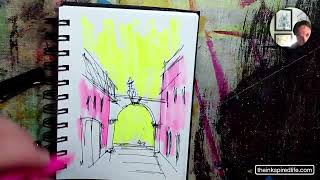
In this livestream, artist Jason Nicholas greets his online community and embarks on a playful, experimental art session centered on painting with espresso coffee as a watercolor medium. He demonstrates how to mix espresso with water, apply it with brushes, and accelerate drying using a Conair hair dryer, while narrating his thought process. Throughout the session he shares multiple sketches— a black‑and‑white architectural rendering of Our Lady Queen of Peace Church in Boothbay Harbor, a loose color wash background, and various quick thumbnail studies— and explains his loose‑style approach, the use of gravity, hatching, and granulation. Jason interacts with viewers (Jennifer, Heather, Cameron, Kim, D‑Ray, etc.), answers questions, and references a recent Instagram post that inspired the coffee technique. He draws parallels between the coffee wash and Leonardo da Vinci’s sepia notebooks, shows a Leonardo model kit, and discusses his love for sketchbooks, technical drawing, and future workshop ideas that will blend loose sketching with hard‑edge technical drawing using T‑squares and rulers. He also reviews his material arsenal (Sharpies, roller‑ball pens, Kilimanjaro and Canson paper, Daniel Smith watercolor samples, granulation effects) and offers tips on background washes, shading, and texture. The stream concludes with a “Whistling Cowboy” outro sketch, a homework assignment to draw rock walls, and a brief discussion of copyright concerns when artwork is reposted online. The overall tone is informal, enthusiastic, and instructional, aimed at encouraging community participation and sharing practical art‑making insights.
Chapters
Hey everybody, happy Monday! Hope you're having an awesome day today. I see, uh, Jennifer is in the house. Hey Jennifer from Arizona. Good to see you, Jen. Hope all is well. Hope the weather is nice in Arizona. We had some like snow and stuff happening here today. Heather's in the house. Good to see you, Heather. Hope all's well. Thanks for popping on. Hope you're having an awesome Monday. So I'm just popping on here just quickly. I wanted to, well, I know you guys think I'm nuts when I say I love watching paint dry, but I love watching paint dry. I thought maybe you'd like to watch it dry with me. Sounds exciting, right? Yeah, I'm kind of silly that way. I do love to watch paint dry, especially watercolors. But I'm actually not using watercolor. This is coffee. This is espresso. So I am doing some painting with espresso here. My awesome friend Linda had a post today about painting with coffee. I've done it in the past, but that post reminded me I always wanted to give it a go again. So I am painting with coffee. I have a few different layers going here. It's fabulous in Arizona. Awesome. I am so glad. I love when things are fabulous. So yeah, this is cool. So it's kind of a long process. I actually broke out something I don't usually use too much when I'm watercoloring, but I have it right here. Some show and tell. I have a hair dryer. Not any hair dryer, but the Conair 1875. I don't think that's the year it was made. I'm sure it's a model number, but I don't know what it means. Um, anyway, I rarely will break out a hair dryer or something when I'm watercolor painting, but I'm kind of rushing this process along a little bit tonight only because I'm excited and just playing around and having fun and seeing what kind of effects I can create. So you can see I have a scrap piece of paper here and I've been kind of messing around with this as well. And I guess I have a— maybe a— how much do I have in here? Not a teaspoon. I don't even know how much I have. I didn't even measure. I just took a couple pinches of espresso and put it in with water, let it dissolve. It smells good. Nothing wrong with having a caffeinated watercolor painting, right? So, uh, this was a sketch I did earlier today. This is of Our Lady Queen of Peace Church. It's in Boothbay Harbor, Maine. I did a quick sketch of it and I wanted to really pop the church out. I love the black and white sketch of the architecture. So I'm just using color in the background to pop out the church. If you zoom— if I zoom in, you can see just how that wash in the background makes the black and white pop out. It's a style I've been playing around with lately, and I really like it. I'm also having fun letting the espresso kind of move around the page here. So gravity is one of our friends when we're painting with watercolor. It's another tool we have at our disposal, so don't be afraid to use gravity and let the water paint dance around a little bit. So yeah, this is kind of what it's looking like. I'm going to let it hang here. I think I kind of want this to dry dark in that area. I might break out the hair dryer. If I do, I'll mute my microphone. I could probably use it on my hair too. See, it's a bonus. It's like the bonus episode. Not only we have a hair dryer to dry our paint, can even do my hair, which needs much more than blow drying. It needs major workover. But anyway, we're not here to talk about that. I hope you guys are doing well. I hope everybody had a nice weekend. Good holiday weekend. I'm on spring break this week, which I'm loving. I do have— I've been catching up around the house, doing some homework as well. It's all good though. So while this dries, let me break out— where's that one I was working on earlier? Let me show you guys this painting over here. So this was a fun piece I was working on yesterday and last night. I guess last night would be part of yesterday. Hey, Kim's in the house! Great to see you, Kim. Uh, this was, this was a fun painting. Cameron's in the house! Hey Cameron, how are you? Hope all's well. Hope architecture school is going fantastic. I know it's not easy and I know how much time you're, you're probably putting into all your, uh, studies. I totally get it, but it's always good to see you, Cameron. Thanks for popping on. We'll have to catch up. Maybe over the summer we can catch up. Um, that would be awesome. Maybe we could do some Minecraft building. You can give me some, uh, some tips. Um, this was a fun, uh, sketch, black and white sketch. I started with some Sharpie pens. I've been breaking out the Sharpies a lot lately because I'm doing these washes now and I don't want I love my Lamy pen, but it'll bleed, and I don't want the bleeding, so I'm using my Sharpies, which is cool. But I want to show you something on here. If you notice, I'm trying to really keep with the loose style, not with only sketching, but loose with the colors as well. So if you look here, I'm, I'm even getting color on in the kind of the overhang here, which should be white, but I let the color bleed on there. It's okay. It just adds that really loose aesthetic, right? You know, the doors have some turquoise and pink mixed in. I have orange on here and yellow. I have red. I don't use red too much, but I do have some red on here. But just letting the colors play around and mix a little bit. Is this an accurate, realistic Sky, sunset, maybe, maybe not. Nature is capable of anything, right? The colors, the shapes, um, the lights, the shadows. So don't— I feel like I don't want to be a slave to painting exactly what I see. Um, I'll do really quick sketches, you know, I'll do some really quick thumbnail sketches you know, like this one here. I also take photographs while I'm sketching, also to have as a reference. But when I come back, um, I will rarely look at the photographs I took because this is just a base. And then I could take my creativity and my imagination, use this base, and add whatever colors I want to it or details. I'm not locked into anything. So that's kind of what I'm doing with this church right here. You know, actually, I'll show you the sketch of this church. So my on-location sketch is in here somewhere. There it is. So this was the on-location sketch I did. This is probably— this is, I think, 2019. But I just use this as a loose base to recreate this sketch here today. But to be honest with you, I didn't look at any photographs. I don't know what the window details look like here. I don't know what kind of glass, what kind of, you know, lights, light patterns are in here. And that's okay. I just took the outline, the idea, and I kind of embellished it myself today, just using my imagination and being playful. So that's just another really great tip. Of how to stay loose with your sketching and your artwork is don't always rely on your— what you see, painting or drawing exactly what you see. That's how I stay loose. Alright, I'm chit-chatting a lot here. Cameron says, "Doing good, you?" Hey Cameron, I am doing awesome. We are on spring break this week. So it's good to have a break from high school. You know I love teaching. But it's great to have a break. And, um, Cameron, you would be interested. We did— we've done some Minecraft projects this year. We did the Minecraft Treehouse Challenge. We— what else did we do? Oh, we did a Minecraft competition where I have two architecture classes this year, and each class created a build. There were about 10 kids in each class And they worked together as teams, and the two classes competed against each other to build a, um, the idea is they had to pick out a biome or a land or environment and create architecture that kind of worked with the environment. So it was a fun project. So we did that this year. Cameron is a big and an awesome Minecraft builder. Minecraft is a great, valid design tool, guys. It's— I used to think it was just a game, but it's really great for conceptual design for buildings. Um, Kim says, love the bright cheery colors you added. Oh, thanks, Kim. Yeah, thank you. Uh, this is fun. This is— originally I was just gonna do the background and not the building, but I really wanted to stretch myself, push myself in a little different direction. and I went for, uh, just adding some colors on the building. And I think it's staying whimsical to, you know, my style and funness. Is that a word? Funness? It is now. But, uh, thanks, I'm glad you like it. Jennifer says, "Wowzers!" So whenever I hear "wowzers," I think of Inspector Gadget. Any Inspector Gadget fans out there, he would always say, "Wowzers." Cameron says, "Don't tell that to my studio critic." I won't tell that, I promise. Oh cool, Cameron says, "Sort of what we're doing now in studio." That's great, Cameron. That is so cool. I know you've been posting some of your stuff and I love seeing your work. Just like everybody, I like seeing your artwork. You guys are amazing artists. Keep sharing your work. It's really, really awesome stuff. So I'm getting a little impatient now. So with this drying, I love watching paint dry, but I'm gonna break out the hair dryer. So I'm gonna mute myself. Enjoy this. Let's find some hair drying music. I don't know. Enjoy this hair drying music while I just dry this for a minute or so. You guys are awesome. Hang in there. Thank you for liking this. Thank you for sharing this. Thank you for the thumbs up and the hearts. You guys are the best. All right, let's change the music. Here we go. All right. Hope you enjoyed that hair drying interlude. So I actually— what I'm going to do is I'm going to let this— I'm going to put it aside and let it dry a little bit more. I do like the way it's dark here, and I kind of want it to dry in that position. Linda is on. Hey, Linda. Linda, you inspired me. Today to paint with coffee. So I am using Ferrara instant espresso coffee. Just put some of it in there, added water, and we got some paint. So we got some coffee going. What I want to do is, guys, is I'm going to— I have the scrap paper I've been messing around with. Let's do, uh, let's just do some kind of sketching on here. I'm not sure what we'll sketch. I'm gonna actually want to dry this a little bit more, so I'm gonna mute myself back to the hair drying. If you guys have any good hair tips, let me know. Maybe some gel or mousse or something. Alright, let's go back to— let's dry this just for a minute and then I'll do a sketch on here. Alright, I'm gonna zoom in on this. Let's, um, put this over here. This will be drying off to the side. So this is just scrap piece of paper I was playing around with. I have a Sharpie. So I have two new pens I've been playing around with. I got them yesterday. This is a Sharpie felt tip pen and a Sharpie roller ball pen. So let's, uh, I don't know, let's break out the roller ball and just do a sketch on here. Wasn't Rollerball a movie? I think it was some kind of movie. You guys are awesome. Love the color of the coffee. Gives the paper— yeah, I love this look. And actually, let me do some show and tell. What this reminds me of is this. I'm just going to grab it here. I'm off camera. There we go. Boom. So I'm a huge Leonardo da Vinci fan, and what this reminds me of, this coffee technique, is reminds me of looking at Leonardo da Vinci's notebooks. So this is actually a— this is a model kit I had purchased years and years ago. There are there was a really cool store in the mall called the Museum Store. I worked in the mall for like 10 or 11 years and I think I bought it way back when, but I still have never built— this is Leonardo da Vinci's flying machine. I still have not built the model. One of these days. But right, I think that coffee technique reminds me of Leonardo da Vinci's sketches. And I love, I love this aesthetic, you know, kind of this sepia tone, this kind of worn-out look. If you look here, there's some kind of worn-out edges. So I think coffee, my color is not quite matching this. This has more of sepia, and I could, you know, I guess if you want to play around with coffee, you can make it darker, add more coffee. Grinds in here or crystals. What are these called? Whatever this instant stuff is, I guess they're crystals. Maybe add more to make it darker. I also have sepia as well, but I'm just playing around with coffee tonight. But this kind of idea reminds— reminded me of Leonardo's notebooks, which I think— correct me if I'm wrong— I think Bill Gates purchased one of the notebooks for— I could be way off. I think it was like $38 million. Yeah. But anyway, this is— I know I'm off the beaten path a little bit, but check this model out. It's— I have more. This came with other blueprints. Actually, instructions for this model kit are amazing. I don't know where they are, but it has amazing drawings in it. So one of these days I will build this thing. Probably whenever I take up my residence in my final location, because I'm afraid to build this and move it. Beautiful, beautiful stuff. So that's my riff on Leonardo da Vinci. I wish I had some of the drawings. I do have some. What do I have here? Oh, I can show you guys. Alright, so show and tell. Let's look at these notebooks. I, um, you know, Leonardo was everything from an inventor to a scientist to an architect to engineer to artist. You name it, he did it. I'm really, really in awe of him. But these are the instructions for that model kit. And— let's see if I can open this up here. I don't wanna— I mean, you can see it's upside down, but you can see there's sketches in there. Sketches done in Leonardo da Vinci style along with instructions. Sorry, they're upside down on camera. Here's some details here. Just really, really, really cool. And it looks like the instructions are in English and French or Italian. English and Italian, I'm guessing. Here's some other details. I love, um, what I love about Leonardo is how he would keep these notebooks and get his thoughts out. He would study, sketch things, uh, just whatever came to mind he put on paper. And that's something I love and I try to practice, is whatever comes to mind, just get it down and get it out of your head and onto paper. That's what I like to say. So Pretty cool stuff. So maybe one of these days I'll build this bad boy. I don't even know if you can get this model anywhere. Is it still? Actually, it'd be cool if I could find another one and keep one in a box and build one and have a backup just in case I mess it up. But cool stuff, guys. So, from espresso to Leonardo. That's what we're gonna call tonight's episode. From espresso to Leonardo. Because we are sketching with coffee. Alright, so I think this one's dry enough, this little scrap paper. Let's, um, do a sketch on here. I don't know what we'll sketch, but hang tight and we'll find out. We're gonna play around with our Sharpie pens tonight. So this is the rollerball pen here. Um, D-Ray! Hey, D-Ray's in the house! Good to see you, D-Ray, hope all's well. I hope it is not snowing in Alaska today. It's always great to see you. Um, dipped into my coffee just yesterday. Alright, D-Ray. Unfortunately, I want a donut now to go with this coffee painting. I won't drink this, my paintbrush has been in it. It's actually cold. It smells strong too. Espresso. Love the front of the instructions. Yeah, those Leonardo da Vinci instructions are really cool. I have other sketches and drawings that came with them, I'll pull them out some other time. For anybody that's interested, and I've been talking about it a little bit, is this This summer, I think what I'd like to do is a workshop about technical drawing. We'll do some sketching. Maybe we'll do sketching à la Leonardo da Vinci. We'll take those sketches and we'll use technical drawing tools like T-squares, rulers, technical pencil, and just for a change of state, you know, we'll do some hard edge straight line drawings. I think that'd be really cool. Cameron says, try building a 2x2x2 model with straws. That's a challenge. Ooh, Cameron, that would be so cool. What, a 2 feet by 2 feet by 2 feet model with straws? Yeah, what kind of a— how— what were you allowed to use to connect the straws? Could you glue them? Could you tape them together? Could you kind of fold the end of the straw and insert it into the other end? I'm curious, how did you connect the straws for your model? Glue? All right, I'm chit-chatting. Let's do some sketching here. You guys are awesome. Thank you for tuning in. I wanted to— I like to sketch with my watch off. There we go. All right. And the cap off my pen. I'm just going to spin this around and see. Eh, we'll see. And I'm just kind of going out of my— off of my head here. And hopefully you guys can see that it's not too small on screen. If it's too small, let me know. And I'm on this Lobster Shack, Fishing Shack, uh, journey, inking journey lately. So that's the shape that came to my mind right now. I really like this background on here. And I'll do this a lot, is I'll take scrap pieces of paper and I'll use them as backgrounds to do some ink sketching on top of. Yeah, let's see, maybe we'll do like some kind of dock or something back in here. We have some piers coming up. And I'm gonna play around with a couple different pens. So this is the rollerball pen. This will bleed. I'll show you. So I can get this pen to bleed if I want. So this pen bleeds, and then let me break out the felt tip pen. The felt tip pen will bleed if you— within like 3 seconds or 5 seconds. After that, it won't bleed. I love docks and piers. What I love about them is I love— we have these posts and you always have this cool network of cross-bracing and repairs that have gone on over the years. All these kinds of timbers happening. And they're really, really interesting to look at. And they're really fun to sketch too. This is just a quick loose sketch here. Someone is technical excited. I tend to turn numbers a lot. That's awesome. Kim said, that sounds fun, the workshop. I'll get into my husband's drafting supplies. Ooh, Kim, that would be so cool. Yeah, probably would be when school ends. So it's probably going to be in July when I do that workshop. I'll let you guys know. I'll keep you posted on it. I think it's going to be a fun change of pace. Again, we'll combine some loose sketching with some hard line technical drawing. Sally says, "I have technical drawing stuff." Ooh, Sally, that's fantastic. That is so cool. Cameron says his drawings suck. I can't draw a diagram. That workshop would probably be helpful. Cameron, Cameron, you are welcome to join the workshop. Let me know if you're interested. You, you can join it for free as my guest. You are, um, you are missed this year for sure. It was so awesome having you in class. The past couple years, and I am so happy that you're on your future journey. It's so exciting. As a teacher, that's what it's about. So thank you, Cameron, for just being you and just inspiring. You're awesome. Cameron says, "I have summer class." Oh, no worries, Cameron. We'll figure something out. D-Ray, I love D-Ray's back. D-Ray was always awesome at, uh, summarizing what I'm saying. I love that, D-Ray. Thank you so much, it is so helpful. Maybe we'll make these— maybe this is kind of a rocky, rocky foreground. Not like, not like the boxer Rocky. We have some rocks going on here. So I'm just sketching some kind of stone wall in the front, perhaps. So if you look at my— the stones, you know, I'm not— I'm not drawing like every individual rock. I'm not doing this, taking my time and drawing. It's kind of painful for me to do this one at a time. I had a boss, really, really talented, amazing designer, one of my— actually my second job out of college. We did our drawings by hand. 90% of them by hand, um, maybe a little more. But we would have to draw every rock individually. Actually, not only by hand, but on the computer, we had to make every rock different from the one next to it. It added hours and hours toward technical drawing time. But they came out looking fantastic. And, uh, on that workshop, I'll show you guys drawings from that, the project I'm thinking of. But I like to draw my stones really almost like a continuous line. Have you, have you guys done those drawings that are just a continuous line? Right, that's kind of what I almost do with these rocks is I'll just kind of overlap lines like this. And I like this aesthetic here better than the way this looks. So for me, this is kind of a— I'm going to be dramatic. Let's get dramatic. For me, this is kind of a no-go. This is a Exclamation point. Yes, this is awesome. So this is how I like to do rocks, and you can kind of see that's how I was doing it here. Janice said that this is a nice sketch. Hey Janice, good to see you. Hope all's well. Oh, there's a storm coming? Wow, Janice, I have— I looked at the weather briefly and I just saw rain, but I didn't see the details. Wow, I— we went for a walk tonight about, um, 7 o'clock and it was, uh, it was snowing. It was like a mixture of rain and snow. Really weird. So, uh, thank you for telling me about the storm. I'll have to check the weather out. You be safe. As well, Janice. So I'm going to do some hatching, guys. Hatching is a great way to add shadows. You know, you can see actually I've done some here. I'll do some more. I'm going to zoom in super close. So hatching is just a great way to create shadow lines quickly. Hatching— I like hatching because it keeps a loose look to it. If I was to sketch a roof like this— let me just draw this quick. Now let's say we have a roof here. If I was to do my shadow instead of hatching, if I was to do this For me, this is almost looking too technical. I want it to be looser with my sketching style. So to get the looser look, that's why I like doing hatching. These lines here, it keeps that sketchy, loose look to it. Windows, you'll notice whenever I sketch windows, I'll color in some of the panes of glass with, or I should say, shade it in or hatch it in. Some of the glass with black, not all of it. And I think that adds to the kind of interesting look. You know, if I was to do a window like this— and I'm just— these are just tips of the way I like to do things. There's no right, no wrong. We're all different. We all have different styles and tastes. This is just what I've become accustomed to and I kind of like. You know, if I was to shade my windows like this I have to be careful, leave some white space to kind of show the grill, right? I mean, you could definitely do it that way, but again, this is more— this is more technical looking, more straight edge, whereas this is really— I mean, this is super loose, guys. I flew through this. Cool. I'm gonna bring out the church in a second. We'll see how that's drying. Let me know if you guys have questions. What do you think of this, the background on here? I think that I like to sketch over the background. Again, this is just scrap we're messing around with, and I'm just sketching this off the top of my brain here. You know, I could I could play around with the shapes that the hard edges created, you know, I could, you know, maybe that's some kind of a tree line or something back there. So sometimes you can use the hard edges of your watercolor or your washes as a guide and they can inform your sketches. So don't be afraid to use washes to your, or hard edges to your advantage. They look cool, but you could also use them, and even back here, this kind of looks to me like some kind of hills or something in the background. So we just kind of created a building, we have a background of mountain. I love sketching electrical poles here, or telephone poles with the cables. So it's an aesthetic, I just love including that. I do— let's see, I just want to hatch this in a little bit, just get a little more. Maybe we have some cross bracing underneath this building here. Some shingles on the roof. So for shingles, I'll do this. I have my quick lines, horizontal lines, but to indicate shingles, I just kind of, kind of follow the roof pitch here, the angle or pitch, and I'll just kind of just dash in some lines to indicate shingles. And then you could do the same thing with your building. If I want to make this a cedar shingle building, I could do the same thing, just kind of throw in some vertical lines here just to give some texture and detail to the building. This is cool. I like, I like the way this is looking. Maybe some kind of like sketching these chimneys coming out of the roofs. Or roofs. Or ruffs. Cool. So I think this is a fun little sketch. This would be a good bookmark maybe. And again, I like it. I like just having the wash in the background. The building I didn't even color, it's just black and white. And let's bring the church out and see how that one's drying. I have to zoom out a little more, I think. So here's the church, you can see how this is kind of drying. It's still wet. But it's the same idea, it's just adding a wash or something in the background This case, I wanted to play around with coffee today, but it really makes the building pop. Pretty cool aesthetic. Linda says, I love the super loose. Super loose. Is that a superhero? Is that a new superhero? I am super loose. Linda says, yes, made a butterfly logo with one continuous line. Ooh, that's cool, Linda. Love to see that. Sally says, digging those rocks. Yeah, I'm glad you like the rocks on here. Right? Again, a couple of ways, so many different ways to do things. And we just went through kind of how I like to do it. So yeah, try that at home. If I could give you guys a homework assignment, I would say I'd like to see you guys sketch rocks. Maybe do a rock wall or a building made from rocks. Maybe a castle. How cool would that be? Um, Cameron says, not bad, has a country vibe. Oh, I just dropped that. Thank you, Cameron. D-Ray says background. Yeah, we're talking a little— talking about background washes. A little bit tonight. Similar to how I draw stitching. Yeah, so I think, Cameron, you're talking about the hatching, right? Maybe you're talking about the hatch marks here. Texture and detail. T-Ray says, oh wow, the church, nice. Oh yeah, so here's the church, guys. Again, this was inspired by Our Lady Queen of Peace. Church in Boothbay Harbor. It's not an exact replica. I just kind of looked at a past sketch as a reference for the outline, the shapes, and I just filled in the blanks with wherever my imagination went today. Jason Nicholas Nicholas, that church is so cool. Oh, Linda, I'm so glad you like the church. Let me zoom in so you guys can see the detail a little bit closer. I'll kind of just start here and pan around it. I'm liking the coffee background. It's a little— I like it. It's a little busier than I wanted it to be, and I can come back and still add more layers to it and soften it. But it has a really interesting effect. I'm almost seeing these as clouds in the sky. And this could even be some kind of landscaping or something happening on this side. Yeah, so this is the church. I'll pan up so you guys can see more of it. Janice says, church is great. Thanks, Janice, I appreciate that. So cool. What was— so Janice, you just made me think of St. Patrick's Cathedral. That is a— that is something I have sketched once, but I really am I've been dying to do a sketch of St. Patrick's Cathedral, or a series of sketches. So I'll have to add that to my list. Cameron says the shingles, yes. Oh, gotcha, stitching, gotcha. D-Ray says homework, a rock wall or just rocks. Thank you, D-Ray, for putting the homework in the chat. So that's what we do in our workshops. We have homework and we do a show and tell with Zoom. It's a lot of fun. We can see what everybody did for their homework and all give feedback to each other. But you guys do not have to do homework unless you want to. Jen says, "Cool, St. Patrick's." Yeah, I love St. Patrick's. I'm also— I also love the Atlas sculpture or statue, you know, that's right across from St. Patrick's Cathedral. So guys, this one's cool. I don't know, I'm actually— let's add another layer on top of this. I know I'm zooming in and out, I'm probably driving you nuts. Trying to think what's the best way to— let me zoom in and we'll, uh, show you guys. We'll work on this. I am back, guys. What's up? Thank you, Cameron, for telling me I was muted. I appreciate it. I had to cough, so I muted myself. I am back. So I want to soften up the edges of the this just to give it more cloud-like appearance in the sky. So that's why I'm going back over this. You'll notice I softened this edge up here a lot. And if I zoom out, to me it's looking a little more, a little more cloud-like up in here. And I'm just going to move the paint around a little bit. Espresso is a coffee. Is that what you use, Jason Nicholas Nicholas? Yeah. So, D-Ray, this is what I used for the— this is what I used for this painting right here. The original use of this was for recipes. I think I had made a banana bread that I put espresso powder in. Some chocolate chip cookies I had put espresso powder in. I love baking. So that's why I originally have this bottle, this jar. The coffee makes your sketch pop out. It does. Yeah, and it smells pretty good. Kim says your muke, your mic, or your muke is mited. Your muke is mited. Or your mic is muted. Thank you, Kim. Sometimes my brain is a lot faster than my mouth, so words come out mixed up sometimes and kind of jumbled up. There we go. I like the way this is looking with this new layer on here. D-Ray says dab it up. I am dabbing. I am not going to do like the dab dance thing, guys. How do you even do it? I forgot how you dab. But we are dabbing. And D-Ray, I'm glad you said that. As you can see, I'm doing exactly what D-Ray says. I'm kind of just dabbing the paint down. I'm not brushing strokes here. I'm just kind of dabbing it in place. So, uh, good observation, D-Ray. This is cool. I'm— I don't want to overdo it. I think it's— I like this. I kind of want to let it dry. Uh, is that Canson paper? So Kim, actually, this is— this is Kilimanjaro paper. I haven't used Kilimanjaro too much, and I was inspired by Roo to try some different papers. So thank you, Roo. And this is Kilimanjaro paper. What I like about it for especially this kind of application is the Kilimanjaro is heavier, feels heavier and thicker to me than the Canson paper. So, you know, I think it can withstand getting wetter. And plus, I love the texture of the Canson— I mean, the Kilimanjaro paper. I'm loving this texture. I do love my Canson paper as a go-to. This is Canson here. Oh, look at that. There's some granulation happening. Can you guys see the granulation? Kind of the pigment is kind of separating and depositing in the paper. I don't know if it's picking it up on camera. So we got a little bit of granulation. I'm going to pick this up. Actually, I'm going to zoom down so you can see the texture of this. You can kind of see some of the texture happening here. So it is, it is Kilimanjaro 140 lb. And what size is this? 5.5 by 9-ish. Where's my ruler? This is, this is a remnant from my college days. Oh yes, we used to go to Pearl Art Supply. Cameron, as you know, architecture school is not cheap. I spent so much money on supplies, but some of them are still around. So yeah, it's about 5.5 by 9.5. Sometimes it— let's put these next to each other and kind of take a look. So I'm not going to add any more coffee to this one. I'm going to let it dry. I'm going to dry my board off. I got some coffee on there as well. And I'm going to wrap up at 9:30. Now let's just put this next to it just to see two different kinds of styles. There you go. So they both have some kind of a background wash behind the building. In this case, we have more of a sunset, orangey, pinkish-yellow sky happening, which I really like. Although I do think I might soften this up, maybe we'll play around with that for a sec. And then this is more of just a— just all, you know, just one color, I guess one pigment, one type of pigment with different layers of it on top of each other. I mean, could I, could I paint the church like I did with this fishing shack? I could, but I'm really loving this. And my gut, I like to go with my gut a lot as an artist, if creative, I'm learning more and more to trust my gut feelings, and my gut is really saying, "This is it. Don't paint the building." Sometimes I feel like when I start adding color to a building, um, my brain wants it to be accurate. This is not accurate, so— excuse me— I had to fight my brain to really go off the edge with this. This, I mean, I can make it funky, but I like the cleanness, the simpleness. So I'm going to leave this the way it is. Uh, D-Race says, yep, see the granulation? Linda says, love the granulation, it's mesmerizing. So yeah, and I know some of you guys use Daniel Smith watercolors. Holy cow! I, I have a sample somewhere of Daniel Smith, but that Daniel Smith is amazing at granulating on the paper. Wow. Um, one day I'll break— I have these little color dots. Let me show you. I'm gonna go into my magic drawer over here, see if I can find them. That's the next one down. Oh boy, yeah, these. I think I've showed them to you guys once before. So these are Daniel Smith, uh, these are different colors to try. They're basically dots of paint that they put on this paper, this watercolor paper, and you could try different colors out. And I think I bought it and it came with 4, I think it was 4 different sheets. Oh, it says there, 4 sheets on it. Some really amazing, beautiful colors here. And it's a great way to sample them. So I haven't played around with them too much yet, but one day I'll just, I'm inking out loud here, I'll break these out and we'll play around with some color samples. I'm loving this one color here. I really love— it's called Iridescent Scarab Red. It's hard to show this, I think, on camera with the light in here, but beautiful. Just look at this Iridescent Electric Blue. Wow, these colors are spectacular. I am a geek. I'm a geek when it comes to colors and watching paint dry. I love my coppers. I love Iridescent Copper here. We have Antique Copper, Bronzes. So when I do my grunge painting or try to create old, you know, industrial buildings, this stuff is great for that. What other colors? I mean, there's so many on here I could show you. This is a beautiful color too, Duochrome Hibiscus. I mean, they're all beautiful. So one day I'll break these out, but these are just a great way to sample different colors. And they're Daniel Smith. I forget, I think I got them off Amazon. I don't remember how much. I wanna say it was like $24 or something. But for me it's worth it. I know Daniel Smith watercolors tend to be expensive. This is a great way to sample them. Excuse my coughing, guys. Cameron says, I wouldn't paint it. Thank you, Cameron. Yeah, we're gonna leave this in black and white. I appreciate your input on that. There it is. Go with your gut. Definitely gonna go with my gut. Linda says, you have two different Daniel Smith palettes, can't get enough. The granulation is stunning. Yeah. Yeah, well, I might have to— we'll do a night of just playing around with Daniel Smith paint here. I don't have any big tubes of it. I haven't gotten that far with it yet. Sally says, does it have the Sleeping Beauty color? No, I don't think it does. I had looked. I actually watched the webinar Um, I can't think— it was an art store, I can't think of the name. They did a Daniel Smith Zoom webinar one day and they were talking about the Sleeping Beauty color, which apparently will be retired at some point because, um, if I remember correctly, because they don't have the supply anymore. Of the material they need for the Sleeping Beauty color. I could be wrong. It could be a different color, so don't quote me on it. But they were talking about Sleeping Beauty and I looked here and I don't think I had it on this, but I hear the Sleeping Beauty is an amazing color. I'd love to, to see it. D-Ray, Daniel Smith paint really leaves a texture to appreciate later once it dries. Yeah, it does. Cameron says, "I'm probably the only one here who doesn't create works with traditional mediums. I use Paint Tool SAI instead." So Cameron, I think, are you talking about like a digital paint tool? If so, that's awesome. What's great is being creative And if you're an artist, you love drawing or sketching, you don't have to, you don't have to stick to paper and pens and pencils. Digital tools are just as viable for creating artwork. So there's an app I love to use, it's called Procreate. So I have the app on my iPad. Procreate is awesome for breaking out and doing sketches. I have the Apple Pencil I like to use with it. So, you know, apps and software are valid ways of being creative and getting drawings out, just different techniques and different methods. Yeah, and I know, Cameron, you've been doing some really cool, cool digital artwork, so keep it up. I, I always have always loved drawing since I was 5 or 6. Put it aside for a while, got into college, and I had to draw. So architecture school, you had to— I had to sketch. We learned to sketch if we wanted to get our professor's attention and get feedback and critiques. We had to be able to sketch quickly to get feedback, to show our ideas and express our ideas. So ever since college, I've been, you know, rekindled my love of sketching and drawing. So that's cool. Hey, DB's in the house! Good to see you. DB says, "Love your churches." Ah, thank you, DB! That is so awesome. I am so glad you love my churches. Yeah, so there's one— let's take a little stroll in the sketchbook, guys. Let me show you another view of— again, this is Our Lady, Queen of Peace. In Boothbay Harbor. My interpretation, it's not an exact replica, but let me show you the same church in here, a different view of it. Cameron says, "Yeah, heard of it." Yeah, Procreate. If you're looking for an interesting or a cool digital app, it's not free, I don't think it's free. It's a really great app for of her iPad use. Oh, that's not it. Womp womp womp. So in my sketchbook here, I think I have a sketch somewhere. I could be imagining it too. I thought I did another sketch in here. Oh well, I guess I didn't. Somewhere I did another sketch of the same church. I'm just going cuckoo. I'm on spring break mind. My mind is going cuckoo right now. I'll find it at some point and post it. So Paint Tool SAI, is that a digital tool? Yeah, so Cameron, let us know, what is that? For sure. Sally says Photoshop and Illustrator. Yeah, so Sally, Photoshop is awesome, and Illustrator as well. Totally agree with you. Hey guys, let me do another sketch while I have you here. We'll do something quick and small. I love this here. This I think will be another example where I just do the background, leave the building white. I— this is probably one of my favorites, and I don't want to really color the building, so this will be background as well. Pretty soon I'll do a showing, a gallery showing of all of these kind of seaside maritime buildings that have inspired me. We'll do a little gallery showing, and I'm working on updating my website with a gallery page where I'll have these posted and the originals posted for for sale. Alright, cool. Alright, so this we'll let dry. Let's break out— it's driving me crazy, I know I did another sketch of that church. Let me see if I put it in this one. This was actually, this is kind of how, kind of the weather tonight when we were outside walking was kind of Well, it was snowing instead of raining. But, um, no, I don't know. I am bad at keeping track of my sketches, but here's— this is another example of an on-site sketch. This was Saratoga Springs at Disney. This was done in actually 2008. This is an old sketchbook, 2008. On location with my sketchbook and pen, and I just did a quick sketch of the building. And somewhere I did a bigger version, a watercolor version of that. I am digressing a little bit. Alright, so a great sketch could be the, the Pharos of Alexandria. Ooh, yeah, that would be really cool to do. I love ancient architecture, ancient Egyptian architecture. I have I have done a sketch of a temple, or a— yeah, a temple. Just looking back here at my sketchbooks. I have way too many sketchbooks that I need to catalog them this summer. I have so many. I'm really bad at labeling things and keeping dates. Trying to think where would that sketch even be? I have no clue. Let's, let's, uh, I'm just looking over here. Since Cameron's in the house, let me break out one of my early college sketchbooks. Alright. So we can do a little more show and tell. Just quickly. So Cameron, this is one of my really early sketchbooks from college. I don't know if they make you guys keep sketchbooks at school. This is actually, I actually have it labeled here. This is my 4th year, 4th year, 2nd semester. So this is one of my sketchbooks. And we'll just— I can look at a couple of things in here. So I love doing these really small thumbnail sketches for conceptual designs. So here's one of an interior perspective of a hall. I think this was a museum. I think the project was a museum. Building we had to design. So these are just some really— I mean, if you look at my thumb here, really small sketches. Quick, loose, just to get the idea down. Maybe I was talking to my professor. I drew a palm leaf here. So somehow I was using that in my design ideas. Some quick elevation sketches here. Here's that palm leaf idea there. This was fourth year, so— oh my gosh, this is real tiny. I was always fascinated with interior perspectives. This had a vaulted ceiling, so, or an arched ceiling. Barrel vault ceiling with coffers. Coffers are these kind of square insets in the ceiling. Arches here. Cameron says, yes, SAI's digital tool is Japanese, primarily used for manga. It has a 1-month free trial. Oh, sounds cool. I might actually check it out. We had to keep a sketchbook last semester. My critic in Jason Nicholas. I think keeping a sketchbook is a great idea, whether it's a digital sketchbook or a physical one, or both. It's just a great way to capture ideas or thoughts that come to mind. Just, you know, for me, I gotta get stuff out of my head and onto paper, because if I leave it here, my head will explode, or I'll forget it. So that's why I'm always just trying to capture things down. Like I said, I'm not the most organized at doing it, but at least I'm getting it out of my head. So there's some other examples. This is actually a house I was working for an architect in Hoboken, New Jersey during the summer, and he said, "Come up with some ideas for a house design for a real project." So I was able to do some sketches. For him. I don't know if the house was ever built, what the final design was, but you could see some— it was a very postmodern design. That was the style we were going for. I love looking back at these. Oh, these— I will end with looking at these guys. These are my favorite. These are This— listen, this is the sketch here that somebody, after I posted it on the internet years ago, maybe 3, maybe like 5 years ago, I posted on the internet, somebody lifted off the internet. I got an email one day, or I used to have an Etsy shop, so I got a notification on Etsy from somebody saying, "Oh," and he showed— had a picture and he said, "Someone is selling your artwork on the corner of a street in New York City along with, you know, hundreds of other pieces of art." So, someone lifted, somehow lifted this image off the internet and was selling posters of it. So, interesting story. But anyway, This is one of my favorite sketches I have ever done, if not the— this has to be the number one sketch I've ever done that I love. This is from 1993. 6/9/93. Working in Hoboken in the summer, you know, I would take lunch breaks. Let me put this down here. I would take lunch breaks and take walks. And this was near Stevens Institute, I believe, in Hoboken. And I would just sketch, I would just sketch. The World Trade Center was still there, obviously, back then in '93. Quick, loose, this was me looking at the skyline, just kind of sketching. And what I love about sketching is When I'm sketching a location, it'll stay in my brain. I can remember being here. I remember it was a rainy day. Uh, just the feeling is coming back to me as I'm thinking about it. You know, a young architect wannabe, because I was still in school at the time, you know, just dreaming of bigger things, dreaming of the city and sketching it. And then I also have one of the Empire State Building. Here, and you can see the Chrysler Building in the background. I've got to— I have to preserve these somehow. And then we have a— this is a boat in the Hudson, and some more buildings along the Hudson. And that is it. So these are And if I didn't have my sketchbook with me, I wouldn't really have been able to capture that moment. I didn't have a cell phone back then. So— I did have a camera. But sketching really is the hand-soul-brain coordination or connection. Sketching really has an impact in I just, yeah, love it. Alright guys, I know I went down a couple different paths tonight. I've been all over the place. That's because I'm excited to see you watching, see your chats, your comments. Thank you guys for sticking with me. Mr. Nick and his cookie cutter designs. Haha, Cameron, not me. You know me and cookie cutter designs. We won't go there. "Jason always interested in the interior perspective." I, yeah, I'm always interested in views and perspectives and how they could frame things and give you a sense of scale. T-Ray says, "Head explosion." "Not cool selling your artwork." Yeah, no, definitely not cool. So every time I go in the city now, I'm always looking at those vendors on the corners and seeing what kind of artwork they're selling. And if I ever see it there, we'll have an interesting conversation. Uh, it's a shame when someone steals. Yeah, it is definitely a shame. I agree. D-Ray, Roll Trace Center, great sketch. Thank you. Thank you, Sally. Lovely sketches. D-Ray, Hansel and Brain Connection, thank you. You guys are awesome. Pick a number from 1 to 20. We're going to end now with the retro— the retro sketch— the outro whistling cowboy sketch. So if you guys want to pick a number, that would be fantastic. And let me move some things around. I have homework to do tomorrow all day, so it's fun to come on tonight and wind down. So a number from 1 to 20, and we'll do a little— we'll do our outro sketch. And here's the church as it's drying. You can see it. It's really cool. I, I don't think I'm going to do much more to this, guys. I like this. I like where it's at. I think this one might be done. I have so much stuff out here. Holy cow. I mean, just on his desk I have like 5 sketchbooks. Alright. Put this there. So those of you that don't know, I like to end the show with what I call the Whistling Cowboy Sketch. I don't know how it started. I have to go back last year sometime, early last year, and find out. I like to end the show playing whistling cowboy music and I do a little sketch with it. So this is volume 3 I started, volume 3 sketchbook. And just, they're just quick loose sketches and I just sketch while the song's playing. It's usually some kind of perspective scene. We have the Whistling Cowboy. Sometimes his dog Retro makes an appearance as well. These are just some of the ones we've done. And we'll start with this page here. 17, Sally says. Alright, we'll do 17. Cameron says, "I have to head into class early tomorrow, so good evening everyone." Cameron, take care. Good luck at school. Thanks for tuning in and keep me posted, okay? Keep being awesome. "Leave the church white, please." Yes, Sally, I am leaving the church white. This is is staying white. This is done. This one's finished. I like it. It was an experiment, being playful, coffee background. It came out, it's pretty cool. Alright, thank you guys for watching. I know I still have some viewers, I think I see like 6 people out, you are still watching. That's incredible. I appreciate everybody's time and support. And here we go, song number 17. Let's find it. 1, 2, 3, 4, 5, 6, 7, 8, 9, 10, 11, 12, 13, 14, 15, 16, 17. This song is called Leave It for Later. Leave it For leave it for later. Dearest says nobody can see all the stuff scattered around your desk, so your mess is safe with us. Thank you. Yeah, no worries. I'm more than happy to show you guys the mess on my desk. Yeah, let's, uh, let's— I'll show you. You guys want to see? I'll zoom out a little bit. So do a little zoomy here, you can kinda see. I got some stuff over there. It's actually not too bad. I have some stuff— whoosh— I have some stuff this way as well. Got my coffee there, some sketchbooks there, I got Mega Pens going on. So this is kind of what you're— this is what I'm looking at. This is This is a little behind-the-scenes peek here. This, this is my Sharpie bin. Mostly Sharpies. Um, other pens in there, my water brushes, pencil sharpener, all kinds of good stuff happening. Alright. Sorry, I have to readjust that. Alright, cool. We got the Cowboy next, anytime now. D-Ray's like, anytime now. Am I procrastinating? Never. Why would I do that? I'm building up suspense, making this exciting. Um, thank you guys for hanging in with me. All right, let's hear it. Leave it for later. Thank you guys for watching. I appreciate y'all so much. Keep paying it forward with creativity. Keep being yourselves. Keep being awesome. And peace, and live creatively. I will see you guys real soon. Um, again, I appreciate y'all. Take care, have a great, great rest of your night, and an awesome Tuesday.





