Thew INKspired Life - Architectural Sketching
Artist Jason Nicholas sketches industrial architecture live, adding ink details to a Spokane power plant and recent NYC drawings of the Copper Building, Brooklyn Bridge, and Grand Central. He shares his tool preferences, explains why sketching shifts his mental state, and announces an April 20 workshop on iconic New York structures.
Chapters
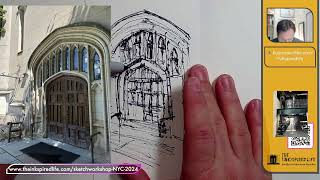
Hello and happy Wednesday, April 10th. Hope you're doing well. I see D-Ray over on YouTube. Awesome, how are you? Great to see you. Very, very fun. Hope you're having a great day. I am on for a few minutes just, uh, to do some sketching. Happy Wednesday again. All right, so I am— here's what I got in front of me. I have my lock— my Lockbie field journal that I took with me to New York City this past Saturday. It was a really cold, windy day, so I didn't do a lot of sketching, but I'll show you what I did do, and I might just work work on it a little bit. Um, these are sketches inspired by the power plant in Spokane, Washington. This one, actually, maybe we'll spend a couple minutes on this. Yeah, I'm gonna— let's add some little bit of ink detail on top of this one. Anyway, hope you're doing well. Let me know in the chat if you can hear me okay and see the video okay. My internet's been wonky. So this sketch was started last week. I would— I used a reference photo that I had taken inside the Steam I keep calling it Steam Plant— the Power Plant building in Spokane, Washington. And I was waiting for it to dry before I could come back and add some detail. So, uh, yeah, I'm gonna throw some hatch lines, just add a little bit of shadow on here. So I'm just adding these kind of angled lines here just to give a little sense of depth on here. Hope everybody's having a great week. We are— we are back in school this week. We had spring break last week, which was nice to have a break for sure, but it's always good, good to get back in the groove again. Let's see, um, I'm gonna add some contour lines, some curved lines here just to make this look like a round pipe that's kind of coming down here. So let's just go here and do this. I'm gonna kind of draw my lines this way. This is where I'd rather be using a Sharpie, not the ultra fine point, the other one, extra fine point, because it's actually a little bit wider. Wider. This one's pretty narrow, but I like the wider one for me because lines don't come out as dark. Lines are coming a little darker than I want, but it's just a fun quick loose sketch, so it's no big deal. Let's pull out the end of this here a little bit, just kind of darken it. There we go. Cool. Yuri says, "A-okay sound and picture." Hey, thank you. You're awesome. Hope all's going well in D-Ray land. These are just rivets. This is a steel beam across here. We have some rivets just to add a little bit of, uh, interest detail. This is a railing. Uh, there's a walkway up here. This is a railing. Yeah, I don't know how much more I'm going to add to this. I like it so far. These hatch lines are really nice for creating shadows. I could color the areas black, make them really dark, but I like the hatch lines. I'll zoom in so you can see. Um, I like the space between the lines. It just keeps the loose look I like. And D-Ray, kudos to you! Oh my gosh, your Brooklyn Bridge sketch was awesome. Thank you for posting that. I think, I think you nailed it. That was so cool to see. Loved it, loved it, loved it. Hey, DB's in the House DB, how are you? Happy belated birthday. I hope you had a great, great day. All right, cool. This one I think is pretty much done except for a couple touches of, uh, some signature colors. Break out colored pencils. We'll use light aqua, of course, neon pink, and I think I'm gonna throw on some highlighter or maybe a neon yellow color pencil. Let's see. I'm gonna grab— actually, you know what? We're gonna use chartreuse. I haven't used chartreuse in a while and I love this color. So, let's throw some color pencil down. Then we'll wrap this up and move on. I'll do a little quick show and tell. Maybe some pictures. From my trip into NYC. Appreciate your comment on that sketch. Hey, D-Ray, of course, yeah, definitely. That was a great sketch. Thank you. I did spend it with your fam— with my family. Love it, love it. That is so cool. I'm happy you believe it. And I have a sketch, DB, that I need to email— I'm not email, I need to mail out to you. So I will make sure to do that. All right, warning, warning, warning, it is time to sharpen this. Brace yourself for the sound of the pencil sharpener. Here it comes. I love this. I know I've— I have plugged this pencil sharpener a few times. This is— I bought this, I don't know how many years ago, I'd have to look, 7 maybe. I love this pencil sharpener, it is great for sharpening these Prismacolors. I've never had any issues with it, it's just a great product. Um, if you go to my website, there's a page I have with common tool supplies I use. I think I have that listed on there if you want to learn more about it. It's a really cool product. All right, let's throw down some pink. So I love using the pink. Let me zoom in and show you guys. I love the way the pink looks over the rusty colors. Um, I love pink over orangey colors as well, and I love to use it here in just the white White Spaces, and I just throw it down on here just to add a little bit of whimsy to this, just popping out some of these colors. So we got some there, there, there. Let's throw some up in here just for fun. Oops, I sharpened too much. There we go. And we'll throw some— usually only do it 3 places, but my eye is I think we're doing 5 in this one. My eye and my hand are saying, hey, let's add some more. So I'm just kind of doing this, just doing this kind of a pattern. Maybe 4. Now I like to do odd numbers, so maybe we'll do something like up in here. Very cool. All right, so we got the pink on there. Um, this one has some, uh, some chartreuse. I bought that sharpener for yourself and some of your friends. Thanks to you, we are enjoying it. Oh, DB, that's so cool! I'm glad you bought it. So I'm assuming you like it, right? You know, it doesn't— this is where the shavings go. It's pretty easy to take off, but make sure you take it off over a trash can, trash can, so you don't spill it onto the floor. Yeah, I'm so glad you bought it and you're liking it. Yeah, it's a cool sharpener. I love the color of Chartreuse. I I didn't know what chartreuse even was until a couple years ago. I had heard of it, but I didn't really know what color it was. And to me, it looks— it's almost like a lime green color. It's, uh, it's become one of my fave colors. I have light aqua. So there is aqua watercolor paint on here, but I like using the colored pencil because you just get really intense with it. I especially love— I love the light aqua against the rusty colors here. It's a cool color palette, especially for that grungy industrial look I love so much. All right guys, this one might be done. Let's see. Hey Chip, great to see you. Hope all's well. Late but here. You are not late. Because I did not tell you guys what time I was going to be on, so you are right on time. Yeah, I may have popped on a little bit early than— earlier than usual, only because I'm really beat today. I'm really, really tired, but I wanted to do some sketching. Why? Because I love it. Sketching's my therapy. It gets me into a zone, a creative zone, a, um, Zen zone. All kinds of different zones. It depends. Creative, definitely. Um, it's a great way for me to wrap up the day and just unwind my brain. It also could be the opposite, and it could also wind me up too, get me energized and charged, recharged. So for me, sketching is a tool that can help transform my current state, like my physical state, my mental state. So, for me, sketching really is a very, very, very powerful tool. You know, it's not just a fun hobby. It really is transforming for me. Cool, guys. All right, I think this one's done. So, let's just take a little quick peek back at our power plant sketches. This is an ongoing series. I'm hoping this series will one day turn into a collab project with a friend of mine. Briefly talked about it for like 20 seconds, but I'm working on sketches and practicing. Here's the first one. Here's the second one. I really like this one. And then here's the most recent one. So yeah, this one's very abstract. There's very little background in this. I mean, I might come in at some point, add something really light, but I'm not sure yet. All right, cool. Let me, uh, I want to show you guys a little bit from my trip in NYC, if that's cool. Let me grab a drink of water. I'm going to run a short video. Really short video of the Copper Building, and then I'll show you some pictures as well. Let's, um, we'll let the music keep playing. Let me just get the video going here. Alright, I'm gonna narrate this quick. So, um, New York City last Saturday, very cold, very, very windy. I— the main purpose was to go and get a little video footage of me doing some sketching that I could add to my website for promoting things, for showing people kind of what I do when I go out and do some urban sketching. So I met a really amazing person, a friend of mine. He is a live streamer on YouTube, uh, and it's called the NYC Walking Show, and his name's Sifat. Sifat met with me and shot some footage, which was awesome. But on my way there, I— my first stop was, um, walking to the ferry where the Copper Building is. I love the Copper Building. It is very right now it is my favorite building besides the classic iconic Chrysler and Empire State Building. Anyway, here's a quick little shot. Uh, sometimes when you're out in the field sketching, you don't have a surface or a table, you make do, right? So I used to— this trash can to put my sketchbook down, um, and sketch. So here it is. You can just kind of see my sketchbook sitting there. It's panning up and you will see trees are starting to bloom, which is cool. And there's the copper building. I, I'm in love with this piece of architecture. I would love to get inside and go up in that sky bridge. Um, so I did a sketch of that. Um, here's a really quick sketch I did of of it. I'll show you my tabletop here. So this was a really, really quick— this was probably a minute at the most, maybe a minute and a half at the most. Really, really cold. I had to get to the ferry, so I wanted to sketch it quick. Um, here's some other pictures of the copper building. Just drag them over. So this was on the street walking towards the ferry. And then once you're at the ferry terminal, here is a view of the Copper Building from the ferry terminal. So you can see it, part of it there. I took a bunch. Here's a, here's a better picture. You can see it much better. So I was able to sit there for a little bit and sketch that view as well. So, this sketch here, let me shrink this or move it. So, this was a sketch I did sitting there waiting for the ferry. So, pretty cool. You can see my take on it. Again, these are really quick sketches. I'm not spending hours and minutes. I'm spending a few minutes. This was probably 3 minutes. Maybe. Quick shading, done. Um, so that was cool. What else? And then, uh, here's a view of the Copper Building from the ferry as we were leaving the terminal. You can kind of see it, some of the surrounding architecture. And I won't bore you with too many pictures. I do want to show you this bridge. This bridge right here, I believe this is the Manhattan Bridge. This picture is from the ferry, so it was moving, so it's a little blurry. But check out the design. I mean, the ironwork. What a beautiful bridge, right? I took a bunch of pictures. I think— let me pull this one on. This one might be one of my favorite pictures. Yeah, I really like this picture. It's just a beautiful, graceful structure. It's a pretty noisy bridge. You can definitely hear the traffic. I believe there's a train that crosses it as well, but it's just— it's spectacular. So I think I might do a quick sketch tonight of this. I'll be honest with you, I haven't really sketched this building, uh, this bridge. If you look in the background, if I could zoom up— I can't zoom more— uh, underneath the bridge to the left is the Domino Sugar building, which is done. I haven't seen it since it was completed. I was there during construction and had a cool tour of it. Uh, it looks really cool, so I'm gonna go back and hang out at Domino Park and sketch it, but it looks beautiful here under the bridge. So that was really fun to see also. Cool stuff. So I'll leave that up here for a second. Let me look in the comments, get a drink of water, and then we'll do some more sketching. Um, Chip says, what determines color— the colors you're going to use? What are you sketching? What are you sketching or mood? Is there a shade or color you haven't tried that intrigues you going forward? Chip, really great questions. Um, yeah, great questions. Let me just make this smaller. Let's go back to my sketchbook here. I'm going to close it. All right, colors. So let's just take a look at the power plant sketches. Um, when I'm sketching industrial architecture, I have a certain color palette that's— I've just developed. It's kind of based on how I feel. I like to try to create rusty kind of feeling, old feeling, um, the color of copper when it patinas and turns that kind of green or aqua-ish color. So those are the colors I use, try to work into anything that's industrial. The power plant building does not look anything like this inside. It is more refined. It is not old and grungy and rusty, um, like my sketches. This is my interpretation. So I— anything I do that's industrial is a certain color palette I tend to use. So some of the colors you see on here are, um, Apple Snail ink, brown ink. You'll also see Aqua watercolor, light aqua colored pencil, the pink. You'll see I like to throw purple on there as well and grays. Um, yeah, this is, this is a cool color I've been using lately too right here. It's called Rusted Rivet ink. So industrial color palettes, that's what comes to my brain, and I've been sticking with these colors pretty regularly. So that's kind of cool. Um, hopefully that answered that. I'm also still really liking, and I think my favorite sketches are still black and white sketches. That's my kind of my bread and butter, what I've been doing for years. I love black and white sketches, um, and that's why you— I'll always start with black black and white because you can always add color later, right? So, um, this is a real rap— this is a rapid fire on the ferry freezing sketch. Um, and it was, uh, it was actually starting to rain, so I wanted to challenge myself and say, all right, what could I draw while we're on the ferry while I'm freezing? Uh, part of urban sketching, outdoor sketching, is the environment We got to learn to live with it or work with it. So that's what this— this is a fast and furious sketch while on the ferry, but I like it. I think it's cool. Chip also asked a color. Any colors intrigue me? Great question. I'm not going to say color intrigues me, but a medium and something that you actually have inspired me with Chip. Um, I used to do acrylic paintings, very abstract paintings. I think I would really love to try doing an architecture— I call them sketch paintings because they're quick and loose— so an architecture sketch painting, maybe with acrylic on it. So that's kind of up here in my brain these days. But yeah, so not really a color but a medium. Hopefully that answered your question. I love the questions. Um, DB says, have you thought about drawing Oriental buildings? Um, yeah, I love, I love Japanese architecture. I love Japanese tea houses, pagodas, buildings, um, temples. So awesome question. I have sketched some of them in the past. So I'm going to make a note in DB. I think that would be fun to do in a next Zoom meeting. Maybe we'll do that all together. Um, I love that idea. So the answer is yes, and I'm going to pull out a show-and-tell book I think I have in here. Let me see if it's back here on the shelf. Yeah, right here. All right, so here's some show and tell. Here's a really cool book, it's called Measure and Construction of the Japanese House. Um, so it has really great architectural type technical drawings in here, which I love. It has detailed woodworking details, and that's— for me, that's the beauty of these kind of— these Japanese buildings is the woodwork and the joinery and how pieces connect. So let me see if I can find— they have floor plans in here, they have some architectural renderings. But yeah, I would love to to try to do some loose style sketching of these types of buildings. See if there's anything a little more traditional. And actually, I love these technical drawings and I'm really— I'm getting back into hand drawing again. I'm teaching my students in school hand drafting. So we're taking a break from the computer. We're going old school with T-squares and pencils and triangles and rulers, and we're drawing stuff on drawing boards. So now that we're teaching that, we're getting back into that a little bit. I am loving it, and I would love to start just recreating some technical drawings. So really great question. So yeah, so let's, let's investigate sketching some Japanese architecture. Great suggestion. Hey, Linda S is in the house. Great to see you, Linda. Hope all's well. Pillow painting would be interesting from you. Yeah, it would be kind of fun. All right, awesome, guys. So this was a quick fairy sketch, and then here we go. I'm gonna, I'm gonna jump to the, um, I can't get enough of this building, or the structure. Sorry, not a building. I'm gonna bring up kind couple pictures and I could talk about this the rest of the night. I love the Brooklyn Bridge. I just— it's— pictures don't do it justice. It's an amazing, incredible, beautiful, solid structure and sketching it has been so fun. Here's kind of a close-up picture. I just, I love the close-up, the details, the ironwork, the support cables. I love the metal in contrast to the massive stone. It's just such a really amazing structure. Here's another image. I'll show you a few and then here we go. For me, it doesn't matter what— where you're standing, what angle you're looking at, there's always going to be an amazing image you get. I mean, here, here's an image just standing underneath part of the bridge and looking up. It's so cool. Let me zoom in. Here we go, right? Just— this is a cool picture. This would be a really great black and white image. So I do— I have noticed that when I am looking at the Brooklyn Bridge, I'm looking at it and thinking about it, how it would look in just black and white photography, uh, shade and shadow. Let me see, uh, here's another classic shot, and this is— this one I've sketched, uh, D-Ray, I think this is the one you sketched as well, I think. Pretty cool, right? So really, really iconic. And here's just a picture of me hanging out right there to prove I was actually there in person. Um, all right, so cool. So that's the Brooklyn Bridge. If anybody is joining me for the April 20th online sketching workshop, we're going to be sketching some of these iconic NYC structures, at least use them as a starting point. So we will be doing a sketch of the Brooklyn Bridge. Let me close some of these up and we'll— I'll show you another sketch and then we'll wrap up. I'm just trying to find all the X's I could click out. All right, cool. Boom. Um, again, freezing day. I actually had gloves on most of the day. It actually warmed up around what, maybe 1, 2 o'clock, probably around 2, started warming up a little bit. Um, this was just a quick— I'm looking for my Sharpie. What the heck? This was just a real, real quick, hey, let me stand here and sketch this and see what I can get done. And I'm challenging myself, so I'm seeing what I can get done in a short amount of time. This one, I tried to capture the World Trade Center, One World Trade here in the background, this iconic building right here kind of hanging out in the back. But here, this is just a real quick sketch, and what I'm trying to capture when I'm sketching the Brooklyn Bridge is— are these arches. These arches are iconic, and I always like showing the American flag up here as well. So, quick sketch. Notice I don't do everything. I kind of let it bleed off the bottom. If I started to show all the details down here to the ground and other stuff, I could. I really just want to focus on the bridge, so I just kind of let it bleed out and ghost out. Um, here's another one. This was a— this was a really quick one. This— I was, uh, Sifat was videoing me while I was sketching this one. Um, I was shivering and really cold, but I wanted to throw some hatch lines, right, some shading here. Just to create a sense of depth underneath the bridge. What else did I sketch? Um, oh yeah, this isn't Brooklyn Bridge. This is, this is the American Radiator Building right off of Bryant Park. Bryant Park, if you don't know, it's a really beautiful little park right next to the New York Public Library. I was sitting there on my way back home. I took a stop here, sit down for a few minutes and just do a quick sketch of this. So that's just part of the American Radiator Building. Again, I'm not showing the entire building. This is— I just wanted to capture a little bit of the top. Cool. Um, DB says PowerMe, can't get it on Amazon. Hmm, I'm going to change up the tunes a little bit. So you can't— oh, so you can't find the PowerMe on Amazon? That's— oh, maybe they don't make them or sell them anymore. Sorry about that. Thank you for telling me though. Yeah, I got this on Amazon a long time ago, so thank you for telling me about that. Um, maybe, maybe another art store would carry them. Um, I'd have to Google it, but good information. Um, Movies on This Bridge: Brooklyn Bridge is a documentary film on the history of the Brooklyn Bridge and the directorial debut of Ken Burns. Whoa, Linda S. Linda, I did not know that. How could I? Wow, I had no idea. I will be watching that. Thank you for telling me. That is so cool. Um, Chip says, what camera are you using? Oh yes, this— the pictures, all these pictures here you know, like this. This is just my iPhone. So this is— these are from iPhone 14. Um, these are not Photoshopped or touched up. These are how they came out right from the camera. So yeah, iPhone 14. Uh, let me see. Here's a really cool— let me show you this. Hope you guys don't mind some show and tell. Here's a cool image. So right next to the Brooklyn Bridge and Brooklyn Bridge Park, there's a building there. It's called the Time Out Market. It has a rooftop area. So this was a view going up to the rooftop area. Um, cool. It's kind of framing the Manhattan Bridge, looking through this old brick arch. That was pretty cool. So, I do love sketching, guys, but I also love photography. I love photographing architecture. It's another kind of joy of mine. This is inside the Time Out Market, kind of the entry courtyard space. That same building that you can go up to the roof, you can see the stairs up here going up to the Guys, cool with this? These images kind of jumping around. Here's a really cool image as well. So this is Grand Central Terminal back here, the clock on it. Zoom in. Really cool bridge here. In the background on the left is, um, what they used to call the Pan Am Building. Pan Am Building. I'm trying to zoom in. What is this called now? I am forgetting. MetLife. I think it's the MetLife Building now. And then over here you can actually see the Chrysler Building peeking up over the bridge. This would be a great one to sketch. I think we might actually be sketching on in our workshop coming up. So yeah, those are just some more images. I have a bunch of videos, but we'll save those for another day. Awesome. I love the angle of the bridge. I know in Kate and Leopold the bridge is part of the movie. Dang, I missed that one too. I gotta get out more. Um, I'll check that out. Made a mistake, you can get, get it. Sorry. Oh good, you found the Power Me pencil sharpener on Amazon. Awesome. Chip, where do we see the Ken Burns documentary? Good question, I'd have to Google it. Um, awesome stuff, guys. I love the sharing going on tonight. This is so fun. All right, what should we do? You guys want to do a quick sketch? Let me know in the chat. Say yeah, quick. Say yes, quick sketch. Give me some hearts or thumbs ups or something. We'll do a quick sketch of something. Uh, here's actually— let me show you this too. So this is a postcard from Junior's. Junior's is— you don't know what Junior's is? It's an amazing I'm gonna call it like a diner-y slash diner-y. It's like a diner and bakery, a diner-y. Um, really cool place. They're known for their cheesecake, world-famous cheesecake. Um, originally started in Brooklyn. This is just a postcard I got from them at some point in time. I've had it a long time. I just love the image of the Brooklyn Bridge here. You can see it's— I got some splatter on it. I always keep it nearby. Yes, yes, Sketch. Yes, yes, I see a couple yeses. All right, cool. Uh, let's throw it out to you guys. Is there a building or style or— doesn't have to be New York City, doesn't have to be iconic, It could be a generic type of building. Let me know in the chat if there's something maybe you want me to, uh, sketch. So we're gonna do a little improv here. We're gonna call this Wacky Wednesday. I don't know, something Wacky Wednesday sketching where you guys are going to throw a suggestion out and we'll see if we can sketch it. Chip says, how about a door? Hey Chip, I know you love your doors. Um, okay, how about, uh, Jim Morrison? Want me to sketch Jim Morrison? See what I did there? No, I can't sketch people. Yeah, let's do a door. I'm gonna go through. Let's see if I have a door here. I— on my NYCs, my photos here. Unless you have a door you want to send over or post, otherwise I'm going to go through and see if I can pull something out. Yeah, doors are amazing. Doors are incredible, um, especially in Europe. European doors are second to none. So I'm just scrolling through. I know, I know, Chip, I have all those Princeton pictures that you and I went to, and Chip was really cool. He was pointing out some amazing doors to me. So actually, why don't I do that? Or a lighthouse. Oh, I love lighthouses too. Yeah, lighthouses are near and dear to me for many, many reasons. I'm gonna Google Princeton, look it up in my photos. I'm gonna pull up a Princeton door. Chip, if you want to pitch in, I probably won't know the building. If you know what building it is— dude, I took like 300 pictures that day when we were in Princeton. Holy cow. Um, yeah, yeah, we got a bunch of doors here. Yeah, Chip was such a great tour guide when we went to Princeton. He's like, oh, you gotta check this out, check this out. So it was so fun. Hmm, all right, should we try this door? I'm going to bring this one on. Might be setting myself up. All right, I saw this door here. Pretty cool, right? So let's put this away. I'm going to grab a sheet of— right here I got some watercolor paper. Let me is one of these. So we have a door here. It's kind of on a little perspective, so it's not a straight-on view. Beautiful woodwork. I'll leave it zoomed up for a second so you can look at it. What I like about it is actually the surround as well. So yeah, let's sketch this. I'm gonna time myself and we're gonna— I'm gonna make it a quick sketch. I'm gonna put it— I'll leave it on screen. Where will I not block it? If I keep it to the left, maybe in a sketch here, you could try that. All right, cool. Not sure, looking it up. All right, cool. Let us know. Yeah, where we can watch it. Lots of timeless buildings and 2 loaves of bread. Oh my gosh, I, I'm buying bread next time. I'm bringing some bread home. It was so funny, Chip was carrying around, uh, some loaves of bread for, I don't know, at least a good hour or 2, right? It was a long time. All right, I'm going to zoom in. Let's sketch this. Let's change the tunes up. I'm going to put choir. I have a choir. It sounds choir. Let's play this. I don't know if it's all choir music. It's kind of— find out what it is. All right. All right. So I'm going to sketch this. I'll kind of talk through it. So what I'm looking at first is kind of We could start with the door here, right? So, but, but my instinct wants me to do one of the bigger outside arches. So I'm going to do like a— this will be a thumbnail kind of sketch. I'm not going for detail, I'm just going for kind of shapes. Right, so I'm thinking my hand's kind of loosening up, my brain and hand are trying to get on the same page together. So, you'll see me doing this a lot when I sketch before I even put pen to paper. I'm kind of mentally prepping, almost like building muscle memory of what I want to start doing. And I'm also doing this to see, okay, am I gonna— what do I need to do to fix fit this on the page. You know, I could start here. If I did something like this, like, oh yeah, this isn't the real deal, I just want to show you guys. If, you know, I could do, oh yeah, maybe I'll do the door like here. Here's the door, and then if I do this, I have the arch here. Then I'm like, oh, I can't fit it. So this way I'm just kind of working out what going to fit on here. I want to look at the big picture, so I gotta move this. All right, I think I lied. I think I'm going to start with the door. Holding the pen far away, one of the 3s. I'm actually looking at the picture and not the paper right now because I want to capture this arch shape. So I know it's symmetrical, and Chip asked me in one show what is my— what's challenging for me to sketch. Yeah, symmetry. But I'm telling my brain I'm not going for beautiful symmetry. I want to just capture these, these arches, this feeling, this kind of Gothic look look, I'm not counting. Um, we have windows up here. I'm not going to count how many there are, but we have another outer arch which maybe is like in here. We have a piece that comes up in here, almost like connect the dots. I'm going to do that, that. I'm going to connect this kind of visually here. So this is that outermost piece. Um, I see a kind of a line happening here at the base of this really cool window. And I know these windows, it's not a rectangle, it's kind of a— what shape would you call it? It's like this kind of a shape here, and it has like a rectangle Almost looks like a candle. We got kind of that happening. Some thin lines here. There is something over the center of the door. I may have missed a bay of windows, and that's okay. I'm not counting. I'm just sketching. This is gonna be a little smaller on this side because of the perspective. And I'll capture more of the perspective when I get to the bottom of the door. I'm just catching these vertical pieces. So our door, I'm going to exaggerate, is coming back at an angle. Notice, to keep it loose, my hand— I'm going over the same lines a lot of times. Keeps it loose, sketchy for me. I don't want to be rigid, make a technical drawing, although that would be fun to try. I'm going to come up here Here we have another one of these kind of arches happening. I'm purposely not going to finish it on the left. I'm going to kind of let it bleed, die out here. And maybe, you know, there's another one. I'm not counting how many of these things are happening. And if you want to count, that's cool. I mean, you can absolutely do it. If I start counting everything, it's going to slow down my flow. And again, this is capture loose, um, to get the perspective look going. I'm looking at the lines on the door, the horizontal, and it's stiles they call that, or rails. Are the rails horizontal and stiles vertical? I think so. So I know DB is our detail, our detail master. So DB, I would, would do an amazing, incredible detail drawing of this door. It would look photorealistic, and that's so awesome. And again, we have these kind of candle-shaped things happening here. My partials are drawing large or small? I like drawing smaller. I like to— so Linda is our tiny master. Linda could draw amazing detail in like 1 inch by 1 inch. Love it. I like to keep my drawings smaller, sketches smaller, um, so I can focus more on feeling and mood and not so much detail. If I draw something really large, I want to show more detail, so I tend to stay smaller. Um, then I just want to capture— we have some lines down here, it looks like. Can't really see it, so we have some kind of lines down here happening. There's a bench somewhere off in here, right? I can kind of sketch a bench maybe coming down, something there. We have— looks like metal, metal rails coming out here, probably cast iron. So we got some rails coming out. Um, no, I maybe should have taken my time a little more on this door. It's beautiful. I do— it has these kind of rivets you can see happening here. I can just sketch— I don't have to sketch them all, just show maybe the idea of some rivets. I would come back and clean this up Pull out some of these rectangles a little bit cleaner just by sketching them in. Proportions— my proportions are really wonky because these are more rectangular like this. We have kind of a square at the bottom. Um, then we have some shaders going on, so we'll just do this. Let's get a little bit of depth happening here. Um, I would do the same thing here. I probably would come back now and clean this— these up a little bit more. And I love— for me, the one of the beautiful things about sketching loose and quick is I'm not— now that I want to pull these shapes out more, I don't mind coming back, going a little bit slower, but you can still see all that really quick loose line work I did before. So for me, that kind of tells the story about how I was creating this. It's my energy, my lines on on there. Um, and I love the aesthetic of that. So I'm not trying to be here clean. I could do this, I could have done it in pencil, erased parts out, but I don't want to. That's one reason I like using a Sharpie. I can't erase anything. Um, I could also add, just to give this a little bit of roundness, we have this kind of this vertical piece coming up here. It is round, so I can— you draw some contour lines or some round lines in here if you want to give a little curve to that. Same thing up here, we can get some curves somewhere up in here, right? So you can start just coming back and layering in some lines of things that you want to show more. And don't feel like you have to show everything. Show what's cool to you. What, what in your heart do you want to show more? You know, I think we worry that we need to show every single thing in an architectural sketch. Show what captures your heart, your imagination, and your eye. Tell your story of the building you're seeing. How do you connect to the architecture? What is the building saying to you? I like this music for this. So, I'm liking this. I'm liking the quick loose sketch. Is it detailed? No, but I think it's calling out that for me, I want to capture the feeling, the Gothic arches of what's happening. Um, I think I'm going to start with the door. Yeah, so my first instinct was to do the outside, very outside one, but in this case I wanted to work from, from the middle. Out because I definitely wanted to capture this part and whatever else I had room for I could expand out and just, um, fill in the rest with whatever I wanted to. I think I'm going to add some more shade to this. Should I throw color on this? I kind of like it black and white. Let me know, guys, should I throw down some color? Curious. Chip says incredible sketch. Oh, thank you, Chip, I appreciate that. So the larger the sketch, the more detail you add. Yeah, that's how my brain works. I'm— I feel like more paper, more space equals more detail because there would be a lot of blank, and I don't mind blank or ghosting out images. Um, but that's— yeah, I like to— I like smaller format. I have been doing the opposite. Wow, that helps me so much. Oh, that's so cool. Yeah, it's just kind of how I think, because when I have a small— and you know, Linda works differently, and that's awesome. That's what I love about her. She can capture detail in an inch square circle, a lot of detail. I'm so quick and fast and furious with my pen, I can't capture a lot of detail in a real tiny space. But in a real big space, it's too much. So I have to find somewhere in between. So I like— I'm liking this format. This is 4 inches by 8 inches. Really good size. Um, cool. I hope you guys are liking this. Hope you're, you're enjoying this quick demo. I'm gonna wrap up in a couple minutes. Um, Chip, I love the suggestion. Thank you so much. You know, the perspective on this is a little off too. I should have canted or angled the top down, but I don't mind it. And then there also becomes a point where you don't want it— for me, I don't want to add too much. I just want to kind of pull out the bottom there for the door. So I'll zoom in. You can see the lines I just did for the bottom of the door. It's not just one line. It's like me, okay, here it's a— it's kind of a few lines next to each other, and that's the look I like, loose kind. It's very scribbly. So I like to say, if you can scribble, you can sketch architecture. All right, cool. There's a big like— you can see I purposely omitted the, um, floor mat there. I could have shown it, I left it out. So capture what you want to capture, don't feel like you need to show everything. And don't— so actually, I'm actually going to count now. I'm— I did miss— I missed a bunch of the windows we have. Let's see, 1, 2, 3, 4, 5, 6, 7, 8. I did 1, 2, 3, 4, 5, 6, so I missed a couple of the windows, but I don't mind. I still, for me, I captured the essence of what I wanted to. If I was to come back, go Let's mix it up. Next time I'm on, guys, if you're watching, remind me to say slow, and I'm going to slow down and sketch in slow mode. That's one of the challenging things for me when I'm doing a workshop, is I need to slow down. I feel like when I slow down, I wonky vibe, but it's something I need to work on.





